Introduction
Compacted bentonite-based materials (e.g. bentonite, bentonite–sand mixture, and bentonite-rock mixture) have been selected as the buffer and backfills in geological repositories for disposal of radioactive waste in many countries. Compacted bentonite is used generally as the cushion and separation layer between a radioactive waste canister and a host rock because of its high swelling capacity, low permeability, and its properties which retard transport of corrosion-promoting ions and migration of fugitive radionuclides (Haynes et al., Reference Haynes, Bailey and Lloyd2021; Pusch & Yong, Reference Pusch and Yong2006; Sellin & Leupin, Reference Sellin and Leupin2013; Yong et al., Reference Yong, Pusch and Nakano2010). Compacted bentonite–sand mixture is proposed widely as backfill in tunnels, shafts, and drifts because this material has significant swelling capacity and low water permeability (OECD, 2003; Pusch & Yong, Reference Pusch and Yong2006; Yong et al., Reference Yong, Pusch and Nakano2010). The buffer and backfills are expected to expand upon adsorption of groundwater to seal construction gaps and to exert a stress (swelling pressure) that stabilizes the radioactive waste canister and the host rock (Pusch & Yong, Reference Pusch and Yong2006).
To improve understanding of the swelling behavior of the buffer and backfill on water uptake, the swelling pressures of compacted bentonite-based materials have been studied extensively in the past. Many experimental studies demonstrated that the swelling pressure of saturated bentonite-based materials is influenced strongly by density, porewater chemistry, the dominant adsorbed cation, and the proportion of montmorillonite (Bucher & Müller-Vonmoos, Reference Bucher and Müller-Vonmoos1989; Castellanos et al., Reference Castellanos, Villar, Romero, Lloret and Gens2008; Komine & Ogata, Reference Komine and Ogata2003; Lang et al., Reference Lang, Tripathy, Baille, Schanz and Sridharan2019; Madsen, Reference Madsen1998; Pusch, Reference Pusch1994; Xiang & Ye, Reference Xiang and Ye2020; Yigzaw et al., Reference Yigzaw, Cuisinier, Massat and Masrouri2016; Zeng et al., Reference Zeng, Cui and Talandier2021; Zhu et al., Reference Zhu, Ye, Chen, Chen and Cui2013). In the case of an unsaturated bentonite-based material at a given density, its swelling pressure upon hydration is controlled mainly by suction or water content (Agus et al., Reference Agus, Arifin, Tripathy and Schanz2013; Kassiff & Shalom, Reference Kassiff and Shalom1971; Liang et al., Reference Liang, Yan, Xu, Zhang, Tian and Wei2021; Lloret et al., Reference Lloret, Villar, Sanchez, Gens, Pintado and Alonso2003; Manca et al., Reference Manca, Ferrari and Laloui2015; Pintado et al., Reference Pintado, Hassan and Martikainen2013; Rawat et al., Reference Rawat, Baille and Tripathy2019; Schanz & Al-Badran, Reference Schanz and Al-Badran2014; Tripathy et al., Reference Tripathy, Thomas and Bag2015; Wang et al., Reference Wang, Tang, Cui, Barnichon and Ye2013a, Reference Wang, Cui, Tang, Delage, Gatmiri and Ye2014; Yigzaw et al., Reference Yigzaw, Cuisinier, Massat and Masrouri2016; Zhang et al., Reference Zhang, Ye, Liu, Wang and Cui2020). In addition, the swelling pressure of unsaturated bentonite-based materials on water uptake is related to the water phase (Agus et al., Reference Agus, Arifin, Tripathy and Schanz2013; Yigzaw et al., Reference Yigzaw, Cuisinier, Massat and Masrouri2016).
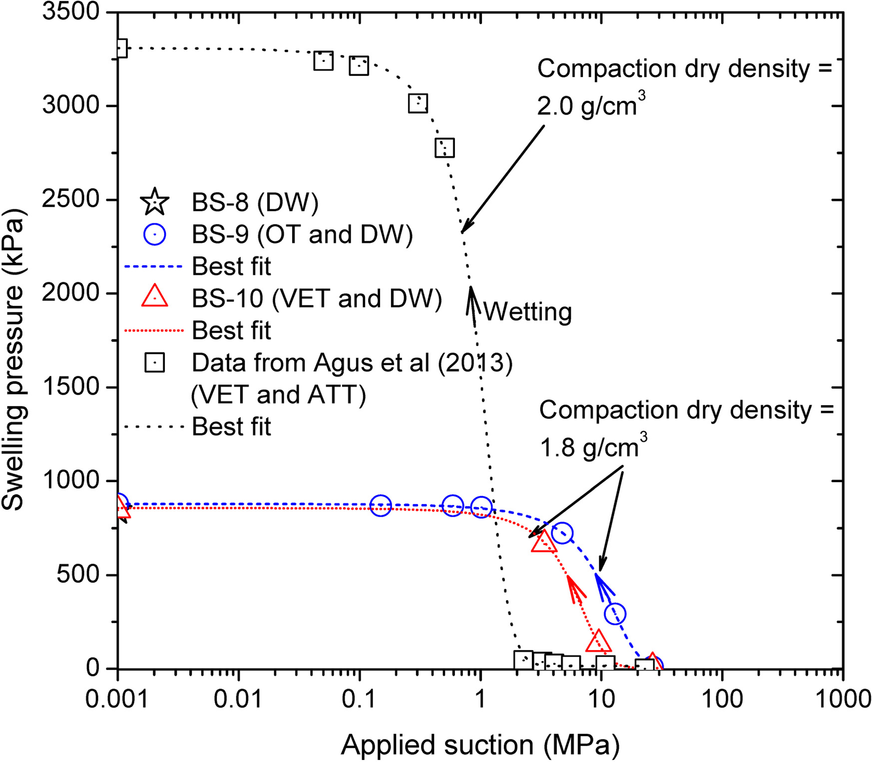
Many studies have shown that for a given dry density, the swelling pressures of compacted bentonites upon adsorption of either liquid water or water vapor increase significantly with gradual decrease of their suction from an initial large value to a value close to zero (Liang et al., Reference Liang, Yan, Xu, Zhang, Tian and Wei2021; Lloret et al., Reference Lloret, Villar, Sanchez, Gens, Pintado and Alonso2003; Schanz & Al-Badran, Reference Schanz and Al-Badran2014; Tripathy et al., Reference Tripathy, Thomas and Bag2015; Wang et al., Reference Wang, Cui, Tang, Delage, Gatmiri and Ye2014; Yigzaw et al., Reference Yigzaw, Cuisinier, Massat and Masrouri2016; Zhang et al., Reference Zhang, Ye, Liu, Wang and Cui2020). Some researchers, however, have found that the development of the swelling pressure of the bentonite–sand mixture with a dry density of 2.0 g/cm3 was insignificant as the mixture adsorbed water vapor over a suction range of 23 to 2 MPa (Agus et al., Reference Agus, Arifin, Tripathy and Schanz2013). For instance, the swelling pressure of the unsaturated mixture upon wetting at a given suction of ~2 MPa accounted for < 2% of the swelling pressure of the saturated version. According to Yigzaw et al. (Reference Yigzaw, Cuisinier, Massat and Masrouri2016), for a given value of suction and a dry density, the swelling pressure of Na-rich bentonites on adsorbing water vapor was less than that on adsorbing liquid water. Those authors stated that osmotic suction caused the bentonites which adsorb liquid water to adsorb more water, leading to more swelling, than those that adsorb water vapor. No systematic experimental studies have been done, however, to explore the influence of the water phase on swelling pressure and water retention of the bentonite–sand mixture with insignificant osmotic suction.
Understanding the influence of the water phase on the swelling pressure and the water retention of bentonite–sand mixtures with insignificant osmotic suction will help to improve understanding of the hydro-mechanical behavior of backfills upon water uptake. Thus, the systematic study of the effect of the water phase on both the swelling pressure and the water retention of bentonite–sand mixtures upon hydration is of interest. The objective of the current study was to examine experimentally the effect of a water phase involving liquid water and water vapor on the swelling pressure and the water retention of an unsaturated bentonite–sand mixture with insignificant osmotic suction. Swelling-pressure tests with suction control and water-retention measurements under constant-volume conditions were performed on compacted bentonite–sand mixtures. An osmotic technique (OT) and a vapor equilibrium technique (VET) were used in the tests to hydrate the specimens.
Materials
The material used in this study was a mixture of Calcigel bentonite and Hostun sand. The mass ratio of dry bentonite to dry sand was 50/50. A compacted mixture of Calcigel bentonite and Hostun sand (50/50) has been proposed as backfill in a German geological repository (Jobmann et al., Reference Jobmann, Flgge, Gazul, Hammer, Herold, Krone, Kuate Simo, Khnlenz, Laggiard, Lommerzheim, Meleshyn, Mller, Rbel, Wolf and Zhao2017; Rothfuchs et al., Reference Rothfuchs, Hartwig, Hellwald, Komischke, Miehe and Zhang2012). Calcigel bentonite is a natural bentonite produced by Süd-Chemie AG, Moosburg, Germany. Hostun sand is a quartz sand produced by Sibelco Europe, Paris, France.
The properties of Calcigel bentonite and Hostun sand were reported by Lang (Reference Lang2019) and Lang et al. (Reference Lang, Tripathy, Baille, Schanz and Sridharan2019). The amount of montmorillonite was 60–70 wt.% of the bentonite and the cation exchange capacity (CEC) was 62 cmol( +)/kg. Ca2+ and Mg2+ ions accounted for 61 and 35% of the CEC of Calcigel bentonite, respectively. The osmotic suction of Calcigel bentonite was ~0.05 MPa for a large range of water content (Arifin & Schanz, Reference Arifin and Schanz2009). The specific gravity values of Calcigel bentonite, Hostun sand, and the bentonite–sand (50/50) mixture were 2.80, 2.65, and 2.73, respectively. The liquid limit and the plastic limit of the mixture were 62 and 26 wt.%, respectively.
Methods
Sample Preparation
The bentonite–sand (50/50) mixture was prepared by adding dry sand to the bentonite powder. Afterward, an amount of deionized water was added to the bentonite–sand mixture to reach 9 wt.% water content. After mixing fully, the mixture was kept in an air-tight container for at least 3 weeks to attain water equilibration. Finally, the initial water content and the relative humidity of the mixture were determined with the oven drying method (110°C for 48 h) and chilled-mirror hygrometer (Decagon Devices, Reference Decagon Devices2003; Leong et al., Reference Leong, Tripathy and Rahardjo2003), respectively. The initial suction of the bentonite–sand mixture was calculated according to Kelvin’s equation (ASTM-D6836, 2003).
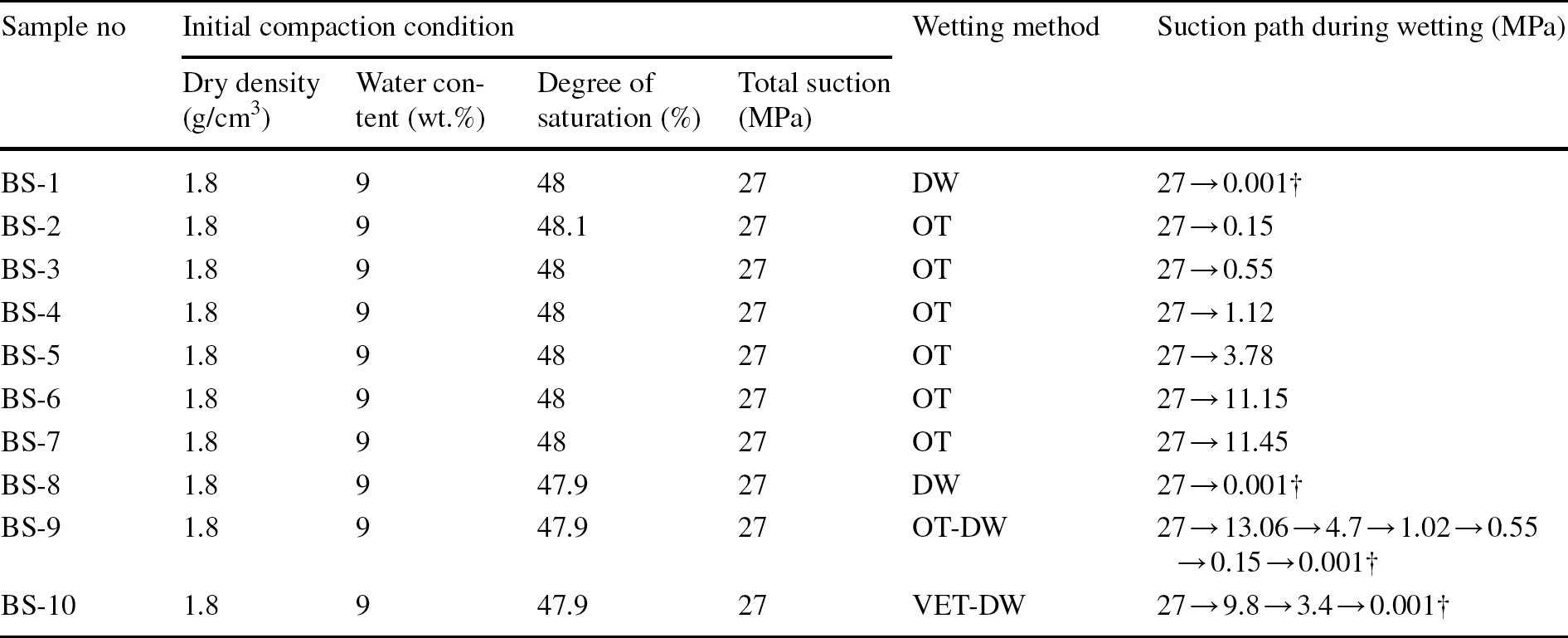
Compacted samples were prepared according to the procedure mentioned by Lang et al. (Reference Lang, Tripathy, Baille, Schanz and Sridharan2019). Compacted bentonite samples, 50 mm in diameter and 5 or 15 mm in height, were prepared by compacting statically the bentonite–sand mixture inside the oedometer ring using a 15-ton capacity compression testing machine. The samples were compacted by applying uniaxial loads. The initial compaction conditions and suction paths followed during hydration under constant-volume conditions are shown in Table 1. The dry density of 1.8 g/cm3 was selected because it was close to the dry density of compacted bentonite–sand bricks used as backfill in the field (Jobmann et al., Reference Jobmann, Flgge, Gazul, Hammer, Herold, Krone, Kuate Simo, Khnlenz, Laggiard, Lommerzheim, Meleshyn, Mller, Rbel, Wolf and Zhao2017; Rothfuchs et al., Reference Rothfuchs, Hartwig, Hellwald, Komischke, Miehe and Zhang2012). To reduce suction equilibrium time, 5 mm-high samples were used in the tests for determining wetting water retention curves (WRCs) under isochoric conditions. However, 15-mm high samples were used in the constant-volume swelling-pressure tests.
Initial compaction conditions of bentonite–sand mixture samples and the suction path followed during hydration under constant volume conditions

The height of samples BS-1 to BS-7 was 5 mm and the height of samples BS-8 to BS-10 was 15 mm, DW: deionized water, OT: osmotic technique, VET: vapor equilibrium technique, †: total suction of deionized water
Determination of Wetting WRCs
The experimental set-up for determining the wetting WRCs under isochoric conditions consisted of an isochoric device and devices to apply suction (Fig. 1). The isochoric device (Romero, Reference Romero1999) was applied in the present study to maintain constant-volume conditions and to measure swelling pressures. The OT was used to control the matric suction during water retention measurements. In the isochoric cell, a semi-permeable membrane was embedded between the sample and the lower porous disk. Polyethylene glycol (PEG) solution could be circulated in the chamber below the lower porous disk. The semi-permeable membrane is permeable to water and ions but impermeable to PEG molecules, clay particles, and sand grains. Water molecules and ions were, therefore, able to pass freely through the semi-permeable membrane. If a difference in free energy (total potential) exists between soil water and PEG solution, water would migrate from the side with higher water potential to the side with lower water potential. Moisture equilibrium between the soil and the PEG solution was established until the difference in free energy between the two sides dissipated. At equilibrium, the osmotic suction due to the soluble salt is the same on each side and the osmotic suction due to PEG molecules is equal to the matric suction of the soil (Delage et al., Reference Delage, Howat and Cui1998; Kassiff & Shalom, Reference Kassiff and Shalom1971; Tripathy & Rees, Reference Tripathy and Rees2013). If the soluble salt in the soil is minimal, the osmotic suction due to the soluble salt would be minimal, too. In this case, the total suction of the soil is nearly equal to the osmotic suction due to PEG molecules. The magnitude of the suction of the PEG solution depends on its concentration. The greater the concentration is, the greater the suction is. Various values of matric suction were applied, therefore, by the circulating PEG solution with various (PEG) concentrations.
Sketch of the experimental set-up for determining wetting-water retention curves under constant-volume conditions and performing a multi-step swelling-pressure test using the osmotic technique to control suction

A Spectra/Pro semi-permeable membrane (SpectrumLabs, Paris, France) with a molecular weight cut-off (MWCO) of 1000 and a PEG (VWR International, UK) with a molecular weight (MW) of 20,000 were used in the present study. To stop PEG molecules from infiltrating the soil, the ratio of the molecular weight of the PEG to the MWCO of the semi-permeable membrane should be at least 2 according to Ballew et al. (Reference Ballew, Clark, Crooks, Ho, Markee, Martinez, Milner, Partee and Simmons2002). The rule of thumb is to choose a MWCO by selecting an MWCO value of about half of the molecular weight of the macromolecules to be retained in order to achieve a minimum 90% retention.
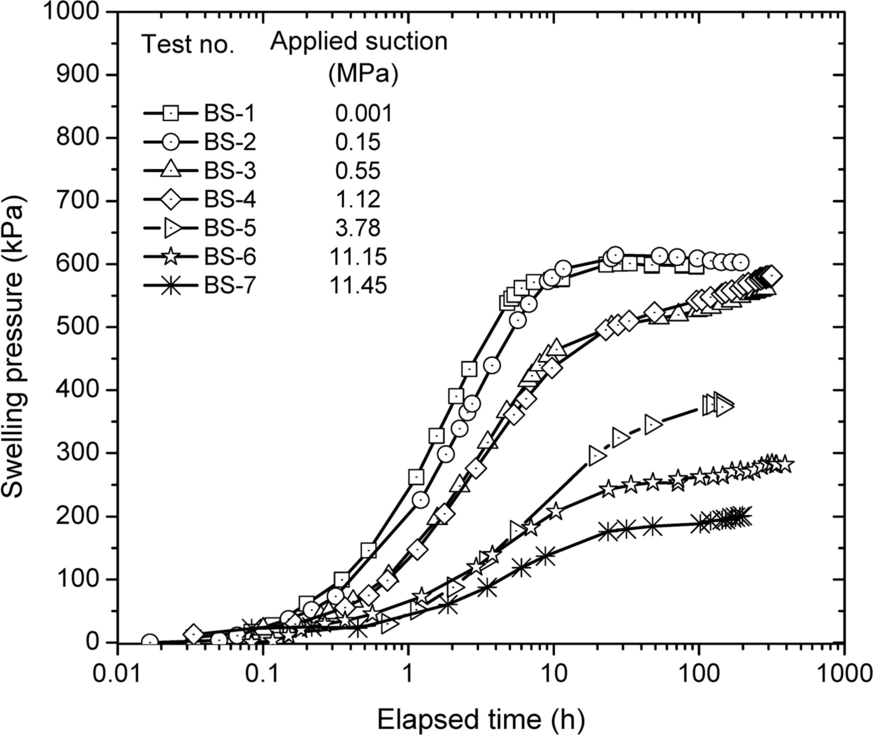
The compacted samples shown in Table 1 were installed in the isochoric device (Fig. 1) to determine swelling pressure and wetting WRCs. Samples BS-1 to BS-7 with the same compaction dry density (1.80 g/cm3) were hydrated with liquid water at the applied suction of 0.001, 0.15, 0.55, 1.12, 3.78, 11.15, and 11.45 MPa, respectively. All the tests were performed in walk-in chambers where the temperature was controlled at 22.5 ± 0.5℃. The suctions of the PEG solutions used in this study were determined according to the methods mentioned by Tripathy and Rees (Reference Tripathy and Rees2013), and the suction of the deionized water applied to hydrated samples was kept at ~ 0.001 MPa (Lang et al., Reference Lang, Tripathy, Baille, Schanz and Sridharan2019). Suction equilibrium between the PEG solution and the sample was assumed to be reached when the variation of swelling pressure was < 5 kPa per 24 h. Once suction equilibrium was established, the tests for each sample were terminated and the PEG solution circulation was stopped. Subsequently, the sample was removed from the swelling pressure device for measuring water content by oven drying.
Determination of Suction-Swelling Pressure Relationship
A multi-step swelling-pressure test was carried out on sample BS-9 with a compaction dry density of 1.80 g/cm3. Following the suction path shown in Table 1, sample BS-9 in the isochoric device (Fig. 1) was hydrated gradually with liquid water by decreasing suction in a stepwise manner from the initial value (27 MPa) to a value close to zero (0.001 MPa). For each applied suction, the suction equilibrium between the PEG solution and sample BS-9 was assumed to be reached when the changes in swelling pressure were < 5 kPa per 24 h. The multi-step swelling-pressure test was performed in a walk-in chamber with a temperature of 22.5 ± 0.5℃.
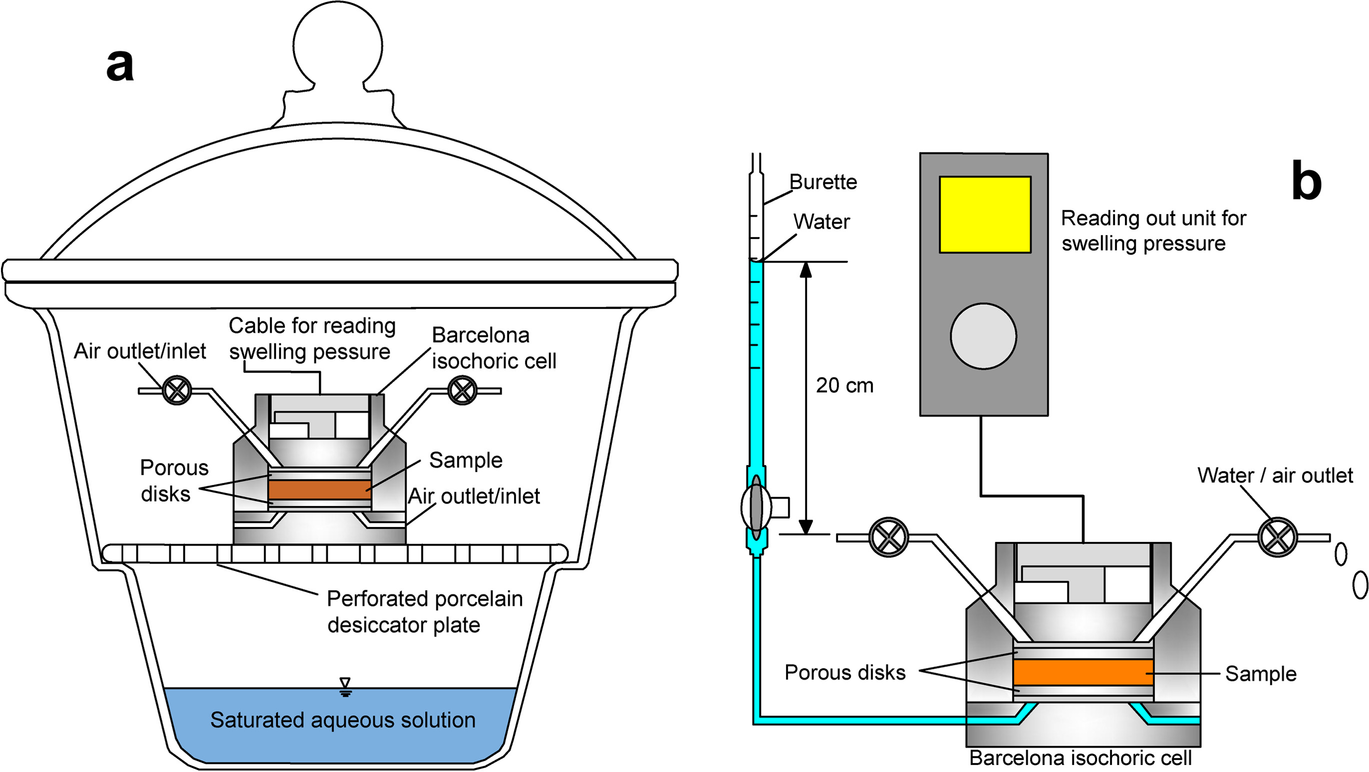
In addition, a multi-step swelling-pressure test was performed on sample BS-10 with the initial compaction conditions the same as those for sample BS-9, using the VET to apply suction. Following the suction path shown in Table 1, sample BS-10 in the swelling pressure cell (Fig. 2a) was hydrated gradually with water vapor by decreasing suction in a stepwise manner from the initial value 27 MPa to 3.4 MPa. Saturated KNO3 and K2SO4 solutions at 22.5℃ provided total suctions of 9.8 and 3.4 MPa, respectively. The total suctions of the solutions above were determined by applying the chilled-mirror hygrometer and Kelvin’s equation (ASTM-D6836, 2003; Leong et al., Reference Leong, Tripathy and Rahardjo2003). The weight of the isochoric cell and the swelling pressure were measured periodically by a balance with a detection limit of ± 0.01 g and the ‘reading out’ unit (Fig. 1) with a detection limit of ± 0.001 kN, respectively. For each applied suction, suction equilibrium was assumed to be reached when both the weight of the swelling pressure cell and the swelling pressure became constant. Afterward, sample BS-10 was hydrated with liquid water by supplying deionized water from the burette depicted in Fig. 2b. For comparison, a one-step swelling-pressure test was also performed on sample BS-8 with the same initial compaction conditions as for samples BS-9 and BS-10. Sample BS-8 in the swelling pressure cell shown in Fig. 2b was hydrated directly with liquid water by supplying deionized water. The multi-step swelling-pressure test and one-step swelling-pressure test were also carried out in the walk-in chamber where the temperature was controlled at 22.5 ± 0.5℃.
Sketches of a the experimental set-up for a multi-step swelling-pressure test with the vapor-equilibrium technique (VET) to control suction and b swelling-pressure test with deionized water to saturate the sample

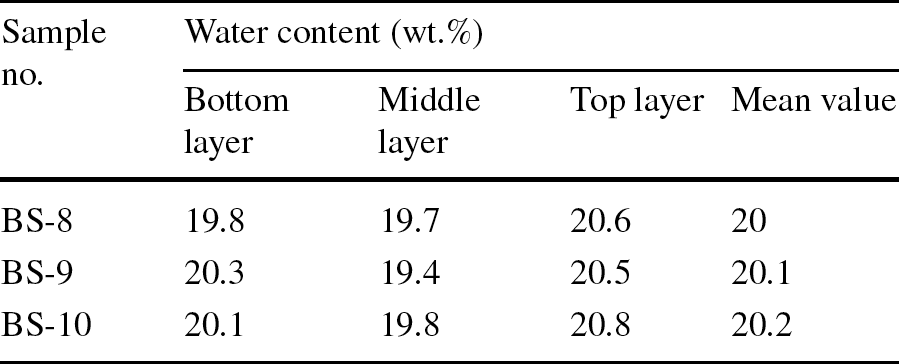
Once samples CB-8 to CB-10 reached saturation and their swelling pressures were constant, the swelling-pressure tests ended. Samples CB-8, CB-9, and CB-10 were dismantled after 22, 102, and 665 days, respectively. To explore the homogeneity of the saturated samples in terms of the water content, the saturated samples were cut into three parts from the top, middle, and bottom layers, respectively. The water contents of the representative samples were determined by oven drying.
Results and Discussion
Swelling Pressure at Saturation
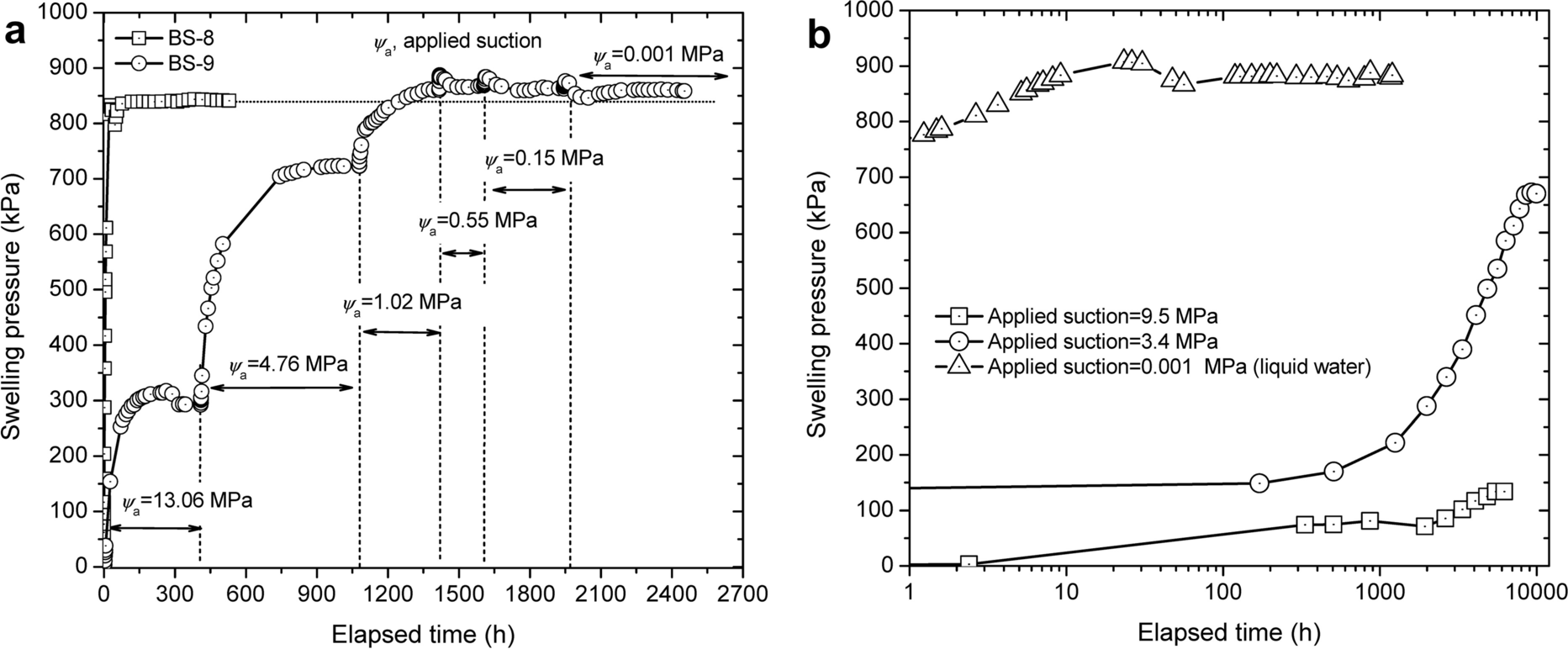
The swelling pressure of the saturated bentonite–sand mixture was affected insignificantly by the suction decrease path (Fig. 3). As sample BS-8 was saturated directly with liquid water, the swelling pressure at saturation was 845 kPa. When sample BS-9 followed the suction decrease path presented in Fig. 3 to be saturated gradually with liquid water, its swelling pressure at saturation was 859 kPa. As sample BS-10 was hydrated first with water vapor and finally saturated with liquid water (Fig. 3), its swelling pressure at saturation was 880 kPa. The difference in the values of the swelling pressures at saturation between samples BS-9 and BS-8 or between samples BS-10 and BS-8 accounted for < 5% of the swelling pressure of sample BS-8 at saturation. In addition, similar experimental results concerning the effect of the suction decrease path on the swelling pressure of saturated bentonite-based materials could be found from research done by Wang et al. (Reference Wang, Cui, Tang, Delage, Gatmiri and Ye2014); Yigzaw et al. (Reference Yigzaw, Cuisinier, Massat and Masrouri2016); Zhang et al. (Reference Zhang, Ye, Liu, Wang and Cui2020).
Evolution of the swelling pressure of compacted bentonite–sand mixture for a sample BS-8 saturated directly with liquid water, sample BS-9 saturated gradually with liquid water and b sample BS-10 hydrated gradually with water vapor and finally saturated with liquid water

The negligible effect of the suction decrease path on the swelling pressure of the saturated bentonite–sand mixture was expected because the swelling pressure of a saturated bentonite-based material upon water uptake is governed by its final dry density or bentonite dry density (Agus, Reference Agus2005; Komine & Ogata, Reference Komine and Ogata2003; Madsen, Reference Madsen1998; Pusch, Reference Pusch1980; Schanz & Tripathy, Reference Schanz and Tripathy2009; Wang et al., Reference Wang, Tang, Cui, Delage, Barnichon and Ye2013b, Reference Wang, Komine and Gotoh2021; Yigzaw et al., Reference Yigzaw, Cuisinier, Massat and Masrouri2016). The swelling pressure of the saturated Calcigel bentonite with dry density < 1.55 g/cm3 is governed by diffuse double layer swelling and, consequently, by the distance between clay platelets (Schanz & Tripathy, Reference Schanz and Tripathy2009). The final bentonite dry density of all the saturated samples in this study was 1.36 g/cm3 (i.e. < 1.55 g/cm3). The same final bentonite dry density, nearly the same water content, and moisture homogeneity (Table 2) imply that the saturated bentonite–sand mixture had microstructural homogeneity and the same distance between clay platelets. Consequently, the swelling pressure of the saturated bentonite–sand mixture was hardly affected by the suction decrease path.
Water contents of saturated bentonite–sand mixture

Suction-Swelling Pressure Relationship
The changes in the swelling pressure of the unsaturated bentonite–sand mixture with a dry density of 1.8 g/cm3 with decreasing suction showed that swelling-pressure patterns of the unsaturated bentonite–sand mixture upon wetting over a suction range from 27 to 3 MPa was hardly affected by the water phase (Fig. 4). The swelling pressure increased significantly with decreasing suction from 27 to 3 MPa, regardless of the mixture adsorbing either the liquid water or water vapor. The experimental results from Agus et al. (Reference Agus, Arifin, Tripathy and Schanz2013) on the same materials but with the greater dry density of 2.0 g/cm3 demonstrated an insignificant development of the swelling pressure upon adsorption of water vapor over a suction range of 23 to 2 MPa (Fig. 4). In that study (Agus et al., Reference Agus, Arifin, Tripathy and Schanz2013), multi-step swelling-pressure tests were performed on two identical samples with an initial water content of 9.1 wt.%. One sample was hydrated gradually with water vapor by decreasing suction in a stepwise manner from the initial value of 23 MPa to 2 MPa using the VET to control suction. The other sample was hydrated gradually with liquid water by decreasing suction in a stepwise manner from the initial value of 23 MPa to a value close to 0.001 MPa using the axis-translation technique to apply suction. The insignificant development of swelling pressure upon the adsorption of water vapor over a suction range of 23 to 2 MPa was caused by two factors according to Agus et al. (Reference Agus, Arifin, Tripathy and Schanz2013): the microstructural swelling compensating for the compression of macrostructure and the VET to apply the desired suction was ‘inefficient’.
Comparison of suction-swelling pressure relationships of compacted bentonite–sand mixture at 1.80 and 2.0 g/cm.3 dry density (DW: deionized water, OT: osmotic technique, VET: vapor equilibrium technique, ATT: axis-translation technique)

The significant development of swelling pressure of the bentonite–sand mixture (with a dry density of 1.8 g/cm3) with a decreasing suction range of 27 to 3 MPa implied that the first reason mentioned by Agus et al. (Reference Agus, Arifin, Tripathy and Schanz2013) was not applicable. The microstructure of the compacted bentonite–sand mixture used by Agus et al. (Reference Agus, Arifin, Tripathy and Schanz2013) was similar to the material used in the current study and was investigated by Arifin (Reference Arifin2008), using mercury intrusion porosimetry and environmental scanning electron microscopy. Arifin (Reference Arifin2008) found that, with increased compaction dry density from 1.6 to 2.0 g/cm3, the macrostructural pore volume of the compacted bentonite–sand mixture decreased from 62 vol.% of total pore volume to 41 vol.% of total pore volume. According to this finding, the percentage of macrostructural pore volume of the compacted bentonite–sand mixture with dry density of 1.8 g/cm3 was greater than the percentage of the macrostructural pore volume of the compacted bentonite–sand mixture with the dry density of 2.0 g/cm3. The greater the percentage of macrostructural pore volume is, the smaller the swelling pressure of unsaturated bentonite–sand mixture upon absorption of water vapor should be, based on the first reason given by Agus et al. (Reference Agus, Arifin, Tripathy and Schanz2013). However, the significant development of swelling pressure within the suction range of 27 to 3 MPa was observed in the case of the bentonite–sand mixture with dry density of 1.8 g/cm3.
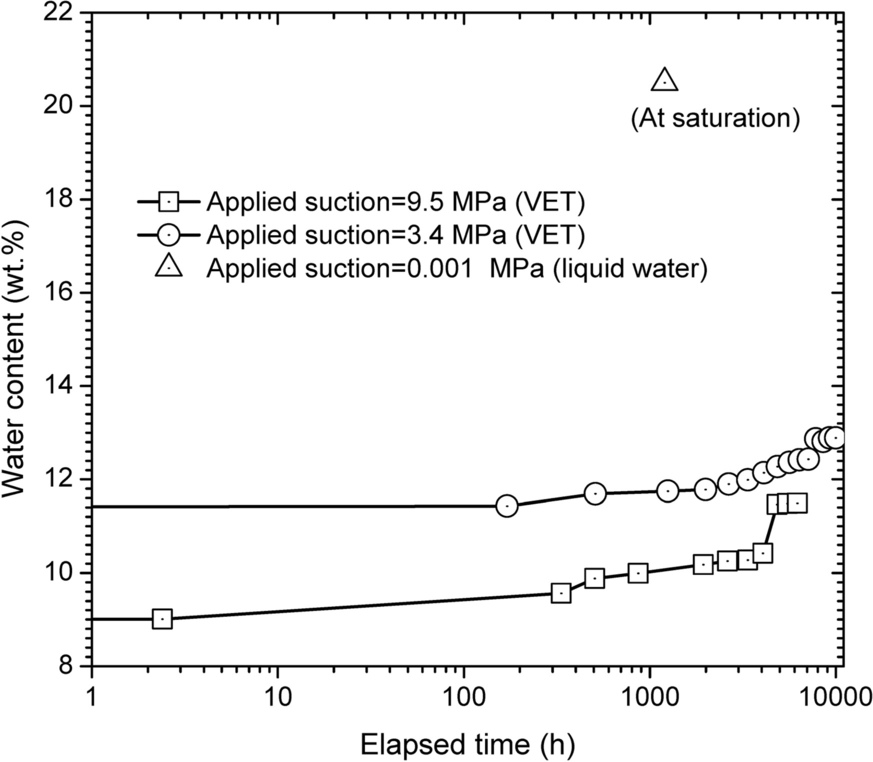
The ‘inefficiency’ of the VET to apply desired suction rather than the microstructural swelling compensating for the compression of the macrostructure might result in the insignificant development of the swelling pressure upon adsorption of water vapor over the suction range 23 to 2 MPa. The ‘inefficiency’ of the VET in applying a desired suction might mean that the suction equilibrium between the applied suction and the bentonite–sand mixture with the dry density of 2.0 g/cm3 is not completely established. The disadvantage of the VET is that it is quite time-consuming (Delage et al., Reference Delage, Romero, Tarantino, Toll, Augarde, Gallipoli and Wheeler2008), and this is seen in Fig. 3b. Incomplete suction equilibrium, therefore, resulted in the insignificant development of the swelling pressure of the bentonite–sand mixture with the dry density of 2.0 g/cm3 over the suction range 23 to 2 MPa.
Effect of the Water Phase on Swelling Pressure and Water Retention
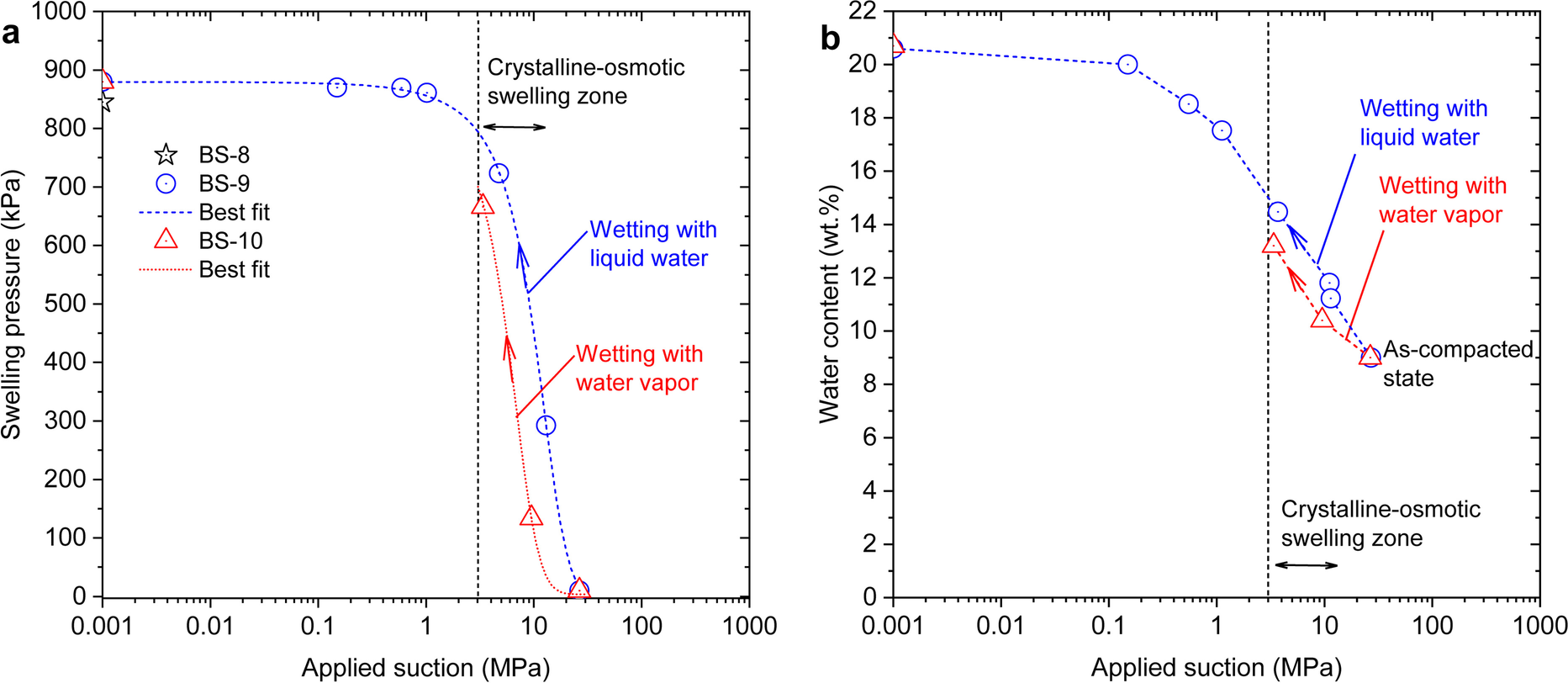
The changes in swelling pressure and in the water content of the compacted bentonite–sand mixture upon adsorption of either liquid water or water vapor with decreasing suction is shown in Fig. 5. The suction-water-content curve with an open cycle (Fig. 5b) corresponded to the experimental data of samples BS-1 to BS-7 (Fig. 6) and the suction-water content curve with an open triangle (Fig. 5b) corresponded to the experimental data of sample BS-10 (Fig. 7). Within the suction range from 27 (initial suction) to 3 MPa, the water phase affected significantly both the magnitude of the swelling pressure and the water content of the unsaturated bentonite–sand mixture. For any suction in this suction range, the swelling pressure and the water content of the mixture upon adsorption of liquid water were greater than those upon adsorption of water vapor. Similar experimental results with respect to swelling strain and swelling pressure were also reported by Cuisinier and Masrouri (Reference Cuisinier and Masrouri2005) on a compacted bentonite-silt mixture with a dry density of 1.3 g/cm3 and by Yigzaw et al. (Reference Yigzaw, Cuisinier, Massat and Masrouri2016) on compacted bentonites with a dry density of 1.4 g/cm3, respectively.
Effect of the water phase on the changes in a swelling pressure and b in the water content of the compacted bentonite–sand mixture with decreasing suction

Evolution of the swelling pressure of compacted bentonite–sand mixture for samples BS-1 to BS-7 hydrated with liquid water and under various suction pressures

Evolution of the water content of compacted bentonite–sand mixture for sample BS-10 hydrated gradually with water vapor and finally saturated with liquid water

Both sets of authors, Cuisinier and Masrouri (Reference Cuisinier and Masrouri2005) and Yigzaw et al. (Reference Yigzaw, Cuisinier, Massat and Masrouri2016), indicated that the influence of the water phase on the swelling capacity of the bentonite-based materials is related to osmotic suction. If the semi-permeable membrane used in the OT was impermeable to soluble ions, both the OT and the VET control total suction and, consequently, a unique water content is expected at a given value of applied suction. However, the semi-permeable membrane used in the OT is permeable to soluble ions. The osmotic effect due to the concentration difference of the soluble ions between the pore solution of the bentonite-based materials and the PEG solution induces water migration from the PEG solution to the pore solution of the bentonite-based materials. The application of the OT to apply suction tends to lead to the bentonite-based materials with soluble ions adsorbing more water and causing more swelling than the application of the VET to apply suction. In the case of the Na-rich bentonite used by Yigzaw et al. (Reference Yigzaw, Cuisinier, Massat and Masrouri2016), its osmotic suction remained at 1 MPa and is significant. In the case of the Calcigel bentonite used in the present study, however, the osmotic suction remained at only 0.05 MPa for a large range of water content (Arifin & Schanz, Reference Arifin and Schanz2009) and the osmotic suction was insignificant. Thus, osmotic suction is not the main reason for the influence of the water phase on the swelling pressure and water retention by the unsaturated bentonite–sand mixture.
The effect of a water phase on the swelling pressure and the water retention of the unsaturated bentonite–sand mixture is mainly related to the hydration or swelling mechanism of Ca-rich bentonite. For the hydration of Ca-rich bentonite, the full development of crystalline swelling (Laird, Reference Laird2006; Van Olphen, Reference Van Olphen1977) arises at a suction of ~ 3 MPa, whereas osmotic swelling arises (Laird, Reference Laird2006; Liu, Reference Liu2013; Van Olphen, Reference Van Olphen1977) at a suction of 26 MPa (Saiyouri et al., Reference Saiyouri, Hicher and Tessier2000, Reference Saiyouri, Tessier and Hicher2004). As Ca2+ is the dominant exchangeable cation in the bentonite–sand mixture, both the crystalline swelling and the osmotic swelling can occur with decreasing suction from 27 to 3 MPa (Fig. 5: crystalline-osmotic swelling zone). If the unsaturated bentonite–sand mixture adsorbs liquid water in the crystalline-osmotic swelling zone, both interparticle hydration (osmotic swelling) and interlayer hydration (crystalline swelling) would contribute to the water content and the swelling pressure of the mixture. Liquid water flow in the compacted bentonite–sand mixture occurs initially in inter-aggregate pores, then interparticle pores, and finally interlayer pores because of the dual-structure characteristics of this material (Agus & Schanz, Reference Agus and Schanz2005; Arifin, Reference Arifin2008; Cui et al., Reference Cui, Loiseau and Delage2002). If the unsaturated bentonite–sand mixture adsorbs water vapor in the crystalline-osmotic swelling zone, however, only interlayer hydration would contribute to the water content and swelling pressure of the mixture. The interlayer hydration of Ca-montmorillonite upon adsorption of water vapor dominates over suction in the range from 303 to 4 MPa, whereas interparticle hydration does not occur or is limited significantly over this suction range (Salles et al., Reference Salles, Bildstein, Douillard, Jullien, Raynal and Van Damme2010). For a given suction in the crystalline-osmotic swelling zone, therefore, the unsaturated bentonite–sand mixture adsorbing liquid water can hold more water and exhibit more swelling than that adsorbing water vapor.
Conclusions
The swelling pressure of the saturated bentonite–sand mixture with a dry density of 1.8 g/cm3 was scarcely affected by the suction-decrease path. The negligible effect of the suction decrease path on the swelling pressure of the saturated bentonite–sand mixture was attributed to the microstructural homogeneity of the saturated bentonite–sand mixture.
The water phase had almost no effect on the swelling pressure patterns of the unsaturated bentonite–sand mixture upon wetting over the suction range from 27 to 3 MPa. Incomplete suction equilibrium would result in the insignificant development of the swelling pressure of the bentonite–sand mixture upon wetting. The water phase had a considerable impact on both the swelling pressure and the water retention of the unsaturated bentonite–sand mixture upon wetting over the suction range from 27 to 3 MPa. For a given suction in the range above, the swelling pressure and the water content of the bentonite–sand upon the adsorption of liquid water were greater than those upon the adsorption of water vapor, respectively. The effect of the water phase on the swelling pressure and the water retention of the unsaturated bentonite–sand mixture is related mainly to the hydration or swelling mechanism of the Ca-rich bentonite instead of osmotic suction.
The effect of a water phase on the swelling pressure of the unsaturated bentonite–sand might be considered as a factor in designing backfills if the host rock of a geological repository is poor in groundwater. Hydration and the develoment of swelling in backfills upon the adsorption of water vapor will be quite time consuming.
Acknowledgements
The authors acknowledge financial support (SCHA 675/16-1) from the Deutsche Forschungsgemeinschaft (DFG). In addition, the first author gratefully acknowledges the Chinese Scholarship Council, Ruhr-Universität Research School PLUS (Germany’s Excellence Initiative [DFG GSC 98/3]), and the Fundamental Research Funds for the Central Universities (2-9-2019-007) for their financial support. The authors also thank the Editor and anonymous reviewers for their comments which helped to improve the quality of the manuscript.
Funding
Funding sources are stated in the Acknowledgements.
Data Availability
All data generated or analysed during this study are are available from the corresponding author on reasonable request.
Declarations
Conflict of Interest
The authors declare that they have no conflict of interest.