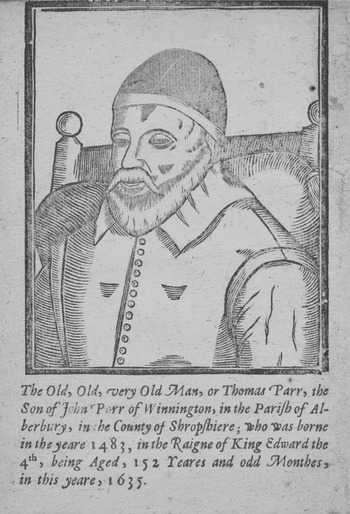
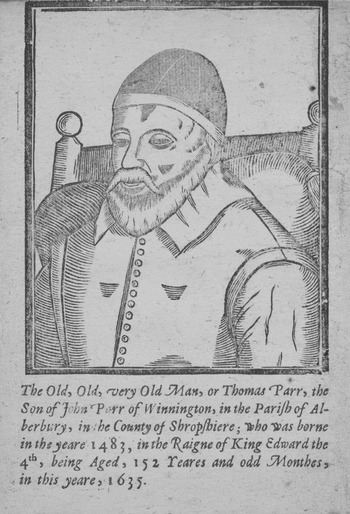
In November 1635, a man reputed to be 152 years of age died in London and was accorded the honour of burial in Westminster Abbey. A native of the small hamlet of Winnington in Shropshire, Thomas Parr had lived a long and vigorous life in the countryside before being persuaded by a visiting nobleman to journey at his expense to the capital, where crowds flocked to see this remarkable example of human longevity. Shortly afterwards, however, affected by the impure urban air, the celebrated centenarian expired. Parr's body was examined by the famous physician William Harvey and the story of this ‘monument and almost miracle of nature’ became the subject of a catchpenny pamphlet by the water poet John Taylor (Figure 1). In a postscript, Taylor described ‘the changes of manners, the variations of customes, . . . the alterations of religions, the diversities of sects, and the intermixture of accidents’ that had happened since Parr's alleged birth in 1483. His lifetime had spanned the era of England's protracted and idiosyncratic Reformation. Brought up in the Catholic faith, by the time of the Henrician break with Rome he was fifty years old – in an era of limited life expectancy already a rather elderly man. He had witnessed the succession of theological and liturgical upheavals and reversals of the reigns of Edward VI, Mary and Elizabeth I and had lived to see the steady entrenchment of the Protestant religion under their early Stuart successors James and Charles. According to Taylor, Parr had borne the religious turbulence of his times with equanimity; he had not been troubled by the dissolution of the monasteries, nor murmured at the replacement of the Latin mass by vernacular prayers. He was unperturbed by the royal supremacy, had observed the passing of old Catholic customs and rituals and the rise of puritanical scruples about remnants of popery with cool indifference, and outlived many sectaries and heretics executed for their unorthodox opinions. ‘He held it safest to be of the Religion of the King or Queen that were in being, for he knew that hee came raw into the world, and accounted it no point of Wisedome to be broiled out of it.’ No martyr or zealot, at least in the witty pen portrait provided by Taylor, Parr was a temporiser by instinct. A bemused bystander rather than active participant in five generations of religious change, he died on the eve of the tumultuous new stage of the English Reformation precipitated by the outbreak of civil war in 1642.Footnote 1
‘The Old, Old, Very Old Man’, Thomas Parr: John Taylor, The Old, Old, Very Old Man: Or, The Age and Long Life of Thomas Par (1635), frontispiece. © British Library Board (shelfmark C. 34. f. 43).
The case of Thomas Parr provokes a series of intriguing questions. Did age matter in the Reformation? How was the life-cycle implicated in the movements for religious renewal that marked the sixteenth and seventeenth centuries? What consequences did these developments have for generational relations: for interactions between children and adults in a hierarchical society that clung tightly to the patriarchal assumption that young people should defer submissively to their elders? And to what extent did the Reformation itself age as it progressed beyond its initial unruly phases and became institutionalised as the official faith? These are issues that have been largely neglected by historians to date. The debate about the Reformation has revolved around alternative polarities: whether it sprang up spontaneously from below or was imposed on the populace from above, whether it was fast or slow, whether it was enthusiastically welcomed or fiercely resented, whether it was a dismal failure or a resounding success, whether it created a nation of convinced Protestants or merely a Protestant nation. Somewhat surprisingly, the consensus that has emerged from the historiographical controversies of the last thirty years that England experienced a long and incremental Reformation has not prompted very much interest in how people at the various points in the life-cycle reacted to it and how far the religious developments of the period can be said to have had a generational complexion, though interventions by Susan Brigden and Norman Jones represent partial and notable exceptions.Footnote 2
Such questions have also been somewhat marginal to the concerns of the social historians who have focused attention upon groups at either end of the age spectrum, intrigued by a society with an age profile sharply contrasting with our own, in which those under twenty-one comprised some 40–50 per cent of the population,Footnote 3 and by the apparent paradox of a gerontocratic culture that revered the authority of the elderly despite the fact that they were numerically in the minority. The work of Keith Thomas, Paul Griffiths, Steven Smith, Ilana Ben-Amos, Lynn Botelho and Pat Thane among others has illuminated key questions about the autonomy and dependence, perception, identity and regulation of the young and old and enhanced our understanding of the ambiguous mixture of agency and vulnerability that shaped the experience of these groups in the two centuries between 1500 and 1700.Footnote 4 However, the connections between these tendencies and trends and the mental and cultural sea changes brought about by the Reformation are still under-investigated.
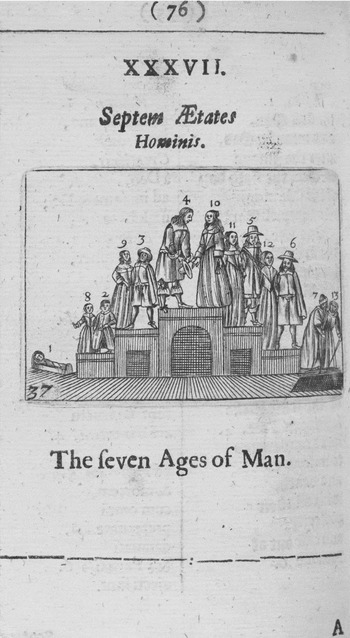
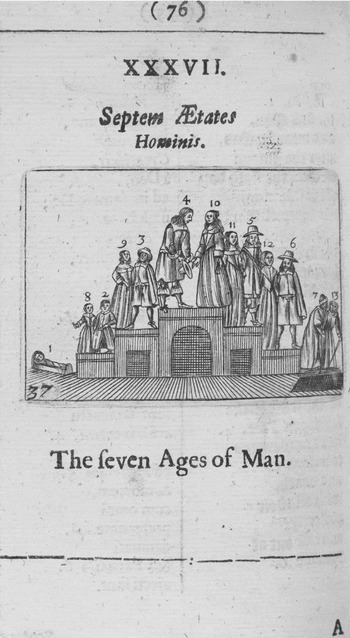
Nor has the Reformation been the subject of ambitious studies of the role of generational difference and conflict as critical forces in history. From the early work of Auguste Comte in the 1830s and 1840s to the fruitful theoretical insights developed by Karl Mannheim in the 1920s and the spasm of intellectual activity on this theme fostered by the youth movements of the 1960s, the primary focus of scholarly attention has been the twentieth century.Footnote 5 Whether conceived of as a cohort of people linked by biology or as a group of coevals bound by a common consciousness shaped by shared experience, the problematic concept of the generation has not been widely exploited by early modern historians. For all its attendant pitfalls, the idea that there may be some kind of correlation between the inexorable cyclical succession of fathers and mothers by daughters and sons and momentous processes of historical change arguably still has considerable potential as a heuristic tool. In the guise of the influential scheme of the Seven Ages of Man the notion that people in different stages in life (infancy, childhood, youth, manhood, old age and decrepit old age) had distinct characteristics, temperaments and instincts and that these corresponded typologically with particular eras of human history was deeply embedded in sixteenth- and seventeenth-century culture itself (Figure 2).Footnote 6 Assimilating the vocabulary of the bible, contemporaries conceived of their world in terms of a series of ‘generations’ to whom God had displayed mercy when they followed His commandments and against whom He would certainly rise up in wrath and judgement if they disobeyed Him.Footnote 7
The Seven Ages of Man: Johann Amos Comenius, Orbis Sensualium Pictus (1659), 76. © British Library Board (shelfmark E 2116 (1)).
Three further preliminary points must be made. The first is that concepts of age in this culture were not fixed and immutable but relative, fluid and flexible; although there were conventions about where childhood ended (typically fourteen) and when old age began (commonly fifty or sixty), the boundaries between youth and age were often imprecise. Furthermore, the words were often utilised metaphorically to describe a stage of mental maturity, moral degeneracy or spiritual development; one could be old in years, but young in faith or display a childish piety but be aged and grey in iniquity. Age was and is both a biological fact and a cultural construct.
Secondly, attitudes towards youth and age were fundamentally ambivalent. Drawing on the reservoir of Scripture and classical culture, the former was linked with both ignorance and innocence. It was seen as a phase in the life-cycle singularly prone to sin, insubordination and idleness but simultaneously as one in which people were particularly receptive to salutary religious influences. Old age had a similarly equivocal quality, being linked on the one side with wisdom, gravity and experience and on the other with folly, depravity and senility. These negative and positive elements coexisted in contemporary mentalities without contradiction.Footnote 8
A third caveat concerns the intractable difficulty of accessing the experience of the young and the elderly in an unmediated form. We mainly see them refracted through the spectacles of the adults who described them or through the equally distorting lenses of recollection and memory. Fiction and fact are inextricably entangled in the prescriptive texts, eulogistic biographies, diaries and other ego-documents upon which we are compelled to rely. It is as pointless as it is impossible to unravel the lives depicted in these texts from the lives lived in the flesh they purportedly describe. Even so, as I hope to show, the manner in which inherited tropes about youth and age were deployed and the ways in which the notion of generational strife was invoked at various stages of England's long Reformation may cast fresh light on the contours and repercussions of this movement.
I
The language of youth and age pervades the polemical literature engendered by the Reformation and was central to the process of confessional identity formation. Those who resisted the tide of change proudly claimed to have antiquity on their side. Catholicism was the ‘old religion’; its roots in the ancient Christian past and its durability over so many centuries were certain signs of its truth and legitimacy. Insisting that their religion alone had the imprimatur of history, a long succession of Catholic controversialists from Thomas Harding and John Rastell to Matthew Kellison and Richard Broughton castigated Protestantism as a new-fangled and upstart religion invented from scratch and stuffed with ‘gross absurdities’ and ‘rotten rags’ by a recent faction. Taunting their enemies with the question ‘where was your church before Luther?’, they hurled the damaging charge of novelty against them with venom.Footnote 9 In reply, Protestant propagandists deftly turned the tables and proclaimed that their church rather than that of the papists was the real incarnation of the primitive religion of Christ and his disciples. The Reformation had not given birth to a new faith but had resurrected an apostolic and indeed an Abrahamic one. As Thomas Bell, Robert Abbot, Josias Nicholls and many others declared, it was the medieval papacy and clergy who were guilty of introducing a false and bastard child into the world, riddled with fabricated superstitions disguised under the title of ancient ‘traditions’.Footnote 10
Protestantism also liked to present itself as the religion of those who had cast aside the puerile beliefs and practices of their benighted forefathers and embraced a system of faith befitting those who had reached the age of discretion and reason. Alluding to the text of 1 Corinthians 13, godly ministers such as Edward Dering described it as the doctrine of those who no longer needed the swaddling bands and mother's milk of signs, wonders and miracles to be persuaded of the truth and who relied solely on the word of God rather such ‘poore and childish conceits’.Footnote 11 Simultaneously, and somewhat inconsistently, Protestants increasingly connected Catholicism with the stubborn conservatism of those in their dotage. Castigating elderly nurses and dames for indoctrinating children with ‘idle fables’ and ‘lying vanities’, they summarised their contempt for this process of generational transmission in the disparaging phrase ‘old wives’ tales’.Footnote 12 The misguided nostalgia of the aged for the pre-Reformation era likewise became a commonplace enshrined in sentences such as ‘it was never merry England since the mass was put down’ or ‘the Bible came abroad’.Footnote 13 Catholicism was at once the faith of those reduced to imbecility by age and those who had failed to transcend their natural infantile state.
By contrast, Catholics were all too willing to exploit the topos of childhood to recall heretics to the bosom of the mother church.Footnote 14 Spokesmen for the Marian Counter-Reformation including Cardinal Pole systematically employed it as a symbol of the attitude English Christians should adopt, urging those seduced by Protestantism humbly to submit themselves to the instruction of their spiritual elders and heed Christ's admonition in Matthew 18 that unless they became like ‘little children’ and ‘young babes’ they would never enter the kingdom of heaven. In a further paradox, Catholic polemicists often blamed the pernicious spread of heresy in the earliest phases of the Reformation on the fickleness of youth. Writers such as William Peryn, Miles Huggarde and John Feckenham attributed the apostasy they saw occurring around them to the inherent tendency of ‘yonglinges’ to be buffeted by ‘every puffe of wynd’ and to their predeliction towards disorder and insolence. They branded Protestantism as a movement of ‘lewd laddys’ and ‘beardless boys’.Footnote 15 The fruits of this new-fangled doctrine were the disobedience of children and the turning of the established hierarchy of youth and age upside down. Writing in 1554, John Christopherson deplored the young evangelicals who made a mocking stock of their ‘papisticall’ parents saying ‘my father is an old doting foole, and will fast upon the fryday, and my mother goeth always mumblinge on her beades’.Footnote 16
For their part, early Protestants acknowledged that these were extraordinary times in which youth might indeed teach or facilitate the conversion of their elders. Nicholas Ridley recalled how during Edward's reign ‘the aged folk, which had been brought up in blindness, and in ignorance of those things which every Christian is bound to know’ absorbed reformed tenets by ‘hearing their children and servants repeating the same’; the illiterate Welsh fisherman Rawlins White learned the complete text of the bible by listening to his son (‘a special minister appoynted by God (no doubt) for that purpose’) read it aloud; and a court case from John Hooper's diocese of Gloucester in 1551 describes how the prowess of a small girl who perfectly recited the catechism was used to shame a recalcitrant parishioner unable to declare the ten commandments and articles of faith despite his more advanced years.Footnote 17
Snippets of evidence confirm the picture Susan Brigden has painted of the energetic involvement of youth in the early Reformation. They show that adolescent apprentices often played a critical role in the spectacles of demystification by which miraculous images like the Rood of Boxley were exposed as fraudulent: after breaking the crucifix in two in the pulpit John Hilsey handed the idol over to ‘the rude people and boyes’ to smash to smithereens.Footnote 18 They hurled snowballs at popish priests, made the trumpery of the mass the subject of satirical jests and carnivalesque games, and like the grammar school pupil John Davis of Worcester composed ballads against the Catholic clergy with provocative titles such as ‘Come down, for all your shaven crowne.’Footnote 19 At Buxton in Derbyshire, with the connivance of a local evangelical gentleman, they profaned the chapel associated with the former holy well of St Anne with irreverent tippling, drinking, piping, dancing and hopping and reproved older parishioners who called upon them to desist from these ‘foolish youthful fashions’.Footnote 20
The pages of John Foxe's Actes and Monuments celebrate the inversion of patriarchal structures of deference to which this revolutionary moment gave rise. They dwell on the fervour of fresh-faced youths who outshine learned doctors of theology with whom they dispute; their presumption in lecturing their elders is excused because it is divinely inspired. The template here is Jesus taking on the rabbis in the Temple at Jerusalem. Julius Palmer is rebuked by his interrogator as ‘a beardless boy, start[ed] up yesterday out of the schools’; the nineteen-year-old apprentice William Hunter arrested for bible-reading and his denial of transubstantiation is angrily reprimanded as a ‘naughty boy’ by an official whom he discomfits with his deep knowledge of scripture, while the blind boy from Gloucester who engages impressively with the chancellor of the diocese overcomes his disability as well as his age.Footnote 21 Such stories represent a reinvigoration of the medieval hagiographical trope of puer senex, the godly child who transcends his stage in the life-cycle and displays the spiritual sagacity of the aged. Nowhere is this more evident than in the evolving myth of England's young Josiah, Edward VI. Present in embryo soon after his premature death in 1547, by the late seventeenth century it was firmly entrenched in patriotic legend. Preaching at the Guildhall chapel in 1699, John Strype invoked the memory of the precocious boy king, who ‘tho he were but a Child, he was a Father, a true Nursing Father, to God's Church and People’.Footnote 22
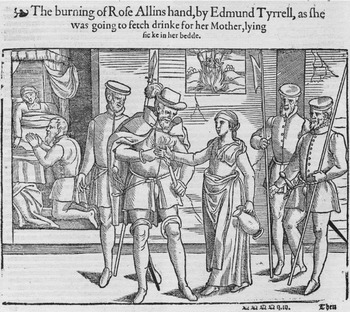
Young people who place confession of the truth above obedience to their elders are also acclaimed for their bravery in martyrological texts. The Chelmsford lad William Maldon boldly defies his father's insistence that he abandon his heretical opinions, saying ‘Forsouthe . . . I have no scholmaster but God.’ Viciously whipped for his temerity, he rejoices in the punishment inflicted upon him by his own parent for Christ's sake.Footnote 23 In the early heady years of the Reformation some children felt compelled in conscience to cast filial duty in order to save the souls of their loved ones: young Robert Plumpton wrote to his ‘worshipfull mother’ in 1536 saying ‘it is my dutie to instruct you, most principallie of all other’ and sent her a copy of Tyndale's New Testament.Footnote 24 Such examples of role reversal and generational dissension were not deplored so much as heralded as signs of the Almighty at work. More generally, Foxe highlighted the youthfulness of those who suffered for their faith: the courage of young maids such as Joan Warren, who was burned at Smithfield with seven other ‘godly and constant martirs’, far exceeded what would normally be expected of their tender years. He similarly celebrated the stoicism of Rose Alline of Colchester, whose hand was gratuitously burned with a candle by Sir Edmund Tyrell ‘til the very sinowes crackte in sonder’ after she dared to answer back to his exhortation to counsel her parents to be ‘better catholicke people’ saying ‘Sir, they have a better instructor then I’ (Figure 3).Footnote 25
The godly maid, Rose Alline, of Colchester: John Foxe, Actes and Monuments (1583), ii, 2006. Reproduced by kind permission of the Syndics of Cambridge University Library (shelfmark Young 200).

In turn, accounts of the courageous deaths of elderly evangelicals at the hands of the Marian regime highlight the childlike simplicity displayed by such martyrs as they went to the stake. In their final moments, they rise above the physical degeneration attendant upon their age and regain their youthfulness in the eyes of spectators; ‘whereas in hys clothes’ (a threadbare gown and penny leather girdle), Hugh Latimer had ‘appeared a withered and crooked sely old man’, stripped of his shroud in readiness for making the ultimate sacrifice in 1555, ‘he now stode bolt upryght, as comely a father as one might lightly behold’. At Cardiff, Rawlins White ‘seemed in a manner to be altered in nature’ as he awaited the fire: ‘For wheras before he was wont to go stowping . . . through the infirmitie of age, havyng a sad countenance and a very feeble complexion, and withal very soft in speache and gesture. Now he wente and stretched up hym selfe’ and acquired the stature and countenance of a man in his prime, his white hair and beard lending him an angelical appearance.Footnote 26 Assimilated to ancient prototypes, these eye-witness accounts do not provide us with access to the real experiences of young and old so much as evidence of the vitality of rhetorical devices that play on the ambivalence of early modern images of age. They highlight the early Reformation as a time when contemporaries anticipated and accepted that the settled hierarchies of their society would be overturned temporarily.
It is worth stressing the surge of pedagogic activity and optimism about the transfiguring effects of education that marked the 1540s and 1550s. Instruction of the young was seen as a key priority for achieving the spiritual regeneration of sixteenth-century England. John Colet, founder of St Paul's School in London, believed that the nation's chief hope lay in having the rising generation trained in good principles. Without the godly education of yeoman's sons, concurred Latimer in a sermon preached before Edward VI in 1549, ‘ye pluck salvation from the people, and utterly destroy the realm’.Footnote 27 As Philippa Tudor has shown, the early reformers developed an ambitious programme of religious instruction for children and adolescents, especially in the guise of catechising. This was to precede their full admission to the church when they reached ‘the yeres of discrecion’ and could affirm with their own mouths the promises made on their behalf by their godparents at their baptism.Footnote 28 Like their counterparts in Lutheran Germany, they were convinced that this was a singularly powerful method of weaning the population from superstition.Footnote 29
II
These convictions persisted, but by the 1570s and 1580s it is possible to detect a growing sense of disillusionment about the receptiveness of the young to the Protestant Gospel. By now, ironically, the children who were the subject of clerical endeavours had been born and baptised in the Protestant church and never known the days in which popery had reigned. This coincided with a developing anxiety about the failure of the Reformation as an engine of evangelical conversion more generally and an awareness of the reluctance of many elderly people to internalise the new faith. One measure of this is the outpouring of printed catechisms and works of practical divinity that Ian Green has dated to these decades. Directed both to ‘children in yeeres and children in understanding’, they provided ‘milke for babes’ not merely in age but also in knowledge of Christ. They reflected a recognition that many older parishioners lacked even a basic understanding of Protestant dogma and required a form of adult education. The weaknesses of such catechumens were to be corrected by clergymen young enough to be their sons.Footnote 30
As the first generation of the Reformation gave way to the second and third and Protestantism progressively cemented its hold on English society, the pattern of the young deferring to their elders vigorously reasserted itself. Dozens of seventeenth-century tracts adopted the form of didactic dialogues, ‘monitors’ and remembrancers’ in which Old Age tutored the Young Man on his pilgrimage through life: spiritual maturity was once more in, rather than out of step with biological age. In a text translated from Dutch in 1659, for instance, Youth submits gratefully to the superior wisdom and experience of Age in matters of faith and acknowledges that without such guidance ‘by reason of my ignorant Child-hood’ he would ‘perish in blindness and misery’.Footnote 31
This was accompanied by a fresh emphasis on the innate vanity and depravity of the young and on the necessity of strict parental discipline that finds clear expression in the burgeoning genre of books of household governance. These works capture the tension between the deeply pessimistic anthropology that lay at the heart of Protestant theology and its lingering hope that training and education might have a redemptive effect by bridling the froward, refractory and ‘brutish’ impulses to which youth were instinctively prone. Predicated on Calvin's precept that children carried ‘an innate corruption from the very womb’, they insist that sharp correction is essential if children are not to slide down the slippery slope into inveterate sin and become, in the words of the Jacobean divine Robert Shelford, ‘the Divels drudges’ and ‘packe-horse’. It was best, they declared, to begin when the plant was pliable and tender and when the minds of the young were still like soft wax and easiest to imprint with the lessons of righteousness.Footnote 32 The diligent efforts of parents to instruct their offspring in godliness, wrote William Gouge in his bestselling manual Of Domesticall Duties, were ‘an especiall means of propagation of true religion from age to age, and from generation to generation’.Footnote 33 Neglect of these obligations was the readiest route to anarchy within the family and the dissolution of Christian society, for, as the Sussex divine John Maynard averred in 1669, ‘Satan's kingdom’ was built ‘upon the ruines of the younger sort’.Footnote 34
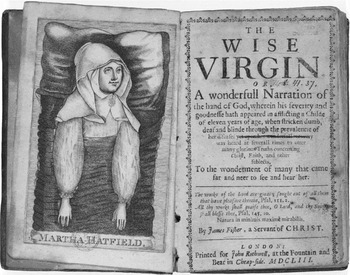
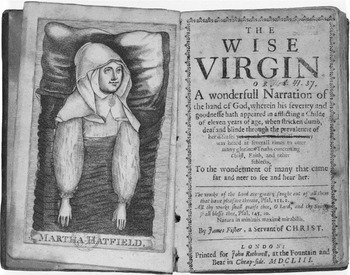
Such sentiments coexisted with the idea that youth and childhood comprised a time when individuals might enjoy special spiritual insight. The later sixteenth and seventeenth centuries throw up many instances of young boys and girls of exemplary piety who died before they reached adulthood. ‘[E]ven from his bairnlie age’, William Michel, the son of a Scottish pastor, who passed away in 1634, ‘had the wit of a Man, the knowledge of a Scholler, & the carriage of a Christian’.Footnote 35 As described by her biographer Henry Wilkinson, Margaret Corbet ‘was young in years, yet . . . old in Grace’ when she died aged twenty-eight in 1656, while the devout New England youth Nathanel Mather, brother of the more famous Cotton, had displayed ‘a sign of Ninety at Nineteen’.Footnote 36 Twelve-year-old Cicely Puckering, celebrated in a funeral sermon published in 1640, had likewise ‘excelled all others of her sexe and age’.Footnote 37 Her profound utterances during her final sickness, which amazed those who assembled at her deathbed, bear comparison with the prodigious pronouncements of the succession of young children who were recognised as prophets in the course of this period – children such as the Suffolk husbandman's son William Withers, who fell into a coma on Christmas Eve 1580 and awoke ten days later to deliver a series of vehement denunciations of sin and immorality, and the eleven-year-old ‘wise virgin’ Martha Hatfield, whose trance-like revelations made her a celebrity in puritan London in 1653 (Figure 4). These episodes reflected the idea, rooted in the text of Psalm 8 v. 2 (‘Out of the mouths of babes and sucklings . . .’), that the young were sensitive radio-transmitters of divine messages from heaven. These prophets’ short-lived usurpation of the role of preachers was sanctioned by God, who resorted to making the young his mouthpieces when people would not heed the impassioned calls of ordained ministers and/or when the apocalypse was nigh.Footnote 38 These, however, were exceptions to a more general rule summed up by William Perkins. Where self-proclaimed seers were young rather than old, ‘babling and talkative’, ‘unruly and disordered’ rather than ‘quiet’ and ‘silent with wisdome’, he declared, ‘suspicion may be gathered’ that their premonitions were ‘an illusion of Satan. For in the weaker sort he most prevaileth.’Footnote 39 Symptomatic of what Max Weber might have called the routinisation of the Church of England's charisma,Footnote 40 the dominant tendency of late Tudor and early Stuart Protestantism was towards scepticism about the capacity of youth to function as vessels and vehicles of divine enlightenment. Such figures represented a threat to the monopoly on religious authority claimed by the ecclesiastical hierarchy, and the more typical response was to dismiss them as victims of diabolical delusion.
Martha Hatfield, ‘the wise virgin’: James Fisher, The Wise Virgin or, A Wonderfull Narration of the Hand of God (1653), frontispiece and title-page. Reproduced by kind permission of the Syndics of Cambridge University Library (shelfmark 8. 41. 37).
The rash of cases of demonic possession that spread from the middle years of Elizabeth's reign is significant here. In many such episodes, possessed adolescents and children oscillate between blaspheming and preaching; the voices that emanate from them as from ventriloquists’ dolls come from God as well as the devil. Thus, in between his fits, the Derbyshire boy Thomas Darling displayed an attachment to Scripture and wished he might live ‘to thunder out the threatenings of Gods word’, while John Starkie cried out against the ‘straunge sinnes of the land committed in all estates & degrees of people’ like an accomplished Paul's Cross preacher.Footnote 41 The diagnosis of possession that prevailed on these occasions represented a defeat for the afflicted and the triumph of a perspective that regarded their disturbing behaviour as an unwarrantable upsetting of the natural order in which children were subservient to their parents, and laypeople to the clergy.Footnote 42 With Jim Sharpe, we might see the impious outbursts and irreverence towards Scripture with which these edifying speeches were intermixed as an index of youthful rebellion against a rigid puritan upbringing. Attributing their misconduct to the work of Satanic forces was a convenient way of explaining disruption in the well-ordered and somewhat claustrophobic households of godly patriarchs, which were widely regarded as microcosms of the Christian commonwealth at large.Footnote 43 By the later sixteenth century, generational conflict was often intra- rather than inter-confessional in character.
Such incidents reflect the pronounced stress that was developing in post-Reformation culture on the fifth commandment, ‘Honour thy father and mother.’ Popular treatises on the Decalogue such as those produced by Gervase Babington and John Dod and Robert Cleaver exhorted the young to show an ‘awful respect and filial or child like feare’ to their parents and masters because they bore the ‘print’ or ‘image of God’.Footnote 44 As Matthew Griffith remarked in his 1633 handbook for family management, Bethel, old men represented the antiquity and eternity of the Almighty, who had ordained obedience to them in Leviticus 19 (‘Thou shalt rise up before the hoarie head, and honour the face of the old man’).Footnote 45 The consequences of defying this element of the Mosaic code were underlined in Thomas Beard's Theatre of Gods Judgements (1597), which regaled its readers with gory anecdotes of the retributive punishments visited upon ungrateful and wayward daughters and sons throughout the ages, from Absolom's rebellion against David onwards. The case of twelve-year-old Denis Benfield, struck dead the day after calling the Almighty ‘an old doting foole’, served a triple purpose: as an example of divine vengeance against those who showed contempt for the deity and for the aged, and as a warning to parents who suffered ‘their young ones to growe up in blindnesse’.Footnote 46
The Reformation of Manners, which gathered pace in the last quarter of Elizabeth's reign, may be interpreted as a further index of Protestantism's advance into middle age. As Patrick Collinson has argued, the sins and vices which magistrates and ministers joined forces to combat were less those of the poor than the young. The dancing, drinking and other pastimes against which the authors of the literature of moral complaint railed were the delinquencies of people living out the contemporary proverb that ‘youth must have its swing’.Footnote 47 Several of these books, including John Northbrooke's treatise reproving dicing, dancing, plays and other ‘idle pastimes’ of 1579, were framed as conversations between Youth and Age. Asked why he disdains parish worship for foolish recreations, the former declares that the church is a ‘place more fitte for suche olde fatherly men as you are than for such young men as I am’. By the end, he heartily thanks the latter for his ‘fatherly instructions’, which have corrected his errors and led him out of his evil ways.Footnote 48 It is also revealing that the majority of offenders from the Essex village of Earls Colne hauled before the church courts of Essex for moral and especially sexual misdemeanours were in their teens and early twenties.Footnote 49 In its second generation, Protestantism became a mechanism for enforcing patriarchal authority and repressing a vigorous adolescent subculture that fiercely resented the interference of parents and other ‘busy controllers’ in its activities. While the polarities implied in moralising tracts of the time are belied by the mid-seventeenth-century Lancashire apprentice Roger Lowe, who combined sermon-gadding with regular trips to dances and alehouses, they nevertheless reflect shifting perceptions of the nature of generational relations.Footnote 50 Their resurgence hints at a sea change in Protestant culture that found expression in its partial repudiation of the catchy popular media such as plays, pictures and songs which young people had exploited to subvert the Catholic establishment in the early Reformation. Protestantism lost its youthful gloss and ceased to be at ease in the inns and bowling alleys in which the young habitually spent their free time.Footnote 51
By the 1580s, the old Marian priests who had survived the Elizabeth settlement and perpetuated conservative religious practices in England's rural parishes were dying out and being replaced by younger ministers trained in seminaries of godly piety like Emmanuel and Christ's. The ignorant ‘dumb dogs’ denounced by puritan surveyors of the ministry were giving way to a breed of clerical youngsters whose intemperate zeal rubbed some of their elders up the wrong way. We catch one glimpse of this in John Earle's deft caricature of the ‘young raw preacher’: ‘a bird not yet fledg'd, that hath hopt out of his nest to be Chirping on a hedge’ who ‘takes on against the Pope without mercy’ and whose ‘action is all passion, & his speech interjections’.Footnote 52 A second is the sharp exchange between Archbishop Whitgift and a nonconforming minister from Kent whom he furiously upbraided with the words ‘Thou boy, beardless boy, yesterday bird, new out of shell.’Footnote 53
Some members of this emerging cohort were the products of religiously divided households. Arthur Hildersham had been ‘brought up in the Popish manner’ and ‘taught to say his Prayers in Latine’; his defiance of repeated parental attempts to send him overseas to train for the priesthood in Rome led to him being cast off. Laurence Chaderton's conservative father had ‘sent him a Poke with a groat in it’ when he exhibited Protestant proclivities, signifying his intention to disinherit him.Footnote 54 Increasingly, though, the clerical ranks of the Church of England were filled by men of impeccably reformed lineage. A growing number, moreover, came from hereditary dynasties of ministers. Andrew Willet, for instance, was the progeny of a Marian Protestant exile who returned to England at the accession of Elizabeth to the parsonage of Barley in Hertfordshire, a living he passed on in his old age directly to his son.Footnote 55 And many of these divines tied the knot with the daughters of neighbouring preachers whom they admired. The increasingly incestuous and endogamous character of the post-Reformation ministry was one of the side-effects of Protestantism's endorsement of clerical marriage, though also of its ambivalent status in post-Reformation society, which limited the pool from which the female offspring of the clergy could choose husbands. It was also a by-product of its studied cultivation of the ideology of the godly household. Many children reared in the hot-house atmosphere that prevailed in such families found it impossible to resist receiving its imprint.Footnote 56
Plentiful evidence of these trends can be found in the ‘testimonies’ and ‘commendations’ of deceased worthies appended to funeral sermons and in biographical works like Samuel Clarke's Lives of eminent divines and Thomas Fuller's Abel Redevivus (1651) which fed parasitically off these encomiastic discourses, albeit refracted through the filter of Erasmian convention and an Aristotelian ideal of moderation. These texts were ‘magazeens of religious patterns’ which conceived of their subjects as living ‘commentaries’ on abstract Protestant doctrine and as walking ‘sermons’.Footnote 57 Two tropes can be detected in their accounts of the childhood and youth of the future lights of the church. The first is an emphasis on precocious piety. As a schoolboy Julines Herring was noted for his prodigious diligence in reading the holy Scriptures and was so religiously disposed that instead of playing he would pray with one or two devout friends, recite the catechism and repeat sermons.Footnote 58 ‘[E]ven from his infancy’, Herbert Palmer, later Master of Queen's College, Cambridge, had been ‘addicted to the serious study of both Religion and Learning’ and exhibited ‘Symptomes of Grace and Piety . . . so that we may not without good ground, esteem him sanctified even from the Womb’.Footnote 59 The zeal of the young Jeremy Whitaker was such that he regularly travelled ‘eight or ten miles to hear a wakening soul-warming sermon’; he was a ‘plant of Gods own setting, [which] did both blossome, and put forth fruit quickly, which Providence did afterwards make a very fruitful Tree’.Footnote 60
Rooted in the Confessions of St Augustine, the second trope is that of the casting aside of a misspent youth to embrace evangelical piety. Samuel Fairclough's moment of spiritual awakening followed an episode in which he robbed an orchard and gorged himself on pears; a week later he listened to a sermon by Samuel Ward which pierced him to the heart like a dart.Footnote 61 Robert Bolton had loved the theatre, gambling, Christmas merrymaking, swearing and Sabbath-breaking until one day God had smote him to the ground, ‘running upon him as a gyant, taking him by the necke and shaking him to peeces’.Footnote 62 And in her girlhood the godly gentlewoman Jane Ratcliffe had been ‘too much delighted with dancing, Stage-playes, and other publick vanities, according to the fashion of young folkes’ until it pleased God to call her by the ministry of Nicholas Byfield to a full assurance of her election to grace.Footnote 63
III
The theme of a sudden or more gradual revelation of the divine spirit working within one is more commonly associated with the conversion narrative, the full emergence of which coincides with the rise of the spiritual autobiography in the seventeenth century. It is present, for instance, in the voluminous personal notebooks that the London woodturner Nehemiah Wallington began to write in 1621 in his early twenties, in which he recorded how despite ‘being brought up in the waies of God from a childelike yong Timothi’, he had lived in ‘a vile and sinfull condition’, being ‘a very froward and disobedient crying childe’ and ‘given to pelfering and stelling’. His conversion was a gradual process, involving a pricking of his conscience and the purchase of a Geneva bible, interspersed with bouts of suicidal temptation as well as moral backsliding.Footnote 64 The early pages of the Presbyterian Richard Baxter's well-known Reliquiae likewise list the adolescent addiction to gluttonous eating of fruit and love of romances, fables and old tales ‘which corrupted my affections’ and the Baptist John Bunyan's Grace Abounding to the Chief of Sinners describes how he had been ‘the very ringleader of all the Youth that kept me company, into all manner of vice and ungodliness’ prior to seeing the light.Footnote 65
Underpinning such stories is another paradoxical passage from St Paul: the exhortation in Ephesians 4:22–4 that the sincere follower of Christ cast off ‘the old man, which is corrupt according to the deceitful lusts’ and take on ‘the new man, which after God is created in righteousness and true holiness’. Repeatedly invoked by sixteenth- and seventeenth-century preachers as a metaphor for the process of metamorphosis experienced by real believers,Footnote 66 this was the root of the concept of spiritual rebirth that permeated the evangelical conversion narrative in its eighteenth-century heyday. It is worth noting the belated appearance (or reappearance) of the genre in its fully blown form: Judith Pollmann has commented on the partial hiatus in this longstanding tradition that can be observed in the first phase of the Reformation.Footnote 67 Glimpses of it appear in the midst of some apologetic texts, including the case of Thomas Bilney, who dated his conversion to a casual reading of a verse from the New Testament, which ‘one sentence’ exhilarated his heart and brought him to ‘a marvelous comfort and quietnesse, in so much, that my brused bones leapt for joy’.Footnote 68 But it remains conspicuous by its relative absence in the sixteenth century. Pollmann explains this interruption by reference to early Protestantism's desire to claim the sanction of antiquity and dissociate itself from the taint of novelty. Its vigorous reemergence in the seventeenth century may be seen as a measure of generational change and the institutionalisation of reform: once Protestantism had firmly established itself as the official faith, the notion of breaking with the past seemed not only less drastic but actually necessary as an expression of personal spiritual development. The conversion narrative told of the process by which people gained a sense of the excitement of the Gospel in an age of settled and complacent Protestant orthodoxy. The change of heart described in such autobiographies did not represent a rebellion against filial piety but an outworking of the struggle for assurance and sanctification that was central to experimental predestinarianism and a sign of the discovery of the inner light that lay behind so much of the sectarian enthusiasm that flourished in the 1640s and 1650s.Footnote 69 Some writers adopted the device of counting their age from the date at which they had been born again in the faith of the Lord. In 1536, a Dominican friar who was a disciple of the charismatic Hugh Latimer was known as ‘Two-Year-Old’, and Ignatius Jurdain, the renowned puritan mayor of Exeter, died in 1640 in the 79th year of his life, but the 65th ‘according to his account for the new-birth’, ‘For so long he reckoned since the time of his effectual Calling.’Footnote 70
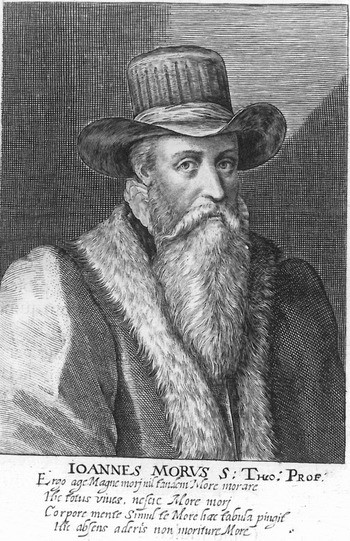
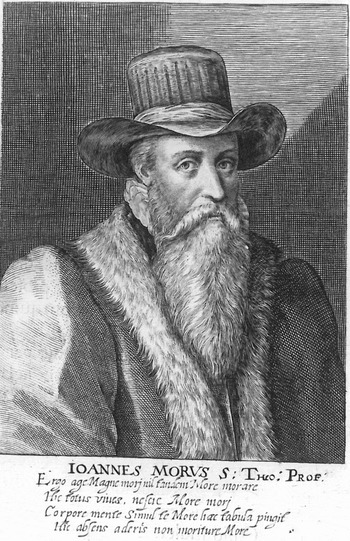
By the 1650s, Protestantism was edging towards a form of gerontocracy. To adhere to it was no longer an act of youthful rebellion against the time-honoured ways of one's forebears; it was an act of conformity with the status quo and its elder statesmen. It is revealing that the average age at which seventeenth-century archbishops of Canterbury were appointed was sixty.Footnote 71 Earle's character of the ‘grave [Anglican] divine’ has several decades of pastoral duty, serious study, and sensible judgement behind him: he ‘is a maine pillar of our Church, though not yet Deane nor Canon, and his life our Religions best Apologie: His death is his last Sermon, where in the Pulpit of his Bed hee instructs men to dye by his example’.Footnote 72 Many of the puritan ministers commemorated in Clarke's Lives exemplify the religious and moral virtues early modern culture prized in old age. In the winter of their life, they continue to demonstrate an indefatigable devotion to duty despite their disintegrating health and display a quasi-divine kind of wisdom. Thomas Cartwright, who died at sixty-eight, was greatly troubled with the stone and gout ‘yet would he not intermit his labours, but continued preaching when many times he could scarce creep up into the Pulpit’. John Carter ‘was as fit for service in Gods Harvest-field at fourscore, as he was at forty’ and a visitor to Suffolk ‘heard him discourse with such holy gravity, and a mixture of all kinde of learning, solidity, and wit, that he stood amazed at it, and said . . . I see you are like unto the Palm and Cedar Tree, you bring forth more fruit in your Age.’Footnote 73 These divines are venerable figures who physically as well as spiritually resemble the prophets and patriarchs of the Old Testament, whose longevity was seen as a sign of divine approbation: Abraham had lived until the age of 175 and the legendary Methuselah, son of Enoch and grandfather of Noah, 969. ‘Towards his latter end in his visage’ William Gouge was reputed to have resembled the ‘the Picture that is usually made for Moses’ and to be his ‘exact Effiges’ in spirit, and the old-fashioned clothing of John Carter and his wife persuaded some visitors that they had seen ‘Adam and Eve, or some of the old Patriarchs’. Thomas Gataker had gone prematurely grey, ‘which made him to be thought elder than he was, because he had long appeared ancient in the eyes of the world’.Footnote 74 Some actively cultivated these comparisons: John More, the so-called ‘Apostle of Norwich’ allegedly grew the longest beard of his generation so that ‘no act of his life might be unworthy of the gravity of his appearance’ (Figure 5).Footnote 75 Though images of God the father as a bearded old sage were technically anathema to the hottest sort of Protestants, more than a few preachers were depicted in a strikingly similar guise.
John More, ‘the Apostle of Norwich’, who grew the longest beard of his generation so that ‘no act of his life might be unworthy of the gravity of his appearance’: Henry Holland, Herɷologia Anglica ([Arnhem], [1620]), 209. Reproduced by kind permission of the Syndics of Cambridge University Library (shelfmark SSS. 40. 19).
Devout laypeople who lived to a ripe old age were also immortalised in funeral sermons and godly Lives. Martha Hasselborn, who expired in 1696, at ninety-five, was celebrated as ‘an aged servant of the Lord’ and ‘Old Disciple of Christ’. Like Sarah in the bible, who had died aged 127, she was ‘a long example of Piety, to the very last step of Humane Life’.Footnote 76 It was a commonplace that the liminal phase immediately before death was a time when human beings were vouchsafed an ability to prophesy. The valedictory exhortations they made to friends and family were listened to with respect and written down as pearls of wisdom for the benefit of their posterity. The belief that old age brought individuals into closer communion with God and that their debilitated bodies contained youthful souls also explains the credence given to reports of the appearance of ancient seers predicting the future and threatening divine vengeance; a ballad of 1657 recorded the ‘strange speeches’ uttered by the 155-year-old Margaret Hough from Cheshire foretelling the fall of the Cromwellian commonwealth, while a pamphlet from the late 1670s told the news of two Frenchmen who declared themselves ‘to be above a thousand years old a piece’ and preached repentance to the world.Footnote 77
IV
By 1700, Protestantism was the faith of those with the wrinkles, creases and grey hairs of experience. The mantle of youthful illegitimacy had passed to other quarters as early as the 1570s and 1580s, when young men and women in their hundreds left England for continental seminaries and convents in search of foreign adventures and in pursuit of a religious vocation. Others stayed at home and risked their lives assisting seminary priests and Jesuits whose very presence in the country after 1585 was an act of treason. As Susan Brigden remarked, now it was Catholicism that had ‘the appeal of exotic and forbidden fruit’. In the mid-Tudor period, youth were the great white hope of the evangelical Protestant movement; half a century later, they were heralded as the best prospect for achieving England's restoration to the Roman fold and for securing the survival of the Old Religion.Footnote 78
Once again, this was a phase marked by inversions of the age hierarchy – by examples of children who heroically disobeyed their Protestant parents and refused to attend Calvinist worship or entered into religious orders without their consent, children whose pious disobedience was celebrated in missionary memoirs and Annual Letters – children such as the Wisbech boy Thomas Dowlton who reasoned with officials in the port of Rye with adult-like defiance when he was arrested in 1595 and Alice Harrison, who was ‘corporally chastised’ after she converted to Catholicism, ‘and when this would not reclaim her, . . . turned adrift by her father’.Footnote 79 It was a time when the young had the audacity to reprehend and instruct their misguided elders in letters modelled on Robert Southwell's famous Epistle to his Father and when middle-aged men like the Benedictine Augustine Baker could lament the lukewarm piety of their elderly church papist parents, whom conformity had reduced to mere ‘neutrals in religion’.Footnote 80 And it was a juncture at which thirteen-year-old girls like Elizabeth Orton of Flintshire could acquire spiritual authority in the eyes of clergy and laity alike as prophets and seers: the visions she experienced in 1580 involved a vigorous endorsement of proscribed Catholic doctrine and a spirited denunciation of the ‘naughtie Religion now used’ as ‘moste abhominable in Gods sight’.Footnote 81 Recent work on the Responsa Scholarum of the English College at Rome promises to reveal more about how Catholic youths conceived of momentous life decisions that often involved an overturning of patriarchal norms and how far these patterns of religiously inspired juvenile delinquency declined over time as Catholicism became an increasingly endogamous and inward-looking community.Footnote 82
Finally, the same tendencies can be traced within the mid-seventeenth-century sects, notably the Society of Friends. Early Quakerism was also a movement that revelled in its carnivalesque reversal of the roles of youth and age. It was a movement of unruly antinomian rebellion against institutionalised religion by individuals who described themselves as the ‘children of light’, who frequently spoke of the process of receiving the Holy Spirit in terms of the displacing of the Old Man by the New, and who engaged in behaviour like ‘going naked for a sign’ and refusing to doff their hats as a mark of respect that conservative contemporaries regarded as immature and insubordinate in the extreme.Footnote 83 It was led by young men like James Parnell, who boldly pitted themselves against the authority of ordained clergymen and compared their encounters with the biblical combat between the little ‘stripling’ David and the ‘proud boaster’ Goliath. In a tract written to refute Thomas Drayton, ‘an ancient Country Minister’ from Huntingdon, Parnell quoted the words of Solomon that ‘a poor and wise Child, is better then an old foolish King’ and that ‘the honourable age is not that which is of long time, neither that which is measured by the Number of years; but wisdom is the gray hair: and an undefiled life is old Age’. He responded to Drayton's condescending comment that he had felt obliged to refute the young Quaker ‘lest the Boy should be highly conceited of himself, and falsely boast, That he understand more then the Ancients’ with the impertinent retort that even ‘a Babe may comprehend thee, and tell thee of they foly, and when thou thinkest of thy beard or age (as thou sayest) confusion of face may cover thee’.Footnote 84 Quakers too initially took pride in their status as agents of household division and intergenerational tension; Parnell wrote of how Christ had now come ‘to set at Variance, Father against Son, and Son against Father . . . and to turn the World upside down’ and he and others urged their followers to shun older relatives who tried to bribe or browbeat them into withdrawing from the sect as ‘Instruments of Satan’.Footnote 85 Eager young converts played up their bravery in defying parental opposition in their autobiographies: Thomas Ellwood recorded how he had received several ‘buffets’ about the head and ‘whirrets on the ear’ for refusing to remove his hat in his father's presence, and travelled on foot to meetings when the latter impounded his horse.Footnote 86 They replaced their own natural progenitors with surrogate ‘spiritual parents’ who were their elders in this fledgling faith.
Over time, like Protestantism, Quakerism lost the spontenaity and tamed the wild enthusiasm that had marked its early years. As it moved into middle age and donned the garb of sober respectability and self-discipline, it looked back on the exploits of the first Friends with growing embarrassment. George Foxe's own journal was carefully edited in the final years of the seventeenth century to eliminate some of his more outrageous reminiscences, that ‘it might not sound uncouth and unfashionable to nice ears’.Footnote 87 This was not just a strategy for surviving persecution and securing the support and sympathy of their orthodox neighbours; it may also be seen as a symptom of generational change. By the 1680s, the Society's heroes were no longer disorderly adolescents and youths but men and women like seventy-eight-year-old Loveday Hambly, the ‘Cornish Quaker saint’ who had maintained their faith over many decades in the face of severe trials and tribulations: the ‘last words and departure’ of this ‘ancient and honourable’ lady from St Austell who had endured several stints in gaol for her refusal to pay tithes, together with ‘farther Testimonies concerning her life and conversation’, were recorded by Friends who had gathered around her deathbed and printed for the edification of others scattered across the realm.Footnote 88
This paper has merely set down a series of signposts and opened up various avenues of enquiry that require further investigation. Its conclusions are accordingly cautious and provisional. It is necessary to reiterate the difficulties of accessing the experience of those at either end of the age spectrum and to underline the extent to which our knowledge of it is refracted through the prisms of literary convention and biblical dictum and distorted by the vagaries of selective memory and sentimental retrospection. The old and young people we have encountered are merely representations, projections of the ideals, hopes and anxieties of those who described them and end-products of carefully studied acts of religious self-fashioning. At one level, they are no more than optical illusions. Nevertheless, the ways in which ancient topoi about youth and age were invoked and manipulated during the long Reformation has disclosed much about how this movement was perceived by outsiders and understood by its adherents. The recycling of negative and positive images of these age groups, of the inherited polarities of innocence and wisdom, irresponsibility and senility, illuminates both its initial impact and its later ramifications. It shows that contemporaries expected religious revolution to be accompanied by an overturning of parental authority and by episodes of youthful rebellion. And it demonstrates that the steady entrenchment of Protestantism coincided with a reassertion of the patriarchal hierarchy and a renewed emphasis on deference to those advanced in physical years and spiritual understanding that may qualify suggestions about the progressive marginalisation of the elderly in early modern society.Footnote 89 As we have seen, these processes were fraught with fruitful paradox and further complicated by the ingrained instincts of a culture that honoured antiquity and distrusted the new. Claims that evangelicalism, post-Reformation Catholicism and Quakerism engendered generational conflict may be exaggerated, but we need to ask ourselves why our sources choose to frame events in these terms and what this might mean. While few contemporaries lived as long as Thomas Parr and witnessed as many phases of revolution, reversal and renewal as he, the evidence assembled in this exploratory essay suggests that the life-cycle is likely to prove a versatile and valuable tool for investigating religious change in sixteenth- and seventeenth-century England.