Introduction
The popularity of the local foods movement has increased the demand for New England-produced meat productsReference Berlin, Lockeretz and Bell1, as a range of concerns with the industrial model of meat production have been publicizedReference Worosz, Knight, Harris and Conner2–Reference Graham, Leibler, Price, Otte, Pfeiffer, Tiensin and Silbergeld4. Consumers are increasingly interested in higher-quality food, and include factors such as taste, nutritive quality, safety requirements, environmental protection, fair labor practices and animal welfare in their consumption decisionsReference Blisard, Lin, Cromartie and Ballenger5, Reference Conner, Campbell-Arvai and Hamm6. While the actual benefits of local foods on reducing greenhouse gas emissions and energy use are still a matter of debateReference Peters, Bills, Wilkins and Fick7, the increase in consumer demand for local is clear. For instance, the American Culinary Federation reported that locally sourced meat was the number two hot trend for 2010, just behind locally grown produceReference Martinez, Hand, Da Pra, Pollack, Ralston, Smith, Vogel, Clark, Lohr, Low and Newman8. New England consumers have been especially enthusiastic about local foods. Vermont has the highest level of per-capita direct-to-consumer sales in the nation, with the rest of the New England states (Connecticut, Maine, Massachusetts, New Hampshire and Rhode Island) all among the top 15 nationally9.
The region's producers have been eager to meet this increased demand, particularly as the changing structure of the dairy sector over the past 20 yearsReference MacDonald, O'Donoghue and McBride10 has led many farmers to explore alternative enterprises. Meat animal production is a common transitional enterprise, as New England dairy farms often have the land, equipment and infrastructure required to grow and store feed. Regional, small-scale livestock production is perceived to offer a range of benefits to farmers, including ecological sustainability, improved animal health, increased financial viability and improved quality of lifeReference Conner, Campbell-Arvai and Hamm6, Reference Renting, Mardsen and Banks11, Reference Ross12. Rhode Island, Massachusetts, New Hampshire, Connecticut and Vermont are the top five states in the USA for direct marketing share of total agricultural sales and Maine ranks number seven. Three percent of total agricultural sales in New England are marketed directly to consumers13.
New England also has a significant land base suitable for livestock production, with approximately 820,300 acres of pastureland and an additional 1,450,400 acres of cropland, some of which are used to grow animal feed crops14. Research by Peters et al. in New York State (which is nearly identical to New England in its ratio of cropland to pastureland14) showed that capacity to meet dietary requirements with local production increased with inclusion of livestock products in the diet, as these products utilize land limited to pasture and perennial foragesReference Peters, Wilkins and Fick15.
However, small-scale livestock producers across the country have expressed difficulty in accessing slaughter and processing services9. A recent survey of livestock producers in southern New England (Connecticut, Rhode Island and Massachusetts) found that 70% of respondents would expand their business if they had better access to slaughter facilitiesReference Bonelli, Herbert, Castrataro and Keilty16. A 2008 survey of Massachusetts livestock producers found that respondents were traveling an average of 52 miles each way to get to a slaughterhouse, for a total of 208 miles traveled when considering delivery and pick-up. Fifty-six percent of respondents said location was the most important quality in a slaughter facility, and 40% said that schedule availability during the fall season was most important. The majority of respondents sent very few (one to ten) animals to slaughter each year17.
The decline in the number of small-scale slaughter facilities reflects the changing structure of the US livestock industry over the past 25 yearsReference MacDonald and McBride18. Between 1980 and 2000, the industry became geographically concentrated in low-cost regions, with beef packing mostly in the Great Plains and pork processing primarily in the Southeast and Great PlainsReference Ollinger, Nguyen, Blayney, Chambers and Nelson19, Reference Drabenstott, Henry and Mitchell20. During this period, the number of slaughter plants nationwide dropped from over 600 to 170 for cattle and from over 500 to 180 for hogsReference Barkema, Drabenstott and Novack21. Economists conclude that small-scale slaughter facilities have been squeezed out of the market due to new mechanical, biological and chemical technologies that enable larger firms to achieve significant economies of scaleReference MacDonald and McBride18, Reference Barkema, Drabenstott and Novack21, Reference Kandel and Parrado22. A USDA study found that costs were approximately 30% lower in 1,000,000-head-per-year plants than in 300,000-head-per-year plantsReference MacDonald, Ollinger, Nelson and Handy23. These numbers dwarf the size of the industry in New England, where all 21 federally inspected plants combined slaughtered fewer than 15,000 cattle and 17,000 hogs in 200924.
Government food safety policy may also give larger firms a competitive advantage. The Hazard Analysis and Critical Control Points (HACCP) rule, promulgated in 1996, requires each plant to establish and implement its own sanitation standard operating plan (SSOP), conduct microbial testing, meet salmonella performance standards and identify critical control points in a detailed HACCP plan. The Government Accountability Office recognizes that the costs of HACCP plan implementation have disproportional effects on small plants, particularly diversified operations offering a range of processing services25. The slaughter industry in the six New England States is characterized by small-scale, family operated, diversified slaughter and processing facilities, the category of plant that has found it most difficult to keep up with increased costsReference Worosz, Knight, Harris and Conner26.
The concerns of small-scale livestock producers in accessing slaughter and processing services have been well publicized in recent media activity, and many stakeholders seem eager for government intervention to revitalize local agricultural infrastructureReference Zezima27, 28. However, there has been very little peer-reviewed research on New England's slaughter industry that could inform decisions on how best to expand or improve processing infrastructure. There has been some state-level research conducted in Vermont as part of the Farm-to-Plate strategic plan, which found that the state actually has underutilized slaughter (i.e. kill floor) capacity over the course of the year, and that the more significant pinch points are in cooling storage and processing (i.e., cut and wrap). A 2010 survey of Vermont slaughter facilities found that they operate at only 30–80% capacity during the off-season (February–August). The strategic plan concluded that, ‘much can be done to address inefficiencies in the current slaughter and meat processing system, without having to significantly increase the total number of inspected meat-processing facilities in the state’29.
Given the complexity of the small-scale livestock industry, more data are needed to understand the extent and causes of the presumed shortage of slaughter and processing capacity across the six New England states (Connecticut, Maine, Massachusetts, New Hampshire, Rhode Island and Vermont). In this study, we test the hypothesis that a shortage of large animal slaughter and processing infrastructure is a constraint to increased production of New England-produced meat by answering the following two questions:
(1) At what percent of maximum capacity are New England's large animal slaughter facilities operating?
(2) What percent of the total number of livestock produced in New England could be slaughtered in existing New England facilities?
We exclude poultry from this analysis because of the significant differences in regulatory regimes between the large animal and poultry slaughter industries. Furthermore, since exemptions exist for small-scale poultry producers that allow them to process their birds on farm, infrastructure constraints may have a more significant impact on the market availability of red meat (beef, pork, lamb, goat and veal) than poultry.
Methods
The analysis examined the total capacity of New England slaughter facilities, the utilization of available capacity and current livestock production. Each is addressed below.
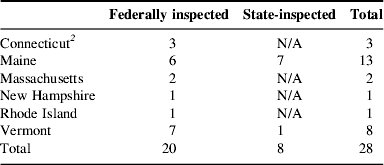
The region's large animal slaughter facility owners and managers were surveyed to determine current capacity and identify challenges facilities face in meeting producer demand. A telephone questionnaire was designed and administered in March and April 2010. Survey participants were identified using a database of contact information for all USDA- and state-inspected slaughter facilities obtained from the Food Safety and Inspection Service (FSIS)30. A total of 28 facilities were identified in New England, 20 of which are federally inspected and eight of which are state-inspected (Table 1). Maine and Vermont have state-run inspection programs whose requirements have been deemed ‘at least equal to’ those imposed by FSIS.
Inspected large animal slaughter facilities in New England, May 2010Footnote 1.
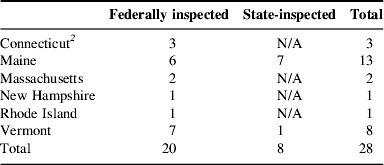
N/A=not applicable (states without state inspection programs).
1 FSIS30.
2 All three of Connecticut's facilities have a federal inspection for slaughter only. Processing for these facilities is ‘custom exempt’, meaning that meat processed is not for resale.
Survey questions were grouped into three areas: (i) general information about the facility (questions about location, inspection status and number of employees); (ii) current physical capacity for slaughter and processing and current usage patterns; and (iii) current challenges and constraints to meeting farmer demand. The overall response rate was 82%. Survey information was used to estimate the total capacity for slaughter and processing for all New England plants over the course of a year. It was also used to glean a qualitative understanding of the industry.
Usage of New England's slaughter facilities was estimated based on data from the USDA National Agricultural Statistics Service Livestock Slaughter Summary 24 and the state inspection programs in Maine and Vermont (personal communication with Henrietta Beaufait, State Veterinarian, Maine Department of Agriculture, and Katherine McNamara, Assistant State Veterinarian, Vermont Agency of Agriculture, March 2010). Numbers of cattle, calves, hogs, sheep and goats slaughtered in all federal and state-inspected facilities were tabulated for New England. The total volume of livestock slaughtered was then compared to the estimates of New England's total slaughter capacity derived from the phone survey. Comparable data on livestock processing are not available from USDA, and thus, the assessment of capacity utilization for processing assumes that all animals slaughtered are also processed within the region. The analysis was completed using 2009 data for all livestock classes except for calves because of data anomaly. Specifically, the livestock slaughter data include values from a large calf-only facility, which opened and closed in the 2009 calendar year. Data from 2008 were used in this case.
Calculating regional capacity to produce livestock is challenging. Unlike crops, livestock production is not clearly tied to a discrete land base. Rather, animals may be raised on feed grown outside the region. Moreover, herds of livestock can expand (or contract) over time, making it difficult to attribute production to a single year. As a result, USDA agricultural statistics do not measure ‘production’ of livestock, but rather tabulate livestock ‘marketings’, animals sold for the slaughter market and younger animals shipped across state lines for feeding and breeding purposes. Our estimates of New England's capacity for livestock ‘production’ are based largely on these ‘marketings’ data. Data on meat animal marketings for cattle, calves, hogs and sheep were obtained from the 2009 NASS Meat Animal Production Summary 31. Comparable data were not available for goats. Therefore, goat marketings were estimated based on inventory data from the 2007 Census of Agriculture 9. Livestock production data were compared with the capacity estimates to determine ability to meet a potential increase in regional demand for slaughter.
Results
Analysis of New England's livestock slaughter and processing capacity
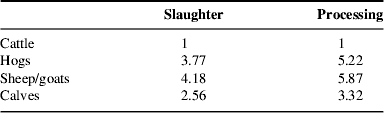
Survey respondents were asked to estimate the number of animals that could be slaughtered and processed per day in their facilities. Responses were different for each livestock class. Since a mix of livestock types are slaughtered and processed in New England, the daily capacity estimates were used to normalize the number of animals slaughtered from head of livestock to ‘animal units’. This allows a standardized estimate for a daily mix of livestock types. The average ratio of the capacity for cattle to the capacity for each other type of livestock for each plant was calculated to estimate equivalence. An analogous estimate was then made for processing. Values for the number of head per each animal unit are reported in Table 2. Because the relative capacity requirement for each livestock type is not consistent between slaughter and processing, animal unit equivalence is different for slaughter than it is for processing. The result is two different animal unit estimates, one for slaughter and one for processing.
Relative ratesFootnote 1 of slaughter and processing for large animals.
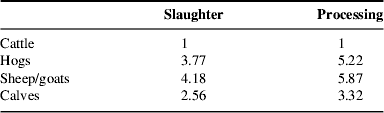
1 Cattle are used as the baseline. Values shown are the equivalent numbers of livestock which can be slaughtered or processed in the same period of time needed for one head of cattle.
Respondents’ slaughter and processing capacity in animal units is reported in Table 3. At maximum physical capacity, federally inspected facilities could slaughter an average of 15.9 animal units per day and process an average of 7 units per day. State-inspected facilities had significantly less capacity, averaging a maximum physical capacity of 9.9 animal units for slaughter and 4.6 animal units for processing.
Daily slaughter and processing capacity of survey respondents in animal unitsFootnote 1, by inspection type, 2009Footnote 2.

1 Cattle used as a proxy for animal units, as all species are normalized to cattle equivalence.
2 To estimate 2009 slaughter capacity, each plant's self-reported daily capacity was multiplied by 250, the number of business days per year. Capacity estimates for 2009 do not include one federally inspected facility that opened in April 2010, or a facility that was open for only a portion of 2009, and was dedicated solely to calves.
3 The five federal plants that declined to participate in the survey were assigned a capacity equal to the average capacity of the 15 plants for which data were collected.
Seasonal demand fluctuations also varied among facilities, although all respondents reported being the busiest from late summer to early winter. Thirty-two percent said that reservations must be made 6–12 months in advance in order to ensure a slot between October and December, and 23% said that 6–12 months were needed for service between July and September. However, 41% of facilities could schedule customers within a month or less at any time during the year. Eighty-two percent could take customers within a month or less between April and June, and 86% could do so between January and March.
Participants were asked about the difficulty of finding labor, complying with environmental regulations and complying with HACCP regulations (Fig. 1). Labor was the most challenging of the three, with 48% of respondents saying it was very difficult to find labor, or that finding labor was their biggest challenge, in comparison with 19% for HACCP and 14% for environmental regulations. Thirty-five percent of respondents said that HACCP regulations were easy to comply with.
Attitudes towards potential constraints, percent of respondents.

Only 18% said that they had more demand than they could meet at all times of the year. Nine percent said that they had insufficient demand during most times of the year. The majority (68%) reported adequate demand during most times of the year. When asked to identify their most significant challenge (as an open-ended question), the most common response (30% of respondents) was the seasonality of the industry, or maintaining business year round. Other common responses included the cost of insurance (13% of respondents) and obtaining credit (13% of respondents). A shortage of rendering companies, the cost of electricity, paperwork and dealing with inspectors were also identified as challenges (one respondent each).
Comparing existing capacity to current utilization and production
The number of animal units slaughtered by type of livestock in both federally and state-inspected plants is reported in Table 4. The number of sheep and lambs slaughtered was nearly three times the number of cattle, which includes both beef animals and dairy culls. There were also a significant number of goats slaughtered in New England. State inspected facilities account for a small proportion of total slaughter, particularly for goats and calves.
Head slaughtered at New England federalFootnote 1- and stateFootnote 2-inspected facilities, by class of livestock, 2009.

1 Source of Federal statistics: NASS (2010)24.
2 Source of State statistics: VT Agency of Agriculture, Food and Markets and Maine Department of Agriculture, Food and Rural Resources.
3 Federal data for calves are from 2008. Data for 2009 do not represent the historic trend, due to a calf slaughterhouse that was open for just a portion of the year.
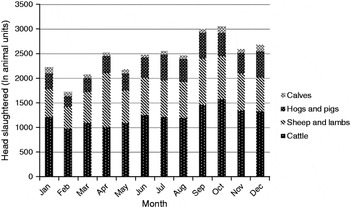
Data for all types of livestock except for goats were reported monthly, and we see significant seasonal differences, with approximately 1700 animal units slaughtered in January, and over 3000 animal units slaughtered in October (Fig. 2). There is a spike in the number of sheep and lambs slaughtered in April, likely due to spring lamb sales for Easter (which fell on April 12 in 2009).
Head slaughtered by month, 2009, by class of livestock, in animal units.

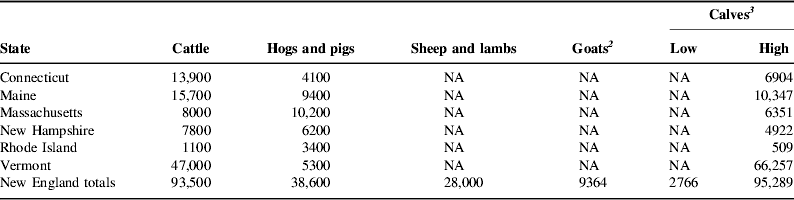
Meat production is reported in Table 5 in 2009 numbers of animals. Cattle and calves constitute the majority of livestock production in New England, with smaller production of hogs, sheep and goats. USDA does not track the number of calves sent directly to slaughter, as opposed to those sold as replacement heifers to dairy operations or feeder calves for beef production. To reflect this uncertainty in veal production, we report a high- and low-production estimate. The low estimate is the number of calves slaughtered in 2008, based on the assumption that the local veal market is already saturated, and production is not expected to increase significantly. The high estimate assumes that all beef calves are sold to feeding operations and that all dairy calves are sold for veal.
Estimated total meat production by class of livestock (head sold), 2009Footnote 1.
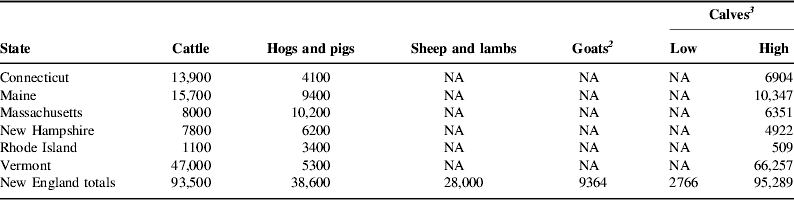
NA, no data available.
1 Unless otherwise noted, production is the total number of animals marketed in 2009; Source: NASS (2010)31.
2 USDA-NASS does not include goat marketings in its annual survey data at the state or regional level. However, both sales and inventory data were collected in the 2007 Census of Agriculture. We assumed that the ratio of sales to inventory was consistent between 2007 and 2009, and used that ratio to estimate goat sales from 2009 inventory data.
3 USDA-NASS estimates of the number of calves marketed include both beef and dairy calves. Considerable uncertainty exists around the fate of these marketed calves. The low estimate assumes that most are sold to dairy or cattle feeding operations outside New England. The high estimate assumes that all beef calves are sold to cattle feeding operations outside New England, whereas all dairy calves are sold for slaughter as veal. The number of dairy calves marketed for slaughter was estimated by multiplying the total number of calves marketed by the ratio of milk cows (that had calved) to total cows (that had calved).
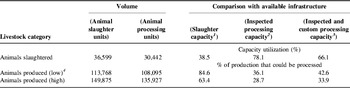
Slaughter and processing volumes are presented in Table 6, with comparisons to production by livestock category. Two estimates were calculated for processing capacity to account for three facilities that are inspected for slaughter only. A high estimate includes the three plants, demonstrating slaughter facilities’ total on-site processing capacity for processing, were they to become inspected for processing in the future. A low estimate excludes the plants, demonstrating the region's inspected processing capacity only. The total capacity in animal units (equivalent to one head of cattle) is 95,071 for slaughter, 46,083 for on-site inspected and custom processing, and 39,000 for on-site inspected processing only.
Slaughter and processing volumes and comparison with available infrastructure, by livestock category.

1 Slaughter capacity is estimated at 95,071 animal units. For this portion of the analysis, the newly opened plant was included for both slaughter and processing capacity.
2 On-site, inspected processing capacity is estimated at 39,000 animal units. This estimate excludes the three facilities with only custom processing.
3 Total on-site processing capacity (inspected and custom) is estimated at 46,083 animal units.
4 Considerable uncertainty exists around the fate of marketed calves. The low estimate assumes that most are sold to dairy or cattle feeding operations outside New England. The high estimate assumes that all beef calves are sold to cattle feeding operations, whereas all dairy calves are sold for slaughter as veal.
When we convert the total number of head slaughtered in 2009 to animal units, we find that only 36,599 animal units were slaughtered in 2009. Comparing total slaughter capacity with number of animal units slaughtered in the region, we find that only 38.5% of New England's physical slaughter capacity was utilized in 2009.
Assuming that all of these animals were also processed within the region, the equivalent of 30,442 animal units was processed in 2009. Data are only collected for the number of head slaughtered, not processed, and so processing capacity utilization rates are estimates only. If we assume that all of the animal units slaughtered in the region were processed under inspection at slaughter facilities, 78.1% of facilities’ processing capacity would have been utilized in 2009. However, this is likely a very high estimate, as it does not take into account animals that were processed at the three facilities without inspected processing or animals that were processed at facilities other than slaughterhouses (e.g., specialized cut-and-wrap operations, butcher shops or restaurants). If all on-site processing infrastructure is included in the capacity estimate (including custom processing), facilities operated at 66.1% of the total physical processing capacity.
Given the uncertainties in capacity and production noted above, Table 6 reports several estimates for the proportion of total livestock production that could be slaughtered and processed within the region. Assuming current levels of veal production (low production estimate), existing infrastructure could slaughter 84.6% of total production, and process 42.6% (assuming total physical on-site capacity) or 36.1% (assuming inspected on-site capacity only). Were all dairy calves to be slaughtered within the region (high production estimate), existing infrastructure could slaughter 63.4% and process 33.9% (physical capacity) or 28.7% (inspected capacity).
Discussion
Were the demand for locally produced red meat increased to such a degree that all of New England's livestock producers wanted their animals slaughtered and processed within the region, we find that current levels of production would outstrip existing slaughter facilities’ slaughter and processing capacity. However, the degree of the capacity shortage varies with different scenarios for processing capacity and calf production, and assumes significant increases in local marketing for some species. For instance, there are many more cattle, calves and hogs marketed than slaughtered in New England. No data are available on where the end markets are, but for cattle and hogs the majority are likely sold at auction in New York and Pennsylvania and slaughtered for the commodity market (telephone interview with J. Smith, University of Vermont Extension Dairy Specialist, July 7, 2010). Many of these producers are not interested adjusting their business models to market their meat locally. It is also interesting to note that for sheep the number slaughtered is actually higher than the number marketed, indicating that animals from outside of the region are being slaughtered in New England.
Perhaps surprisingly, we find that currently the region's slaughter capacity is actually substantially underutilized over the course of a year. One key reason for the low-capacity utilization rate seems to be the seasonality of the industry, with the highest levels of demand for slaughter and processing occurring in the late summer and fall. The demand for slaughter and processing are low during the winter and spring months for several reasons. First, spring is the traditional calving season for beef cattle in New England, and the average time from calf to market weight is 18 months, such that the animals are ready for slaughter in the fall.
There are also incentives to keep a small herd in the winter. For ruminants in grass-based production systems, the price of feeding increases significantly over the winter, when farmers must either buy feed or store what they have grown during the season (and absorb associated storage losses). For all livestock, feed efficiency decreases in the colder months as animals spend more calories on body temperature maintenanceReference Ritchie32. Finally, producers that engage in direct marketing often have more opportunities to sell their meat in the summer, when farmers, markets and farm stands are open. For these reasons, slaughter facilities often have less business in the spring. When asked to report their biggest challenge in an open-ended question, one-third of facilities discussed seasonality and a lack of year-round demand.
A shortage of labor compounds seasonal constraints on infrastructure availability by limiting facilities’ capacity to temporarily ramp up production during the busy season. Unlike farms, which can hire unskilled labor on a seasonal basis, large animal slaughter and processing facilities require a more skilled labor force. There are also fewer people willing to do the work. Because of the resources needed to develop human capital, and the small size of the labor pool, slaughter facilities avoid laying employees off during the slow season. One survey respondent reported that he was paying his crew to paint his house because he did not want to recruit and train new employees in the summer.
Plant location could be another important reason for underutilization, and spatial analysis could determine areas where producers are isolated from slaughter and processing infrastructure. More research is also needed on the appropriate transportation distance from farm to slaughter. Producers on small, diversified livestock operations may be more transportation-adverse than those on large, specialized operations due to higher opportunity costs of time spent on the road, and an inability to achieve economies of scale for transport. Existing research on transportation's economic costs, carbon costs, and effects on animal health should be analyzed to estimate maximum feasible distance. These factors must be balanced against slaughter facilities’ need to maintain sufficient throughput to achieve financial viability, given their slim profit margins.
Furthermore, there is a significant difference between the slaughterhouses’ capacity for slaughter versus processing. Traditionally, processing was not under the purview of the slaughterhouse, especially for beef. In the 1970s most facilities sold whole or half carcasses to retailers who would then cut them down into pieces, often to order for each customerReference MacDonald, Ollinger, Nelson and Handy23. With the rise of supermarkets and convenience foods, retailers preferred to receive cuts of meat, which could be more easily stored and marketed than an entire side of beef.
More research is also needed to determine the total capacity for processing in the region, including processing being done outside of slaughter facilities. Examining processing separately from slaughter could be an effective way to increase capacity. The inspection requirements are not as burdensome for processing as for slaughter, and the potential labor pool is larger. There is evidence of a renaissance of artisanal butchery, with a growing number of chefs buying whole animals and cutting them down in the restaurant to economically meet the demand for local meat. A 2009 New York Times article went so far as to deem butchers the rock stars of the food worldReference Severson33. Were a greater proportion of processing to occur outside of slaughterhouses, better transportation systems would be required such that producers would not be required to make an additional trip from slaughter to processing facility. For instance, the slaughterhouse could ship the carcass to the processor, increasing the total cost of processing, but perhaps increasing access to a greater range of value-added processing services.
Conclusion
A more complete understanding of the meat processing industry is needed in order to determine how to improve or expand capacity and promote growth in local red meat production. While we foresee a long-term need for additional infrastructure, any efforts to increase the number of slaughter facilities must address the competitive nature of the national meatpacking industry and a regulatory regime that may be disproportionally burdensome for small-scale plants. We find that the infrastructure exists in New England to slaughter most of the livestock produced in the region, but a relatively small percentage of this existing capacity is currently utilized. While further research may demonstrate that spatial separation between producers and slaughterhouses necessitates the construction of new plants closer to production loci, there may be ways to maximize utilization of current infrastructure in the short term. Increasing regional meat production requires more than simply increasing slaughter and processing infrastructure.
Acknowledgements
Any opinions expressed here are the views of the writer and do not necessarily reflect the views and opinions of the Vermont Agency of Agriculture, Food and Markets. This research was funded in part by the Vermont Agricultural Innovation Center. It was also supported by the Agriculture Food and Environment Program at Tufts University. Special thanks go to Dr Timothy Griffin, Program Director. Many thanks to the members of the Farm and Food Security Initiative's Meat Processing Working Group for their feedback and expertise: Katherine McNamara, Steve Crawford, Cris Coffin, Phil Prelli, Tim Storrow, Dick Burke, Carl Cushing, Jennifer Hashley, Sean Bowen, Scott Soares and Kim Foley.