In the early hours of February 6th, 2023, both Turkey and northwestern Syria were struck by a devastating earthquake measuring 7.8 on the Richter scale, which unleashed a barrage of over 60 subsequent aftershocks. This event stands as one of the most catastrophic disasters to befall the region since the year 1939,Reference Patwary, Ashraf and Swed1 and tragically resulted in more than 4500 lives lost and over 15 000 individuals injured in the initial hours.Reference Picheta, Tuysuz and Sariyuce2
This seismic disaster compounded the challenges faced by the conflict-affected northwestern Syrian health care sector, already grappling with the consequences of war, including economic turmoil, disease outbreaks, targeted assaults on health care infrastructure, and civilian displacement.Reference Hart, Rodríguez and Carvajal3–Reference Tabor, Almhawish and Aladhan7 The earthquakes further impacted a critical supply route “Bab Al-Hawa,” as humanitarian aid to the area had been funneled through only a single border crossing in Gaziantep, Turkey, a region also significantly affected by the earthquakes.Reference Cinar, Abbara and Yilmaz8
The closure of Bab Al-Hawa for 2 days, authorized as the sole border crossing for the United Nations (UN) by its Security Council without requiring the consent of the Al-Assad Regime, coupled with the subsequent delay in obtaining Al-Assad’s permission to open 2 other crossings, namely Bab Al-Salameh and Al-Rai, until February 13th, 2023, had the immediate consequence of postponing the much-needed delivery of assistance to the conflict-affected areas of Syria. This delay affected critical aid operations and the search and rescue response.Reference Heller9 Additionally, the conflict-affected Syrian area lacked the internal supply chain support available in Turkey, which received substantial internal and external assistance.Reference Masri and Al10
Conversely, Turkey found itself grappling with the aftermath of the earthquakes, resulting in hundreds of thousands without shelter, a surge in casualties, and an unprecedented strain on the local health care system. The damage inflicted on infrastructure further complicated economic instability and hindered access to health care services, thereby heightening the risk of disease outbreaks.Reference Ateş and Erdem5
This study aims to assess the disparities in the initial health care response between Turkey and the conflict-affected region in Syria following the seismic events of February 2023.
Methods
Study Design
This study employed a comprehensive search strategy to identify relevant studies and news articles detailing the initial health response in the affected areas in Turkey and northwestern Syria following the February 2023 earthquakes. This study utilized only existing open access data from the Humanitarian Data Exchange,11, 12 World Health Organization (WHO) flash appeal as of February 13, 2023,13 ReliefWeb and MAPACTION14, 15 databases.
Study population
The databases were downloaded and searched using the internal database search functions for populations exposed to the earthquakes in Syria and Turkey between the 6th and 13th of February 2023. In the Humanitarian Data Exchange database, the population exposure has been calculated using a 1 km resolution WorldPop raster (WorldPop Database 2020) and summarized per affected neighborhood in Syria and Turkey. Boundaries were defined by Gaul 2015 dataset. The population in each neighborhood was then divided per modified Mercalli scale impact intensity. The intensity levels were derived from the ShakeMap, a product of the USGS Earthquake Hazards Program, as of February 6th, 2023.12 Additionally, Humanitarian Data Exchange provided quick charts showing the temporal trend of death tolls and injuries until March 8th, 2023.12
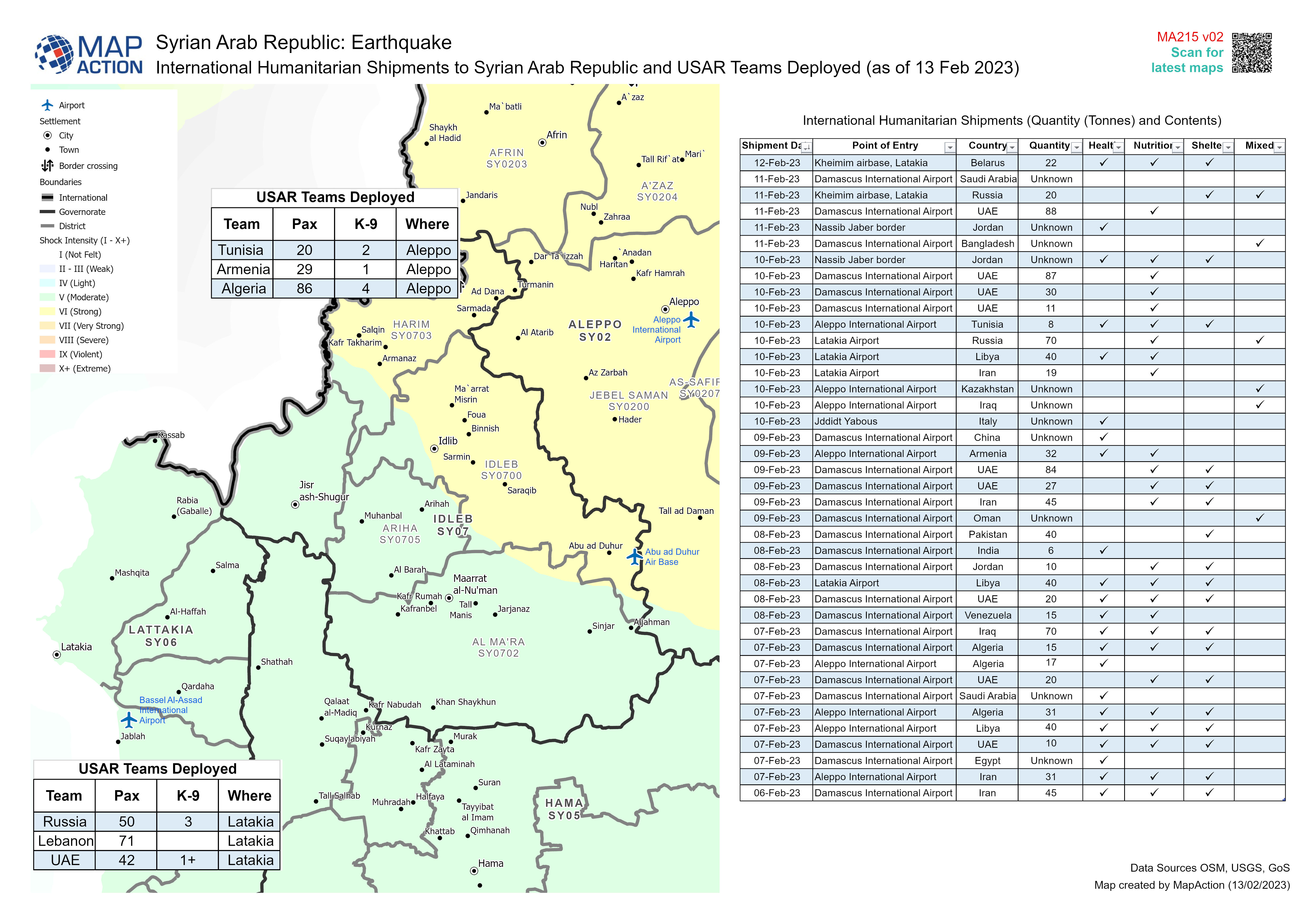
The number of Urban Search and Rescue teams, humanitarian aid personnel, and search and rescue dogs deployed to Syria and Turkey were summarized by MAPACTION14 and ReliefWeb15 databases, respectively.
Statistical analysis
Crude Mortality Rates (CMR) and injury rates were calculated for the affected regions in both countries. These rates were also estimated in areas where the earthquakes exhibited higher seismic intensities, according to the Modified Mercalli scale, within both nations.
Temporal trends in death tolls, injuries, and the extent of infrastructure damage (measured by the number of buildings destroyed) were compared between the 2 countries during the initial month following the catastrophic events.
Furthermore, utilizing the WHO flash appeal, which estimated the initial health care funding requirements as of February 13, 2023, we anticipated the funding needed per population, with particular emphasis on the ratio of funding required per 100 affected individuals, for each health care priority affected in the local health care systems of exposed areas in Turkey and Syria.
Disparities in deploying Urban Search and Rescue (USAR) teams, the ratios of humanitarian aid personnel within these teams per population, and the count of canine rescue units assisting in rescue operations were assessed and quantified in both countries.
Results
Our dataset found that 56 051 096 individuals were estimated to be part of the affected population in both countries during the earthquakes. Syria accounted for nearly 20% of this total population, comprising 12 068 376 individuals, while a significantly larger number of people were exposed to the seismic events in Turkish cities, totaling 43 982 720 individuals. The CMR was notably higher in the affected Turkish population, with 10.5 deaths per 10 000 people, as opposed to the 5.0 deaths per 10 000 people in Syria. However, it’s noteworthy that in areas with higher classes of the Modified Mercalli Intensity Scale (ranging from 6-8), the CMR was higher in Syria (9.2 deaths per 1000 people) compared to Turkey (7.7 deaths per 1000 people). The earthquakes resulted in a higher incidence of injuries per population in Turkey, with 24.6 injuries per 10 000 people, whereas in Syria, the rate was 9.9 injuries per 10 000 people. Even in areas with greater seismic intensity, the injury rate remained higher in Turkey, with 7.3 injuries per 1000 people, compared to 2.6 injuries per 1000 people in Syria (Table 1). In terms of infrastructure damage, the catastrophic earthquake in Turkey destroyed 6200 buildings, whereas in Syria, the number of destroyed buildings was 2000 (Figure 1).
Crude Mortality Rate (CMR), injury rate, and Humanitarian Aid Personnel per population in Syria and Turkey following 2023 earthquakes

Temporal trends of the death tolls, injuries, and buildings destroyed in the first month after the earthquake. This figure was taken as is from Humanitarian Data Exchange database.

Over the first month following the earthquakes, the temporal trends of the death tolls in Syria nearly plateaued after the third day, while in Turkey, it continued to rise before stabilizing around the seventeenth day. Specifically, on February 10, 2023, the death toll in Syria was 3.5 thousand compared to Turkey’s 20.2 thousand, increasing to 6 thousand and 46.1 thousand, respectively, on March 9, 2023. The same trends were observed for injury rates in affected areas of both countries, with Syria having 7.2 thousand injuries on February 10, 2023, increasing to 12 thousand on March 9, 2023, while Turkey saw an increase from 8.1 thousand to 108.3 thousand during the same period (Figure 1).
Both countries identified the provision of essential medicines and supplies and the replacement of specialized medical equipment and ambulances as primary funding priorities for supporting initial health care responses, with Syria allocating 35.97% and 18.22% of the total estimated funding to these priorities, respectively. Turkey allocated 30.50% and 15.75% of the total estimated financing to the same priorities. Remarkably, Syria allocated higher estimated required funds per population to almost all health care priorities, including essential medicines and supplies, replacement of damaged specialized medical equipment and ambulances, trauma care, emergency health care via Emergency Medical Teams and mobile clinics, mental health support, continuity of essential health services, surveillance, early warning, risk communication, and prevention of sexual abuse (100.6 vs. 35.2, 51.0 vs. 18.2, 12.2 vs. 8.2, 16.3 vs. 2.7, 41.7 vs. 8.0, 24.4 vs. 5.7, 7.1 vs. 5.9, 16.7 vs. 5.7, and 3.4 vs. 1.4, 1.7 vs. 0.11 USD per 100 affected persons, respectively, Figure 2). In contrast, Turkey had a more significant need for specific priorities, such as health facility assessment and rehabilitation, and support from implementing partners (18.8 vs. 4.6, 5.7 vs. 0 USD per 100 affected persons, in order, Figure 2).
WHO estimates of the initial funding requirements, as of February 13, 2023.

During the first week after the earthquakes, 219 USAR teams were deployed to Turkey, whereas only 6 teams were dispatched to Syria. This translated to a ratio of 23.7 humanitarian aid personnel per 100 000 affected population in Turkey, in contrast to a ratio of only 2.5 per 100 000 in Syria (Table 1). These rescue teams were supported by 364 canine rescue units in Turkey and 11 in Syria.
Discussion
This narrative review integrates studies and news articles assessing the initial health response in earthquake-exposed areas of Turkey and northwestern Syria. Employing data from multiple open-access datasets, disparities in the response were identified. The disaster impacted nearly 65 million individuals, predominantly in Turkish cities. While the Crude Mortality Rate (CMR) and injury rates were higher for the overall affected population in Turkey, Syria witnessed a surprising elevation in CMR, particularly in regions with higher Modified Mercalli intensity scale classes. Temporal trends indicated a plateau in deaths and injuries after the third day in Syria, contrasting with a continuous rise over 17 days in Turkey. According to the WHO, Syrian population fund needs surpassed those of Turkey across all initial health care priorities, except for health facility assessment, rehabilitation, and support from implementing partners. These findings underscore the necessity for nuanced and targeted response strategies based on the distinctive challenges faced by each region.
Humanitarian response amid conflict represents a significant challenge in an already difficult situation. Stoddard et al. point out that “humanitarian coverage is not only uneven within and across contexts but is also proportionally lower in areas under the control of militants in opposition to the government (2017)".Reference Stoddard, Jillani and Caccavale16 This was demonstrated in the immediate response to the catastrophic earthquakes in Syria and Turkey. While the response in Turkey was swift, the initial response in Syria was delayed substantially. This delay is critical, as Ciottone et al. state, “Demand for health care is greatest in the period immediately after [an] earthquake, with studies showing peaks between 12 hours and 3 days after the event”.17
The cause of the delay in response in Syria is multifaceted. There was difficulty obtaining the needed equipment for response, as Dr. Bilbert Burnham points out, “Heavy machinery was badly needed, but those resources were already occupied in Turkey”.Reference Winny18 This significantly limited search-and-rescue efforts. In addition, due to the conflict over the past several years, Syria lacks in-country infrastructure for humanitarian relief. Throughout the conflict, there have been times of substantial danger to humanitarian relief groups, leading the UN and other Non-Governmental Organizations (NGOs) to operate from cross-border hubs.Reference Stoddard, Jillani and Caccavale16 Another possible causative factor is that the significant UN hub for relief in northern Syria was located in Gaziantep, Turkey, and the Bab Al-Hawa border crossing was utilized to provide relief.Reference Heller9 Unfortunately, the earthquake significantly impacted this city. Many of the workers themselves had to be rescued due to the devastation from the earthquake, further delaying their ability to respond in Syria.Reference Winny18 Finally, the Bab Al-Hawa crossing became impassible until February 9, 2023.Reference Heller9 This delay worsened because the Al-Assad regime did not approve opening alternative routes until February 13, 2023.
In addition to the substantial delays in physical resources arriving, there were significant delays in funding the relief efforts in Syria. Winny pointed out that rather than directly supporting local, culturally sensitive, and regionally knowledgeable non-government organizations, the United Nations and other international NGOs sent financing for Syrian relief.Reference Winny18 This delayed funding from reaching the most hard-hit areas of the disaster and, thus, further slowed the relief response. Moreover, major challenges existed before the earthquake to international aid arriving in Syria due to safety and security concerns, particularly in light of the prior attacks on health care facilities and workers.19 Given security concerns that were also exacerbated by the lack of formal recognition of opposition-held areas by some members of the international community in the Northwest region, political difficulties are recognized as a contributing factor to the lack of deployment of search and recovery operations to Syria.Reference Fisher, Bela and Rexhepi20, Reference Ekzayez21
This delayed response likely resulted in a higher crude mortality rate and exacerbated health care needs in Syria relative to Turkey, particularly in areas where the earthquake was more intense, which can be contributed to a combination of longstanding conflict and resource scarcity. Syria’s protracted civil war has significantly damaged its health care infrastructure, diminishing the capacity for emergency response and medical services delivery.Reference Alhaffar and Janos22 Additionally, the economic repercussions of the conflict have led to limited investment in disaster preparedness and reduced public health resources.Reference Alhaffar and Janos22 Moreover, international sanctions have complicated the Syrian response by restricting the flow of essential goods, including medical supplies, further impairing health care provision in the aftermath of this earthquake.Reference Sen, Al-Faisal and AlSaleh23 The disparity is also evident in the 2 nations’ population management during disasters, where Turkey’s more stable situation allows for better execution of emergency protocols.24
Even though Turkey’s post-1999 earthquake reforms have strengthened its buildings and emergency systems, demonstrating a robust preparedness and mitigation strategy,24 the World Bank reported that Turkey had experienced higher physical damage from the earthquake ($34 billion vs. $5.1 billion in Syria). The World Bank further clarified that the areas hit in Turkey had high poverty rates and a substantial refugee population, amplifying the need for extensive expenditure to address the immediate needs of a large, affected population.25
The extensive damage to infrastructure, particularly in Gaziantep, Turkey, was exacerbated by the proximity of the most potent tremors to the Turkish side of the border. Gaziantep, located a mere 37.5 km from the epicenter, experienced more severe seismic forces than Aleppo, situated over 100 km away.Reference Ghosh26 This resulted in heightened structural damage to buildings, increasing the frequency of collapses and, subsequently, the rate of injuries and fatalities. The elevated casualty rates in Turkey may also be influenced by potential underreporting. Syria faces challenges in accurately collecting, compiling, and reporting public health data due to ongoing conflict, damaged infrastructure, and political instability.27 The hindrances in humanitarian aid access, stemming from deficiencies in relief infrastructure, further compound the challenges in reporting disaster casualties.Reference Heller9
Furthermore, the difficult weather conditions aggravated the situation in Syria and Turkey.Reference Mavrouli, Mavroulis and Lekkas28 Heavy snow blocked roads and railways, which complicated search and rescue and prevented aid from reaching affected areas on the same day.Reference Hussain, Kalaycıoğlu and Milliner29 These conditions made it difficult for those trapped in the rubble to survive, as they were exposed to low temperatures, among other things, but also for people without housing, many of whom chose to stay near their destroyed homes for fear of imminent looting.Reference Hussain, Kalaycıoğlu and Milliner29 According to the UN Office for the Coordination of Humanitarian Affairs (OCHA), winterization gear was needed for the earthquake-affected population.30
Disaster response stakeholders in conflict zones like Syria should learn from the 2023 earthquake health care lessons, emphasizing coordination, addressing gaps in responder knowledge, improving the international humanitarian emergency response system,Reference Yılmaz, Karakayali and Yilmaz31 prioritizing the implementation of the Civil-Military Coordination Model (CIMIC) at the highest organizational level,Reference Araghizadeh, Peyravi and Sharififar32 and utilizing frameworks like the humanitarian-development-peace nexus to improve the coordination and integration of humanitarian, development, and peacebuilding efforts in crisis-affected contexts, including proactive measures before disasters occur.33 The UN should focus on policies supporting mutual aid, meeting local needs, and trusting local USAR teams,Reference Heller9 while also implementing the essential recommendations provided by OCHA within the first 72 hours of disaster response. These recommendations include pre-disaster preparedness, deployment of skilled personnel, understanding the disaster context, assessing response capacity, mobilizing funding, and planning operations.34 In seismic-prone areas like Turkey, enhancing response involves decentralizing emergency management, educating citizens, implementing strong incident command structures, coordinating resources nationally and internationally, and establishing bilateral agreements for future support.Reference Fisher, Bela and Rexhepi20
The study’s strength arises from data granularity, evaluating population data at a 1 km level and considering Mercalli score impact for precise neighborhood comparisons, along with the assessment of objective metrics such as CMRs, reported injury per population, and aid per population, serving as indicators of health care disparities post-2023 earthquake in Syria and Turkey.
Limitations
Limitations of this study include the absence of quantitative analysis, challenges accessing conflict data, difficulty identifying contributing confounders, focus on the acute response phase, absence of data reflecting pre-earthquake infrastructure and housing status in Syria, and reliance on open-source databases with internal data quality validation. Notably, the data, sourced voluntarily from diverse channels, may exhibit skewness attributable to access or reporting.
Conclusions
Significant initial health care response disparities post-2023 earthquakes in Turkey and Syria emphasize the urgent need for improved disaster response in conflict zones. Key measures include enhanced coordination, addressing knowledge gaps, strengthening the international humanitarian response, and implementing the CIMIC model. Insights from seismic-prone areas stress decentralized emergency management, citizen education, robust incident command structures, and coordinated resources. Establishing bilateral agreements is pivotal for future support, creating a comprehensive framework for refining capabilities in complex geopolitical settings.
Author contribution
All authors contributed to the study conception and design. Material preparation and data collection were performed by Abeer Santarisi and Attila J. Hertelendy. Data Analysis was performed by Abeer Santarisi and Jeffrey Franc. The first draft of the manuscript was written by Abeer Santarisi, Dana Mathew, Jacob Noel, Timothy J. Curtis, Eric D. Miller, Chinonso Agubosim, Van Kenyon, and Ryan Boasi. It was revised by Gregory R. Ciottone, Fadi Issa, Christina Woodward, Amalia Voskanyan, and Eman AlShaikh. All authors commented on previous versions of the manuscript. All authors read and approved the final manuscript.