Implications
The present study demonstrated the existence of genetic variation in three key health traits in sheep, namely dagginess, lameness and mastitis. All health traits fulfil the three key criteria necessary for the inclusion in a breeding goal, namely (1) importance, (2) exhibit genetic variation and (3) measureable on a large scale or correlated with a measurable trait in order to achieve a high accuracy of selection. Therefore, breeding as part of an overall holistic strategy, could contribute to reducing the incidence of these three economically and socially important traits.
Introduction
Compromised health in sheep, while a welfare concern, can also reduce productivity, increase costs and labour requirement and thus reduce overall profitability (Bishop and Morris, Reference Bishop and Morris2007). Despite this, health traits (i.e. dagginess, lameness and mastitis) are not explicitly included in many sheep breeding goals, including those in Ireland. Breeding strategies for improved sheep health, however, could be useful as part of an overall holistic strategy to improve sheep health and welfare, flock profit, as well as consumer perception of modern-day sheep production systems.
Dagginess is the accumulation of faecal material around the hind quarter of an animal and has been shown to be both genetically and phenotypically (Greeff et al., Reference Greeff, Karlsson and Schlink2014) correlated with flystrike. Flystrike is the most common ectoparasite disease affecting sheep in the UK and Europe (Bisdorff and Wall, Reference Bisdorff and Wall2008), and is of considerable animal welfare concern (Pickering et al., Reference Pickering, Dodds, Blair, Hickson, Johnson and McEwan2011). Dagginess is also a trait of substantial economic importance in some countries, due to the financial penalties incurred at slaughter for lambs of excessive dagginess in for example, Ireland, Australia and New Zealand.
The cost of lameness has not been reported per se, but has been reported in the context of the cost of footrot (the cause of 90% of lameness; Kaler and Green, Reference Kaler and Green2008). The annual cost of footrot to the UK and New Zealand sheep industries have been estimated at £24 million and NZ$11 million, respectively (Nieuwhof and Bishop, Reference Nieuwhof and Bishop2005; Hickford et al., Reference Hickford, Davies, Zhou and Gudex2005). Within flock prevalence of footrot in sheep in the UK is on average 15%, with flock prevalence peaking at 59% (Nieuwhof and Bishop, Reference Nieuwhof and Bishop2005).
Subclinical mastitis prevalence rates have been reported to range between 12% and 29% in a Norwegian meat sheep population, whereas clinical mastitis has been reported to have an annual prevalence rate of 2% to 3% (Waage and Vatn, Reference Waage and Vatn2008). Conington et al. (Reference Conington, Cao, Stott and Bünger2008) stated that mastitis is the single largest reason for the premature culling in some UK flockbook sheep breeds.
Clear evidence exists for inter-animal variability in the prevalence of dagginess, lameness, and mastitis. For example, breed differences are known to exist among meat sheep in dagginess (Scobie et al., Reference Scobie, O’Connell, Morris and Hickey2008), lameness (Nieuwhof et al., Reference Nieuwhof, Conington, Bünger, Haresign and Bishop2008) and mastitis (Waage and Vatn, Reference Waage and Vatn2008). Although a paucity of estimates exist in the literature, and these estimates are generally confined to a small number of populations, heritable genetic variation is known to exist for dagginess (Scobie et al., Reference Scobie, O’Connell, Morris and Hickey2008; Pickering et al., Reference Pickering, Dodds, Blair, Hickson, Johnson and McEwan2011) and lameness (Nieuwhof et al., Reference Nieuwhof, Conington, Bünger, Haresign and Bishop2008; Raadsma et al., Reference Raadsma, Egerton, Wood, Kristo and Nicholas1994). Although heritability estimates for mastitis have not previously been reported in meat sheep, heritable genetic variation is known to exist for somatic cell count (SCC) in dairy sheep, an indicator trait of mastitis (Bergonier et al., Reference Bergonier, De Cremoux, Rupp, Lagriffol and Berthelot2003).
The objective of this study was to quantify the genetic variation present in three key health-related traits in the Irish sheep population (i.e. dagginess, lameness and mastitis) for the purpose of future inclusion of these traits in national sheep genetic evaluations. The risk factors (i.e. fixed effects within the model) associated with each of the traits were also determined.
Material and methods
Recorded health events and body-related data (n=49 493), between the years 2009 and 2015, inclusive were available from the Sheep Ireland national database (http://www.sheep.ie). Health data were available from 402 flocks, which were members of either the Sheep Ireland LambPlus initiative, the Central Progeny Test (CPT) initiative, or the Maternal Lamb Producer (MALP) initiative. Members of the LambPlus initiative (n=362) are performance recording flocks registered with official flockbooks. The aim of the LambPlus initiative is to generate performance information on flockbook registered animals for subsequent use in national genetic evaluations. CPT flocks (five commercial flocks) are used primarily to improve genetic connectedness among LambPlus flocks. MALP flocks (16 commercial crossbred flocks) were used to evaluate the robustness of national genetic evaluations across different meat sheep production systems as well as demonstrate potential improvement in performance from breeding. Breeds included in the study were Belclare, Charollais, Suffolk, Texel and Vendeen; crossbreds were also included.
Trait definition
Three health traits were measured by trained technicians during flock inspection throughout the study period; these measures included dag score (dagginess; for ewes and lambs), lameness (for ewes and lambs) and mastitis (for ewes only). Four body-related traits were also measured including live weight (LW), body condition score (BCS), muscle depth and fat depth; LW and BCS were measured in both ewes and lambs, whereas muscle depth and fat depth were only measured in a selection of lambs within the flock. All traits were measured in accordance with the protocols outlined by Sheep Ireland (http://www.sheep.ie).
Dag score was measured throughout the study period by trained technicians on a five-point scale similar to the Visual Scoring System (Australian Wool Innovation Limited (AWI), 2007) based on increasing severity of dirtiness or faecal soiling around the hind quarter of an animal; 1=no faecal soiling, 2=light faecal soiling surrounding the anus, 3=faecal soiling and dags surrounding the anus, 4=faecal soiling and dags extending further around the breech area, 5=faecal soiling and dags covering the breech area and extending down the hind legs towards the pasterns. Dag score was not recorded if the animal had been recently shorn or crutched.
Lameness was measured by trained technicians on a scale of 0 to 4 during the years 2009 to 2013 inclusive and on a scale of 1 to 4 during the years 2014 to 2015. Both scales measured the severity of lameness with the lowest score indicating no lameness and the highest score indicating severe lameness on both scales. For the purpose of the present study both lameness scales were amalgamated to a three-point scale (i.e. 0=not lame, 1=mildly lame, 2=moderately to severely lame). Lameness was determined visually by assessing each animal individually as it walked. The cause of lameness was not recorded and hooves (digits) were not inspected.
Mastitis was measured by trained technicians by examination and palpation of the udder. Mastitis was measured as a binary trait; 0 indicated the absence of the disease with no evidence of (historical) mastitis and 1 indicated evidence of mastitis having been (historically) present. Mastitis was only recorded during the year 2015; each flock was only inspected once throughout 2015. The date when mastitis occurred, or the cause of the infection (i.e. causative organism), was not available.
Live weight was recorded throughout the study period by trained technicians on the date of inspection using a pre-calibrated weighing scale. Body condition score was also measured by trained technicians by physically palpating each animal along the back and loin area. Body condition score was measured on a five-point scale where 1=emaciated and 5=obese (Jefferies, Reference Jefferies1961). Muscle and fat depth were both determined throughout the study period using ultrasound scanning over the third lumbar transverse process. Not every lamb within the flock was scanned on the day of inspection; in many cases a selection of animals within flock was measured for muscle depth and fat depth with the aim to scan lambs with a range of good to poor condition and at least fifteen lambs per sire.
Data editing
For the purpose of the present study, sheep were categorised as lambs (n=35 377) or ewes (n=10 623); rams, which were defined as male animals greater than 365 days old on the date of inspection (n=522), were not considered further. Lambs were defined as any animal <365 days of age on the date of inspection. Ewes (i.e. females ⩾365 days old) were divided into yearling ewes (i.e. females aged between 365 days and 730 days, but without a recorded lambing) or ewes with a recorded lambing date. Ewes that had been previously recorded as embryo transfer donors (n=533) were not considered further in this study.
Animal gender included males, females and unknown; the unknown sex was recorded only in lambs where no differentiation was made at the time of inspection on the gender of the lamb. Ewe parity was categorised as 1, 2, 3, 4 and ⩾5; ewes with a parity >9 were not included in the analysis. Ewes in their first parity were also further subdivided into ewes that lambed for the first time as ewe-lambs (i.e. ~1 year of age) and those that lambed for the first time as hoggets (i.e. ~2 years of age). Animals <50 days of age (n=39) or >4000 days of age (n=64) on the date of inspection were discarded. The median age of lambs and for each parity was calculated. Where animals had repeated records for a specific trait (~4% of animals), only the most recent measurement was retained for the analysis.
Ewes measured for mastitis after August (n=654) or >250 days post lambing (n=540) were excluded from the analysis to avoid any bias associated with the culling of ewes at weaning; the median date of lambing in the dataset was 23 January 2015. Live-weight records from ewes weighing <30 kg (n=10) or >120 kg (n=52) and lambs weighing <10 kg (n=16) or >100 kg (n=13) were excluded from the analysis.
The breed proportion of each animal was available from the Sheep Ireland database (http://www.sheep.ie). Breeds were categorised as Belclare, Charollais, Suffolk, Texel and Vendeen (i.e. the five major recording breeds in Ireland); all other breeds were collectively classified as ‘other’; the ‘other’ breed will not be discussed further. The coefficients of general heterosis and general recombination loss were calculated for each animal using the formulae
 $$1{\minus}\mathop{\sum}\nolimits_{i\,{\equals}\,1}^n {\,sire} _{i} \cdot dam_{i} $$
and
 $$1{\minus}\mathop{\sum}\nolimits_{i\, {\equals}\,1}^n {sire} _{i}^{2} {\plus}dam_{i}^{2} /2$$
, respectively, where sire
i
and dam
i
are the proportion of a specific breed (i) in the sire and dam, respectively.
Only animals with a recorded sire were retained; 41 333 animals remained. Individuals were assigned a contemporary group represented as a three-way interaction between flock, date of inspection and animal type (i.e. lamb, yearling ewe (i.e. females ⩾365 days, but <730 days old that have not yet had a recorded lambing) or ewe). Only data in contemporary groups with at least five records were retained. After edits, 39 315 observations from individuals in 790 contemporary groups across 264 flocks were available for inclusion in the analysis; these records originated from 19 297 crossbred animals and 20 018 flockbook registered animals.
Statistical analysis
Variance components were estimated using linear animal mixed models in ASReml (Gilmour et al., Reference Gilmour, Gogel, Cullis and Thompson2009). Direct heritability was estimated as the ratio of the additive genetic variation to the total phenotypic variation observed. One series of analyses considered each trait in lambs and ewes as separate traits, whereas another series of analyses considered both age groups combined, thereby assuming they represented the same trait (i.e. genetic correlation of unity). Phenotypic and genetic correlations between traits (i.e. dagginess, lameness, mastitis, LW, BCS, muscle depth and fat depth) were estimated using bivariate animal linear mixed models in ASReml (Gilmour et al., Reference Gilmour, Gogel, Cullis and Thompson2009). The basic fitted model was:
 $$\eqalignno{ Y\, {\equals}\, &CG{\plus} \mathop \sum\limits_{i{\equals}1}^5 \!Breed_{i} {\plus}Het{\plus}Rec{\plus}age\cr & {\plus}gender{\plus}parity{\plus}a{\plus}e$$
where Y is the dag score, lameness, mastitis or body-related data; CG the fixed effect of contemporary group; breed i the fixed effect of the breed proportion of a specific breed (i=Belclare, Suffolk, Vendeen, Charollais, Other; Texel (numerically largest breed) was assumed to represent the referent class); Het the fixed effect of coefficient of general heterosis; Rec the fixed effect of coefficient of general recombination loss; age the fixed effect of difference in age of the animal from the median of the respective parity or age group; gender the fixed effect of gender of the animal (only included for lamb traits); parity the fixed effect of parity of the animal on the date of inspection (only included for traits measured in ewes); a the random additive genetic effect; e the random residual effect. The coefficients of general heterosis and general recombination loss will not be discussed further. The significance of a random maternal genetic effect, a within-litter permanent environmental effect and across-litter, within ewe, permanent environmental effect was quantified for each trait assessed in lambs based on the likelihood ratio test between nested models. The maternal heritability was calculated as the ratio of the sum of the additive genetic variation and the additive maternal genetic variation to the total phenotypic variation. Direct-maternal genetic correlations were estimated in lamb traits as the ratio of the direct-maternal genetic covariance to the square root of the product of the additive genetic effect and the maternal genetic effect. Least square mean were used to estimate parity effects in ewes.
Results
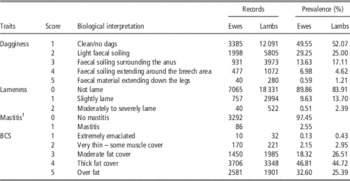
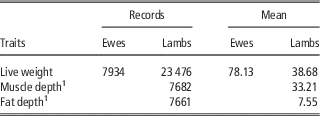
The number of observations within each score for dag score, lameness score, mastitis and BCS are in Table 1. The number of observations and mean values for LW, fat depth and muscle depth are in Table 2.
Number of records and prevalence of each score for dagginess, lameness, mastitis and body condition score (BCS)

1 Mastitis was measured only in ewes.
Number of records and mean live weight (kg), muscle depth (mm) and fat depth (mm)

1 Muscle depth and fat depth were measured only in lambs.
Dagginess
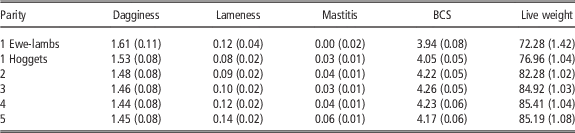
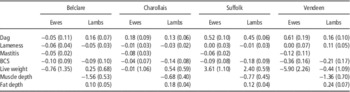
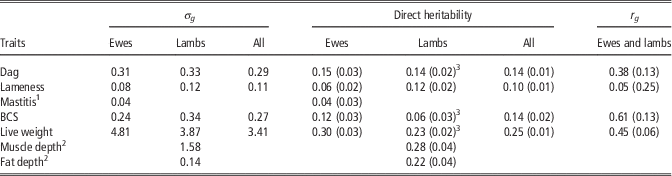
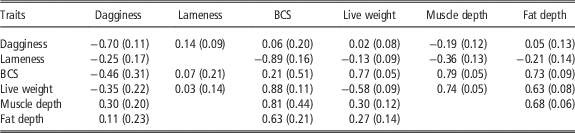
Only 49.55% of ewes were scored ‘clean’ (i.e. score 1), whereas 52.07% of lambs were scored ‘clean’. The prevalence of ‘dirty’ animals (i.e. ⩾score 3) was 21.2% and 22.94% for ewes and lambs, respectively. The average dag score where all data were combined was 1.78. Dagginess in ewes decreased with parity (Table 3); in parity one animals, ewe-lambs were more (P<0.05) daggy than hoggets. Vendeen lambs were more daggy than Texel lambs (P<0.05), whereas Suffolk lambs were more daggy than Belclare lambs (P<0.05; Table 4). Charollais, Suffolk and Vendeen ewes were all more daggy than Texel ewes (P<0.05), while Belclare and Charollais ewes were both less daggy than both Suffolk and Vendeen ewes (P<0.0.5) (Table 4). Dam litter explained 13% (SE=2%) of the variance in dagginess in lambs, whereas the maternal heritability for dagginess in lambs was 0.05 (0.02). The direct heritability of dag score was similar in both lambs (0.14; SE=0.02) and ewes (0.15; SE=0.03) (Table 5). The direct-maternal genetic correlation for dagginess in lambs was −0.70 (0.11) (Table 6). The genetic correlation between dagginess in ewes and lambs was 0.38 (0.13) (Table 5).
Least square means (standard error in parenthesis) for dagginess (score 1 to 5), lameness (score 0 to 2), mastitis (binary), body condition score (BCS; score 1 to 5) and live weight (kg), by parity number for Texel ewes

Regression coefficients (standard error in parenthesis) for flockbook-recorded ewes and lambs across different breeds for dagginess (score 1 to 5), lameness (score 0 to 2), mastitis (binary; measured in ewes only), body condition score (BCS; score 1 to 5), live weight (kg), muscle depth (mm; measured in lambs only) and fat depth (mm; measured in lambs only)

The Texel was used as the reference breed.
Genetic standard deviation (σ g ) and direct heritability (standard error in parentheses) for dag score (score 1 to 5), lameness (score 0 to 2), mastitis (binary), live weight (kg), body condition score (BCS: score 1 to 5), muscle depth (mm) and fat depth (mm); also included is the genetic correlation (r g ) between lamb and ewe traits for dag score, lameness, BCS and live weight

1 Mastitis was measured only in ewes.
2 Muscle depth and fat depth were measured only in lambs.
3 The maternal heritabilities for dag, BCS and live weight were 0.05(0.02), 0.12(0.04) and 0.08(0.02), respectively.
Direct genetic correlations (above diagonal; standard error in parentheses) and maternal genetic correlations (below diagonal) between traits; dagginess, lameness, body condition score (BCS), live weight, muscle depth and fat depth; in lambs only

The correlation between the direct and maternal genetic correlation is on the diagonal.
Lameness
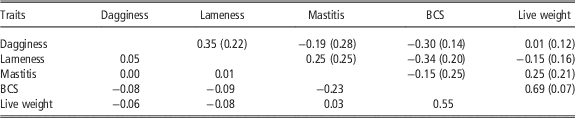
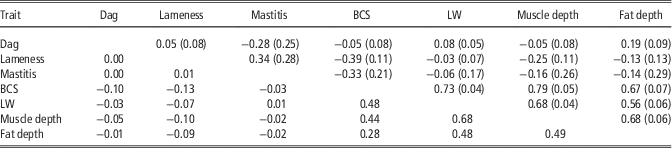
The prevalence of lameness (i.e. ⩾score 1) in ewes (median parity of parity 2) and lambs (median age of 117 days) was 10.14% and 16.09%, respectively. The overall prevalence of lameness where all data were combined was 14.5%. With the exception of ewe-lambs, the risk of lameness increased with parity (Table 3). Vendeen lambs had a greater risk of lameness than Belclare, Charollais, Suffolk and Texel lambs (P<0.05), whereas no breed differences existed for lameness in ewes (Table 4). No maternal effects were evident for lameness in lambs. The direct heritability for lameness (Table 5) ranged from 0.06 (0.02) (in ewes) to 0.12 (0.02) (in lambs). No genetic correlation (0.05; SE=0.25) existed between lameness in ewes and lambs (Table 5). No genetic correlation was evident between lameness and dagginess in lambs (Table 6), ewes (Table 7) or where all data were combined (Table 8).
Direct genetic correlations (above diagonal; standard error in parentheses) and phenotypic correlations (below diagonal) between the traits; dagginess, lameness, mastitis, body condition score (BCS), live weight; in ewes only

The standard error of all phenotypic correlations (r p ) was ⩽0.02.
Direct genetic correlations (r g ; above diagonal; standard error in parentheses) and phenotypic correlations (r p ; below diagonal) between traits; dag, lameness, mastitis (measured in ewes only), body condition score (BCS), live weight (LW), muscle depth (measured in lambs only) and fat depth (measured in lambs only); across all data

The standard error of all phenotypic correlations (r p ) was ⩽0.02.
Mastitis
Of the ewes that were assessed for mastitis (n=3378), 2.55% had evidence of (historical) mastitis (Table 1). Ewe-lambs had the least mastitis, whereas parity five ewes had the greatest incidence of mastitis (Table 3); no obvious trend in risk of mastitis was evident among the other parities. Belclare, Charollais and Suffolk ewes all had a lesser risk of mastitis compared with Texel ewes (P<0.05; Table 4); other breed differences were not evident. The direct heritability of mastitis was 0.04 (0.03). Genetic correlations between mastitis and other health traits were not different from zero (Table 7; Table 8).
Body-related traits
Mean LW of lambs and ewes was 38.68 kg and 78.13 kg, respectively. The prevalence of BCS 3 or 4 was 65.13% in ewes and 71.23% in lambs. Mean muscle depth and fat depth was 33.21 mm and 7.55 mm, respectively. Both BCS and LW increased with parity, but plateaued from parity three onwards (Table 3). Suffolk lambs were heavier than Belclare, Charollais, Texel and Vendeen lambs (P<0.05). Vendeen ewes were lighter than Charollais, Suffolk and Texel ewes (P<0.05), whereas Suffolk ewes were heavier than both Charollais and Belclare ewes (P<0.05; Table 4). Texel lambs had a greater muscle depth than Belclare lambs (P<0.05); no other breed differences were evident for muscle depth. Belclare, Charollais, Suffolk and Vendeen lambs all had a greater fat depth than Texel lambs.
Maternal effects were evident for both LW and BCS in lambs (Table 5). The within-litter and across-litter permanent environmental effect accounted for 12% and 8% of the phenotypic variance in live-weight, respectively. The within-litter and across-litter permanent environmental effect were not seen in BCS, whereas the maternal heritability for LW and BCS was 0.08 (0.02) and 0.12 (0.04), respectively. No maternal effects existed for either muscle depth or fat depth. Direct heritability estimates for LW were similar for both lambs (0.23) and ewes (0.30) although the direct heritability for BCS in lambs (0.06) was lower than in ewes (0.12). The direct heritability (in lambs only) for muscle depth and fat depth was 0.28 and 0.22, respectively (Table 5). The direct-maternal genetic correlations for lamb LW and BCS were −0.58 and 0.21, respectively, but the latter was associated with a large standard error (Table 6).
Moderate direct genetic correlations were evident for live-weight between lambs and ewes (0.45) and for BCS between lambs and ewes (0.61) (Table 5). Strong positive direct genetic correlations existed among the body-related traits (Tables 6 to 8).
Negative maternal genetic correlations were evident between lamb dagginess and lamb LW and between lamb dagginess and lamb BCS although the latter was associated with a large standard error (Table 6). A positive maternal genetic correlation was also evident between lamb LW and lamb BCS (Table 6). Direct genetic correlations between the body-related traits and the health traits differed by trait and by the age category under investigation (i.e. lambs only, ewes only or all data combined). In ewes, a negative direct genetic correlation (−0.30) existed between dagginess and BCS (Table 7). Negative direct genetic correlations exited between lameness and muscle depth and between lameness and BCS. Where all data were combined, a positive genetic correlation was evident between dagginess and fat depth (measured only in lambs; Table 8).
Discussion
For a trait to be included in a breeding objective, it must fulfil three criteria: (1) it must be either economically, socially or environmentally important, (2) it must exhibit genetic variation and (3) it should be (easily) measureable on a large population of animals, ideally at a low cost, or correlated with a heritable trait that can be (easily) measured on a large population of animals (i.e. achieving a high accuracy of selection). The health traits analysed in the present study are of economic importance, a large volume of data have now been accumulated and the results in the present study show ample genetic variation exists for these traits. Therefore these traits should be considered in national breeding goals.
Relative importance
Population statistics for dag score in sheep are often reported as a mean, rather than the prevalence of each individual dag score, as presented in the current study. The average dag score in the present study was 1.78 (when lamb and ewe data were combined) which was within the range (1.47 to 2.99) reported by Scholtz et al. (Reference Scholtz, Cloete, Cloete, Kruger, van Wyk and van der Linde2012) in a population of South African Merino sheep where animals were also assessed on the same scale as used in the present study. The overall prevalence of lameness in the present study (14.5%) is similar to the prevalence of 10.4% for farmer scored lameness documented by Kaler and Green (Reference Kaler and Green2008) in member flocks of the English Beef and Lamb Executive (EBLEX). The incidence of mastitis in the present study (2.55%) is within the range (2% to 3%) reported in a population of Norwegian meat sheep (Waage and Vatn, Reference Waage and Vatn2008) and was also similar, albeit slightly lower, than the incidence of clinical mastitis of 5% previously quoted in dairy ewes (Bergonier et al., Reference Bergonier, De Cremoux, Rupp, Lagriffol and Berthelot2003; Barillet et al., Reference Barillet, Rupp, Migon-Gasteau, Astruc and Jacquin2001). The common practice in Ireland is to cull ewes with mastitis at weaning (i.e. before August) therefore, the actual prevalence of mastitis could potentially be higher than reported here. The incidence of three health-related animal traits in the present study suggests that a breeding programme could be beneficial in reducing the respective incidence, should genetic variation exist.
Welfare implications (Fitzpatrick et al., Reference Fitzpatrick, Scott and Nolan2006) and social perception aside, all three health-related traits in the present study pose considerable economic costs to the producer. A total annual cost of £24 million was documented to be attributable to footrot in the UK sheep industry (Nieuwhof and Bishop, Reference Nieuwhof and Bishop2005) which was further partitioned into treatment and performance loss costs (£10 million) as well as prevention costs (£13.9 million). Dag score has been shown to be strongly correlated, both genetically and phenotypically, with flystrike (Pickering et al., Reference Pickering, Dodds, Blair, Hickson, Johnson and McEwan2012) suggesting dag score has an indirect economic cost in sheep (Pickering et al., Reference Pickering, Dodds, Blair, Hickson, Johnson and McEwan2012; Greeff et al., Reference Greeff, Karlsson and Schlink2014). While excessively daggy lambs are financially penalised at slaughter in Australia, New Zealand (Pickering et al., Reference Pickering, Dodds, Blair, Hickson, Johnson and McEwan2011) and Ireland, there are many other economic costs associated with daggy sheep such as the required labour associated with treatment and prevention measures such as crutching (Byrne et al., Reference Byrne, Ludemann, Amer and Young2012). Conington et al. (Reference Conington, Cao, Stott and Bünger2008) reported that mastitis is the largest individual reason for premature culling in UK flockbook-recorded sheep. Furthermore, a modelling study by Conington et al. (Reference Conington, Cao, Stott and Bünger2008) predicted that the losses incurred due to mastitis could vary by up to £17 per ewe, materialising into an annual loss due to mastitis of ~£2.7 million for UK Texel ewe population alone. Given the economic and social cost of these health traits in sheep, the first criterion justifying inclusion of a trait in a breeding goal (i.e. being important) has been clearly fulfilled.
Genetic variability
Previous studies on dagginess have been generally confined to lamb populations in Australia-Asia. The direct heritability estimates for dagginess in the present study (Table 5) were nonetheless within the range (0.07 to 0.32) reported by Pollot et al. (Reference Pollot, Karlsson, Eady and Greeff2004) in a population of Australian Merino lambs. However, the direct heritability estimates for dagginess in the present study were low compared with the range (0.30 to 0.63) reported in another Australian study on Merino lambs (Greeff et al., Reference Greeff, Karlsson and Schlink2014). Other studies in New Zealand also reported higher heritability estimates (0.31 to 0.41) for dagginess than in the present study (Pickering et al.,. Reference Pickering, Dodds, Blair, Hickson, Johnson and McEwan2011; Scobie et al., Reference Scobie, O’Connell, Morris and Hickey2008). The presence of a maternal genetic component for dagginess in lambs in the present study has not been reported elsewhere. The maternal heritability of dagginess in the present study indicated that the maternal ability of the dam had an effect on the dagginess of her progeny. Given the observed negative maternal genetic correlation between dagginess and weight in the present study (Table 6), it could be speculated that lower milk yield (i.e. higher maternal weight) was associated with greater dagginess.
Few heritability estimates exist for lameness per se in sheep although many studies have documented heritability estimates for footrot (Skerman et al., Reference Skerman, Johnson, Kane and Clarke1988; Raadsma et al., Reference Raadsma, Egerton, Wood, Kristo and Nicholas1994; Nieuwhof et al., Reference Nieuwhof, Conington, Bünger, Haresign and Bishop2008), the main cause of lameness (Kaler and Green, Reference Kaler and Green2008). Nieuwhof et al. (Reference Nieuwhof, Conington, Bünger, Haresign and Bishop2008) reported heritability estimates of 0.08 (0.02) and 0.11 (0.06) for footrot in a population of Scottish Blackface sheep and Mules, respectively; these estimates are similar to the range of direct heritability estimates reported in the present study for lameness (Table 5). Skerman et al. (Reference Skerman, Johnson, Kane and Clarke1988) analysed footrot as a binary trait in a population of Romney lambs at 8 to 9 months of age and reported a heritability for footrot (0.17), similar to that in the present study. A higher heritability (0.30) for footrot was, however, documented by Raadsma et al. (Reference Raadsma, Egerton, Wood, Kristo and Nicholas1994), but that study involved the deliberate infection of Merino sheep at 10 to 21 months of age.
To our knowledge, direct heritability estimates for mastitis have not been previously reported in ewes. Somatic cell count has however previously been cited as an indicator trait for mastitis in sheep (Bishop and Morris, Reference Bishop and Morris2007); although SCC heritability estimates exist in dairy sheep (Barillet et al., Reference Barillet, Rupp, Migon-Gasteau, Astruc and Jacquin2001; Bergonier et al., Reference Bergonier, De Cremoux, Rupp, Lagriffol and Berthelot2003), no such heritability estimates for SCC exist in non-dairy sheep. Barillet et al. (Reference Barillet, Rupp, Migon-Gasteau, Astruc and Jacquin2001) reported a heritability of 0.15 for SCC in French Lacaune dairy sheep, whereas Serrano et al. (Reference Serrano, Perez-Guzman, Montoro and Jurado2003) reported a heritability range of 0.04 to 0.24 in Manchega (dairy) ewes for SCC across different parities. Nonetheless, the direct heritability of mastitis in the present study (0.04) is similar to the heritability reported (0.05) in dairy cattle (Berry et al., Reference Berry, Bermingham, Good and More2011). The existence of genetic variation suggests that breeding could indeed be a useful (complementary) strategy to reduce the incidences of these three diseases.
Achieving high accuracy of selection
The final criteria necessary to be fulfilled for a trait to be included in a breeding goal is to be able to achieve some (ideally high) accuracy of selection either by direct selection on the trait itself or by indirect selection via correlated traits. Because both dagginess and lameness can be relatively easily measured on a large population of animals, direct selection for these traits is feasible. In an effort to improve the level of recording of lameness, the heritability of lameness, recoded as a binary trait (0=not lame; 1=any sign of lameness), was also quantified in the present study; the resulting heritability was 0.08 suggesting little loss in accuracy by reducing lameness from a three-point scale (heritability of 0.10) to a binary scale. However, the heritability of dagginess recoded as a binary trait (score 1 and 2=‘clean’; score 3, 4 and 5=‘dirty’) in the present study was 0.09, less than the 0.14 estimated when treated as a five-point scale. Despite the ease of measurement of both dagginess and lameness, the accuracy of selection for both traits could, nonetheless, be improved through indirect selection on BCS as moderate genetic correlations were evident in the present study between lameness and BCS in lambs (−0.89) and between dagginess and BCS in ewes (−0.30). Of course the maximum accuracy achievable for the goal trait (i.e. lameness or dagginess) cannot surpass the genetic correlation with the index trait. Using selection index theory, direct measurement of dagginess on 100 progeny would generate an accuracy of selection of 0.89 for the sire; the same accuracy of selection could be achieved with just 70 measures for dagginess if BCS information was also available on those 70 progeny. Although measuring BCS would obviously be useful in selection for dagginess and lameness, BCS may itself have an economic value; furthermore having measurements for BCS could also be beneficial in day-to-day flock management.
Although mastitis was not genetically correlated with any other trait investigated in the present study, other studies have documented traits phenotypically associated with mastitis (Waage and Vatn, Reference Waage and Vatn2008) including number of lambs born, dystocia, age and time of lambing. Mastitis has been shown to be phenotypically associated with BCS in dairy cattle (Berry et al., Reference Berry, Lee, Macdonald, Stafford, Matthews and Roche2007). The relationship between mastitis and BCS in the present study may have been more evident if a larger range of BCS (at specific time periods) was evident in the ewes involved. As mastitis was not correlated with any other trait in the present study, mastitis must be measured directly on a large population of ewes pending the discovery of a heritable trait genetically correlated with mastitis and measureable on a large scale. The California Mastitis Test (CMT) (Barillet et al., Reference Barillet, Rupp, Migon-Gasteau, Astruc and Jacquin2001; Bergonier et al., Reference Bergonier, De Cremoux, Rupp, Lagriffol and Berthelot2003) has previously been used to identify mastitis in (dairy) sheep although this may not be the most feasible method especially for non-dairy ewes. Infrared thermography has previously been documented to successfully diagnose mastitis in both ewes (Martins et al., Reference Martins, do Prado Paim, de Abreu Cardoso, Stéfano Lima Dallago, de Melo, Louvandini and McManus2012) and cows (Polat et al., Reference Polat, Colak, Cengiz, Yanmaz, Oral, Bastan, Kaya and Hayirli2010) and has recently been reported to successfully identify foot lesions in sheep that may cause lameness (Talukder et al., Reference Talukder, Gabai and Celi2015). Therefore IR thermography may be useful to simultaneously measure both mastitis and lameness.
In conclusion, each of the three health-related traits (dagginess, lameness and mastitis) measured in the present study fulfil the three criteria required for a trait to be considered for inclusion in a breeding goal; each trait is both economically and socially important, displayed exploitable genetic variance, and each trait is measureable on a large number of animals. Therefore lameness, dagginess and mastitis should be considered for breeding goals although the breeding programme should be designed to ensure a high level of phenotypic recording to achieve a high accuracy of selection for the relatively lowly heritable health traits, especially mastitis.
Acknowledgements
This research was part of the OviGen project (14/S/849) which is funded by the Department of Agriculture, Food and Marine, Ireland.