Paediatric cardiac catheterisation is an important tool for evaluating and treating congenital cardiac diseases in infants and children, but it carries risks and complications that may have long-term consequences. Femoral arterial thrombosis is an important complication to recognise, as it can lead to loss of an extremity if left untreated. Pulse loss – which serves as the first clinical sign of femoral arterial thrombosis – occurs in 0.3–9.6% of paediatric cardiac catheterisation cases, with infants at greatest risk.Reference Bergersen, Gauvreau, Jenkins and Lock 1 – Reference Vitiello, McCrindle, Nykanen, Freedom and Benson 8 When routine radiographic screening is used, the prevalence of arterial thrombosis is even higher.Reference Kocis, Snider, Vermilion and Beekman 9 , Reference Kulkarni and Naidu 10
Our current understanding of femoral arterial thrombosis after cardiac catheterisation derives from single- or multi-centre data. These studies have identified that certain patient- and procedure-specific factors are associated with an increased risk of arterial thrombosis after cardiac catheterisation.Reference Bulbul, Galal and Mahmoud 3 , Reference Saxena, Gupta, Kumar, Kothari and Wasir 6 , Reference Kulkarni and Naidu 10 In a prospective study of 60 patients, Bulbul et alReference Bulbul, Galal and Mahmoud 3 found that patients with weight <4 kg or age <1 year were at higher risk for arterial thrombosis. Saxena et alReference Saxena, Gupta, Kumar, Kothari and Wasir 6 identified several procedural variables associated with a higher rate of arterial thrombosis, such as multiple attempts at arterial access, absence of back bleed at the end of the procedure, and increased duration of catheterisation.
Although these previous single-centre studies have provided important information to our understanding of femoral arterial thrombosis, it is unclear whether these data are generalisable to other institutions across the United States of America. To date, there has been no nationally representative study examining the prevalence of thrombotic complications after paediatric cardiac catheterisation. Moreover, no study has evaluated the economic significance of femoral arterial thrombosis after paediatric cardiac catheterisation. Therefore, we utilised the Kids’ Inpatient Database to examine the clinical and economic impact of femoral arterial thrombosis after cardiac catheterisation in children.
Materials and methods
Data source
Developed as part of the Healthcare Cost and Utilization Project, the Kids’ Inpatient Database is a sample of paediatric discharges – defined as all discharges in which the patient was aged 20 years or less at admission – from community, non-rehabilitation hospitals in states that participate in Healthcare Cost and Utilization Project. It is intended to survey children’s use of hospital services in the US. Systematic random sampling is used to select 10% of uncomplicated in-hospital births and 80% of other paediatric cases from each hospital. Data from the Kids’ Inpatient Database have been released every 3 years since 1997, and each release contains 2–3 million paediatric inpatient records from 2500 to 4100 hospitals. 11
Study design
This study was considered exempt from review by the Duke University Institutional Review Board. All hospitalisations involving patients⩽18 years of age who underwent cardiac catheterisation (Ninth Revision of the International Classification of Diseases [ICD-9] procedure codes 37.21, 37.22, 37.23) were identified in the Kids’ Inpatient Database 2003, 2006, and 2009 data sets. Hospitalisations that involved cardiopulmonary bypass, right heart catheterisation only, or placement of a femoral arterial line were excluded. The primary end point was femoral arterial thrombosis, defined as a reported diagnosis of arterial thrombosis or embolus of the lower extremity (ICD-9 code 444.22) during the same hospital stay as the cardiac catheterisation. Important covariates included cyanotic CHD (ICD-9 codes 745.0, 745.10, 745.11, 745.19, 745.2, 745.3, 745.55, 746.1, 746.7, 747.41), single-ventricle defects (ICD-9 codes 745.3, 746.7, 746.1), and cardiopulmonary bypass (ICD-9 code 39.61). To calculate hospital costs, the hospital cost-to-charge ratio was used, based on the year that the data originated from. Cost data were adjusted for inflation to 2015 US dollars using the consumer price index inflation calculator provided by the US Bureau of Labor Statistics. This calculator uses government data, which is updated monthly, to calculate the cumulative inflation rate. 12
Statistical analysis
Standard summary statistics were used to describe patient characteristics and outcomes, as well as to screen for outliers. The prevalence of cardiac catheterisation and arterial thrombosis was visualised by simple bar plots. Patients were then stratified into two groups by age: <1 year of age and 1–18 years of age. Baseline characteristics and unadjusted outcomes were compared using the Kruskal–Wallis test for continuous variables and Pearson’s χ2 test for categorical variables. Within each age cohort, patients were propensity matched using a 2:1 nearest-neighbour algorithm on the following covariates: sex, hospital type, hospital region, north-east, mid-west, south, or west, procedure type, single-ventricle physiology, presence of congestive heart failure, and coagulopathy. A p value<0.05 was considered statistically significant. All statistical analyses were performed using R version 3.1.2 (R Foundation for Statistical Computing, Vienna, Austria).
Results
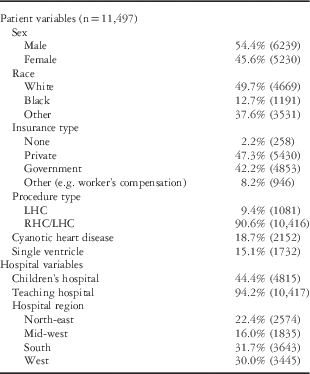
A total of 11,497 inpatient paediatric cardiac catheterisations met study criteria in the 2003–2009 Kids’ Inpatient Database (Table 1). Most patients were male (54.4%), had private insurance (47.3%), and received concurrent right and left heart catheterisations (90.6%). In total, 18.7% of cardiac catheterisations were associated with cyanotic heart disease, and 15.1% cases were associated with single-ventricle pathology. Most catheterisations were performed in a teaching hospital (94.2%).
Patient and hospital variables of children (n=11,497) who underwent cardiac catheterisation in the 2003–2009 Kids’ Inpatient Database.

LHC=left heart catheterisation; RHC=right heart catheterisation
Categorical variables are represented as percentages (number), and continuous variables are represented as medians (interquartile range)
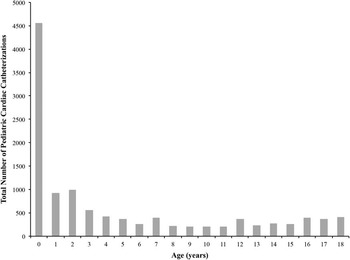
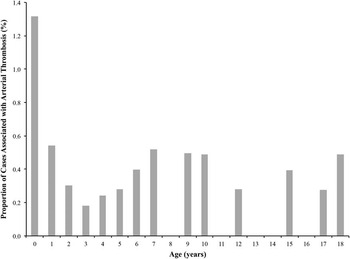
In all, 4558 catheterisations (39.6%) were performed in children <1 year of age, constituting the greatest number of paediatric cardiac catheterisations performed in a single age group (Fig 1). This age group also experienced the highest rate of reported femoral arterial thrombosis (1.3%) in conjunction with cardiac catheterisation (Fig 2). On the basis of these observations, patients were stratified by age into two groups: <1 year of age versus 1–18 years of age.
Total number of pediatric cardiac catheterizations reported in the Kids’ Inpatient Database between 2003 and 2009, by year of age.

Proportion of cardiac catheterization cases associated with femoral arterial thrombosis in the Kids’ Inpatient Database, by year of age.

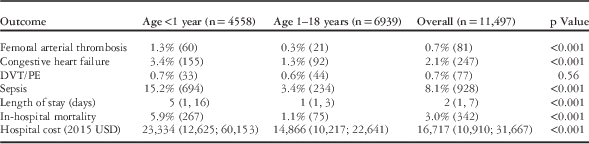
Compared with the 1–18-year-old group, hospitalised patients<1 year of age who underwent cardiac catheterisation had higher rates of femoral arterial thrombosis (1.3 versus 0.3%), congestive heart failure (3.4 versus 1.3%), sepsis (15.2 versus 3.4%), and in-hospital mortality (5.9 versus 1.1%) (all p<0.001, Table 2). They also had significantly longer hospital stays, with a median of 5 days compared with 1 day in the 1–18-year-old group (p<0.001). Given higher rates of clinical co-morbidities and longer hospital stays, the median hospital cost for patients <1 year of age was correspondingly higher: $23,334 versus $14,866 in the older cohort (p<0.001).
Complications and hospitalisation variables of paediatric inpatients who underwent cardiac catheterisation, stratified into two age groups.

DVT=deep venous thrombosis; PE=pulmonary embolism; USD=US dollars
Categorical variables are represented as percentages (number), and continuous variables are represented as medians (interquartile range)
Among matched children<1 year of age, presence of femoral arterial thrombosis was not associated with a significant difference in mortality, length of stay, or hospital cost (Table 3). Mortality was similar between the two groups (5.4 versus 1.8%, p=0.28), as was total hospital cost ($27,135 versus $28,311, p=0.61). Infants with femoral arterial thrombosis had longer hospital stays, but this finding was not statistically significant (8 versus 5 days, p=0.11).
Hospital-related outcomes for matched patients<1 year of age who underwent cardiac catheterisation.

In the matched 1–18-year-old group, those who experienced femoral arterial thrombosis had similar mortality (5.3 versus 0.0%, p=0.15) and similar length of stay (1 versus 1 day, p=0.39), compared with those who did not (Table 4). Total hospital cost, however, was greater in those who experienced thrombosis ($21,207 versus $13,954, p=0.02).
Hospital-related outcomes for matched patients aged 1–18 years who underwent cardiac catheterisation.

Discussion
In our study, the overall rate of femoral arterial thrombosis in children⩽18 years of age undergoing cardiac catheterisation was 0.7%, with the highest rate of thrombosis in children <1 year of age. This value is consistent with previous single- and multi-centre studies, which have reported pulse loss occurring in 0.3–9.6% of cases.Reference Bergersen, Gauvreau, Jenkins and Lock 1 – Reference Vitiello, McCrindle, Nykanen, Freedom and Benson 8 With routine radiographic screening, the prevalence of arterial thrombosis has been noted to be higher.Reference Kocis, Snider, Vermilion and Beekman 9 , Reference Kulkarni and Naidu 10 , Reference Glatz, Keashen and Chang 13
Although our study did not demonstrate significant differences in mortality or length of stay, femoral arterial thrombosis after cardiac catheterisation in children has been shown in previous studies to carry significant morbidity. Acute femoral arterial thrombosis can lead to limb loss and requires use of high-risk therapies such as anticoagulation, fibrinolytic therapy, or thrombectomy.Reference Ino, Benson, Freedom, Barker, Aipursky and Rowe 14 – Reference Punzalan, Hillery, Montgomery, Scott and Gill 18 On the other hand, chronic arterial ischaemia related to cardiac catheterisation is a known complication but has been studied in a limited manner.Reference Lee, Reddy and Rao 19 , Reference Taylor, Troutman, Feliciano, Menashe, Sunderland and Porter 20 In one retrospective study of 58 children who underwent cardiac catheterisations 5–14 years earlier, Taylor et alReference Taylor, Troutman, Feliciano, Menashe, Sunderland and Porter 20 found that 33% had arterial occlusion, whereas 8% had leg growth retardation. Children with a history of cardiac catheterisation who present with claudication or leg length discrepancy typically require treatment with bypass grafting procedures.Reference Lin, Dodson and Bush 17
Given these acute and chronic consequences of femoral arterial thrombosis, researchers have understandably sought measures to better prevent and manage thrombosis after cardiac catheterisation – for example, systemic heparin is given routinely during cardiac catheterisation as it has been shown to reduce the incidence of arterial thrombosis.Reference Girod, Hurwitz and Caldwell 21 In addition to systemic heparin, studies have found that 16–32% of infants who undergo routine ultrasound screening after cardiac catheterisation have a thrombosed femoral artery on imaging, which is not necessarily clinically evident.Reference Kocis, Snider, Vermilion and Beekman 9 , Reference Kulkarni and Naidu 10 Recently, Glatz et al have described their institutional algorithm for active diagnosis and management of acute arterial thrombus after paediatric cardiac catheterisation. Since implementation of the algorithm, pulse loss has occurred in 93 out of 1672 (5.4%) cardiac catheterisation cases. Thrombus resolution was achieved in 89% of patients who completed treatment with 12 weeks of enoxaparin.Reference Glatz, Keashen and Chang 13 In comparison with these studies that actively screened for thrombus, the prevalence of arterial thrombosis in our cohort was much lower. This may be related to possible under-reporting of thrombotic complications as some institutions may only have coded the complication if an intervention, such as thrombolytics or surgical thrombectomy, was performed.
Although previous studies have demonstrated significant morbidity related to femoral arterial thrombosis after cardiac catheterisation, our analysis provided limited evaluation of patient morbidity related to cardiac catheterisation because of insufficient data within Kids’ Inpatient Database – for example, Kids’ Inpatient Database did not provide specific documentation on the use of anticoagulation or thrombolytics to treat femoral arterial thrombosis. Moreover, with the reporting system utilised by the Kids’ Inpatient Database, we could not verify that arterial thrombosis was a direct consequence of cardiac catheterisation; however, we did exclude other procedures that can be associated with femoral arterial thrombosis, such as cardiopulmonary bypass and placement of a femoral arterial line, so that the thrombotic events captured in our cohort would be more likely related to cardiac catheterisation. Despite these limitations, our study still provides a unique, national-level perspective on the prevalence of femoral arterial thrombosis in children who undergo cardiac catheterisation, highlighting the need for additional monitoring in children <1 year of age.
Given the higher prevalence of arterial thrombosis in children <1 year of age, routine ultrasound screening after cardiac catheterisation in this age group may aid earlier detection of thrombosis, reduce downstream complications such as critical limb ischaemia, and subsequently decrease use of hospital resources. At our institution, we have implemented routine ultrasound screening of cannulated femoral vessels in all children <1 year of age who undergo cardiac catheterisation. Since implementation of this quality improvement initiative, we have anecdotally observed a relatively high rate of subclinical arterial thrombosis that aligns with published literature.Reference Kocis, Snider, Vermilion and Beekman 9 , Reference Kulkarni and Naidu 10 At our institution, subclinical thromboses have been treated with post-procedural anticoagulation in the hospital, and thrombus regression is monitored by serial Doppler ultrasound imaging. As ultrasound is both sensitive and specific in detecting thrombus,Reference Koelemay, den Hartog, Prins, Kromhout, Legemate and Jacobs 22 sonographic screening may prove cost-effective by preventing severe thrombotic complications that would require major vascular surgery, but this remains to be seen.
In summary, femoral arterial thrombosis after cardiac catheterisation carries both short- and long-term consequences for children. Nationally, this complication is especially prevalent in children <1 year of age. These results should alert paediatric specialists to be especially vigilant in monitoring for femoral arterial thrombosis after cardiac catheterisation in infants and neonates.
Acknowledgements
None.
Financial Support
This research received no specific grant from any funding agency or from commercial or not-for-profit sectors.
Conflicts of Interest
None.
Ethical Standards
The authors assert that all procedures contributing to this work comply with the ethical standards of the relevant national guidelines on human experimentation and with the Helsinki Declaration of 1975, as revised in 2008, and has been approved by the institutional committees at Duke University Medical Center.