INTRODUCTION
Increasing numbers of dying patients are cared for at home by their relatives with support from an advanced palliative home care team. Being an informal caregiver to a dying relative is often perceived as a highly meaningful experience (Milberg & Strang, Reference Milberg and Strang2003; Stajduhar, Reference Stajduhar2003; Rabow et al., Reference Rabow, Hauser and Adams2004; Jo et al., Reference Jo, Brazil and Lohfeld2007). However, the experience of caring for a terminally ill relative at home is also burdensome and sometimes even exhausting (Axelsson & Sjödén, Reference Axelsson and Sjödén1998; Fakhoury & McCarthy, Reference Fakhoury and McCarthy1998; Rollison & Carlsson, Reference Rollison and Carlsson2002; Carlsson & Rollison, Reference Carlsson and Rollison2003). Relatives have been shown to experience a different burden depending upon where the patient was cared for and died (Carlsson & Rollison, Reference Carlsson and Rollison2003). Relatives of patients cared for at home have been reported to regarded their situation as more physically burdensome, and suffer greater sleep deficit, than relatives whose ill family members are cared for at a hospital. Relatives' sleep disturbance emerges as one of the salient issues that must be addressed if we continue to expect relatives to assume major responsibility for palliative home care; however, scant research has specifically addressed sleep disturbance in this group. The majority of work has been done by Carter and co-workers. Carter and Chang (Reference Carter and Chang2000) examined the correlation between relatives' sleep disturbance and depression, and found that 95% experienced severe sleep problems. In the study by Gibbins et al. (2009), 42% of relatives reported that they did not sleep well, but they also reported sleeping an average of 7.8 hours per night. In the study by Carter (Reference Carter2003) on the other hand, the mean sleep duration was only 4.8 hours. In another study by Carter (Reference Carter2002), relatives described the experience of progressive sleep deprivation, which caused irritability, anger, guilt, and depression, as well as an inability to provide care.
A pilot study with a cross-sectional and comparative design and has been conducted (Carlsson, Reference Carlsson2009) using the Multidimensional Fatigue Inventory (MFI-20) (Smets et al., Reference Smets, Garssen and Bonke1995). Relatives scored high on every dimension on the MFI-20 scale and they were significantly more tired than more tired than reference values from Schwarz et al. (Reference Schwarz, Krauss and Hinz2003) study. The verbal expressions that come closest to the relatives' scoring on the Karolinska Sleepiness Scale (Åkerstedt & Gillberg, Reference Åkerstedt and Gillberg1990) were that they were neither alert nor sleepy and scored between “enough” and “insufficient” sleep, and that they also reported their sleep quality as neither good nor bad on the Karolinska Sleep Questionnaire (Kecklund & Åkerstedt, Reference Kecklund and Åkerstedt1992). As anticipated, there was a correlation between relatives' amount of sleep and all dimensions of fatigue. The pilot study also contained some open-ended questions (Carlsson, Reference Carlsson2010). Very briefly, the results showed that the relatives' situation was very demanding, and they often attributed too many demands, distress, and disturbed sleep as the causes for their fatigue. The consequences of the fatigue were lack of motivation, feelings of insufficiency and apathy, and that they needed to put their own interests aside. The answers to the open questions give the impression that the sleep problems were more severe than the quantitative data showed. An explanation for this may be that the sleep questions used in the questionnaire did not capture the complex problem of sleep disturbance caused by caring for a dying relative at home.
In a literature review by Hearson and McClement (Reference Hearson and McClement2007), the authors criticized the lack of definition of the term “sleep disturbance” in many studies. The present study used Hearson and McClements' definition of “sleep disturbance” in a palliative setting namely:
any change(s) or variation(s) in the family caregiver's normal sleep pattern while providing palliative care to a family member who wishes to remain at home for as long as possible. As a family caregiver, these changes or variations may include, but are not limited to, one or any combination of the following attributes: (a) difficulty falling asleep; (b) fragmented or interrupted sleep or difficulty maintaining sleep; (c) early morning awakening; (d) not feeling refreshed in the morning, excessive daytime sleepiness, or inability to functioning in a caregiving role.
Because most relatives are healthy, but may suffer from sleep disturbance and fatigue, it would be a big problem if caring for a dying relative resulted in long-lasting fatigue. Therefore there is a great need to scientifically investigate this important but overlooked subject. The aim of the present pilot study was to investigate insomnia, sleep quality, and daytime sleepiness in relatives of dying patients cared for in palliative home care.
METHOD
This study, which has a descriptive, comparative, and cross-sectional design, was a pilot study preceding a larger, longitudinal study. Relatives of patients receiving palliative home care in Uppsala County (in four different units) on three specific days were invited to participate in the study. The staff identified the relative who was the most involved in the patient's care and gave oral and written information about the study. This relative was asked to fill in a questionnaire consisting of some demographic questions, for example, age and gender (relatives and patient), the relation to the ill person and the patient's functional status (e.g., bedridden the whole day; bedridden half the day; mostly ambulatory).
The questionnaire also included items from the Insomnia Severity Index (ISI), which measures perceived insomnia severity. A rating is given on a 0–4 Likert scale, with higher values indicating higher levels of perceived severity of insomnia. The ISI total score ranges from 0 to 28 (0–7 = no clinically significant insomnia, 8–14 = sub-threshold insomnia, 15–21 = moderate clinical insomnia, 22–28 = severe clinical insomnia) (Bastien et al., Reference Bastien, Vallières and Morin2001). Also included were questions from the Epworth Sleepiness Scale (ESS) (John, Reference John1991) and the Richard Campell Sleep Questionnaire (RCSQ). The ESS assesses the degree of sleepiness during eight common situations or actions (scale 0–3 for each situation or action and a total score of 0 to 24). A score of 0–10 indicates normal levels of daytime sleepiness; scores that fall within the11–14 range are interpreted as indicating increased daytime sleepiness, whereas a score of between 15 and 24 indicates clinically significant daytime sleepiness. The RCSQ consists of five items and the possible score ranges from 0 to 100 (from worst possible sleep to the best possible sleep). A total sleep score is derived by adding up the individual scores on the five sleep items and dividing the total by five. Respondents falling within the lowest quartile (i.e., scores of 1–25) are considered to have very poor sleep and respondents falling within the highest quartile (i.e., scores 76–100) are considered to have very good sleep (Richards et al., Reference Richards, O'Sullivan and Phillips2000).
Statistical Methods
Means (M) and their standard deviation (SD), and range were calculated for descriptive purposes. Statistical comparisons among groups were conducted using a Mann–Whitney U test or Student t test (gender), or Kruskal–Wallis or analysis of variance (ANOVA) (functional status) depending upon the numbers of groups. Chi-square tests and Spearman's correlation coefficients (age) were used for correlation analysis. Statistical significance was accepted at p < 0.05.
Ethics
Ethical considerations in this study are individual autonomy and dependence, informed consent, and risk of causing emotional injury. To protect the relatives' privacy, all contact with them was via the members of staff who had provided oral and written information about the study. When the subjects had given oral informed consent to participate in the study, they were given the questionnaire and an envelope in which to return the completed questionnaire. All data have been treated as confidential information by the author, who was not involved in the patients' care. All questions were related to insomnia and sleeplessness and were not emotionally distressing. This pilot study has not been reviewed by an ethics committee but the future, longitudinal study has been approved by the Regional Ethics Committee in Uppsala (Dnr 2008/140).
RESULTS
Descriptive Results
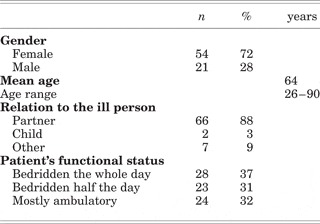
During the 3 days, 107 relatives met the inclusions criteria and 75 answered the questionnaire (70% response rate). Some demographic data are summarized in Table 1. The majority of relatives was women (72%) and was partners (88%) to the patients. The patients' functional status was: bedridden the whole day (n = 28), bedridden half the day (n = 23) and mostly ambulatory (n = 24).
Demographic characteristics of the relatives

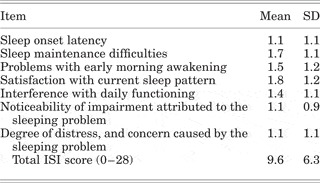
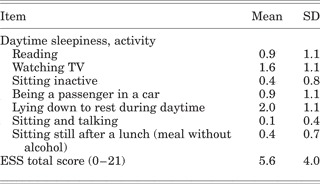
The ISI average total score was 9.6 (SD 6.3) (Table 2). Twenty-nine (38.7%) relatives reported no clinically significant insomnia problems, 28 (37.3%) had sub-threshold insomnia problems, 16 (21.3%) had clinical insomnia of moderate severity, and 2 (2.7%) reported severe clinical insomnia. The most serious problems were “[lack of] satisfaction with current sleep pattern” and “sleep maintenance difficulties.” Approximately half of the relatives (49.3%) had insomnia problems three times a week or more. Sleep duration was assessed in terms of quantity and quality. Seventy-three percent of the relatives reported that they had too little sleeping time. The mean sleep duration was 6.5 hours, the mean assessed need of sleep was 8 hours, and the mean discrepancy was 1 hour. Daytime sleepiness (Table 3) was not a great problem: the total mean score was 5.6 and only 11 (15 %) scored excessive daytime sleepiness (>10 ESS). The two most reported situations were that relatives fell asleep when lying down to rest during the daytime (mean 2.0) and when watching television (mean 1.6).
Insomnia severity index (ISI)a scores (time frame = previous week)

a aThe ISS is a 0–4 point scale.
Epworth Sleepiness Scale (ESS)a (time frame = previous week)

a aThe ESS is a 0–3 point scale, where a lower score means less sleepiness.
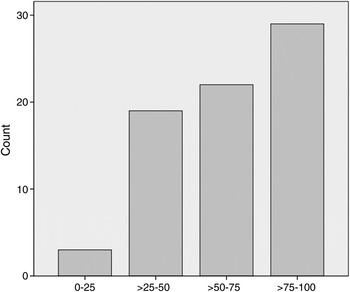
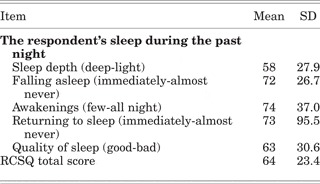
The relatives' rating on the RCSQ (Table 4) varied widely (RCSQ total score: range 14–100, mean 64.3). Only three (4%) relatives reported very poor sleep (i.e., score of <25) and 29 (38.7%) reported very good sleep (i.e., score of <75) (Fig. 1). The sleep quality ranked fairly high (mean 63) and the item with the lowest ratings was sleep depth (mean 58).
The relatives divided into four groups based on total RCSQ score (n = 73).

Richard Campell Sleep Questionnaire (RCSQ)a scores (time frame = previous night)

a The RCSQ is a 0–100 point scale.
Statistical Comparisons
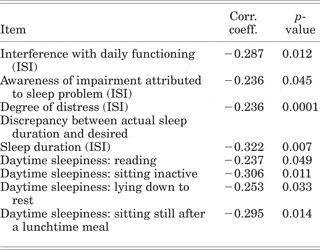
Two general age- and gender-related patterns were observed. Negative correlations were found with younger relatives reporting more insomnia problems (total score ISI –0.236, p < 0.05), and daytime sleepiness (total ESS score, –0.409, p < 0.000) than did older relatives. Other significant age-related differences are shown in Table 5. The other general patterns were that women had significantly inferior sleep quality (total RCSQ score t –2.889, p < 0.005), sleep depth (t 2.102 p = 0.039), and sleep quality (t 3.241 p = 0.002) compared to men. They also had more problem with insomnia (total ISI score, z –2.588, p < 0.01) and on the different items relating to sleep maintenance (z –2.058 p = 0.04), satisfaction with current sleep pattern (z –2.979 p = 0.005), noticeable of impairment (z –2.979 p = 0.003), and degree of distress (z −2.745 p = 0.006) (data not shown in the table).
Significant correlation between age and items from Insomnia Severity Index (ISI) and Epworth Sleepiness Scale (ESS)

A positive correlation was found between the ISI and ESS results (0.260: p = 0.026), but not between RCSQ and ESS scores. There was a significant negative correlation between sleep duration and quality of sleep (the sleep quality item from the RCSQ) (–0.565, p < 0.0001), but not between sleep duration and the ESS.
DISCUSSION
The ISI average total score was 9.6, which is comparable to a score of 7.3 in a sample of cancer patients (Savard et al., Reference Savard, Savard and Simard2005) but much lower than the results (19.7) from a sleep disorder center (Bastien et al., Reference Bastien, Vallières and Morin2001). This suggests that the insomnia problems are quite modest in the present study. However, about 23% of the relatives scored as having moderate or severe clinical insomnia. Furthermore, nearly half of the relatives reported frequent insomnia problems (of three times or more a week).
The relatives in the present study reported sleeping an average of 6.5 hours per night. This can be compared to other studies that have reported an average of 6 (Carter, Reference Carter2003) and 7.8 hours (Gibbins et al., Reference Gibbins, McCoubrie and Kenderick2009). The subjective scoring of sleep quality as “bad” is probably the result not only of the total sleeping time but also of sleep fragmentation and difficulties in returning to sleep. The study by Gibbins et al. (Reference Gibbins, McCoubrie and Kenderick2009) showed that a substantial proportion of carers of patients with advanced cancer complained of poor sleep despite reporting ‘‘normal’' duration of sleep. The objective measurements revealed good sleep efficiency, but high levels of sleep fragmentation and movement, suggesting that sleep quality may be disturbed. By contrast Carter's (2003) study showed that relatives underestimated their sleep problems: relatives reported 6 hours of sleep, but the sleep duration captured by actigraphy was slightly under 5 hours. The relatives in the present study were not especially worried about their sleeping problems and maybe this was because of the generally held opinion that it is quite normal to sleep poorly under the given circumstances. However, the younger relatives were significantly more worried than were the older ones.
Daytime sleepiness was not a common problem. The mean score of 5.6 in the present study is comparable to the score of 5.0 in Gibbins et al.'s (2009) study. The two most reported situations were that relatives fell asleep while watching television and when lying down to rest during the daytime, situations in which it is quite common to fall asleep. However, there was a positive correlation between insomnia problems measured by the ISI and daytime sleepiness (ESS). This result is contrary to the findings by Ohayon and Bader (Reference Ohayon and Bader2010), who stated that the most striking results of their study were the “lack of association between any insomnia symptom and daytime sleepiness.” That the younger relatives reported more insomnia problems and daytime sleepiness than did the older relatives is similar to the patterns found in the fatigue study (Carlsson Reference Carlsson2009), in which the youngest subject was the most tired. However, in other samples, the reverse was more common, with older subjects being more tired (Schwarz et al., Reference Schwarz, Krauss and Hinz2003) and having more insomnia problems (Morin et al., Reference Morin, Le Blanc and Daley2006; Ohayon & Sagales, Reference Ohayon and Sagales2010).
That insomnia was higher in women than in men is consistent with other Swedish studies (Lindberg et al., Reference Lindberg, Janson and Gislason1997; Hetta et al., Reference Hetta, Broman and Mallon1999; Ohayon & Bader, Reference Ohayon and Bader2010) and also with a number of studies from elsewhere in Europe (Leger et al., Reference Leger, Guilleminault and Dreyfus2000; Ohayon & Zulley, Reference Ohayon and Zulley2001; Ohayon & Smirne, Reference Ohayon and Smirne2002; Ohayon & Sagales Reference Ohayon and Sagales2010). This result is important, as most informal caregivers in palliative home care are women. The absence of any significant difference related to the patients' functional status was quite surprising, and not in concordance with the results of the fatigue study (Carlsson, Reference Carlsson2009).
The sleep instruments used in the present study gave a more comprehensive and better picture of the relatives' sleep condition than did the questions used in the earlier pilot study (Carlsson, Reference Carlsson2009). However, the RCSQ added less information than did the ISI and the ESS. Still, a shortcoming of this study was that the questionnaire did not contain any questions about the use of hypnotics/sedatives to enhance sleep. One relative wrote a comment on the questionnaire saying that she slept well because she used sleeping pills. Therefore, the sleep problems reported here are possibly underestimated.
CONCLUSIONS
The results of this pilot study give only a brief insight and raises new questions that need further exploration. A longitudinal study is required to gain a broader picture of the relatives' sleep condition during a patient's palliative care phase, and also to investigate more thoroughly whether the difference between younger and older relatives remains.