I. INTRODUCTION
Pattern synthesis of antenna with different methods such as large phased array antenna, shaped beam reflector antenna, and multi-feed reflector antenna (MFRA) has been provided for different applications such as satellite communications and astronomy [Reference Mandal, Zafar, Das and Vasilakos1–Reference Foudazi, Mallahzadeh and Samadi-Taheri5]. Pattern synthesis of phased array antenna in [Reference Mandal, Zafar, Das and Vasilakos1] showed several restrictions such as using a lot of elements to achieve desired gain and sidelobe level, complexity of beam-forming network, and weight of radiation box. For pattern synthesis of shaped reflector antenna fed by a single antenna element, surface of the reflector was deviated to achieve the desired radiation pattern, which is expensive and increase the complexity of implementation [Reference Bhattacharyya2]. MFRA has been used widely for pattern synthesis problems. Due to several advantages of MFRA such as ease of fabrication, better cross-polarization, and frequency reuse, they can be a good candidate for satellite communication systems [Reference Botha and McNamara3–Reference Foudazi, Mallahzadeh and Samadi-Taheri5]. Also, offset reflector antenna has negligible blockage effect with respect to the simple parabolic model. Thus, MFRA with offset parabolic reflector attracts attention based on its merits for pattern synthesis applications [Reference Foudazi and Mallahzadeh4].
In order to find appropriate excitation value (amplitude and/or phase) for each array elements of MFRA, different mathematical methods can be used [Reference Venkataraman6, Reference Perini7], which are time-consuming and difficult to perform for complicated problems. Therefore, two evolutionary algorithms (EAs) have been used widely for pattern synthesis of reflector antennas, called genetic algorithms (GAs) [Reference Oraizi and Fallahpour8–Reference Oraizi and Fallahpour10], and particle swarm optimization (PSO) [Reference Jin and Rahmat-Samii11, Reference Fallahpour, Baumgartner, Kothari, Ghasr, Pommerenke and Zoughi12]. Recently, invasive weed optimization (IWO) with simple, powerful, and robust process for array antennas has been suggested [Reference Karimkashi and Kishk13]. Also, Foudazi et al. [Reference Foudazi and Mallahzadeh4, Reference Foudazi, Mallahzadeh and Samadi-Taheri5] discussed some aspects of the IWO method and presented a brief comparison between IWO and two other methods, GA and PSO.
In this paper, MFRA with an offset parabolic reflector antenna is used to provide a comparison between these evolutionary methods for the pattern synthesis problem. Three different conditions are considered: amplitude-only, phase-only, and amplitude–phase optimization. The desired radiation pattern is an elliptical-shaped beam in the U–V plane. The radiation pattern of MFRA is calculated using physical optic (PO) illumination of the reflector surface. Generally, PO is an approximate method and does not include the edge-diffracted field. The PO field is known to be very accurate in the main beam and the first few sidelobe regions. However, in contour beam pattern synthesis, the shaped beam pattern is at the main beam and the sidelobe is not taken into account for the pattern synthesis. Also, the desired elliptical-shaped beam pattern in the U–V plane covers small portion of θ angle in the U–V plane with complete coverage in the φ direction (0°–360°). For example, point (0.05, 0) in the U–V plane corresponds to the (2.8°, 0°) in the θ–φ plane which is at the main beam.
In order to calculate the far-field radiation pattern of the MFRA with offset parabolic reflector antenna, a commercial electromagnetic simulation package, FEKO, is used [14]. The excitation values of the array elements are tuned by Edit-FEKO. The convergence diagram as well as radiation patterns in the U–V plane for IWO are compared with two other well-known EA methods, GA and PSO, for the pattern synthesis of reflector antenna.
II. REFLECTOR ANTENNA DESIGN
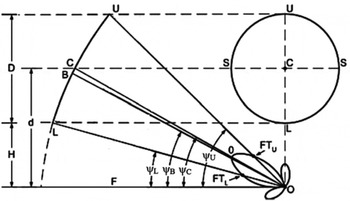
MFRA consists of a reflector antenna which is fed by a planar array of horn antennas, shown in Fig. 1. The reflector antenna is an offset parabolic reflector antenna with D = 22λ, H = 10λ, and F = 16λ where D is the diameter of the offset parabolic reflector antenna, H is the offset height of the reflector, and F is the focal point of the initial reflector with diameter of Dp (Dp = 2D + 2H = 64λ). Array elements are placed at (x f–y f) plane at focal point of the reflector antenna and rotated toward the center point of offset parabolic reflector with angle of ψ C. One of the advantages of MFRA with parabolic offset reflector is that the feed network illuminates the reflector surface from the offset to prevent the blockage problem. In equations (1–4), the general relationships between the angles and D, H, and F are presented.
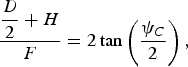 $$\displaystyle{{\displaystyle{D \over 2} + H} \over F} = 2\tan \left({\displaystyle{{{\psi _C}} \over 2}} \right)\comma$$
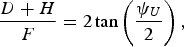 $$\displaystyle{{D + H} \over F} = 2\tan \left({\displaystyle{{{\psi _U}} \over 2}} \right)\comma$$
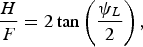 $$\displaystyle{H \over F} = 2\tan \left({\displaystyle{{{\psi _L}} \over 2}} \right)\comma$$
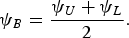 $${\psi _B} = \displaystyle{{{\psi _U} + {\psi _L}} \over 2}.$$
Offset parabolic reflector antennas fed by an array of horn antennas [4].
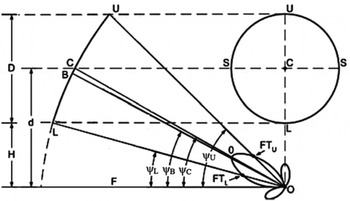
Based on these equations for the feed array network, ψ U= 90, ψ L= 35, ψ C= 67, and ψ B= 62.5 are achieved.
Each array element has 10 dB gain with waveguide diameter of 0.68λ, flare length of 0.6λ, aperture diameter of 0.9λ, and spacing (center to center) of λ with the next element in both x f and y f directions. The feed network consists of 25 horn antennas with rectangular lattice of 5 × 5 at center frequency of 10 GHz. The excitations value of the feed network should be optimized to achieve the desired radiation pattern. The desired radiation pattern is an elliptical-shaped beam in the U–V plane. In equations (5) and (6), the definitions of U and V are given.
 $$U = \sin\! \theta \cos \varphi\comma$$
 $$V = \sin\! \theta \sin \varphi .$$
III. OPTIMIZATION METHODS
Three conditions, amplitude-only, phase-only, and amplitude–phase optimizations, are considered for pattern synthesis of the desired elliptical-shaped beam. To achieve the desired radiation pattern, the differences between the calculated and desired patterns are minimized. To compare different evolutionary algorithms for the pattern synthesis problem, the error equation or cost value should be defined. Generally, this value is calculated by root-mean-square (RMS) of differences in samples [Reference Foudazi and Mallahzadeh4]. Then, the initial parameters of GA, PSO, and IWO should be defined properly.
Basically, GA is inspired from the biological behavior of genes and their evolution for the next generations. In this paper, the tournament method for mating and the uniform crossover method for providing binary chromosomes for offspring are chosen based on [Reference Haupt and Werner9].
Also, PSO is based on particle swarm to find the source of food. For the PSO, the speed of the swarms are define as equation (7), where w is the inertial weight, P is the personal best, G is the global best, c 1 is the cognitive rate, c 2 is the social rate, and V max is the maximum velocity. Random behavior for the swarm movements are added using random parameters of η 1 and η 2 based on [Reference Haupt and Werner9].
 $${V_t} = w{V_{t - 1}} + {c_1}{\eta _1}\lpar {P_{t - 1}} - {X_{t - 1}}\rpar + {c_2}{\eta _2}\lpar {G_{t - 1}} - {X_{t - 1}}\rpar .$$
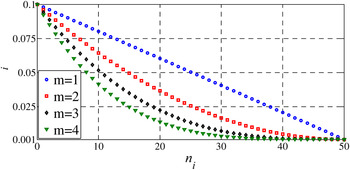
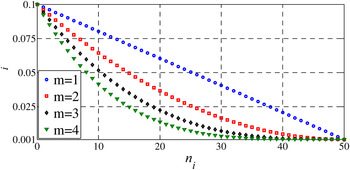
IWO, as a new EA method, is based on the ecology and biology of weeds in nature. In IWO, provided seeds for the next iteration for each flowering planet are spread based on its standard deviation. This parameter is defined based on equation (8) and shows that the provided seeds spread closer to their parents as the number of iteration increased [Reference Foudazi and Mallahzadeh4]. In this equation, n i is the number of iteration, N is the total iteration, m is the non-linear modulation index, S min and S max are the minimum and maximum numbers of produced seeds, and P max is the total number of produced seed after initial iteration. The standard deviation for the maximum number of 50 iterations with initial and final deviations of σ ini = 0.1 and σ f = 0.001 is presented in Fig. 2. Based on equation (8), the standard deviation changes linearly for m = 1. Although m = 2 converged faster than m = 1, the convergence speed is slow and takes long time to find the best result due to wide distribution of seeds at the intermediate stage. Moreover, m = 4 converged very fast and cannot explore appropriately during the convergence. Thus, m = 3 can be a good number for fast and accurate convergence of IWO [Reference Karimkashi and Kishk13].
Standard deviation of the IWO algorithm for m = 1, 2, 3, and 4 with σ ini= 0.1, σ f= 0.001, and N = 50.
 $${\sigma _i} = {\left({1 - \displaystyle{{{n_i}} \over N}} \right)^m} \times \lpar {\sigma _{ini}} - {\sigma _f}\rpar + {\sigma _f}.$$
For each number of iteration, the error value is calculated based on the RMS value of the differences between the desired and optimized radiation patterns. The value is calculated based on equation (9).
 $${\rm Cost} = \sqrt {\displaystyle{1 \over L}\sum {{{\lpar {G_i}\lpar \theta\comma \; \phi \rpar - {G_d}\lpar \theta\comma \; \phi \rpar \rpar }^2}} }\comma$$
 $$L = {L_\theta } \times {L_\phi }\comma$$
which G d(θ, φ) is the desired radiation pattern and G i(θ, φ) is the optimized radiation pattern in iteration of n i. Also, L is described in equation (10), which is based on the number of total samples in the θ and φ planes to calculate the differences between desired and optimized radiation patterns. In order to compare these three methods, the maximum number of iterations for GA, PSO, and IWO are the same and fixed at N = 50. The maximum number of iteration is the number that the process of optimization is stopped irrespective to the RMS value of error.
IV. RESULTS AND DISCUSSION
A) Amplitude-only
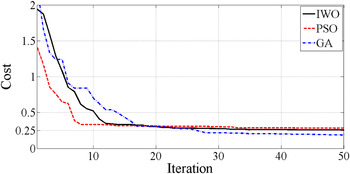
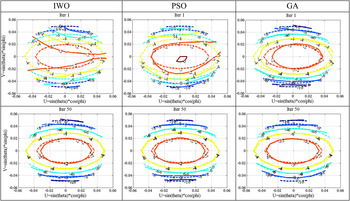
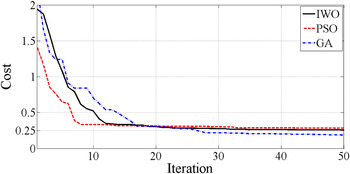
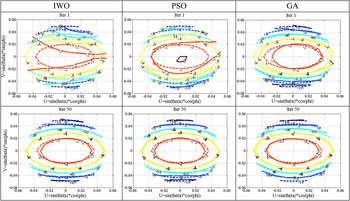
To initiate the optimization algorithms, the initial population is 40 with the total number of 50 iteration (N = 50). The initial search areas for these three optimization methods are considered to be the same to be able to compare them based on their performance. While the same number of populations is chosen, the comparison is based on the speed of convergence with the same initial space and dimensions. In [Reference Foudazi and Mallahzadeh4, Reference Foudazi, Mallahzadeh and Samadi-Taheri5] and [Reference Chandrasekar and Ramana15], the comparison between different evolutionary methods were presented based on the same initial population size. Initial populations were chosen randomly with the same size and dimension for each method. Also, it is considered that the population size is 40 after the initial iteration. The dimension of the optimizer program for the feed network with 5 × 5 elements is 25 (only 25 amplitudes). Thus, 40 different points in a 25-dimensional space is created for each iterations and changes in [0–1] to find appropriate amplitude excitation. For PSO algorithm, the main parameters are c 1= 2, c 2= 2, w = 0.9, η 1= 0.99, η 2= 0.99, and V max= 0.1. The main parameters of IWO algorithm are m = 3, S min= 0, S max= 5, σ ini= 0.1, and σ f = 0.001. In Figs 3 and 4, the optimization results are presented. As shown in Fig. 3, the final RSM error values based on equation (9) for L = 133 samples (L = L θ × L φ) are around 0.28 for PSO and IWO and 0.24 for GA. The PSO, IWO, and GA converged after 8, 12, and 17 iterations, respectively. As depicted in Fig. 4, initial (i = 1) and final (i = 50) iteration results for GA, PSO, and IWO are presented. The radiation patterns of GA, PSO, and IWO are acceptable at the final iteration. For the amplitude-only optimization, good radiation pattern for synthesis of simple elliptical-shaped beam of MFRAs is achieved for IWO. Although PSO and GA have been used widely as accurate optimization processes, IWO shows promise to be an applicable and accurate method for pattern synthesis problems with simple algorithm and few tuning parameters.
Cost diagram of MFRA with GA, PSO, and IWO for the amplitude-only optimization.
Optimized radiation pattern of MFRA with GA, PSO, and IWO for the amplitude-only optimization (G d(θ, φ) is dashed line and G i(θ, φ) is solid line).
B) Phase-only
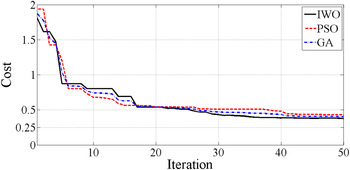
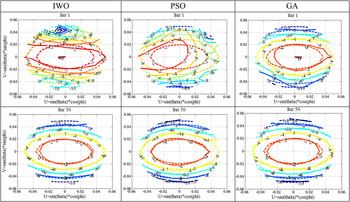
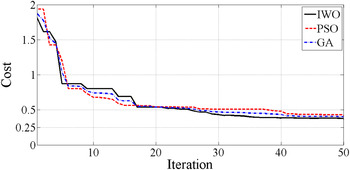
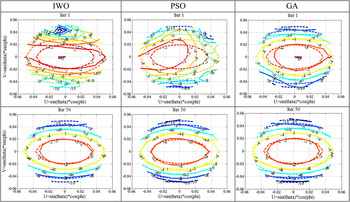
In this section, phase of 25 fed antennas is considered to be optimized to achieve the desired simple elliptical-shaped beam in the U–V plane. To initiate the optimization algorithms, the initial parameters for GA, PSO, and IWO are the same as the previous section, while the phase changes in [0–360] for optimizations process. In Fig. 5, the convergence diagram of phase-only optimization for MFRA with GA, PSO, and IWO is presented. It is shown that the RSM value of error between desired and calculated radiation patterns at L = 133 samples becomes converged around 0.4 after about half of iterations (around 25 iterations). The GA and PSO become converged after 40 iterations. Also, it is obvious that IWO converged after 34 iterations. As presented in Fig. 6, the radiation patterns of GA, PSO, and IWO are acceptable at the final iteration. For phase-only optimization, it is obvious that IWO converged at 0.36 and provides good radiation pattern for synthesis of simple elliptical-shaped beam for MFRA. Also, in comparison with amplitude-only optimization, it is clear that the results of amplitude-only converged at smaller error than phase-only optimization. In other words, it means that better results can be achieved using amplitude optimization than phase optimization. The capability of the IWO method shows the promise of having robust, simple, and accurate method for phase optimization of array antennas.
Cost diagram of MFRA with GA, PSO, and IWO for the phase-only optimization.
Optimized radiation pattern of MFRA with GA, PSO, and IWO for the phase-only optimization (G d(θ, φ) is dashed line and G i(θ, φ) is solid line).
C) Amplitude–phase
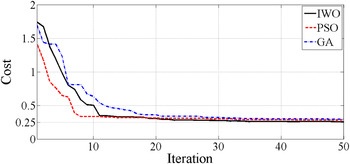
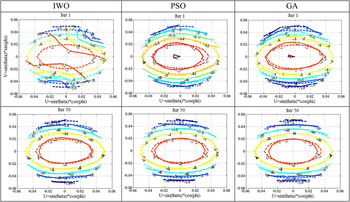
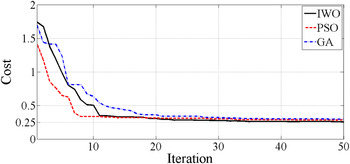
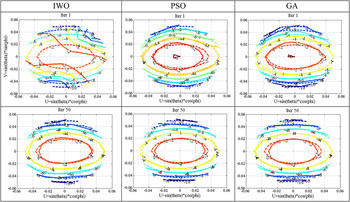
In this section, the amplitude and phase of 25 fed antennas is considered to be optimized to achieve the desired radiation pattern. To initiate the optimization algorithms, the initial parameters for GA, PSO, and IWO are the same as the first section. The dimension of the optimization space is 50 in this case, whereas in the two previous conditions it was 25. In Fig. 7, the convergence diagram of amplitude–phase optimization for MFRA with GA, PSO, and IWO is presented. It is shown that the RSM value of error between desired and calculated radiation patterns at L = 133 samples becomes converged around 0.25 before reaching half of iterations (around 20 iterations). Although PSO converged sooner than IWO, but IWO error is less than PSO. In addition, GA is converged later than IWO with worse error values. The PSO and GA become converged after 18 and 27 iterations, respectively. Also, it is obvious that IWO converged after 22 iterations. As presented in Fig. 8, the radiation patterns of GA, PSO, and IWO are acceptable at the final iteration. For amplitude–phase-only optimization, it is obvious that IWO converged at 0.36 and provides good radiation pattern for synthesis of simple elliptical-shaped beam of MFRAs.
Cost diagram of MFRA with GA, PSO, and IWO for the amplitude–phase optimization.
Optimized radiation pattern of MFRA with GA, PSO, and IWO for the amplitude–phase optimization (G d(θ, φ) is dashed line and G i(θ, φ) is solid line).
V. CONCLUSION
Comparisons between GA, PSO, and IWO for pattern synthesis of reflector antennas fed by planar array of horn antennas are presented. Using the PO method, the surface of offset reflector antenna is illuminated. The desired radiation pattern is an elliptical-shaped beam in the U–V plane. These three evolutionary algorithms (EAs) are used to find good guess for excitations value of feed network based on the minimizing the error value between the desired, G d(θ,φ), and the calculated radiation pattern, G i(θ,φ). Moreover, three types of excitation named as amplitude-only, phase-only, and amplitude–phase optimization for antenna elements of feed network are used. The results of the convergence diagram as well as simulated radiation patterns during the optimization process are presented and compared with each other. It is obvious that the results of the amplitude-only are almost the same as results of the amplitude–phase optimization. However, the amplitude–phase optimization has bigger dimension in optimization space than amplitude-only. Also, the phase-only optimization results are worse than amplitude-only and amplitude–phase optimization. It is shown that the IWO algorithm which is a new and simple optimization method with few parameters can provide good and comparable results with two other well-known optimization algorithms, GA and PSO, in all three conditions and shows the promise that it can be a good candidate for complicated electromagnetic problems.
 Seyed Mohammad Alavi received his B.Sc. and M.Sc. degrees in Electronic Engineering from Amir Kabir University of Technology (Polytechnic of Tehran), Iran, University of Tehran, Faculty of Engineering Tehran Iran, and Ph.D. degrees in Telecommunication Engineering from Electrical and Computer Engineering of K. N. Toosi University of Technology, Tehran, Iran in 1987, 1991 and 2011, respectively. He had worked at Iran Telecommunication Research Center (ITRC), Tehran, Iran, between 1987 and 1989, at Iran Electronic Industry between 1991 and 1998, and at Laboratory of Electronic Instrumentation of Nancy (LIEN) France between 1998 and 2006. Now, he is working as an Assistant Professor in the Department of Electrical Engineering at Imam Hossein Comprehensive University. His research interests are high-frequency microelectronic devices and circuits design.
 Ali F. Naini received his B.Sc. and M.Sc. degrees in Electrical Engineering from Shahed University. His main research interests are antenna design and optimization algorithms in electromagnetics.