Introduction
In South Korea, the unprecedented global popularity of K-pop has led to a trend of coining terms prefixed with the letter K to denote Korean products or phenomena that have gained worldwide recognition and market success. For instance, K-cinema, K-drama, K-beauty, and K-food – all attest to the global popularity of Korean cultural outputs. Accordingly, a strong sense of national pride is associated with “K”. Recently, the South Korean press and government have adopted the term “K-literature” or “K-lit”, especially since The Vegetarian (Chaesikjuuija 2007; English translation Reference Han2015), a novel by Han Kang, was awarded the Man Booker International Prize in 2016. In contrast with K-pop, a term that has been widely adopted by audiences, K-lit has not gained much currency, being used mostly by the Korean government and press to appraise its growing international status. Notably, a number of government agencies, including the Ministry of Culture, Sports, and Tourism, have used the term, mainly for publicity purposes.Footnote 1
Particularly noticeable for its K-lit activity is the Literature Translation Institute of Korea (LTI), a subsidiary of the Ministry of Tourism, Culture and Sports. Founded in 2001, LTI has continuously provided significant funds for the translation and publication of Korean literary works abroad. For LTI, with its mission of promoting the “development and globalization of Korean literature”, the K-literature term and concept epitomize the global acknowledgment of Korean literature. International media attention and literary prizes are allegedly evidence of the success of the institute's long-standing efforts to promote Korean literature in the global literary field (LTI 2019).Footnote 2
Some countries operate government-funded institutes such as the Foundation for the Production and Translation of Dutch Literature in the Netherlands; the Institute for the Translation of Hebrew in Israel; or the National Centre for Publishing in France, to secure their status within “the world republic of letters” (Casanova Reference Casanova2004). However, distinct from institutions in other countries, LTI's big budget enables it to singlehandedly manage multiple programs under the banner of global promotion of Korean literature (Rao Reference Rao2016). As of 2019, LTI's total annual program budget is about KRW7 billion (about US$6.5 million).Footnote 3 Whereas 27% of the budget is allocated to translation, 19% is directed specifically to the translation academy, a program that distinguishes LTI from state-run institutes in other countries. The academy trains translators, both Korean and non-Korean, to attain expertise in translating Korean literary works into foreign languages. There are additional programs: the annual Seoul International Writers' Festival, a platform for international literary exchange; Korean Literature Now, LTI's own literary magazine; and LTI Translation Awards for individuals and organizations that have made substantial contributions to the translation of Korean literature.Footnote 4
The South Korean state's investment in translation reflects long-standing state-led endeavors to enhance the international status of the country. Although the state's main focus has been export-oriented economic growth, it has also engaged in cultural exports to foster global acknowledgment of Korean culture. Since the 1970s, the South Korean state has overseen international cultural promotion through agencies such as the Korean Cultural Centers (founded in 1971), Korean Culture and Arts Foundation (founded in 1973), and Korea Foundation (founded in 1991), which have undertaken a wide range of cultural exchange and export initiatives. It may seem that this ambitious investment in cultural business is part of the pervasive “mercantilist state ideology of ‘catch-up’” (Chang Reference Chang1999, p. 49), which is currently being reprised through “K” rhetoric.
The uniqueness of the South Korean state investment in cultural production and translation is to be understood in relation not only to the country's continuing quest for upward mobility but also to the role of cultural policy in the general nation-state building processes. Cultural policy is a constitutive part of the formation of political unity at both national and international levels, inculcating the idea of culture as the basis of common identity and civic life (Bourdieu Reference Bourdieu and Steinmetz1999, Mulcahy Reference Mulcahy2017). The cultural policies of the modern nation-state in general are based on the belief that “government has a say in the shape of a country's culture and that nations are valued and identified by their cultural characteristics” (Dominguez Reference Dominguez, Bradford, Michael and Wallach2000, p. 23). Thus, the government taking initiative in promoting national literature abroad is considered a valid, if not universal, measure, since “for a nation-state, exporting its literature is a sign of is symbolic recognition on the international scene” (Sapiro Reference Sapiro2016, p. 84).
It should be also noted that, due to its scale and scope, the LTI policy induces the participation of a wide range of actors including authors, publishers, and professional translators who invest their expertise in literary translation. Here, the state does not simply impose a mobilizing force on the field but depends on external expertise for the implementation and legitimation of the policy. Habermas (Reference Habermas and Seidman1989, p. 277) argues that “the state cannot simply take over the cultural system and […] in fact, the expansion of areas for state planning creates problems for things that are culturally taken for granted”. Cultural policies are legitimate and effective insofar as they utilize meanings and values from broad cultural systems that cut across state–society relations (Steinmetz Reference Steinmetz1999). Thus, as much as South Korean state investment in translation is an effort at gaining acknowledgment of Korean literature in the global literary field, the resulting initiatives inevitably draw on social forces and actors with their own interests and values in literature and translation, which both enable and constrain state policy.
As will be discussed later, European theoretical approaches often deem that the tension between mobilization and dependency within state's intervention in literary development is resolved in ways that secure symbolic autonomy from external pressures along with the formation of a modern literary field (Bourdieu Reference Bourdieu1993, Reference Bourdieu1996; Casanova Reference Casanova2004). Accordingly, translation studies tend to assume that the state gives way its control over translation to the market, reducing its role to supporting marginal literary actors, vulnerable to market sway (Heilbron and Sapiro Reference Heilbron, Sapiro, Roig-Sanz and Meylaerts2018; Sapiro Reference Sapiro2016). This study argues that LTI and the South Korean state present a case of literary translation efforts that resist the conceptual binary between the mobilization of a strong state over a national literature and the dependency of a weak state on the literary market and expertise. The Korean case exemplifies the mutual intertwining of strength and weakness of the state in formulating a national literature within and without the policy domain of the nation-state – a process that requires an alternative understanding of the state's role in translation practices.
This study examines the extensive policy initiatives of LTI to understand how the state defines or tries to define a national literature through translation, and by exporting Korean literature to the global literary field where the “national” achieves “trans-national” currency both symbolically and non-symbolically. Inasmuch as K-literature is the policy object of a “strong government with big ambition”, the “K” in K-literature is a social construct contingent on the specific dynamics of translation policy but encompassing wider state–society relations. In translation policy, we thus find a complication and entanglement of literary value, national pride, and global markets that affect the global and domestic representation and perception of Korean literature. The analysis of LTI policy reveals the contentious nature of the state-led literary project and problematizes the construction of a national literature within the global context.
This paper is a theoretical attempt to shed a new light on the role of state in translation as a collective effort at national literary championing at a global level. By investigating LTI policy in South Korea, this paper suggests that the state hardly monopolizes the representation of national literature in and to the global literary field; this instead occurs via the participation of various actors and the interplay of ideas about what literature is or should be within and without the nation-state. The South Korean state plays a central role in “regulating translation flows and shaping translation practices” through subsidies and other forms of support or restrictions (Heilbron and Sapiro Reference Heilbron, Sapiro, Roig-Sanz and Meylaerts2018, p. 182). However, how the centrality of the state operates and shifts in translation policymaking is contingent upon the configuration of networks among policy participants and the flow of works and ideas in them, which are the main objects of analysis in this study.
The sociological analysis of the formulation of Korean literature led by LTI is part of a broader understanding of translation as an “ongoing process of institutionalization” (Helgesson and Vermeulen Reference Helgesson and Vermeulen2015, pp. 9–10). LTI's translation policy involves not only textual work but also institutional arrangements involving various agents who interact with one another to nurture national literature vis-à-vis global literary worlds. That is, LTI selects not only particular texts but also particular translators, publishers, committee members, and writers, who in turn shape the policy practices of LTI. With this complexity in mind, this study analyzes the role of the state as a central agent in formulating Korean literature as a global literary project as well as its interaction with non-government actors, a case that has rarely been discussed within translation studies, regional studies, cultural studies, or cultural sociology.
The state and literary translation
Associating national literature with world literature
Several studies have paid attention to the role of the state in global literary transfer. Typically, previous studies have applied the binary of “strong government/weak cultural autonomy” and “weak government/strong cultural autonomy” in theorizing the relationship between the state and literary translation (Casanova Reference Casanova2004; Ducournau Reference Ducournau, Helgesson and Vermeulen2015; Sapiro Reference Sapiro2016). These studies postulate, for example, that whereas authoritarian regimes use and treat literary translation at their disposal for political or ideological objectives, liberal-democratic regimes, based on the arm's length principle, support literary translation to protect small-sized publishers from market constraints (Heilbron and Sapiro Reference Heilbron, Sapiro, Wolf and Fukari2007).
Previous studies have often assumed that the relationship between the state and translation evolves along a linear path. State investment in translation is freed from political constraints as literary production secures viability and autonomy with the development of resource environments such as increased numbers of readers, critics, publishers, and so on (Ferguson Reference Ferguson1987). The process of nation-state building lays the foundation for the initial formation of the modern literary field, which proceeds alongside the establishment of shared national languages to provide narratives and figures constitutive of national identities. Casanova (Reference Casanova2004) argues that Germany and the United Kingdom, in the process of fostering national unity, utilized vernacular languages to form national literatures against the hegemony of French literature. Other European countries with smaller languages followed suit. According to Wachtel (Reference Wachtel1998), intellectuals in the minority nations of the Habsburg Empire rediscovered folk customs and traditions to define national literatures distinct from modern European literature. Shin (Reference Shin2017) also shows how Alisher Navoi, a fifteenth-century poet from Herat, Afghanistan became a symbol of Uzbek national exceptionalism for Uzbek writers and scholars during the early Soviet period.
However, the accumulation of literary resources such as particular literary styles and discourses also allows “literary space gradually to achieve independence and determine its own laws of operation”, as was the case with German romanticism, which detached itself from nationalism in its development (Casanova Reference Casanova2004, p. 37). Bourdieu (Reference Bourdieu1993) argues that the formation of the literary field in nineteenth-century France accompanied the emergence of professional writers deploying beliefs and knowledge against the political and economic logic used to regulate literary practices to serve the interests of the established dominant class. In this context, along with social differentiation and political democratization, the autonomy discourse prevails, and the state's role is minimized from imposing regulation on literature to supporting its status in the global literary field. The literary and artistic rivalries among countries cannot be reduced to economic and political rivalries over which the state takes direct control (Casanova Reference Casanova2004, Heilbron and Sapiro Reference Heilbron, Sapiro, Wolf and Fukari2007, Sapiro Reference Sapiro2016).
The foregoing depictions of Western literary history tend to posit a transition from literature without autonomy (subordinated to politics) to literature with autonomy (freed from politics). However, equally important is the external influence that often prevails throughout the process of national literature formation. The emergence of new linguistic and literary practices such as newspapers and novels is a political process, disseminating imaginaries and vocabularies to represent new societies, mentalities, and communities of nation-states (Anderson Reference Anderson2006). Karatani (Reference Karatani1993, p. 33) presents a Japanese case where “the overwhelming dominance of the West” prompted the invention of subjective interiority in literary forms, which itself is constitutive of nation-state formation at a cultural level. Hence, instead of a linear development from a politicized national literature to a depoliticized universal literature (Casanova Reference Casanova2004), we can delineate the dialectical processes of literature formation that give rise to the interconnection between Western literary influences and non-Western literary practices and that affect the founding of a domestic literary field at both textual and institutional levels.
The case of writers and publishers from the 1930s in Korea, then under Japanese rule, illustrates the dialectical process, especially at an institutional level, that legitimated the emerging national literature through its association with the dominant Western literature (Heilbron and Sapiro Reference Heilbron, Sapiro, Wolf and Fukari2007). The colonial authority at best did not support Korean literature, so that the development of the literary field and market was left to a small number of writers and publishers. These publishers imported Western canonical works in particular, such as those of Goethe, Tolstoy, and others, by retranslating Japanese-language translations of the originals. They strove to build a literary market catering to educated readers by carrying out the “canonization” of Korean literature, drawing on rhetorical tropes such as “Dostoyevsky and Gorky of Korea” to praise renowned novelists of the 1920s, such as Sang-Sup Yeom and Seo-Hae Choi. Korean writers also argued that they should join PEN International to strengthen the status of Korean literature at an international level (Park Reference Park2009, p. 688). As such, the West-dominated “world culture” could be linked to “local actors” in Korea causing “similarities in mobilization agendas and strategies” across regions (Meyer et al. Reference Meyer, Boli, Thomas and Ramirez1997, p. 161). Here, the similarities lay in literary value, professional ethics, industrial system, and so on, which were established and disseminated by publishers, literary journals, critics, and readers. These domestic institutional processes aligning with Western models of literary practice affected Korean literature at the political, economic, and literary levels.
Strategies of translator-intermediaries
If importing world literature provides reference points for a national literature to transcend local boundaries, exporting the national literature to the world also involves a mixture of universalism and particularism. According to Casanova, in the process of entering into the global literary field through translation, individual authors, “translated men from small languages”, are caught in:
a dramatic structural contradiction that forces them to choose between translation into a literary language that cuts them off from their compatriots, but that gives them literary existence, and retreat into a small language that condemns them to invisibility or else to a purely national literary existence (Casanova Reference Casanova2004, p. 257).
Casanova argues that authors who are also translators of small languages respond to this contradiction by employing various textual strategies ranging from “adoption of a dominant language” to “symbolic merger of two languages” (Casanova Reference Casanova2004, p. 258). However, for translators, who are intermediaries more than authors are (“translating men” rather than “translated men”), the effort of striking a balance between two languages involves selecting texts and constructing a body of work that presents a national identity as compelling to audiences in other cultures.
Long before the establishment of translation institutes by the South Korean government starting in the 1970s, translations of Korean literature – some even in the early twentieth century – were led by a small number of Korean culture devotees such as missionaries and academics. They translated mostly classical and early modern literature, which often emphasized “Korean culture” over “literature” (Kwak Reference Kwak2011, Torres-Simón Reference Torres-Simón2013). Additionally, there was an issue of availability of contemporary works that, individually, could be considered representative of the general quality of Korean literature. According to Torres-Simón (ibid., 96), translating contemporary work was delayed because “a certain stretch of time needs to go by for works to be considered ‘translatable’”. In short, at the beginning stage, there is a nationalist tendency in translator-intermediaries' selection of texts, whether due to patriotism, orientalism, or simple practicality.
Although a nationalist orientation focusing on past literary works as a key part of Korean culture prevailed in individual efforts in translating from small languages into large ones, there were a few cases whereby translators selected literary works representing the whole gamut of national literature, from classical to contemporary works. In 1960, Peter Hyun collected and translated Korean poetry under the title Voices of the Dawn: A Selection of Korean Poetry from the Sixth Century to the Present Day, which was later included in the “UNESCO Collection of Representative Works – Korean Series”. He wrote in the preface of his book: “I have aimed not only at gathering poems which are representative of our poets and poetic genres at all stages of Korean history, but more particularly those poems which lend themselves to translation into English” (Hyun Reference Hyun1960, p. 11). In 1972, his first translation was published in French, and a reviewer wrote:
The selection of poems is general in date, theme, and type…. It is fairly clearly intended primarily to give pleasure as a book of poetry in French, though with UNESCO's usual laudable motive of interesting a wider audience in the literature of a relatively little-read language (W.E.S. 1974, p. 199).
Hyun's translation strategy, to cater translations of Korean literature to European languages, reflects how initial Korean translation efforts had to be adjusted to be inclusive of contemporaneity in order to secure readership in target cultures. Translators in general have to cope with multiple needs and imperatives from surrounding environments that circulate and judge translations. Jijon (Reference Jijon2019) argues that cultural brokers or intermediaries do not simply transfer texts with pre-determined meaning; instead, the intermediaries' interpretive work of selecting and organizing texts is contingent upon broader cultural contexts, especially, the audience's “horizon of expectations” (Jijon Reference Jijon2019, p. 248).
The pressure for adjustment is strong especially when translator-intermediaries are embedded at an intersection where diverse social forces converge. Hyun, a young aspiring writer studying and living in France, was connected to European intellectual society.Footnote 5 Compared to translators with religious or academic backgrounds, who tended to invest their interest in Korean culture, Hyun was keenly aware of the contemporaneous Eurocentric literary world in the 1950s and 1960s. As a result, he constructed a body of works that ranged from the traditional to the contemporary in an effort to meet the demands of both authenticity and acceptability of Korean literature.
Strong government's global literary project
The “embeddedness” of translator-intermediaries also applies to state investment in literary translation (Heilbron and Sapiro Reference Heilbron, Sapiro, Wolf and Fukari2007). As mentioned above, it is often assumed that as a political regime becomes more democratic and the domestic literary field becomes more autonomous, state investment in translation is reduced to supporting or providing channels for the market economy. However, recent studies of Korean cultural policy suggest a different story. They focus on the central role of the Korean government in leading both the democratization of cultural expression and the globalization of the cultural economy, as typified by state investment in the Korean Wave, which allegedly ensures both the innovativeness and viability of Korean culture (Jin Reference Jin2014; Kwon and Kim Reference Kwon and Kim2014; Lee Reference Lee2019).
According to Lee (Reference Lee2019, p. 61), South Korean cultural policy can be understood as the cultural initiatives of “a new patron state”, promoting cultural freedom as well as intervening in cultural activities. Lee (Reference Lee2019) argues that this defies the framework of Western cultural policy, centered around the binary of strong government/weak cultural autonomy and weak government/strong cultural autonomy, and also the framework of authoritarian regimes that regulate cultural industries in a top-down manner. Committed to both democratization and development, the state “does not necessarily seek an overarching, unitary rationale of cultural policy”, while “the overall commitment of the Korean state to culture is persistent and ever-increasing” (Lee Reference Lee2019, p. 59). Korean cultural policy, though extensive and ambitious, is enmeshed in tensions among hierarchical policy rules, economic interests of industries, and the imperative of cultural autonomy.
The discussion of South Korean cultural policy draws partly on the theory of the developmental state, which conceptualizes the state as capable of advancing rational strategies and robust infrastructure for economic growth (Evans Reference Evans1995). The state attains autonomy when its bureaucratic organizations are equipped with “commitment and a sense of corporate coherence” (Evans Reference Evans1995, p. 12); it attains embeddedness when it is interlocked “in a concrete set of social ties that binds the state to society and provides institutionalized channels for the continual negotiation and re-negotiation of goals and policies” (Evans Reference Evans1995, p. 12). According to Evans, the South Korean state in the 1970s and 1980s attained both embeddedness and autonomy, whereby the state's organizational capacity in partnership with domestic and global business entities facilitated economic development.
The theory of the new patron state posits that “strong government with big national ambition” can be entrepreneurial, investing resources in global cultural projects despite tensions (as above) in their execution. At the same time, the theory of the developmental state attests that the state's entrepreneurial project is contingent on its embeddedness within state–society relations wherein the state tests and strengthens its organizational capacity. These two theoretical models together provide a basic understanding of the South Korean state's extensive involvement in translation. They suggest that the state is embedded in a web of various individual and organizational actors at both domestic and global levels as it carries out the project of the globalization of the national literature.
Although the two theories provide a broad background to the analysis of the literary project of LTI, they tend to neglect the specificity of literature, in particular, the issue of uncertainty, which hampers state-led patronage and development from gaining clear-cut measures of success. Uncertainty is inherent in any cultural production and circulation that lacks objective standards for the evaluation of qualities (DiMaggio Reference DiMaggio1977, Karpik Reference Karpik2010, Menger Reference Menger2014). Furthermore, the global and domestic literary field comprises writers, translators, critics, academics, and publishers with diverse statuses and identities. Their pursuit of recognition, through ongoing competition and collaboration, places the field of literary production in a constant “anomie” by which the distinction between winners and losers is constantly challenged and reshaped (Bourdieu Reference Bourdieu1993).
Lee criticizes the application of the theory of the developmental state to Korean cultural policy, arguing that South Korea is “already developed and democratized” and thus, should not be categorized as a developing country (Lee Reference Lee2019, pp. 50–51). However, given that Korean literature has only a peripheral position in the global literary field, a state with cultural pride and competitive drive naturally remains motivated to pursue a developmental strategy in literary production and circulation. This strategy cannot succeed mainly because the literary space has its own logic of symbolic struggle centered around the judgment of literary quality, irreducible to the political order controlled by the state (Casanova Reference Casanova2004). Moreover, tension arises in state translation policy not only because of the contradiction between state patronage and the arm's length principle but because of the state's inherent inability to orchestrate the literary field in a coherent manner: The state, when selecting writers, works, publishers, and translators, must depend on literary expertise and the value systems of the literary field, which often contradict the state's policy frames.
In order not to fail, the state must embed itself in the literary field for information and implementation, which, however, rarely provides a predictable path toward success. As previously mentioned, rather than keeping an arm's length distance, LTI takes steps to administer extensive programs by utilizing literary expertise from the field. The greater LTI's ambitions to fulfill cultural, economic, and political goals, and the more it needs to rely on field expertise, the more the “K” in K-literature distances itself from an overarching singular framework of valorizing Korean literature in terms of success. As such, the tale of the construction of K-literature by LTI is a story of paradox, not of coherence, due to its embeddedness within the field of cultural production and circulation.
The state-led formulation of K-literature
Selecting Korean literature worthy of state support
From the beginning, the state's initiatives in translating Korean literature aimed at winning the Nobel Prize (Yun Reference Yun2012). Soon after Yasunari Kawabata, a Japanese novelist, won the Nobel Prize for Literature, in 1968, the South Korean government founded the Korean Culture and Arts Foundation, in 1973. While its mission was to promote the arts in general, at the core of its programming was promoting Korean literature abroad through translation. The state pushed this initiative further by establishing the Korea Translation Award in 1993 and the Korean Literature Translation Fund in 1996. These efforts culminated in merging the Foundation's translation program and the Fund to establish LTI in 2001.
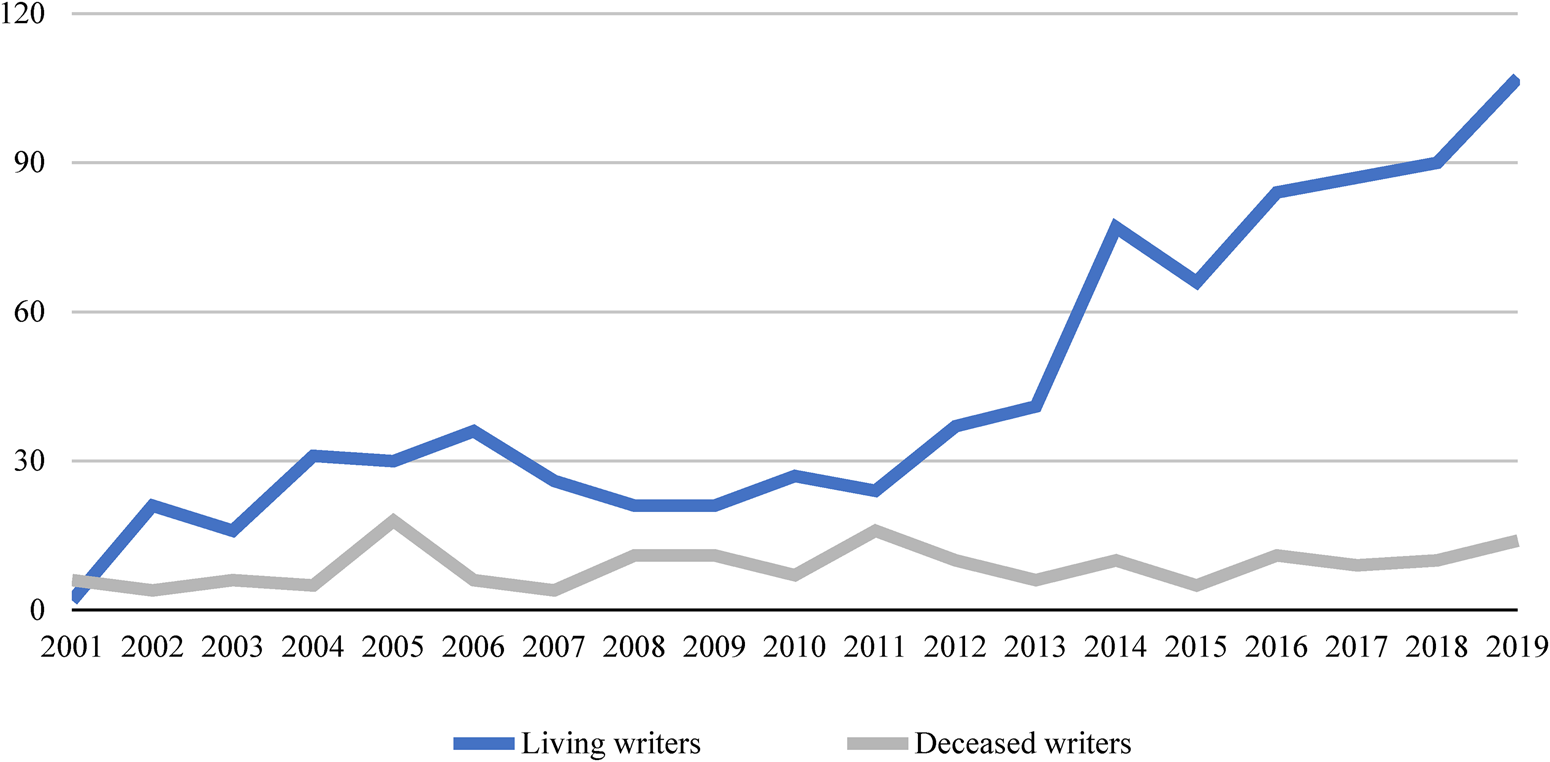
Translators even worry that LTI will shut down if a Korean writer wins the Nobel, since it would mean that the institute's ultimate dream has come true (Rao Reference Rao2016). LTI's policy drive to boost Korean literature's profile in the global literary field is reflected in its focus on the translation of literary works into English, French, and German (39% of all subsidized publications) (LTI 2019). According to Kwon (Reference Kwon2007), the majority of translations into German, subsidized by the state even before the founding of LTI as above, were contemporary works, especially of living writers; Kwon asserts that this is clear evidence that the primary policy objective has always been winning the Nobel. The list of translations from 2001 to 2019 confirms that LTI's emphasis on contemporary works and living writers has further amplified (Figs. 1 and 2).Footnote 6
Contemporary works vs. classical works (Source: Literature Translation Institute of Korea (2020)).

Living contemporary writers vs. deceased contemporary writers (Source: Literature Translation Institute of Korea (2020)).

Criticizing this short-sighted obsession with the Nobel Prize,Footnote 7 Kwon argues that LTI should strike a balance between contemporary and classical translations: “it is important to promote Korean history, culture, and lifestyle for foreigners who are eager to learn not only about Korean literature but also about the country and people” (Kwon Reference Kwon2007, p. 83). In other words, from the nationalist perspective that subsumes literature under a larger Korean culture, LTI's policy is overtly outward-oriented, lacking concern for authentic Korean culture.
Non-Korean translation experts criticize LTI's bias from a different angle. They argue that the state initiative overemphasizes “Koreanness”, which results in poor-quality translations (King Reference King2003, Torres-Simón Reference Torres-Simón2013). It seems contradictory that, whereas Korean experts see the institute's policy as too outward, non-Korean experts see it as too inward. However, this contradiction reveals LTI's mixture of external orientation and internal orientation, which is criticized by experts who pay attention to only one aspect of the mixture.
According to King, LTI's bias is found in two forms of gatekeeping: “(a) the practice of maintaining lists of preferred and/or recommended Korean authors and works, as well as the concomitant practice of giving funding priority to applicants who conform to such lists” and “(b) the tendency to favor literary translation conducted by teams comprised of one SL (source language) speaker and one TL (target language) speaker” (King Reference King2003, pp. 2–3). For (b), see the next subsection. As for (a), there seem to be two potential justifications for the maintenance of the list. First, policymakers may impose their own preferences in a top-down manner, to emphasize “Koreanness” in translations. However, this hypothesis is rejected by the diversity within the titles of contemporary translations, which, even in the eyes of non-Koreans, presents “an apparently genuine willingness to take chances on all manner of stories – even unflattering ones” (Rao Reference Rao2016, p. 7). Another hypothesis is that the list reflects the preferences of Korean literary experts, who function as reference points for the selection of contemporary works that supposedly have qualities that can represent Korean literature to foreign literary worlds. For non-Koreans, this hypothesis offers a more convincing explanation of the function of the list than the first one, as shown in King's quoting a critical comment made by An Sŏnjae (Brother Anthony), one of the most frequent non-Korean recipients of funds, about LTI: “The discovery and encouragement of Korean writers that can interest readers in the outside world cannot safely be made by Korean critics applying their own criteria of what ought to be admired” (King Reference King2003, p. 3). Thus, the list presents not simply LTI's recommended titles but the judgment of Korean experts regarding Korean literature, to be imposed upon non-Koreans' selection of works.
The list reveals LTI's embeddedness in the domestic literary field. LTI staff may have their own literary preferences, given that many of them, including the directors, have literature degrees and backgrounds. However, the state institute, as an intermediary, is not able to impose its own preferences and agenda to control the quality of cultural outputs. “Brokerage administrators lack professional competence to build a finished product and must defer to specialists beneath them on the organizational charts” (DiMaggio Reference DiMaggio1977, p. 442). As their job is administering large-scale policy programs rather than exercising individual skills or literary expertise, LTI staff members depend on the exchange of information and implementation of expertise available in the domestic literary field. Indeed, the embeddedness of LTI in the domestic literary field is reflected in the composition of board members and review committee members, who are all native Korean writers, critics, and literary academics.
Criticism of LTI policy by non-Korean experts is not directed toward the nationalist claims often articulated in LTI policy rhetoric, but rather toward those who have sway in selecting and translating works. Here, the stakes are “assumptions about ownership”, that is, who is qualified to select literary works based on the judgment of “‘universal’ characteristics to make it worthy of translation into foreign languages” (King Reference King2003, p. 3). It should be noted that some non-Korean experts who were vocally critical about LTI during the early stage were missionaries and academics – Korean culture devotees dedicated to promoting Korean culture and literature abroad long before the state-initiated translation policy. As they participated in the LTI program, their long-time individual commitment to Korean literature in the absence of public support became the object of policy evaluation, and they were confronted with new criteria set by Korean bureaucrats, critics, and academics.
In that sense, the contentions surrounding the selection of literary works for translation were based not simply on who best represents Korean literature but on whose expertise is best suited for the claim of universalism in Korean literature within the global literary field. LTI, as an intermediary, opened up an intermediate field where diverse actors with different definitions of the universal in Korean literature competed with one another. In this field, the state has the initiative not by defining the substance of national literature but by mobilizing various actors within the policy and authorizing them to present Korean literature abroad. The key actor is, of course, is the translator, a practitioner who enacts the universal value of Korean literature in the medium(s) of foreign languages.
Selecting translators worthy of state support
Criticizing the ownership claims of Koreans regarding Korean literature, King (Reference King2003) argues that LTI's favored teaming of one SL speaker with one TL speaker occurs because of its distrust of non-Korean translators' capability to understand Korean literature, which leads to the need to consult with Korean experts to guide foreigners' translations. The statistics (LTI 2020) confirm the marginalization of individual non-Korean translators especially in translating contemporary works into LTI's primary target languages, such as English, French, and German, which comprise 39% of total translated works (Fig. 3).
Contemporary works by type of translator (English, French, and German) (Source: Literature Translation Institute of Korea (2020)).

The unequal distribution of types of translators is partially due to the low availability of non-Korean translators, who are mostly individual Korean literature devotees residing in Korea, foreign academics in Korean studies, and professional writers and translators.Footnote 8 By contrast, Korean translators are drawn from wider academic worlds that train and supply translation experts, and include professors, graduate students, and professionals trained in literature or translation studies. However, the salience of team-type translators (i.e., including TL speakers) needs to be explained, since the availability or the ownership claim of Korean experts might be expected to result in greater predominance of Korean translators than we see (in the statistics above, the rates of “Koreans only” and “TL speakers only” are 25% and 13%, respectively).
The review committee for LTI's funding program responded to King's criticism of LTI and Korean critics arguing that the review committee does not count simply on the opinion of insiders but on the acceptability of selected translated works in target cultures (LTI 2003). Here, the consideration of acceptability is the key factor that signals (if not guarantees) successful literary transfer to target cultures (Jijon Reference Jijon2019; Sapiro Reference Sapiro2016), the outward orientation of which may partly counterbalance the exclusive ownership claim of Korean experts.
TL acceptability at a contextual level, along with readability and accuracy at a textual level, is one of the main review criteria in LTI's funding program. Acceptability serves as a sort of practical proxy for universalism in that it can at least help translation reach audiences beyond the boundary of source cultures. However, it is impossible for intermediaries to be fully knowledgeable about audiences' preferences, in this case, the tastes of readers in target cultures. Although some intermediaries have deep exposure to target cultures, it does not necessarily mean that they are equipped with explicit knowledge that can be utilized to increase the acceptability of translations among readers; rather, most intermediaries “must make brokering selections based on ‘imagined audiences,’ on ‘gut’ instincts about the fit between types of culture and types of audiences” (O'Brien et al. Reference O'Brien, Allen, Friedman and Saha2017, p. 273). In this sense, it is no wonder that reviewers of LTI's funding program mention acceptability less than other criteria such as readability and accuracy and do not clarify the rationales for acceptability judgments (Yun Reference Yun2012).
Teaming TL speakers with SL speakers can, from the perspective of LTI, serve as a solution to the acceptability problem, since their reputation and track records credit their “gut” understanding of target cultures. Interestingly, it was An Sŏnjae (Brother Anthony) who, though vocally critical of LTI, has received grants most frequently (nineteen times as an individual and seven times as a team member).Footnote 9 This shows the mutual reinforcement among skills, track records, reputation, and opportunities, which amount to trust in one's professional competence in translation. The teaming strategy also provides a solution to the dilemma of “translator/traitor” where translators must eventually choose between the target culture and the source culture (Jijon Reference Jijon2019, p. 149). For example, Peter Hyun, as mentioned above, was concerned about selecting Korean poems that could lend themselves to the English language as much as about their representation of authentic Korean literature. Hence, the teaming strategy can send the signal that the uncertainty of acceptability is reduced by TL speakers, while the authenticity of translation is checked by SL speakers.
It should be noted that LTI does not arrange translator teams by designating separate roles for TL speakers and SL speakers, such as the former ensuring technical competence in target languages and the latter providing knowledge of Korean literature, as King (Reference King2003) presumes. The translation teams are often married couples (Bruce Fulton/Ju-Chan Fulton, Hyesun Ko/Francisco Carranza, Youngsun Jung/Herbert Jaumann, and Hye-Gyeong Kim/Jean-Claude de Crescenzo, to name a few) where the Korean spouses have academic backgrounds in target cultures or the non-Korean spouses in Korean studies or language. There are even cases in which non-Korean writers or devotees team up with Korean translators and it is hard to tell whose knowledge level in Korean literature is higher.
Given the ambiguity of the levels of expertise and, thus, of the division of roles among these team members, the teaming strategy functions as a sort of safety measure to solve the dilemma of acceptability and authenticity. Although LTI can exert a minimum level of quality control over translations through the review process, it cannot control in advance the fit between translations and target cultures. Similar to cultural intermediary organizations in general, LTI lacks “standards for evaluating the acceptability of the final product” and can only evaluate the fit “post hoc on the basis of success” (DiMaggio Reference DiMaggio1977, p. 442), a measure that is itself ambiguous in the case of literary production and circulation.
The teaming strategy shows how LTI copes with the dilemma regarding the fit between translations and target cultures by drawing on its embeddedness within the networks of experts. Ensuring best practice of translation is the work of translators and is only evaluated by the readership, which is outside the jurisdiction of LTI. Here, for LTI as an intermediary organization, the role of translators is not only doing their job of translation but also reducing uncertainty in creating a fit between authentic translation of Korean literature and its acceptability in target cultures. By preferring teams over individuals, LTI both facilitates and counts on joint work between Korean and non-Korean experts to ensure that the institute meets the double imperatives of authenticity and acceptability.
If LTI funding program reflects the institute's dependency on external expertise for reviews, selection, and translation, LTI Translation Academy exemplifies its proactive initiative to pursue desired outcomes with less dependency on external resources and imperatives. However, even in this program, the issue of uncertainty prevails. From 2001 to 2020, the academy has trained around a thousand experts at translating Korean literature into seven foreign languages (Chinese, English, French, German, Japanese, Russian, and Spanish) (LTI 2019). LTI manages the academy under its own discretion in terms of setting up the curriculum and other educational programs. It should be noted that the professional competence of the academy student does not automatically guarantee positive outcomes, such as higher quality or larger quantity of publications; the careers of academy graduates, like those of other creative workers, are full of uncertainty (Menger Reference Menger2014) as they try to find a place and partner with publishers, writers, and funding agents, who rarely fall under LTI's discretion. Thus, even the program on which the institute has the strongest grip cannot avoid the issue of uncertainty inherent in cultural production and circulation or, in this case, in making the fit between translations and target cultures.
The emergence of K-literature: Is the power of the state reduced or sustained?
As LTI's embeddedness in the domestic literary field and in its network of experts indicate, the strength of state translation policy does not lie in its direct control of literature, as suggested by studies of literary practices in the early stages of nation-states (Casanova Reference Casanova2004) or communist states (Heilbron and Sapiro Reference Heilbron, Sapiro, Wolf and Fukari2007, Heilbron and Sapiro Reference Heilbron, Sapiro, Roig-Sanz and Meylaerts2018). The South Korean investment in translation led by governmental institutes began under the authoritarian regime in the 1970s, when the state regulated and censored literature and the arts directly. However, the state plays a significant role as a resourceful intermediary within the field of translation, creating an institutional space where various actors such as translators, critics, academics, and publishers advance professional norms and skills to (re)present Korean literature within the global literary field. In other words, the state has power, because of its administrative competence, to provide a common stake, in this case, “formulation of Korean literature through translation”, around which various actors garner resources and legitimacy through participation in the state's policy of translation.
Thus, state power is reduced when the embeddedness of translation policy in state–society ties weakens and narrows, which, in turn, leads social actors to enact their own literary translation projects outside of state policy. Heilbron and Sapiro (Reference Heilbron, Sapiro, Wolf and Fukari2007), taking the examples of France, the Netherlands, and Israel argue that, along with the development of liberal book markets, target-culture publishers – for instance, big publishers in the United States – are likely to bypass the state to directly pursue consultancy from literary experts and conduct contracts with publishers and writers in source cultures. Publishers naturally avoid the cost of “red tape” in dealing with bureaucratic regulations and thus, consider acting outside the umbrella of the state a rational choice. As the state, which has been a central provider of information and resources, cedes its power to control the literary trade to market agents, the state's role is minimized to subsidizing small-scale circulation of literary works that are otherwise likely to fail in the market.
Indeed, since 2015, LTI has shifted its funding priority from translators to foreign publishers. It reports a drastic increase in foreign publishers that have applied for LTI funding, which signals increased recognition of Korean literature abroad (Fig. 4). Individual translator grantees are required to secure contracts with publishers in target cultures on their own, but they often fail to do so. In contrast, when foreign publishers apply for funding, they have generally already secured translation rights and translators, drawing on their own networks and information. By prioritizing publishers over translators, LTI can secure publications and reduce uncertainty around acceptability, given that publishers themselves are a proxy for the acceptability of translations in target cultures.
Number of international publishers that applied for funding (by region) (Source: Literature Translation Institute of Korea (2019)).

LTI's policy since 2015 of deploying the “K-literature” rhetoric seems to have taken a neo-liberal turn, putting emphasis on short-term success among young, contemporary writers. The critical and commercial success of Han Kang's The Vegetarian has driven LTI's strategy to pursue global stardom for young contemporary writers by partnering with foreign publishers. For example, from 2016 to 2020, LTI subsidized the translation of Kim Ji-young, Born 1982, by Nam-joo Cho, a million-seller in Korea, into eight languages; it sold more than 100,000 copies in Japan. From 2015 to 2020, LTI also subsidized the translation of The Good Son and Seven Years of Darkness by Yu-jeong Jeong into seven and ten languages, respectively. The Good Son, a thriller, was translated into English and published by Penguin Books. These young commercial writers are not really plausible candidates for the Nobel.
Here, the strategy of LTI seems to be to encourage international publishers with their own interests and tastes to invest in contemporary Korean literature by subsidizing transaction costs. Of course, LTI can gatekeep publishers' selections by choosing or not choosing particular works, translators, and publishers through a review process. However, from 2014 to 2019, the acceptance rate among applicant publishers was 73%, meaning that LTI is willing to embrace most inquiries from foreign publishers (LTI 2019). In short, as LTI shifts its policy focus from translators to publishers, it loses controlling power in selecting works and translators.
Thus, Heilbron and Sapiro's (Reference Heilbron, Sapiro, Wolf and Fukari2007) analysis of Western cases, where state investment in translation is reduced to supporting small-scale literary circulation, applies partly to LTI, which does subsidize small foreign publishers producing translated Korean literary works. However, many of these works, especially those of living writers, have already been published by big Korean publishers, and would have been less likely to be subsidized if it were the Western case. In short, LTI's strategy to promote writers who are associated with big publishers and have secured popularity often becomes “cultural entrepreneurship” (Bourdieu Reference Bourdieu1993)Footnote 10 for small-scale literary production in Western book markets. This asymmetry attests to the marginal position of Korean literature, scaling down the neo-liberal K-lit ambition to small-scale literary projects in the Western market dependent on public subsidies.
American publishers show different patterns when importing, for example, French literature, which has occupied a prestigious position within the global literary field. According to Sapiro, there is a division of labor among American publishers in distributing French literary works with different levels of “consecration” (Bourdieu Reference Bourdieu1993): “large conglomerates who prefer to reprint classics, university presses engaged in the canonization of modern French literature, and small independent publishers investing in living writers” (Sapiro Reference Sapiro2015, p. 320). In this way, the American book market accommodates the whole gamut of French literature, as publishers, corresponding to their financial capacity and literary interests, invest in different segments of it. By contrast, although some big Western publishers bypass or simply ignore LTI to conduct contracts directly with big Korean publishers associated with star writers, the works of the same writers are often published by small publishers, indicating that even commercially popular Korean works can be subsumed under the category of “world literature”. It is the Western small publishers, the core beneficiaries of LTI, that embrace the wide range of contemporary Korean literature from emerging to established writers and from commercial to non-commercial works.
Despite the shift in LTI policy from focus on translators to focus on foreign publishers since 2015, which has paralleled the success of some Korean literary works abroad, the institute has not taken major measures to turn its policy in a market-oriented direction. LTI's partnership with “small publishers in dominant languages”, another aspect of its embeddedness in the literary field, keeps diversity in its list of translated titles, with both popular works and experimental works included. It is noticeable that small publishers, many of whom are non-profit or academic entities, such as Parlor Press and White Pine Press in the United States, have continuously shown interest in contemporary Korean poetry, although its overall share of the list is relatively small compared to that of fiction. As LTI has engaged in partnership with Western publishers, the number of translations and publications of contemporary Korean poetry in Western book markets has increased accordingly (Fig. 5). Given that poetry is a genre that belongs to non-commercial literary production, the list of translated titles presents a mixture of commercial and non-commercial interests, which defies the simplified depiction of South Korean translation policy, amounting to a criticism of neo-liberalism and the rhetoric of K-literature.
Number of poetry and fiction translations (English, French, and German) (Source: Literature Translation Institute of Korea (2020)).

If contemporary poetry introduces into the scope of Korean literature – as conceived or formulated by LTI – a non-commercial, universal element of literary complexity, transcending parochial identity and value, translation of classical works adds a different, canonizing element. Whereas the selection of contemporary works, especially those of living writers, is intended to promote the reputation of individual writers, the editorial selection and translation of classical works rather construct the body of titles representing Korean literature to international readers. In 2015, when LTI shifted its focus from translators to foreign publishers, the institute also began a “special translation program” focusing on classical works. The LTI website introduces the program as follows: “For the purpose of facilitating systematic publication of Korean literature in translation, we recommend selected classical and modern titles to convey the history and key trends of Korean literature.”Footnote 11
In fact, the overall share of classical works among the published titles is too small (0.9%) to claim that they really diversify LTI policy.Footnote 12 However, efforts for the translation of classical works have been ongoing from academics and literature devotees who valorize Korean literature as part of Korean national culture, worthy of international recognition. We should remember that it was a small number of individuals who initially led the early translation of both classical and modern Korean literary works into European languages (Kwak Reference Kwak2011, Torres-Simón Reference Torres-Simón2013, Torres-Simón Reference Torres-Simón, Fuertes and Torres-Simón2015). Thus, LTI's investment in the translation of classical works seems to reflect a long-standing legacy of translation as a nationalist project of discovering and presenting early Korean literature as the gem of Korean culture.
Given the small portion of translations that are classical works, it might be argued that LTI's investment in classical literature is only lip service to show the institute's commitment to the national literature. However, there is also a separate strategical consideration in LTI's special program committed to classical works, as distinct from the past translation of classical works by foreign devotees of Korean culture, speakers of dominant languages. Currently, most classical works are translated into small languages where Korean literature has yet to be meaningfully introduced. Since 2015, for instance, among thirty classical titles translated, twenty-two were translated into languages other than Western languages such as English, French, and German. In Vietnamese, for example, LTI has subsidized not only literary but also non-literary works, related to history, culture, and the humanities. This clearly shows that one of the primary aims of the institute's policy is exporting Korean culture as a body of knowledge with distinguished collective qualities, under which literary works are subsumed (LTI 2020).
The results of the partnerships between LTI and publishers in central languages show the peripheral position of Korean literature in the global literary field, turning its ambition for upward mobility into a series of small-scale literary projects. Yet, exporting Korean classical works to non-Western countries reveals Korea's relatively central position within the literary space engaging in the transfer of Korean literature as part of Korean culture. LTI's policy orientation toward central languages focuses on the promotion of individual writers, whose aggregated success will arguably strengthen the global status of Korean literature. In contrast, the classical translation program for smaller languages focuses on the promotion of Korean culture as a collective entity in newly emerging small cultural markets. Thus, along with the drive toward success in Western book markets, the implementation of special programming catering to smaller languages maintains the nationalist orientation within LTI policy.
The shift of LTI policy to the seemingly neo-liberal K-literature project since 2015 has not taken one single path – for instance, one along which the marketization of national literature would have prevailed to reduce state power as a literary agent. Rather, shifting, while not reducing, its embeddedness within the network of expertise in literature and translation, LTI has sustained multiplicity within its formulation of Korean literature. One of the changes is in particular its increased partnerships with foreign publishers through a grant program. This change has prompted the emergence of professional translators – writer/translators, freelancers, graduates of LTI academy, among others – who are often directly contracted with foreign publishers, and the demise of the translators of the old generation, that is, Korean culture devotees with religious or academic backgrounds. Thus, it indicates the professionalization of the translation of Korean literature (Torres-Simón Reference Torres-Simón, Fuertes and Torres-Simón2015).
It has yet to be determined in what directions these changes will lead in terms of the balance between commercial and non-commercial or universal and nationalist orientations, which will also depend on the future policy choices of LTI in relation to its embeddedness in the literary sphere and Korean literature's global status. As of now, despite LTI's shift from cultivating ties with individual translators to pursuing relationships with publishing organizations and professional agents, its power has not weakened. It still plays a significant role as an intermediary organization providing an institutional space in which various actors compete and collaborate to form the field of Korean literary translation.
Conclusion
The construction and characterization in recent years of the “K-literature” concept by Korean government agencies have been criticized for its overt nationalist-commercial orientation, which, according to critics, contradicts universal values of literature transcending parochial interests. For instance, the translator of The Vegetarian into English, Deborah Smith, opposes the term “K-literature”, arguing that “the state-led effort to increase branding value of the country betrays the spirit of literature”. She further claims that part of the reason for the success of The Vegetarian is that the novel has been promoted in a way that obscures its national origin (Park Reference Park2016). Of course, there must be audiences who are drawn to cultural products from specific countries or regions. However, ambiguity can secure a broader readership, since it functions as “the capacity of a novel for evoking multiple interpretations and the creative tension the reviewer experienced in deciding what was [the author's] likely intended meaning or point of view” (Griswold Reference Griswold1987 as cited in Jijon Reference Jijon2019, p. 153).
Contrary to Smith's portrayal of LTI, the analysis here shows that its policy does not pursue an overarching nationalist branding of Korean literature, despite its rhetorical tone.Footnote 13 Rather than imposing a singular agenda for a desired outcome, it embraces the multiple imperatives of commercial success, non-commercial consecration, and nationalist championing, embedded in the network of a wide range of literary agents, both domestic and international. Additionally, the diverse partnerships between LTI and international publishers reveal the intermediate position of Korean literature, presented as individual works to Western literary worlds and as a collective cultural body to non-Western cultural markets, and the resulting shifts in policies and strategies related to shaping the national literature.
In the globalizing world of literature, works largely cannot circulate outside their culture of origin without translation – except those written in English. However, how translations reach outside of source cultures is dependent upon the institutional arrangements that provide pathways of information, resources, and networks, through which selection and publication of works are effected. Levitt, analyzing the case of translations from Lebanese literature, argues that the lack of central agents controlling the internal Lebanese literary world allows for “no clear roadmap or set of gatekeepers to guide outsiders looking to do [literary] business in the region” (Levitt Reference Levitt2020, p. 7). This was also the case for the translation of Korean literature before the establishment of state agencies specialized in translation, as the historical translation of Korean literature was made possible mainly by informal, individual and irregular practices, an evident sign of lack of professionalization (Torres-Simón 2015). By contrast, LTI now functions as a focal point to arrange and disseminate information and resources for literary agents who have a stake in the translation of Korean literature.
South Korea presents a case in which an institutional system of translation, centered on LTI, has – since its inception – attracted a variety of actors, such as individual Korean culture and literature devotees, professional translators, literary critics, and international and domestic publishers, who, by drawing on LTI funding, invest in the global profile and promotion of Korean literature. Here, we perceive the continued strength of the state as an intermediary, allocating resource and utilizing expertise to facilitate organizational and individual participation in translation. Furthermore, through its shifting position in the production and promotion of Korean literature abroad, LTI's effect on the shape of the national literature entails diverse literary pursuits: pursuit of marketization toward profits and of consecration toward long-term recognition; pursuit of universal literary value reflecting the complexity of human life; and pursuit of national identity, associating literature with the nation's cultural strength.
Despite the considerable resources of the emerging state policy, with its extensive programs, large funding, and broad participation of literary actors, the introduction of the national literature to the center of the global literary field is still a project beset with challenges. The intermediate position of Korean literature in the global field results in a lesser degree of long-term international academic or critical support for the canonization and consecration of Korean literature than of French literature, for example, with its higher global status encompassing academic worlds, literary fields, and markets; LTI's international partnership comprises mainly market agents, whether commercial or non-commercial, causing multiplicity and incoherency shaped by the diverse interests of the agents in (re)presenting Korean literature.
The export of Korean literature depends on the uncoordinated work of intermediaries, such as publishers, translators, prizes, and journalists, in the global circulation of Korean literature.Footnote 14 For foreign publishers, the “K” in K-lit signifies at best a new source of supply of emerging writers for literary markets, often involving public subsidies. Market agents label Korean literature through disparate categories such as “Asian literature”, “world literature”, “international bestseller”, and other characterizations of individual works, which hardly amount to a coherent body of literature organized according to literary history, genres, or commercial/non-commercial or “established”/“emerging” binaries. Other intermediaries that valorize or consecrate Korean literature, for example, prizes, criticism, or literary events, are also geared toward individual originality rather than the collective characteristics of Korean literature.
This study illuminates how the domestic institutional strength of the Korean state and the weakness of Korean symbolic capital globally are mutually intertwined and transformative in formulating the national literature within the global context. For intermediaries in the field of Korean literary translation, it is difficult to define the substance of K-literature; yet, they know what they can do with K-literature for their literary enterprise, as they incorporate it into their “brand name” or “identity” as publishers (Sapiro Reference Sapiro2016, p. 93). In this sense, Korean literature is a site of institutional leverage that provides intermediaries with benefits, both symbolic and economic, that are gained through interactions and transactions centered around translation and publication, to which defining K-lit's substance is secondary. In the end, the success of K-literature equates with the success of these intermediaries in their own field(s).
LTI implements its special translation program oriented to the agenda of a national literature as a coherent and collective cultural substance. This endeavor reflects LTI's nationalist interest in presenting Korean literature and having it acknowledged by outsiders for its distinguished qualities. However, this constitutes only one element among the relevant policy frameworks and is not able to override the general multiplicity within the policy. Thus, the analysis of LTI suggests that there are no pre-scripted, linear paths for the development of a national literature. Rather, it is constructed by multiple factors such as interconnections among the organizational capacity of state agencies, their embeddedness in the literary field and markets – domestic and international – and the status of the national literature within the global literary space.
Given this analysis of LTI policy, I propose that the conventional depiction of the state as either strong or weak (here, in the production of cultural artifacts) has to be reconsidered in terms of these complexities. On the one hand, state policy encourages participation of individuals and social groups in cultural practices and production. On the other hand, state policy is both enabled and constrained by the availability of expertise and by experts' value orientations regarding the given cultural matters. “State power is rooted not only in the technologies of coercion and control, but in its symbolic organization” (Friedland and Alford, Reference Friedland, Alford, Powell and DiMaggio1991, p. 237–38). Here, the state's symbolic organization of translation and national literature is to be shared and shaped by the involved actors both within and without the state.
In “the world republic of letters” (Casanova Reference Casanova2004), new contenders constantly emerge to challenge the symbolic hierarchies of world literature while still adhering to literary values in an effort to claim legitimacy, as seen in the historical emergence of, for example, Russian, American, and Latin-American literatures to challenge the established European literatures. I hope this study can contribute to the exploration of the complexity of global literary projects, especially those of non-Western or peripheral languages struggling to secure their status by moving back and forth between contradicting imperatives – universalism vs. nationalism and commercialism vs. non-commercialism. Finally, I reaffirm that the state, though powerful, is only one intermediary among others active in the field of translation. Future research should examine the bottom-up processes of participation among cultural producers, that is, writers themselves and other cultural intermediaries such as critics, academics, publishers, and translators, and how they negotiate their own identities, interests, and the textual work of translation within the global dynamics of literary transfer.
Conflict of interest
None.