




No CrossRef data available.
Article contents
Visual attention in long-term survivors of leukemia receiving cranial radiation therapy
Published online by Cambridge University Press: 01 March 2004
Abstract
The effect of cranial radiation therapy (CRT) on visual attention was examined in long-term survivors of childhood acute lymphoblastic leukemia (ALL) compared to peers with no history of ALL (n = 24) using a cued orienting task and a global–local task. ALL participants treated with CRT (n = 13) demonstrated an increased cost in response time with invalid spatial orienting cues and inefficient shifts of attention across hierarchical levels. ALL participants treated only with chemotherapy (n = 8) showed performance similar to the non-ALL comparison group. Participants with exposure to CRT early in life appeared to largely account for the attention deficits, and showed particular difficulties with shifting attention from the local level of stimuli to the global level. The data are consistent with prior reports emphasizing attention deficits following CRT, and suggest that attention shifting may be particularly affected by CRT early in life. (JINS, 2004, 10, 211–220.)
Keywords
Information
- Type
- Research Article
- Information
- Journal of the International Neuropsychological Society , Volume 10 , Issue 2 , March 2004 , pp. 211 - 220
- Copyright
- © 2004 The International Neuropsychological Society
INTRODUCTION
Cranial radiation therapy (CRT) has been an important but controversial form of prophylactic treatment for acute lymphoblastic leukemia (ALL). Although CRT can provide an important reduction in mortality for children with ALL, it has also been linked to neurologic complications and declines in cognitive abilities (Bleyer & Griffin, 1980; Cousens et al., 1988b). Because of these side effects CRT is used less frequently and in lower doses in current treatment of ALL, but remains an important treatment option for high-risk cases, children with CNS involvement, or when relapse occurs. Therefore, understanding the effects of CRT on cognitive functioning is an important issue for minimizing or remediating unwanted side effects.
Two sources of debate regarding the effects of CRT have been (1) demonstrating the particular circumstances under which there is an effect of CRT on cognition; and (2) specifying the nature of the cognitive deficits when they are found. Factors that have been proposed to impact the presence or degree of cognitive deficits include age at treatment (Cousens et al., 1988b; Jankovic et al., 1994; Jannoun, 1983; Lansky et al., 1984; Robison et al., 1984), CRT dosage (Chessels et al., 1990; Halberg et al., 1992; Williams et al., 1986), time since treatment (Cousens et al., 1988b; Jankovic et al., 1994; Moore et al., 1991; Mulhern et al., 1991; Ochs et al., 1991; Rubenstein et al., 1990), gender (Christie et al., 1995; Mullenix et al., 1994; Robison et al., 1984; Waber et al., 1990, 1992, 1995), and the particular chemotherapy regimen used in conjunction with CRT (Balsom et al., 1991; Mullenix et al., 1994; Schunior et al., 1994; Waber et al., 1990, 1992, 1995). Among these factors, the studies with the largest samples have consistently noted that early exposure to CRT in childhood has a more pronounced effect on cognition than later exposure, and that the degree of deficit appears to increase with time since treatment (Cousens et al., 1988b; Jankovic et al., 1994).
Although cognitive deficits have been indicated primarily from examining IQ test results, many researchers have emphasized more specific deficits are related to CRT. Understanding what specific pattern or patterns of cognitive deficits are present, however, has also varied across reports. For example, Fletcher and Copeland (1988) reviewed cognitive outcome studies and primarily noted the variability in outcomes across studies, but also interpreted the data to suggest a trend toward greater difficulties with Performance than Verbal IQ tasks. Among reports describing specific deficits, one can frequently find mention of particular difficulties on tests tapping into attention, psychomotor speed, or short-term memory (Anderson et al., 1994; Brouwers & Poplack, 1990; Brouwers et al., 1984; Christie et al., 1995; Ciesielski et al., 1994; Copeland et al., 1985, 1988; Cousens et al., 1988a; Hertzberg et al., 1997; Lockwood et al., 1999; Rogers et al., 1992; Überall et al., 1996a, 1996b; Waber et al., 1995). One difficulty associated with the interpretation of many of these reports is that most of the cognitive tests used are somewhat heterogeneous in terms of the specific processing demands of the tasks. Therefore, attention deficits have been noted in many reports of cognitive functioning in ALL (Brouwers et al., 1984; Christie et al., 1995; Cousens et al., 1988a; Goff et al., 1980; Hertzberg et al., 1997), but identifying the specific type of attentional difficulties from these reports is problematic.
Lockwood et al. (1999) used Cohen et al.'s (1993) neuropsychological model of attention to examine the effects of treatment type (CRT plus intrathecal methotrexate, intrathecal methotrexate without CRT) and age of treatment (less than 4.5 years, more than 4.5 years) in long-term survivors of ALL. Cohen's model of attention involves four factors (sensory selection, response selection, attention capacity, sustained attention) and was measured in the study with multiple standardized, norm referenced tests as manifest variables of each factor. CRT was associated with poorer performance within the sensory selection, attention capacity, and sustained attention domains. Early CRT treatment was also associated with worse performance than late CRT treatment for the sensory selection domain. Early treatment with CRT was associated with particularly poor performance relative to the other study groups on the controlled oral word association test, Stroop word reading speed, Coding/Digit Symbol, and completion time on Trails A.
Strengths of the study by Lockwood et al. include providing an a priori conceptual framework for examining attention functions and sampling a broad range of attention abilities with commonly used measures. When using measures with relatively heterogeneous processing demands this approach of grouping tasks according to their most salient demands, and treating a group of tests as an indicator of the construct, is one strategy for isolating underlying factors responsible for performance. An alternative approach is to simplify task requirements in order to isolate the component cognitive processes of interest. This approach, which is more common in cognitive psychology and cognitive neuroscience, provides a more direct assessment of component operations.
The primary goal of the present study was to examine the integrity of attention skills in long-term survivors of ALL treated with CRT by examining specific components of visual attention. A secondary goal was to explore possible differences in visual attention between early and late exposure to CRT. The aspects of visual attention studied were visual orienting and hierarchical (global–local) visual attention. These two aspects of visual attention have been well studied in adult populations and the component cognitive processes as well as lesion-to-deficit relationships are relatively well understood (Posner, 1988; Rafal & Robertson, 1995; Robertson & Lamb, 1991). These tasks likely represent component operations that best map onto Cohen's sensory selection factor, although these measures were not chosen to fully represent this construct. We hypothesized that CRT would be associated with a disruption of visual orienting and shifting attention across hierarchical stimuli, especially when CRT was administered at a young age.
For visual orienting the most widely used cognitive model involves three component operations: engage, move, and disengage (Posner, 1980, 1988). Midbrain, thalamic, and parietal regions (respectively) have been shown to be critical for these operations. Studies of visual orienting in children, however, have indicated anterior regions are of particular importance for the normal development of component orienting skills such as the rapid engagement and disengagement of spatial attention (Craft et al., 1992, 1994a, 1994b; Heffelfinger et al., 1997; Johnson et al., 1998). Difficulty with the rapid engagement of attention is typically shown by a reduced facilitation of response time when spatial location cues are provided briefly before targets, whereas a problem with the disengagement of attention is typically shown by a larger than expected increase in response time when spatial location cues mislead the individual to an incorrect location prior to the target presentation.
Hierarchical visual attention has also been decomposed into component operations. Selectively attending to the component (“local level”) versus configuration (“global level”) of hierarchical stimuli are distinct processes in terms of interference effects (Navon, 1977), dependence on component visual pathways (Lamb & Yund, 1993; Michimata et al., 1999), and hemispheric advantage in processing (Delis et al., 1986; Fink et al., 1996; Robertson et al., 1988; Van Kleeck, 1989). Sequentially shifting attention from one level of a stimulus to a different hierarchical level requires attention resources and is critically dependent on left parietal cortex (Rafal & Robertson, 1995; Robertson et al., 1993). With left parietal lesions individuals appear to be slow to shift attention across hierarchical levels from trial-to-trial regardless of the hierarchical level of the target stimulus (Rafal & Robertson, 1995). There has been limited study of the development of attention shifting across hierarchical levels in children, and it is unclear if the lesion-to-deficit relationships are similar or different during childhood compared with adults.
METHODS
Research Participants
Twenty-one long-term survivors of ALL participated in the study (M age 16.9 ± 4.8 years, M years of parental education 14.5 ± 1.9). This group represents a subgroup of the 27 long-term survivors of ALL that also completed a study evaluating working memory following CRT (Schatz et al., 2000). Long-term survivors of ALL were recruited through the Children's Cancer Program at the University of California at San Francisco Medical Center. Prospective participants with ALL were identified that were 9 years of age or older at the time of the study, no longer receiving chemotherapy treatment, and in at least 30 months of complete continuous remission. Potential participants were also screened in advance to exclude patients with confounding psychiatric or neurologic conditions (e.g., mental retardation, autism, epilepsy).
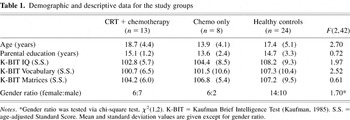
Twenty-four healthy comparison participants were also entered into the study (M age 17.4 ± 5.1 years, M years of parental education 14.7 ± 3.3). Comparison participants were a combination of siblings of the ALL participants and other members of the general community. The ALL survivors and comparison group were similar in terms of ethnicity with a distribution of 88% Caucasian/European American, 8% Hispanic, and 4% Asian-American. Descriptive information for the study groups are shown in Table 1. The chemotherapy only group appeared somewhat younger than the CRT group; however, the group comparisons did not reach statistical significance. IQ scores did not differ.
Demographic and descriptive data for the study groups

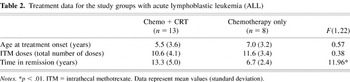
Each ALL participant's medical record was reviewed to determine the age of onset and duration of their illness, as well as the treatment regimen. The specific treatment protocols varied across participants, but included participants from Children's Cancer Study Group protocols CCG-161, CCG-162, CCG-1881, CCG-1882, CCG-1901, CCG-1922, and one participant from the United Kingdom Medical Research Council trial UKALL XI. All children were administered intrathecal methotrexate for central nervous system prophylaxis treatment at age-titrated doses (either 8, 10, or 12 mg depending on the child's age). Thirteen of the ALL participants received 18 Gy CRT plus chemotherapy regimens with intrathecal methotrexate. Eight of the participants were treated only with central nervous system chemotherapy. None of the ALL participants had evidence of CNS metastasis. Among the participants with a history of CRT, two were considered high risk at diagnosis and eleven were considered standard risk. In the group with ALL receiving only chemotherapy one participant was considered high risk at diagnosis and seven participants were considered standard risk. Summary information regarding the history of the ALL groups is shown in Table 2.
Treatment data for the study groups with acute lymphoblastic leukemia (ALL)

The ALL groups were similar in age at treatment and the total number of doses of prophylactic intrathecal methotrexate (see Table 2). The chemotherapy only group had been in remission for fewer years than the early CRT group, although in absolute terms both groups of long-term survivors had been in remission for a considerable time. The shortest period of remission for a participant was 2.9 years.
Orienting Task
The orienting task was programmed using MEL Professional v.2.01 software (Psychology Software Tools, Inc., Pittsburgh, PA) and administered on a personal computer with an Intel 486 processor. Participants were seated approximately 40 cm in front of a computer monitor and instructed to maintain their fixation at the center of the screen. A central cross appeared at the beginning of each trial and remained throughout each trial. Two boxes, each occupying approximately 1° of visual angle appeared 5° to the left and right of the fixation point. The participant was instructed to press the space bar as soon as they saw a target (a bright star) appear in one of the boxes. On cued trials one of the two boxes was brightened and remained so until a response was made. The target appeared either 150 or 800 ms following the cue. On 80% of the cued trials, the target appeared in the brightened box (valid cue trials). For the remaining cued trials the target appeared in the unbrightened box (invalid cue trials). Prior studies of children with cerebral insults have primarily found difficulties with visual orienting on short stimulus onset asynchrony (SOA) trials (Craft et al., 1992, 1994a, 1994b). Because of these previous findings, the primary focus of this study was the short SOA trials; the 800 SOA trials were included primarily to prevent anticipatory responses. There were 120 trials at 150 ms SOA and 60 trials at 800 ms SOA. In addition, 30 no cue trials at 150 ms SOA were also included as catch trials. There was an interstimulus interval of 1000 ms between trials. Children completed 10 practice trials followed by three blocks of 70 experimental trials each.
Hierarchical Attention Task
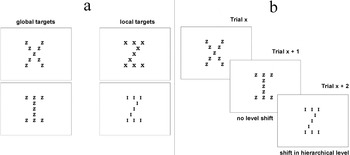
The hierarchical (global–local) task was also programmed using MEL v.2 software. Adapted from Robertson and colleagues (Robertson, 1996; Robertson et al., 1993), a task of divided hierarchical attention was administered. Children were seated approximately 40 cm in front of a computer screen and asked to respond by indicating which of two letters (an I or an X) were present on each trial by pressing one of two response keys. The stimuli were constructed hierarchically so that the target letter may occur either in the overall configuration of elements (i.e., global level) or the component elements (i.e., local level; see Figure 1a). Similar paradigms have indicated that the hierarchical level of the target on the previous trial affects the response time on subsequent trials (Robertson, 1996; Robertson et al., 1993; Ward, 1982). These paradigms have shown facilitation in response time occurs for targets at the same hierarchical level as the prior target and a cost in response time occurs for targets in which the prior trial was at a different hierarchical level (see Figure 1b).

Examples of the hierarchical stimuli are shown in Panel a. Panel b displays a sequence of three trials showing the relationship between prior and subsequent trials. Facilitation of response time is expected on Trial x + 1 and, as the hierarchical level shifts, a cost in response time is expected on Trial x + 2.
A central cross appeared for 250 ms indicating the start of a trial. The hierarchical stimulus appeared for 150 ms in the center of the screen. The stimuli were occupied approximately 4° of visual angle in both the horizontal and vertical planes. There was a 750 ms delay after each response and before the warning cue. After seeing sample stimuli, participants completed 15 practice trials followed by three blocks of trials for a total of 180 experimental trials. There were 80 global trials, 80 local trials, and 20 facilitation trials in which the target letter appeared at both the global and local level.
Statistical Methods
The primary focus of the research was to examine the effects of CRT on visual attention. Because the group with ALL and only chemotherapy treatment was small in size and appeared slightly younger in age than the group with CRT treatment, a planned comparison between the CRT and healthy comparison groups was used to evaluate the performance of the CRT group. Additional analyses comparing the chemotherapy only treatment group and the healthy comparison group were also run to examine any effect that could be detected related to receiving chemotherapy treatment alone. For the orienting task a mixed factor repeated measures multivariate analysis of variance procedure (MANOVA) was used to analyze the results with cue validity (valid, invalid) and side of target (left, right) as within subjects factors and age included as a covariate. For the global–local task a mixed factor repeated measures MANOVA procedure was used with target type (global, local) and shifts in hierarchical level (no shift, shift) as the within subjects factors and age included as a covariate.
RESULTS
Visual Orienting Task
Response times of less than 100 ms and more than 3000 ms were excluded from analyses to eliminate unusually fast or slow responses. These comprised less than 2% of all trials. Catch trials (no cue, 800 ms SOA) were excluded from the primary analysis.
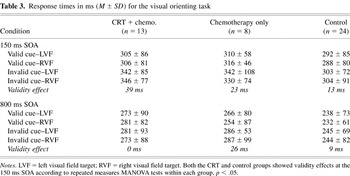
For the comparison of the CRT group and control group there was a significant two-way interaction between Group × Cue Validity [F(1,34) = 4.45, p < .05, ηp2 = .16]. Main effects were also present for cue validity [F(1,34) = 17.87, p < .01]. All remaining two- and three-way interactions were not statistically significant (all F values less than 2, all p values more than .2). As shown in Table 3 the CRT group demonstrated relatively larger difference between valid and invalid cue trials than the control group.
Response times in ms (M ± SD) for the visual orienting task

For the comparison of the chemotherapy-only treatment group and control group there was a main effect for cue validity [F(1,29) = 4.60, p < .05]. This effect was due to valid cue trials leading to faster response times than invalid cue trials across all participants (see Table 3). All other effects in the model demonstrated F-values of less than 1.5 with p-values greater than .2.
Post-hoc analysis of the 800 ms SOA trials was conducted to evaluate whether any group differences were present for these trials. The mixed factor repeated measures MANOVA comparing the CRT and control groups did not indicate any significant effects. All F-values were less than one with the exception of a trend toward an overall difference in response time [F(1,34) = 3.18, p < .09]. The comparison of the chemotherapy-only group and the control group also showed no significant effects (all F-values less than 1).
Hierarchical Attention Task
For the global–local attention task, all incorrect trials or responses of less than 100 ms or more than 3000 ms were excluded from analyses. This comprised less than 5% of all trials. The error rate for the CRT, chemotherapy, and control groups were 4%, 4%, and 3%, respectively.
Comparison between the CRT and control groups
There was a significant two-way interaction between Group × Shifts in Hierarchical Level [F(1,34) = 4.19, p < .05, ηp2 = .11]. There were also main effects for target type [F(1,34) = 8.31, p < .01] and shifts in hierarchical level [F(1,34) = 6.33, p < .01]. There was no significant three-way interaction [F(1,34) = 3.15, p < .09] and the main effect for group was not significant (F < 1). Evaluation of the two target types analyzed separately indicated the interaction between Group × Shifts in Hierarchical Levels was predominantly due to the difference for global–level targets [F(1,34) = 5.85, p < .05]. There was no interaction between Group × Shifts in Hierarchical Levels when local–level target trials were analyzed separately [F(1,34) = 1.08, p > .30; see Table 4]; however, it is noted that the three-way interaction in the overall analysis was not statistically significant. As seen in Table 4, overall response times were also faster for local than global level targets.
Response time in ms (M ± SD) for the hierarchical attention task

Comparison between the chemotherapy only and control groups
There were no significant interactions between group and any of the within subjects effects (all Fs < 1). There was a main effect for target type reflecting faster responses to local than global targets [F(1,29) = 4.80, p < .05] and a main effect for shifting reflecting a cost in response time with changes in the hierarchical level of the target across trials [F(1,29) = 4.76, p < .05]. As seen in Table 4, the patterns of performance between the chemotherapy only and control groups were similar.
Early Versus Late Exposure to CRT
Among the participants who had received CRT, 7 participants had been treated before the age of 4 years (M age of onset 2.9 ± 0.7 years) and 6 had been treated after the age of 4 years (M age of onset 8.7 ± 3.0 years). The mean age at the time of study participation was 17.2 years for the early onset group and 20.2 years for the late onset group. As exploratory analyses, the performance of each of these subgroups was evaluated relative to the control group.
Visual orienting task
The data for the early and late onset groups are shown in Table 5. The response time values for each condition were analyzed using the same mixed factor repeated measures ANOVA models as reported above. For the comparison between the early onset CRT and control groups, there was a significant two-way interaction between Group × Cue Validity [F(1,29) = 5.27, p < .05, ηp2 = .22], reflecting a larger difference between valid and invalid cue response times for the early onset CRT group. The remaining main effects and interactions were not significant (all ps > .2). The comparison between late onset CRT and control groups revealed no significant group differences in response times across conditions (all ps > .2).
Response times in ms (M ± SD) for the visual orienting task according to age at treatment

Hierarchical attention task
The data for the early and late onset groups are shown in Table 6. The same mixed factor repeated measures MANOVA models were used for this task as reported above. For the early onset CRT group, there was a significant three-way interaction between Group × Target Type × Shifts in Hierarchical Level [F(1,28) = 5.31, p < .05, ηp2 = .16]. There was a two-way interaction between Group × Shifts in Hierarchical Level [F(1,28) = 5.41, p < .05] as well as main effects for target type [F(1,28) = 5.62, p < .05] and shifts in hierarchical level [F(1,28) = 4.34, p < .05]. All remaining effects had F values of less than 1. As seen in Table 6, the three-way interaction was due to a larger cost when shifting attention from the local level to the global level for the early onset CRT group than for the control group. This effect was confirmed by repeating the mixed factor MANOVA procedures separately for local target and global targets. This demonstrated a significant two-way interaction between group and shifts in hierarchical level for global targets [F(1,28) = 7.91, p < .01], but not local targets (F < 1).
Response time in ms (M ± SD) for the hierarchical attention task for age at treatment effects

For the late onset CRT group there were only main effects for target type, F(1,28) = 7.37, p < .05, shifts in hierarchical level, F(1,28) = 44.16, p < .01, and a two-way interaction between target type and shifts in hierarchical level, F(1,28) = 7.26, p < .05. All remaining effects had F values of less than 1.
Functional Significance of Visual Attention Effects
The potential functional significance of performance on the visual attention tests was examined in a post hoc fashion by conducting Spearman rank-order correlation analyses within the ALL participants. The degree of attention shifting effects (standardized RT for valid vs. invalid cue trials, RT for global targets on level-repeated vs. level-shifted trials) were examined in relation to scores for the Kaufman Brief Intelligence Test (Kaufman, 1985; see Table 1). This cognitive test contains two subtests: Vocabulary, a measure of crystalized knowledge, and Matrices, a measure of fluid reasoning. The correlation values for the visual orienting and hierarchical attention tasks with Full Scale IQ (r = −.08 and r = −.24, respectively) and Vocabulary (r = −.01 and r = −.18, respectively) were not significant. Larger relationships were evident between attention shifting and Matrices (r = −.34, n.s., and r = −.45, p < .05, respectively).
DISCUSSION
In the present report we evaluated the integrity of specific visual attention operations in long-term survivors of ALL treated with CRT and chemotherapy compared to a demographically matched comparison group. A group of long-term survivors treated with chemotherapy only were also compared to the control group. Individuals receiving CRT as children demonstrated exaggerated cue validity effects on a task of visual orienting. In addition, the group who had received CRT showed exaggerated level-repetition effects across trials on a global–local processing task. It should be noted that the specific treatment protocols of the participants in this study varied considerably. The results suggest there are at least some common areas of difficulty in visual attention that arise across individuals treated with CRT and central nervous system chemotherapy. More specific patterns of attention effects related to particular combinations of chemotherapy agents and CRT would likely not be detected with this study design.
In contrast to the patterns of performance in the participants receiving CRT, the chemotherapy-only treatment group demonstrated similar performance to the control group on both visual attention tasks. Although this study was not designed to provide a strong test of the effects of chemotherapy only treatment on visual attention, the similar pattern of performance between the chemotherapy only and control group suggests a specific role for the addition of CRT in creating certain attention difficulties. It is possible, however, that chemotherapy regimens without CRT lead to attention difficulties that are evident on different types of attention tasks than used in the present study.
Component Visual Attention Operations Following CRT
The performance of long-term survivors of ALL treated with CRT suggested difficulties with shifting attention for both spatial locations and hierarchical patterns. The pattern of exaggerated cue validity effects on the covert orienting paradigm indicates difficulties with the disengagement operation, a critical component of shifting attention to specific spatial locations (Posner, 1988). In addition, the exaggerated level repetition effects for hierarchical stimuli indicate broader difficulties with shifting attention during object-based perceptual analysis (Rafal & Robertson, 1995; Robertson, 1996). Although both of these performance patterns have been noted in adults with focal parietal lobe injury, exaggerated cue validity effects in spatial orienting have also been associated with diffuse perinatal white matter injury (Craft et al., 1994b) and early disruption of catecholamine systems (Craft et al., 1992; Heffelfinger et al., 1997). Thus, a variety of both focal and diffuse brain insults are associated with this performance pattern. The similar pattern of performance in children with perinatal brain injury may be particularly relevant because diffuse white matter injury is the most likely brain change to be found on neuroimaging exams of individuals with CRT treatment (Bleyer & Griffin, 1980; Schultheiss et al., 1995). It should be noted that specific neuroanatomical findings were not confirmed in the present sample, and these presumed changes are inferred from findings in other studies of CRT.
Attention shifting in hierarchical stimulus processing has received less attention from researchers compared to the larger body of research examining spatial orienting and selective attention to global versus local form. A similar pattern of difficulties with hierarchical attention shifting as found with the CRT group have been reported for children with diffuse cortical stroke (Schatz et al., 1998). The developmental pattern and effects of childhood brain insults on this ability, however, requires further study. The exploratory analyses of this visual attention measure with IQ test results indicated performance on this measure may also relate to higher-level cognitive functioning. The precise increase in sensitivity over more traditional neuropsychological measures of attention and functional meaning of performance on this measure requires further evaluation.
The performance pattern for the hierarchical attention task further indicated that this attention shifting difficulty was largely limited to shifting from the local level of analysis to the global-level of analysis. The pattern shown by the control group was a larger level-shifting effect for local-level targets than for global-level targets, whereas the CRT group showed a more symmetric pattern of level repetition effects. It is of note that an asymmetry in the size of the level-repetition effect does not necessarily occur in level-repetition paradigms (Lamb et al., 2000; Lamb & Yund, 1993; Robertson, 1996). In addition, an asymmetry in the size of level-repetition effects in the opposite direction as found in the present study has also been reported (Lamb et al., 1999). It should be noted that in all of these studies level-repetition effects have been found for both global and local level targets, and the potential factors responsible for asymmetries in the size of level-repetition effects have not been described.
One difference between the hierarchical task in this study and prior level-repetition priming tasks was the overall advantage in response time for local-level targets. Faster response times to global-level targets are typically found (Robertson & Lamb, 1991). It is possible that this difference is partly responsible for the asymmetry in the size of the level repetition effect for the control group. The local-level advantage in response times may be due to the larger size and somewhat larger dispersion of the local-level elements in the present task compared to those used by other researchers (e.g., cf. Lamb et al., 2000; Schatz & Erlandson, 2003). The hierarchical stimulus task as constructed in the current study, however, has shown a pattern of cortical activity with event-related potentials (ERPs) that is consistent with those found with other hierarchical stimuli (Schatz & Erlandson, 2003). This includes the expected asymmetries in ERP amplitudes to hierarchical stimuli over posterior electrodes and repetition priming effects in the amplitude of the P1 ERP component (Schatz & Erlandson, 2003). Thus, the neural processing during this hierarchical task appears to be similar in many ways to hierarchical tasks used by other researchers.
Age at Treatment Effects
The analyses of CRT effects indicated that the performance pattern found in the CRT group was most evident in the subgroup of participants receiving CRT early in life. Those receiving CRT later in childhood showed a performance pattern more similar to the control group. Although the subgroup of individuals with early treatment included a small number of participants and heterogeneous treatment protocols, the interpretation of this data is strengthened by the consistency of this finding with the pattern of data reported by Lockwood et al. (1999). Lockwood et al. demonstrated a wider range of deficient attention skills with early onset CRT than late onset CRT, especially for basic sensory selection aspects of attention.
The results of the CRT subgroup analyses highlights the importance of examining age at treatment in order to understand performance patterns of ALL survivors treated with CRT. Combining early and late onset treatment subgroups could attenuate the findings from such an overall group analysis because of the heterogeneity of the group (see Shallice, 1988, pp. 203–216). If based on the overall group findings, the effects of CRT treatment on visual attention in the present study would be underestimated for the early onset group and overestimated for the later onset group.
Study Limitations and Conclusions
The primary limitation of the present data is that the sample size, though comparable to many studies of long-term survivors of ALL, is small in absolute terms and includes heterogeneous treatment protocols. In particular, the exploration of differences between CRT early versus late in childhood was based on small samples that limit the possible generalization of these findings. It also would have been a stronger test of the effects of CRT to have sufficient numbers of long-term survivors of cancer without CRT treatment to use as the comparison group. Alternately, however, the size of the effects between groups for performance on these attention paradigms suggests these group differences are not trivial in size, and that these types of response time measures of attention skills may be a fruitful method for understanding the effects of CRT.
References
REFERENCES
Anderson, V.,
Smibert, E.,
Ekert, H., &
Godber, T.
(1994).
Intellectual, educational, and behavioural sequelae after cranial
irradiation and chemotherapy.
Archives of Disease in Childhood,
70,
476–483.Google Scholar
Balsom, W.R.,
Bleyer, A.,
Bobison, L.L.,
Heyn, R.M.,
Meadows, A.T.,
Sitarz, A.,
Blatt, J.,
Sather, H.N., &
Hammond, G.D.
(1991).
Intellectual function in long-term survivors of childhood acute
lymphoblastic leukemia: Protective effect of pre-irradiation
methotrexate? A Children's Cancer Study Group study.
Medicine and Pediatric Oncology,
19,
486–492.Google Scholar
Bleyer, W.A. &
Griffin, T.W.
(1980).
White matter nectosis, mineralizing microangiopathy, and
intellectual abilities in survivors of childhood leukemia: associations
with central nervous system irradiation and methotrexate therapy. In
H.A. Gilbert &
A.R. Kagan (Eds.),
Radiation damage to the nervous system (pp.
155–174).
New York:
Raven Press.
Brouwers, P. &
Poplack, D.
(1990).
Memory and learning sequelae in long-term survivors of acute
lymphoblastic leukemia: Association with attention deficit.
American Journal of Pediatric Hematology Oncology,
12,
174–181.Google Scholar
Brouwers, P.,
Riccardi, R.,
Poplack, D., &
Fedio, P.
(1984).
Attentional deficits in long-term survivors of childhood acute
lymphoblastic leukemia (ALL).
Journal of Clinical Neuropsychology,
6,
325–336.Google Scholar
Chessels, J.M.,
Cox, T.C.,
Kendall, B.,
Cavanagh, N.P.,
Jannoun, L., &
Richards, S.
(1990).
Neurotoxicity in lymphoblastic leukaemia: comparison of oral and
intramuscular methotrexate and two doses of radiation.
Archives of Disease in Childhood,
65,
416–422.Google Scholar
Christie, D.,
Leiper, A.D.,
Chessells, J.M., &
Vargha-Khadem, F.
(1995).
Intellectual performance after presymptomatic cranial radiotherapy
for leukaemia: Effects of age and sex.
Archives of Diseases in Childhood,
73,
136–140.Google Scholar
Ciesielski, K.T.,
Yanofsky, R.,
Ludwig, R.N.,
Hill, D.E.,
Hart, B.L.,
Astur, R.S., &
Snyder, T.
(1994).
Hypoplasia of the cerebellar vermis and cognitive deficits in
survivors of childhood leukemia.
Archives of Neurology,
51,
985–993.Google Scholar
Cohen, R.A.,
Sparling-Cohen, Y.A., &
O'Donnell, B.F.
(1993).
The neuropsychology of attention.
New York:
Plenum Press.
Copeland, D.R.,
Dowell, R.E.,
Fletcher, J.M., &
Bordeaux, D.
(1988).
Neuropsychological effects of childhood cancer treatment.
Journal of Child Neurology,
3,
53–62.Google Scholar
Copeland, D.R.,
Fletcher, J.M.,
Pfefferbaum, B.,
Jaffe, N.,
Ried, H., &
Maor, M.
(1985).
Neurological sequelae of childhood cancer in long-term survivors.
Pediatrics,
75,
745–753.Google Scholar
Cousens, P.,
Ungerer, J.A.,
Crawford, J.A., &
Stevens, M.
(1988a).
Cognitive effects of childhood leukemia therapy: A case for four
specific deficits.
Journal of Pediatric Psychology,
16,
475–488.Google Scholar
Cousens, P.,
Waters, B.,
Said, J., &
Stevens, M.
(1988b).
Cognitive effects of cranial irradiation in leukaemia: A survey and
meta-analysis.
Journal of Child Psychology and Psychiatry and Allied Disciplines,
29,
839–852.Google Scholar
Craft, S.,
Gourovitch, M.L.,
Dowton, B.,
Swanson, J.M., &
Bonforte, S.
(1992).
Lateralized deficits in visual attention in males with
developmental dopamine depletion.
Neuropsychologia,
30,
341–352.Google Scholar
Craft, S.,
Schatz, J.,
Glauser, T.,
Lee, B., &
DeBaun, M.R.
(1994b).
The effects of bifrontal stroke during childhood on visual
attention: Evidence from children with sickle cell anemia.
Developmental Neuropsychology,
10,
285–297.Google Scholar
Craft, S.,
White, D.A.,
Park, T.S., &
Figiel, G.
(1994a).
Visual attention in children with perinatal brain injury:
Asymmetric effects of bilateral lesions.
Journal of Cognitive Neuroscience,
6,
165–173.Google Scholar
Delis, D.C.,
Robertson, L.C., &
Efron, R.
(1986).
Hemispheric specialization of memory for visual hierarchical
stimuli.
Neuropsychologia,
24,
205–214.Google Scholar
Fink, G.R.,
Halligan, P.W.,
Marshall, J.C.,
Frith, C.D.,
Frackowiak, R.S.J., &
Dolan, R.J.
(1996).
Where in the brain does visual attention select the forest and the
trees?
Nature,
382,
626–628.Google Scholar
Fletcher, J.M. &
Copeland, D.R.
(1988).
Neurobehavioural effects of central nervous system prophylactic
treatment of cancer in children.
Journal of Clinical and Experimental Neuropsychology,
10,
495–538.Google Scholar
Goff, J.R.,
Anderson, H.R., &
Cooper, P.F.
(1980).
Distractibility and memory deficits in long-term surivors of acute
lymphoblastic leukemia.
Developmental and Behavioral Pediatrics,
1,
158–161Google Scholar
Halberg, F.E.,
Kramer, J.H.,
Moore, I.M.,
Wara, W.M.,
Matthay, K.K., &
Ablin, A.R.
(1992).
Prophylactic cranial irradiation dose effects on late cognitive
function in children treated for acute lymphoblastic leukemia.
International Journal of Radiation Oncology, Biology, and Physics,
22,
13–16.Google Scholar
Heffelfinger, A.,
Craft, S., &
Shyken, J.
(1997).
Visual attention in children with prenatal cocaine exposure.
Journal of the International Neuropsychological Society,
3,
237–245.Google Scholar
Hertzberg, H.,
Huk, W.J.,
Ueberall, M.A.,
Langer, T.,
Meier, W.,
Dopfer, R.,
Skalej, M.,
Lackner, H.,
Bode, U.,
Janben, G.,
Zintel, F., &
Beck, J.D.
(1997).
CNS late effects after ALL therapy in childhood. Part I:
Neuroradiological findings in long-term survivors of ALL—an
evaluation of the interferences between morphology and
neuropsychological performance.
Medical and Pediatric Oncology,
28,
387–400.Google Scholar
Jankovic, M.,
Brouwers, P.,
Valsecchi, M.G.,
Veldhuizen, A.V.,
Huisman, J.,
Kamphuis, R.,
Kingma, A.,
Mor, W.,
Van Dongen-Melman, J.,
Ferronato, L.,
Mancini, M.A.,
Spinetta, J.J., &
Masera, G.
(1994).
Association of 1800 cGy cranial irradiation with intellectual
function in children with acute lymphoblastic leukaemia.
Lancet,
344,
224–227.Google Scholar
Jannoun, L.
(1983).
Are cognitive and educational development affected by age at which
prophylactic therapy is given in acute lymphoblastic leukemia?
Archives of Disease in Childhood,
58,
953–958.Google Scholar
Johnson, M.H.,
Tucker, L.A.,
Stiles, J., &
Trauner, D.
(1998).
Visual attention in infants with perinatal brain damage: Evidence
of the importance of anterior lesions.
Developmental Science,
1,
53–58.Google Scholar
Kaufman, A.S.
(1985).
The Kaufman Brief Intelligence Test (K-BIT).
Circle Pines, MN:
American Guidance Services.
Lamb, M.R.,
Pond, H.M., &
Zahir, G.
(2000).
Contributions of automatic and controlled processes to the analysis
of hierarchical structure.
Journal of Experimental Psychology: Human Perception and
Performance,
26,
234–245.Google Scholar
Lamb, M.R. &
Yund, E.W.
(1993).
The role of spatial frequency in the processing of hierarchically
organized stimuli.
Perception and Psychophysics,
54,
773–784.Google Scholar
Lamb, M.R.,
Yund, E.W., &
Pond, H.M.
(1999).
Is attentional selection to different levels of hierarchical
structure based on spatial frequency?
Journal of Experimental Psychology: General,
128,
88–94.Google Scholar
Lansky, S.B.,
Cairns, N.U.,
Lansky, L.L.,
Cairns, G.F.,
Stephenson, L., &
Garin, G.
(1984).
Central nervous system prophylaxis: Studies showing impairment in
verbal skills and academic achievement.
American Journal of Pediatric Hematology/Oncology,
6,
83–90.Google Scholar
Lockwood, K.A.,
Bell, T.S., &
Colegrove, R.W.
(1999).
Long-term effects of cranial radiation therapy on attention
functioning in survivors of childhood leukemia.
Journal of Pediatric Psychology,
24,
55–66.Google Scholar
Michimata, C.,
Okubo, M., &
Mugishima, Y.
(1999).
Effects of background color on the global and local processing of
hierarchically organized stimuli.
Journal of Cognitive Neuroscience,
11,
1–8.Google Scholar
Moore, I.M.,
Kramer, J.H.,
Wara, W.,
Halberg, F., &
Ablin, A.R.
(1991).
Cognitive function in children with leukemia. Effect of radiation
dose and time since irradiation.
Cancer,
68,
1913–1917.Google Scholar
Mulhern, R.K.,
Fairclough, D., &
Ochs, J.
(1991).
A prospective comparison of neuropsychologic performance of
children surviving leukemia who received 18-Gy, or 24-Gy, or no cranial
irradiation.
Journal of Clinical Oncology,
9,
1348–1356.Google Scholar
Mullenix, P.J.,
Kernan, W.J.,
Schunior, A.,
Howes, A.,
Waber, D.P.,
Sallan, S.E., &
Tarbell, N.J.
(1994).
Interactions of steroid, methotrexate, and radiation determine
neurotoxicity in an animal model to study therapy for childhood
leukemia.
Pediatric Research,
35,
171–178.Google Scholar
Navon, D.
(1977).
Forest before trees: The precedence of global features in visual
perception.
Cognitive Psychology,
9,
353–383.Google Scholar
Ochs, J.,
Mulhern, D.,
Fairclough, D.,
Parvey, L.,
Whitaker, J., &
Ch'ien, L.
(1991).
Comparison of the neuropsychologic functioning and clinical
indicators of neurotoxicity in long-term survivors of childhood
leukemia given cranial radiation or parenteral methotrexate: A
prospective study.
Journal of Clinical Oncology,
9,
145–151.Google Scholar
Posner, M.I.
(1980).
Orienting of attention. The VIIth Sir Frederic Bartlett Lecture.
Quarterly Journal of Experimental Psychology,
32,
3–25.Google Scholar
Posner, M.I.
(1988).
Structures and functions of selective attention. In
T. Boll &
B. Bryant (Eds.),
Clinical neuropsychology and brain function: Research, measurement,
and practice (pp.
173–202).
Washington DC:
American Psychological Association.
Rafal, R.D. &
Robertson, L.C.
(1995).
The neurology of visual attention. In
M. Gazzaniga (Ed.),
Handbook of cognitive neuroscience (pp.
625–648).
Cambridge, MA:
MIT Press.
Robertson, L.C.
(1996).
Attention persistence for features of hierarchical patterns.
Journal of Experimental Psychology: General,
125,
227–249Google Scholar
Robertson, L.C.,
Egly, R.,
Lamb, M.R., &
Kerth, L.
(1993).
Spatial attention and cuing to global and local levels of
hierarchical structure.
Journal of Experimental Psychology: Human Perception and
Performance,
19,
471–487.Google Scholar
Robertson, L.C. &
Lamb, M.R.
(1991).
Neuropsychological contributions to theories of part/whole
organization.
Cognitive Psychology,
23,
299–330.Google Scholar
Robertson, L.C.,
Lamb, M.R., &
Knight, R.T.
(1988).
Effects of lesions of temporal-parietal junction on perceptual and
attentional processing in humans.
Journal of Neuroscience,
8,
3757–3769.Google Scholar
Robison, L.L.,
Nesbit, M.E.,
Sather, H.N.,
Meadows, A.T.,
Ortega, J.A., &
Hammond, G.D.
(1984).
Factors associated with IQ scores in long-term survivors of
childhood acute lymphoblastic leukemia.
American Journal of Pediatric Hematology/Oncology,
6,
115–121.Google Scholar
Rogers, J.,
Britton, P.G.,
Morris, R.G.,
Kernahan, J., &
Craft, A.
(1992).
Memory after treatment for acute lymphoblastic leukemia.
Archives of Disabled Children,
67,
266–268.Google Scholar
Rubenstein, C.L.,
Varni, J.W., &
Katz, E.R.
(1990).
Cognitive functioning in long-term survivors of childhood leukemia:
A prospective analysis.
Journal of Developmental Behavioral Pediatrics,
11,
301–305.Google Scholar
Schatz, J.,
Craft, S.,
DeBaun, M.R., &
Koby, M.
(1998).
Spatial deficits following unilateral versus bilateral
childhood stroke [Abstract].
Journal of the International Neuropsychological Society,
4,
71.Google Scholar
Schatz, J. &
Erlandson, F.B.
(2003).
Level-repetition effects in hierarchical stimulus processing:
Timing and location of cortical activity.
International Journal of Psychophysiology,
47,
255–269.Google Scholar
Schatz, J.,
Kramer, J.H.,
Ablin, A., &
Matthay, K.K.
(2000).
Processing speed, working memory, and IQ: A developmental model of
cognitive deficits following cranial radiation therapy.
Neuropsychology,
14,
189–200.Google Scholar
Schultheiss, T.E.,
Kun, L.E.,
Ang, K.K., &
Stephens, L.C.
(1995).
Radiation response of the central nervous system.
International Journal of Radiation Oncology: Biology, Physics,
31,
1093–1112.Google Scholar
Schunior, A.,
Mullenix, P.J.,
Landy, H.,
Zengel, A.E.,
Howes, A., &
Tarbell, N.J.
(1994).
Radiation effects on growth are altered in rats by prednisone and
methotrexate.
Pediatric Research,
34,
416–423.Google Scholar
Shallice, T.
(1988).
From neuropsychology to mental structure.
New York:
Cambridge University Press.
Überall, M.A.,
Haupt, K.,
Hertzberg, H.,
Langer, T.,
Meier, W.,
Huk, W.J.,
Beck, J.D., &
Wenzel, D.
(1996a).
Quantitative EEG in long-term survivors of acute lymphoblastic
leukemia.
Pediatric Neurology,
15,
293–298.Google Scholar
Überall, D.
(1996b).
P300 abnormalities in long-time survivors of acute lymphoblastic
leukemia in childhood—side effects of CNS prophylaxis?
Neuropediatrics,
27,
130–135.Google Scholar
Van Kleeck, M.H.
(1989).
Hemispheric differences in global versus local processing of
hierarchical visual stimuli by normal subjects: New data and a
meta-analysis of previous data.
Neuropsychologia,
27,
1165–1178.Google Scholar
Waber, D.P.,
Tarbell, N.J.,
Fairclough, D.,
Atmore, K.,
Castro, R.,
Isquith, P.,
Lussier, F.,
Romero, I.,
Carpernter, P.J.,
Schiller, M., &
Sallan, S.E.
(1995).
Cognitive sequelae of treatment in childhood acute lymphoblastic
leukemia: Cranial radiation requires an accomplice.
Journal of Clinical Oncology,
13,
2490–2496.Google Scholar
Waber, D.P.,
Tarbell, N.J.,
Kahn, C.M.,
Gelber, R.D., &
Sallan, S.E.
(1992).
The relationship of sex and treatment modality to
neuropsychological outcome in childhood acute lymphoblastic
leukemia.
Journal Clinical Oncology,
10,
810–817.Google Scholar
Waber, D.P.,
Urion, K.D.,
Tarbell, N.H.,
Niemeyer, C.C.,
Gelber, R., &
Sallan, S.E.
(1990).
Late effects of central nervous system treatment of acute
lymphoblastic leukemia in childhood are sex-dependent.
Developmental Medicine and Child Neurology,
32,
238–248.Google Scholar
Ward, L.M.
(1982).
Determinants of attention to local and global features of visual
forms.
Journal of Experimental Psychology: Human Perception and
Performance,
8,
562–581.Google Scholar
Williams, J.M.,
Ochs, J., &
Davis, K.S.
(1986).
The subacute effects of CNS prophylaxis for acute lymphoblastic
leukemia on neuropsychogical performance: A composition of four
protocols.
Archives of Clinical Neuropsychology,
1,
183–192.Google Scholar
Demographic and descriptive data for the study groups
Treatment data for the study groups with acute lymphoblastic leukemia (ALL)
Examples of the hierarchical stimuli are shown in Panel a. Panel b displays a sequence of three trials showing the relationship between prior and subsequent trials. Facilitation of response time is expected on Trial x + 1 and, as the hierarchical level shifts, a cost in response time is expected on Trial x + 2.
Response times in ms (M ± SD) for the visual orienting task
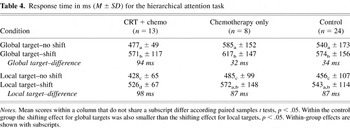
Response time in ms (M ± SD) for the hierarchical attention task
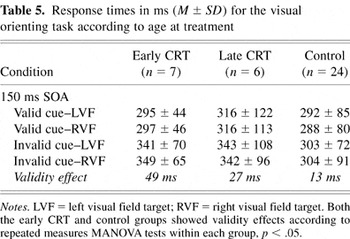
Response times in ms (M ± SD) for the visual orienting task according to age at treatment
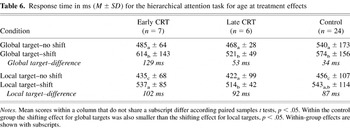
Response time in ms (M ± SD) for the hierarchical attention task for age at treatment effects
 You have
Access
- 19
- Cited by