

Introduction
Aquilaria Lam. (Thymelaeaceae) is an endangered tropical tree, valuable for its fragrant agarwood (Barden et al., Reference Barden, Anak, Mulliken and Song2000). The tree is currently listed in the trade regulations in the CITES list and categorized as Vulnerable in the IUCN Red List (UNEP-WCMC, 2015). The formation of agarwood in Aquilaria trees is initiated by natural injury or manually inflicting the stem. Local people would wound the trees using machete, nails or drills, creating an open wound for further pathogenic infection, which triggers the defence mechanism to release agarwood. Without human intervention, agarwood formation in wild Aquilaria trees happens randomly due to natural factors. Commercial and illegal harvesters commonly apply indiscriminate felling method without prior confirmation on the agarwood content and quality during the search process for agarwood, directly threatening the survival of the species in the wild (Barden et al., Reference Barden, Anak, Mulliken and Song2000).
There are 21 Aquilaria species recorded in the world and they are distributed in the Indomalesian region (Mabberley, Reference Mabberley2008; The Plant List, 2013). Five of them are found in Malaysia, with Aquilaria malaccensis Lam. being the most commonly occurring species (Faridah-Hanum et al., Reference Faridah-Hanum, Mustapa, Lepun, Tuan Marina, Nazre, Alan and Mohamed2009). The other species are Aquilaria beccariana Teigh, Aquilaria hirta Ridl., Aquilaria microcarpa Baill. and Aquilaria rostrata Ridl. Being the first Aquilaria species to be listed in Appendix II of the Convention of International Trade in Endangered Species of Fauna and Flora (CITES) in 1995, A. malaccensis is still widely available in natural populations of two other sourcing countries besides Malaysia, which are Indonesia and India. Natural populations of A. malaccensis in India concentrates particularly in the Assam Province; while in Indonesia on the Sumatra island. However, due to illegal agarwood harvesting, which is a major problem in most sourcing countries, the number may be declining over the years (Barden et al., Reference Barden, Anak, Mulliken and Song2000). Conservation efforts are therefore necessary to ensure the continued survival of these species.
To identify areas of conservation priority, information of the genetic diversity of the species is crucial. The internal transcribed spacer (ITS) region in plants is known to be an effective genetic marker to estimate intraspecific genetic variation. Unlike chloroplast DNA, which is chiefly maternally inherited, the ITS is from nuclear DNA and thus contains biparentally inherited information (Neves and Forrest, Reference Neves, Forrest, Cagney and Emili2011), providing better resolution in the estimation of genetic variation. Due to its universality and simplicity to amplify, the ITS region is among the easiest to isolate in most low-copy nuclear loci in the plant genome (Alvarez and Wendel, Reference Alvarez and Wendel2003). The first report that utilized ITS to differentiate populations of Aquilaria was carried out by Shen et al. (Reference Shen, Yan, Zhao, Pang and Zhao2008), who studied nine different A. sinensis populations in China. However, information on population structure and genetic variation of Aquilaria species in Malaysia is still lacking. Therefore, in this study, we evaluated the feasibility of ITS region to determine the genetic variation within Aquilaria species from natural populations in Peninsular Malaysia and their relationship to other populations in different geographical regions, and propose a practical approach in developing conservation strategies for Aquilaria in Peninsular Malaysia.
Materials and methods
Plant materials
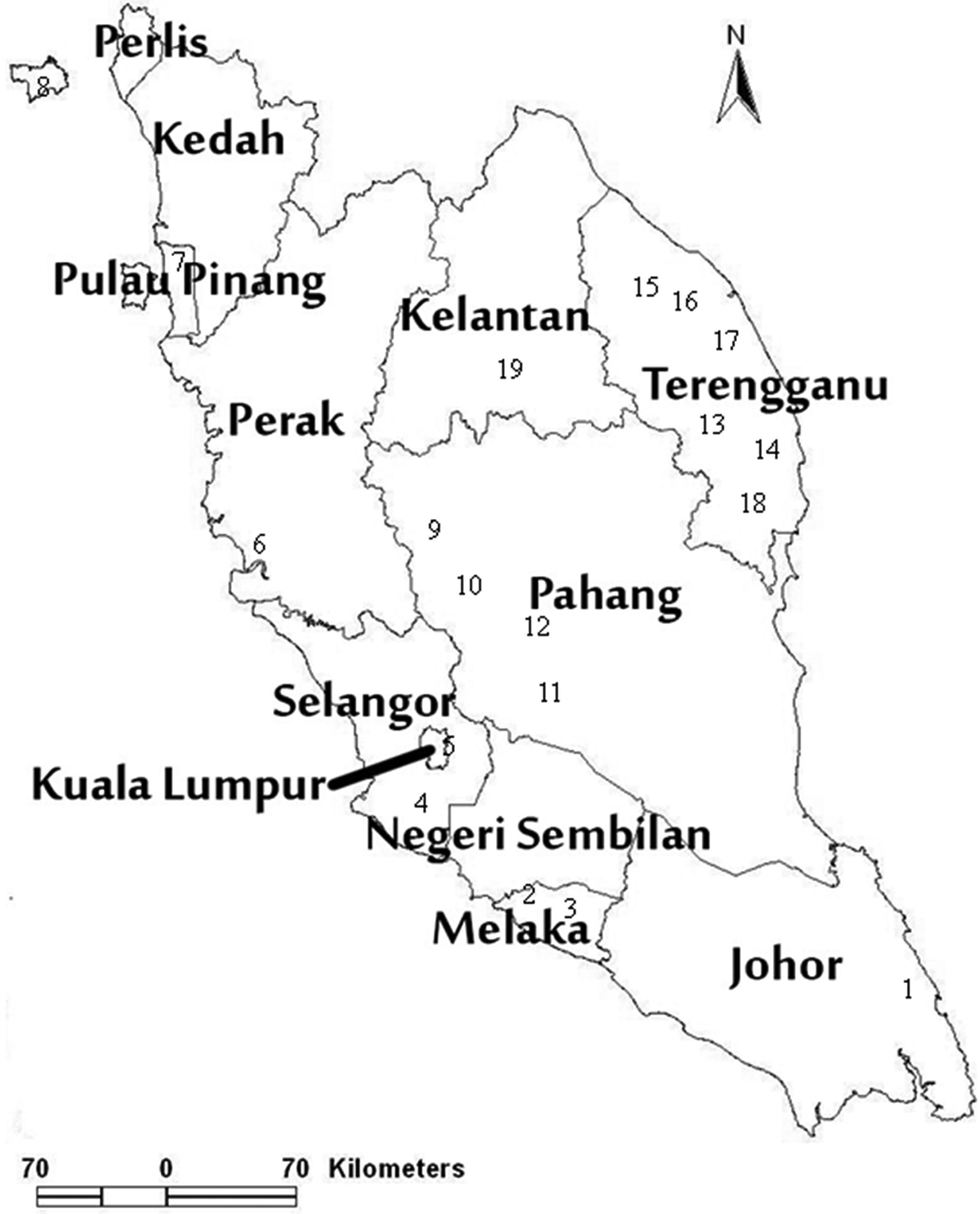
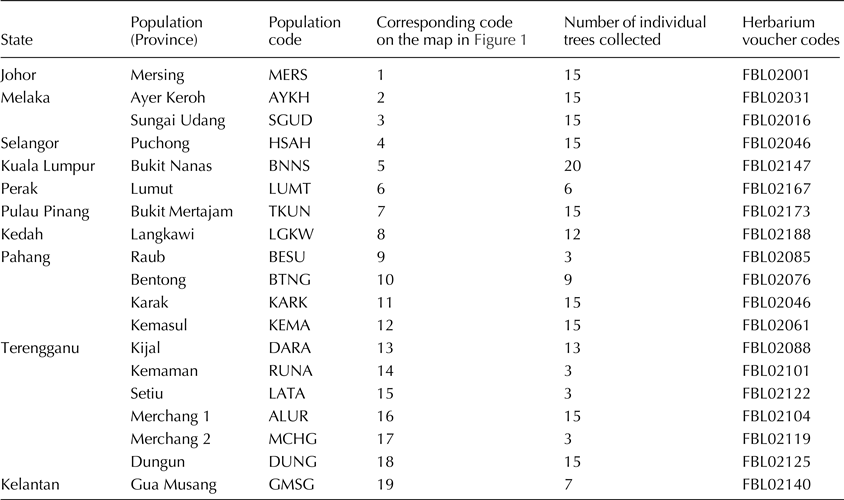
For the populations in Peninsular Malaysia, sample collections were carried out between March and May 2015. Fresh leaves or small pieces of broken stem (in situations where leaves could not be retrieved) were sampled from a number of individuals representing 19 different natural populations (Table 1 and Figure 1). Permissions to collect the specimens were given by the Forestry Department of Peninsular Malaysia and the respective State Forestry Departments. The exact coordinates/locations for each population were kept discrete to protect the populations from being exploited. All samples were kept in laminated aluminium zip lock packets, stored on ice during transportation to the laboratory, and later kept at −80°C. Voucher specimens were deposited at the Forest Biotech Laboratory, Faculty of Forestry, Universiti Putra Malaysia, Serdang, Selangor, Malaysia. Samples in the form of dried leaves of four and two individuals of A. malaccensis from India and Indonesia, were donated by a trader and Dr Maman Turjaman (Forest Research and Development Agency, Bogor, Indonesia), respectively. The Indian samples originated from the Assam state, northeast of India, and the Indonesian samples were from ex situ trees planted at the Bogor Botanical Garden and were originally from the Jambi Province, east coast of Central Sumatra.
Distribution of the 19 (listed from 1 to 19) Aquilaria populations from Peninsular Malaysia used in this study. Population names are listed in Table 1.

List of collected samples based on location

DNA extraction
For leaf samples, 50 mg was required for each extraction. The plant genomic DNA was extracted using the FavorPrep™ Plant Genomic DNA Extraction Mini Kit (Favorgen, Taiwan), according to the manufacturer's protocol. Wood samples were extracted using the DNeasy® Plant Mini Kit (Qiagen, Germany), with minor modifications according to the protocol proposed by Jiao et al. (Reference Jiao, Yin, Chen and Jiang2013). The quantity and quality were determined by spectrophotometry (NanoPhotometer™, IMPLEN, Germany). For PCR amplifications, the ITS region, consisting the ITS1, 5.8S-coding region and ITS2, were amplified using the universal forward primer ITS92 5′AAGGTTTCCGTAGGTGAAC3′and reverse primer ITS75 5′TATGCTTAAACTCAGCGGG3′ (Baldwin, Reference Baldwin1992). The final reaction volume was 25 µl, containing 12.5 µl of 2× PCRBIO Taq Mix Red (PCRBiosystems, UK), 10 mM of forward and reverse primers, and 25 ng of genomic DNA. For negative control, distilled water was added instead of DNA to verify absence of contamination. PCR amplification was conducted in a SpeedCycler2 Thermal Cycler (Analytik jena, Germany), programmed for 1 min at 95°C; 40 cycles for 15 s at 95°C, 15 s at 50°C and 1 min at 72°C; and a final 3 min extension at 72°C. Amplification products were separated using electrophoresis on 1% agarose gels in 1× TAE (tris-acetate-EDTA) buffer, stained with ethidium bromide and photographed under the UV light. PCR products with successful amplifications were sent for direct sequencing from both ends at the 1st Base Laboratory Sdn. Bhd., Malaysia.
Data analysis
Complimentary strands of the ITS region were assembled and the GC content of the sequence was calculated using Gene Runner v3.05 (Hastings Software Inc., USA). Sequences were saved in FASTA. The ITS sequences obtained from the Aquilaria voucher specimens were deposited in the NCBI GenBank for references. Sequences obtained from the samples collected from the field were then checked for homology using the NCBI BLAST program (http://www.ncbi.nlm.nih.gov/BLAST/) to identify their respective species origin in a single population. Nucleotide multiple alignments were conducted with ClustalW embedded in MEGA6 (Tamura et al., Reference Tamura, Stecher, Peterson, Filipski and Kumar2013). The genetic distances were generated with Kimura two-parameter model (Kimura, Reference Kimura1980), and all position containing gaps and missing data were included in the data set (pairwise deletion option). Cluster trees were constructed with neighbour-joining (NJ), using a bootstrap consensus of 1000 replicates in the MEGA6 software package.
Results
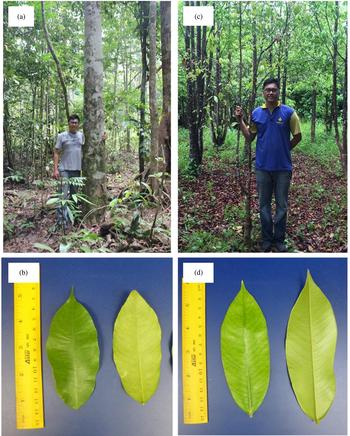
In this study, the locations of the Aquilaria populations in Peninsular Malaysia were identified from the herbarium records compiled by Faridah-Hanum et al. (Reference Faridah-Hanum, Mustapa, Lepun, Tuan Marina, Nazre, Alan and Mohamed2009). Species identification was based on morphological characteristics. From a total of five Aquilaria species recorded in Peninsular Malaysia, only two were included in this study, namely A. hirta and A. malaccensis. Briefly, A. malaccensis has chartaceous leaves with wavy margins and a mature tree can reach a height of more than 40 m (Figure 2(a) and 2(b)), while A. hirta has coriaceous leaves with dense hair on the abaxial leaf surface and reaches only about 4–5 m when matured (Figure 2(c) and 2(d)) (Hou, Reference Hou and Van Steenis1960; Whitmore, Reference Whitmore1973). Collections were difficult for the other three species as information found on labels of herbarium specimens of several herbaria around the country were incomplete and imprecise, resulting in failure to detect their natural habitats in the wild, or the forest was felled. Furthermore, A. beccariana, A. microcarpa and A. rostrata have limited distributions in Peninsular Malaysia and thus difficult to find when compared with A. hirta and A. malaccensis.
Photographs of mature Aquilaria trees and their leaf characteristics collected in this study, (a, b) Aquilaria malaccensis, (c, d) Aquilaria hirta.

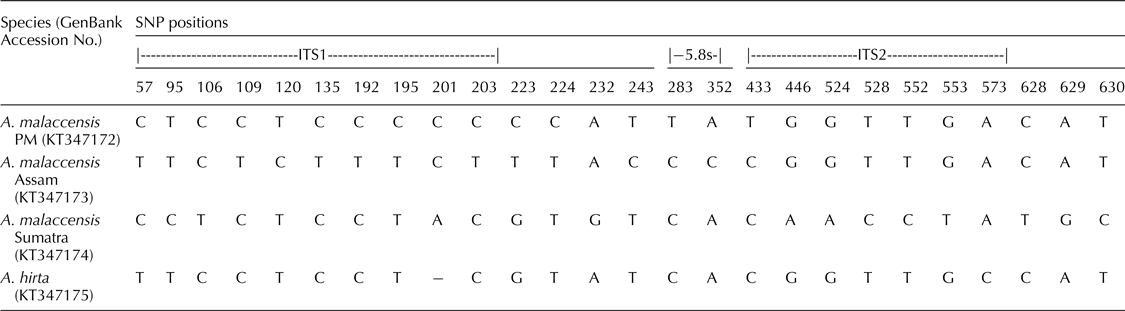
Based on the sequencing results, there was a small difference in the length of the ITS sequences; A. hirta was 682 bp, while A. malaccensis was between 682 and 683 bp. The average GC content in their respective ITS sequences were 48 and 49%, respectively. Using homology searches in the BLAST program, we identified that among the 19 natural populations studied, 14 were of A. malaccensis populations (AYKH, BESU, BNNS, BTNG, DUNG, GMSG, HSAH, KARK, KEMA, LGKW, LUMT, RUNA, SGUD and TKUN) and three were of A. hirta populations (DARA, LATA and MCHG). Interestingly, two populations, MERS and ALUR, had both A. hirta and A. malaccensis. However, A. hirta individuals in ALUR were scarce and outnumbered by the surrounding A. malaccensis individuals. From multiple nucleotide sequence alignment, we detected no nucleotide polymorphisms (SNPs) among A. malaccensis individuals from all populations, but a rare occurrence of a C nucleotide deletion at the ITS1 region (427) was observed in an individual from KARK and another individual from MERS. As the indel is small, this could probably be due to replication slippage during PCR (Gregory, Reference Gregory2004). When comparing A. malaccensis and A. hirta, several SNPs were identified in the three regions of the ITS sequence (ITS1-5.8S-ITS2) (Baldwin et al., Reference Baldwin, Sanderson, Porter, Wojciechowski, Campbell and Donoghue1995). A. hirta has four SNPs in the ITS1 region, one in the 5.8s region, and two in the ITS2 region. The sequences have been deposited in GenBank (Table 2).
SNPs identified in the ITS sequences from Aquilaria malaccensis of Peninsular Malaysia (PM), India (Assam) and Indonesia (Sumatra) origins

The ITS region is separated into three regions: ITS1, 5.8s and ITS2. A total of 7 SNPs were detected between A. malaccensis and A. hirta, both of PM origin; while 25 SNPs were detected between A. malaccensis of PM, Assam and Sumatra origins. Aquilaria hirta sequence originated from PM was included for comparison. SNPs are highlighted in grey.
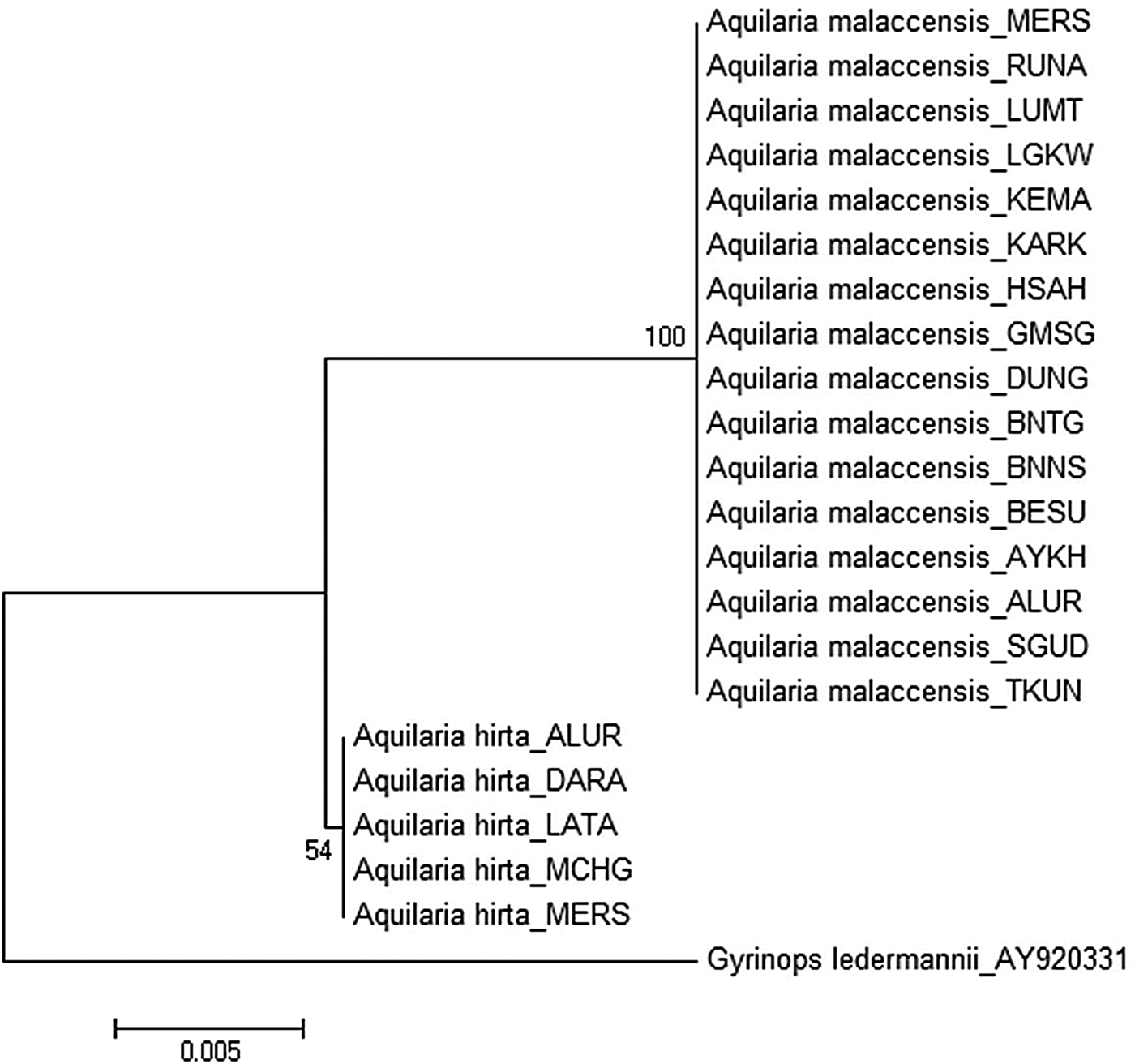
The genetic distance was calculated using the Kimura two-parameter. For MERS and ALUR, we renamed the population groups as to differentiate between the two Aquilaria species in a same sampling region. The results showed that the intraspecific distance in all populations was zero, indicating that there is no intraspecific variation within each population of the same species. As for the interspecific distance, we categorized the populations based on their respective species and calculated the genetic distance between A. malaccensis and A. hirta at 0.0103, which is considerably low. As there was no intraspecific variation within the population of the same species, we included an individual from each population to represent the sampling site when constructing the NJ tree (Figure 3). The ITS sequence for Gyrinops ledermanni, a closely related genus was obtained from GenBank and included as an outgroup. The phylogenetic tree showed two clearly distinct clades, which separated populations of A. malaccensis from A. hirta, in Peninsular Malaysia.
NJ tree based on the ITS sequences of Aquilaria malaccensis and Aquilaria hirta populations in Peninsular Malaysia. Sampling sites are: MERS (Mersing), RUNA (Kemaman), LUMT (Lumut), LGKW (Langkawi), KEMA (Kemasul), KARK (Karak), HSAH (Puchong), GMSG (Gua Musang), DUNG (Dungun), BTNG (Bentong), BNNS (Bukit Nanas), BESU (Raub), AYKH (Ayer Keroh), ALUR (Merchang 1), SGUD (Sungai Udang), TKUN (Bukit Mertajam), DARA (Kijal), LATA (Setiu) and MCHG (Merchang 2). Gyrinops ledermannii from NCBI GenBank as outgroup. All gap sites were included in the analysis. Numbers on the branches indicate the bootstrap values (1000 replicates).

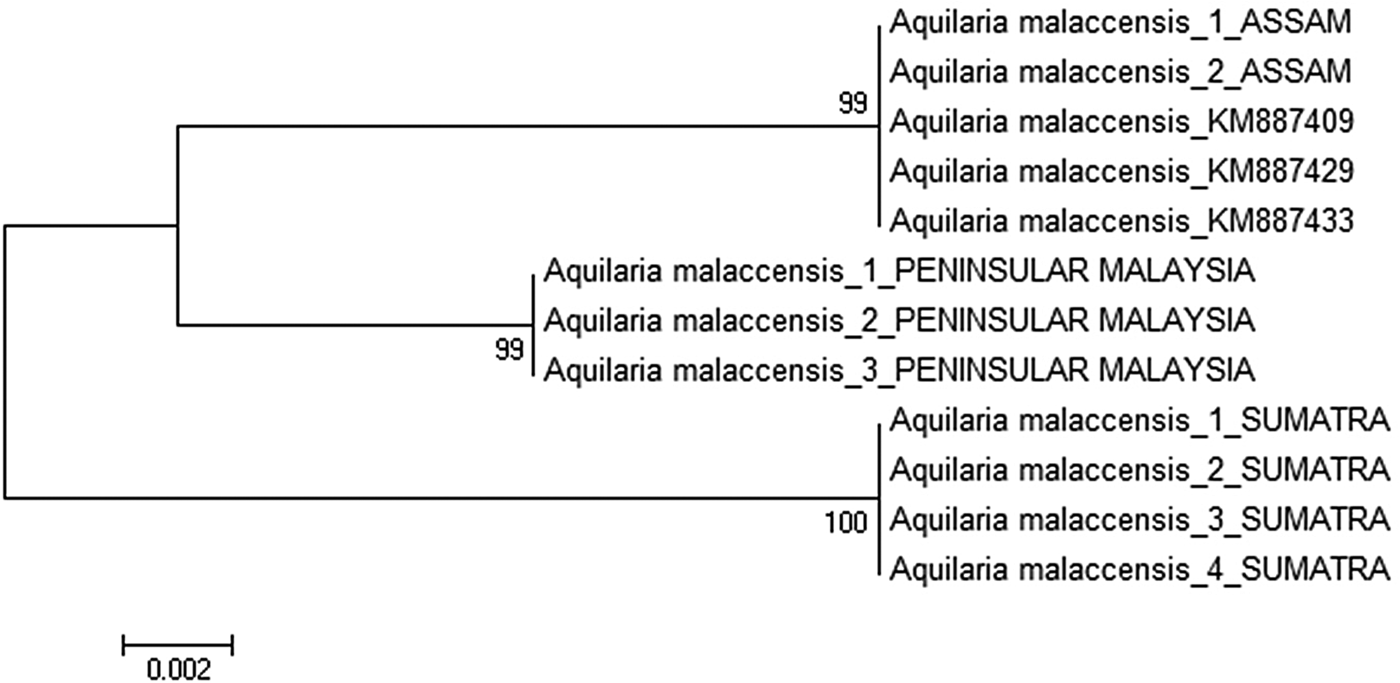
We calculated the intraspecific variation between A. malaccensis from Peninsular Malaysia, Assam and Sumatra. The total length of the ITS sequence for A. malaccensis from Assam was 682 bp, while from Sumatra was 683 bp. The average GC content in their respective ITS sequences were 48 and 50%, respectively. When comparing A. malaccensis ITS sequences from the three geographical areas, the number of SNPs detected in the ITS1, 5.8s and ITS2 regions were: ten, two and one, respectively, for Assam; and seven, one and nine, respectively, for Sumatra (Table 2). Similar to A. malaccensis from Peninsular Malaysia, the intragenetic variations for the A. malaccensis from Assam and Sumatra were zero. Although A. malaccensis from the three countries had 96.20% sequence similarity in the ITS region, some degree in genetic variations were observed between Peninsular Malaysia and Assam (0.0194), Peninsular Malaysia and Sumatra (0.0254), and Assam and Sumatra (0.0316).
An NJ tree was constructed to test the phylogenetic relationship of ITS sequences from this study with known ITS sequences deposited in GenBank (Figure 4). The sequences clustered into three different clades, each corresponding to its country of origin. Interestingly, the Peninsular Malaysia sequences are closely tied to the Assam sequences than Sumatra. Our results suggest that the observed small genetic variation in the ITS sequence is sufficient to resolve place of origins for A. malaccensis.
NJ tree based on the ITS sequences of Aquilaria malaccensis from three different sourcing countries, Malaysia (Peninsular Malaysia), India (Assam) and Indonesia (Sumatra). Sequences deposited in the NCBI GenBank were included for analysis. GenBank Accession Nos. KM887429, KM887409 and KM887433 originated from A. malaccensis of India. All gap sites were included in the analysis. Numbers on the branches indicate the bootstrap values (1000 replicates).

Discussion
To date, there are only three reports on the genetic diversity of Aquilaria in Malaysia. Two of the studies used markers from microsatellite regions in A. malaccensis (Tnah et al., Reference Tnah, Lee, Lee, Ng, Ng, Nurul-Farhanah, Lau and Chua2012; Mohamad et al., Reference Mohamad, Azhari, Ismail and Parween2013), while the third used random amplified polymorphic DNA (RAPD) markers to analyse genetic variation between selected species (Lee et al., Reference Lee, Weber and Mohamed2011). Utilization of the ITS region for distinguishing A. malaccensis populations appeared to be useful as demonstrated from the present study. However, the ITS region comprises limitation whereby it only covers a selected region in the whole-plant genome to tell apart the genetic variation of the study material, whereas DNA markers such as ISSR and RAPD make use of different unspecific regions in the plant genome to provide information in genetic variations. The molecular information provided from each DNA marker may be different due to their source of genetic variation information and respective mathematical calculations. Despite being limited to just a selected region, the biparental inheritance characteristic resides in the nuclear genome is able to provide a thorough speculation in reticulate evolutions, hybridizations and polyploidy parentages in plants (Alvarez and Wendel, Reference Alvarez and Wendel2003).
It has been reported that phenotypic changes influence sequences in the ITS region, i.e. the sequences may change or consist indels to adapt in different climatic conditions (Gao et al., Reference Gao, Zhang, Duan, Zhang, Li, Fu and Chen2012). Although there are geographical differences between the sample collection sites in Peninsular Malaysia, for example MERS, LUMT and LGKW populations are located near the sea, while BESU, BTNG, KARK and KEMA populations are surrounded by the mountains, yet we deduced that variations in the climatic conditions within Peninsular Malaysia were insufficient or did not persist long enough to come out as an evolution factor. This could explain the high similarity in the ITS sequences between populations of the same species throughout Peninsular Malaysia. Unlike the study of Shen et al. (Reference Shen, Yan, Zhao, Pang and Zhao2008), the ITS sequences were different for A. sinensis populations from Guangdong, Guangxi and Yunnan Provinces. Even if the three provinces are all within China, their distances are huge. The total land area of Guangdong Province is larger when compared with Peninsular Malaysia, which are 177,900 and 131,598 km2, respectively. Perhaps different climatic and geographical conditions experienced in each province had influenced phenotypic changes within the A. sinensis populations. This assumption was further brought up by Zhou et al., Reference Zhou, Xia, Lu, Wang, Ji and Wang2012 when they utilized ISSR and SRAP (sequence-related amplified polymorphism) in studying the genetic diversity of A. sinensis in Guangdong Province and Hainan Province. A high level of genetic diversity was observed between these two populations, possibly caused by the Strait of Qiongzhou, which separates the two provinces apart since earlier times.
In order to justify that the ITS region is capable to tell the difference between A. malaccensis populations, we expanded our analyses by including A. malaccensis ITS sequences of various origins. A. malaccensis from different sourcing countries displayed stable and clear differences in their ITS region (Table 2). Most of the SNPs in A. malaccensis from Assam were discovered in the ITS1 region, while from Sumatra in the ITS2 region. Similarly, SNPs were abundant in the ITS1 region among A. sinensis from different populations in China (Shen et al., Reference Shen, Yan, Zhao, Pang and Zhao2008; Niu et al., Reference Niu, Ji and Lu2010). We suppose that geographical boundaries had functioned as a buffer zone to prevent outcrossing between the natural populations. This explained the differences in A. malaccensis sequences between Peninsular Malaysia and Sumatra in Indonesia, which are separated by a vast body of sea. On the contrary, the LGKW population, which is on the Langkawi Island in the Kedah state of Peninsular Malaysia, has identical sequence to populations on the mainland. In this case, the geographical limit was not successful due to the short distance between the island and the mainland. For populations in the Malay Peninsula and Assam, they are separated not only by a great distance, but also by mountain ranges. In addition, the climatic and geographical conditions for Assam are different from Malay Peninsula. The large genetic variation observed among same species may be caused by geographic separation, followed by several factors such as poor seed dispersal, genetic drift and local adaptation via genotype by environment interaction (Zhou et al., Reference Zhou, Xia, Lu, Wang, Ji and Wang2012).
From field observations conducted during this study, we found that A. malaccensis natural population is widely distributed in the Peninsular Malaysia, whereas A. hirta is mainly distributed along the east coast region, towards the South China Sea. Aquilaria trees can still be found in the wild, but the number of mother trees in a single population is relatively low, especially in sample collection sites such as Lumut (LUMT) for A. malaccensis, and Terengganu (ALUR, LATA and MCHG) for A. hirta. This raised some doubts whether the population could survive through the next generation. Overexploitation and habitat loss due to urban or agriculture development are major factors causing Aquilaria natural stands to decline over the years.
We propose that planting material for in situ conservation efforts to include as many populations as possible. Aquilaria species cultivation for agarwood production is common these days and since A. malaccensis does not flower and fruit annually (Paoli et al., Reference Paoli, Peart, Leighton and Samsoedin2001), this could be an advantage to repopulate the natural stands or creating plantations. Although the low genetic variation showed in this study may raise attention towards a bottleneck effect; however, as this study was concluded only from the finding through a single gene, we suggest more markers to be used to determine its true diversity.
Conclusion
An adequate amount of genetic information is an essential aid in constructing a good conservation strategy for endangered species. Aquilaria in Peninsular Malaysia is at a vulnerable state due to illegal harvesting and overexploitation of its habitat. Conservation approaches, both in situ and ex situ, should be implemented to achieve its effective and sustainable population growth in the wild. Results obtained in this study may provide a new perspective towards the conservation strategies for this endangered species to improve their population abundance in the wild.
Conflict of interest
The authors declare that they have no conflict of interest.
Supplementary material
The supplementary material for this article can be found at https://doi.org/10.1017/S1479262117000016
Acknowledgements
The authors thank the Forestry Department of Peninsular Malaysia and the respective State Forestry Departments for the approvals to conduct this work, and for assistance rendered during field collections. This work was supported by the Ministry of Higher Education, Malaysia, under the Fundamental Research Grant Scheme (FRGS/1/2012/STWN02/UPM/02/1, Project No. 07-01-13-1183FR) and Universiti Putra Malaysia Putra Grant (GP-IPS/2015/945400).