The quintessential Berlin artist Heinrich Zille, while remaining almost unrecognized outside Germany and certainly neglected in art historical circles on both sides of the Atlantic, nonetheless offers an important way to understand the modern city in late-nineteenth-century Europe. Zille, I argue, represents a proletarian modernism, a way of viewing and embracing a vibrant working-class domesticity—a milieu—that the Großstadt itself had created.Footnote 1 In so doing, he offered intimate representations of Berlin for Berliners; he was decidedly grounded in the local and telescoped Berlin from its districts to its neighborhoods to its streets. What reemerged at this insider level, however, were glimpses of the wider world into which Berliners had been cast. Zille thus blurred distinctions between public and private spaces that marked the social boundaries of the city and drew from both the local and the global in ways that have gone unrecognized in his work. His perspective on the new capital, in other words, was accomplished by embracing the liminal, and he ultimately offered a kind of palatable social protest—a vision of reform without socialism—that was itself quite remarkable.Footnote 2
His vision particularly resonated in Berlin, which almost overnight was promoted from a royal seat to the national capital. Perhaps more dramatically, Berlin was transformed from a provincial city to an industrial metropolis between German unification in 1871 and the start of the Great War in 1914. The city brimmed with social inequality as the Prussian aristocracy came to mingle with the German Bürgertum, who together both shunned and were drawn to the growing mass of workers. By depicting interactions among Berliners in social-leveling public venues and the interior lives of the working class in various domestic spaces, Zille demanded that his contemporaries confront Berlin as it was at the turn of the twentieth century, rather than how the leading elites believed or hoped it to be. In his images, the proletariat soothed themselves; he lifted up their problems with humorous commentary often placed in the mouths of babes. His dark comedy and private eye created a local reading of the modern condition that his fellow capital-dwellers found particularly appealing, and a more careful examination of his artistic portfolio contributes to a broader understanding of modernism that includes both the domestic, the worker, and the child.
Zille claimed to hold a kind of mirror up to the Berlin masses. It illuminated social hierarchies and liminal spaces; it was also trained on a variety of colonial subjects, from the poor, women, children, Africans, and Native Americans, all of whom new imperial historians have noted were placed in similar matrices of representations and desires. Studies of Zille have failed to consider the Kolonialstadt that emerged from his oeuvre. He certainly always reached behind the imperial façade to present murkier cityscapes, but despite an outpouring of scholarship on Germany as an empire with its own colonial and postcolonial histories in the past decade or so, Zille's worldview has been presented as remarkably unchanged since his 1929 hagiography Das Zillebuch.Footnote 3 It has become too easy to ignore Zille's contribution to the production of race in Germany, which was so intimately intertwined with the construction of class, although he presented Berlin as an intertwined local and imperial context. Heinrich Zille carefully engineered his beloved cartoons and his less well-known photographs, playing with the emotional distance between the local and the global.
* * *
For nineteenth-century scholars of Europe, the city has come to represent modernity in its economical, sociological, and visual configurations. Berlin, then, became a fascinating case study as the emergent capital city of the newly unified Germany, for the rapidity of its imperial ascendancy corresponded to its industrial rise. In fact, contemporary observers found the speed of its metropolitan makeover deeply unsettling, as it pointed to not only an accelerated experience of time, which was itself a product of modernity, but also a contrived landscape, which was an aesthetically unpleasing approach to modernity.Footnote 4 In discourses of urban modernity, Berlin was often either decried as the parvenu “Chicago on the Spree” or celebrated as a progressive world city.Footnote 5 It was, however, generally agreed that Imperial Berlin was ugly—a kind of transient “American” ugliness due to its explosive population growth of 402 percent between 1871 and 1919.Footnote 6 The German capital lacked the visual stimulation of, say, Paris—that celebrated nineteenth-century capital—subsequently ensuring its neglect in the fin de siècle's visual arts.Footnote 7 Moreover, contemporary critics understood Imperial Berlin to be in “isolation from the rest of the art world” and deemed Berlin's artists “weak,” even as the city attracted crowds to exhibitions and salons.Footnote 8
Heinrich Zille provided a response to such negative voices. He embraced both the filth, promoting an aesthetic of ugliness, and the local, rooting his works in a Berlin milieu. He self-consciously stylized himself, after all, as the artist of the people in interviews and publications. The art historian Matthias Flügge has noted that he was proud to be counted among the “gutter artists.”Footnote 9 He often, in fact, highlighted the gutter: “the latrine,” one contemporary critic decried, was “seldom missing” in Zille's images.Footnote 10 The self-proclaimed and oft-heralded “drawer of the people” was a compelling persona. If Zille were not to be counted as a leader among modern artists in Germany, however, then he certainly moved in their ranks. Zille first exhibited with the Berlin Secession, the influential avant-garde group of artists in fin-de-siècle Berlin, in 1901, and he counted the well-known, innovative artists Max Liebermann (1847–1935) and Käthe Kollwitz (1867–1945) among his friends.Footnote 11
His biography is widely known, and he helped to craft it during his lifetime as his popularity soared. The narrative harmonized with the story of Imperial Berlin—from a provincial Großstadt to a modern Weltstadt—that emerged in the imperial era; here was a provincial boy making good in the big city.Footnote 12 He was not a Berliner by birth, but his immigrant status only lent him more credibility. He was born in Radeburg in 1858 and lived briefly in Potschappel before arriving in Berlin in November 1867 at the age of nine with his family just after the old city walls had come down. The Zilles entered Berlin at the Schlesischer Bahnhof and moved into their first apartment at Kleine Andreasstraße 17 in Friedrichshain—details that corresponded to the deep spatial knowledge of Berlin associated with Zille's work.Footnote 13 The young Zille attended elementary school and worked odd jobs, contributing to the familial income. He later related visiting the working-class haunts of his boyhood in “Berlin O.,” his intimate shorthand for Berlin's working-class eastern neighborhood: “I have again wandered through the Old East to greet the former places of my childhood. I like to sit in the basement pub of the Wallner Theater, where as a boy I sold playbills only from outside [the theater] but strangely without jealousy of the well-fed, well-dressed people.”Footnote 14 Zille identified himself as a proletarian child, and his parents never left Berlin O. The same year, 1872, that he began training as a lithographer, his parents moved into a single-family dwelling in Rummelsburg, an eastern suburb of Berlin and site of the first industrial settlement, where they remained until their deaths.
Zille adopted an itinerant identity that held particular resonance in Imperial Berlin. For one, he was among the many immigrants who moved to the industrializing city, which attracted large numbers of newcomers hailing from the state of Brandenburg, the provinces of East Prussia and Silesia, and beyond. The famous journalist and author Hans Ostwald, who had spent much time away from Berlin as a traveling craftsman, as well as the famous sociologist Georg Simmel, who felt uneasy with his Jewish family background and early death of his father, cultivated their respective vagabond and alien perspectives while documenting the city.Footnote 15 Their outsider perspectives made the social order, in the words of Simmel, “‘more concrete and intensely experienced.’”Footnote 16 Zille, too, trained his immigrant eye upon the modern capital and saw contradictions. Perhaps the second most repeated quote in the literature on Zille was the instructions that his teacher Theodor Hosemann gave him to “go out, rather, in the street, in the open, and observe for yourself.”Footnote 17 Ostwald, who worked with the artist near the end of his life to publish the tell-all Das Zillebuch, reported that he “followed the advice of his teacher” and thus captured the “real” city.Footnote 18
As historian Peter Fritzsche has argued in Reading Berlin 1900, the “antinarratives of the modern novel, the disruptions and displacements of Expressionist poetry,” and, he later adds, the “style and content of the newspaper” were “related to a distinctly metropolitan way of seeing at the turn of the century, which can be summed up as modernism.”Footnote 19 Zille's cartoons and photographs were certainly another kind of metropolitan vision. In a 1908 treatise on the aesthetics of the metropolis, the architect August Endell discussed the modern visual culture to be found in such a city as Berlin. With the dexterity of a prestidigitator, Endell turned the Großstadt's ugliness into beauty. He proposed a way of seeing the big city—“the most visible and peculiar product of our contemporary lives,” Endell proclaimed—as beautiful in its own construction and rhythm.Footnote 20 This was “a beauty not of planning but of seeing; its locus [was] not the buildings and avenues of the city but the eye of the flâneur.”Footnote 21 A cliché to us, beauty being in the eye of the beholder was once a provocation.Footnote 22 Endell's eyesight also transformed the Großstadtkinder, who heavily populated Heinrich Zille's Berlin, into enchantments: “How pretty the sickly colors of the city children often are; how their features have, sometimes precisely because of need and deprivation, a wonderful, austere beauty.”Footnote 23
That Zille was once one of those sickly Großstadtkinder was central to the role he had cast for himself. But he did not live out his days in Friedrichshain. With his lithographic training, Zille went to work in various Berlin firms and eventually married the daughter, Hulda Frieske, of one of his teachers in 1883. In 1892, he moved his wife and their three children—Margarete (born October 4, 1884), Hans (born February 26, 1888), and Walter (born January 9, 1891)—into an apartment at Sophie-Charlotte-Straße in Charlottenburg. This move to the western, more affluent suburb signaled geographically his climb on the socioeconomic ladder. His position with the Photographische Gesellschaft, which ended in 1907, had precipitated the move and had provided Zille with expanded economic means, allowing for the intra-city emigration. By that time, the Hauptstadt had begun to encroach on surrounding fields and towns, so that a Greater Berlin existed by the turn of the century that included such nearby communities as the large towns of Charlottenburg and Wilmersdorf in the west, and Schöneberg and Neukölln in the south and southwest. With his parents in Rummelsburg, Zille's social network stretched across this conurbation, while his professional network continued to expand.Footnote 24 It may be telling that Zille selected the Wallner Theater, as described above, as a site of memory, for it perched at the bustling intersection of Alexanderplatz, where the poorer eastern districts began to blend into the wealthier Mitte.
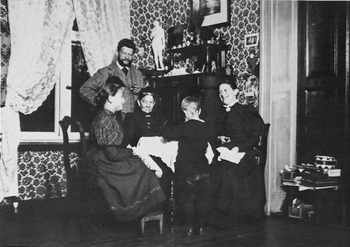
A September 1897 photograph captured the Zille family in the Charlottenburg apartment (Figure 1). The staged scene had Zille's wife, mother-in-law, and three children seated at a small table. Intended for the family album, this photograph, and the series to which it belongs, revealed a well-dressed and well-possessed cast of characters. If the portrait alone were not enough, the patterned wallpaper and the long curtains in the open room, and the women's and children's nice, neat clothing were the material evidence of the achievement of middle-class comfort. The German middle class, the collective Bürgertum, was, of course, fragmented by political and economic interests, but as historian Marion A. Kaplan has explained, culture had become a “defining character” of the splintered middle class, “combining elements of cultivation (Bildung) with new aspirations to wealth and display (Besitz).”Footnote 25 The concept of Bildung was certainly on display in the September 1897 photographic series: three images portrayed the Zille children as students, the school-age boys posed with the traditional elementary school knapsack. The focus on his children also revealed Zille's general and unflagging artistic interest in the private world of children. Through Bildung as well as Besitz (i.e., the cluttered armoire as well as the photograph), middle-class respectability—even if only a Kleinbürger one—had been achieved by the former proletarian child. The photograph also captured Heinrich Zille in a dominant pose, looking from a standing position over the seated female and child members of his three-generational family. This image presented Zille as the patriarch, a clear reminder that middle-class identity was also highly gendered, especially as the three women shared intimate sightlines in the photograph.
Familie Heinrich Zille mit Großmutter Frieske in der Charlottenburger Wohnung.

Zille promoted his identification with the city, where he could maintain an itinerant identity based on class-inscribed spatial boundaries. He sustained a dual insider/outsider status based on his childhood in Berlin O. and his adulthood in Berlin W. and was, therefore, able to move seamlessly between the two. In fact, his acclaim was attributed in the Ostwald “docudrama” Das Zillebuch to his portrayal of “the people” and “the environment in their best and often amusing appearance.”Footnote 26 Berliners from all walks of life were his people; every Kiez in the city was his environment. His subject matter was simply defined as Milljöh—the French “milieu” rendered familiar and warm through dialect. Milljöh suggested the “lived environment of the locality,” a “vernacular modernism” that rebuked an understanding of modernity as purely about acceleration and globalization. Bernd Hüppauf and Maiken Umbach have promoted a “more complex narrative of the modern” focused on “the negotiation between, and the interdependence of, the regional and the global, concrete locality and border-devouring abstraction.”Footnote 27 Zille's oeuvre in its localism and (its often ignored) liminality is a testament to just such a modernism.
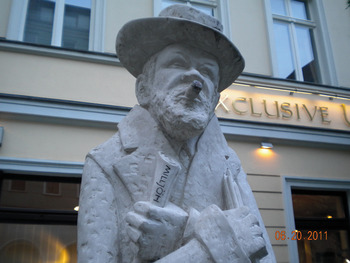
The Zille-Milljöh, as the term was most often deployed, invoked the city as a gemütlich urban universe, a series of cozy corners and simple pleasures heightened by difficult circumstances. Even as Berlin achieved world-class status, the concreteness of the domestic, captured in Berlinisch, was critical. Matthias Flügge has noted that the Zille-Milljöh is “ingrained still today in the consciousness of the people.”Footnote 28 The local enacted a kind of timelessness, so expressed in the 2007 statue of Heinrich Zille erected in the Nikolaiviertel, the heart of Old Berlin (Figure 2). Clutching pencils and a roll of paper, upon which Milljöh has been boldly carved, Zille stands on Poststraße in repose. The arms crossed upon his chest suggest the possible position of his remains—he certainly has no free hand with which to remove the cigar in his mouth. He is frozen, rather, as the embodiment of Milljöh. As a built environment, the Nikolaiviertel itself is nostalgic; the German Democratic Republic gave Alt-Berlin a facelift in time for the city's 750th birthday in 1987 (a far cry from the slum squeezed along the river Spree in Zille's lifetime). Presenting Zille's images as nostalgia, as done in so many collections, misses the complexity and dynamism as well as the playfulness of scale of Milljöh.
Zille statue.

The mythos of Heinrich Zille—one that conflated his art to a Berlin consciousness—was based on his stated hope to build a world that forestalled social needs. He attributed his impetus for social change to his difficult past. The world he wanted, he noted, would be different from the one of his childhood.Footnote 29 Werner Schumann, who promoted Zille's work in the post-World War II period, even interpreted the Zille-Milljöh as an “emotional chapter of social critique.”Footnote 30 His artistic credo has been summarized as “to make visible the social conditions to the victims of these conditions.”Footnote 31 And he often worked on the most intimate level: the home. The most frequently used quote from Zille is his condemnation of working-class housing in Berlin: they were “deadlier than an ax” went the repetitions.Footnote 32 He thus became a champion for the belittled and impoverished, and he deliberately crossed spatial boundaries that signaled the social order in order to do so. His graphic assessments of working-class neighborhoods and households were aimed at enlightening not only victims but also oppressors, such as his middle-class neighbors in Charlottenburg.
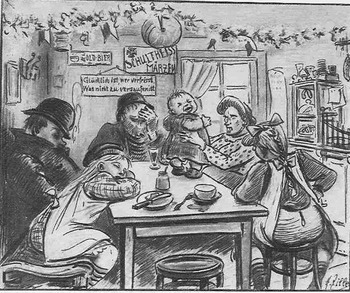
In the cartoon humorously or ironically labeled “Im Bürgerheim,” Zille imagined a family portrait no less intimate, no less staged, than his own (Figure 3). The witticism is, of course, that the home is a neighborhood pub. Flügge has described Zille as a Kleinbürgerhumorist with sharp insights; his humor was often crass and even ribald as it edged toward dark comedy.Footnote 33 Yet his jokes cut Berlin society several ways as he recast the Kneipe as a kitchen. Pubs appeared on many street corners in Germany, were rather ubiquitous in Imperial Berlin, and became seen as the “most important loci” for mainly male, working-class community building.Footnote 34 Urban uplifters, in the meantime, disparaged the taverns and their patrons, articulating the degrading effects of alcohol. Zille, however, offered an alternative vision to the pub as the stronghold of workers’ organizations or as the hotbed of vice; he ignored such discourses and insisted on the existence of working-class home life and, in other prints, pleasure in such haunts. This is, to be sure, a classic Zille-Milljöh.
“Im Bürgerheim.”

In his drawings, Zille established Milljöh with a few compelling elements. In his discussion of the contemporary Berlin artist Hans Baluschek, John Czaplicka has noted that Baluschek arranged “some telling if still standard city props,” “construct[ing] an urban environment from a few set pieces,” such as a closed street barrier; a gas lantern; tenements; and arched, bricked viaducts in his painting Berlin Landscape.Footnote 35 Zille established the locales and moods of proletarian Berlin with similar signs. In some sense, the picture “Im Bürgerheim” may have been of any pub in Germany, for there is nothing—no glimpse of a distinguished landmark in the window, for example—to indicate the city or town. Yet it is clearly a Berlin scene, since Zille rendered the caption in Berlinisch and included a Schultheiss, a local brewery, sign on the wall. He drew his characters with plain clothes and recessed eyes using thick, contoured lines, creating the atmosphere of a working-class district in the industrialized metropolis.
“Im Bürgerheim” told of a dramatic event with great sympathy: the crying infant at center stage was being reprimanded by his mother, as the caption read, “Howler monkey, father must first drink [his beer], then you can lick the glass!” The screaming child and the placating mother left seemingly undisturbed the introspective and haggard father in his patriarchal place at the head of the table. Zille framed a working-class family, including at least a father, a mother, and a baby (along with two young girls, possibly daughters, cousins, or school friends, and another adult, male worker, perhaps an uncle, coworker, neighbor, or stranger) in a narrow pub. This establishment appeared inclusive, comfortable, and apolitical—a garland decorated the ceiling, while signs and hooks decorated the walls, a curtain was drawn across the window, and a food counter occupied a wall. Zille invited his viewers to see a domestic setting, a citizen's home, as the title indicated. The setting also promised contentment through beer, if not companionship and rest as well, in a culture where by the turn of the twentieth century, every person drank on average 119 liters of beer.Footnote 36 Here Zille presented a working-class domesticity that was comparable in its informal familiarity to the 1897 photograph of his own household.
August Endell observed in his treatise on metropolitan aesthetics, “Die Schönheit der großen Stadt,” that people scoffed that cities were “no homes” with “their desolate noises, their filth, their dark courtyards, and thick, obscuring air.” Yet Endell continued, “hundreds of thousands” made cities their homes where it was possible to see “so much joy, so much strength” in their environment.Footnote 37 Heinrich Zille would have concurred with Endell's assessment of the possibilities of the city as a home. The image of the home/pub, however, presented a more complex proletarian reality than a simple domestic tableau, one that is open to multiple readings. In most ways, this Bürgerheim was quite unlike Zille's Charlottenburg apartment. He insisted on drawing the exhaustion and distress of the working class, likely gathered at the end of the day. Another man at the table smokes a pipe with his head deeply bowed, while one girl rests with her head in folded arms on the table. He sought to make visible the effects of difficult labor on members, young and old, male and female, of the urban working class. They were participatory in the modern life of the industrial city and were wearied from it.
That the characters in this drawing sought comfort outside a typical home—most likely, a tenement apartment—was telling of housing predicaments for working people in Berlin. And although we cannot tell if the beer offered was in lieu of food, the drinking does not appear social. Zille was neither blind nor unsympathetic to the problems that the urban poor faced; he became recognized as a piercing social commentator during his lifetime, and this caricature certainly sent a message about the impoverishment, if also tenacity, of the proletarian home in Berlin. Zille's cartoon, however, might have been viewed another way, allowing some audiences to laugh at members of the working class. Equating the screaming child to a monkey surely provoked smiles, as the Social Darwinistic undertone emphasized the poors', and especially the poor child's, greater proximity to non-human animals. Sympathy, too, like beauty, was a matter of perspective. His insider status in this world of dark humor—even as he carefully protected his bourgeois identity by publicizing the working-class home and privatizing his middle-class one (his photographs were not made public until the 1970s)—allowed his images to be seen as stemming from the viewpoint of the people.
* * *
According to the Zille story, Theodor Hosemann had told Zille to go out and into the streets, which he did. But Zille also went inside, leaving the streets to enter homes. His images thus blended the public and the private, which were by no means separate spheres; he depicted public activities nestled inside private spaces and private moments enacted in public venues ad infinitum. His equal concern, however, with the domestic recalled his contemporaries’ attention to housing conditions; a vast literature on the subject had begun to materialize in Germany in the late nineteenth century.Footnote 38 A recognized housing crisis had developed in urban centers across Imperial Germany in the boom of the Gründerjahre. Lower-income workers faced a shortage of affordable housing and were packed into Mietskasernen, literally rental barracks, in the growing cities. Historian Dan P. Silverman has argued that municipalities had no will to provide low-cost public housing in the absence of a clear profit motive, and so without housing codes, developers were able to pack workers into poorly constructed, small apartments.Footnote 39 Living conditions and housing construction in the Kaiserreich and Weimar Republic were key, historians argued, to understanding the “social question.”Footnote 40
Housing is a local market, so it is unsurprising that Zille picked up on concerns with Berlin's. In Berlin, as architectural historians Johann Friedrich Geist and Klaus Kürvers have described in a two-volume study, tenement buildings were erected in northern and eastern districts, such as Gesundbrunnen, Wedding, and Moabit to the north and Prenzlauer Berg and Friedrichshain to the east, with smaller enclaves in western districts such as Schöneberg. They were typically five stories high with multiple wings that stretched beyond the entrance in a series of narrow inner courtyards, and the pathology of the city was often traced to these structures. Members of the working class, some sixty to seventy percent of the urban population, lived in the overcrowded, tunnel-like apartments or even squatted in makeshift camps.Footnote 41 The tenement building called Meyer's Hof on Ackerstraße in the northern district of Wedding was the notorious example with nine inner courtyards rising like above-ground mine shafts to the gray Berlin sky; Meyer's Hof alone housed approximately 5,000 people.Footnote 42
Yet the inequality of housing was not a primary concern of the European labor movement prior to 1914; the locus for social change for communists and socialists was the workplace rather than the home. Housing issues were thus perceived as a byproduct of such issues of greater significance as working conditions and urban planning. Friedrich Engels, for one, made such a distinction in his 1872 series “Zur Wohnungsfrage” in Der Volksstaat. Moreover, this lack of apparent concern was attributable to diverse accommodations among the working class, for party functionaries and skilled workers had better housing—and thus fewer complaints—than unskilled workers, as labor historians have pointed out.Footnote 43 Zille's images, however, insisted upon the centrality of the home to workers. He depicted the apartments and courtyards in their nefarious conditions, empathizing with the occupants and condemning the landlords. His message was neither overtly revolutionary nor particularly political; rather, he showed ordinary Berliners resigned to their material surroundings, having made the very best of their situations.
Historian Hsi-Huey Liang has argued that the construction of Mietskasernen in Berlin and the relative distribution of workers throughout Greater Berlin masked the squalor of working-class living conditions and even suppressed the discontent of the proletariat. The closed courtyards behind prim façades hid the extent of overcrowding and, Liang has suggested, radical politics: “Everything pointed to social peace.”Footnote 44 The apartments were damp, cold, and unhygienic as well as overcrowded. Many families moved constantly in attempts to escape skyrocketing rents, and many more families took in boarders, Schlafburschen, offering working-class men a place to sleep for a little extra money. The issue of housing reform reached the general attention of all Berliners only in the early twentieth century, but for so-called land reformers who sought a solution to the housing shortage, the “‘entire social question [was] a ground and land question.’”Footnote 45 As an artist, however, Zille often recast the tenement courtyard that appeared to contemporaries as a dark tunnel to degeneration as a rowdy playground or viable workshop—one 1905 drawing depicted small children dancing in an alley off Ackerstraße filled with attentive adults and occupied outhouses.Footnote 46 In doing so, he lifted façades to render public what was supposedly private.
Zille's identification with the Hinterhof is telling of his play with private and public spaces in Imperial Berlin. As it was removed from the street, the courtyard was secluded from metropolitan traffic; however, dozens of residential windows overlooked the space, which had multiple functions, none easily divided into private or public. He portrayed tenement courtyards, a distinctive feature of the Berlin cityscape, as effervescent worlds that were secluded from the larger city yet bustled with poor Berliners. Residents and boarders came and went; vendors and street artists, such as organ grinders, conducted business; coal and wood piles catered to various customers; trash boxes and privies were visited regularly; and children danced and played in all these semi-private, semi-public spaces. These courtyards were not (always) the abyss viewed by land reformers but were often a vibrant urban experience.
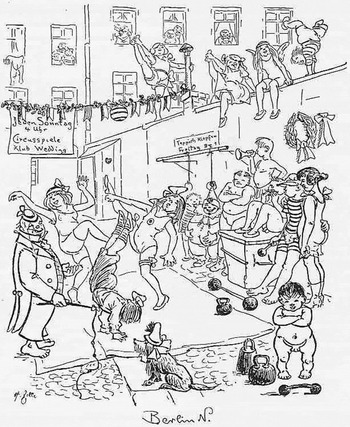
In at least one drawing, he literally created a circus; simply titled “Berlin N.,” the scene was a circus troupe's practice in a courtyard (Figure 4). Contrast Zille's image with Walter Benjamin's description of Berlin courtyards around 1900:
When, on sultry summer afternoons, I gazed down on them from my [train] compartment, the summer appeared to have parted from the landscape and locked itself into those yards. And the red geraniums that were peeping from their boxes accorded less well with summer than the red feather mattresses that were hung over the windowsills each morning to air. . . . In the years since I was a child, the loggias have changed less than other places. This is not the only reason they stay with me. It is much more on account of the solace that lies in their uninhabitability for one who himself no longer has a proper abode. They mark the outer limit of the Berliner's lodging. Berlin—the city god itself—begins in them.Footnote 47
“Berlin N.”

Benjamin, to be sure, was writing nostalgically from exile and from adulthood, but he readily invoked the unique spatial dimension of the Berlin courtyard. His childhood courtyard with its lanai was in the western end of Berlin in a bourgeois neighborhood; it was a sanctuary and a garden, and later a reading circle. But it was also “uninhabitable,” a distinction that was not shared by courtyards in proletarian neighborhoods.
Zille's assessment of the courtyard in “Berlin N.,” was equally magnanimous to the birthplace of the city god. The image was distinctly proletarian Berlin, and the title served to fix the event spatially and thus socially in the modern metropole. In “Berlin N.,” the circus troupe previewed its Sunday show at Klub Wedding, according to the banner above the entrance to the yard. The antics of a clown with his trained dog and young female acrobats, one performing a handstand and two others practicing leg extensions, were being observed by inhabitants in windows overlooking the inner square. For the residents’ future amusement, Zille had suggestively aligned more entertainers along the far right wall and even on top of the wall. For example, a strong man waited with his arms crossed for the opportunity to lift weights that were nearby, while a young boy blew a horn next to him. Troupe members seemed absorbed in their performative labors, and Zille drew the viewer into the spectacle as some faces, not least a naked male toddler in the bottom right corner, stared back. In these images, Berliners derived immense pleasure from Hinterhof activities. Zille staged the courtyard as a lively space of amusement, and in “Berlin N.,” one watched people watching—a distinctly modern experience of vision.
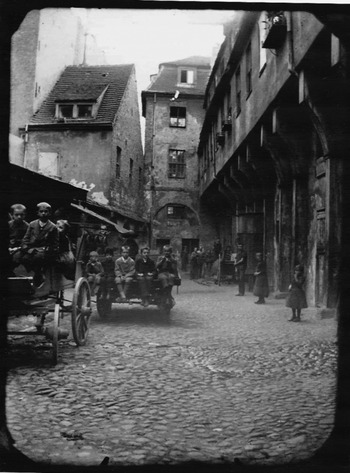
In drawings and lithographs, Zille was omnipotent; he scaled high walls and entered closed doors to capture a scene. His photography, by contrast, was secular; it revealed his actual geographical limitations. His interior shots included a few all-male workshops, but mainly showed his home and workspace (artist studios); it is only with a pencil and sketchpad that the doors in the city opened to his omniscient point of view. Nevertheless, between about 1890 and 1902, Zille investigated with a camera Alt-Berlin, where his statue stands today, encompassing at its center the working-class, labyrinthine neighborhood Krögel, which was characterized by narrow passages, linked courtyards, and dilapidated buildings. There he made photographic studies that framed alleyways and courtyards in journalistic ambience, and displayed his ability to manipulate light and capture texture on film. Several photographs from these series were devoid of people, appearing as architectural studies of doorways, archways, and stairways—exactly those passageways between public spaces and private abodes. But more often than not, Zille photographed Berliners, including many women and children. In one print of a courtyard in Krögel that Zille took around 1896, children sat in rows on two separate carts, while other children and male adults stood at identical intervals along the courtyard wall (Figure 5).Footnote 48 The precise arrangement emphasized the orderliness of the workspace and the high number of participants in courtyard activities.
Krögelhof.

In the photograph of this Hinterhof, his presence—his intrusion—was felt. The viewer was not invited to spectate as in “Berlin N.”; rather, the viewer was met with a dozen direct gazes. The photographer, and thus the viewer, seemingly became the spectacle. Zille made the photograph for private use, perhaps as a study for a lithograph, but he was not alone in his overt interest in Alt-Berlin. In the 1890s, professional photographers grew fascinated with the run-down neighborhoods around the Nikolaiviertel and traveled into the proletarian spaces.Footnote 49 These images often took on a nostalgic tint, as the cramped working-class quarters appeared impervious to metropolitan progress. On the city streets, Zille photographed the new rhythms of the city—the bustle of the marketplace, the pace of construction, and the vibrancy of print advertisements—but inside Krögel, he engaged in portraiture. These portraits, many of children, were still not images of destitution. The courtyard produced a feeling of safety rather than claustrophobia. Life not only existed in proletarian Berlin, but Zille showed that it existed in large, youthful numbers.
Zille penetrated deeper into the working-class milieu, moving firmly into domestic spaces, into tenement interiors, once he put the camera down. He sought to make working-class lives visible, to lift the physical borders of the social order. His nestling of public and private spaces and affairs served to portray the flawed structures in which working-class people were caught. For example, in one etching of a one-room tenement apartment, a man and a woman are engaged in intercourse, although little is seen beyond the bedding, her voluminous skirt, and his expansive bottom. The caption, though, explained that the scenario was due to a very public event: “the seamstress during the manufacturing strike.”Footnote 50 The woman turned to prostitution to support herself during a work stoppage, about which Zille invited compassion rather than condemnation. Of course, nothing quite grabbed the attention of late-nineteenth-century male artists than the prostitute—that very “public” woman.Footnote 51
Another practice that called into question the boundaries of domestic space was the taking in of male boarders to provide a source of income for working-class families.Footnote 52 The extra person's payment, it was hoped, would further stretch meager resources, but Zille suggested in a few images that boarders threatened the intimacy of the home, particularly the integrity of the female body. Take the example of an etching in his picture book Kinder der Straße in which a boarder stood in the presence of a woman breastfeeding her baby and a young girl bathing (Figure 6). These images were not romanticized portraits of working-class environs, but rather sympathetic portrayals of the difficulty of supporting proletarian households. The lithograph of the boarder, as well as the one of the out-of-work seamstress, point to Zille's focus on human forms and his frank portrayal of sexuality.
“Der späte Schlafbursche.”

In “Der späte Schlafbursche,” the eye was drawn to the woman's generous breasts illuminated by the lantern overhead. She roughly scolded the renter for complaining and reminded him that she could do as she wished, since she was the tenant and he only rented a bed. In the far left quarter of the frame, beyond the lighted exchange taking place center stage, Zille included sleeping and sleepy children crowded into a bed and cot. In the right-hand corner, the bare back of a nude young girl who was standing and washing herself in a tub faced the viewer. While it was not immediately clear how old she is—her height perhaps suggests prepubescent—and the boarder was not looking at her, the curves of her waist and buttocks erotically caught the light, emphasizing her nakedness. In fact, she was reminiscent of Zille's nude studies.Footnote 53 For Berliners, the image conveyed more than just the suggestion of impropriety. Very little, certainly not sleeping or bathing, was private in a working-class home. Zille, of course, questioned the very definition of home, as we saw in Figure 3, as a private space.
Zille's images of working-class homes in Imperial Berlin were not idealized, but neither were they the sensationalized hellholes portrayed by journalists and social reformers. Otto Rühle (1874–1943), who became well known for both helping to found the German Communist Party and contributing to the antitotalitarianism debate in Germany, passionately condemned the configuration of proletarian life with respect to children in his 1911 treatise Das proletarische Kind: “The milieu in which the proletarian child grows and develops has quite a few names. It is called deprivation, motherless home, and tenement misery—often enough it is all three.”Footnote 54 The issue of urban deprivation, according to Rühle, stemmed from inadequate housing and low wages. He described the urban-dwelling, working-class child being born “into an almost failing world” of poor material surroundings and disrupted family lives.Footnote 55 Industrializing Berlin attracted such socialist leaders, and it became the capital of the labor movement by the beginning of the twentieth century. Workers had developed such stable organizations as labor unions and the Social Democratic Party by the end of the nineteenth century. Zille, however, depicted a broader workers’ culture; his images maintained that workers’ lives were rooted in other experiences and traditions as well as the successful SPD. He showed that workers had lives outside even workers’ organizations and rarely delivered a clear “party message.”Footnote 56
Although Zille did not provide a political vision of work, as he more often focused on leisure, like Rühle, he attempted to portray the flawed structures in which working-class people were caught. Instead of blaming the proletariat for “motherless homes” and “tenement misery,” Rühle recognized the impossibility of working-class women, to whom child care unquestioningly fell, both to work for living wages and adequately care for their children. The social activist concluded that the situation nevertheless guaranteed that the “struggle for existence is 350 times harder for the proletarian child than for the child of the more well-off classes.”Footnote 57 Zille may not have fundamentally disagreed with Rühle, but Zille chose to portray the pleasure or, at least, the resiliency that members of the working class also cultivated, while paying tribute to workers’ organizations. In an image titled “Sonntagmorgen,” Zille depicted yet another proletarian home; here a mother reclined in bed and held up a smiling, bare-bottomed baby. The room was no bigger and no better furnished than the out-of-work seamstress's apartment, yet the scene played quite differently. The father on that Sunday morning read the Social Democratic newspaper, the Vorwärts, perched on the side of the bed, as the mother bragged to him, “Hubby, [the baby] has learned something this week; he made a fist already at the policeman!”Footnote 58 In a life-affirming drawing, Zille parodied the working class's repudiation of authority in the baby's clenched hand. The defiance was poignantly rendered in Zille's Milljöh. He did not gloss over significant problems in working-class households and tenements, but he did depict individuals surviving and thriving. He promoted social reform without a direct line to socialism.
* * *
Like Charles Dickens's Victorian London and Jacob Riis's turn-of-the-twentieth-century New York City, Heinrich Zille's Imperial Berlin unfolded most dramatically—and perhaps most disturbingly—on the child's eye level. He placed children at the center of representations of Berlin, reminding his audiences (then as now) that the so-called graveyard of infants was also at once a playground and blurring distinctions drawn by his contemporaries between private and public spaces that marked the social boundaries of the city. Social reformers such as Otto Rühle found children to be the most innocent of victims. Proletarian children were also powerful allies really for any social activist. The famed reformer Adolf Damaschke, himself a product of a Berlin rental barrack, specifically linked the problem of housing shortage to children's misery. As the leader of the Bund Deutscher Bodenreformer, he believed that family apartments with only one usable room, one of Zille's favorite lithographic stages, were to blame for “our entire social problems.”Footnote 59 To emphasize the stakes of his cause, Damaschke retold the infamous 1904 murder of ten-year-old Lucie Berlin, a story sensationalized by journalists such as Hans Ostwald, who lived and died in Berlin N.Footnote 60 This was an emotional plea to improve the rental barracks by curbing private speculation that governed land development in cities and by convincing people of all “political and religious camps” to push for progressive legal measures.Footnote 61 Damaschke sought to ensure “our Fatherland also becomes a Kinderland.”Footnote 62
While neither Damaschke nor Zille fully embraced the SPD, they both sought an alternative socialism of “uplift.” The parallels between these two men, though, quickly end, for Zille easily saw Berlin already as a Kinderland, a kind of children's paradise. This perspective was produced in part by his invocation of a populated city, one filled with ordinary people—adults and children, men and women—interacting in daily affairs. Zille portrayed intimate moments—small, human dealings—by closely following his fellow city dwellers. In Zille's eyes, Berlin was already a Kinderland because he paid close attention to their social spaces. Their existence in the tenement courtyards and neighborhood pubs as well as in the dark alleys of Krögel and the overcrowded beds of apartments—in other words, everywhere—buoyed Zille's dark humor. His work, in fact, documented in far less bleak terms that new species of child identified by Rühle: the proletarian child. His focus on children, while immediately apparent, has often been overlooked in artistic critiques and art historical treatments of his work. Art historian Enno Kaufhold in discussing Zille's photographic work referred to children as accessories in Zille's photographs and as common subjects in family albums.Footnote 63 His assessment failed to consider the powerful effect created by Zille's portrayal of children.
Children, often sidelined in the history of Berlin, were nevertheless foregrounded in Zille's work, and these domesticated creatures in turn domesticated Heinrich Zille's city.Footnote 64 In a photograph that Zille took in summer 1898, several children, including a young girl and a group of slightly older boys, have discovered a large muddy expanse in the middle of the Knobelsdorff bridge in western Berlin; the hardscape of the city had melted into the surrounding countryside (Figure 7). As with several of his photographs of Berliners going about their business, the children seemed unmindful of his presence. The image appeared to be a casual snapshot; the main female figure even twisted away from the viewer, obscuring her face and emphasizing spontaneity. Zille's photographic oeuvre pieced together the rhythms of the metropolis—men strolling to work, women shopping at the market, children going to school, etc. The workings of the city were his focus, and he understood that children playing in a muddy street were a part of it. The photograph raised the question, too, of where children should be, for this playground was essentially carved out of the city, and Zille, it appeared, celebrated the children's appropriation. Here the children turned a cobblestone thoroughfare into a natural wonderland—a Kinderland to those who knew how to find it.
Kinder auf der Knobelsdorffbrücke, Blick Richtung Charlottenburg.

Zille captured complex young lives that were filled more by work than by play in his Milljöh. But his proletarian children had quite a bit of fun, as seen in the first drawing that he published in the weekly satirical Munich magazine Simplicissimus (Figure 8). In Zille's arrangement, a group of children appeared on an empty background; he sought to invoke a social space rather than to depict an actual location. Titled “Aus Berlin,” Zille used bold lines and heavy shading to represent a dozen boys and girls of various ages—a style for which he became instantly recognizable. In fact, the plumpness of his figures echoed the roundedness of the lives Zille sought to capture.Footnote 65 These roly-poly children gathered to play a very specific game, one derived from the capital itself. The children listened attentively as the central male figure explained the play in Zille's Berlinisch caption: “Now we play Friedrichstraße. I am the criminal, and you must scream, ‘The authorities are coming!’ And then I will catch you.”Footnote 66 The children enacted an urban drama—Friedrichstraße—the city's main commercial street, a north-south route intersecting the main Imperial artery, Unter den Linden, lined with stores and galleries. Arcades along Friedrichstraße and surrounding streets housed such modern media events as the Kaiser-Panorama, a large stereoscopic projector that was the forerunner to movies. Children of the working class had few opportunities to access Friedrichstraße's products, yet Zille represented them as keen modern spectators.
“Aus Berlin.”

The children, at least the group leader, had a vision of Friedrichstraße's offerings. In some ways, Zille's children were modern observers—they watched from lowly positions on the streets as other people partook in urban experiences. They absorbed the sights of the city from their unique perspectives. One of Zille's most famous images is of a group of children pressed against an opulent toy store's picture window during the Christmas season, while the viewer looked at the children and over the children's heads in a complicit act of virtual consumption. In “Aus Berlin,” the children, too, imaginatively accessed the excitement the city had to offer by staging a “cops and robbers” game. Denied certain urban pleasures, these working-class children recreated the commercial and recreational heart of Berlin in play. The exercise in make-believe allowed children to assume various identities. Zille's specific humor and point of view were also at work, as the central figure wanted to play a criminal rather than a policeman. The image had an element of defiance in the children's lack of admiration for municipal authorities, but the overall image evoked envy rather than rebellion, a comfortable position for Zille's well-to-do audience.
Children were particularly good to see the modern city with. Scholars have noted that beginning in the seventeenth century, children along with women were relegated in Europe to a private domestic sphere as “the public, the ‘social,’ power-laden, and historically determining sphere” emerged as men equal before the law.Footnote 67 The geographers Sarah L. Holloway and Gill Valentine have specifically noted the “increasing domestication” of children in Europe, the United States, and Canada “over the course of the past two centuries.”Footnote 68 Children lacked political and economic control and were deprived of control over their own persons. Yet this did not lead to geographic and social segregation suggested by the notion of separate spheres. In Zille's images children moved readily between contemporary distinctions of private and public spaces; children filled both homes and the streets, and existed in every place in between. Rather than passively being restricted to spaces coded as “private” and “domestic,” children actively traveled through and interacted with urban spaces. Once again, we have the nesting, or overlapping, of the private and public that I discussed above. And perhaps more importantly, the city appeared less menacing, perhaps less miserable, by depicting children moving fluidly between otherwise segregated social spaces.
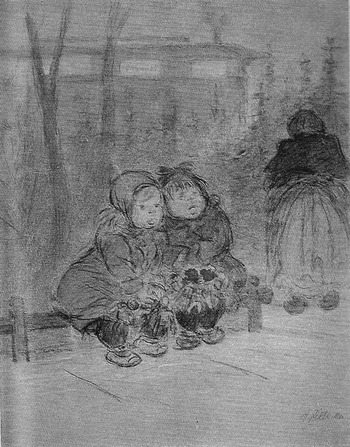
Zille did not presume children to be innocent. He did not romanticize them. He did, however, manipulate the perception of childhood innocence to soften otherwise scathing social indictments by placing accusations in the mouths of babes. The satirical periodical Jugend published in 1905 a chalk and watercolor composition by Zille. In the image, two young girls tightly clutched Hampelmänner and their coats, appearing tired and cold from selling the novelty items (Figure 9). They huddled side by side, the cold having seeped through their bodies, on a railing in front of faintly outlined evergreen trees: the scene was a Berlin Weihnachtsmarkt. This Christmas fair was bleak, devoid of welcoming lights and tempting wares that Zille displayed in other images; there was a latrine, however, in the background. Zille included with the graphic a bit of imagined speech from one of the young vendors: “Only two Hampelmänner were sold today. Humanity has no sense for the harmless.” Zille placed the world-weary, pessimistic assessment of the human condition in the mouth of a street urchin. He allowed the girls to speak “innocently” back to the elites, the consumers of the Christmas market wares. He was apparently fascinated by the juxtaposition of children working to provide Berliners with Christmas diversions, for he returned to the subject again and again in such drawings as a row of child vendors titled “Die Weihnachtszeit” and a drawing of Hampelmänner sellers with the caption “Zehn Pfennig der Hampelmann.”Footnote 69 The working-class children in Zille's drawings were sympathetic figures with wise comments on social injustices.
* * *
“Berliner Weihnachtsmarkt.”

If children have been marginalized in histories of Berlin, then nonwhites and non-Europeans have been completely ignored in studies of Heinrich Zille's work. All, however, have been connected in European representations of Others as uncivilized and degenerate. New imperial historians and scholars of race have maintained that notions of class and gender, easily viewed in Zille's images, were always about race.Footnote 70 Discussions regarding the construction and operation of race in the Second German Empire have been hampered by the lack of scholarly engagement with the German colonialism of the same period.Footnote 71 A framework and vocabulary for understanding German constructions of whiteness and blackness, in light of literary and race scholar Fatima El-Tayeb's contention that blackness was a “central point of reference in German culture,” has begun to materialize.Footnote 72 Historians of Germany have recently begun to tease out the impact of colonialism/imperialism on German national identity. For if, as Ann Laura Stoler and Federick Cooper have argued, “we can certainly not understand the construction of whiteness without exploring its class dimensions,” then certainly the contraposition is true as well.Footnote 73 Despite recognition of his keen eye for class distinctions, Zille's portfolio has not once been discussed in terms of race. His images of Berliners have rather been operationalized as unspoken claims to Imperial Germany's supposed racial homogeneity. Historian Lora Wildenthal pointed out more than a decade and a half ago that “the image of a homogenous white German people confronting a legally and culturally distinct foreign people was as inaccurate a hundred years ago as it is today.”Footnote 74 Including ignored images from Zille's portfolio not only illuminates the production of whiteness in German society and culture, but also expands our understanding of the interest that Zille displayed with liminality—with the borders of the adult/civilized world, which, in turn, often corresponded to the borders of the city itself.
In an image in his 1926 picture book Rund um's Freibad (swimming and bathing were activities that Zille frequently visited in his career), he depicted a group of curious children swarming a black man (Figure 10). A question has been posed to him that served as the caption: “Little man, doesn't it rub off?” The “punch line” has, once again, been delivered by a child, a young girl who was at the center of the image. Although she was the one who was speaking, her back was to the viewer, allowing the man's exaggerated visage to be better displayed to the viewer. His open stance, his legs spread past his hips and his elbows pointed out, further emphasized his physicality. This was, of course, the point, since it was the pigment of his skin that was being commented upon. And while the man towered over the children, even in his slack pose, who the child was in the exchange was called into question. The Berlinisch address of “Männeken,” or little man, did not have the same connotation as the American address of “boy” with its roots in the enslavement of black men. In the United States, racist thinking and practice infantilized the black man, emphasizing a dependency upon whites; use of the moniker lasted well beyond the end of slavery in the U.S. South.Footnote 75 In Zille's image, the girl, too, did not fully view the black man as an adult; she addressed him as an adult would a child, inverting the power in the relationship. Moreover, we do not receive the man's answer; he has been effectively silenced, as a child could be.
“Männeken, ferben Sie ooch nich ab?”

While the man and the children were not on equal footing, there was another element that gestured to the porousness of Berlin's social—and racial—hierarchies. The black man's bathing suit was similar to the dozens of men's suits that Zille drew and photographed. It was almost identical to a suit that he wore himself, as seen in a family photograph. The exceptional element was the eagle on the chest. It was a familiar icon, one that had a more local reference to Brandenburg, perhaps a regional reference to Prussia, and certainly a national reference to Germany. By wearing a bathing suit emblazoned with a kind of German logo, the black man suggested that he very much belonged where he was. He, too, could be part of the nation. The questioning child was then being cheeky, as young Berliners often were in Zille's work. The girls and boys did not shy away from the man either, so while the question—doesn't it rub off?—suggested that his skin color was unnatural and undesirable, it was not (necessarily) contaminating.Footnote 76 The children with open looks and smiles crowded around the man even as the exchange attracted no notice from bathers in the background. Unsurprisingly, then, Zille appeared eager to cross borders and to engage with the unfamiliar, if not exotic, for by 1926 there was an Afro-German population centered in Berlin. Although Black Germans were viewed as “specters of racial mixture” after the Rhineland occupation from 1919 to 1922 by French African troops, there was little of the hostility in Zille's image described by the German scholar Tina M. Campt that accompanied discourses about the so-called “Rhineland bastards.”Footnote 77 Nevertheless, the black man was easily outmanned—by sheer numbers and by an infantilizing name—by the white children, which preserved the racial order.
Zille appeared to be as playful with the racial order of the city as he was with the social order. He insisted that members of the working class be recognized equally as Berliners, and he, thereby, rejected a visual reading of “darkest Berlin.” Berlin was not London, as British travelers were fond of pointing out. Scholarly literature on the most prominent imperial capital in the nineteenth century has convincingly connected British imperial policies abroad and at home; a heightened racism emerged in the metropole as immigrants, South Asians, Irish, and Jews, and poor populations were seen to overlap in a shared and degenerate “blackness.”Footnote 78 And although Zille refused such de-civilizing and dehumanizing depictions of poor Berlin, he, too, contributed to the construction of “whiteness” in Germany, as evidenced in Figure 10. His engagement with racial categories is complicated by his photographs. During the last years of the nineteenth century, Zille photographed Rummelplätze, constructed from undeveloped land around Berlin. With such attractions as live shows, carousels, and beer tents, they were popular destinations for city inhabitants, young and old. The crowds themselves were also an attraction, and Zille's photographs showed adults and children jostling to view dog theaters, gymnastic and weight-lifting exhibitions, anatomical theaters, and “exotic” people. He captured, for example, an exhibition at one fair of the indigenous populations of North America (the signage announced displays of “Sioux Indians,” Figure 11) and Australia (the signage trumpeted shows of “The Original Australians”), exposing the collective whiteness of Berliners’ identity.Footnote 79
Zuschauer vor der Schaubude mit “Sioux-Indianern.”

Representations of indigenous peoples of North America and Australia held different meanings than those of Africans with whom Germans had direct colonial connections. As historian H. Glenn Penny has explained, Germans have long had a fascination with Native Americans that was driven by both the desire for the authentic and the recognition of a cultural affinity.Footnote 80 Despite differences in the historical reality of German interactions with black and brown Others, Zille cast them on a stage (figuratively in Figure 10 and literally in Figure 11) for Germans to examine. In both figures, Germans inquisitively crowded around a nonwhite man. His photograph of a “Sioux Indian” tellingly captured both his own eagerness to see the man and the crowd's excitement to witness the spectacle (Figure 11). This image, too, confirmed a modern vision in which a “spectator occup[ied] two places at once: the double experience of having an experience and of watching that experience from the outside, exactly what we moderns parody when we catch ourselves watching ourselves, experiencing ourselves experiencing.”Footnote 81 Zille pressed into the crowd himself, holding his camera up and capturing an obscured view of the stage over the heads and hats of his fellow Berliners. The photograph is additionally unsettling because the man being displayed in a headdress, a vest revealing his bare torso, and a grass skirt squinted back in Zille's direction. Zille always carefully framed his photographs to capture the details that he later worked into his drawings and lithographs. This photograph, however, appears sloppy, even amateurish. It seems that he succumbed to his own excitement and eagerness, and the image therefore unfolded rather haphazardly. A man's hat blocked a better view of the main attraction, and one step to the right or to the left would have revealed a better shot. Nowhere else did Zille as a photographer appear so discombobulated as before the “Sioux Indian.”
The socioeconomic tensions that Zille so adeptly dissected in his comics and prints disappeared in a spectacle of racial Otherness. In the photographic series from which Figure 11 was taken, he deliberately turned the camera onto the fairgoers jostling in lines and amassing for shows. Here were his Berliners amassed for his artistic study and for ready comparison with the “noble savages” of America and Australia. With regard to the non-Europeans on display as entertainment, as with the black man being confronted by the group of white children, the result was an “us” versus “them” scenario. Members of Berlin's upper, middle, and lower classes were to recognize and accept one another's foibles through the Zille-Milljöh in part because, after all, they shared in the superior culture and civilization of Germany. Berliners would have been growing accustomed to seeing Others on display, as both “freak shows” and “exotic exhibitions” were staged in the capital in the name of German scientific and cultural endeavors. The new discipline of anthropology, the birth of the modern zoo, and the emergence of ethnographic museums contributed to Germans’ fascination with colonial worlds and colonized peoples.Footnote 82 Zille's photographs testified to entrepreneurs’ and collectors’ success in meeting such demands by staging the authenticity of Others.
Global movements of people thus helped to shape Zille's Milljöh. He eagerly depicted confrontations of white Germans and black Germans, and Europeans and non-Europeans. The Berlin identity that Zille carefully cultivated needs to be reimagined in light of this wider and racialized lens. Zille offered a multiculturalism at the heart of the German empire that predates most discussions of Germany as a multicultural, multiethnic nation. This was certainly the case in part because Zille was pulled to the social spaces not firmly held by the city elite. Berlin's borders were particularly in flux. Imperial Berlin was caught between a town sinking into the marshes of Brandenburg and a city adopting the modern elements of industrialization. Zille depicted Berliners escaping from the hustle and bustle of the city center to enjoy bathing in a lake and going to a fair. He was drawn to the “wild places” that emerged as prospectors purchased undeveloped land on the city's outskirts. The instability of boundaries and the creation of so-called “waste ground,” such as empty lots, untended spaces, and marginal fields, became a motif in Zille's work.Footnote 83 These borderlands were important sites for urban spectacles; it was in these still undeveloped urban plots and open grounds that fairs as described above were staged, ice rinks were constructed, and city waste was collected. His engagement with space also supports a wider reading of Berlin identity; his images lightened—with the implication of a racial uplift in that word fully implied—Berlin's shadows.
* * *
In 1927, the experimental filmmaker Walter Ruttmann debuted his documentary Berlin. Die Sinfonie der Großstadt. This sixty-five-minute silent film followed the life of the metropolis over the course of a single day. The film presented the modern age with atmospheric scenes of technological expertise, but contemporary critics were uncomfortable with its fragmentation and decried its lack of social commentary. What is striking about the film and its reception in the context of reviewing Heinrich Zille's own ode to the city is that almost every screen shot in Ruttmann's film could be, in fact, one of Zille's images. Zille consistently foreshadowed Ruttmann's masterpiece, from the children going to school to a woman attempting suicide by jumping off a bridge. Despite such a disturbing scene, Ruttmann's film was accused of “myopic optimism” and an “essentially conservative effort.”Footnote 84 I would not wish to open Heinrich Zille to similar accusations, as I emphasize his inspiring depictions of the downtrodden. I have argued, rather, that his close examination of Berliners’ lives and homes was not done without social commentary, even if not of the blowsy kind. Ruttmann's film has received a great deal of attention in English-language scholarship, while Zille's oeuvre has not.
Those who encounter Zille as a lesser-known figure in the world of modern European art are seemingly compelled to offer comparisons with better-known artists in terms of popular prestige (to the American illustrator Norman Rockwell), contemporary practice (to the French caricaturist Honoré Daumier), class sympathy (to the Dutch painter Adriaen van Ostade), photographic skill (to the French photographer Eugène Atget), emotional manipulation (to Danish-American journalist Jacob Riis), etc. That Zille's work invokes such far-ranging and provocative correlations among the initiated and uninitiated further highlights his appalling neglect in the English-speaking world.Footnote 85 The neglect seemingly coincided with a narrow reading of modernism that dismissed the local and the worker. Zille's proletarian modernism, however, highlighted the domesticity of the working class while also considering the impact of the “Other” on Berlin identity. Zille did much to create a unique Berlin aesthetic just when both visitors and Berliners were comparing the capital, and finding it lacking, to its more glamorous and worldly counterparts. His defiant affection for the young, brazen, and shabby capital-dwellers set a tone that gained popularity in Zille's own time and, I would note, echoes still today in Berlin.