Introduction
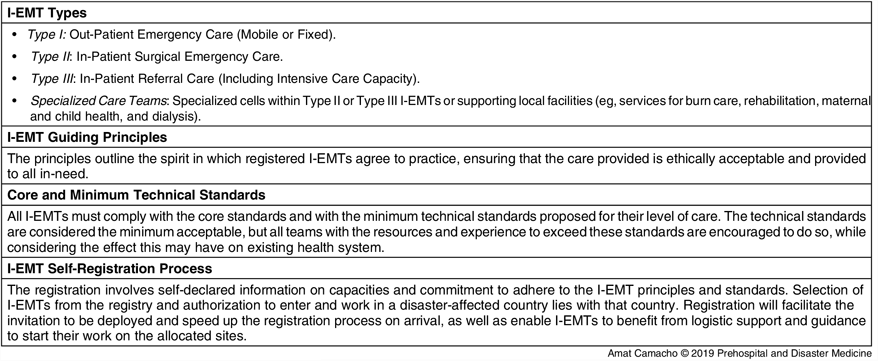
National and International Emergency Medical Teams (N-EMTs and I-EMTs) provide medical assistance to disaster-affected populations world-wide. In the past, disaster response has been characterized by the late arrival of I-EMTs, varying levels of quality of care, poor coordination, and lack of accountability systems.Reference Lind, Gerdin and Wladis1 Aiming to improve and professionalize disaster response, the World Health Organization (WHO; Geneva, Switzerland) and partners launched the Emergency Medical Teams (EMTs) initiative in 2013. The initiative involves a system to classify EMTs, minimum standards for I-EMTs (previously called Foreign Medical Teams), and mechanisms for EMT registration and quality assuranceReference Norton, von Schreeb and Aitken2 (Table 1). It places a strong focus on national capacity building and supports country coordination and EMT deployment following disasters.3
Classification and Minimum Standards for I-EMTs (former Foreign Medical Teams) in Sudden Onset DisastersReference Norton, von Schreeb and Aitken2

Abbreviation: I-EMT, International Emergency Medical Team.
The strategy to improve EMT response needs to build on documented experience of past EMT response. Studies have assessed I-EMTs’ response following sudden-onset disasters (SODs) – earthquakes in Iran (2003), Haiti (2004, 2010), Indonesia (2004), and Pakistan (2005); and the typhoon Haiyan in the Philippines (2013) – tracking their characteristics, timing, activities, and adherence to available guidelines.Reference von Schreeb, Riddez and Samnegård4 – Reference Brolin, Hawajri and von Schreeb6 Study results raised concerns about a general lack of data availability, the late arrival of teams, an over-focus on trauma care, and a poor adherence to guidelines for foreign field hospitals. A brief report by the WHO following typhoon Haiyan in the Philippines also compiled data on I-EMT deployment and assessed the implementation of the WHO-EMT registration process following this disaster.Reference Peiris, Buenaventura and Nevio7 Its conclusions underlined the advantages of the WHO-EMT classification and registration system and suggested areas for improvement. The replication of this type of study following SODs seems crucial to document trends in EMT performance and assess the implementation of the WHO-EMT initiative in order to adapt it to improve future response to disasters.
On April 25, 2015, a 7.6 magnitude earthquake struck Nepal, followed by several aftershocks. The quakes left more than 8,962 dead and 22,302 injured.Reference Karki, Pandey and Pandey8 Damage to health facilities involved the full or partial destruction of over 46% of hospitals and 30% of primary health centers and health posts in the 14 most affected districts.9 As an immediate response, the Ministry of Health and Population (MoHP) in Kathmandu, Nepal activated the Health Emergency Operations Centre (HEOC) to rapidly deploy N-EMTs and coordinate trauma care. Several I-EMTs arrived in-country and deployed before a coordination mechanism for I-EMTs was set up. On April 29, the WHO set up an EMT Coordination Cell to support the MoHP to coordinate the registration, arrival, tasking, and supervision of I-EMTs deployed to the country.
Several papers have presented I-EMT individual experiences of deployment after the Nepal earthquake.Reference Merin, Yitzhak and Bader10 – Reference Basu, Ghosh and Jana20 Additionally, a report by the Nepal Health Research Council (NHRC; Kathmandu, Nepal) reviews the effectiveness of I-EMTs’ deployment following the earthquake.Reference Karki, Pandey and Pandey8 Building on the information already available, the aim of this study was to describe the characteristics, timing, and activities performed by I-EMTs deployed to Nepal after the 2015 earthquake, and to assess their adherence to WHO-EMT registration and minimum standards. The results are further discussed and compared with previous I-EMT deployments.
Methods
For this retrospective descriptive study, a comprehensive online search was performed to gather all available information on I-EMT deployment and performance after the 2015 Nepal earthquake. The methodology used is reported following the STARLITE principles.Reference Booth21 The Internet search was conducted from September 2016 through February 2018 using the following search engines:
- PubMed (National Center for Biotechnology Information, National Institutes of Health; Bethesda, Maryland USA): introducing the terms “Earthquake” AND “Nepal;”
- Google (Google Inc.; Mountain View, California USA): using a combination of the terms: “Emergency Medical Teams,” “Foreign Medical Teams,” “Field Hospital,” “Disaster Response,” AND “Nepal Earthquake;” and
- A purposive search using key web sites: Humanitarian Response, WHO, Organization for Coordination of Humanitarian Assistance, ReliefWeb, ACAPS, MoHP Nepal, and web pages of I-EMTs that deployed to Nepal after the earthquake.
The results from the search were examined and assessed against the inclusion criteria: (1) any type of studies and documents, (2) in English, (3) related to I-EMT response in Nepal 2015, and (4) containing any information about EMT characteristics (type, size, origin), timing, activities, registration, and adherence to WHO standards. Documents not meeting the inclusion criteria were excluded from the study.
The PubMed search yielded 179 results. All titles and abstracts were screened and only 11 articles met the inclusion criteria.Reference Merin, Yitzhak and Bader10 – Reference Basu, Ghosh and Jana20 The Google search returned over 300,000 hits for each word combination entered, and the first 200 hits for each search were examined; data were extracted from 20 sources (mainly official EMT webpages with limited information). More data were obtained from key web sites, especially from the web Humanitarian Response, including 10 WHO-MoHP coordination meeting reports, 17 WHO situation reports (sitreps), 12 district summaries, response updates, data presentations, and infographics.22 Information was also retrieved from the WHO-EMT extranet, ReliefWeb, one report published by the MoHP on health sector response to the earthquake, 9 and a NHRC report on I-EMT performance.Reference Karki, Pandey and Pandey8 A list published online by the Nepal HEOC containing part of the I-EMTs deployed and their characteristics was also considered for the study.23
The information retrieved was systematized in two Excel (Microsoft Corp.; Redmond, Washington USA) databases. The first database included numerical and qualitative information coming from official reports and meeting minutes, scientific papers, and official I-EMT webpages. The second database contained the Nepal HEOC list of I-EMTs deployed. The first database was used to compile the majority of the results presented. When data were conflicting between different sources, the figures recorded in WHO-EMT and MoHP meeting reports, and ultimately the NHRC report, were selected. The second database was restructured by removing duplications, unclear information, and data not relevant to this study. The final list contained the following variables: I-EMT name, type, and origin; out-patient, in-patient, and surgical capacities reported; number of doctors, nurses, and ancillary staff deployed; and estimated length of stay, arrival, and deployment date. This list included around 65% of the I-EMT organizations that were reported to deploy, and a considerable amount of data for the different variables were missing. In consequence, this database was only used to calculate the capacities reported by I-EMTs on registration (ie, the number of out-patient consultations, in-patient beds, and surgeries offered per day).
To add validity, the results were verified and discussed with the Nepalese MoHP designated focal point for the coordination of I-EMTs after the earthquake. Only minor data variations were noted between the preliminary study findings and the MoHP representative records, and all authors reached a consensus for a final version.
Ethics Statement
The data used for this study were obtained from open online sources available. Therefore, the authors did not identify any ethical concerns that required the revision and approval of the study by an ethical review board.
Results
I-EMT Characteristics
A total number of 137 I-EMTs – pertaining to 127 organizations, from 36 countries – provided medical services after the Nepal earthquake. The countries sending most teams were the United States and India with over 20 teams each, followed by the United Kingdom (8), South Korea (6), Germany (6), Spain (5), Japan (5), France (5), China (5), and Canada (5). In relation to their type, 45% of I-EMTs were classified as Type I fixed, 20% as Type I mobile, 15% as Type II, one percent as Type III, and 19% as specialized cells (including specialized cells for surgery, maternal and child health, rehabilitation, microsurgery, epidemiology, and water and sanitation). Both government civilian (18%) and military (12%) teams deployed to the field, but the largest percentage of I-EMTs registered represented non-governmental organizations (70%).
Timing
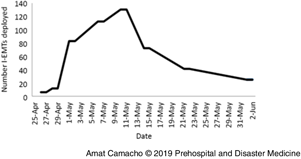
The Nepalese MoHP, Army, Nepal Police, and the Armed Police Force were the first responders implementing search and rescue activities and providing medical care to the injured the day the earthquake struck. The first I-EMTs deployed were the military medical teams from Bhutan and India, which arrived within the first 24 hours after the earthquake. On day two, national army teams from Bangladesh and China, and the Pakistan medical team were in the field. By day three, at least 11 I-EMTs had deployed, including the Israel Defense Force, a Type III I-EMT. By day seven (May 1), 83 I-EMTs had registered to deploy, 70 of which were already allocated specific tasks and locations for deployment. On May 6, around 112 I-EMTs were working in the country. By May 14, a total of 121 I-EMTs had deployed, with only 72 I-EMTs remaining operational in the field at that time. The number of I-EMTs reduced to 41 by May 21, and to 25 by June 1. Based on those records, a model representing the approximate trend of I-EMTs deployed in the country is shown in Figure 1.
Approximate Number of I-EMTs Deployed in Nepal Following the 2015 Earthquake Over Time.

Activities
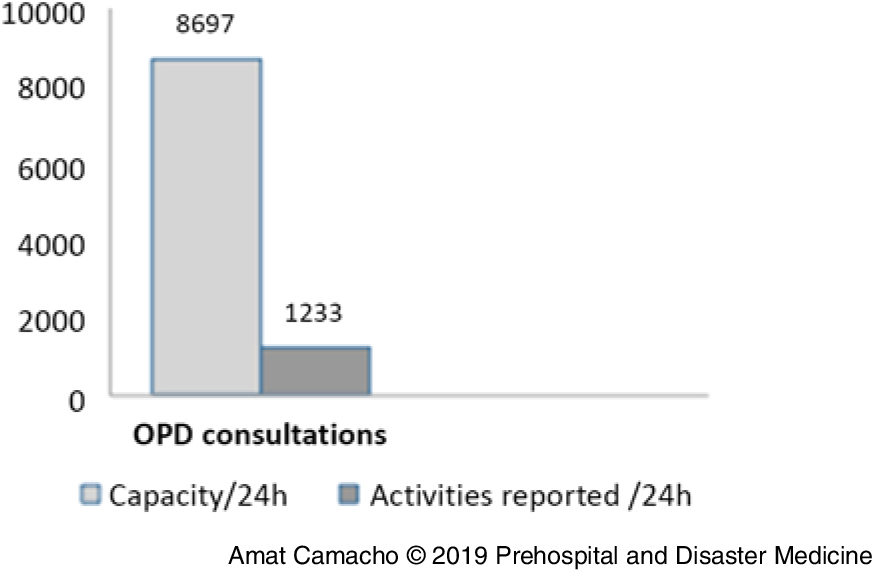
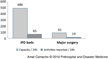
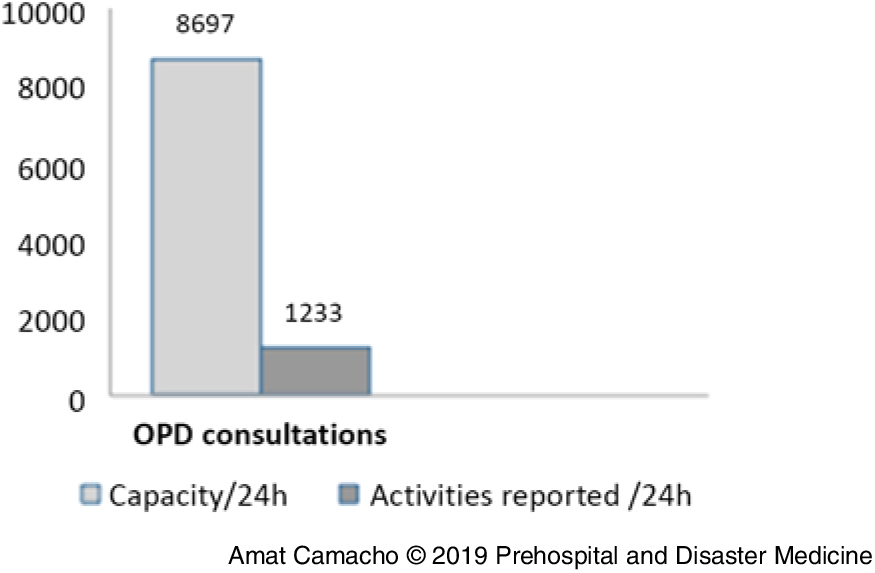
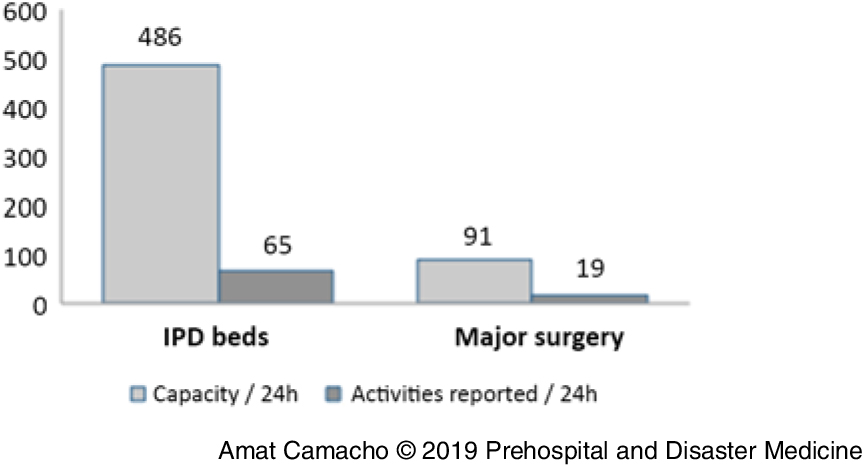
According to the HEOC data, I-EMTs declared on arrival capacities to offer 8,697 out-patient consultations, 486 in-patient beds, and 91 surgical procedures per day.
Based on daily reporting information recorded in the EMT Coordination Cell meeting minutes, the activities delivered by I-EMTs until May 18 included 28,372 out-patient consultations (comprising of 6,073 trauma cases); 1,499 in-patient admissions; and 440 major surgeries – an average of 1,233 consultations, 19 admissions, and 65 major surgeries per day. The highest concentration of activities was reported between May 2 and May 10 (day seven to day 15 post-earthquake), approximately.
Registration and Adherence to WHO-EMT Standards
Around 80% of I-EMTs registered through the WHO-EMT or HEOC registration mechanisms. Military I-EMTs were generally registered and coordinated by the Nepalese Army, although the EMT Coordination Cell also followed their activities. In terms of reporting, only 54% of I-EMTs submitted at least one daily report and just 17 I-EMTs sent exit forms pre-departure. Due to lack of data, it was impossible to assess adherence to technical standards. Anecdotal cases of mal-practice were reported (eg, one I-EMT treated wounds without proper sterilization of equipment, and one I-EMT used expired drugs). The lack of self-sufficiency (eg, teams arriving without needed supplies) and the poor adaptation to the local context by some I-EMTs were also raised as concerns, including language barriers and conflicts between national and I-EMT treatment protocols.
Discussion
According to the findings of this study, the I-EMT response to the 2015 Nepal earthquake was quicker than in previous SODs, and registration and follow-up of teams were better. An increase in data availability was also noticed, which allowed a broader description of I-EMT deployment in terms of their characteristics, timing, and activities performed, including pieces of qualitative information in relation to I-EMT performance. However, data describing I-EMT activities were not sufficiently captured, and this made it impossible to assess their adherence to WHO-EMT standards.
Almost 70% of I-EMTs were classified as Type I (fixed or mobile), a similar percentage found following typhoon Haiyan. These two examples represent a change from previous SODs in which EMT response overly focused on trauma care while not addressing chronic and non-trauma emergency medical needs. One paper about the activities of the Singapore Armed Forces in Nepal stated that 81% of their patients had non-earthquake-related injuries or illnesses.Reference Ho, Lim and Tan14 The experience of the Israel Defence Force team was similar, reporting 74% of non-earthquake-related cases.Reference Bar-On, Blumberg and Joshi12 Likewise, the Indian Army reported that only one-third of their patients had traumatic injuries caused by the earthquake.Reference Chauhan and Chopra19 These figures reinforce the need for EMTs to have the appropriate capacities to manage the non-trauma and non-earthquake-related conditions normally presenting at health facilities in the country.
A shortage of I-EMTs offering services in areas such as mental health, rehabilitation, and physiotherapy was reported by Nepal MoHP officers after the earthquake.Reference Aryal, Mahat and Dhimal24 A significant number of disaster survivors presenting impairments highlights that rehabilitation capacity is a necessary minimum standard for EMT response.25 Early rehabilitation in disaster settings leads to positive outcomes, including fewer complications, decreased length of acute hospital stay, improved functional outcomes, and better community reintegration of survivors.Reference Landry, Sheppard and Leung26
The difficult geographical access in Nepal caused logistic constraints that prevented large and heavy teams to arrive fast to the affected areas. Consequently, I-EMTs were requested to divide into smaller teams to access quicker the hard-to-reach areas.Reference Karki, Pandey and Pandey8 In future responses, I-EMTs should be ready to adapt to varied tasking proposals, including restructuring and relocation of their teams.
In terms of timing, an important progress from past SODs was noticed. For the first time, I-EMTs from neighboring countries arrived within the first 24 hours after the quake. Still, the immediate response was mainly managed by N-EMTs. Following the 2010 earthquake in Haiti and the typhoon Haiyan, the peak of I-EMTs’ arrival was at day 17 and day 22, respectively. In Nepal, the peak arrival was between days seven and 15, with almost 60% of all I-EMTs already in the field by day seven.
According to a paper documenting Indian Army activities in Nepal, the peak of earthquake-related injuries was seen on day five, and by day 10, the numbers had decreased significantly.Reference Chauhan and Chopra19 Another paper records that most injuries were operated on within seven days of onset.Reference Basu, Ghosh and Jana20 These findings coincide with previous studies suggesting that trauma teams arriving after one week will have few injuries to treat. After typhoon Haiyan, a considerable number of small non-registered and not self-sufficient I-EMTs arrived four to six weeks after the typhoon.Reference Peiris, Buenaventura and Nevio7 In contrast, two weeks after the earthquake, the Nepalese MoHP already requested no more I-EMTs to deploy.
The number of I-EMT activities presented in this paper covers only 23 days post-earthquake, and it is likely under-estimated considering the low reporting rate. Remarkably, I-EMT activities were found to be significantly lower than the available I-EMT capacities declared and registered on arrival (Figure 2 and Figure 3). This may be explained by low reporting, but it could also indicate that I-EMT capacities exceeded the needs or that patients in-need did not reach EMT facilities. The NHRC report highlights problems with communication between the information unit at the HEOC and the WHO-EMT coordination unit that resulted in inadequate tasking of I-EMTs to areas in-need. Teams were sometimes deployed on a first-come-first-served basis rather than going through a systematic process to match I-EMTs capacities with identified needs. Also, some I-EMTs were accused of prioritizing their organization’s visibility over the populations needs when setting up their facilities and accepting or rejecting the allocated location and task.Reference Karki, Pandey and Pandey8
Out-Patient (OPD) Consultation Capacities Declared by I-EMTs On-Arrival Compared to OPD Consultations Reported by I-EMTs During Deployment.
In-Patient (IPD) and Major Surgical Capacities Declared by I-EMTs On-Arrival Compared to IPD Admissions and Major Surgical Interventions Reported by I-EMTs During Deployment.
A total of 80% of I-EMTs deployed registered through the WHO-EMT or HEOC registration systems, which was significantly higher compared to previous SODs. Following typhoon Haiyan, only 55% of I-EMTs registered.Reference Brolin, Hawajri and von Schreeb6 Registration allows improved site and task allocation, and the opportunity to relocate teams if needs change.Reference Peiris, Buenaventura and Nevio7 Low reporting rates were observed after the Nepal earthquake compared to typhoon Haiyan, when activity reports and exit forms were submitted by most of the registered I-EMTs. Some of the reasons behind low reporting in Nepal could be the inclusion of I-EMT activities within the reports developed at the district health offices and the poor access to Internet and other means of communication. To improve response coordination and quality assurance, daily surveillance reporting by I-EMTs should be systematized and reinforced in the future. The WHO-EMT initiative has recently developed a standardized data collection mechanism - the Minimum Data Set - that may help this task.27 Only the availability of detailed information about I-EMT capacities and activities will allow an accurate assessment of I-EMT performance and adherence to minimum standards that goes beyond anecdotal cases.
Limitations
This retrospective descriptive study has several limitations. First, the results are based on secondary data. The lack of completeness, clarity, and uniformity of data sources made impossible a more in-depth analysis. For example, when referring to timing, terms like “deployed” were used indistinctively to describe teams just-arrived and teams already providing care. To triangulate the results and gain additional information, a web survey involving deployed I-EMTs was initially planned. This was not finally conducted considering the low response rates to this type of survey in previous studies (14% and 12.5%).Reference Gerdin, Wladis and von Schreeb5 , Reference Brolin, Hawajri and von Schreeb6 Despite these methodological considerations and lack of data, the results likely represent a true picture of I-EMT activity in Nepal, as confirmed by official Nepalese sources.
Conclusions
The results of this study suggest an improvement from previous disasters in terms of timing and registration. However, more efforts are needed to improve I-EMT coordination and to ensure adherence to WHO minimum standards. A minimum basis for this is the increase in EMT data collection and sharing. Although the I-EMT response timing improved in Nepal, N-EMTs, and then regional EMTs, will always remain the first responders to SODs, and the best suited to provide care in their local context. Therefore, N-EMT capacities and regional coordination need to be strengthened to ensure quicker and better culturally adapted care is provided after future SODs.
Conflicts of interest/funding
The National Board of Health and Welfare in Stockholm, Sweden provided financial support to cover the Karolinska Institutet (Stockholm, Sweden) contribution to the study. The authors declare no conflicts of interest.