INTRODUCTION
The construction of ports is increasing worldwide since a wide range of human activities of great economic importance (i.e. trade, fisheries, transportation and recreation) is associated with their development (Townend, Reference Townend2002). Benthic communities that settle on artificial hard substrata, i.e. fouling communities (see Redfield & Deevy, Reference Redfield, Deevy and Columbus1952), and on the natural soft substrata among piers, constitute a special entity with respect to benthic typology (Pérès & Picard, Reference Pérès and Picard1964). Such communities are mainly constituted of a basic stock of cosmopolitan species, very tolerant to environmental changes. In ports, they develop on very sheltered coastal environments, where water renewal is minimal (Karalis et al., Reference Karalis, Antoniadou and Chintiroglou2003). In contrast, sedimentation is very intense and creates the need for regular dredging operations (Simonini et al., Reference Simonini, Ansaloni, Cavallini, Graziosi, Iotti, Massamba N'Siala, Mauri, Preti and Prevedelli2005) that further disturb benthic communities both on the structural and functional level (Karalis et al., Reference Karalis, Antoniadou and Chintiroglou2003; Chintiroglou & Antoniadou, Reference Chintiroglou, Antoniadou and Nairne2009).
Benthic habitats in temperate ports are deemed as pollution hot-spots, severely affecting nearby habitats by the diffusion of heavy metals, hydrocarbons, organic matter, etc (Fichet et al., Reference Fichet, Radenac and Miramand1998; Gupta et al., Reference Gupta, Gupta and Patil2005), including also the particular case of allochthonous species, which are transferred via coastal shipping and many of them became invasive (Zibrowius, Reference Zibrowius1991; Boudouresque & Verlaque, Reference Boudouresque and Verlaque2002). Consequently, the need for biomonitoring using specific protocols to assess long-term changes and system response (Townend, Reference Townend2002) is currently recognized as a prerequisite to establish specific environmental management plans for each port (Gupta et al., Reference Gupta, Gupta and Patil2005). The scientific interest about the poorly studied temperate port communities (Chintiroglou & Antoniadou, Reference Chintiroglou, Antoniadou and Nairne2009) has been increasing, focusing to the selection of appropriate indicators among the various biological quality elements for the assessment of their ecological quality status, as several International Conventions impose (e.g. EU Directives 2000/59, 2000/60 and 2008/56). Such attempts shifted from a single-species point of view towards a more global multi-species approach (Saiz-Salinas & Urkiaga-Alberdi, Reference Saiz-Salinas and Urkiaga-Alberdi1999), also incorporating functional units of the ecosystem, recognized under the concept of ecosystem-based management (Tillin et al., Reference Tillin, Rogers and Frid2008). However, the complexity of a benthic ecosystem imposes several difficulties for the definition of habitat quality and for the prediction of future state, mostly due to the lack of comprehensive data about its spatial-temporal dynamics and endogenous properties (Currie & Parry, Reference Currie and Parry1999; Chintiroglou et al., Reference Chintiroglou, Antoniadou, Baxevanis, Damianidis, Karalis and Vafidis2004a, Reference Chintiroglou, Damianidis, Antoniadou, Lantzouni and Vafidisb; Chintiroglou & Antoniadou, Reference Chintiroglou, Antoniadou and Nairne2009).
Considering all the above the present work aims at assessing the small-scale spatial variability of zoobenthic communities in a Mediterranean port with high levels of commercial shipment. The above task was accomplished by: (1) analysing the structure of benthic communities developed both on hard and soft substratum; (2) investigating the fauna at a functional level; and (3) comparing the present status with previous data in order to assess any change in the ecosystem over time.
MATERIALS AND METHODS
Study area
The study area is located in Thermaikos Gulf, a shallow-water embayment in the north-west Aegean Sea (eastern Mediterranean). Thermaikos Gulf is among the most disturbed marine areas in Greece, receiving discharges from large river systems and also sewage and industrial effluents from the city of Thessaloniki (Chintiroglou et al., Reference Chintiroglou, Antoniadou and Krestenitis2006). Water circulation follows a cyclonic pattern, driven mainly by the prominent winds of northward direction (Krestenitis et al., Reference Krestenitis, Kombiadou and Savvidis2007). The abiotic parameters follow a seasonal pattern: water column is homogeneous from autumn to spring, whereas a thermocline appears during the intermediate period; salinity decreases in spring, where the inflow of the adjacent rivers is maximized (Hyder et al., Reference Hyder, Simpson, Christopoulos and Krestenitis2002). These hydrological features result in large concentrations of organic matter and nutrients especially to the more sheltered north-western part.
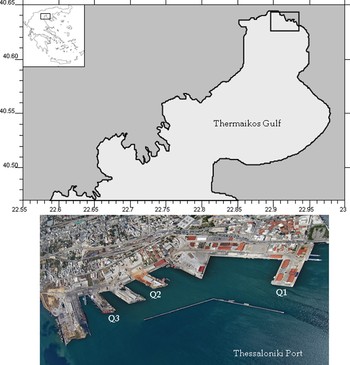
Thessaloniki Port, located in the northern part of Thermaikos (Figure 1), is the second major port in Greece; it handles an estimated annual average of over 16,000,000 tons of cargo, 370,000 twenty-foot equivalent containers, 3,000 ships and 220,000 passengers. Its quays have a total length of 6200 m and a depth down to 12 m. It is a very sheltered port, exposed mostly to southward winds and water renewal has low rates. For the purposes of the study three quays were selected as sampling stations differing in terms of exposure and ranked as follows: Q1 > Q3 > Q2 (Figure 1).
Map of the study area and aerial image of Thessaloniki Port, indicating sampling sites.

Field sampling
Sampling was carried out in August 2004 at three depth levels: (1) 0.5 m; (2) 3 m; and (3) 7 m. Three replicate samples were randomly collected from each site with SCUBA diving by totally scrapping the artificial hard substratum with a quadrate sampler covering a surface of 400 cm2 (Karalis et al., Reference Karalis, Antoniadou and Chintiroglou2003). Three replicate soft substratum samples were also collected from the sea bottom among the three sampled quays using an 18 × 25 cm core sampler (Antoniadou et al., Reference Antoniadou, Krestenitis and Chintiroglou2004). The obtained samples were sieved (mesh opening 0.5 mm) and fixed in 9% formaldehyde. After sorting all living specimens were identified at the species level, using a binocular stereoscope or microscope and the relevant identification-keys for each taxon, and counted.
At each sampling site the main abiotic factors, i.e. temperature, salinity, dissolved oxygen and pH were measured in the water column, with a CTD (SeaBird SBE-19) on a seasonal basis and water clarity was estimated with a Secchi disc. Two substrate samples were collected at each site with a core sampler (1 l) in order to estimate the particle composition of soft substratum, according to Folk's system of sediment classification (Gee & Bauder, Reference Gee, Bauder and Klute1986).
Data analyses
Data were analysed with common biocoenotic methods (Karalis et al., Reference Karalis, Antoniadou and Chintiroglou2003), including the estimation of abundance as population density (N/m2) and the calculation of diversity indices (i.e. Shannon–Wiener and Pielou's evenness, based on log2). At a functional level, the fauna was classified into feeding groups according to the nature and origin of food, as follows: (1) herbivores (H) feeding on macroalgae; (2) carnivores (C) feeding on various sessile or motile invertebrates; (3) suspension feeders (S) feeding on suspended organic particles in the water column; and (4) deposit feeders (D) feeding on particles deposited on the sea bottom (Karalis et al., Reference Karalis, Antoniadou and Chintiroglou2003; Dimitriadis & Koutsoubas, Reference Dimitriadis and Koutsoubas2008).
Analysis of variance (two-way balanced ANOVA) was used to test for spatial effects at horizontal (site, three-level fixed factor) and vertical scales (depth, three-level fixed factor nested on sites) on the average abundance of the fauna, of the dominant taxonomic groups separately and of the feeding groups, through a general linear model (Underwood, Reference Underwood1997). Prior to the analyses, data were tested for normality by the Anderson–Darling test, while the homogeneity of variances was tested by Cohran's test. The Fisher's LSD test was used for post hoc comparisons. ANOVAs were performed using the SPSS software package. The faunistic diversity, expressed as the number of species S, and through diversity indices, i.e. Shannon–Wiener and Pielou's evenness was also tested with the same model of ANOVA.
Hierarchical cluster analysis and non-metric multidimensional scaling (nMDS) via Bray–Curtis distances on log-transformed numerical abundances data were used to visualize spatial changes in the composition of the fauna. Analysis of similarity (ANOSIM) was used to test for spatial effects at the composition of the fauna and similarity of percentage (SIMPER) was used to identify the species which were responsible for any spatial pattern found. All multivariate analyses were performed with the PRIMER software package (Clarke & Gorley, Reference Clarke and Gorley2006).
Also, two biotic indices proposed under the Water Framework Directive auspices for the assessment of the ecological quality status of coastal water bodies, i.e. AMBI (Borja et al., Reference Borja, Franco and Pérez2000) and BENTIX (Simboura & Zenetos, Reference Simboura and Zenetos2002), were calculated in order to test their applicability in temperate ports.
RESULTS
Abiotic factors
The values of the measured abiotic factors were similar among sampling sites, with salinity being the only parameter with lower values at the western station, i.e. Q3. Water clarity reached 3 m at all sampling sites. As regards the seasonal pattern observed, temperature ranged from 10.9 to 28.7 °C, salinity from 34.5 to 36.3 psu, dissolved oxygen from 2.8 to 7.8 mg/l with the lowest values recorded near the sea bottom, and pH varied around 8.7. The sediment characteristics differed among sampling sites. At Q1 a mixed occurrence of biogenic fragments (dead bivalve shells), sand and silt (30%, 25% and 45%, respectively) has been recorded, while at both Q2 and Q3 the sediment was silty (over 90%).
Community structure
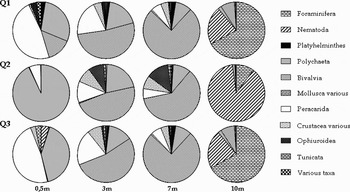
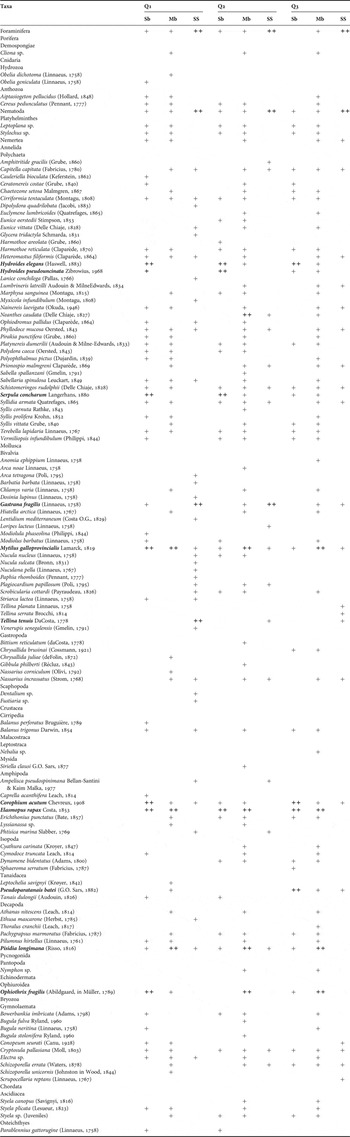
A total of 34,578 individuals were collected, identified to 118 animal species, while three higher taxa, namely Nematoda, Nemertea and Foraminifera were not identified at species level (Table 1). The most dominant in terms of abundance was the taxon of Polychaeta, in particular the family Serpulidae, followed by Bivalvia and Peracarida (Figure 2).
Percentage contribution of the main taxonomic groups to the abundance of the fauna, at each sampling site and depth.

Taxonomic list of the species found (+) in the fouling community, i.e serpulid blocks (Sb) and mussel beds (Mb), and soft substratum community (SS) at each sampled quay (Q1–Q3) of Thessaloniki Port. Dominant species in bold and marked with two crosses (++) at the relevant assemblage.

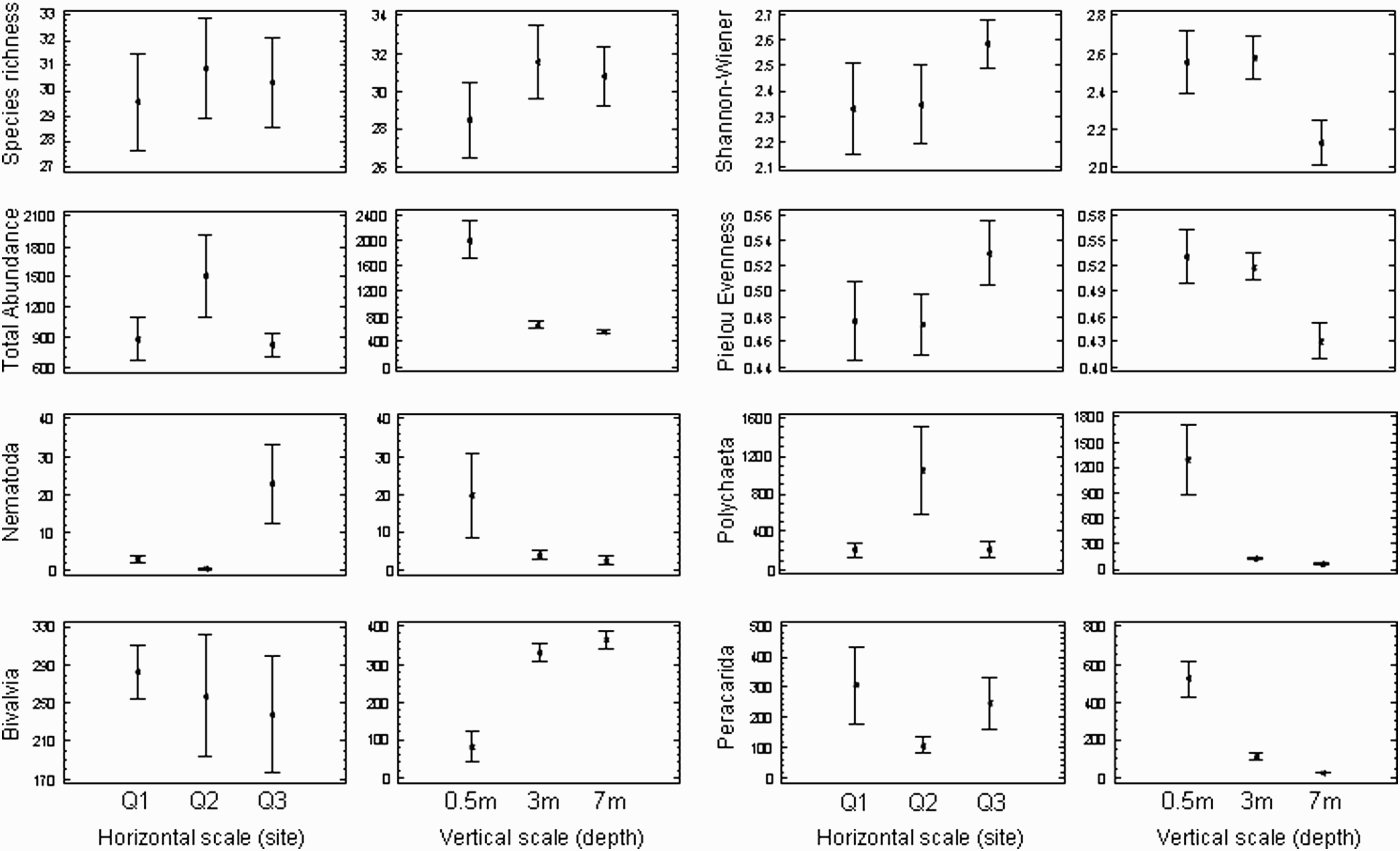
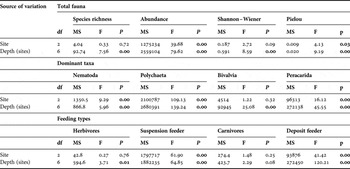
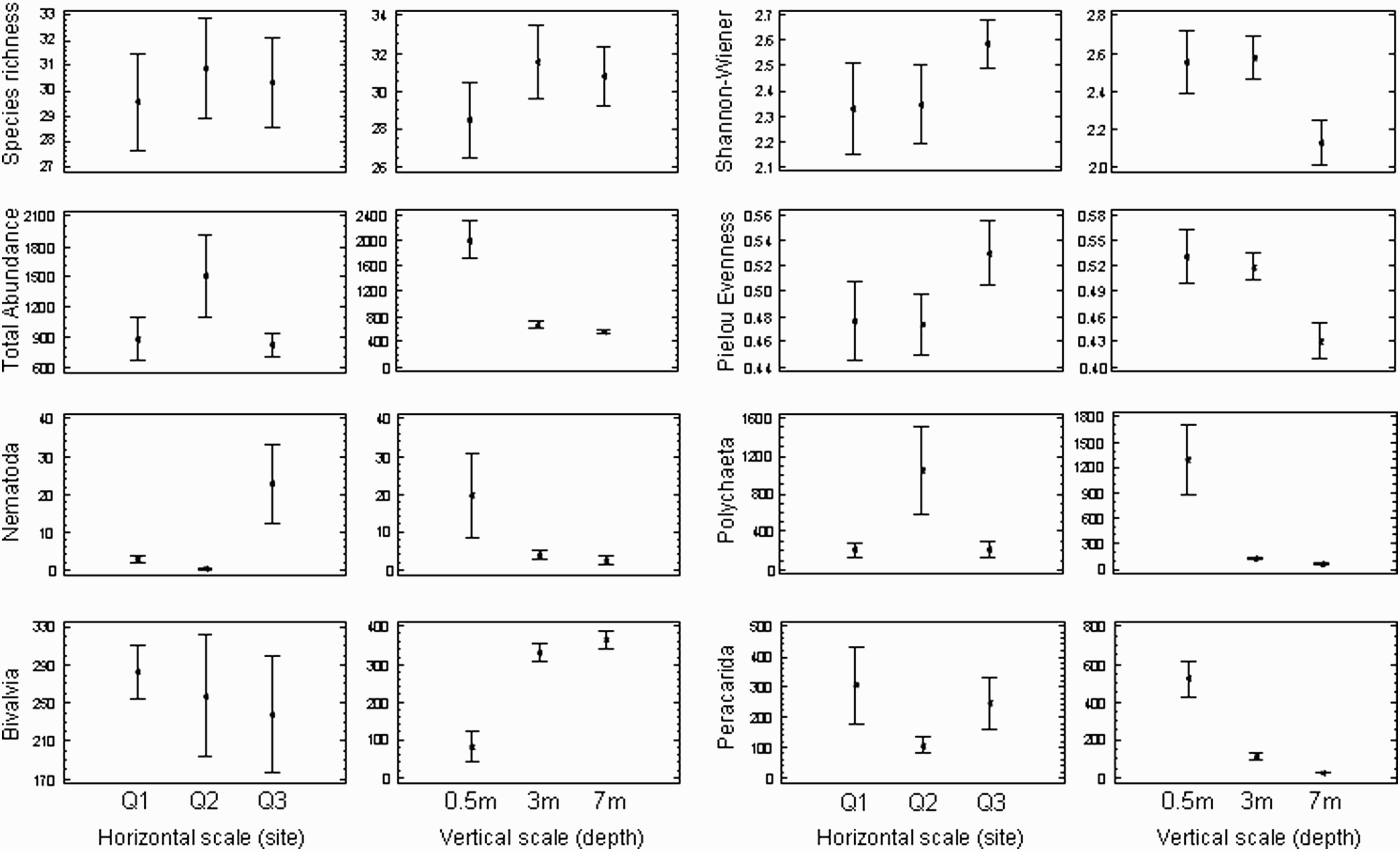
The estimated biocoenotic parameters of hard substratum communities varied significantly in vertical scales, i.e. among depths (Table 2; Figure 3); species richness, Shannon–Wiener index and the abundance of Bivalvia also varied in horizontal scales, i.e. among quays. At soft substratum communities, the abundance of Foraminifera and Bivalvia showed significant spatial variability (P < 0.05); both taxa had increased abundance at Q1. The diversity of the fauna expressed as the total number of species (S) and through diversity indices (J and H) also showed significant spatial variations (P < 0.05) that can be synopsized either to increased values recorded at Q1, or to decreased ones at Q3.
Spatial variability of diversity (species richness, Shannon–Wiener and Pielou's evenness) and abundance (number of individuals m−2) of the fouling fauna in total, and of each dominant taxonomic group, at horizontal and vertical scales (bars represent standard error).
Analysis of variance results for the spatial effects (i.e. stations and depth) on fouling community parameters.

Significant differences in bold.
Considering the trophic structure of hard substrata fouling communities, the abundance of deposit and suspension feeders showed significant spatial differences in both studied scales (Table 2); the former showed increased abundance at Q1 and the latter at Q2, both decreasing with depth. Herbivores abundance varied only according to depth, while that of carnivores did not vary. In soft substratum, carnivores and herbivores had very low abundances; thus, they were omitted from the analysis. Suspension feeders showed non-significant differences among sampling sites (P > 0.05) and only deposit feeders showed increased abundance at Q1 (P < 0.05).
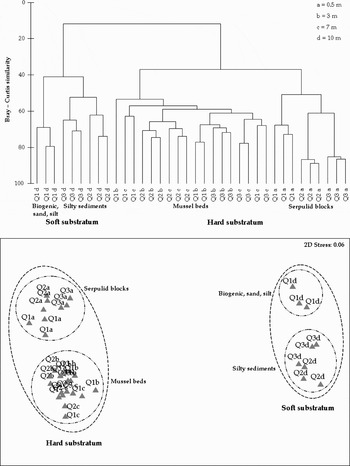
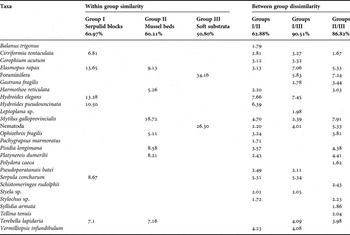
Multidimensional analyses of the assemblage structure discriminated all samples from soft substratum, which were subdivided according to the sediment particles. The samples from hard substratum were placed in the same group, which was further divided according to depth (Figure 4). Thus, on hard substratum two separate assemblages of an animal-dominated community can be detected: the blocks of various serpulids in the lower midlittoral zone, and the beds of the common Mediterranean mussel Mytilus galloprovincialis in the sublittoral. Two-way ANOSIM showed that the assemblage structure differed spatially both in horizontal (R = 0.89 P < 0.01) and vertical scales (R = 0.95 P < 0.01). Pair-wise tests showed the highest similarity in the assemblage structure in the sublittoral zone, i.e. between 3 and 7 m depth (R = 0.77 P < 0.01), where a dense mussel bed occurs at all quays. Considering both hard and soft substrata communities increased similarity can be detected between Q1 and Q3, located at the eastern and the western opening of the port, respectively (R = 0.77 P < 0.01). SIMPER analysis showed that 2 to 7 species contribute to 60% of the average similarity of each group, while 15 to 18 species contribute to 60% of the average dissimilarity among groups (Table 3).
Hierarchical cluster and non-metric multidimensional scaling ordination of port communities' structure, based on Bray–Curtis similarity index calculated from log-transformed numerical abundance data.

Species contributing to about 60% of the average in-group similarity or among groups dissimilarity resulting from SIMPER analysis.

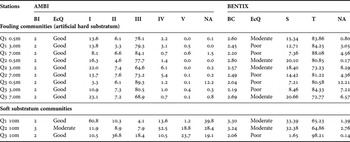
The biotic index AMBI calculated for soft and hard substrata sites was 2 in all cases, reaching 3 only in Q2 soft substratum samples (Table 4). Thus, the port is classified as slightly polluted with the exception of the most sheltered soft substratum site (Q2 10 m), which is assigned as moderately polluted. The percentage contribution of the five ecological categories of species showed the dominance of the tolerant to organic pollution ones (Group III) in hard substratum. In contrast, soft substratum sites are characterized by sensitive species at Q1, mainly represented by the bivalves Tellina tenuis and Gastrana fragilis, by first order opportunistic species at Q2 (Neanthes caudata and Prionospio malmgreni), while at Q3 indifferent to organic pollution species co-dominate with tolerant ones. The BENTIX index ranged from 2.06 to 3.30 (Table 4); thus, according to this index, all stations were classified as moderately or heavily polluted. The contribution of the tolerant species dominated the species/abundance matrix at all stations, with the exception of soft substratum sites Q1 and Q2, where the above mentioned sensitive bivalves abound.
Estimated biotic indices, AMBI and BENTIX results.

BI, biotic index value; BC, biotic coefficient value; EcQ, ecological quality; I–V, percentage of the five ecological groups of AMBI at increasing order of tolerance; S, percentage of sensitive species; T, percentage of tolerant species; NA, percentage of the not assigned species.
DISCUSSION
All the species found during this study have been previously reported from the Aegean Sea, most of them living in fouling communities or silty sediments (Koçak et al., Reference Koçak, Ergen and Çinar1999; Damianidis & Chintiroglou, Reference Damianidis and Chintiroglou2000; Karalis et al., Reference Karalis, Antoniadou and Chintiroglou2003; Chintiroglou et al., Reference Chintiroglou, Antoniadou, Baxevanis, Damianidis, Karalis and Vafidis2004a, Reference Chintiroglou, Damianidis, Antoniadou, Lantzouni and Vafidisb; Antoniadou et al., Reference Antoniadou, Krestenitis and Chintiroglou2004; Manoudis et al., Reference Manoudis, Antoniadou, Dounas and Chintiroglou2005; Çinar et al., Reference Çinar, Katağan, Koçak, Öztürk, Ergen, Kocatas, Önen, Kirkim, Kurt, Dağli, Açik, Doğan and Özcan2008; Koçak, Reference Koçak2008). Significant horizontal small-scale spatial differences in the composition of the fauna were detected: fouling communities had increased abundance at the most sheltered station. This pattern was produced mainly from Polychaeta, since the abundance of the other three major taxa showed high values at Q3 for Nematoda, at Q1 and Q3 for Peracarida, or did not vary significantly for Bivalvia. Relevant differences were much more apparent in vertical scales; the abundance of the dominant taxa and of the fauna in total, showed a decreasing trend with depth. Diversity indices had low values close to the sea bottom, in contrast with species richness whose minima were recorded in shallower depth.
Less than ten species dominated fouling communities, namely Hydroides elegans, H. pseudouncinata, Serpula concharum, Mytilus galloprovincialis, Corophium acutum, Elasmopus rapax, Pseudoparatanais batei, Pisidia longimana and Ophiothrix fragilis; the first five have been commonly reported among the dominant species in Mediterranean ports and marinas (Leung Tack Kit, Reference Leung Tack Kit1972; Relini, Reference Relini1993; Bellan-Santini, Reference Bellan-Santini and Ruffo1998; Karalis et al., Reference Karalis, Antoniadou and Chintiroglou2003; Chintiroglou et al., Reference Chintiroglou, Antoniadou, Baxevanis, Damianidis, Karalis and Vafidis2004a, Reference Chintiroglou, Damianidis, Antoniadou, Lantzouni and Vafidisb; Ramadan et al., Reference Ramadan, Kheirallah and Abdel-Salam2006; Çinar et al., Reference Çinar, Katağan, Koçak, Öztürk, Ergen, Kocatas, Önen, Kirkim, Kurt, Dağli, Açik, Doğan and Özcan2008). The serpulid polychaete H. elegans was the dominant species in the lower midlittoral zone (0.5 m) and the common Mediterranean mussel, M. galloprovinciallis, in the sublittoral (3 and 7 m). These species were previously reported as foulers in Thessaloniki Port (Karalis et al., Reference Karalis, Antoniadou and Chintiroglou2003). Currently their density has considerably increased, especially at the most sheltered site, surpassing 2000 and 950 individuals m−2, for H. elegans and M. galloprovinciallis, respectively. On the contrary, the density of both amphipods was currently decreased compared with previous records (Karalis et al., Reference Karalis, Antoniadou and Chintiroglou2003). This is more evident considering C. acutum, whose population was almost absent from the most sheltered and organically enriched site. The density of E. rapax was also reduced according to organic content; however, this species appeared to be more tolerant with densities ranging from 100 to 280 individuals m−2. The decapod P. longimana inhabited M. galloprovincialis beds as previously reported (Chintiroglou et al., Reference Chintiroglou, Damianidis, Antoniadou, Lantzouni and Vafidis2004b), whereas O. fragilis was found among both serpulids and mussels. Indeed, this very common Mediterranean brittle-star occasionally forms dense aggregations on various habitat-providing organisms, such as sponges (Turon et al., Reference Turon, Codina, Tarjuelo, Uriz and Becerro2000) and mussels (Chintiroglou et al., Reference Chintiroglou, Damianidis, Antoniadou, Lantzouni and Vafidis2004b). In contrast with all the above species, the tanaid P. batei has not been reported as a fouling species. It inhabits various algal-dominated communities and mäerl beds (Hall-Spencer & Bamber, Reference Hall-Spencer and Bamber2007), also reported among the symbiotic epifauna of the ascidian Microcosmus sabatieri in oligotrophic areas of the Aegean Sea (Voultsiadou et al., Reference Voultsiadou, Pyrounaki and Chintiroglou2007). Pseudoparatanais batei seems to be sensitive to organic pollution; its populations are seriously depressed in proximity to aquacultures (Hall-Spencer & Bamber, Reference Hall-Spencer and Bamber2007). Nevertheless, the species is currently detected in Thessaloniki Port, where a dense population was found to live in the interstices among the calcareous tubes of serpulids.
At soft substratum macrofauna was very impoverished both in terms of species richness and abundance; the 51 identified species had an overall abundance of 520 individuals m−2. Five polychaetes, i.e. Capitella capitata, Heteromastus filiformis, Neanthes caudata, Prionospio malmgreni and Cirriformia tentaculata, and two bivalves, i.e. Gastrana fragilis and Tellina tenuis, dominated. These polychaetes flourish in organically polluted areas (Pearson & Rosenberg, Reference Pearson and Rosenberg1978; Bellan, Reference Bellan1967a, Reference Bellanb, Reference Bellan, Moraitou-Apostolopoulou and Kiortsis1991; Grall & Glemarec, Reference Grall and Glémarec1997). On the contrary, both bivalves are considered as sensitive (Borja et al., Reference Borja, Franco and Pérez2000; Simboura & Zenetos, Reference Simboura and Zenetos2002); they live buried in sandy substratum tolerating only a small amount of silt (Alyakrinskaya, Reference Alyakrinskaya2004). Their distribution in Thessaloniki Port was in accordance with sediment composition: they showed increased density at Q1, where the sea bottom consists of biogenic fragments, sand and silt, and reduced density at Q2 and Q3, where the amount of silt is increasing.
The analysis of the port community structure at a functional level, revealed an evident dominance of suspension and deposit feeders in fouling and soft substratum, respectively; the accumulation of organic matter probably enhanced their abundance (Simonini et al., Reference Simonini, Ansaloni, Bonvicini Pagliai and Prevedelli2004; Chintiroglou et al., Reference Chintiroglou, Antoniadou and Krestenitis2006). These feeding types presented a similar vertical pattern with increased values at the shallower stations; at horizontal scales their maxima was recorded at Q2 and Q1, respectively. This could be explained considering the circulation pattern in Thermaikos Gulf: water currents follow a cyclonic pattern (Krestenitis et al., Reference Krestenitis, Kombiadou and Savvidis2007) and thus, organic particles are transferred from Q3 towards Q1, and accumulate at the most sheltered site, benefiting both suspension and deposit feeding animals, which thrive in the studied port. The prevalence of suspension feeders at Q2 is due to the settlement of dense serpulid blocks, which are probably favoured by sheltered conditions. In contrast, at the most exposed site serpulid density was reduced; probably strong surface waves produced by southward winds detach serpulids, which prefer more protected sites. The prevalence of deposit feeders at the exposed site is attributed to a dense population of the amphipod Elasmopus rapax. This species is tolerant to organic enrichment (Bellan-Santini, Reference Bellan-Santini and Ruffo1998; Chintiroglou et al., Reference Chintiroglou, Antoniadou, Baxevanis, Damianidis, Karalis and Vafidis2004a) but its populations seem to decline under the increased siltation at the most sheltered sites of the port.
Ordination analysis discriminated fouling from soft substratum communities. Both fouling assemblages were animal dominated: (1) the blocks of serpulids in the lower midlittoral zone; and (2) the mussel beds in the sublittoral zone. These assemblages are classified to the photophilic algae community, according to the benthic typology of the Mediterranean Sea (Pérès & Picard, Reference Pérès and Picard1964). Serpulid blocks presented a clear spatial pattern: the composition of the macrofauna differed at the most exposed site. The fauna associated with mussel beds showed a more complicated pattern since the observed differences intermingled at horizontal and vertical spatial scales. However, in all cases samples from the most sheltered site are grouped together, showing increased dissimilarity with those from the most exposed one. It seems therefore that the composition of the fauna reflects the small-scale variability of the environmental characteristics (i.e. depth, water circulation and organic content). Serpulid polychaetes and mussels are typical suspension feeding organisms. They frequently form dense beds at temperate ports, persisting under severe pollution events hosting a species rich and abundant macrofauna (Leung Tack Kit, Reference Leung Tack Kit1972; Bellan, Reference Bellan1980; Bitar, Reference Bitar1982; Relini, Reference Relini1993; Damianidis & Chintiroglou, Reference Damianidis and Chintiroglou2000; Chintiroglou et al., Reference Chintiroglou, Antoniadou, Baxevanis, Damianidis, Karalis and Vafidis2004a, Reference Chintiroglou, Damianidis, Antoniadou, Lantzouni and Vafidisb; Çinar et al., Reference Çinar, Katağan, Koçak, Öztürk, Ergen, Kocatas, Önen, Kirkim, Kurt, Dağli, Açik, Doğan and Özcan2008). These animals are involved in ecosystem engineering processes (Jones et al., Reference Jones, Lawton and Shachak1994) adding physical structure to the environment (Commito et al., Reference Commito, Celano, Celico, Como and Johnson2005). They form a complex biotic construction on otherwise smooth artificial substrates (concrete blocks) enhancing habitat complexity and providing space for the settlement of many other organisms. In this way they contribute to the structuring of fouling communities in temperate ports, since it is well accepted that benthic organisms respond to the increasing habitat complexity (Dean & Connell, Reference Dean and Connell1987; Antoniadou et al., Reference Antoniadou, Voultsiadou and Chintiroglou2010).
Considering soft substratum the ordination of samples followed sediment composition, which seems to be the dominant structural factor in such habitats (Mancinelli et al., Reference Mancinelli, Fazi and Rossi1998; Antoniadou et al., Reference Antoniadou, Krestenitis and Chintiroglou2004). The most exposed site, in which a mixed occurrence of biogenic sand with silt occurred, was clearly differentiated mostly due to the presence of the sensitive to organic pollution bivalves Gastrana fragilis and Tellina tenuis. Accordingly, the benthic community can be assigned to the superficial muddy sand in sheltered areas (Pérès & Picard, Reference Pérès and Picard1964). At the other two studied sites silt prevailed in sediment composition. The macrofauna was very impoverished (less than half of the species richness compared with Q1) and a few tolerant to organic pollution polychaetes dominated. Accordingly the benthic community conforms to one of highly polluted sediments (Bellan, Reference Bellan1967b). The large amount of organically rich wastes produced by the dense mussel bed assemblages (about 700 individuals m−2) occupying all docks seems to further disturb the adjacent soft-substratum communities (Commito et al., Reference Commito, Celano, Celico, Como and Johnson2005).
The estimated biotic indices classified Thessaloniki Port communities to different ecological quality states; ‘good’ or ‘slightly polluted’, according to AMBI and ‘moderate to bad’ or ‘moderately to heavy polluted’, according to BENTIX. This difference between the two indices seems to be constant, at least for the eastern Mediterranean, with AMBI showing a trend over a better ecological status (Chintiroglou et al., Reference Chintiroglou, Antoniadou and Krestenitis2006). It is attributed to the different weight each index puts on the various ecological categories and to their different boundary limits (Simboura & Reizopoulou, Reference Simboura and Reizopoulou2007). The applicability of these indices to soft substratum port communities was limited; this is probably due to the impoverished fauna in terms of both species richness and abundance, which is a drawback to the utility of biotic indices (Borja & Muxica, Reference Borja and Muxica2005). Considering hard substratum, the results were contradictory; accordingly, their power is even more questionable. Indeed, these indices have been originally developed for soft substratum and they need either to be modified to cover hard bottoms or to be substituted by new robust tools for ecological quality assessment in the latter (Borja & Muxica, Reference Borja and Muxica2005; Chintiroglou et al., Reference Chintiroglou, Antoniadou and Krestenitis2006; Borja & Dauer, Reference Borja and Dauer2008).
Fouling communities in Thessaloniki Port underwent important changes in their structure: in the mid-1990s a homogeneous algal-dominated community occurred with low levels of temporal variability (Karalis et al., Reference Karalis, Antoniadou and Chintiroglou2003), which has been currently replaced by an animal-dominated one. This substitution was accompanied by a decrease in the biodiversity of macrobenthos and by the dominance of suspension feeders at a functional level (Chintiroglou & Antoniadou, Reference Chintiroglou, Antoniadou and Nairne2009). Another important difference in the structure of fouling communities during the last decade is the decline of the formerly very abundant ascidian Styela plicata. This species, due to its large filtration abilities, has been assigned as a biological filter, contributing to the removal of suspended organic matter in eutrophic areas (Kombiadou et al., Reference Kombiadou, Krestenitis, Antoniadou and Chintiroglou2010). Therefore, its decline could further enhance organic pollution in the port negatively affecting the diversity of the fauna. The substitution of the algal-dominated community is probably linked with the intense development of mussel farms after 1990 in the western area of Thermaikos Gulf; the annual production of these cultures reached 35,000 tons after 2000 (Chintiroglou & Antoniadou, Reference Chintiroglou, Antoniadou and Nairne2009). Therefore, Mytilus galloprovincialis due to its high reproduction rate (Bownes & McQuaid, Reference Bownes and McQuaid2006) successfully colonized hard substrata over the entire bay. This ‘imperialistic’ behaviour of the mussel probably facilitated the expansion of serpulids as well, since they are among the dominant biofoulers on mussel shells, especially on cultured ones (Chintiroglou & Antoniadou, Reference Chintiroglou, Antoniadou and Nairne2009). The reproductive output of serpulids is large as well (Bianchi, Reference Bianchi1981; Qiu & Qian, Reference Qiu and Qian1997). Serpulid and mussel larvae spread over the entire Thermaikos Bay following water masses circulation and settled on various submerged structures. In this way, these organisms have established dense populations in the area, monopolizing artificial substrata.
Summarizing, the following remarks can be made: (1) fouling communities at the studied port showed increased small-scale spatial variability on horizontal and vertical scales, at both structural and functional level. This variability is influenced by both environmental factors and biotic interactions, since various sessile species provided physical structure and acted as ecosystem engineers having the potential to facilitate or inhibit the establishment of other macrobenthic species; (2) soft substratum communities were very impoverished and showed some spatial patterns in accordance to sediment composition and water currents. These communities seem to be further disturbed by the engineering process of mussel beds; (3) two animal-dominated assemblages substituted an algal-dominated one, previously recorded at the port quays. Serpulid blocks and mussel beds provided additional substrata increasing habitat complexity. However, the diversity of the associated fauna decreased in contrast with the number of tolerant to organic pollution species that increased. This is probably due to the combined effect of organic enrichment and the monopolization of the substrata by densely aggregated individuals of mussels and serpulids, whose populations boomed over the entire area due to the intense culture of Mytilus galloprovincialis; and (4) the above considerations clearly show the necessity of biomonitoring studies on recursive temporal scales to assess the change of the system. They also highlight the need to develop specific integrated management plans for temperate ports under a broader landplanning coastal zone policy.