1. Introduction
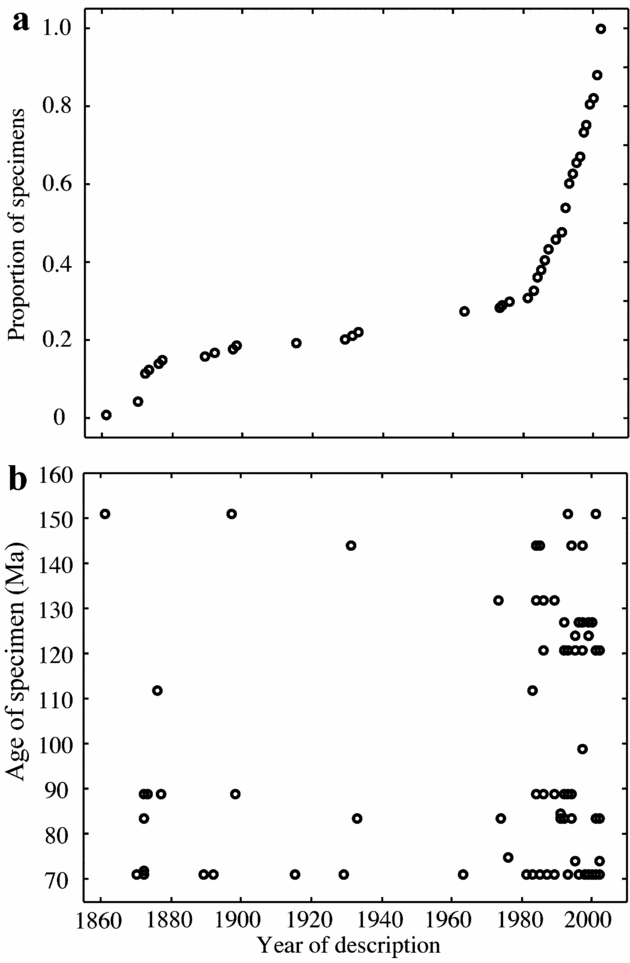
Over the last two decades the number of fossil birds known from the Cretaceous has ballooned; more fossils have been discovered and described since the early 1980s than were known for almost the entire preceding century (Chiappe, Reference Chiappe1995; Kurochkin, Reference Kurochkin1995; Chiappe & Dyke, Reference Chiappe and Dyke2002; Fountaine et al. Reference Fountaine, Benton, Dyke and Nudds2005) (Fig. 1). Because of this explosion in the known record, several new lineages of fossil birds have been discovered and documented, among them Enantiornithes (Walker, Reference Walker1981; Kurochkin, Reference Kurochkin, Kurochkin and Rakhimov2001; Chiappe & Walker, Reference Chiappe, Walker, Chiappe and Witmer2002). This clade is now thought to have been the most diverse group of flying birds throughout the Cretaceous, comparable in morphological and taxonomic diversity to that of modern birds (Chiappe & Walker, Reference Chiappe, Walker, Chiappe and Witmer2002). The flight styles of these birds mirrored those seen amongst their modern counterparts (Neornithes) (Rayner & Dyke, Reference Rayner, Dyke, Bels, Gasc and Casinos2002) and some were even flightless (Chiappe et al. Reference Chiappe, Suzuki, Dyke, Watabe, Tsogtbaatar and Barsbold2006).
Collector curves to show increasing numbers of known Mesozoic birds since the 1980s: (a) increasing proportion of all known specimens, and (b) distribution of geological ages. From Fountaine et al. (Reference Fountaine, Benton, Dyke and Nudds2005).

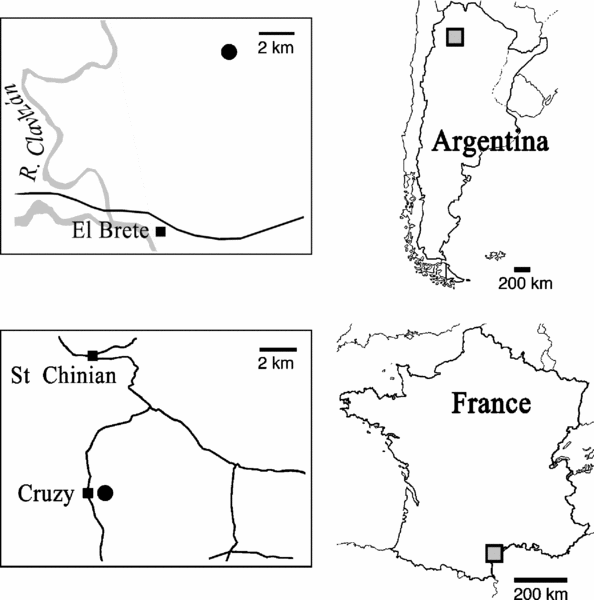
Our current understanding of the evolution of enantiornithine birds dates from the work of Walker (Reference Walker1981), who recognized novel morphologies in a collection of Late Cretaceous bones which had been shown to him by J. Bonaparte in the 1970s (Bonaparte was then working at the Universidad de Tucuman, Argentina). Bonaparte had collected a series of fossil bones between 1974 and 1976 (with help from J. Leal) from continental deposits of the Maastrichtian Lecho Formation in Salta Province, northwestern Argentina (Bonaparte et al. Reference Bonaparte, Salfitty, Bossi and Powell1977; Bonaparte & Powell, Reference Bonaparte and Powell1980) (Fig. 2). Bonaparte took this collection of largely isolated bones to the USA where he showed them to the late Pierce Brodkorb; because Brodkorb told him that these elements ‘did not belong to birds’, he carried them on to London where they were examined in The Natural History Museum by Walker. A description and short analysis of some of the original El Brete collection followed (Walker, Reference Walker1981); however, the bulk of this collection still remains undescribed, even though it has formed the basis for much subsequent descriptive and phylogenetic work on Enantiornithes (e.g. Brett-Surman & Paul, Reference Brett-Surman and Paul1985; Chiappe, Reference Chiappe1993, Reference Chiappe1996; Chiappe & Walker, Reference Chiappe, Walker, Chiappe and Witmer2002). Walker (Reference Walker1981) based his diagnosis for ‘Enantiornithes’ on the anatomy of the forelimb and shoulder girdle; limited subsequent taxonomic work on the El Brete collection (Chiappe, Reference Chiappe1993, Reference Chiappe1996) focused instead on the hindlimb, in particular the anatomy of the tarsometatarsus.
Maps showing the locations of El Brete (Argentina) and Massecaps (France). Regions of countries are shown as shaded boxes, localities as filled dots.

In this paper we review previous taxonomic studies and note that Walker's original manuscript, later to form the basis for his 1981 publication, was much longer than in its final published form (Chiappe & Walker, Reference Chiappe, Walker, Chiappe and Witmer2002; cited in Chiappe, Reference Chiappe1991, as ‘in preparation’). We also provide a historical review of early ideas about enantiornithine taxonomy (1980s) and describe a new taxon that was originally identified (but never fully documented) by Walker in the 1980s. Some elements of this new bird were figured by Walker (Reference Walker1981). Based on well-preserved humeri, this new Late Cretaceous bird is well represented in the original El Brete collections, and has more recently been discovered in sediments of the same age in southern France. Also collected in the mid-1970s, one additional bone also testifies to the presence of this taxon in the North American Late Cretaceous.
2. Material and methods
Repositories for specimens, and abbreviations used in the text, are indicated by the following acronyms: BMNH – The Natural History Museum, London, UK (Palaeontology Department collections); KU-NM – University of Kansas, Museum of Natural History, Lawrence, Kansas, USA; ACAP – Musée de Cruzy, Cruzy (l'Association Culturelle, Archéologique et Paléontologique de l'Ouest Biterrois), Cruzy, France; PVL – Fundación-Instituto Miguel Lillo, Tucumán, Argentina. Although our illustrations are of original specimens (PVL), some of our anatomical descriptions are based on casts made in London in the 1980s (BMNH).
3. Historical review
In the late 1970s, pre-cladistic views of avian phylogeny and classification recognized three ‘subclasses’ of birds, termed ‘Archaeornithes’, ‘Odontornithes’ and ‘Neornithes’. Examination of the morphology of the El Brete specimens, brought to London by J. Bonaparte, led Walker to name a new avian group, which he termed the subclass ‘Enantiornithes’ (Walker, Reference Walker1981) to accommodate these (at the time) strange forms. Once published, not everyone agreed with this interpretation: at the time, considerable doubt was expressed verbally and in print concerning the ‘avian affinities’ of Enantiornithes (Steadman, Reference Steadman, Brush and Clark1983). Later, and as more material came to light, Walker's (1981) identification became more generally accepted in the literature (Elzanowski, Reference Elzanowski1981; Martin, Reference Martin, Brush and Clark1983; Thulborn, Reference Thulborn1984; Kurochkin, Reference Kurochkin1985; Olson, Reference Olson, Farner, King and Parkes1985; Cracraft, Reference Cracraft1986; see review in Chiappe & Walker, Reference Chiappe, Walker, Chiappe and Witmer2002). Some authorities, however, remained unconvinced and still considered that at least part, if not all, of Walker's ‘enantiornithine assemblage’ was ‘reptilian’ (Steadman, Reference Steadman, Brush and Clark1983; Brett-Surman & Paul, Reference Brett-Surman and Paul1985). The turning point came with subsequent reinterpretation of Alexornis antecedens, a sparrow-sized bird from the Cretaceous of Mexico that had been originally described as a ‘coraciiform/piciform ancestor’ by Brodkorb (Reference Brodkorb1976). Walker (Reference Walker1981) noted similarities between the humerus of this taxon and elements from El Brete (which we discuss in this paper); critics of the ‘enantiornithine’ hypothesis had up until then not questioned the avian affinity of Alexornis, anatomically comprising little more than a scaled-down version of some of the bones from El Brete (Walker, Reference Walker1981). This connection was communicated to L. D. Martin by Walker, and eventually appeared in Martin (Reference Martin, Brush and Clark1983); Brodkorb (Reference Brodkorb1976) had understandably mis-identified the scapula and coracoid of Alexornis.
Martin (Reference Martin, Brush and Clark1983), in the same paper, also suggested placing the ‘ratite-like’ Gobipteryx (Elzanowski, Reference Elzanowski1974, Reference Elzanowski1977), from the Cretaceous of Mongolia, within Enantiornithes. Martin (Reference Martin, Brush and Clark1983) referred specifically to the morphology of an undescribed lower jaw from Argentina, figured by Elzanowski (Reference Elzanowski1977); this suggestion, like Martin's (1983) comment on Alexornis, was also criticized by Steadman (Reference Steadman, Brush and Clark1983). Nevertheless, description of additional, incomplete, specimens of anatomically similar fossil birds followed in the 1980s; further isolated bones from the Cretaceous were next described and figured by Nessov (Reference Nessov1984). Two small genera were recognized: Zhyraornis kashkarovi, which was thought closely related to the marine Ichthyornis; and Kizylkumavis cretacea, which Nessov (Reference Nessov1984) likened to the similarly sized Alexornis (and thus to Enantiornithes). The distal part of a humerus that is the type and only known specimen of Kizylkumavis was considered enantiornithine by Walker in his original manuscript; it has a dorsoventrally curved distal end with poorly developed condyles on its cranial surface (Chiappe & Walker, Reference Chiappe, Walker, Chiappe and Witmer2002).
In general, a dearth of fossil birds, let alone specimens well-enough preserved to corroborate Walker's (1981) ‘Enantiornithes’, formed the research materials of the 1980s (Fig. 1) (Harrison & Walker, Reference Harrison and Walker1973; Brodkorb, Reference Brodkorb1978; Feduccia, Reference Feduccia1980; Martin, Reference Martin, Brush and Clark1983; Olson, Reference Olson, Farner, King and Parkes1985; see Feduccia, Reference Feduccia2006). It is in this context that the approaches and methodologies used, as well as the conclusions reached, by early students of Enantiornithes must be viewed.
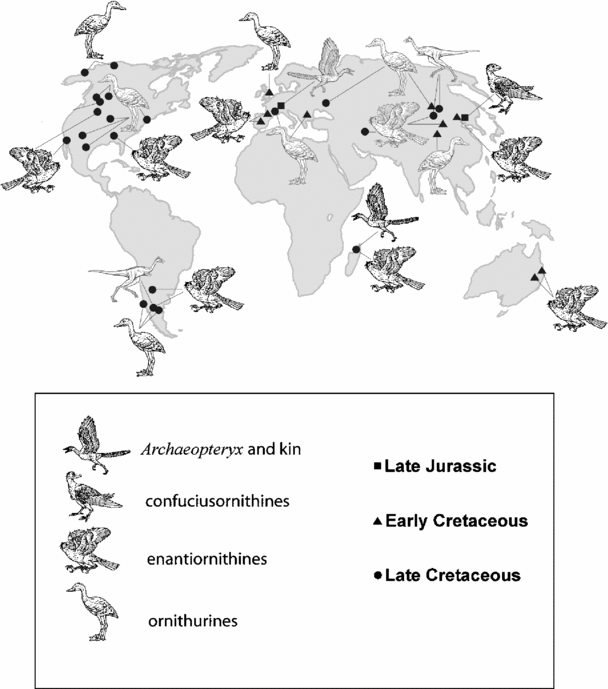
Walker (Reference Walker1981) hypothesized that: (1) Enantiornithes would prove to be widespread, that they likely enjoyed a global distribution in the Cretaceous; and that (2) Enantiornithes would prove to be the most abundant group of Mesozoic birds, but that their range would be restricted to the Cretaceous. Both of Walker's (1981) hypotheses have been borne out by subsequent fossil discoveries (Fig. 3) (Kurochkin, Reference Kurochkin1995, Reference Kurochkin1996; Feduccia, Reference Feduccia1999, Reference Feduccia2006; Zhang & Zhou, Reference Zhang and Zhou2000; Zhang et al. Reference Zhang, Zhou, Hou and Gu2000; Chiappe & Walker, Reference Chiappe, Walker, Chiappe and Witmer2002; Fountaine et al. Reference Fountaine, Benton, Dyke and Nudds2005).
Map to show the known geographic distribution and relative ages of Enantiornithes alongside the other main lineages of Mesozoic birds (re-drawn from Chiappe & Dyke, Reference Chiappe and Dyke2002).

4. Geological setting and fossil associations
4.a. Southern France
The French specimen described here was collected during the course of systematic excavations at the Massecaps locality close to the village of Cruzy, Hérault, southern France (Fig. 2). Excavations in this area are conducted by the Centre National de la Recherche Scientifique (CNRS) and the Association Culturelle, Archéologique et Paléontologique de l'Ouest Biterrois (ACAP); this Massecaps locality has yielded an abundant and diverse fauna of Late Cretaceous vertebrates, mostly represented by isolated elements, including lepisosteid fish, coelacanths, amphibians, turtles, varanoid lizards, mammals, dinosaurs and enantiornithine birds (Buffetaut, Reference Buffetaut1998, Reference Buffetaut2005; Buffetaut et al. Reference Buffetaut, Le Loeuff, Tong, Duffaud, Cavin, Garcia and Ward1999; Cavin et al. Reference Cavin, Forey, Buffetaut and Tong2005). Remains of enantiornithines, consisting of a coracoid and a fragmentary femur, were first reported from Massecaps by Buffetaut (Reference Buffetaut1998).
This region of France, a hilly area located between the coastal plain that borders the Mediterranean and the Palaeozoic massif of the Montagne Noire (Fig. 2), is the expression of a complex geological structure that was folded and faulted during the Cenozoic. In this area the Late Cretaceous is well represented by fluvial red beds that comprise conglomerates, sandstones and clays, and are overlain by freshwater limestones; these deposits are often referred to as the ‘Grès à reptiles’ (Buffetaut, Reference Buffetaut2005). Although precise dating of these sediments has proved difficult (Buffetaut, Reference Buffetaut2005), the vertebrate assemblage, especially from the Cruzy area, is consistent with a late Campanian–early Maastrichtian age. This has been corroborated by the presence of certain types of dinosaur eggs which suggest an early Maastrichtian age (Garcia & Valentin, Reference Garcia and Valentin2001–2002).
4.b. Argentina
All the Argentine specimens were collected as mainly isolated elements from a small quarry (J. Bonaparte, pers. comm.) about 8 m wide, roughly in the mid-section of the Lecho Formation in Salta Province (Walker, Reference Walker1981). As reported in Chiappe (Reference Chiappe1991, Reference Chiappe1993), the Lecho Formation is part of the Late Cretaceous Salta Group of sediments, part of the much larger Andean sedimentary basin (Bonaparte et al. Reference Bonaparte, Salfitty, Bossi and Powell1977). All the bird bones examined by Walker in the BMNH were collected by J. Bonaparte and J. Leal from fine-grained sandstones within the Lecho Formation (Fig. 2); for more details relevant to the geological context of these specimens, see Chiappe (Reference Chiappe1991). Because of the non-associated nature of the bird bones from El Brete, direct anatomical comparisons other than on the basis of size cannot be corroborated. As noted by Walker (Reference Walker1981) and Chiappe (Reference Chiappe1993), this ‘lack of association’ means that fore- and hindlimb bones cannot definitively be associated with one another.
5. Systematic palaeontology
AVES Linnaeus, Reference Linnaeus1758 ORNITHOTHORACES Chiappe, Reference Chiappe1996 ENANTIORNITHES Walker, Reference Walker1981 EUENANTIORNITHES Chiappe, Reference Chiappe, Chiappe and Witmer2002 Genus Martinavis nov
Type species. Martinavis cruzyensis, described below.
Etymology. The generic name is in honour of Larry D. Martin, in recognition of his contributions to the study of Mesozoic birds and for his support of Cyril Walker in the 1980s. Many of the original illustrations of the El Brete collection were rendered by KU-NM artists in the 1980s (Chiappe & Walker, Reference Chiappe, Walker, Chiappe and Witmer2002).
Diagnosis. An euenantiornithine bird that possesses the following unambiguous synapomorphies of the humerus (based on the phylogenetic analysis detailed in Chiappe, Reference Chiappe, Chiappe and Witmer2002, and Chiappe & Walker, Reference Chiappe, Walker, Chiappe and Witmer2002): dorsal margin concave in its central portion, rising both ventrally and dorsally on either side; bicipital crest prominent (well developed and broad); and ventral surface of bicipital crest bearing a small fossa for muscle attachment. In addition, this taxon shares with other members of Enantiornithes the presence of: an ‘L-shaped’ articulation between the proximal part of the humerus and the coracoid (seen in proximal view: Walker, Reference Walker1981); a well-marked depression underneath the proximal head of the humerus; weakly developed distal condyles; and a flat distal end that is not deflected dorsally (Chiappe & Walker, Reference Chiappe, Walker, Chiappe and Witmer2002). Additional characteristics of Martinavis include: wide pneumotricipital fossa; unperforated ventral tuberculum; flat and broad deltopectoral crest that joins the shaft smoothly and lacks any degree of ventral curvature; small and boss-like bicipital crest that is projected cranially; ventral martin of bicipital crest small with distally located fossa; ventral tuberculum does not bear proximodistal canal; distal end with poorly developed ventral condyle; ectepicondyle and entepicondyle lack marked tricipital grooves; ventral condyle enlarged and extended distally to below level of the dorsal and ventral condyles; external condyle transversely orientated.
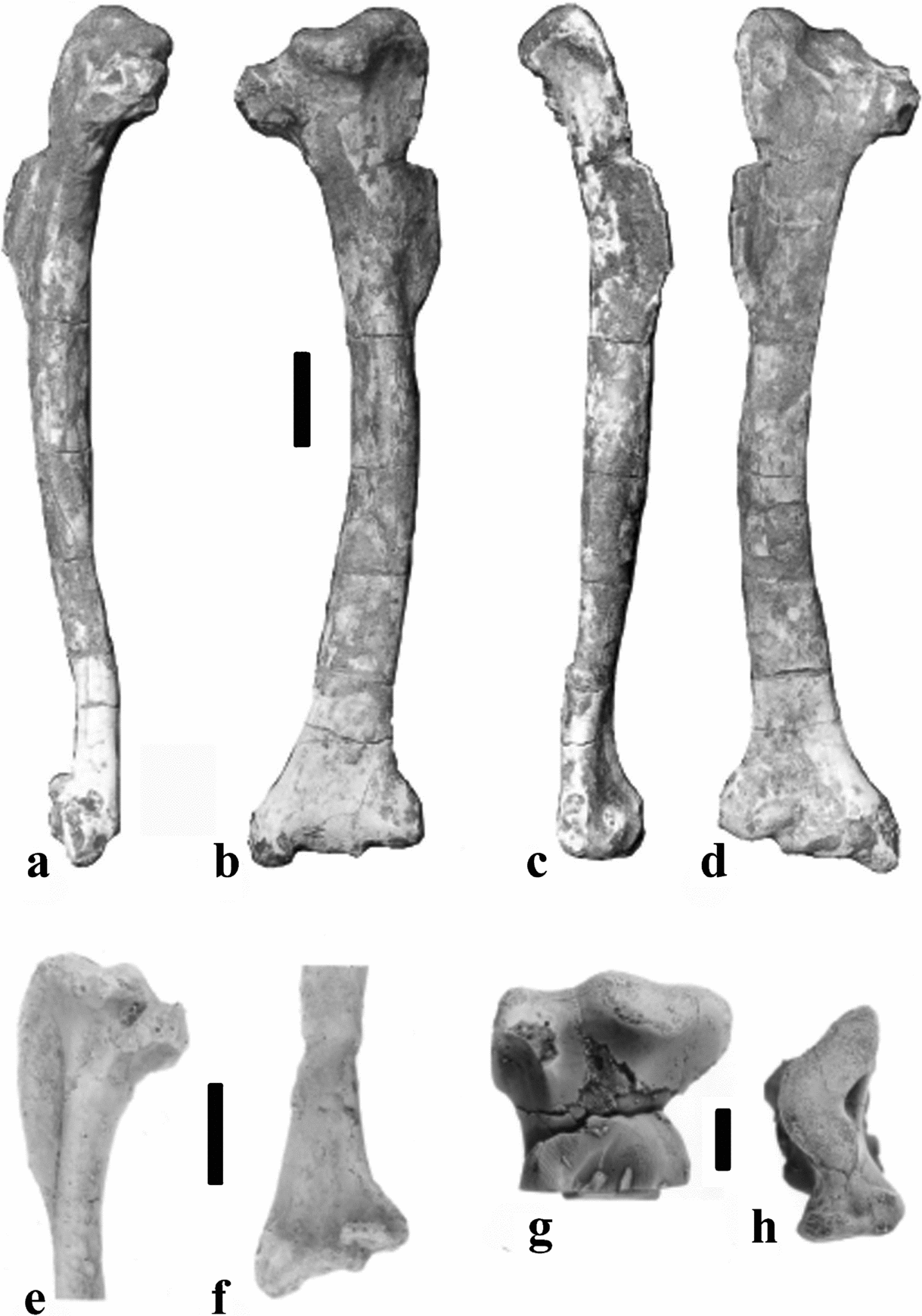
Differential diagnosis. Martinavis comprises a taxon of euenatiornithine bird easily differentiated from the contemporaneous Enantiornis (from the same El Brete locality) on the basis of its more gracile humerus and in the morphology of its deltopectoral crest (Fig. 4). Distinct differences in comparison with other euenantiornithines include the fact that the surface between the shaft and the deltopectoral crest is smoothly angled (Fig. 4). This bird also has a bicipital crest that is not inclined caudally, a small entepicondyle, a laterally positioned ectepicondyle, and a transversely orientated external (dorsal) condyle. As we have noted above and has been discussed elsewhere (Walker, Reference Walker1981; Chiappe, Reference Chiappe1993), direct comparisons between bones referred here to Martinavis and the other El Brete euenantiornithines (apart from Enantiornis): Lectavis, Yungavolucris and Soroavisaurus (Chiappe, Reference Chiappe1993), all based on tarsometatarsi, are impossible because these elements were not collected in association. Note that Martinavis is similar in its preserved morphology with Gurilynia, described from the Late Cretaceous of the Gobi Desert, Mongolia (Kurochkin, Reference Kurochkin, Darevskii and Averianov1999); discussion of this will follow in a later paper.
Humeri referred to Martinavis (see text for details): ACAP-M 1957, complete right humerus (holotype of M. cruzyensis) in left lateral (a), caudal (b), right lateral (c) and cranial (d) views; PVL 4054, portions of complete left humerus in caudal (e) and cranial (f) views; KU-NM-37, proximal end of left humerus in caudal (g) and proximal (h) views. For measurements see Table 1; scale bars are 10 mm.

Martinavis cruzyensis sp. nov
Holotype. ACAP-M 1957, a complete uncrushed right humerus (fig. 4a–d) preserved in three dimensions. In caudal view, the deltopectoral crest of this specimen is cracked at about its midpoint. This specimen is one of the largest euenantiornithine forelimb bones to be collected from the European Cretaceous and remarkably is almost identical to Argentine specimens from El Brete, collected some 20 years earlier (Fig. 4).
Etymology. For the village of Cruzy, Hérault, southern France, where this specimen was collected (Massecaps locality) (Fig. 2).
Type locality. Late Campanian–early Maastrichtian sediments (Massecaps locality), close to the village of Cruzy, Hérault, southern France (Fig. 2).
Diagnosis. Euenantiornithine bird exhibiting the following characters: bicipital crest of humerus strongly projected cranially; capital groove deeply depressed and wide; attachment site for m. pectoralis depressed and broad; absence of well-defined proximodistal groove on ventral tuberculum; internal (ventral) and external (dorsal) condyles greatly enlarged and expanded; ventral epicondyle enlarged and extended distally.
Martinavis vincei sp. nov. Holotype. PVL 4054, complete left humerus (fig. 4e). Paratype. PVL 4059, distal end of left humerus (fig. 4f)
Etymology. For M. Vince who helped to collect the original El Brete material and was responsible for much of its preparation (J. Bonaparte, pers. comm. 1976).
Type locality. El Brete, Maastrichtian Lecho Formation, Salta Province Argentina (Bonaparte et al. Reference Bonaparte, Salfitty, Bossi and Powell1977; Bonaparte & Powell, Reference Bonaparte and Powell1980; Chiappe, Reference Chiappe1993) (Fig. 2).
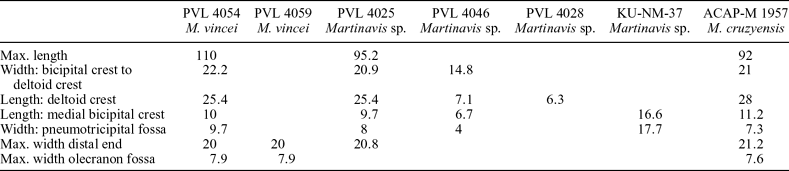
Diagnosis. Euenantiornithine bird, comparable in size to M. cruzyensis (Table 1) but with a humerus that has a bicipital crest angled more cranially, a capital groove with a deeper depression, and more distally enlarged internal and external condyles (fig. 4e, f).
Measurements of humeri (in mm) referred to the euenantiornithine Martinavis

See text for details and museum acronyms.
Martinavis sp
Referred specimens. PVL 4025, almost complete left humerus lacking the ‘median ridge’ that is crushed distally; PVL 4046, left humerus lacking its distal end; PVL 4028, left humerus lackings its distal end; KU-NM-37, proximal end of left humerus.
Localities. Argentina: PVL 4025 and 4046 were collected from the same locality as M. vincei (J. Bonaparte pers. comm.). USA: KU-NM-37 was collected from Campanian sediments at Lance's Quarry, in New Mexico, USA (L. D. Martin, pers. comm. 1980).
Remarks. Although PVL 4025 and PVL 4028 are smaller than the humeri referred above to either M. vincei or M. cruzyensis (Fig. 4; Table 1), we do not consider it prudent at present to allocate these specimens to distinct species. In addition to size, a number of subtle osteological differences are nevertheless evident in comparison, not only between these specimens, but also with ACAP-M 1957, and the types of M. vincei (PVL 4054 and PVL 4059) (Fig. 4). The bicipital crest of PVL 4025 is less cranially inclined than in the other elements referred to Martinavis, the distal extremity of the deltoid crest meets the shaft more abruptly, no depression is present in the capital groove, and the floor of the pneumatic fossa is depressed and broader. PVL 4028 is similar in size to PVL 4046 (Table 1), but differs in having a shorter deltopectoral crest and a deeper pneumatic fossa. The bicipital crest in this specimen is also more inclined cranially than in its counterpart PVL 4046 and the external tuberosity is more enlarged and bulbous (Fig. 4). In comparison, the most distinctive of these referred specimens is KU-NM-37, from the Campanian of New Mexico (Fig. 4). This incomplete element is indistinguishable from other bones referred here to Martinavis; it is from a large bird, slightly larger than the proximal part of humerus of the first named euenantiornithine from El Brete, Enantiornis leali (Walker, Reference Walker1981; Table 1).
6. Description
Of the large sample of elements collected from El Brete, the humerus is the most diagnostic at present and thus is used to diagnose Martinavis. As noted above, we are unable to match the El Brete forelimb bones with any of the hindlimb elements already described (and named) by Chiappe (Reference Chiappe1993) and figured by Chiappe (Reference Chiappe1996) and Chiappe & Walker (Reference Chiappe, Walker, Chiappe and Witmer2002). While it is certainly possible that Martinavis may prove to be a junior synonym of either Soroavisaurus, Lectavis or Yungavolucris (Chiappe, Reference Chiappe1993), the discovery of additional articulated fossil birds will be required before this can be tested.
The general features of the Martinavis humerus exemplify the morphology of this bone in Enantiornithes in general and Euenantiornithes in particular; all of these birds are characterized by the presence of an ‘L-shaped’ (Walker, Reference Walker1981) proximal articulation, a well-marked depression below the caput on the cranial surface (sulcus for the transverse ligament) and poorly developed distal condyles (Fig. 4). In all Martinavis specimens, as in all euenantiornithines, the head of the humerus is concave cranially and convex dorsally; the dorsal margin of this bone is particularly concave below the deltopectoral crest. The shaft of the humerus lacks marked curvature, although it is somewhat thicker and more robust in the specimen from Cruzy (ACAP-M 1957), compared to the bones from El Brete.
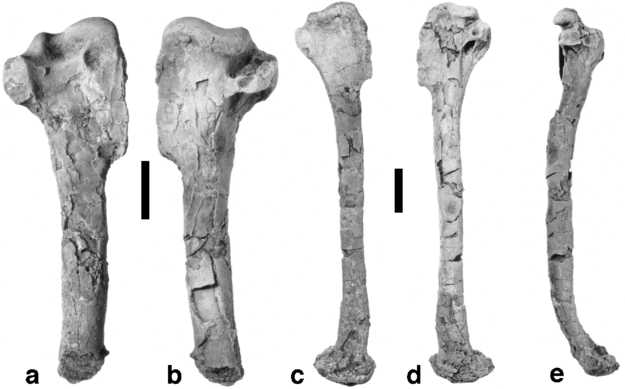
The pneumatic fossa of the proximal part of the humerus (crus dorsale fossae) in Martinavis is much wider than in its contemporary Enantiornis (Chiappe, Reference Chiappe1996; Chiappe & Walker, Reference Chiappe, Walker, Chiappe and Witmer2002) and the ventral tuberculum is not perforate (Figs 4, 5). Both taxa lack a pneumatic foramen on the proximal part of the humerus.
The deltopectoral crest of the humerus in Martinavis is flat, broad and lacks any marked degree of cranial curvature, while the bicipital crest is smaller, boss-like and projected cranially. On the ventral margin of this crest there is a small distally located fossa, likely a site for muscle attachment (region of m. pectoralis). The ventral tuberculum is well developed, projected caudally, and does not bear a well-defined proximodistal canal. The deltopectoral crest in Martinavis joins the shaft smoothly, as opposed to at an angle as is the case in Enantiornis (Walker, Reference Walker1981; Chiappe, Reference Chiappe1996; Chiappe & Walker, Reference Chiappe, Walker, Chiappe and Witmer2002). The bicipital crest is more cranially deflected in Martinavis than in Enantiornis (Fig. 5).
Some of the skeletal elements (parts of PVL 4035 and 4020) previously referred to the El Brete euenantiornithine Enantiornis leali (Walker, Reference Walker1981; Chiappe & Walker, Reference Chiappe, Walker, Chiappe and Witmer2002): proximal end of left humerus (PVL 4035) in cranial (a) and caudal (b) views; reconstructed complete left humerus of Enantiornis leali (PVL 4035 and 4020) in cranial (c), caudal (d), and right lateral (e) views. Scale bars are 10 mm.

Distally the humerus of Martinavis is flared cranially and has a poorly developed ventral (internal) condyle. The ectepicondyle and entepicondyle are distinctly rounded and lack marked tricipital grooves; between the two distal condyles there is a deep, excavated olecranon fossa on the caudal surface (Fig. 4). The ventral epicondyle is enlarged, extending distally to below the level of the dorsal and ventral condyles. The internal condyle is not expanded and bulbous, as in modern birds (Neornithes: Clarke & Norell, Reference Clarke and Norell2002).
A number of fossil eggshell fragments from the same horizon and locality as Martinavis cruzyensis are currently under study by Gerald Grellet-Tinner (South Dakota School of Mines, Rapid City, South Dakota); preliminary analysis of these fragments supports their enantiornithine affinities, as well as the presence of additional birds and non-avian dinosaurs at Massecaps (Grellet-Tinner et al. unpub. data).
7 Discussion
7.a. El Brete euenatiornithines
Walker (Reference Walker1981) was the first to address the El Brete collection of euenantiornithine bones, presenting a series of osteological characters to define the taxon Enantiornis leali (Walker, Reference Walker1981, table 2). Walker (Reference Walker1981) also intended to present the osteological evidence for the existence of a new clade of Cretaceous birds (‘Enantiornithes’), a conclusion that met with extensive criticism in the 1980s (Steadman, Reference Steadman, Brush and Clark1983).
The holotype of the first of the El Brete euenantiornithines to be described, Enantiornis leali, is PVL 4035 (Walker, Reference Walker1981; Chiappe, Reference Chiappe1996; Chiappe & Walker, Reference Chiappe, Walker, Chiappe and Witmer2002). This is one of the very few El Brete specimens that consists of associated elements: portions of a left humerus (Fig. 5), coracoid and scapula. The coracoid of Enantiornis leali (PVL 4035) was figured in cranial view by Walker (Reference Walker1981) alongside the humerus (PVL 4054) which is now the holotype of Martinavis vincei. A scapula (PVL 4039) is very similar to PVL 4035, while a carpometacarpus (PVL 4049), right femur (PVL 4037), distal tibiotarsus (PVL 4033), and ilium and ischium (PVL 4042) are consistent in their size to the holotype of E. leali. Alongside these bones, a proximal tarsometatarsus (PVL 4021, now the holotype of Lectavis bretincola: Chiappe, Reference Chiappe1993), a complete right tarsometatarsus (PVL 4053, now the holotype of Yungavolucris brevipedalis: Chiappe, Reference Chiappe1993), and a complete tarsometatarsus (PVL 4048) (Walker, Reference Walker1981) have also been described and await revision. We note that PVL 4049, PVL 4037 and PVL 4033 are consistent in size with the humeri of Martinavis.
In the early 1990s, Walker sent all materials pertaining to his work on the El Brete collections to L. M. Chiappe, then working at the American Museum of Natural History in New York. Chiappe (Reference Chiappe1991) described and figured a number of the El Brete specimens for the first time: PVL 4048 and PVL 4021 (Walker, Reference Walker1981), alongside PVL 4052 (a complete left tarsometatarsus) and PVL 4043 (the proximal end of right humerus). Chiappe (Reference Chiappe1992, Reference Chiappe1993) focused on the hindlimb morphology of these birds (contra Walker, Reference Walker1981). In the context of the known morphology of the group, Chiappe (Reference Chiappe1992) presented a discussion of the tarsometatarsal morphology of the enantiornithine Avisaurus, describing the anatomy of this element based on specimens PVL 4048, PVL 4053 and PVL 4021. Chiappe (Reference Chiappe1992) also provided a sketch of PVL 4690, for the first time (Chiappe, Reference Chiappe1992).
Chiappe (Reference Chiappe1993) published a review of known tarsometatarsal types based again on the El Brete collections, recognizing three taxa: Yungavolucris brevipedalis, Lectavis bretincola and Soroavisaurus australis. The squat tarsometatarsi from El Brete were used by Chiappe (Reference Chiappe1993) to diagnose Yungavolucris brevipedalis (PVL 4053 (holotype), PVL 4040, PVL 4052, PVL 4268 and PVL 4692 (referred specimens)). Of these elements PVL 4692 is extremely fragmentary, comprising just the distal trochlea of metatarsals II and III; the holotype (PVL 4053) and PVL 4692 were figured by Chiappe (Reference Chiappe1993). Lectavis bretincola was erected by Chiappe (Reference Chiappe1993) on the basis of a single specimen (PVL 4021), an elongate and slender associated left tarsometatarsus and tibiotarsus. PVL 4021 was illustrated by Chiappe (Reference Chiappe1993). Finally, Chiappe (Reference Chiappe1993) named Soroavisaurus australis on the basis of two isolated tarsometatarsi, PVL 4690 (holotype) and PVL 4048 (referred specimen including associated phalanges and claws). Both of these specimens were illustrated by Chiappe (Reference Chiappe1993); they were originally referred to the enantiornithine Avisaurus by Brett-Surman & Paul (Reference Brett-Surman and Paul1985) (see also Chiappe, Reference Chiappe1992; Chiappe & Calvo, Reference Chiappe and Calvo1994).
All the bones of the holotype specimen of Enantiornis leali were figured by Chiappe (Reference Chiappe1996), and following Walker (Reference Walker1981), some additional specimens were referred to this taxon: PVL 4020 (an associated but crushed forelimb skeleton including a left scapula, coracoid, both ends of a humerus and an imperfect ulna as well as a right ulna and radius and proximal portion of a carpometacarpus and digits), PVL 4039, PVL 4055 (isolated scapulae), PVL 4023, and PVL 4181 (isolated ulnae).
To date, the most complete published compendium of euenantiornithine anatomy is that of Chiappe & Walker (Reference Chiappe, Walker, Chiappe and Witmer2002), who reviewed the composition of the entire clade drawing heavily on the El Brete specimens, many of which were illustrated in this paper for the first time (PVL 4698, an isolated right mandibular ramus; PVL 4041 and 4051, series of thoracic vertebrae; PVL 4041 and PVL 4042, complete pelvises). Chiappe & Walker (Reference Chiappe, Walker, Chiappe and Witmer2002) also figured PVL 4025 (referred here to Martinavis) and provided a sketch of PVL 4060 (a proximal end of a femur). Some of this newly figured material had been previously referred to Enantiornis leali (PVL 4055, an isolated scapula; PVL 4023, a complete ulna), but was not available to us for this study. In addition, Chiappe & Walker (Reference Chiappe, Walker, Chiappe and Witmer2002) referred PVL 4049 (a complete carpometacarpus, also figured) to E. leali and referred PVL 4033 and PVL 4030 (two tibiotarsi; PVL 4030 figured for the first time) to Soroavisaurus australis.
As a result of this earlier work, we know that at least four taxa of euenantiornithines were present at El Brete: Enantiornis (Walker, Reference Walker1981; Chiappe & Walker, Reference Chiappe, Walker, Chiappe and Witmer2002), Martinavis (this paper), and at least two of the three taxa described by Chiappe (Reference Chiappe1993). This conservatively assumes that one of Chiappe's (1993) taxa could turn out to be the same bird as either Martinavis or Enantiornis. On the other hand, as many as six euenantiornithines may be represented in the El Brete collections: all of the genera mentioned above as distinct taxa, as well as an additional morphotype identified by Walker (Reference Walker1981). Further discussion of this material, as well as additional post-cranial elements subjectively referrable to Martinavis, will form the subject of a later paper (Walker & Dyke, unpub. data).
7.b. Massecaps euenantiornithines
Buffetaut (Reference Buffetaut1998) briefly reported two euenantiornithine bones from the Late Cretaceous Massecaps locality, near Cruzy in southern France (see also Buffetaut, Reference Buffetaut2005). These bones, a right coracoid and left femur, are large and were at the time the first records of Enantiornithes from the European Upper Cretaceous. Subsequently, additional specimens have been described from similarly aged (late Campanian to early Maastrichtian) strata in Provence, southern France (Buffetaut, Mechin & Mechin-Salessy, 2000) and from Santonian deposits in the Bakony Mountains, Hungary (Ösi, Reference Ösi2007). Buffetaut (Reference Buffetaut1998) noted particular similarities between the Massecaps specimens and Enantiornis from El Brete: the coracoid (ACAP-M 192) is almost the same size as PVL 4035 and has a reduced acrocoracoid and robust head. Both specimens also have a pneumatic foramen located cranially with respect to the sternocoracoid impression (the ‘dorsal fossa’ of Buffetaut, Reference Buffetaut1998); in ACAP-M 192 and Enantiornis (PVL 4035) this foramen does not open into the fossa. The left femur (ACAP-M 193) from Massecaps is also very similar in size to other bones from El Brete (Buffetaut, Reference Buffetaut1998; Chiappe, Reference Chiappe1996); the French element also has a well-developed trochanteric crest and is deeply excavated on its lateral face, as described in some of the El Brete specimens (Chiappe & Calvo, Reference Chiappe and Calvo1994; Chiappe & Walker, Reference Chiappe, Walker, Chiappe and Witmer2002). The clear degree of anatomical similarity between the Massecaps and El Brete euenantiornithines is further confirmed by the humeri described in this paper (Fig. 4). It cannot be excluded that the coracoid, femur and humerus from Massecaps all belong to the same individual, although this cannot be demonstrated other than on the basis of their relative proportions, as they were not found in articulation.
7.c. Distribution of euenantiornithines
Martinavis is one of very few reported Cretaceous vertebrate taxa known to have had a distribution spanning Europe, North and South America; in other words, we have demonstrated that very similar euenantiornithine taxa were present on both Laurasia and Gondwana in late Campanian–early Maastrichtian times. Most other enantiornithines, indeed Mesozoic birds in general (Kurochkin, Reference Kurochkin, Kurochkin and Rakhimov2001; Chiappe & Dyke, Reference Chiappe and Dyke2002; Fountaine et al. Reference Fountaine, Benton, Dyke and Nudds2005), are known from a single locality; just the Late Cretaceous enantiornithines Nanantius (Queensland, Australia and the Gobi Desert, Mongolia: Molnar, Reference Molnar1986; Kurochkin, Reference Kurochkin1996), Avisaurus (El Brete, Argentina and the Two Medicine Formation, Montana: Brett-Surman & Paul, Reference Brett-Surman and Paul1985; Varricchio & Chiappe, Reference Chiappe1995) and Martinavis (Maasecaps, France and El Brete, Argentina) have so far been described with a distribution spanning both hemispheres. Subsequent work, however, has suggested that the Gobi Desert species of Nanantius (N. valifanovi: Kurochkin, Reference Kurochkin1996) is instead referrable to Gobipteryx (Chiappe, Norell & Clark, 2001), previously described from the Gobi Desert by Elzanowski (Reference Elzanowski1974, Reference Elzanowski1977) (see also Kurochkin, Reference Kurochkin, Buffetaut and Loeuff2004).
The status of Avisaurus, known only from isolated postcranial elements, is also uncertain because the El Brete tarsometatarsi referred to this taxon (PVL 4048, PVL 4053, PVL 4021, PVL 4690) are unassociated. The difference in geological age between the Albian Nanantius eos from Australia and the Campanian Nanantius valifanovi from Mongolia is also worth noting and may not be suggestive of a congeneric status. The tarsometatarsus of Avisaurus is largely indistinguishable from similarly sized enantiornithines: indeed, one of the specimens from El Brete referred to Avisaurus (PVL 4048) was illustrated as an example of variation within the El Brete collection by Walker (Reference Walker1981) (and subsequently referred to Soroavisaurus australis by Chiappe, Reference Chiappe1993). At the time, Walker (Reference Walker1981) had not intended to give a new name to this specimen; this was done by Brett-Surman & Paul (Reference Brett-Surman and Paul1985) and Chiappe (Reference Chiappe1993), despite the specimen's lack of association. We raise the possibility that Avisaurus, indeed Soroavisaurus, could be junior synonyms of Enantiornis.
Biogeographically, the occurrence of the same bird taxon in the Late Cretaceous of Europe, South and North America may appear surprising. However, the presence of faunal elements with ‘Gondwanan’ affinities in the Late Cretaceous vertebrate faunas of southwestern Europe has already been reported (Buffetaut, Reference Buffetaut1989), the most convincing cases probably being those of abelisaurid theropods (Buffetaut, Mechin & Mechin-Salessy, 1988) and mawsoniid coelacanths (Cavin et al. Reference Cavin, Forey, Buffetaut and Tong2005), both of which occur at Massecaps together with Martinavis. Moreover, the dispersal abilities of a volant euenantiornithine such as Martinavis were probably good, which may further explain the wide geographical distribution of this genus. Dispersal, even migratory behaviour, might be envisaged for Martinavis, but such a hypothesis can hardly be tested on the basis of fossil evidence.
Acknowledgements
Cyril Walker thanks Jose Bonaparte for the initial loan of El Brete material to London in the 1970s, Larry Martin for his generosity, help and encouragement in the initial phases of this work, and other staff of the University of Kansas who provided support and facilities in the 1970s (including a number of illustrations that appeared in Chiappe & Walker, Reference Chiappe, Walker, Chiappe and Witmer2002). Phil Crab, Judy Greenwood, Phil Hurst and Tim Parmenter provided a great deal of invaluable help and support with this project over the years. Jose Bonaparte's visits to London were funded by the Frank M. Chapman fund of the American Museum of Natural History; Eric Buffetaut and Gareth Dyke received support for this project from Enterprise Ireland's Ulysses Programme (2003–2004). Excavations at Massecaps have been funded by the Centre National de la Recherche Scientifique, the ECLIPSE programme of CNRS and the Association Culturelle, Archéologique et Paléontologique de l'Ouest Biterrois; Eric Buffetaut thanks all the participants in the Massecaps excavations. The text and arguments presented in this paper greatly benefited from comments provided in review by Zbigniew Bochenski, Evgeny Kurochkin and Jingmai O'Connor; Julia Sigwart kindly drew Figure 2.