I. Introduction
Like government investigators who identify the defects and mistakes that cause automobile or airplane crashes, scholars have begun to sort out the problems in criminal justice systems that create disastrous injustices and wrongful convictions (Sorochan Reference Sorochan2008; Gershowitz Reference Gershowitz2014; Hollway Reference Hollway2014). Police practices related to eyewitness identifications and interrogations have drawn the most criticism, along with questionable forensic evidence and shoddy laboratory practices (Garrett Reference Garrett2011; Gould et al. Reference Gould, Carrano, Leo and Hail‐Jares2014; Simon Reference Simon2014). Others have criticized judicial doctrines that tolerate law enforcement errors, such as the materiality component of the Brady v. Maryland disclosure rule and the harmless error rule on appeal (e.g., Gershman Reference Gershman2001; Findley and Scott Reference Findley and Scott2006; Medwed Reference Medwed2012; Baer Reference Baer2015). In this article, we shift the spotlight to the prosecutors who supervise and litigate the cases that end in wrongful convictions, engaging in what we call “wrongful conviction practice.”Footnote 1
Scholars and advocates who have talked about the prosecutors involved in wrongful conviction practice seem to share a particular “hyperadversarial” (Aviram Reference Aviram2013) vision of the job. Whether explicitly or implicitly, they subscribe to a “conviction psychology” theory of prosecution, where prosecutors prioritize convictions over justice.Footnote 2 According to this account, conviction psychology is a routine and expected development in the prosecutor's career because the structure of the workplace creates it. Incentive systems within the office reward prosecutors for their convictions, both at trial and through plea negotiations (Bibas Reference Bibas2009). At an individual level, prosecutors believe that defendants must be guilty because their future careers and professional self-images depend on the fact that only the guilty are prosecuted and convicted (Findley and Scott Reference Findley and Scott2006; Medwed Reference Medwed2012). Putting the pieces together, scholars writing in this tradition assume (and sometimes declare) that the longer the prosecutor works in the office, the more this perverse worldview dominates, thus steadily increasing the risk that the prosecutor will wrongfully convict someone (see, e.g., Felkenes Reference Felkenes1975; Melilli Reference Melilli1992; Cummings Reference Cummings2010).
This final tenet of the wrongful conviction literature—the assumed or asserted connection between prosecutor experience, conviction psychology, and the risk of wrongful conviction practice—is the topic we investigate in this article. While conviction psychology has some intuitive appeal as a way to explain the disheartening examples of prosecutorial misconduct that have surfaced over the years, we believe these scholars have made two unfortunate choices that cloud our understanding of the prosecutor's risk of engaging in wrongful conviction practice.
First, commentators in this arena have focused attention on serious cases and experienced prosecutors, a view that is reinforced by the existing wrongful conviction databases.Footnote 3 The priority they place on serious cases (rapes and murders) is not surprising, given the likelihood that DNA evidence would be available in these cases and the magnitude of the injustice that results from a death sentence or lengthy term in prison imposed on an innocent person. Nevertheless, readers of these works could miss the problems that junior prosecutors cause in less serious cases. Qualitative data suggest that junior prosecutors who handle less serious cases also contribute to mistaken convictions, although those cases are rarely reported in the press or appealed (King Reference King2013; Hollway Reference Hollway2014).
Second, the literature tends to treat prosecutors as generic actors in fungible workplaces, building up years of experience that create a toxic mind-set and a high risk of error wherever they happen to practice. We believe this orientation pays insufficient attention to features of the prosecutor's office that might intensify or diffuse the risk of wrongful conviction practice. While scholars and journalists have reported some extreme office practices, such as keeping score of trial outcomes on public scoreboards, or giving cash to prosecutors for each conviction (Findley [2011] Reference Findley2012, n 106; Medwed Reference Medwed2012, 77), more subtle markers of office culture can create problematic mind-sets, too (Bandes Reference Bandes2008).
Our study adds texture to the standard portrait of prosecution by comparing junior and senior prosecutors working in different types of offices. The data suggest that the prosecutorial slide into conviction psychology, and wrongful conviction practice, may not be uniform or inevitable. Our interviews with more than 200 state prosecutors in eight offices in the southwestern and southeastern United States reveal that, as a population, prosecutors differ in their risk potential. Those at highest risk of conviction psychology and wrongful conviction practice—the ones who should concern us the most—are either early career prosecutors or zealots immune to the normal maturation process.
It is common for prosecutors early in their careers to make mistakes of the sort that can lead to wrongful convictions because they tend to embrace a combative spirit to prove themselves formidable adversaries in court. After the junior years are over, high-risk prosecutors are those individuals who resist the normal lessons of experience and eschew the sense of proportionality and restraint that their colleagues embrace. We call these prosecutors “zealots.” In some cases, zealots fail to develop to full prosecutorial maturity because of their working environment; they work in offices that reward conviction psychology and risky behavior. Other zealots might be driven by their core personalities, suggesting that they would have embraced zealotry rather than balance in any office that employed them.
Our data thus signal that while some prosecutors succumb to conviction psychology and could readily participate in a wrongful conviction, others seem much further from the edge. Of course, even one zealot in an office can do enormous harm, but given this diversity in the profession, future studies of prosecutorial misconduct and wrongful conviction should consider the influence of prosecutorial experience in producing or discouraging these devastating outcomes. Furthermore, wrongful conviction scholarship and advocates should routinely specify the office structures and habits that interfere with the maturation of prosecutors. Those are the risky places and habits that create disasters.
II. Career Influences on the Prosecutor
Doctrines of criminal law and criminal procedure, together with office policy and the interactions between prosecutors and other courtroom actors, all flow together to shape the work of prosecutors. However, law, policy, and politics do not act alone. The prosecutor's professional identity, which defines for her what it means to do the job well, also influences her behavior.
A. Continuity Theory: Personality's Effect on Identity
Because personality is the “stable core at an individual's center” (Oberfield Reference Oberfield2010), continuity theory suggests that personality—and the behaviors it inspires—will remain the same throughout one's working life. Some longitudinal studies have shown “significant personality continuity” over time (De Fruyt et al. Reference De Fruyt, Bartels, Van Leeuwen, De Clerq, Decuyper and Mervielde2006; Hampton and Goldberg Reference Hampton and Goldberg2006); that is, personality traits can overpower institutional efforts to socialize the worker into a new way of thinking about problems or doing tasks. Empirical research has shown, for example, that bureaucrats' official identities are associated with experiences they had before they joined the organization (Saks and Ashforth Reference Saks and Ashforth1997; Maynard-Moody and Musheno Reference Maynard‐Moody and Musheno2003). Workers tend to draw from their “generational, religious, class, physical, ethnic, racial, sexual, and gender identities” as they interact with customers, clients, or the general public (Maynard-Moody and Musheno Reference Maynard‐Moody and Musheno2003).
Some prosecutors describe their professional selves by pointing to their core personality traits—as a “black and white person,” for example (see, e.g., Everly 725; Harris 1097; Gill 326; Gill 185; Atkins 1049; Brooks 950; Cline 575; Flatt 505; Harris 1101).Footnote 4 Others emphasize their upbringing, whether in a family that emphasized strict “law and order” values or by parents who emphasized public service or caregiving values (see, e.g., Dean 1270; Dean 1240; Cline 600; Gill 323; Gill 158), as the most significant influence throughout their careers.Footnote 5 Some insist that the prosecutor personality is Type A, methodical, and rule-oriented (maybe even verging on obsessive-compulsive or bossy) in contrast to the more “free-form” personality common among defenders (Gill 230; Harris 1085; Harris 1097).Footnote 6
In a less flattering light, defense attorneys sometimes depict flawed character as the defining feature of most prosecutors. For instance, Professor Abbe Smith recently conducted an informal survey of public defenders, who opined that most prosecutors are smug, self-important, and unimaginative people (Smith Reference Smith2012, 953). One of our interviewees whose first career aspiration was to be a public defender painted a similar portrait of prosecutors; before she became a prosecutor, she always had an image of prosecutors as “very buttoned up, very Republican, very straight and narrow, no-soul kind of people” (Gill 167).
B. Developmental Theory: Experience Matters Too
Complementing personality, organizational experiences surely shape a person's professional identity and job performance, too (Wheeler Reference Wheeler, Brim and Wheeler1966; Berman Reference Berman1974; Nelson Reference Nelson1983; O'Hear Reference O'Hear2008). The offices where professionals work have particular cultures, exposing their employees to specific norms about acceptable behavior between coworkers and between office insiders and outsiders. Those norms affect the everyday tasks, and the interpretation of those tasks, that professionals perform (Utz Reference Utz1978; Nelson Reference Nelson1983). Outside experiences may also play a part, as the professional encounters many dimensions of human behavior in the community and brings those insights with her to work each day.
To capture this larger set of experiential influences on the professional—work experiences, office norms, and life experiences—we think of this latter perspective as “developmental,” rather than simply “organizational” (Oberfield Reference Oberfield2010). Developmental theory suggests that the experience of working as a professional interacts with a person's core personality to shape her professional self-image and behavior.
For the prosecutor, the professional transformation that comes from experience might take different forms. Experience on the job might lead a lawyer to temper her instinctive adversarial nature in favor of targeted pragmatism and proportionality. This would be consistent with the observations of sociologist Milton Heumann, in his empirical study of four Connecticut state courts (Heumann Reference Heumann1977). Heumann found that state prosecutors do not ratchet up their adversariness over time; instead, they learn to work with defenders and judges, “drifting” into a state of acceptance about plea bargaining and recognizing the limits of the trial process for achieving just outcomes. They recognize that their original battlefield mentality impedes rather than fosters relationships with other criminal court actors, which in turn impedes the production of just outcomes in individual cases.Footnote 7
The counternarrative to Heumann's account of prosecutors who mellow over time is conviction psychology theory, described in the introduction to this article. According to this career development story, years of criminal court experience make the once idealistic prosecutor more cynical about the inherent badness of the defendant population, more committed to obtaining convictions in every case, and more skeptical about the value of the defense bar to the justice system. As a result, prosecutors increase their taste for conviction the longer they stay on the job (Felkenes Reference Felkenes1975; Medwed Reference Medwed2004; Orenstein Reference Orenstein2011). Reinforcing this connection between experience and lack of concern for justice, Findley and Scott (Reference Findley and Scott2006, emphasis added) depict the natural “process of being a prosecutor” as dominated by increasing, irresistible pressures to sacrifice justice for advocacy:
[R]ole pressures naturally incline prosecutors to investigate in ways that confirm guilt, to fail to recognize and hence fail to disclose to the defense exculpatory evidence, to coach and prepare witnesses in ways that make their testimony more compelling or consistent with the theory of guilt, or to discourage witnesses from talking to defense counsel or investigators. … The process of being a prosecutor, even an ethical prosecutor, thus exacerbates general cognitive biases and contributes to tunnel vision.
C. Prosecutor Developmental Theory in the Wrongful Conviction Literature
Legal scholars who concentrate on wrongful conviction cases implicitly embrace the conviction psychology account of prosecutor career development.Footnote 8 Daniel Medwed, for instance, emphasizes incentive systems that reward prosecutors for their convictions, both at trial and through plea negotiations (Medwed Reference Medwed2012). He also reminds readers that chief prosecutors are elected officials and, as such, they assume that voters put the highest value on solving crimes and convicting defendants. In that competitive electoral environment, chief prosecutors pressure their staffs to obtain convictions at all costs. Aviva Orenstein (Reference Orenstein2011, 423) makes a slightly different point about the reasons for prosecutorial development toward conviction psychology. She writes that prosecutors grow tired of dealing with defendants, whom they regard as liars, manipulators, and whiners. Prosecutors thus come to consider the entire defendant population unworthy of belief and learn to turn a deaf ear to the concerns they raise (see also Covey Reference Covey2009).
Wrongful conviction scholars tend to draw on recent social and experimental psychology literature to buttress the conviction psychology account (see, e.g., Bandes Reference Bandes2005; Burke Reference Burke2007a; Bowers Reference Bowers2008; O'Brien Reference O'Brien2009; Gould et al. Reference Gould, Carrano, Leo and Hail‐Jares2014). These studies document the risk of cognitive biases among law enforcement actors more generally (see, e.g., Findley and Scott Reference Findley and Scott2006; Rassin Reference Rassin2010; Simon Reference Simon2012; Kassin, Dror, and Kukucka Reference Kassin, Dror and Kukucka2013). Psychologists warn that accurate information processing in criminal cases is threatened by confirmation bias (the tendency to seek or interpret information in ways that support one's existing beliefs) (Nickerson Reference Nickerson1998), belief perseverance (the persistence of one's initial hypothesis even in the face of new evidence) (Ross, Lepper, and Hubbard Reference Ross, Lepper and Hubbard1975), hindsight bias (the “I saw it all along” effect) (Harley, Carlsen, and Loftus Reference Harley, Carlsen and Loftus2004), and outcome bias (the projection of new knowledge into the past as a way to validate one's past decisions) (Baron and Hershey Reference Baron and Hershey1988). Over time, prosecutors thus cannot resist what Dan Simon calls the “adversarial pull” of their position (Simon Reference Simon2012).
Given the apparent ubiquity of these cognitive failings and the role pressures that are inherent in the adversary system, all prosecutors—not just a select few—are subject to biases that cause tunnel vision. It stands to reason that these biases are likely to deepen the longer one stays in the profession (Findley and Scott Reference Findley and Scott2006; Burke Reference Burke2007a; O'Brien Reference O'Brien2009; but see Leo and Gould Reference Leo and Gould2009 and Smith and Levinson Reference Smith and Levinson2012, warning of the risk of generalization that cannot be empirically supported). When we consider conviction psychology and cognitive biases together, the logical implication is to treat experience as a negative. If that is true, the risk of wrongful conviction is greatest among the most experienced prosecutors, and offices should take measures to minimize the impact that experienced prosecutors have on serious cases and junior colleagues.
Notably, though, many wrongful conviction scholars offer recommendations that tend to endorse seniority for its power to produce good judgment. For example, Daniel Medwed painstakingly documents the elements of conviction psychology and cites Felkenes with approval. Yet he also comments with interest on Philadelphia's placement of eighteen senior prosecutors in its case-screening unit as a way to correct for overcharging and abusive filing practices by the five junior prosecutors who previously staffed it (Medwed Reference Medwed2012, 26).Footnote 9 Donald Sorochan, documenting conviction psychology lessons from the Canadian exoneration experience, notes that experts have recommended the use of senior staff to provide internal checks and balances (Sorochan Reference Sorochan2008). Gould and his coauthors, who detail the cognitive biases that plague prosecutors, likewise recommend experienced prosecutors to serve as internal office auditors (Gould et al. Reference Gould, Carrano, Leo and Hail‐Jares2014).
When we read the wrongful conviction literature in this comprehensive way, we are struck by the need to reconcile the intuitive appeal of the conviction psychology theory with Heumann's finding that experience generally produces a mellowing effect on prosecutors and the experience-friendly reform suggestions that are currently under debate.
III. Methodology
In an attempt to understand the role of experience in the professional lives of state prosecutors, we interviewed prosecutors in eight offices in the US Southeast and US Southwest during the period 2010–2013.Footnote 10 Some of the offices, which we call County Attorney's Offices, handle only misdemeanors. Some handle only felonies (designated here as State's Attorneys), and still others handle a mixture of felonies and misdemeanors (labeled here as District Attorneys).
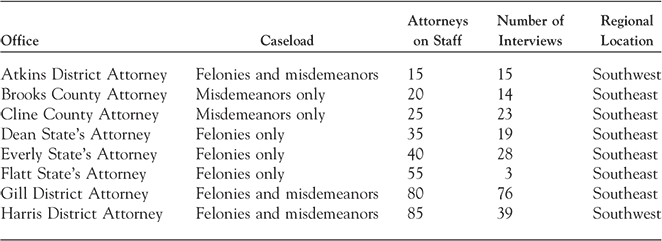
We selected offices for this research based on a variety of factors—size, docket diversity, and political climate diversity. All but one of the offices are located in urban and suburban areas; rural offices have very small staffs, making it difficult to maintain the confidentiality of interviewees. We list the eight pseudonymous offices in Table 1, from smallest to largest, and note how many interviews we conducted in each location.Footnote 11
Participating Prosecutor Offices

| Office | Caseload | Attorneys on Staff | Number of Interviews | Regional Location |
|---|---|---|---|---|
| Atkins District Attorney | Felonies and misdemeanors | 15 | 15 | Southwest |
| Brooks County Attorney | Misdemeanors only | 20 | 14 | Southeast |
| Cline County Attorney | Misdemeanors only | 25 | 23 | Southeast |
| Dean State's Attorney | Felonies only | 35 | 19 | Southeast |
| Everly State's Attorney | Felonies only | 40 | 28 | Southeast |
| Flatt State's Attorney | Felonies only | 55 | 3 | Southeast |
| Gill District Attorney | Felonies and misdemeanors | 80 | 76 | Southeast |
| Harris District Attorney | Felonies and misdemeanors | 85 | 39 | Southwest |
Once the office leadership agreed to come on board, we received a list of all prosecutors currently working in that office, allowing us to contact them individually. In some locations, we contacted each prosecutor on that list to request an interview. In other offices, our limited time in the city dictated that we select a subset of attorneys for interviews; in those offices, we chose a sample that preserved the overall office blend in terms of race, gender, type of caseload, and years of experience.Footnote 12 Individual prosecutors were told that the decision to participate was theirs alone, and that their supervisors would never receive any information about identifiable individual participants.
Ultimately, we interviewed 217 attorneysFootnote 13 in these eight offices, following a semistructured format that produced interviews lasting between sixty and ninety minutes in most cases.Footnote 14 With the permission of the interviewees, all interviews were audio recorded and professionally transcribed. Among the 217 interviewees, 101 (46 percent) were females and thirty-six (16 percent) were racial minorities. To maintain confidentiality, we deleted information that would identify the interviewee personally as the source of a comment (such as hometown or college).Footnote 15
These prosecutors had varying levels of experience on the job. At the low end, we met people who had been working as prosecutors for only a few months. At the high end, we interviewed prosecutors with more than thirty years of experience. The mean experience level was 8.9 years. For the purposes of this article, though, we collapse this range into two designations: rookies and veterans. The term “rookie”Footnote 16 describes prosecutors who had anywhere from a few months to a few years of experience; the term “veteran”Footnote 17 generally applies to prosecutors who had been on the job at least five years. Seasoning, in other words, tends to take a few years. But because some prosecutors mature faster than others, we felt it was wiser to identify the two ends of the spectrum rather than to locate specific individuals at points in the middle.
Much of what we learned about the rookie mind-set comes from veterans reflecting back on themselves as younger prosecutors or commenting on the younger prosecutors in their office. For that reason, it would not be prudent for us to organize our data in terms of percentage of respondents by category. We thus do not quantify how many prosecutors who are currently rookies said something consistent with the rookie mind-set, nor how many prosecutors who are veterans said something consistent with the veteran mind-set. We instead provide a thick description of both mind-sets, using data from everyone who spoke with us.
Our interviews covered many aspects of the prosecutors' educational and professional development. For example, we asked our respondents about their reasons for becoming prosecutors, the influence of office policies on their day-to-day work, and their future career plans. They discussed the tools and skills needed to do the job well, their philosophies of prosecution, and how their ideas about the job had changed over time. We coded the transcripts into discrete subject matter areas. Then we returned to several topic headings likely to address themes of professional growth, noting pertinent comments among different subgroups.Footnote 18 We did not specifically design our research to pick up the effects of experience; consistent with a “grounded theory” approach (Ibarra Reference Ibarra1999; Lingard et al. Reference Lingard, Garwood, Schryer and Spafford2003), this theme emerged as a surprising but persistent motif in the transcripts.Footnote 19
These self-descriptions of prosecuting attorneys offer only one vantage point for understanding actual prosecutor behavior. To be sure, the interview data have serious limits, because the speakers might not have been fully candid with us or with themselves.Footnote 20 Nevertheless, such reflections can uncover connections that researchers might initially miss when examining quantitative data alone. Changes in professional self-image do not manifest themselves directly and predictably in the recorded actions of prosecutors, comparable from case to case. The interviews therefore open up new possibilities for exploration through complementary methods.
IV. Professional Transformations Among Prosecutors
The interview data reported in this section show that many features of rookie prosecutors map precisely onto the concerns about conviction psychology, and thus explain why rookies present a high risk of wrongful conviction practice. Veteran prosecutors, described in the second section, say they embrace proportionality and pragmatism—what we call balance or maturity—and distinguish that approach from views they held earlier in their careers, or from views currently held by rookie members of their offices. The interviews also identify a third possibility: “zealot” prosecutors who resist the maturation process and continue to focus on convictions rather than justice. The qualities of zealots place them at high risk for wrongful conviction practice, no matter their level of experience.
A. The Early Career Self-Image
The rookie prosecutor sees himself as working in a simple but intensely competitive world, with the forces of good battling the forces of evil. The prosecutor in this tableau dresses like a superhero. As one veteran prosecutor in Harris County described her initial approach, “I had sort of that romantic popular idea of what … a prosecutor did, which is, ‘I'm going to put on my cape, and I'm going to go join the crusade and fight for right’” (Harris 1079). Another veteran explained that she became a prosecutor because she “wanted to wear the white hat and go charging in on a horse” (Everly 725). Clothed in this way, the “hothead” (Gill 311; Cline 585) new prosecutor heads to court with “guns-a-blazing” (Gill 299), “full of righteousness and vinegar” (Atkins 1007), “bound and determined to get as many scalps on [his] belt as [he] can” (Gill 248; see also Gill 113, who said when he was new, he “fought everything to the death”).Footnote 21 To put it more charitably, the rookie's professional demeanor is often marked by “a lot of enthusiasm but no skill,” declared Harris 1129.
Beyond simple enthusiasm, the causes of this “Young Prosecutors' Syndrome” (Wright and Levine Reference Wright and Levine2014, 1081) are plentiful. First, the rookie prosecutor is trying not to appear weak or scared to his peers and supervisors. He is constantly “worried about what everyone thinks” (Dean 1240; see also Everly 785; Dean 1250; Cline 615; Gill 167; Harris 1075; Gill 326). A veteran from Dean acknowledged that for new prosecutors, it is easier to “default to ‘If I'm tougher I can't get in trouble with my boss'” than to exercise judgment in a given case (Dean 1240).
Second, the rookie prosecutor seeks to establish “street cred with the defense bar” (Dean 1250). Some of this involves responding to credibility “testing” by the defense attorneys (Harris 1097),Footnote 22 sorting through their “garbage” motions (Cline 550), and learning which attorneys do “frivolous and annoying things” (Harris 1077). The experience gap between newer prosecutors and senior members of the defense bar who defend drug and DUI cases in particular creates a constant source of stress for the new prosecutor, who is often concerned about being outmaneuvered or “run over” (Cline 560; Harris 1067; Gill 290; Gill 194).
Third, when prosecutors start their careers, all defendants seem to be bad guys and all police seem trustworthy. The rookie prosecutor unquestioningly believes that “[t]he [defendants] wouldn't be here if they weren't guilty,” we were told by Atkins 1053 (see also Gill 152; Dean 1245; Brooks 910). Moreover, because inexperienced prosecutors tend to take everything the police say “as holy writ” (Gill 248)—one rookie prosecutor even referred to himself as a “holster sniffer” (Dean 1265)—they predict that they will be “crushed” if they ever learn that a police officer lied about a defendant's guilt (Harris 1069). Inspired by a cops-versus-robbers perspective, a rookie prosecutor often wants to “prosecute the hell out of everyone” (Cline 565; see also Cline 585; Dean 1255).
Young Prosecutors' Syndrome heightens the risk of wrongful conviction practiceFootnote 23 for a number of reasons. First, it can lead an attorney to approach each file with a standardized view, focusing on the need to punish everyone. This perspective puts a burden on the defendant to demonstrate some flaw in the evidence or to make a viable legal argument that would successfully block a conviction (Everly 700). The rookie prosecutor's “natural inclination is to go toward the guilty side” in the face of “murky evidence” (Dean 1270).
Second, the newly hired prosecutor believes her role is simply to fit each case into the relevant statutory mold. If she does so, she believes the right outcome will result: “I always follow the statute. I always follow case law. You can't go wrong if you have legal backing for your decisions and the things that you do” (Gill 305; see also Harris 1061; Brooks 950; Everly 755). This confidence that the answers are to be found in the codebook, divorced from any human context or uncertainty in the facts, makes a new prosecutor vulnerable to mistakes.
Third, many rookie prosecutors emphasize their trial work because they feel uneasy about the discretion involved in plea bargaining and are eager to prove themselves as courtroom performers. Harris 1123, who had about two years of experience when we met her, expressed her preference for clear rules over fuzzy boundaries: “[P]leas are my least favorite things to do,” she said. “I get a trial, it makes sense to me. There's rules I can follow. Pleas are a greyer area, and I don't really like that.” Gill 188, who had been a prosecutor for less than a year, explained that he used trials to send signals to the judge and the police officer about his commitment to law: “I want the officer to know I feel it's a strong case. I want the judge to know I think it's a strong case.” He believes taking cases to trial is about more than just testing the evidence; he is also showing others in the courtroom that he is not afraid to embrace the adversarial role. The rookie prosecutor, like the rookie police officer (Cain Reference Cain1973), wants to contribute to the larger law enforcement effort and to feel important, even though the cases he handles are relatively unimportant. Frequent trials and focus on one's winning record create that sense of contribution.Footnote 24
One final contributor to wrongful conviction risk is the inexperienced prosecutor's view of the defense bar. Prosecutors at every level of experience expressed during our interviews the orthodox view that defense attorneys perform an important function in the criminal courts. Rookie prosecutors, however, were more likely to describe this positive value in the abstract, even in grudging terms: “I'm coming around to the idea that they're just doing their job. It's not how I would want them to do their job, but I have to kind of adjust to that” (Gill 110).
When it comes to their own cases, rookies see defense attorneys as doing more harm than good. Given the resources devoted to careful filing of new cases, newer prosecutors tend to believe that their offices successfully keep the innocent out of the system. Defense lawyer attempts to test further these prevetted cases therefore involve a lot of flimsy argument and “games” that leave a “bad taste” in the prosecutor's mouth (Gill 110). For instance, one rookie prosecutor in Harris County declared that he resented the efforts of defense attorneys to question the integrity and truthfulness of his officers because they never lied to him. He said, “I look in the cop's eye and I ask them. And I look at the evidence. I've never had anything” that could support any suspicions that the officer was lying (Harris 1069).
More generally, “[rookies] tend to think the adversarial nature of our system makes defense attorneys personal enemies,” said Dean 1280 (see also Dean 1225), or to take a “speedy trial demand as a personal affront” (Everly 725).Footnote 25 This observation is consistent with the findings of Heumann (Reference Heumann1977) and Stemen and Frederick (Reference Stemen and Frederick2013; see also Frederick and Stemen Reference Frederick and Stemen2012), who reported that junior prosecutors were considerably more antagonistic to the defense bar than were their senior colleagues.Footnote 26
The grudging attitude among new prosecutors about the contributions of defense lawyers reinforces their tendency to treat cases in categorical terms rather than dwelling on the qualities that make each case and each defendant different. A prosecutor who remains alert to potential differences among cases, who is “open to the evidence that the defense attorney presents to [him]” (Dean 1280), should be better situated to notice signs of weak evidence and sloppy investigation.
B. The Indicia of Maturity
Veteran prosecutors who have matured differ from their rookie colleagues in both professional self-identity and behavior. Their image of the prosecutor's role is more textured; they see and accept the limits of the criminal justice system and are more willing to venture beyond the pure advocacy role to achieve results. These qualities enable veteran prosecutors, all else equal, to avoid the greatest risks of wrongful conviction.Footnote 27
In contrast to the combative approach that rookies take, veteran prosecutors arbitrate among the interests of the defendant, the victim of the crime, and society at large. For example, one Gill prosecutor observed that while she was a “victim's rights advocate” in law school, she saw herself differently now. Because the police, victims, and defense attorney all look at their own interests, “my job as the prosecutor is to weigh all of those” interests and to figure out, “[a]lright, well, how can I make this work?” (Gill 206; see also Gill 239; Everly 720).
These comments suggest that over time, prosecutors move from a “black and white” view of the world (Cline 525; Dean 1255; Everly 800) to an ability to see “shades of gray” in their cases and in the people involved in those cases.Footnote 28 There is no single point in time in which this conversion happens; rather, as Burke (Reference Burke2007b, 190) observed, “season[ed]” prosecutors think in a new way about their professional role and its obligations (see also Heumann Reference Heumann1977).
In contrast to their inexperienced colleagues, who embrace a formalistic legal sufficiency model of charging, veteran prosecutors understand that consulting the codebook is only the starting point for weighing a defendant's case. System efficiency matters more (Mellon, Jacoby, and Brewer Reference Mellon, Jacoby and Brewer1981). Because some defendants are hard-core, dangerous actors while many others are just “small screw-ups” (Everly 805) or “normal working people that have made mistakes” (Cline 585; see also Everly 785; Atkins 1007; Brooks 945; Everly 780), the experienced prosecutor has learned to distinguish “between the people we're mad at and the people we're afraid of” when making charging decisions and plea offers (Everly 770).
A prosecutor who recognizes that very few defendants in his caseload are “evil criminal masterminds” (Dean 1280) feels comfortable considering less punishment for the nonmasterminds than a strict application of the criminal law might support. The veteran thus acknowledges that “just because you can do a tap dance on somebody's head doesn't mean that that's what should happen” (Everly 725). A seasoned prosecutor from Harris invoked the classic tension at the heart of Les Miserables: “Not everybody needs to have the death penalty if they are stealing a loaf of bread” (Harris 1113).
Having “redefine[d] his professional goals” (Heumann Reference Heumann1977, 109), the veteran prosecutor might even strive to help rather than to punish defendants. This veteran Flatt County prosecutor emphasizes the difference between the rookie prosecutor who thinks of cases as paperwork and the more experienced prosecutor, who sees the faces behind the paper:
When you look at it as a young prosecutor, you look at it as a piece of paper, as a file. You don't ever put a face behind it. And I think when you evolve, you kind of start … understanding how everything can affect a community, economy, background, family history, things of that nature. (Flatt 510; see also Dean 1225).
The prosecutor who can see the person embedded in the case file locates the responsibility for proportional justice primarily in the prosecutor's office; she does not leave this duty entirely to the legislature or to the sentencing judge (Gill 206). As Heumann observed almost four decades ago, “the prosecutor comes to feel that if he does not develop these standards, if he does not make these professional judgments, no one else will” (Heumann Reference Heumann1977, 109).
Finally, the veteran prosecutor finds more concrete value in the work of defense lawyers and acknowledges that they provide important “checks and balances,” even in the prosecutor's own cases (Harris 1109; Harris 1089: Gill 131; Cline 570; Gill 101). For example, when a defense attorney presses a point before trial, it helps the prosecutor reassess the strength of the case, which is far better than having a case fall apart in the courtroom (Gill 320; Gill 209). Moreover, “you want a defense attorney that knows what objections to make, and how to argue objections … [it] just mitigates so much of that post-conviction [claim] … for ineffective assistance of counsel … [when] it's evident on the record that they've done a good job” (Gill 230; see also Brooks 935). For both these reasons, defense attorneys help prosecutors avoid “icebergs” that might later sink the ship (Harris 1079). When one recognizes these benefits, the “us-versus-them” mentality appears to be a form of “prosecutorial immaturity” rather than a successful career strategy (Everly 715; see also Harris 1128; Gill 152; Everly 780; Gill 275).
C. The Causes of Maturity
The prosecutors we interviewed offered three reasons why development toward balance is the evolutionary path most common to prosecutors. With experience, they said, prosecutors develop (1) an ability to distinguish small crimes from large crimes, (2) an appreciation for past mistakes, and (3) an increased self-confidence. All these traits contribute to a sense of balance that can counteract the “adversarial pull” (Simon Reference Simon2012) of conviction psychology.
As to the first point, veteran prosecutors regularly talk about being able to see the “big picture” in terms of their dockets as a whole (see, e.g., Everly 770; Gill 104; Cline 535; Gill 110; Harris 1117; Gill 101; Gill 125; Everly 765; Atkins 1013; Cline 525). Seasoned prosecutors know they have to make choices within their caseload to save resources for the small subset of very bad crimes and very bad defendants, whom one of our interviewees called “the hunters” (Flatt 500). One veteran prosecutor from Everly explains how the seriousness of low-level crimes automatically diminished once she started handling violent felonies:
When I started this job, I thought stealing a car was just a terrible thing to do, … but it gets to where you see and litigate so much terrible stuff that you have to become a little more dismissive of the motor vehicle thefts and forgeries. … I think you become conscious of limited resources. … When you're a younger prosecutor … it's very hard to realize that some crimes need to be a little bit marginalized, you know? (Everly 725)
Prosecutors thus tend to become desensitized to low-level crimes as they “move up the ladder” and see a wider range of criminal behavior (Gill 317).Footnote 29 They regard aggravating factors like violence and weapons (Dean 1255) as necessary to justify enhanced punishment and use of county resources, choosing to “marginalize” the simple crimes to save money, time and credibility.
The second cause of prosecutor maturity that our interviewees mentioned is learning from one's mistakes. Past disappointing experiences with police officers and victims lead veteran prosecutors to listen more closely to their intuitions and to defense lawyers, and to continuously reevaluate their cases.
Several prosecutors spoke of being naïve in the beginning, as far as their ideas about the seamlessness of the evidence and the credibility of law enforcement witnesses. For example, in comparison to the rookie prosecutor who says, “in my heart I feel like police officers do a good job, … [so] when they arrest somebody they are usually guilty of what they are arrested for” (Cline 595), experienced prosecutors have fine-tuned their “BS meter” on the job (Gill 278; Gill 293; Gill 257; Cline 555; Atkins 1053). In so doing, their goal is to avoid the uncomfortable feeling of finding oneself in trial asking: “How did I get here? Why did I not have enough sense to say, ‘Dismiss the damn thing. You can't prove it’” (Everly 725). In short, a veteran prosecutor is not “married to cops” (Gill 284) but views the case suspiciously when the officers first present it to avoid “disastrous, terrible things” (Everly 715) from happening later.
The sort of “healthy skepticism” involved in doing one's own math, in questioning whether things “add up” in the way the officer says (Everly 745), has significant implications for wrongful conviction practice. As the Manhattan District Attorney recently acknowledged, it may be the prosecutor's best protection against “the possibility of convicting the innocent, and the surest path to ensuring the integrity of convictions” (Vance Reference Vance2013, 633).
Learning to deal with victims as witnesses is also a painful lesson for many prosecutors, as they try to find the best balance between empathy and critical evaluation of potential testimony. Veterans told us: “Don't let your victim wag the tail of a case” or “suck you in” (Everly 725; Dean 1280). A prosecutor who becomes “a little bit blinded by their feelings of trying to protect the victim in the case, rather than evaluating from a perspective of neutrality,” is likely to miss something important, get ambushed at trial, or convict an innocent person (Gill 245). For example, Dean 1225 expressed frustration with purported victims who use the criminal justice system “to accomplish their own hidden agenda”:
I didn't think that people would be deliberately deceptive and deceitful. … [It] really irks me … when people are utilizing us to dig at their spouse [in a] trumped up aggravated stalking or domestic violence case or to go get your vehicle recovered from a car rental agency or anything like that, making us a collection agent of sorts.Footnote 30
Coming to grips with the fact that certain people are “deliberately deceptive and deceitful” about their reasons for calling the police is a hard lesson for many prosecutors. However, veteran prosecutors who are skeptical about victim accounts, who dig deeper to uncover improper motivations, are less at risk of pursuing a meritless case.
The third causal factor our interviewees mentioned is an increase in self-confidence. A prosecutor's confidence in herself, her trial skills, her judgment, and her ability to evaluate people grows over time, once she has seen and handled a lot of cases. This sense of confidence frees the prosecutor to take risks that favor a defendant, such as declining or dismissing charges, or seeking a conviction or sentence less than the maximum available under the law.Footnote 31 She no longer needs to “stick slavishly to her positions” (Atkins 1953) but can think creatively about dispositions.
As the prosecutor's judgment improves, based on an increasing store of experiences and courage, she can feel her “backbone” (Atkins 1007; Brooks 960) strengthening, which in turn makes her feel more confident about voicing her opinions. In other words, the prosecutor learns not to be a “waffler” and not to get “pushed around” by judges, police officers, and defense attorneys (Gill 137). For example, a mid-level Cline County attorney recalled a police officer yelling at her in open court after she reduced charges in a case that he had developed; he accused her of not having enough backbone to be a prosecutor (Cline 555). Even though she is now regarded as one of the toughest prosecutors in her office, she does not defer to police officers.
For all these reasons, veteran prosecutors who have developed a sense of balance appear to be at lower risk for wrongful conviction practice. They are skeptical of reports from police officers and victims, and they understand the costs of full prosecution for participants and for the state coffers. Moreover, they are more inclined to listen to defense attorneys, to value their professional reputations in working-group settings, and to feel confident that they can “separate the wheat from the chaff” (Everly 725; Everly 740) when it comes to potentially meritorious defense claims. In sum, they are more comfortable exercising a sense of proportionality in their case management decisions and in crediting defense arguments about innocence or proof problems.
The connection that we observed between experience and various facets of (self-reported) “balanced” prosecutor behavior appeared as a persistent theme in the interview transcripts. We do not believe, however, that the maturation effect happens to the same degree, or at the same rate, among all prosecutors. Not every prosecutor with three or five years of experience will display the same level of maturity as others in her experience cohort.Footnote 32 Moreover, balance is not an all-or-nothing trait; it's more like a mosaic, where certain features emerge early on but others take longer to appear. Finally, offices with different cultures may foster or discourage pragmatism and proportionality (Utz Reference Utz1978; Yaroshefsky and Green Reference Yaroshefsky, Green, Levin and Mather2012). Even with all those caveats, we found that more than 80 percent of our interviewees, including people from each of the eight offices, made comments consistent with the normal movement toward balance when discussing their own or others' career development. Most made more than one such comment.
D. Evidence of Resistance: Permanent Conviction Psychology
While the evolution toward balance predominated in our data, our interviewees also told stories of “zealots” (Gill 326), prosecutors who were rigid or overly aggressive throughout their careers, rather than just at the beginning. Prosecutors fitting this description force cases to trial just to show off their skills or to make a point. They are regularly antagonistic with defense counsel or stingy with discovery, and give little thought to what others perceive to be substantive justice concerns. Zealots have on “blinders” (Cline 635; Atkins 1009) about the strength of their evidence and lack a sense of proportion in punishment (Gill 269; Everly 765), marking themselves as “rabid” (Harris 1128) or “straight line hard balls” (Gill 113).
Consider, for example, Dean 1200, who displayed strong zealot tendencies during his interview. Calling himself “politically incorrect,” he emphasized that the best prosecutors are former competitive athletes because they are not afraid to “get in there and mix it up” and do not need things to be “warm and fuzzy.” In his view, the job of the prosecutor is “warfare,” and prosecutors should be “instruments of vengeance” when dealing with habitual or violent criminals. He recalled the good old days of “trial by ambush,” in contrast to the “sissy approach to discovery now,” where “we tell everybody everything.” This prosecutor did distinguish among defendants in his caseload, remarking that people who just make mistakes (as opposed to engaging in violence) deserve “New Testament” treatment rather than “Old Testament,” but he seemed particularly to relish the cases that involved violent criminals because those cases allow him to use a “hammer … to crush a stone.”
Harris 1097 also showed troubling signs of zealotry. During her interview she complained that the pendulum in the United States has swung too far in favor of defendants' rights; she pointed to the amount of resources spent on death penalty appeals and the overuse of Miranda as two examples of this trend. She particularly criticized the “highly liberal bench” in her jurisdiction as focusing too much on defendants' constitutional rights in “blind adherence” to certain ideals. To counter the bench's influence, she insisted that there was nothing wrong with prosecutors upping a plea offer after a failed suppression motion, no matter how legitimate the issue raised; any other prosecutorial practice would incentivize defendants to hold out as long as possible before pleading guilty.
As the comments from these two prosecutors show, zealots present a high risk of wrongful conviction practice. One of our interviewees lamented that zealot prosecutors “spend less time [than their colleagues] worrying about the possibility that somebody might not have done it” (Dean 1285). Another phrased the concern this way: “You'll see some people come down very—‘get an active sentence, get the conviction, at all costs’” (Gill 269, emphasis added). Still another referred to the zealots pejoratively as “true believer” prosecutors, lawyers who have lost their ability to be objective and therefore “take shortcuts, or [get] tempted to put on perjured testimony” or to prosecute a “case that they know doesn't have merit” (Atkins 1017).
Notably, our interviewees believed that zealots were rare among the prosecutors they knew. Some commented that their own office would not employ a zealot, or that zealots “don't seem to last a long time in this business” (Everly 790; Gill 326; Gill 239; Everly 785; Flatt 500). This depiction of zealots as the exception contrasts with some portraits of prosecution in the literature (see, e.g., Smith Reference Smith2012), where stories about horrific, unethical prosecution practices create the impression that zealots dominate the field. Aside from Dean 1200 and Harris 1097, described above, a few prosecutors admitted to us that they became more aggressive and/or less sympathetic to defendants' life stories over the years as their trial skills improved (Brooks 950; Dean 1230; Harris 1125). No other prosecutors, however, openly portrayed themselves as zealots.Footnote 33
Given the breadth of the conviction psychology literature and the documented cases of wrongful conviction that have emerged in the past decade, it is noteworthy that we did not meet more prosecutors whose comments located them on the zealot end of the spectrum. Various explanations for this trend are possible. Zealots might have self-selected out of our study; they opted not to be interviewed even though we were talking to their colleagues because they did not want to have their views scrutinized. This risk affects any research that depends on securing fully informed consent from participants. Alternatively, zealots might have interviewed with us but kept their true attitudes hidden. Showing us a highly edited view of their professional selves was thus a form of “impression management”: these prosecutors may have learned the “right” story to tell outside interviewers in order to protect their profession from criticism (Hodgson Reference Hodgson, Hodgson and Kelley2001). Under either scenario, Dean 1200 and Harris 1097 stand out as unusually candid.
Lastly, it might be the case that balanced prosecutors and zealot prosecutors are not permanently, mutually exclusive groups. We are inclined to agree with Alafair Burke (Reference Burke2007b) that even a normally balanced prosecutor can engage in zealotry in the right (or wrong) combination of circumstances. Burke argues that a prosecutor who becomes more “passionate” about winning a certain case becomes more willing to take shortcuts in the case, which often leads to error. If this prediction holds true, we likely spoke with some prosecutors who generally espouse balance but might set aside their proportional habits in a particularly incendiary case. The result of such an unfortunate trade—even in a single case—would be an increased risk for wrongful conviction practice.
Regardless of frequency, comments documenting the existence of zealot prosecutors confirm the conviction psychology story and validate scholars' concerns about unethical or hyper-adversarial practices that lead to wrongful convictions. Even one zealot can do a lot of damage over the course of his or her career, so their existence—even if they are not the majority of prosecutors—should motivate us to work harder to change prosecutorial incentives.
Because the effect of experience was a theme that emerged from our review of the transcripts and was not one of the direct topics covered in our interview instrument, we did not ask our interviewees to explain why some prosecutors mature and others remain entrenched in conviction psychology throughout their careers. Without their insights, we can only speculate as to the causal pathways. Persistent aggressiveness in a prosecutor may stem from nature, such as core personality traits or upbringing. This would be consistent with continuity theory, the idea that a professional remains essentially the same person throughout a career, regardless of experiences or organizational influences. But nurture—in the form of mentoring or office culture—surely plays a large part (Bandes Reference Bandes2008).
The office we call Harris, for example, manifests what its employees perceive as a “very hard core” attitude toward trial rates (Harris 1117). The elected chief prosecutor (hereinafter “the Elected”) insists that each prosecutor assigned to designated units conduct at least twelve trials each year. A prosecutor who has not met this quota toward the end of the calendar year may force a few cases to trial (i.e., not offer a plea deal or accept a reasonable defense offer) in order to protect his employment status and chance for promotion (Harris 1117).Footnote 34 The office also emphasizes winning trials, not just doing them, as signified by the trophy that passes to the prosecutor who most recently won a jury trial (Harris 1091).
Building on this thread, we next discuss several ways office culture might influence an individual prosecutor's tendency to embrace zealotry and engage in wrongful conviction practice.
V. The Role of the Office in Fostering or Impeding Risky Behavior
One of our interviewees summed up the potentially corrosive influence of office culture on professional behavior like this: in some offices, he said, there is “an outlook that you grab every defendant by the throat, wring everything out of them that you can” (Gill 326). In that sort of office, even a prosecutor who might be personally inclined to develop a sense of balance could become entrenched in the hyper-adversarial mind-set, hoping to feel professionally accepted and to remain in line for promotion. In this final section, we explore the structural features of prosecutor offices that might foster zealotry (or balance), with an eye toward encouraging wrongful conviction scholars and database designers to include these variables in their research.
The structure of a legal workplace determines the “professional ideologies of lawyers” (Nelson and Trubek Reference Nelson, Trubek, Nelson, Trubek and Solomon1992, 211) who work there. The ethical climates of offices vary too, and thus the ethical practices of lawyers can be expected to vary according to their workplace settings.
Which features of the workplace seem most salient in this regard? To begin, leaders in the office can mold the ethical norms and practices of the workplace, both by word and by example. According to Nelson (Reference Nelson1988) in his study of large law firms, the professional values of the workplace “reflect the managerial ideology” and promote the interests of those in power.
Beyond the signals from office elites about expectations for behavior, workplaces have structures that determine who gets what type of work and with what degree of mentoring (Johnson Reference Johnson1998; Wilkins Reference Wilkins1999). Leaders who place seniors in the regular line of sight of their junior colleagues give seniors the opportunity to model good or bad behavior. Junior attorneys learn by watching their mentors how to solve complex problems, how to deal with opposing counsel, how close is too close to the ethical line, and generally what it means to be a good lawyer in that workplace.
Taking these insights into the prosecution setting, we can see how the influence of the Elected and the structures in the office might contribute to a prosecutor's developing sense of whether balance or zealotry is expected. Roy Flemming and his coauthors (Reference Flemming, Nardulli and Eisenstein1992) found in their study of nine courthouse communities that the ideologies and priorities of the Elected influenced how the line attorneys interacted with the defense bar and the judiciary (see also Nelken [Reference Nelken, Daems, Snaken and Van Sylsmit2011], describing political agenda setting in the Italian prosecution context, and Utz [Reference Utz1978], comparing two California counties). More relevant to our purposes here, wrongful conviction scholars (see, e.g., Findley [2011] Reference Findley2012, n106; Medwed Reference Medwed2012, 77) have spotlighted certain office practices, such as displays of trial scoreboards and cash rewards to prosecutors for convictions, that surely inspire a zealot mentality and foster conviction psychology among the attorney staff.
We are interested in more subtle ways that an office signals the values prosecutors should embrace. While in other work (Wright and Levine Reference Wright and Levine2014) we extensively discuss how offices can improve their hiring and workflow practices to promote a sense of balance, below we present three particular variables that deserve further scholarly attention in the wrongful conviction setting: the professional background of the office leadership, the existence of specialized prosecution units, and the use of techniques to bring senior and junior prosecutors together.
A. Professional Background of Office Leadership
First, the background of the office leader is likely to influence how she sees the prosecution function, particularly with respect to maintaining a balance between the adversary role and the minister of justice role. When it comes to background, one critical question is work experience: Is the elected prosecutor a career prosecutor, or does she have some meaningful time and experience on the defense side? This data would be easy to collect, and their implications in the wrongful conviction context could be numerous and far-reaching.
An Elected who spent years as a defense attorney is likely to have strong friendships with members of the defense bar, a healthy skepticism about police reports and certain forensic techniques, and a concrete understanding of the important contributions the defense makes to the justice system. Such an Elected is likely to disfavor gamesmanship by her line attorneys when it comes to turning over discovery, and may openly embrace an open-file policy or use of Brady checklists (Baer Reference Baer2015) even if not required by state law. She may also insist that collegiality with the defense bar is expected. Finally, in contrast to the career prosecutor who has never made arguments in support of mitigation or innocence, she may be in a better position to train her staff to recognize holes in their cases and to spot potentially meritorious defense claims.
The benefits of an elected chief prosecutor having defense experience are likely to be magnified in the wrongful conviction context. In most offices, we surmise that the Elected plays a prominent role in determining the proper response to an allegation of wrongful conviction, given the press attention and the potential electoral impact if the allegation is sustained. When such an allegation arises, an Elected with a background in defense work may be more likely than a career prosecutor to entertain the possibility that such a thing could happen, and to cooperate with the defendant's attorney in investigating the allegation (see Boehm [Reference Boehm2014], noting the creation of conviction integrity units by elected officials who were formerly defense attorneys).
Such was the case in one of our research sites—the Everly State's Attorney. At the time of our research, the elected chief prosecutor of Everly had been in office more than fifteen years, but his prior career involved defense work. When the local Innocence Project alerted the Everly State's Attorney to the possibility of an error in a case that had been prosecuted under the prior administration, the Elected not only conducted a full internal investigation of that case but authorized an internal audit of all homicide and sexual assault cases that the office had prosecuted in the past twenty years. Although this is just one example of a salient connection between the chief prosecutor and the ethical tone of the office, it seems to us relatively straightforward to determine whether the elected chief prosecutor of a jurisdiction has defense experience in her professional background.
B. Specialized Units and Junior-Senior Interaction
Although we can offer a specific hypothesis about the correlation between the work background of the elected chief prosecutor and the risk of wrongful conviction practice by her staff, predicting the role played by internal prosecutor office structures in wrongful conviction practice is a bit harder.
Consider, for example, the existence of specialized prosecution units. Although it would be fairly easy to ascertain whether a prosecutor involved in a wrongful conviction was a member of a specialized unit—such as a homicide or sex crime unit—at the time he prosecuted the case, we are unsure whether specialized unit membership increases or reduces the likelihood of zealotry by the prosecutor.
On the one hand, specialized units offer three significant advantages that lean in the direction of balance. First, prosecutors in these units develop expertise in difficult cases, which could translate into a sharper awareness of potential proof problems (compare Beichner and Spohn Reference Beichner and Spohn2005 with Pyrooz, Wolfe, and Spohn Reference Pyrooz, Wolfe and Spohn2011). Second, these units provide a hedge against the generalist prosecutor who handles mostly routine cases and tends to get carried away—to feel a special need to win—when assigned to a very serious crime. Lastly, specialized units give prosecutors the practice and self-assurance they need during the difficult conversations that must happen with the victim or the victim's family when justice requires the prosecutor to dismiss or reduce charges.
On the other hand, we worry that units might create a group of prosecutors whose diet consists entirely of very serious and tragic cases. Surrounded by so much misery and heinous behavior, where every case involves a “hunter” and a victim who has been devastated, these attorneys might lose some perspective on their minister of justice role. If every case a prosecutor handles is a “passionate” one (Burke Reference Burke2007b), the temptation to take shortcuts remains constant. In that environment, zealotry might triumph over balance in a moment of weakness.
Because of these competing tendencies, the influence of specialized units on the risk of wrongful conviction practice is still unclear. Our purpose here is to note its potential effects and to encourage researchers to pay attention to this variable. The data are publicly available and possible to track.
Beyond the existence of specialized units, prosecutor offices create internal channels that influence the formation of mentor-protégé relationships. Identifying these aspects of an office's “social architecture” (Levine and Wright Reference Levine and Wright2012) cannot be done from the outside, as there are no visible markers in the court files or publications generated by the office. For that reason, case studies and ethnographic research would be necessary (similar to research by Nelson [Reference Nelson1988] in the private firm context, Katz [Reference Katz1978] in the legal services context, and Johnson [Reference Johnson2001] in the Japanese prosecution context). But we think the effort would be worthwhile, as these channels reveal how the ideals of zealotry or of balance are passed down to new generations of prosecutors within the office (see, e.g., Yaroshefsky's [Reference Yaroshefsky2012] study of the New Orleans prosecutor's office). This research might begin with offices known to produce an unusually high number of wrongful convictions (based on frequent appearances in the wrongful conviction databases), but valid conclusions would require a comparison sample of other offices.
Case studies of office culture should focus on the institutional and informal settings in which prosecutors discuss particular cases with each other. In offices that use roundtable techniques, for example, group discussions often range far beyond advice for handling specific pieces of evidence (Wright and Levine Reference Wright and Levine2014, 1117–19). Consider this reflection from Everly 805, recalling his early years as a “green” prosecutor in an office that had weekly roundtable meetings:
[I]t was the best thing in the world for me, because I got to … sit in those staff meetings every Friday and listen to all of these experienced trial lawyers that were trying cases left and right just talk about what they were doing. And literally I was so green when I came in there, “What's an arraignment? What happens there?” … I kept whispering to people [to get more information].
Prosecutors in these settings can help each other and test the evidence in a variety of ways. They might identify red flags that signal witness credibility or availability problems, share intelligence about which police officers are not trustworthy, and discuss how to determine whether evidence is subject to disclosure under constitutional and statutory rules. They might openly distinguish important or challenging cases from the run-of-the-mill cases that deserve fewer courtroom resources, or play devil's advocate with each other to subject a potential indictment to adversary testing before it becomes final. Whatever the specific content, “[s]omebody is hearing a level of discussion about the issues of a case that they have never even thought about before. … All those sorts of things that it would take you years to even come up on your radar, and you could get that sitting around, hearing other people talk about it” (Gill 320). During these explicit conversations about difficult prosecution subjects, rookies see firsthand how their more experienced colleagues dissect weak evidence and weigh cost-benefit concerns.
In an office committed to balance, these conversations should inspire rookie prosecutors to consider the complexities of the prosecution role, critically evaluate their own cases and choices, and develop the sort of healthy skepticism that Vance (Reference Vance2013) encourages. In contrast, in offices that tolerate zealotry, inexperienced prosecutors participating in roundtable discussions learn from their older colleagues to embrace conviction psychology and to value punishment for sake of punishment, at any cost.
Office culture can be a powerful force for good or for evil. Gathering data about office culture variables—through outside sources or from ethnographic case studies—would infuse our knowledge base with details of the prosecution experience. Such environmental knowledge would significantly improve our chances of ferreting out risky prosecution practices before they lead to true injustices.
VI. Conclusion
While the prosecutor is the pivotal actor in criminal justice systems in the United States, the role of the prosecutor in contributing to wrongful convictions remains understudied. Some scholars have asserted that prosecutorial behavior can be explained by conviction psychology theory, which posits that prosecutors are uniformly and inevitably subject to the polarizing influence of the adversarial system. These scholars consequently assert or assume that prosecutors generally become more wedded to conviction rather than justice the longer they stay in the job.
We argue, based on our qualitative data, that the conviction psychology perspective might overgeneralize about the mind-set and performance of prosecutors. Not all prosecutors perform the job in the same way, whether based on their core personality instincts, their office environment, or some combination of the two. For that reason, they do not all present the same risk of misconduct. We suggest that scholars ought to pay closer attention to the differences among prosecutors and their offices in order to sort the high-risk prosecutors (and workplaces) from the low-risk actors (and workplaces).
Our qualitative data from eight offices in two different regions of the United States offer some tentative evidence, but it remains to be seen if quantitative analysis of actual cases or qualitative reports from other offices will point in the same direction. For example, our interviewees for this article do not include prosecutors from any large urban offices, the kind that employ hundreds of prosecutors, rather than dozens; a different pattern of prosecutorial development might emerge in those large offices, particularly in cities characterized by high antagonism between the prosecutor's office and the defense bar.Footnote 35
While tentative, our data do suggest various strategies for minimizing the risk of new wrongful convictions posed by the prosecutor community. First, if professional prosecutorial development in fact normally inclines toward balance rather than hyper-adversarialism, then veteran prosecutors—all else equal—should closely supervise their rookie colleagues until the rookies demonstrate signs of maturity. That supervision should include regular conversations about the rookies' cases as well as the veterans' cases, so that the rookies can see firsthand how the veterans think about and challenge each other on issues of evidence, witness credibility, disclosure obligations, and the like. Responsible decision making should be modeled frequently and self-consciously.
Furthermore, individual offices can reduce the risk that their rookie and veteran attorneys will obtain wrongful convictions by enacting systemic reforms that promote balance at every opportunity. Institutional changes are necessary because efforts to alter the mind-sets or ethical frameworks of individual prosecutors, one by one, is not likely to produce results. The individual reform strategy also mistakenly assumes that problem prosecutions result primarily from bad decisions made by individual bad apples, rather than recognizing the corrosive influences that exist in the adversarial barrel.
In furtherance of systemic reform goals, elected prosecutors should embrace hiring, training, and promotion practices that instill and reflect the values of balance—pragmatism and proportionality—while eliminating the impression that zealotry will be rewarded. This approach first would include shutting down workplace contests or morale boosters that promote trial victories over other measures of good prosecution. Second, leaders in the prosecutor's office should instruct hiring committees to signal expectations about open-file discovery and collegiality with the defense bar. Third, offices should encourage prosecutors to rigorously question each other's filing decisions, to help identify when tunnel vision is compromising judgment and to challenge complacency about guilt, profiles, and other risk factors that lead to wrongful convictions. Fourth, both old and new employees should receive training about ways to spot a potentially problematic conviction that has already occurred, to counter any tendencies to treat finality or loyalty to law enforcement as the dominant values in the justice system (Levenson forthcoming; see also the Center for Prosecutor Integrity, available at http://www.prosecutorintegrity.org/). Fifth, offices should embrace and fund conviction integrity units, both to signal their commitment to justice and to ferret out problems that have occurred in prior cases. These sorts of broad institutional reforms can help even mature prosecutors effectuate the values they endorsed in our interviews.
In an adversary system of justice, the lure of conviction psychology is strong. Prosecutors are human beings, subject to a range of cognitive biases that can distort their assessment of evidence and cannot be easily willed away. We recognize, therefore, that the chance is slim of altogether eradicating zealot prosecutors from the profession, and yet if we fail even to consider reform efforts because the problem seems entrenched, we abdicate our responsibility to constitutional ideals and to truth for offenders and victims.