Introduction
Microfinance is commonly associated with poverty reduction initiatives and programs in the Global South to enable the poor to access capital markets. There are some indications that microfinance contributes to improved social determinants (McHugh et al ., Reference McHugh, Biosca and Donaldson2017), but critics suggest microfinance is more about deepening financial markets than reducing poverty (see Mader, Reference Mader2012). In this article, we critique the growth of government-supported microfinance programs in a developed state. We focus on the roll-out of a regulatory framework that exhorts individuals who are experiencing economic hardship to self-manage and explore entrepreneurial solutions. Drawing on fieldwork conducted in Australia, we explore the experiences of a sample of rural South Australians who have accessed microcredit loans (Louth and Goodwin-Smith, Reference Louth and Goodwin-Smith2018; Mackenzie and Goodwin-Smith, Reference Mackenzie and Goodwin-Smith2018). We found that on the one hand, for those people who are able to access it, microcredit provides an avenue for poverty survival by reducing the stresses associated with financial shocks through consumption smoothing. Yet on the other hand, we question the extent to which microfinance products, particularly small loans, contribute to further entrenching the state’s retreat from addressing poverty and inequality.
In this article we argue that using microcredit as a means of poverty survival demands a form of resilience that is less about ‘bouncing-back’ and more about developing coping strategies to deal with the everyday reality of ongoing and persistent poverty (Hickman, Reference Hickman2018: 416). We consider ways in which the efforts of the community sector, which often bridge to or act as microfinance providers, are overshadowed by the expansion of an emergent state sanctioned neoliberal framework. We question the extent to which the state is concerned with reducing poverty, or with encouraging behaviour change to enable self-reliant neoliberal citizens who can make ‘good decisions’ about their money – and consequently more effectively participate in a consumption-based economy. We argue that the state’s increasing reliance on the community service sector to further financialisation, including the provision of microfinance as a credible alternative to pay-day and consumer loans, reflects a policy shift whereby the state is less inclined to provide welfare that is even close to covering the expenses of daily living. Further, we suggest that there is a very real risk that even if microfinance services were available across all Australian jurisdictions, those services would remain restricted to people who are able to make repayments, while the most marginalised Australians would be forced into ever-increasing levels of deep and persistent poverty. Finally, we contend that despite the coalescing of deepening poverty and inequality that has accompanied the transition from direct, state provided welfare to indirect welfare guided by market forces, microfinance is emerging as part of a common-sense view of how to best manage poverty. Moreover, we argue that it is a common-sense viewpoint that aligns with global financial inclusion, wellbeing and resilience agendas.
The deserving and undeserving neoliberal citizen
While neoliberal regimes decry big government and interventionist practices, the rapid shift of social service program delivery into the non-government and private sectors across the developed world requires the state to create and regulate the appropriate conditions (Jayasuriya, Reference Jayasuriya2005; Lovell, Reference Lovell, Hur and Walter2014). Consequently, states create the markets that individuals experiencing economic hardship are required to navigate. In the Australian context, the rise of microfinance products can be viewed as a policy response to deepening and intergenerational poverty among the most disadvantaged Australians. Yet, this very problem is intertwined with such things as the rolling back of the Australian welfare system, increasing out-of-pocket expenses associated with the Medicare system (Australia’s state-funded health insurance program) and the privatisation of essential utilities (e.g. power and water). Yet for those surviving poverty, resilience is now championed as one of their most important resources. The concept of resilience speaks to choice and agency – the ability to deal with ‘stressors’ marking out those who are deserving and underserving (see Hickman, Reference Hickman2018). The former Australian Treasurer made this quite clear when he heralded that ‘the age of entitlement is over, and the age of personal responsibility has begun’ – despite the already progressed erosion of the welfare state (Jericho, Reference Jericho2014).
Within this brave neoliberal world, people are extracted from traditions, cultural contexts and their sense of place; instead, individuals are seen as ‘utility maximisers’ that are autonomous, self-regarding and self-actualised decision makers (Louth and Potter, Reference Louth, Potter, Louth and Potter2017). To fail at this – to lack the ability to self-manage – becomes a source of shame and this shame becomes a tool for characterising deviant behaviour (Soldatic and Morgan, Reference Soldatic, Morgan, Louth and Potter2017). The groups that most readily fall into this category – often for historical reasons attached to class, social exclusion and broader intersectional inequalities – include those who are poor; who have been through the criminal justice system; are Indigenous; single mothers; recent migrants; or who have a disability (Walby et al., Reference Walby, Armstrong and Strid2012; Lovell, Reference Lovell, Hur and Walter2014; Soldatic and Morgan, Reference Soldatic, Morgan, Louth and Potter2017).
Thus, we are witnessing an evolution of a nineteenth century liberal moral economy of deserving and underserving poor. The main difference is the manner in which welfare or law and order agendas, through policy, legislation or policing, are being mobilised to mark out deviant versus commendable behaviour (Wacquant, Reference Wacquant2009). The neoliberal ascendency entangles appropriate or commendable behaviour with market forces; the increased focus on welfare fraud as a category of deviant behaviour is a testament to this (Chunn and Gavigan, Reference Chunn and Gavigan2004). The ‘capable neoliberal citizen’ has the capability to manage their own risk, as it may relate to their employment status, health, disability and, as we are exploring in this article, their financial wellbeing (Lovell, Reference Lovell, Hur and Walter2014: 226). As neoliberal citizens, we are encouraged to manage ourselves – to become entrepreneurs of the self (Gershon, Reference Gershon2011); part of the performance that aligns with a ‘neoliberal rationality of improvement’ that celebrates ‘self-esteem, empowerment and independence’ (Lawrence, Reference Lawrence2005: 45–46). This is an imaginary (see Jessop, Reference Jessop2009) where the deserving neoliberal citizen navigates this world with ease and minimal (explicit) government involvement.
Dealing with the undeserving neoliberal citizen has become the cornerstone of social policies that aim to address this entrepreneurial-self gap. Financial inclusion, literacy and wellbeing have become a global cause (Soederberg, Reference Soederberg2014). The World Bank (2013) has highlighted that financial capability needs to be a policy objective for governments around the world. The OECD (2015), championing a need to focus on a financial education and wellbeing agenda that empowers people at an individual level, has praised Australia for its uptake and delivery of financial education. The Australian Securities and Investment Commission’s (ASIC, 2014) National Financial Literacy Strategy is aligned with OECD policy developments and definitions. There is a global institutional architecture that informs the interiorisation of neoliberal subjectivity right down to the local and most intimate levels (see Louth and Potter, Reference Louth, Potter, Louth and Potter2017). As part of this, we are witnessing the normalisation and democratisation of credit and financialised processes, which encompasses the burgeoning poverty industry from payday lenders through to state sponsored microfinance (Soederberg, Reference Soederberg2014). Indeed, this ‘socialization of credit’ locks-in more and more low-income earners into cycles of finance (Ronald, 2008 in Rolnik, Reference Rolnik2013: 1061)
It is the interiorisation and the general acceptance of a financial inclusion agenda, incorporating microcredit opportunities for vulnerable communities, that informs this research. It represents a connection between the political program and state regulation that contributes to the production of and consent to a common sense that acts as a bulwark to a hegemonic worldview (Gramsci, Reference Gramsci, Hoare and Smith1971). While there are multiple common senses at play, the prevailing historic bloc, through institutions and civil society, favours that which represents dominant interests (Gramsci, Reference Gramsci, Hoare and Smith1971; Jones, Reference Jones2006). In short, power is lived and experienced at an everyday level through an accepted common sense – the status quo becoming normalised (Jones, Reference Jones2006).
In the context of this research, the non government organisations (NGOs) that we worked with actively resisted classifying the people that they work with as deviant or undeserving in various forms of everyday resistance (Baker and Davis, Reference Baker and Davis2018). Nevertheless, there is a contrapuntal tension where program provision must ascribe to the rules laid down by government, while at the same time these organisations advocate and push back against injustice for their local communities. It is to the normalisation of financial inclusion as social policy in the Australian context that we now turn our attention.
Poverty and welfare provision in Australia
As a political and economic worldview, neoliberalism has been in ascendancy since the 1970s, with the 2008 global financial crisis (GFC) the only serious threat to its hegemony. We argue that the Australian Government’s Financial Wellbeing and Capability (FWC) Activity grants program, within which a significant proportion of access to microfinance is situated, is part of the neoliberal project. In the 1980s, along with the UK and other states, Australia moved from a largely state-regulated Keynesian economic growth model to relying on private money markets rather than fiscal policy to maintain consumer demand (Berry, Reference Berry2015). Individuals have been increasingly required to participate in the financial system through financialisation, which Berry (Reference Berry2015: 512) defines as:
a series of connected trends, including: first, the increased role and power of the finance sector in the economy; second a reorientation of private economic actors’ goals towards short-term financial returns; third, a greater degree of interaction between individuals and financial services; and, fourth, the personalisation of financial risks as collectivised financial mechanisms are dismantled.
Thus, the work of managing financial risk and consumption smoothing has moved from the responsibility of the state to the responsibility of individuals (Morduch, Reference Morduch1995; Berry, Reference Berry2015). Financialisation is consequently associated with a shift toward exhorting individuals to become self-reliant, and blaming them when they fail to do so, supporting the thesis that deepening financial markets is a key driver of the burgeoning global microfinance industry (Mader, Reference Mader2012).
We argue that, in Australia, the move from direct to indirect welfare goes further by using the discourse of resilience to foster the production of deserving neoliberal citizens who are moving toward self-reliance and able to smooth their own individual and household finances. Within the context of our study, we critique the proliferation of microfinance products in the Global North where the provision of welfare is shifting into private and community sector hands, contributing to shadow welfare states (Barinaga, Reference Barinaga2014; Marston and Shevellar, Reference Marston and Shevellar2014). Simultaneously, there is an increase in financialisation associated with a broader financial inclusion agenda that favours market forces at the expense of appropriate welfare responses (Berry, Reference Berry2015).
The development of the FWC program in Australia and the roll out of financial inclusion and resilience agendas are tied to the shrinking of the state’s role in direct welfare expenditure (Marston and Shevellar, Reference Marston and Shevellar2014); a shift that has been accompanied by a subsequent increase in ‘deep and persistent disadvantage’ (AIHW, 2017: 42). Reductions in state expenditure, including cuts to essential services (e.g. health and human services, outsourcing utilities), means that increasing numbers of Australians, particularly those who live beyond major cities, are unable to afford them. Australian studies consistently demonstrate that people on low incomes can barely afford essential items for daily living (Burkett and Sheehan, Reference Burkett and Sheehan2009; ACOSS, 2016; Burchardt and Hick, Reference Burchardt and Hick2017).
In 2016, approximately 2.4 million adult Australians ‘experienced severe or high financial stress’ (Marjolin et al., Reference Marjolin, Muir, Ramia and Powell2017: 15). Recent reports suggest that income-to-debt ratios in Australian households are at a record high of 190 per cent (Heath, Reference Heath2017). This endemic hardship that cuts across Australian communities informed the Federal Government initiative to promote a financial inclusion agenda – through indirect welfare. Strategies include the implementation and setting up of a regulatory framework to encourage the provision of FWC programs and associated financial literacy and resilience programs (some programs are funded by different jurisdictions, philanthropy or through NGOs general revenue). Yet, unlike direct welfare, this indirect welfare is not universal (Marston and Shevellar, Reference Marston and Shevellar2014). Those who can adapt, or have the capacity to respond positively to an intervention, can be framed as the deserving poor and will be rewarded (within the confines of indirect welfare) for becoming good, self-regulating neoliberal citizens. Those who cannot navigate or respond in an appropriate fashion to this environment are at risk of being categorised as the undeserving poor and becoming increasingly marginalised.
Financial exclusion therefore needs to be understood as the coalescing of interrelated processes and causes and consequences which can contribute to a ‘spiral’ of ongoing and continuing exclusion (ANZ, 2004: 36). Factors like race, class and gender – particularly when they intersect – exacerbate and can ‘lock in’ financial exclusion. Furthermore, a spiral of disadvantage can become entrenched with cross-country analyses illustrating that these processes contribute to reinforcing poverty (Gaille et al., Reference Gaille, Paugam and Jacobs2003).
The neoliberal solution to mitigate financial exclusion has been to focus on increasing people’s financial literacy and consequently their financial capability. In 2014, ASIC launched the National Financial Literacy Strategy (NFLS) on the premise that a commitment to changing financial behaviours would result in improved outcomes for Australians, stating that:
Financial literacy is a combination of financial knowledge, skills, attitudes and behaviours necessary to make sound financial decisions, based on personal circumstances, to improve financial wellbeing (ASIC, 2014: 6).
There is little evidence to suggest that people seek to improve their financial literacy, nor that living in poverty is an incentive to pursue possible financial solutions (e.g. by re-entering the workforce) (Gaille et al., Reference Gaille, Paugam and Jacobs2003). Indeed, there are wholesale questions about the overall effectiveness and efficacy of financial literacy education (Willis, Reference Willis2011; Brimble and Blue, Reference Brimble and Blue2013). An extensive World Bank literature review of financial education has determined that at best the impact is modest (Miller et al., Reference Miller, Reichelstein, Salas and Zia2014).
In response, financial capability has become an important policy objective for governments around the world (World Bank, 2013), subsuming the focus on financial literacy education. While financial literacy focuses on knowledge and skills, financial capability attends to behaviour and broader structural factors (Russell et al., Reference Russell, Bowman, Banks and de Silva2016). The World Bank (2013) definition explicitly mentions environmental and socioeconomic considerations, representative of emerging policy directions in a post-GFC world. This shift registered in the Australian context, with ASIC’s (2017) proposal to replace ‘financial literacy’ with ‘financial capability’. Yet, the main concern remains with the Australian economy rather than the everyday lives of the poor; the Hon Kelly O’Dwyer states in her foreword of the resultant National Financial Capability Strategy that it ‘supports the Government’s priority for a stronger economy by ensuring that all Australians have the financial capabilities they need to live their best lives.’ Further, the focus on structural and local factors remains lacking. The renaming of Department of Social Services (DSS) funded Money Management services to ‘financial capability’ was accompanied by a significant four-year funding commitment of A$579.38 million that has been revised down to A$394.1 million over four years from 1 July 2015 (DSS, 2016). We are witnessing the gradual shift from directly funded, universal state welfare, to indirect, targeted welfare, and a much-diminished funding commitment even to that externalised welfare.
Moreover, financial literacy education is presented as value-neutral, as if it is about individual choice. The consequence of sidelining already marginalised groups (i.e. the undeserving poor) is not only that it becomes normalised, it becomes common sense and so is not criticised (see Brimble and Blue, Reference Brimble and Blue2013). Current financial behaviour research indicates that ‘skills are of secondary importance to behaviour’ (Russell et al., Reference Russell, Bowman, Banks and de Silva2016: 3), and behaviour is most strongly influenced by a person’s social and cultural environment (e.g. see Popay and MacDougall, Reference Popay, MacDougall, Keleher, MacDougall and Murphy2007; Banks et al., Reference Banks, Marston, Russell and Karger2015). Further, an overreliance on advocating for financial products (e.g. no interest loans, insurances) as a chief mechanism for improved financial inclusion risks deepening financialisation and prioritising market orientated solutions for the financially vulnerable at the expense of actual human improvement (Buckland, Reference Buckland2018).
Yet, in partnering with the community sector, the DSS has the stated aim to improve community cohesiveness by working with ‘vulnerable individuals, families and communities to improve their financial capability, resilience and lifetime wellbeing’ (DSS, 2016: 5). FWC grants have provisions for financial services including crisis support, financial counselling and access to microfinance products (DSS, 2016). Central to this profound shift from direct to indirect welfare is the idea that resilience is a positive resource that can simply be tapped into; that it is an attribute that is intrinsic to individuals (Hickman, Reference Hickman2018). This is resilience expressed as agency; it is about an individual’s ‘ingenuity… stoicism; adaptability; resourcefulness; selflessness; and high levels of endurance’ (Hickman, Reference Hickman2018: 417). It is an image of a strength-based approach, but one that is built upon false choices. The abilities to deal with and live in poverty are social conditions that already require resilience and skill sets from budgeting and negotiating complex bureaucracies, through to accessing food banks and less desirable alternatives. To ‘tap into’ resilience reflects an attitude of the resourceful neoliberal citizen, yet the emerging evidence is that resilience is a product of access to resources, local services and social and personal networks (Hickman, Reference Hickman2018). Hence, there is an irony that the very support networks that sustain resilience are undergoing intense privatisation, marketisation and finacialisation – processes that contribute to uneven access. Microfinance is one part of this overall picture to which we now turn our attention.
Microfinance in Australia
Microfinance schemes have been established in the global south for more than half a century and in Australia and other countries in the global north around thirty-five years (UNCDF, 2017). In an international development setting, this may feature as income smoothing in the form of enterprise lending – for example, by providing a small leasehold farmer with an alternative income during low production or low yield periods (Morduch, Reference Morduch1995). In Australia, the term microfinance broadly refers to a range of basic financial services that are designed to be used as a form of individual or household consumption smoothing through interest-free personal lending where mainstream options such as bank loans or insurance are inaccessible (Morduch, Reference Morduch1995; Burkett and Sheehan, Reference Burkett and Sheehan2009; McHugh et al., Reference McHugh, Biosca and Donaldson2017).
In Australia since the 1980s, the opening up of the economy and cuts to direct state provided welfare have contributed to a marked shift toward outsourcing and privatisation of welfare provision – a so-called ‘shadow welfare state’ (Marston and Shevellar, Reference Marston and Shevellar2014). The two predominate forms of shadow financial support are the purely for-profit high interest payday lending market (small amount credit contracts) provided by private money lenders, and microfinance for social purposes provided by NGOs.
Payday lenders in Australia offer loans of up $2000 with short repayment periods. Generally, these lenders advertise as offering a 20 per cent establishment fee and 4 per cent monthly fee, which equates to 48 per cent interest per annum and is the current maximum allowable annual interest rate under current Australian law. The 2015 Review of Small Amount Credit Contract Laws found that SACC provider practices ‘can result in debt spirals and put consumers on a path to financial exclusion’ (Australian Government, 2016: 14).
Australian microfinance services, by comparison, were initially established in the 1980s. The largest now nation-wide scheme (NILS) was initially established by the Good Shepherd Sisters in Victoria for emancipatory purposes, to enable women to leave violent intimate partners (Dale et al., Reference Dale, Feng and Vaithianathan2012). The program expanded to become Good Shepherd Microfinance in 2012 and from 2014 was aligned with FWC grant funding, stimulating an expansion of community sector lending activities (Voola, Reference Voola2013).
One of the major challenges to the potential of microfinance programs alleviating poverty and contributing to improvements in the health and wellbeing of communities is their capacity to achieve universality and scale (Awaworyi Churchill and Nuhu, Reference Awaworyi Churchill and Nuhu2016). This is a challenge for microfinance programs due to the often limited size of their capital base (Burkett and Sheehan, Reference Burkett and Sheehan2009; Awaworyi Churchill and Nuhu, Reference Awaworyi Churchill and Nuhu2016). Also limiting the potential success of microfinance programs, in terms of alleviating poverty, are the thresholds set for applicants, meaning that the poorest of the poor will remain excluded, thus limiting the reach (Burkett and Sheehan, Reference Burkett and Sheehan2009; Awaworyi Churchill and Nuhu, Reference Awaworyi Churchill and Nuhu2016). In the Australian context, thresholds are set by microfinance lenders largely to avoid causing loan applicants to become further in debt, avoiding the risk of increasing rather than reducing financial strain (Burkett and Sheehan, Reference Burkett and Sheehan2009; Dale et al., Reference Dale, Feng and Vaithianathan2012). Nevertheless, a consequence may mean those people who are unable to access microfinance may turn to the easily accessible payday- and consumer-lenders, which have no such qualms about causing increased financial hardship (Signal et al., Reference Signal, Lanumata and Bowers2012).
Studies that have examined the extent to which microfinance programs have been effective in alleviating poverty and of reducing the effects of financial exclusion on people’s lives have produced mixed results (Howell and Wilson, Reference Howell and Wilson2005; Voola, Reference Voola2013; Awaworyi Churchill and Nuhu, Reference Awaworyi Churchill and Nuhu2016). There is growing evidence that while microfinance may not alleviate poverty in an Australian context, studies suggest that access to microfinance can lead to reduced financial stress (Dale et al., Reference Dale, Feng and Vaithianathan2012). We argue that these improvements result from the effects of income and/or consumption smoothing rather than reducing poverty and ultimately contribute to deepening financial markets (Morduch, Reference Morduch1998; Mader, Reference Mader2012; Berry, Reference Berry2015; Wickramasinghe and Fernando, Reference Wickramasinghe and Fernando2017).
The South Australian study that stimulated our interest in broader macro-level policy sought to examine the real-life, material effects of a rural-based NGO’s microcredit scheme.Footnote 1 Like the original Good Shepherd Sisters program, their microcredit scheme was developed in response to their local community’s needs, prior to the establishment of the Federal Government’s FWC grants program.
Methods
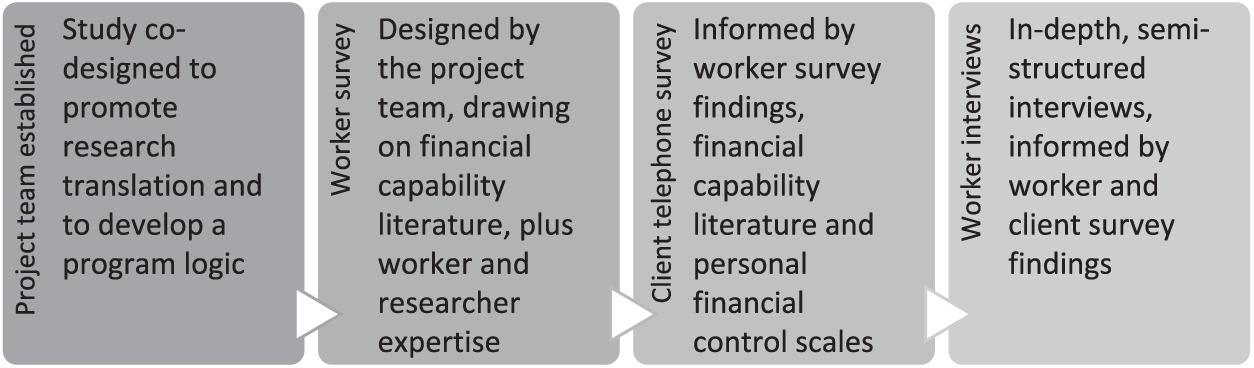
To explore the experiences of using microcredit, CM established a project team comprising NGO staff and university researchers to co-design the study, to facilitate research translation (Wehrens, Reference Wehrens2014). Mixed, staged methods were used to answer project research questions, including a worker survey, a client telephone survey and in-depth semi-structured interviews with key workers (see Figure 1). Client telephone survey questions were informed by findings from the worker survey and literature regarding financial capacity, literacy and control (Smith et al., Reference Smith, Ryan, Sonnega and Weir2017). Open-ended semi-structured questions were included to elicit in-depth responses. NGO staff randomly selected a pool of sixty clients who have accessed their microcredit loans across all NGO client postcodes (a total pool of 7,000 people) from which CM selected a sample of thirty participants.
Staged methods

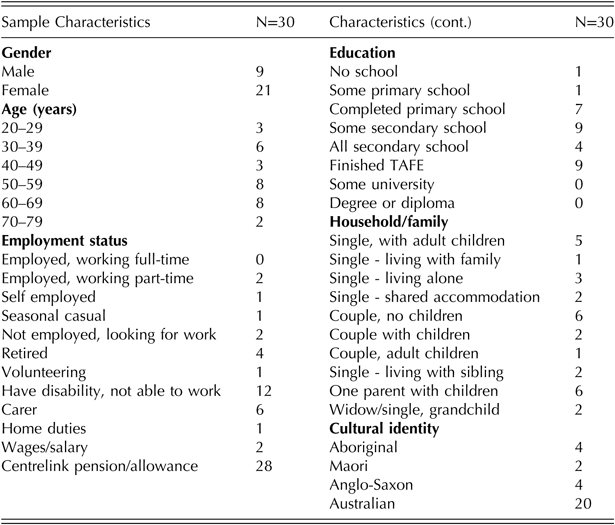
Clients from a broad range of backgrounds participated in the client telephone survey (see Table 1). Half of the client respondents had been clients of the NGO for more than five years, a third of respondents less than five years and around 20 per cent for two years. Eleven respondents had applied for their first microcredit loan within five years, ten had done so more than five years ago and five had applied within the last two years. More than half of the clients had accessed microcredit loans more than five times; the scheme is set up such that when a loan is completed, i.e. paid in full, clients may be eligible for another loan without being required to complete a new application.
Client respondent sample characteristics

CM then conducted semi-structured telephone interviews with five client-focussed workers to elicit their perspectives of client experiences of the microcredit scheme. All five interview participants were female, three based in the town where the NGO’s head office is located and two worked in other geographical locations. University ethics approval was obtained before commencing the study, formal consent was sought from each participant and all data were de-identified.
Findings and discussion
Following the fieldwork an immediate tension was evident. Clients, despite the financial pressures in their lives, were extremely satisfied with the microcredit loan scheme. For many, it had been the microcredit loan scheme that had enabled them to gain some financial control where this had previously been virtually impossible. It is understandable, then, that their accounts were overwhelmingly positive. The findings support the literature regarding the use of microcredit to assist in consumption smoothing, by enabling people to proactively manage financial stress and therefore reduce its negative effects on daily life and wellbeing (Morduch Reference Morduch1995; Dale et al., Reference Dale, Feng and Vaithianathan2012). However, their responses represent stark illustrations of how power is lived and experienced at an everyday level, reflecting the internalisation of the deserving neoliberal citizen as they move toward self-reliance and being able to smooth their own individual and household finances (Jones, Reference Jones2006; Lovell, Reference Lovell, Hur and Walter2014; Louth and Potter, Reference Louth, Potter, Louth and Potter2017).
Clients distinguished the scheme from charity because it provides access to a loan or line of credit that they were repaying. In their view, it is a system that means they can budget their fortnightly income such that they can afford their everyday living expenses and use the loans as an emergency backup. The account below illustrates what was a common view among respondents and what we consider the internalisation and the acceptance of the retreat of the state.
It makes me feel much better to access microcredit loans because I am paying for it – it’s not charity … I’ve been able to make my appointments, fix things that are wrong with my health. I’d be missing appointments because I couldn’t get down to them, so I keep my job and keep my appointments. Now at the end of my fortnight I’ve still got some money and I think that’s good because I never used to. Plus all my bills are up to date which is good.
Being able to self-manage because of access to a small interest free loan rather than seeking charity is at one level a success. This is a positive outcome for the individual involved and represents a successful, strength-based engagement with a client for the NGO concerned.
Yet, this is also an exemplar of strength-based stoicism (Hickman, Reference Hickman2018). The participant’s account is representative of the good neoliberal citizen; an individual who has been able to access a fair financial product to smooth out the dips and the bumps in their everyday financial life. However, this masks the overall story around having to live in poverty and the production and regulation of a whole poverty industry (see Soederberg, Reference Soederberg2014). Within this industry the poor are required to develop coping strategies to deal with their ongoing everyday poverty and thus there will be, in relative terms, winners (the deserving poor) and losers (the undeserving poor) (Jessop, Reference Jessop2009; Hickman, Reference Hickman2018).
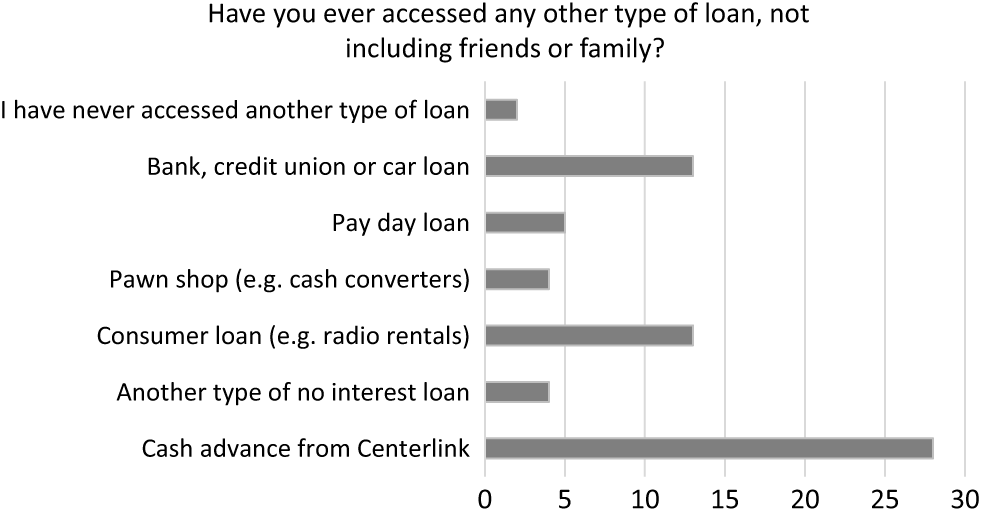
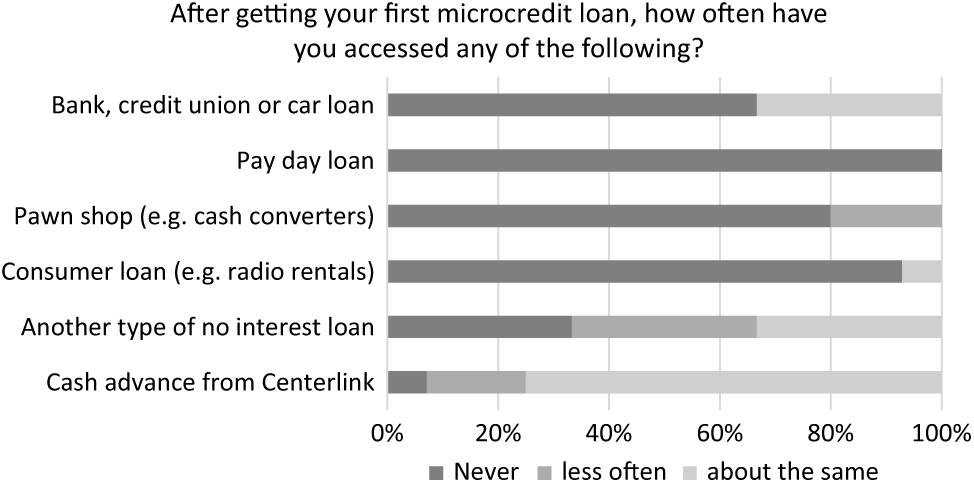
The survey included questions about clients’ borrowing behaviour prior to and since accessing microcredit loans. Almost all respondents had accessed cash advances from Centrelink (the state welfare provider) and tended to do so as soon as they were eligible and most had used other types of loans (see Figure 2). Respondents described using cash advances for items that were not eligible for microcredit loans, for example Christmas gifts or stocking up on perishable or freezer food. All five participants who had previously used a payday lender said they would never use one again, since accessing microcredit loans (see Figure 3). By comparison, two thirds of respondents said it was extremely likely that they would need to access microcredit loans in the future. These findings suggest that the microcredit loan scheme reduced the use of high interest and consumer loans among clients who access the scheme. In this way, participants framed microfinance as beneficial and high interest payday and consumer loans as detrimental. Nevertheless, both types represent ways in which the state is distanced from everyday poverty.
Types of loans accessed before first microcredit loan

Types of loans accessed after first microcredit loan

The survey included a personal control question regarding financial control: ‘has the amount of control you have over your financial situation changed in the last year?’ (Smith et al., Reference Smith, Ryan, Sonnega and Weir2017). Seventeen respondents selected the statement ‘I have more control now’, thirteen answered that ‘the amount of control I have has stayed the same’, while no participants selected ‘I have less control now’. This finding suggests that the microcredit scheme has assisted clients to improve their financial control and therefore their financial capability. Yet, put together with the majority of respondents stating they were very likely to need to access a microcredit loan in the future suggests that while accessing microcredit loans may assist people to smooth financial shocks, the extent to which microcredit loans can reduce poverty is unconvincing.
There is no doubt, however, that being able to access microcredit loans had real, material effects on the daily lives of participants. Clients were invited to describe how accessing microcredit loans has affected their daily lives. They offered a range of ways in which the loans had reduced their financial stress and almost all stated: ‘I don’t miss the $40 per fortnight’, and emphasised that having the microcredit loan did not add to their financial hardship. Again, such responses were illustrative of the ways in which the effects of financial smoothing resulting from access to microcredit loans improved these clients’ daily lives.
Several respondents talked about their access to microcredit loans and the NGO’s services more generally, meaning that their levels of stress were reduced and that, as one woman said, it brought them ‘peace of mind’. Several respondents, like her, also noted that access to a microcredit loan had made the difference between accessing often life-saving medical services when these were otherwise out of reach, frequently because of travel expenses.
I’d be lost without them. I’ve had to travel a lot for my husband’s health – we probably would not have been able to have the medical treatment for him. We used up all our reserves. [It] helps with stress – it would be very stressful trying to work out where the money would come from… I know it’s there in case of an emergency – it’s peace of mind.
Many such participants gave accounts of being unable to afford to travel long distances to specialist doctor appointments in the South Australian capital, Adelaide, for either themselves or their family members without the availability of microcredit loans. These accounts point to the extent to which essential medical services have become dependent on an individual’s capacity to pay – to rely on the entrepreneurial self, requiring out-of-pocket expenses to compensate for inadequate Medicare funding and health services to rural and remote communities. While in South Australia there is the SA Health-funded Patient Assistance Transport Scheme for people to recover accommodation and travel costs, that scheme relies on reimbursement and so people must have the funds to pay in the first place (see SA Health, 2018). None of the participants in this study mentioned accessing this type of assistance, most likely because they did not have the capacity to pay for the costs upfront.
A few of the participants with children expressed gratitude for being able to buy clothes for their children without – in their minds – being forced into further financial hardship, especially during change of season when children have outgrown their clothes, as described in the account below.
It’s helped me with the change of season – because my kids are growing I can buy new clothes and new bedding. I don’t have to worry how I’m going to afford a new jumper when it gets cold and they’ve grown out of it. I don’t have to stress… It gets deducted each fortnight and I don’t have to worry about it so I’m not used to having it anyway.
Without being able to access microcredit loans, several of the parents would have had to place clothes on lay-by with the consequence of it being some time after the change in season before they could bring the clothes home for their children to wear, or by using a consumer loan system (e.g. see afterpayFootnote 2 ) which may consequently deepen their financial hardship. It was clear among participants, particularly those who were Centrelink allowance recipients, that if the microcredit scheme was not available to them they were simply unable to afford essential items and services. Their experiences highlight that current Centrelink allowances do not cover the expenses of daily living.
Respondents identified the accumulative effects of poverty on daily life – for example, that not being able to repair a car can mean that you cannot travel to work which leads to a further reduction in income for those who are employed, or can be a barrier to seeking employment, as outlined in the account below.
The first loan was to fix my car and without fixing up my car I would not have been able to get a job.
NGO workers also reported many cases where clients had achieved positive outcomes directly because of their access to the microcredit loan scheme. One of the interview participants illustrated the importance of the microcredit loan scheme for income support recipients, critiquing state-funded welfare as inadequate for managing daily living expenses.
They can really just get on top of things and feel like they’re moving forward, particularly like Newstart [welfare] applicants when they’ve just got no breathing space financially.
Workers highlighted ways in which access to the microcredit loan scheme has contributed to preventing debt accumulation for clients, with the following comment being typical among workers and clients:
We get so many clients caught up with [consumer loans] and all those quick-fix services are available now where you can… ‘yeah, we’ll give you a loan, $5000 today if you want’, but then they charge massive interest. Finances are a huge issue for most of our clients so microcredit just makes life so much easier.
Workers also demonstrated the flow-on effects of microcredit loans for clients whereby they can afford to continue their medication. For clients who are prescribed medication to maintain mental health, or remain on a methadone program, the flow-on effects are wide-ranging – for example, making the difference between being able to join the paid workforce and avoiding homelessness, illustrated below:
We have people on massive lists of prescriptions and they just can’t fill them… we don’t want them coming off their medication so we actually have arrangements with some of our clients to have a microcredit loan attached to the pharmacy… [One client] was at risk of eviction so that’s why something had to happen [for them]. And our program has no brokerage so we can’t afford to pay for things for the clients to better themselves so yeah, microcredit’s the only way to go.
To summarise, the clients interviewed for this study clearly felt that the microcredit scheme alleviated their financial stress and made an enormous difference to their everyday lives. The findings align with the small amount of Australian studies that have found that, from the client’s perspective, microcredit loans can make an enormous difference to daily life (Dale et al., Reference Dale, Feng and Vaithianathan2012). While the sample of clients in our study did not necessarily improve their financial capability, being able to access microcredit clearly enabled them to engage in consumption smoothing (Morduch, Reference Morduch1995). These study findings also support previous Australian studies regarding the extent to which people on low incomes can ill afford essential items for daily living (Burkett and Sheehan, Reference Burkett and Sheehan2009; ACOSS, 2016; Burchardt and Hick, Reference Burchardt and Hick2017).
Conclusion
Neoliberalism as economic orthodoxy has facilitated the onset of social and public policy that is required to ‘fit’ with the common sense of our times. Increasingly we speak of encouraging financial resilience; that it is the subjects who must adapt to the economic reality. Margaret Thatcher embodied this shift when she claimed that ‘Economics is the method. The object is to change the soul’ (Hunt and Lockey, Reference Hunt and Lockey2017: 124). This has been a process that has been accelerated through rapid financialisation. As we increasingly move to a cashless society, we are all being ‘nudged’ to accept the accompanying changes (just consider the rise of self-service checkouts). What was once not even a consideration becomes the norm. The hegemonic conditioning of neoliberal ideology is writ large across societies (Scott, Reference Scott2018). The consequences are considerable if not always immediately apparent. As systemic financial exclusion creeps even in to the middle classes, with the financialisation of housing excluding many for home ownership (Rogers and Power, Reference Rogers and Power2017), those at the peripheries are required to find their own entrepreneurial self in order to navigate the structural disadvantage within which they are situated. There is a simultaneous denial that poverty is the product of a distinct set of social relations that determine who is and who is not poor, and the expectant behavioural expectations that society places upon those who are poor or who are not poor (Mader, Reference Mader2015).
Our findings suggest that in the current Australian political and economic context, access to community sector NGO-managed no interest microcredit can be seen as a process of financialisation that redresses the effects of diminishing state-provided welfare (Burkett and Sheehan, Reference Burkett and Sheehan2009). The provision of this product has become very important to those who are able to access it. On the evidence that we have gathered, community sector microcredit loans offer an alternative to predatory practices that seek to take full advantage of those whom are attempting to smooth the vagaries of marketised poverty. In the current context, the programs are vital and the community sector organisations involved are to be commended. Nevertheless, the scheme is restricted to a portion of the poor who can demonstrate their ability to repay, or who live within jurisdictions offering such microcredit. The NGO footprint and limited capital base therefore exclude a significant number of people. Our findings align with Hickman (Reference Hickman2018: 421) in that there is limited evidence that people dealing with financial hardship undergo ‘positive transformative agency’. Instead, microfinance offers an opportunity to navigate ‘pernicious choices’, where heating, cooling, educational resources for children and other necessities are negotiated or sacrificed (Hickman, Reference Hickman2018: 421).
We argue that there needs to be a shift in focus away from an overarching objective to reduce welfare and towards a focus on inequitable structural determinants of peoples’ daily lives, such as high energy costs, high medical costs and high travel costs (Marmot et al., Reference Marmot, Allen, Bell, Bloomer and Goldblatt2012). Given that the current economic epoch is unlikely to change radically – and in the face of the insufficient regulation of payday lenders – community sector microfinance should certainly remain as one response to consumption smoothing. However, ultimately, more effort should be directed at developing a structural, proportionate universal approach that does not rely on financially vulnerable individuals having to undertake a performance of free choice so that they might navigate a regulatory environment that rewards and punishes in accordance to a market logic.
Acknowledgements
We would like to thank all those Uniting Country South Australia (UCSA) and CatholicCare Northern Territory (NT) clients and workers who participated in and assisted with this study. We especially extend our gratitude to the respective UCSA and CatholicCare NT project team members. We also extend thanks to UCSA and CatholicCare NT for supporting this work.