1. Introduction
Bilingualism research provides evidence that language takes part in the processes of sculpturing the cognitive structure, and that it helps to build the network of knowledge in the mind (Bowerman & Levinson, Reference Bowerman and Levinson2001; Cook & Bassetti, Reference Cook and Bassetti2011; Dewaele, Reference Dewaele2007; Grosjean & Ping Li, 2013; Nelson, Reference Nelson1996; Pavlenko, Reference Pavlenko2014). Cognitive function of language is understood as verbalisation of analytical processes which occur in conscious thinking activity. Vygotsky (Reference Vygotsky1986) viewed language as a cognitive scaffold for knowledge to be acquired, stored, accessed, and modified; and a necessary condition to acquire further cognitive skills. Language is therefore an integral part of almost every kind of cognitive process, including perception, conceptual thinking, reasoning, and mental calculation, as well as domains of planning, problem solving, and memorisation (Lewis, Reference Lewis1969). The Complementarity Principle proposed by Grosjean (Reference Grosjean1997, Reference Grosjean2010, Reference Grosjean, Silva-Corvalán and Treffers-Daller2016) proclaims that bilingual language use is domain-specific, in other words, bilinguals tend to use different languages for different domains of their life; and “different aspects of life often require different languages” (Grosjean, Reference Grosjean2010, p. 29). The notion of domain, as defined by Schrauf (2002, p. 101), “refers to a particular area of human experience for which we possess a specific ‘language’ for example, we have a specific way of talking about family relations and obligations, a specific way of talking about work and occupation”. Schrauf’s definition, which the present paper adopts, was developed from three concepts, namely: ‘discourse domain’ in second language acquisition, ‘semantic domain’ in cognitive anthropology, and ‘cognitive domain’ in cognitive linguistics.
Bilinguals may have different linguistic habits depending on the domain they operate in (Cooper, Reference Cooper, Fishman, Cooper and Ma1971; Hoffman, Reference Hoffman, Fishman, Cooper and Ma1971). Some domains within the cognitive function of language tend to be more language-dependent than others, for example retrieving sequences of numbers and letters from memory, such as postcodes, telephone numbers, or passwords. The situation becomes even more prominent in case of sequential bilinguals, and in situations of mobility-migration, where the L2 (second language) user changes the context of language use from L1- (first language) to L2-dominant. In her most recent book, Pavlenko (2014, p. 101) reveals: “in my own case, the number of my old apartment in Kiev may pop out in Russian, while my social security number comes out in English.” Similar experiences were reported by American psychologist Spelke, who “could readily provide American friends with her summer address in France but not with her telephone number. Retrieving the number required that she say it in (non-native) French, visualize the numerals, and then mentally read them off in English” (Spelke & Tsivkin, Reference Spelke and Tsivkin2001, p. 69). Cook (Reference Cook2002) argues that the mind of an L2 user differs from that of a monolingual speaker, due to the development of multi-competence, which is not equivalent to the sum of two mono-competences. This links with Grosjean’s (Reference Grosjean1989) assertion that a bilingual speaker is not a sum of two monolinguals in one. Knowledge of more than one language in one mind, and the development of multi-competence, is said to alter the mind of the bilingual speaker, and affects their cognitive representations (Cook, Reference Cook2002; Cook & Bassetti, Reference Cook and Bassetti2011). It can also impact ways in which knowledge is accessed and categorised, as the two languages can be found to interact and/or intertwine (Dewaele & Pavlenko, Reference Dewaele and Pavlenko2003; Jarvis & Pavlenko, Reference Jarvis and Pavlenko2008). Researchers have called for more studies to investigate how bilingual speakers process cognitive information, and what languages they use in that process (Cook & Bassetti, Reference Cook and Bassetti2011; Dewaele, Reference Dewaele2007; Pavlenko, Reference Pavlenko2014). This paper aims to address those calls by undertaking a comparative investigation of the extent of L2 use in cognitive domains, and analysing it against acculturation level, social network profile, length of residence in the L2-context, and predicted future domicile.
2. Literature review
2.1. bilingual language use and cognitive domains
Research shows that, in the case of bilinguals, some domains of life may be covered by one language, others by the other language, while some domains may be covered by both languages (Grosjean, Reference Grosjean2010; Schrauf, Reference Schrauf2002). Multiple, large-sale studies revealed that people who speak more than one language tend to have linguistic preferences when operating in different domains of life, or when communicating different types of content (Dewaele, Reference Dewaele2004a, Reference Dewaele and Pavlenko2006, Reference Dewaele2010). L2-dominant bilinguals were also found to occasionally revert to L1 in cases of translation non-equivalence, where L1-specific terms lack exact translation equivalents in the L2 (Pavlenko, Reference Pavlenko2014). According to the CP, bilinguals use their languages for different purposes, in different domains and contexts of their life, and this linguistic complementarity is crucial when analysing language use in bilinguals (Grosjean, Reference Grosjean1997, Reference Grosjean2010, Reference Grosjean, Silva-Corvalán and Treffers-Daller2016). This applies to all functions of language use, including the cognitive function. Grosjean (Reference Grosjean2010) argues that the measurement of language use in bilinguals should include the CP in the operationalisation process in order to measure the extent of domain-specific language usage, enabling more detailed investigations. Domain-based studies provide the evidence that even dominant bilinguals may use the non-dominant languages for specific domains (Grosjean, Reference Grosjean2015).
Carroll and Luna (Reference Carroll and Luna2011) conducted a study focusing on accessibility of words and concepts in 30 Spanish–English bilinguals based on domain-specificity. The authors argued that the use of different languages can impact the accessibility of certain concepts. Their study showed that words presented in the language which is typical for a given domain are accessed and linked to concepts more quickly than words in the other language. Their study supported the importance of the complementarity principle and its relevance when studying language use in bilinguals.
Chiaro (Reference Chiaro, Norrick and Chiaro2009) investigated domain-specific language practices in 59 English–Italian bilinguals. The results showed that the majority of domains were shared between the two languages; however, particular topics and activities had high L1 scores, and these included counting (74%) and mental calculation (88%).
Empirical studies into retrieval of numerical knowledge showed that speedier and more precise recall occurs when the language of retrieval is the same as the language of encoding, or instruction, in other words, in the situation of language congruency (Marian & Fausey, Reference Marian and Fausey2006; Marian & Kaushanskaya, Reference Marian and Kaushanskaya2004; Spelke & Tsivkin, Reference Spelke and Tsivkin2001). As far as accessing numerical knowledge is concerned, researchers found a significant L1 advantage in that domain (Campbell, Kanz, & Xue, Reference Campbell, Kanz and Xue1999; Frenck-Mestre & Vaid, Reference Frenck-Mestre and Vaid1993; Marsh & Maki, Reference Marsh and Maki1976; Tamamaki, Reference Tamamaki1993). A similar scenario surrounds the use of number for mathematical calculation. Mental calculation involves cognitive faculties which are, to a certain degree, based on language, often on the language of instruction (Campbell & Epp, Reference Campbell and Epp2004). This interdependency is particularly interesting in the case of bilinguals. Empirical studies found that many sequential bilinguals and multilinguals, irrespective of language dominance, tend to use L1 for mental calculation and multiplication tables (Dewaele, Reference Dewaele2007, Reference Dewaele2009; Pavlenko, Reference Pavlenko2014; Spelke & Tsivkin, Reference Spelke and Tsivkin2001). L1 advantage was also found for number-oriented memory span (da Costa Pinto, Reference da Costa Pinto1991; Hoosain, Reference Hoosain1979).
Dewaele (Reference Dewaele2007) conducted a study on 1,454 adult multilingual speakers to measure language choice for mental calculation, and analysed it against a range of sociobiographical variables, including frequency of language use and L2 socialisation. Results showed that L1 was the preferred language for mental calculation in multilinguals. The findings also showed that multilinguals with higher frequency of L2 use and higher levels of L2 socialisation were more likely to use the target language for some elements of mental calculation. Readiness to use the target language for mental calculation proved to be dependent on the type and complexity of the mathematical task in hand. His finding coincided with that of Planas and Setati (Reference Planas and Setati2009).
Planas and Setati (Reference Planas and Setati2009) studied 24 immigrant South American L1 Spanish learners of mathematics in Catalan schools, with Catalan as the language of instruction. They measured how Spanish-dominant learners of mathematics engaged their two languages in the learning process. They found that shifts in language use (from L1 to L2 and vice versa) coincided with shifts in the complexity of the task. Participants were found to use their two languages for different purposes, according to the nature of the task. New mathematical concepts introduced in Catalan would promote activation of the participants’ target language, while analytical reasoning and the actual process of ‘solving the task’ would promote a shift to L1 Spanish (2009, p. 49). L1 advantage in the domain of mental calculation is associated with the language-specific character of the initial arithmetic instruction, which results in more efficient retrieval and a shorter processing time (Dehaene, Reference Dehaene2011; Dewaele, Reference Dewaele2007; Epstein, Reference Epstein1915). Nevertheless, Pavlenko (Reference Pavlenko2014) points out that language dominance also plays a significant role as far as language choice in this domain is concerned.
Dewaele (Reference Dewaele, Schmid, Koepke, Keijzer and Weilemar2004b) found a significant link between self-reported language dominance and language use for mental calculation. L1-dominant participants were found to be much more likely to use L1 for mental calculation than L2-dominant participants, or those whose self-reported language dominance was balanced between the two languages. This coincides with later findings by Dewaele (Reference Dewaele2007) which showed that higher levels of L2 socialisation and higher frequency of L2 use are linked with lower levels of L1 use for the domain of mental calculation.
Findings by Vaid and Menon (Reference Vaid and Menon2000), as well as by Tamamaki (Reference Tamamaki1993), show that L1 preference for mental calculation decreases proportionally to the length of residence in the L2-speaking context. Vaid and Menon (Reference Vaid and Menon2000) concluded that length of residence in the L2-dominant context (over six years), and high self-reported proficiency, lower the likelihood of L1 use for the domain of mental calculation. Greater length of residence in the host country is said to be linked with more extensive use of L2 in general, which can affect language dominance (Magiste, Reference Magiste1979). Greater length of residence has also been linked to processes of cognitive restructuring in bilinguals, and a gradual act of “re-naming the world” (Pavlenko, Reference Pavlenko2011, p. 199).
The studies presented above suggest that the number-based domain of mental calculation tends to be heavily L1-dependent. The exceptional character of this domain is due to intensive repetition and practice of number, multiplication tables, and mathematical vocabulary in the L1 during childhood, which can most likely explain bilinguals’ reliance on L1 calculation later in life. Other domains belonging to the cognitive function of language may be less language dependent, and more context- or even location-specific (Grosjean, Reference Grosjean2010).
Context-specific domains, in contrast to language-dependent ones, are more prone to changes in language use, and the direction of the change will be guided by the context. Grosjean (Reference Grosjean2010) points out that if one language is dominant in a given domain, language choice for that domain is usually the language of its practice; however, an instance of writing out a shopping list may be determined by the local language of the group where the speaker is at the time of creating the list; in other words, context-specific activation. In her study of Russian–German bilinguals resident in Germany, Schmidt (Reference Schmidt2014) found that when writing out shopping lists, 32% of the bilinguals used both languages when compiling the lists (they code-switched in writing), 3% wrote them in L1 Russian, and 65% wrote their shopping lists in L2 German only.
As far as note-taking in L2 is concerned, Barbier, Roussey, Piolat, and Olive (Reference Barbier, Roussey, Piolat and Olive2006) found that notes taken by Spanish–French and English–French bilingual students in France were generally shorter and less organised when taken in L2 French, in comparison to notes taken in the students’ respective L1s. Moreover, notes taken in L2 were characterised as having significantly fewer abbreviations and a more limited syntax. In addition, the perceived difficulty of note-taking in L2 was higher than in L1 (Barbier et al., Reference Barbier, Roussey, Piolat and Olive2006). What should be noted, however, is that the students’ general abilities in L2 French were not sufficiently accounted for in the study. Note-taking is a process which involves simultaneous language comprehension and production activities, which is linked to working memory capacities (Baddeley, Reference Baddeley2000) and therefore requires a strategic management of both processes by the note-taker (Piolat, Reference Piolat and Piolat2004, Reference Piolat, Torrance, van Waes and Galbraith2007). A significant degree of mastery and high automation levels in L2 are linked to efficient transcription of information (Ransdell & Barbier, Reference Ransdell, Barbier, Ransdell and Barbier2002). Also, unrestricted meta-cognitive control of note-taking translates into a more competent evaluation of the reliability of the notes’ content in respect to the existing competence and knowledge acquired in L1 (cf. Barbier et al., Reference Barbier, Roussey, Piolat and Olive2006).
2.2. cognitive aspects of acculturation
Acculturation is defined as a “process of cultural and psychological change” (Berry, Reference Berry2005, p. 698). The acculturative process is initiated at the point of migration and it is said to comprise socio-cultural, psychological, and cognitive aspects (Schrauf, Reference Schrauf2002; Schumann, Reference Schumann1986). Voluntary migration is associated with higher levels of motivation when it comes to target language acquisition, use, and possibly further processes of L2 internalisation and language shift (Esser, Reference Esser2006). Acculturation involves changes in the behavioural repertoire of the individual, which usually includes the learning and extensive use of the target language, adoption of new communication styles, and other forms of socio-cultural and psychological adjustment. Socialisation with members of the host culture is considered to be a strong component of the acculturation process, and L2-oriented social networks have been linked with increased rates of integration and socio-cultural adaptation (Chiswick & Miller, Reference Chiswick and Miller2005; Singleton, Regan, & Debaene, Reference Singleton, Regan and Debaene2013; Stoessel, Reference Stoessel2002). Language use is considered to be one of the fundamental elements of the acculturation process (Acton & Walker de Felix, 1986). Acculturation is a complex process which combines psychological, cognitive, linguistic, and social aspects (Ryder, Alden, & Paulhus, Reference Ryder, Alden and Paulhus2000; Sam & Berry, Reference Sam and Berry2006; Schwartz, Unger, Zamboanga, & Szapocznik, Reference Schwartz, Unger, Zamboanga and Szapocznik2010).
According to the Cognitive Theory of Acculturation, acculturation does not happen across all domains of life at the same time, but progresses domain by domain (Schrauf, Reference Schrauf2002). The gradual character of the acculturation processes is said to break down the overall cognitive effort required into manageable chunks in order to avoid a cognitive overload. Schrauf (2002, p. 101) asserts that “language shifts in experiential domains provide the clues to patterns of acculturation”. He also claims that some domains are more prone to language shift than others, and that it is often the level of need that dictates the development of L2 linguistic competence in a given domain.
Schrauf (Reference Schrauf2009), in his study of 60 older Spanish–English Puerto Rican bilinguals, investigated language use in social and private domains, where the latter included cognitive domains of writing notes to oneself and counting. Results showed that lower proficiency levels in L2 positively correlated with lower levels of acculturation, which was reflected in language use. Higher-proficiency groups were reported to use English significantly more frequently across different domains when compared with low-proficiency groups. Schrauf concluded that acculturation is reflected in domain-specific language use, and that higher levels of L2 use are associated with higher levels of acculturation and L2 proficiency. Significant links between L2 proficiency and acculturation were also found by Hammer and Dewaele (Reference Hammer, Dewaele, Forsberg Lundell and Bartning2015).
Empirical research provided evidence for the effects of L2 socialisation on patterns of language use, as well as cognitive restructuring. L2 socialisation drives processes of cognitive restructuring, facilitates the internalisation of translation non-equivalents, and aids lexicalisation of emotions in sequential bilinguals (Pavlenko & Driagina, Reference Pavlenko and Driagina2007). The latter may result in a gradual loss of a discourse accent in L2, which stems from the existence of L1-oriented cognitive concepts, and leads to the development of new, L2-oriented concepts in the cognitive structure of the bilingual speaker (Pavlenko, Reference Pavlenko2011). Changes in L2 use and cognitive restructuring are associated with significant periods of L2 immersion, for example following migration (Grosjean, Reference Grosjean2002, Reference Grosjean2010).
Predicted future domicile has been linked with either integrative or instrumental motivation to acquire and use the L2 (Gardner & Lambert, Reference Gardner and Lambert1972; Schumann, Reference Schumann1976). Permanent domicile in the host country is associated with the integrative type of motivation, for the L2 users see themselves as belonging to the new socio-cultural reality in the long run. This is in opposition to instrumental motivation, more typical of sojourners, where the L2 users treat their stay in the L2-speaking country as temporary (Bochner, Reference Bochner, Sam and Berry2006). Domicile of a finite nature is said to have an influence on how sojourners acculturate to the host society, which is viewed as a temporary arrangement. This in turn may link with other psychological as well as cognitive aspects of L2 acquisition and use, such as attitudes towards the L2-speaking community and culture, and a desire to learn and use the L2 (Dörnyei & Ryan, Reference Dörnyei and Ryan2015).
3. Methodology
3.1. research questions
Two research questions and five hypotheses were formulated to investigate L2 use in cognitive domains including mental calculation, action plans, shopping lists, and note-taking:
1. To what extent do sequential bilinguals use the L2 in cognitive domains following migration?
2. Is the extent of L2 use in cognitive domains following migration linked to acculturation level, social network profile, predicted future domicile, and length of residence?
One hypothesis was formulated to address the first research question, which investigates the extent of L2 use in cognitive domains following migration, namely:
Hypothesis 1: Participants will use the L2 to varying extents across the four cognitive domains; context-specific domains of note-taking, shopping lists, and action plans will attract significantly higher levels of L2 use than the language-dependent domain of mental calculation.
Four hypotheses were formulated to address the second research question, which investigates the links between the extent of L2 use in cognitive domains and four acculturation variables, namely:
Hypothesis 2: Participants with higher acculturation levels will use the L2 to a significantly higher extent across all four cognitive domains; however, context-specific domains (note-taking, shopping lists, and action plans) will reveal significantly higher levels of L2 use than the language-dependent domain of mental calculation, even in completely acculturated bilinguals.
Hypothesis 3: Participants who function in predominantly L2-speaking social networks will use the L2 to a significantly higher extent across all four cognitive domains; however, context-specific domains (note-taking, shopping lists, and action plans) will reveal significantly higher levels of L2 use than the language-dependent domain of mental calculation.
Hypothesis 4: Participants who intend to remain in the UK indefinitely will use the L2 to a significantly higher extent across all four cognitive domains; however, context-specific domains (note-taking, shopping lists, and action plans) will reveal significantly higher levels of L2 use than the language-dependent domain of mental calculation.
Hypothesis 5: Participants with greater length of residence will use the L2 to a significantly higher extent across all four cognitive domains; however, context-specific domains (note-taking, shopping lists, and action plans) will reveal significantly higher levels of L2 use than the language-dependent domain of mental calculation.
3.2. participants
Respondents included 149 highly educated L2-competent sequential Polish–English bilinguals who migrated to the UK at an average age of 23. Age at migration ranged from 18 to 41 years old (Mean = 23.6, SD = 3.8), and 128 participants migrated by the age of 26. The average length of residence was eight years. All respondents were professionally or academically active following migration, and the average age within the sample was 31, ranging from 23 to 45 years old (Mean = 31.1, SD = 4.7). Respondents were university/college graduates holding the following academic qualifications: MAs (58.4%), BAs (26.2%), PhDs (10.1%), and College Diplomas (5.3%). All participants were competent users of English, including 45.6% of proficient L2 users, 38.3% native-like L2 users, and 16.1% independent users of English, according to the Common European Framework of Reference for Languages (CEFR) (Council of Europe, 2011). The average age of L2 acquisition (AoA) was 12 years. The lowest AoA recorded was 3 years old (Mean = 12.3, SD = 4.6). Over half of the respondents began learning English before the age of 13. Participants comprised 86% females and 14% males, which reflects a typical gender distribution in online questionnaires devoted to languages (Wilson & Dewaele, Reference Wilson and Dewaele2010).
In order to take part in the study, participants had to meet a previously defined set of selection criteria with regards to: (1) current age and age at migration (18–45 years plus/minus one year in both cases due to differences in age reporting between England and Poland); (2) linguistic profile (being a native speaker of Polish and an L2 speaker of English); (3) proficiency level (competent users of English L2, able to naturally function in an English-dominant environment); (4) education level (having a university or college education, and a degree qualification or equivalent); and (5) history of migration (experience of relocation from Poland to an English-speaking country in early adulthood).
The requirements for the participants to have high levels of education ensured that respondents would be generally familiar with filling out questionnaires, and that participation in the study would not appear taxing. High education levels also ensured a much higher likelihood of the respondents being able to reflect on their experiences with language, due to higher level of metalinguistic awareness (Dewaele, Reference Dewaele2010). This, in turn, would make their selection choices more meaningful and relevant for the study.
Participants were recruited by sending e-mail invitations to individuals, organisations, and groups who were likely to meet the selection criteria. This included contacts with professionals employed in different sectors across the economy, students and staff at different British universities, professional Polish–English translators and interpreters registered and living in the UK, and professionals working in UK higher education. No L1-oriented communities were approached to recruit participants for the study, which contrasts this study from other studies focusing on linguistic and cultural acquisition in Polish émigrés in Ireland (Debaene, Reference Debaene, Singleton, Regan and Debaene2013). Recruiting from L1-oriented infrastructure circles is not seen as appropriate in this case, as while it “can yield some interesting results on certain aspects of SLA [second language acquisition], there may be other acculturation-related phenomena which will remain largely undetected” (Hammer, Reference Hammer2014, p. 507). As the current study takes an acculturation perspective, the sampling technique involves “isolated immigrants” (Stoessel, Reference Stoessel2002, p. 100), and not Polish communities in the UK, as the latter could result in little variation in the data when it comes to core acculturation-oriented variables, such as social network profile, and so the phenomena of interest could be missed altogether. This sampling technique adds to the originality of this study, as, despite recruiting from non-communities, the sample is representative enough in terms of numbers to run statistical analyses.
In total, 177 individuals opened the questionnaire, of whom 149 fully completed the survey and met all the selection criteria. In all 149 responses there was no missing data, and 91 respondents voluntarily opted to leave their email addresses for the purpose of future research activities and interviews.
3.3. instrument
This study implemented both quantitative and qualitative approaches, which enabled the combination of statistical quantification with individual experience (Dewaele, Reference Dewaele and Sharifian2015; Dörnyei, Reference Dörnyei2007). Inspired by pre-existing methodologies in the form of the Bilingualism and Emotion Questionnaire (BEQ), developed and administered by Dewaele and Pavlenko (2001), the present questionnaire aimed to collect empirical data on language use among sequential Polish–English bilinguals who migrated from Poland to the UK in early adulthood (post-EU-accession migration), and underwent processes of acculturation. Participants completed an online questionnaire consisting of closed and open-ended questions, and filled out a table of language use (Hammer, Reference Hammer2012). The questionnaire was easy to navigate and it took approximately 20 minutes to complete. Open-ended questions collected biographical information, including education level, age at migration, and current age, as well as the experience of a linguistic transition.
The closed-ended Likert scale questions elicited key socio-cultural variables, including acculturation level, social network profile, and predicted future domicile. The paragraphs below present the operationalisation of the research variables as part of the questionnaire, and list the leading questions which were asked during semi-structured interviews.
Acculturation level was operationalised by asking the following closed-ended question: “Acculturation is a process roughly defined as: social and psychological integration with the target language group. How integrated with your English language group do you feel?” Participants were presented with a single-choice drop-down menu including options representing five acculturation levels: Completely / Highly / Moderately / Slightly / Not at all. Validation of acculturation-level scores was performed by means of correlating them with other relevant variables, namely, social network profile (rs = .454**; p < .0001), predicted future domicile (rs = .279**; p < .001), L2 dominance (rs =.450**; p < .0001), and length of residence (rs = .264**; p < .001).
Social network profile was operationalised by asking the following closed-ended question: “In terms of languages spoken, how would you describe your social network these days?” This question employed the egocentric approach; in other words, it attempted to elicit information about the proportion of English speakers in the participants’ personal network (Daming, Xiaomei, & Wei, Reference Daming, Xiaomei, Wei, Wei and Moyer2009). Participants were presented with a single-choice drop-down menu which included the following options: The majority of my social network consists of Polish speakers / There is a more or less equal number of Polish and English speakers in my social network / The majority of my social network consists of English speakers (native or not). Pre-existing methodologies (Dewaele & Pavlenko, 2001) used an alternative question to enquire about the linguistic character of the social network, namely: participants were asked to provide the exact number of L1 and L2 interlocutors within their social networks. The answers would provide exact numerical values; however, a higher number of L1 or L2 interlocutors may not necessarily mean that the L2 user speaks more L1 or L2 in general, as that would depend on the character and frequency of contact. The present study therefore asked the question about the linguistic profile of the social network, aiming to elicit an overall perception of whether the participant is part of majority L1-speaking social network, majority L2-speaking social network, or a balanced one.
Predicted future domicile was operationalised by asking the following closed-ended question: “Do you see yourself living in this English-speaking country permanently?” Participants were presented with a single-choice drop-down menu which included the following options: No (future domicile outside the UK) / I’m not sure (undecided) / Yes (future domicile in the UK). This question was asked in order to elicit information about the residency intentions of the participants.
Language use for cognitive domains data were collected using the table of language use which was part of the online questionnaire. The table of language use employed the Complementarity Principle in the operationalisation process; in other words, the extent of L1/L2 use was noted for different experiential domains by using a set of domain-specific language choice drop-down menus. The table listed a total of 20 domains, and the four cognitive domains analysed in this paper include: (1) note-taking, (2) shopping lists, (3) action plans, and (4) mental calculation (Hammer, Reference Hammer2012). The domain of mental calculation is understood to be a language-dependent domain of language use, while the remaining three domains are understood to be more context-specific (Pavlenko, Reference Pavlenko2014). As part of the table, language use data for the four cognitive domains were collected by means of four individual drop-down menus, each attached to one of the four cognitive domains, and each using a five-point Likert scale measurement including the following items: (1) Polish, (2) Mainly Polish, (3) Equally Polish and English, (4) Mainly English, (5) English.
3.4. procedure
The study was granted full ethical approval by the host institution prior to being publicly available and advertised to potential respondents. The landing page for the online questionnaire displayed full contact details of the researcher and the host institution, provided information about the purpose of the study, informed online visitors that proceeding with the questionnaire was synonymous with taking part in the study, and reassured them that they could exit the questionnaire at any time should they choose to do so. Participants who decided to partake in the study proceeded with the questionnaire, which from the landing page directed them to the first part, of three, of the survey.
Part one of the questionnaire consisted of questions aimed at eliciting socio-biographical information including age, linguistic background, education level, and history of migration. The demographic questions included the following items: (1) “How old were you when you migrated to an English-speaking country?” (2) “How old are you now?” (3) “Is Polish your mother tongue?” (4) “Is English your main second language?” (5) “What is your highest academic qualification (or one you are currently working towards)?” (6) “Were you born in Poland but relocated to an English-speaking country in adulthood?” (7) “Which country do you live in now?”
Part two of the questionnaire contained the table of language use. The participants were instructed to think about what languages they use in the experiential domains listed in the table, and select one of the available Likert-scale options for each of the cognitive domains. Pre-existing methodology, and specifically Schrauf (Reference Schrauf, Duarte and Gogolin2014), provided empirical validation for the utilisation of domain-specific Likert-scale self-reporting when measuring language use in bilinguals. High internal consistency reliability for language use data across all domains listed in the table was revealed by calculating Cronbach’s alpha, which equalled = .88. A series of one-sample Kolmogorov–Smirnov tests revealed that language use data across all domains were not normally distributed (Kolmogorov-Smirnov z-values vary between 1.9 and 6.5, all p < .0001); therefore, a non-parametric equivalent of a one-way ANOVA was used in each case.
Part three of the questionnaire consisted of questions aimed at eliciting information of a socio-cultural and psychological nature, including acculturation level, social network profile, and predicted future domicile. Most questions belonged to the closed-ended category, with a set of available answers provided in the form of drop-down menus. At the end of the questionnaire, participants were asked whether they would give their consent so that quotations from their responses could be published in an academic paper, for which a Yes/No response was obligatory.
The semi-structured interviews were conducted following online data collection, and focused on researching changes in language use for cognitive domains following migration and acculturation. Fourteen participants were interviewed as part of the study. Interviewees were recruited from the pool of participants who completed the online questionnaire and left their email addresses for the purpose of future research activities. Each interviewee signed a paper consent form prior to their interview taking place. The consent form included the following question: “Do you agree to be anonymously quoted in a research paper / publication?” The interview questions included the following:
1. “Has the frequency of the use of Polish and English changed since you relocated? Could you describe this process?”
During the interviews, participants were presented with a visual aid listing the four cognitive domains investigated in this paper, and were asked the following questions:
2. “Which of the areas of life would be subject to the biggest change in language use?”
3. “In which of the four spheres do you use most Polish/English?”
4. “Do you have any interesting observations on your change in the use of Polish and English in those areas of life?”
The interviews were recorded and transcribed, after which the transcript was read multiple times and a preliminary analysis was begun. The purpose of the initial reading was for the themes to emerge naturally, and short descriptions of the topics were noted (Richards, Reference Richards, Heigham and Croker2009). Following the preliminary analysis, a second-level analysis of the text began, which included (1) coding, (2) growing ideas, and (3) interpreting the data (Dörnyei, Reference Dörnyei2007). Patterns of experience which emerged from the data were coded thematically. The themes included (1) language choice in the four individual cognitive domains, (2) the overall experience of L1/L2 use for cognitive domains, (3) language choice for cognitive domains preferences, and (4) possible rationale behind selecting L1/L2 for cognitive domains. Links between the qualitative extracts and the research questions were made as part of the second-level analysis. The qualitative fragments cited in this paper represent patterns of experience which were particularly resonant and relevant (Smith, Reference Smith2011; Straub, Reference Straub, Straub, Weidemann, Kolbl and Zielke2006).
4. Results: groups of participants
Participants were divided into groups within each predictor based on their responses to the questionnaire items described in the Section 3.3 above; all participants (N = 149) answered the same set of questions.
Participants were split into four groups within the acculturation level variable, based on the degree to which they felt acculturated to the host culture group, namely: Completely acculturated participants (n = 42); Highly acculturated participants (n = 68); Moderately acculturated participants (n = 31); Slightly acculturated participants (n = 8).
Participants were split into three groups within the social network profile variable, based on the linguistic character of their immediate social network, namely: Participants operating in majority English-speaking social networks (n = 74); Participants operating in equally Polish- and English-speaking social networks (n = 57); Participants operating in majority Polish-speaking social networks (n = 18).
Participants were split into three groups within the predicted future domicile variable, based on the character of their residency in the UK, namely: Participants willing to remain in the UK indefinitely (n = 79); Participants declaring an undecided character of domicile (n = 58); Participants willing to leave the UK at some point in time (n = 12).
Participants were split into three groups within the length of residence variable, namely: Participants with under five years of residence (n = 39); Participants with residency lasting between 5 and 10 years (n = 86); Participants with over 10 years of residence (n = 24). The five-year residency brackets were based on the section in UK immigration law which states that permanent residency is granted to EU citizens after 5 years of residency in the UK (Home Office, 2017).
5. Results: first research question
5.1. frequency of l2 use in cognitive domains
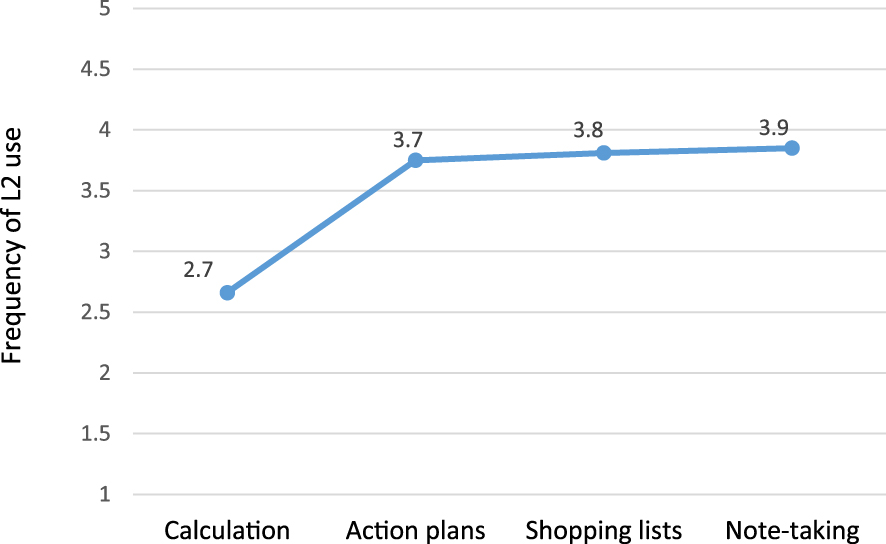
Across all participants (N = 149), the highest L2 use scores were recorded for the domain of note-taking (Mean = 3.9), followed by shopping lists (Mean = 3.8), action plans (Mean = 3.7), and mental calculation (Mean = 2.7).
A Friedman test revealed a statistically significant difference in frequencies of L2 use between cognitive domains (χ2 = 178.9, p < .0001).
Pairwise comparisons were performed (SPSS Statistics 23) with a Bonferroni correction for multiple comparisons (adjusted p-values are presented). Frequency of L2 use was statistically significantly different between mental calculation and action plans (p < .0001), mental calculation and note-taking (p < .0001), and mental calculation and shopping lists (p < .0001), but not between any other combination. Figure 1 presents the frequency of L2 use in cognitive domains.
Frequency of L2 use in cognitive domains.

6. Results: second research question
6.1. acculturation level and l2 use in cognitive domains
6.1.1. Domain of note-taking
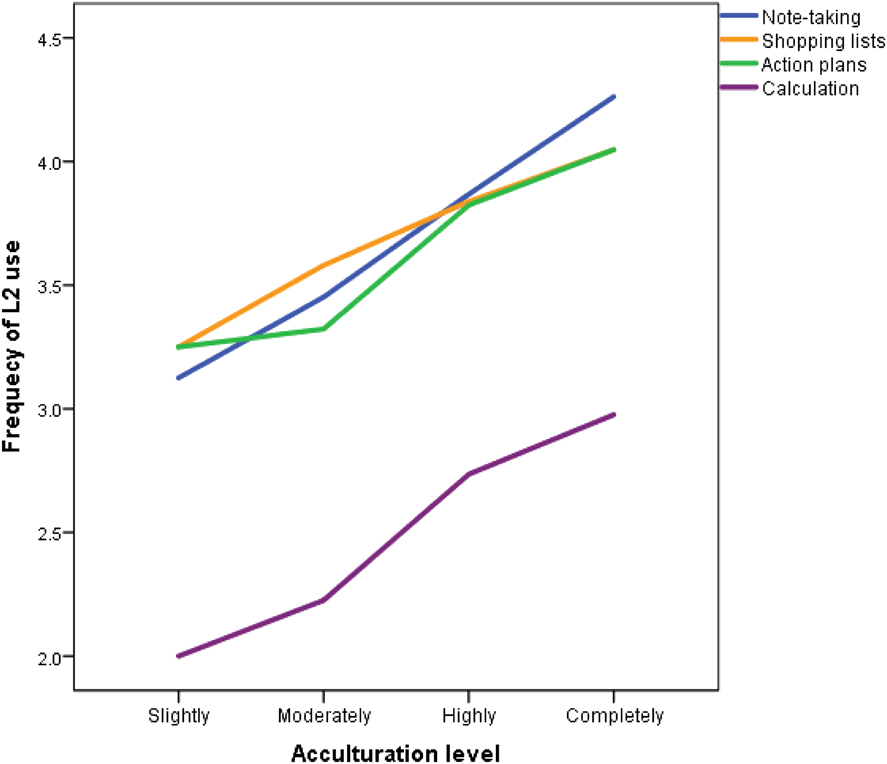
A Kruskal–Wallis test showed that there is a statistically significant effect of acculturation level on frequency of L2 use in the domain of note-taking (χ2 = 18.8, p < .0001), with a mean of 3.13 for the slightly acculturated group (n = 8), 3.45 for the moderately acculturated group (n = 31), 3.87 for the highly acculturated group (n = 68), and 4.26 for the completely acculturated group (n = 42).
Pairwise comparisons were performed using Dunn’s (Reference Dunn1964) procedure with a Bonferroni correction for multiple comparisons (SPSS Statistics 23). Adjusted p-values are presented. This post-hoc analysis revealed statistically significant differences in mean scores between the slightly (3.13) and completely (4.26) acculturated groups (p = .006), and between the moderately (3.45) and completely (4.26) acculturated groups (p = .002), but not between any other group combinations.
6.1.2. Domain of shopping lists
A series of Kruskal–Wallis tests showed no statistically significant effects of acculturation level on frequency of L2 use in the domain of shopping lists (χ2 = 6.6, p = .086), with a mean of 3.25 for the slightly acculturated group (n = 8), 3.58 for the moderately acculturated group (n = 31), 3.84 for the highly acculturated group (n = 68), and 4.05 for the completely acculturated group (n = 42).
6.1.3. Domain of action plans
A Kruskal–Wallis test showed that there is a statistically significant effect of acculturation level on frequency of L2 use in the domain of action plans (χ2 = 12.5, p < .006), with a mean of 3.25 for the slightly acculturated group (n = 8), 3.32 for the moderately acculturated group (n = 31), 3.82 for the highly acculturated group (n = 68), and 4.05 for the completely acculturated group (n = 42).
Pairwise comparisons were performed using Dunn’s (Reference Dunn1964) procedure with a Bonferroni correction for multiple comparisons (SPSS Statistics 23). Adjusted p-values are presented. This post-hoc analysis revealed statistically significant differences in mean scores between the moderately (3.32) and completely (4.05) acculturated groups (p = .010), but not between any other group combinations.
6.1.4. Domain of mental calculation
A Kruskal–Wallis test showed that there is a statistically significant effect of acculturation level on frequency of L2 use in the domain of mental calculation (χ2 = 8.6, p = .035), with a mean of 2.0 for the slightly acculturated group (n = 8), 2.23 for the moderately acculturated group (n = 31), 2.74 for the highly acculturated group (n = 68), and 2.98 for the completely acculturated group (n = 42).
Pairwise comparisons were performed using Dunn’s (Reference Dunn1964) procedure with a Bonferroni correction for multiple comparisons (SPSS Statistics 23). This post-hoc analysis revealed no statistically significant differences in mean scores between any group combinations.
6.1.5. Synthesis of acculturation level and frequency of L2 use in cognitive domains
The results showed that higher acculturation levels were tightly linked to higher levels of frequency of L2 use in the domains of note-taking, action plans, and mental calculation. The domain of shopping lists noted an observable, yet statistically non-significant, monotonic increase in frequency of L2 use proportionally to acculturation level. Figure 2 presents a comparative illustration of the effect of acculturation level on frequency of L2 use in cognitive domains.
Acculturation level and frequency of L2 use in cognitive domains.

6.2. social network profile and frequency of l2 use in cognitive domains
6.2.1. Domain of note-taking
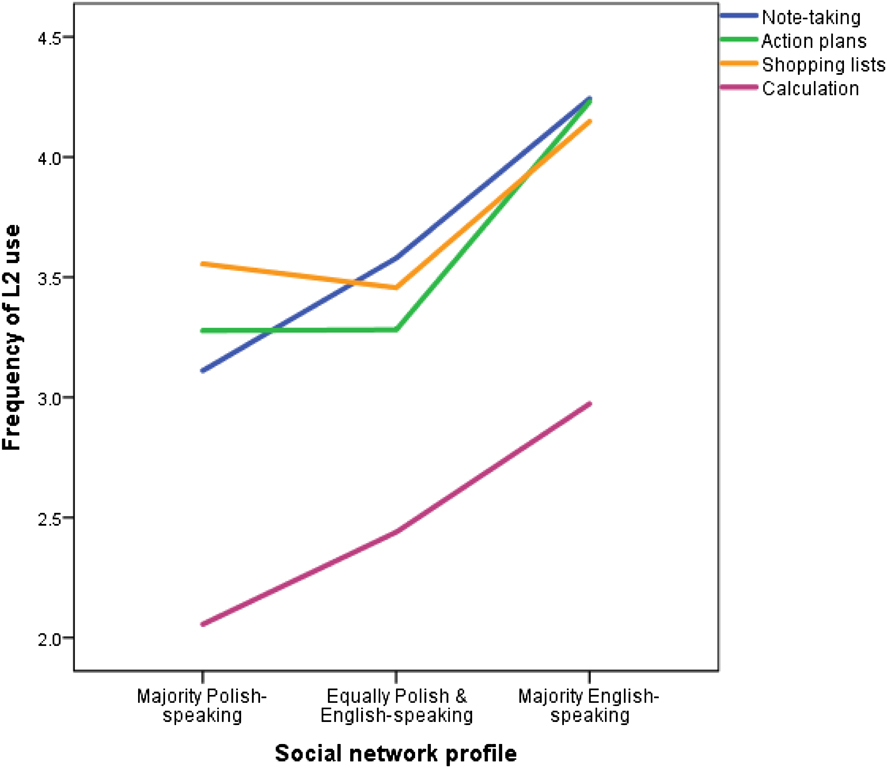
A Kruskal–Wallis test showed that there is a statistically significant effect of social network profile on frequency of L2 use in the domain of note-taking (χ2 = 30.3, p < .0001), with a mean of 3.11 for the majority Polish-speaking social network (n = 18), 3.58 for the equally Polish- and English-speaking social network (n = 57), and 4.24 for the majority English-speaking social network (n = 74).
Pairwise comparisons were performed using Dunn’s (Reference Dunn1964) procedure with a Bonferroni correction for multiple comparisons (SPSS Statistics 23). Adjusted p-values are presented. This post-hoc analysis revealed statistically significant differences in mean scores between the majority Polish-speaking (3.11) and majority English-speaking (4.24) social network groups (p = .000), and between the equally Polish- and English-speaking (3.58) and majority English-speaking (4.24) social network groups (p = .000), but not between the majority Polish-speaking and equally Polish- and English-speaking social network groups.
6.2.2. Domain of shopping lists
A Kruskal–Wallis test showed that there is a statistically significant effect of social network profile on frequency of L2 use in the domain of shopping lists (χ2 = 14.6, p < .001), with a mean of 3.56 for the majority Polish-speaking social network (n = 18), 3.46 for the equally Polish- and English-speaking social network (n = 57), and 4.15 for the majority English-speaking social network (74).
Pairwise comparisons were performed using Dunn’s (Reference Dunn1964) procedure with a Bonferroni correction for multiple comparisons (SPSS Statistics 23). Adjusted p-values are presented. This post-hoc analysis revealed statistically significant differences in mean scores between the equally Polish- and English-speaking (3.46) and majority English-speaking (4.15) social network groups (p = .001), but not between any other group combinations.
6.2.3. Domain of action plans
A Kruskal–Wallis test showed that there is a statistically significant effect of social network profile on frequency of L2 use in the domain of action plans (χ2 = 31.6, p < .0001), with a mean of 3.28 for the majority Polish-speaking social network (n = 18), 3.28 for the equally Polish- and English-speaking social network (n = 57), and 4.23 for the majority English-speaking social network (n = 74).
Pairwise comparisons were performed using Dunn’s (Reference Dunn1964) procedure with a Bonferroni correction for multiple comparisons (SPSS Statistics 23). Adjusted p-values are presented. This post-hoc analysis revealed statistically significant differences in mean scores between the majority Polish-speaking (3.28) and majority English-speaking (4.23) social network groups (p = .000), and between equally Polish- and English-speaking (3.28) and majority English-speaking (4.24) social network groups (p = .000), but not between majority Polish-speaking and equally Polish- and English-speaking social network groups.
6.2.4. Domain of mental calculation
A Kruskal–Wallis test showed that there is a statistically significant effect of social network profile on frequency of L2 use in the domain of thinking of mental calculation (χ2 = 10.0, p < .007), with a mean of 2.06 for the majority Polish-speaking social network (n = 18), 2.44 for the equally Polish- and English-speaking social network (n = 57), and 2.97 for the majority English-speaking social network (n = 74).
Pairwise comparisons were performed using Dunn’s (Reference Dunn1964) procedure with a Bonferroni correction for multiple comparisons (SPSS Statistics 23). Adjusted p-values are presented. This post-hoc analysis revealed statistically significant differences in mean scores between the majority Polish-speaking (2.06) and majority English-speaking (2.97) social network groups (p = .016), but not between any other group combinations.
6.2.5. Synthesis of social network profile and frequency of L2 use in cognitive domains
The results showed that social network profile is tightly linked to higher levels of frequency of L2 use in the domains of note-taking, action plans, shopping lists, and mental calculation. Majority L2-speaking social networks were linked to higher levels of frequency of L2 across all domains. Figure 3 presents a comparative illustration of the effect of social network profile on frequency of L2 use in all cognitive domains.
Social network profile and frequency of L2 use in cognitive domains.

6.3. predicted future domicile and frequency of l2 use in cognitive domains
6.3.1. Domain of note-taking
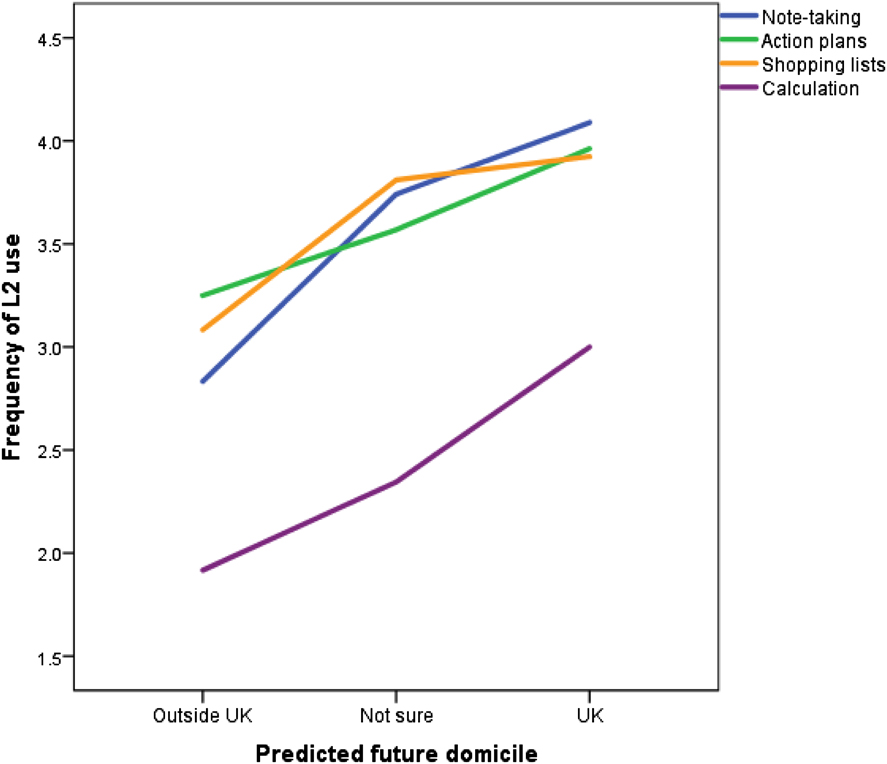
A Kruskal–Wallis test showed that there is a statistically significant effect of predicted future domicile on frequency of L2 use in the domain of note-taking (χ2 = 17.2, p < .0001), with a mean of 2.83 for the intention to leave the UK at some point in the future (n = 12), 3.74 for being unsure about predicted future domicile (n = 58), and 4.09 for the intention to stay in the UK indefinitely (n = 79).
Pairwise comparisons were performed using Dunn’s (Reference Dunn1964) procedure with a Bonferroni correction for multiple comparisons (SPSS Statistics 23). Adjusted p-values are presented. This post-hoc analysis revealed statistically significant differences in mean scores between all group combinations, namely: the group intending to leave (2.83) and the group unsure about future domicile (3.74) (p = .049), and between the group intending to leave (2.83) and the group intending to remain indefinitely (4.09) (p = .000), and between the group unsure about future domicile (3.74) and thegroup intending to remain indefinitely (4.09) (p = .042).
6.3.2. Domain of shopping lists
A series of Kruskal–Wallis tests showed that there is no significant effect of predicted future domicile on frequency of L2 use in the domain of shopping lists (χ2 = 5.6, p < .060), with a mean of 3.08 for the intention to leave the UK at some point in the future (n = 12), 3.81 for being unsure about predicted future domicile (n = 58), and 3.92 for the intention to stay in the UK indefinitely (n = 79).
6.3.3. Domain of action plans
A Kruskal–Wallis test showed that there is a statistically significant effect of predicted future domicile on frequency of L2 use in the domain of action plans (χ2 = 7.8, p < .020), with a mean of 3.25 for the intention to leave the UK at some point in the future (n = 12), 3.57 for being unsure about predicted future domicile (n = 58), and 3.96 for the intention to stay in the UK indefinitely (n = 79).
Pairwise comparisons were performed using Dunn’s (Reference Dunn1964) procedure with a Bonferroni correction for multiple comparisons. This post-hoc analysis revealed no statistically significant differences in mean scores between any group combinations.
6.3.4. Domain of mental calculation
A Kruskal–Wallis test showed that there is a statistically significant effect of predicted future domicile on frequency of L2 use in the domain of mental calculation (χ2 = 14.2, p < .001), with a mean of 1.92 for the intention to leave the UK at some point in the future (n = 12), 2.34 for being unsure about predicted future domicile (n = 58), and 3.00 for the intention to stay in the UK indefinitely (n = 79).
Pairwise comparisons were performed using Dunn’s (Reference Dunn1964) procedure with a Bonferroni correction for multiple comparisons (SPSS Statistics 23). Adjusted p-values are presented. This post-hoc analysis revealed statistically significant differences in mean scores between the group intending to leave (1.92) and the group intending to remain indefinitely (3.00) (p = .011), and between the group unsure about future domicile (2.34) and the group intending to remain indefinitely (3.00) (p = .007), but not between any other group combinations.
6.3.5. Synthesis of predicted future domicile and frequency of L2 use in cognitive domains
The results showed that there is a significant effect of predicted future domicile on frequency of L2 use in the domains of note-taking, action plans, and mental calculation, but not in the domain of shopping lists, as little distinction was recorded between indefinite and unspecified types of residency. Figure 4 presents a comparative illustration of the effect of predicted future domicile on frequency of L2 use in all cognitive domains.
Predicted future domicile and frequency of L2 use in cognitive domains.

6.4. length of residence and frequency of l2 use in cognitive domains
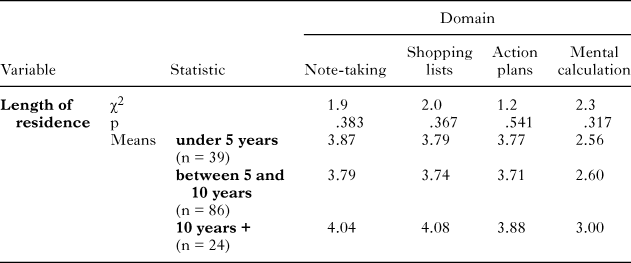
A series of Kruskal–Wallis tests showed no significant effects length of residence on frequency of L2 use in cognitive domains including note-taking, shopping lists, action plans, and mental calculation. The results are presented in Table 1
Length of residence and frequency of L2 use in cognitive domains

6.5. qualitative illustrations
The feedback from the interviews and the open questions confirmed the statistical patterns. A selection of the most interesting and illustrative examples, i.e., qualitative gems, was selected (Smith Reference Smith2011; Straub Reference Straub, Straub, Weidemann, Kolbl and Zielke2006). The sections below present two qualitative illustrations for each cognitive domain and across different acculturation levels. The remaining four excerpts address more than one cognitive domain per excerpt, providing interesting personal insights on language use within cognitive domains in completely acculturated bilinguals.
6.5.1. Domain of note-taking
MI6 (highly acculturated) explained that, for her, taking notes in English is highly efficient as more content can be captured using fewer words, when compared to taking notes in Polish:
When it comes to note-taking, I tend to, even if I hear Polish being spoken, I tend to take notes in English, I think it’s because English for me is more condensed and you can write more content using fewer words, so especially when you are in a hurry it’s easier to write things in English.
MI9 (moderately acculturated) reported that her note-taking is context-specific and that she takes notes in English when it is the language being spoken; however, she also shared that taking notes in English L2 helps her memorise the content better:
Note-taking – it depends on the context, but normally when the conversation is taking place in English I would take notes in English too, note down bullet points, keywords, and I will be able to better memorise it and so on.
6.5.2. Domain of shopping lists
N152 (highly acculturated) noted a context-specific character of both shopping lists and note-taking, and reported that choosing a language to write out a list depends on the purpose and the environment in which the list will be referred to:
Note-taking and shopping lists: it depends on the purpose of the list I’m creating; if I’m creating a list also for my colleagues, if there is a group of people I’m organising … like last year I organised a ski trip for example, so if I know there will be English speakers there, I’m preparing the list in English, but if it’s something I’m noting down for any other reason, or that I can share with my mum or someone, then it’s in Polish, so it depends on the purpose.
MI6 (highly acculturated) shared that it was a shift from L1 to L2 for writing out shopping lists that made her realise she had started using her languages in a different way following relocation:
At first when I started thinking … when I became more aware of the ways in which I was using the two languages I was really surprised me was that I was actually making shopping lists in English. And sometimes I was looking for words that I didn’t even know in English, for those products. And that’s when I realised that I started doing something differently. And the same with action plans, I spent a month in Poland in August and even then all the action plans they were always written down in English, and I think this is something that’s wired now.
6.5.3. Domain of action plans
MI6 (highly acculturated) reported using L2 when making plans, even though the plans were being made for situation which would include L1:
A friend is going to visit me soon, a Polish friend, and I was thinking what we could do together, where to go out and that kind of stuff, and I was thinking about our conversations in English, while there is no logical reason why we would actually be using English to communicate.
MI9 (moderately acculturated) reported that her planning and thinking is done mainly in L1; however, she uses the L2 when writing shopping lists for it helps her to locate products quicker:
Action plans: on a bigger scale that would be in Polish. Last year I planned a trip across some countries and I planned it in Polish. Shopping lists always in English so then I know what I’m looking for, so yeah. My thinking is done mainly in Polish.
6.5.4. Domain of mental calculation
MI1 (highly acculturated) pointed out that he reverts to L1 to calculate numerical content even when the remaining elements of the task are performed solely in L2:
I do a bit of calculation at work, everything will be in English and then I will need to count hours of educational content within a programme and I will count this in Polish and I smile at myself and ask myself why do you do this; and then when someone needs to know this number I say it in English. Numbers inside my head stay in Polish and I don’t know why.
MI8 (completely acculturated) reported using L1 for counting, and switching to L1 even in instances when the counting process would originally begin in L2:
There is one thing and I don’t know what it is … counting … I don’t know why, I did notice that if I start counting in English I will then switch to Polish.
6.5.5. Comparative illustrations (all domains)
MI2 (completely acculturated) reported using L2 for the majority of cognitive domains, apart from numerical computation and mathematics, the concepts of which had been learnt in L1, and the learning of which was not re-experienced thereafter:
I always do shopping lists in English, irrespective where I am actually; and I would take notes as well [in English]. Note-taking depends on what it relates to, if I was taking notes at the lecture that would be conducted in Polish I’m sure I would be noting in Polish … When it comes to certain matters, like maths for example, I do all the maths in Polish … If I think about certain concepts then I would possibly have the Polish word for it rather than the English one because I’ve never experienced the English one, I don’t do anything that would involve maths at the moment, so I wouldn’t have means to learn it and for it to sink in my head.
MI4 (completely acculturated) reported that she uses L2 for making plans and that it has become a part of her, yet that her memory for numbers is language dependent:
If you ask me for my telephone number, I prefer to say it in English, my English telephone number; however, if you ask me for my Polish number I prefer to say it in Polish. I was thinking about it, I think there is a melody to it, the way it sounds, I can say it [the English number] very quickly in English; in Polish … I can do it but I have to think about it, for a split second but I do, and if I call my family and I have to dial the Polish number, in my mind I have to say it in Polish. And even when I was in Poland last time and someone asked me about my [English] phone number and then I said “just wait a moment”, I had to say it in English, write it down and then I could give it to them … I am generally a planner, so I lie down in the evening and I plan, I have to do this and that, and it’s all in English. And I have no idea why, maybe because of my work and my marriage, it’s all in English, so my relatives are English … I think in English, yeah. I think it really became a part of me.
MI8 (completely acculturated) reported that she remembered when the language of her action plans shifted to L2, yet her shopping lists would include items in both languages:
When I came over to England, I don’t know why, I always used to make plans on paper, and I’m pretty sure that in the first couple of years they would be written in Polish but then I would change to English. I think pretty quickly, note-taking and action plans I would do in English. Shopping lists, I think I used to … some of the things would be in English some in Polish, I don’t know why. It depended on words which I liked, I don’t know.
7. Discussion
The results revealed a variation in frequency of L2 use in cognitive domains. Across all participants, the L1-dependent domain of mental calculation recorded the lowest level of L2 use, in comparison with the remaining domains. The more context-specific domains of note-taking, shopping lists, and action plans recorded higher frequencies of L2 use across all participants, and their average frequencies were almost identical. Further variation among participants was revealed when investigating the effects of the independent variables.
The findings showed that acculturation level had a significant effect on the frequency of L2 use in cognitive domains including note-taking, planning (action plans), and mental calculation. An observable, yet statistically non-significant difference was noted for the domain of shopping list. Participants with higher levels of acculturation were found to use the L2 more frequently in all domains belonging to the cognitive function. Differences were also found in frequency of L2 use between domains, across all acculturation levels. Mental calculation was found to have the lowest level of L2 use, when compared to note-taking, shopping lists, or action plans, which recorded a comparable level of L2 use on average. Completely and highly acculturated bilinguals were nevertheless found to use the L2 markedly more in the domain of mental calculation, than moderately or slightly acculturated participants.
This result provides empirical evidence that domain-specific language use reflects the degree of acculturation, which confirms earlier findings by Schrauf (Reference Schrauf2009). Bilinguals who acculturate to a higher level tend to use the L2 more frequently across the cognitive domains of language use than participants with low acculturation levels. The findings link with Acton and Walker de Felix (Reference Acton, Walker de Felix and Valdes1986), in that language is a fundamental component and marker of acculturation. Acculturation scores were found to strongly correlate with L2 dominance scores, which was revealed as part of the validation process. This links with Dewaele (Reference Dewaele, Schmid, Koepke, Keijzer and Weilemar2004b) and Pavlenko (Reference Pavlenko2014), in that overall language dominance may also be linked to an increased likelihood of choosing the L2 for mathematical operations.
Social network profile, an important constituent of the acculturative process, was found to be tightly linked to frequency of L2 use in all cognitive domains. Participants operating in majority L2-speaking social networks were found to use the L2 significantly more across all four cognitive domains. A steady monotonic increase in L2 use between groups was observed for the domain of note-taking. Frequency of L2 use in domains of shopping lists and action plans was more similar in respondents operating in balanced and majority L1-oriented social networks, and significantly higher in respondents functioning in majority L2-operating networks. Participants operating in balanced and majority L1-speaking social networks were found to use the L2 more frequently in the domains of shopping lists and action plans, than in the domain of note-taking. The domain of mental calculation recorded the lowest level of L2 use across all three groups, but a significant, stable monotonic increase in levels of L2 use was noted between the groups, with the majority L2-speaking social network group recording the highest frequency of L2 use in this domain.
These results provide empirical evidence that social networks and linguistic enclaves have an effect on patterns of language use in cognitive domains in sequential bilinguals residing in L2-speaking contexts. This links with previous research by Dewaele (Reference Dewaele2007), as well as Stoessel (Reference Stoessel2002) and Chiswick and Miller (Reference Chiswick and Miller2005). The results also show that the multidimensional character of acculturation, which combines social, cognitive, and linguistic aspects, is an important factor in language performance following migration, for its effects are found in patterns of language use within cognitive domains (Ryder et al., Reference Ryder, Alden and Paulhus2000; Sam & Berry, Reference Sam and Berry2006; Schwartz et al., Reference Schwartz, Unger, Zamboanga and Szapocznik2010).
Also, predicted future domicile was found to have significant links with frequencies of L2 use in the domains of note-taking, action plans, and mental calculation, but not in the domain of shopping lists. Participants who planned to stay in the UK indefinitely were found to use the L2 significantly more than those who were unsure of their domicile, and definite sojourners. The domain of shopping lists recorded an observable and comparable higher level of L2 use in participants who planned to remain in the UK indefinitely, and those who were yet unsure, but a lower level of L2 use in those who planned to leave the UK at some point in time. Again, the domain of mental calculation was the one with the overall lowest frequency of L2 use across all groups, but participants who planned to remain in the UK indefinitely were found to use more L2 in this domain than the other two groups.
These results provide empirical evidence that, as far as language use for cognitive domains is concerned, the intentions of the speakers and their competence in the L2 are equally important. The findings suggest that bilinguals intending to remain in the UK indefinitely display a more integrative motivation in using the L2, which translates into more extensive patterns of L2 use even in cognitive domains. The latter supports earlier assertions made by Schumann (Reference Schumann1976) and Gardner and Lambert (Reference Gardner and Lambert1972).
The findings showed that the domain of mental calculation contained the highest levels of L1 use, which highlights the unique character of this L1-dependent domain. However, the presence of a significant effect of acculturation on the frequency of L2 use for mental calculation connects with studies by Vaid and Menon (Reference Vaid and Menon2000) and Tamamaki (Reference Tamamaki1993), who found that L1 preferences for mental calculation decrease proportionally to length of residence in the target language country. The present study found significant strong positive correlation between acculturation level and length of residence, which supports the above studies. The increased frequency of L2 use for mental calculation, proportional to acculturation levels, also connects with Dewaele (Reference Dewaele, Schmid, Koepke, Keijzer and Weilemar2004b, Reference Dewaele2007), who found that L2 can be used for mental calculation more frequently in L2-dominant bilinguals with high levels of L2 socialisation. On average, however, the frequency of L2 use for the domain of mental calculation proved to be the lowest in comparison to other domains within the cognitive function, which reflected the L1-dependent character of the domain, and so linked this study with previous research on language-dependence in the domain of calculation and number (Campbell et al., Reference Campbell, Kanz and Xue1999; Frenck-Mestre & Vaid, Reference Frenck-Mestre and Vaid1993; Marian & Fausey, Reference Marian and Fausey2006; Marsh & Maki, Reference Marsh and Maki1976; Spelke & Tsivkin, Reference Spelke and Tsivkin2001).
The context-specific domains of note-taking, shopping lists, and action plans saw significantly more L2 use when compared to mental calculation, which may link with the availability of context-specific content and concepts in those domains (Carroll & Luna, Reference Carroll and Luna2011). It may also be linked, particularly in completely and highly acculturated bilinguals, with processes of cognitive restructuring and re-naming the surrounding reality (Pavlenko, Reference Pavlenko2011).
The qualitative data revealed how particularly significant the L2-dominant context proved to be, as far as language use in context-specific cognitive domains is concerned. Many respondents shared that following migration they started to use English L2 when making plans and drawing up lists. They explained that this shift towards L2 felt automatic, which suggests that functioning in the L2-dominant context, and integrating to the L2-dominant society, has psycholinguistic consequences. Choosing the L2 was perceived as an automatic and natural step, as well as a more efficient way to operate, which links with processing economy (Dehaene, Reference Dehaene2011). The degree to which the sequential bilingual acculturated, and the degree to which they felt part of the new culture and host society were, to an extent, reflected in the frequency of L2 use across cognitive domains. Patterns of L2 use in cognitive domains, and their links with acculturation, could suggest an ongoing process of conceptual restructuring in sequential bilinguals (Grosjean, Reference Grosjean2002, Reference Grosjean2010; Pavlenko, Reference Pavlenko2011).
The results provide support for the Cognitive Theory of Acculturation (Schrauf, Reference Schrauf2002) in that the extent of L2 use in cognitive domains was not found to be equal, but related to degrees of acculturation, and domain-specific. Differences in the extent of L2 use between domains suggest a gradual spread of L2 across domains, and show that L1-dependent domains are more resistant to the shift than context-specific domains.
No links were found between length of residence in the UK and frequency of L2 use in the domains of note-taking, action plans, shopping lists, and mental calculation. It should be stressed, however, that a strong positive correlation between length of residence and acculturation level was established. This may indicate that length of residence is not a causal variable in its own right, but that it is the acculturative processes that happen to a higher or lower degree during that length of residency that are linked to possible shifts in language use in cognitive domains. In other words, it may not be the number of years that matters, but the events and the level of socio-cultural and psychological integration, which is then reflected in language use for cognitive function.
8. Conclusion
This study provides empirical evidence that acculturation level, and associated variables of social network profile and predicted future domicile, are strongly linked to frequency of L2 use in cognitive domains. The findings suggest that immersion in L2-dominant context and processes of acculturation have significant effects on language use for information processing. The findings also revealed that context-specific domains associated with the cognitive tasks of planning, organising, and problem-solving (Lewis, Reference Lewis1969) recorded an overall higher frequency of L2 use, as opposed to the L1-dependent domain of mental calculation. The L2 is seen to be used for the majority of cognitive operations in the L2-context, which links with Pavlenko’s (Reference Pavlenko2014) notion of context-specific activation in L2 following migration. Extensive use of L2 for context-specific information processing links with Grosjean’s (Reference Grosjean2002) concept of cognitive restructuring, which may occur following migration (change of context), and acculturation. On the other hand, the L1-dependent domain of mental calculation recorded the lowest levels of L2 following migration when juxtaposed with the remaining cognitive domains. This supports previous findings by Spelke and Tsivkin (Reference Spelke and Tsivkin2001), Dewaele (Reference Dewaele2007, Reference Dewaele2009), Planas and Setati (Reference Planas and Setati2009), and Dehaene (Reference Dehaene2011), in that L1 is typically the preferred language used for numerical processing, due to an L1-dependent processing advantage. Nevertheless, completely and highly acculturated bilinguals were found to use more L2 even in this highly L1-dependent domain, which highlights the possible transformative effects of acculturation on language use in sequential bilinguals.