…[B]ut above all things he [the prince] must keep his hands off the property of others, because men more quickly forget the death of their father than the loss of their patrimony. (Niccoló Machiavelli, The prince, chapter 17)Footnote 1
[Milton Friedman] advised politicians that immediately after a crisis they should push through all the painful policies at once, before people could regain their footing. He called this method ‘economic shock treatment’. I call it ‘the Shock Doctrine.’ (Naomi Klein on The Shock Doctrine)Footnote 2
1. INTRODUCTION
In May 1374, Jan Bonin, the bailiff representing the Count of Flanders in the region of Courtrai, picked up a shabby bed from the estate of newly deceased Katheline sVos, and resold it for 23 sous.Footnote 3 At about the same time, the heirs of Katheline Roden handed over a calf, worth 3 livres, to the bailiff in Oudenaarde.Footnote 4 Willem van Maldeghem, the bailiff in Tielt, only obtained 40 sous for the calf yielded up to him by the estate of Beele Bels, half of the 3 livres 10 sous that the bailiff of Oudburg netted for the sale of a cow taken upon the decease of Lijsbette Saghers.Footnote 5
Comprising the western portion of the northern, Dutch-speaking half of modern-day Belgium, together with the northern corner of modern-day France, the medieval county of Flanders had been the economic and commercial centre of northern Europe since the twelfth century. Flanders bustled with major cities such as Ghent – the second largest city at the time in northern Europe after Paris – as well as dozens of smaller towns such as Courtrai and Tielt (Courtrai in French and English, Kortrijk in Dutch). It had been home to local and foreign merchants, to entrepreneurs, to bankers, artisans and textile workers for almost two centuries. The maturity of the financial administration in Flanders in the Middle Ages is well attested. Flemish counts had, for example, established a stable currency consisting of 12 d(eniers) to 1 s(ous) and 20 s(ous) to 1 l(ivre) as early as the twelfth century.Footnote 6 Why, then, the many references to payment being made to the Count's bailiffs in the form of furniture and livestock rather than in cash?
The taking of a single, specific item indicates that these payments fell into the category of ‘mortmain’ – traditionally a payment to which the lord of a servile person was entitled when that individual died. Very broadly, serfs were agricultural labourers bound to work on the estate of their lord (seigneur), unfree in the sense that they were unable to leave that land. Under the impetus of the Commercial Revolution, serfdom had, however, virtually died out in Flanders by the early fourteenth century.Footnote 7 Nonetheless, comital (the adjective form of Latin comes or ‘count’) bailiffs in the 1370s were routinely describing such payments in their accounts as ‘mortmain’.Footnote 8 Within this new frame of reference, mortmain linked the servile status on the local level with subject status at a regional one.
The bailiff's plucking of a single, specific item from amongst the goods of a deceased person, and then frequently selling it to the highest bidder, defined the deceased as subject to their lord in a way nothing else could. At the very least, as Denise Angers remarks, payments such as mortmain struck the obligated at ‘the very heart of their personal lives as a reminder and sign of their dependence on their lords’.Footnote 9 That fact that their heirs, who pass uniformly unidentified in the sources, paid mortmain implies that they also stood in a servile relationship to the lord.
Studies of servile status and mortmain in Flanders bookend the twentieth century. At the beginning of the century, Léo Verriest questioned the association of specific payments with the legal category of ‘serf’. He claimed that such payments indicated tenancy and not legal status, since such legally articulated categories and the apparatus to enforce them did not yet exist in the twelfth century.Footnote 10 On the basis of this reasoning, Verriest argues that serfdom was nonetheless fairly widespread in Flanders. However, at the end of the twentieth century, Erik Thoen, in his authoritative work on the Flemish rural economy in the late Middle Ages, contends first that serfdom was not nearly as widespread in Flanders as Verriest claims,Footnote 11 and second, that counts, having established the apparatus to execute it, sought to absorb and generalise the kind of seigneurial authority exemplified by the collection of mortmain.Footnote 12 Both of these analyses focus either on the twelfth, thirteenth or fifteenth centuries, curiously skipping lightly over the fourteenth. Thoen, for example, argues that bailiffs started collecting mortmain with renewed zeal as an expression of the increased administrative efficiency associated with the ascension of the Duke of Burgundy as Count of Flanders in 1384.Footnote 13
Here it will be argued that intensifying collection began instead 15 years earlier, not during a period of order, but instead during a period of disorder. Plague ravaged Flanders between 1368 and 1372, and in 1379 (not for the first time) a number of towns, led by Ghent, rose up against Count Louis II. The years of civil conflict between 1379 and 1385 (when the Duke of Burgundy (now also Count of Flanders) finally made peace with Ghent)Footnote 14 coincide with the zenith of mortmain payments in the accounts of bailiffs. The high mortality resulting first from plague and then from civil strife did more than give comital bailiffs the means to boost their revenue. These crises also fostered the strategic application of the ‘Shock Doctrine’ that increased collection of mortmain represented,Footnote 15 particularly in those regions close to Ghent, such as the territory dominated by the established market and textile town of Courtrai, located 42 km southwest of Ghent and 25 km northeast of Lille, and the region centred on the emerging local market town of Tielt, 19 km north of Courtrai and only 27 km west of Ghent. It also gave him the opportunity to demand these payments not as local lord but rather based on his authority as regional overlord trying to stabilise his county.
Michael Bush argues that in its most mature expression the seigneurial system, of which mortmain was an integral part, functioned as a type of government wherein ‘the relationship between subject and state might seem in practice to be no more than the relationship between serf and lord’.Footnote 16 As distinctions between unfree and free faded over the course of the thirteenth and fourteenth centuries, the obligation to pay mortmain appears to have nonetheless become generalised, metamorphosing into a somewhat arbitrary distinction between those who were, or were not, subject to mortmain payments, for whatever reason. The dislocation and disorientation of the population during the crisis-ridden years of the 1370s and early 1380s enabled Count Louis to expand the seigneurial rights implicit in mortmain payments to increasingly amorphously defined sectors of the population, turning what was essentially a seigneurial charge (mortmain) into a tax.
In the rest of Europe the appropriation of personal goods in this manner, sometimes – as in Catalonia – dubbed ‘bad practices’ (mals usos), contributed to the peasant revolts of the later Middle Ages.Footnote 17 Historians studying Flanders, however, have instead pointed out the absence of rural rebellions there.Footnote 18 No cause-and-effect relationship appears to have existed between the reassertion of seigneurial obligations such as mortmain and the Flemish revolts of the late fourteenth century. For one thing, the accelerated collection of ‘mortmain’ post-dated two previous revolts (1328 and 1340). For another, those in revolt were not peasants, but rather citizens of powerful towns, who, as part of their urban privileges, had never been (and in point of fact were not currently being) subject to mortmain. Their revolt represented not rural rebellion as elsewhere, but rather a struggle for mastery between two fully mature civil entities.
For what differentiated the county of Flanders from the other highly urbanised region in Europe at the time – northern Italy – was that Flemish counts and countesses had, over the centuries, established administrative mechanisms that helped to give the county a coherence lacking in northern Italy.Footnote 19 Central to their success were the bailiffs, who, established and accountable by the mid-thirteenth century, implemented the count's justice and expanded his authority throughout the county. Although originating initially from amongst the petty nobility, bailiffs, with the advent of urban growth, often came to be chosen from the bourgeoisie of the large towns.Footnote 20 Paul Freedman has argued that for Catalonia the development of legal categories for dependent persons, concomitant with the ascent of aristocratic power, ‘legitimated and regulated social control’ that an application of mortmain exemplified.Footnote 21 While legal texts defining status do not exist for Flanders, it is clear that in the persons of his bailiffs and in the collection of subject-specific payments such as mortmain, the Count was attempting to do just that. Although cities such as Ghent controlled their own courts, finances, and even militias, the count's bailiffs held courts and executed justice on his behalf, collected his revenue and paid his debts, extended his interests and defended his rights within their jurisdictions, whether these were rural or urban.Footnote 22
The Flemish counts had early established a sophisticated and complex fiscal bureaucracy.Footnote 23 From as far back as the first extant bailiff's account of 1255, bailiffs had collected their revenues in cash.Footnote 24 When mortmain first appears in comital financial records – specifically in the 1295 local reckoning of the community of Aalst – no item is mentioned, only the sum received for it.Footnote 25 This also became the practice when the count moved the responsibility for collecting mortmain from local officials to bailiffs who operated at the regional level; the 1308 account of the bailiff of Oudenaarde, for example, notes only the name of the deceased and the sum received for the item levied.Footnote 26
In the early 1370s, when all other exactions were rendered in coin, mortmain, and mortmain only, was collected in kind, the actual item being detailed in the bailiff's account. This breaking of over 75 years of clerical routine was a glaring anomaly. Behind this detail was the laborious process of collecting the physical object in question, finding a buyer (likely to be the heir),Footnote 27 haggling over how much it was worth, finally ending with the recording of the money received in his account: ‘From the death of Jhan Mersiane, from a kettle, 40 s(ous).’Footnote 28 In a time of instability and fear, people cling to their possessions; they also cling to tradition. While they might have reluctantly paid the monetary fee because it was customary, it seems highly unlikely that they would have voluntarily surrendered the items a bailiff was demanding unless, reeling from the shock of recent events, they were likely to offer little resistance.
A comparison of mortmain payments in Courtrai, a medium-sized commercial town, with those in Tielt, a smaller, more agricultural community, during these years suggests that the count was taking advantage of the on-going instability to subtly assert his authority, through demands for mortmain, particularly in the regions surrounding the rebellious towns. Unlike the semi-autonomous cities,Footnote 29 towns such as Courtrai and Tielt had neither the capacity (Courtrai) nor the tradition of self-government (Tielt) to prevent the bailiff from collecting mortmain. This study thus begins with a discussion of how the concept of mortmain lost its initial definition as it became generalised to less specific populations. The text of mortmain entries in the accounts of the bailiffs nonetheless shows remarkable stability, and so the argument turns next to examining its content. The discussion ends with an analysis of the financial and political significance of mortmain.
More than any other duty, mortmain emphasised the enduring bond of subject to overlord (whether the latter were a local lord or, at a later date, a regional prince). It was, after all, embodied in a payment, triggered by the death of one of the lord's subjects, and owed to the lord by the successor or heir of the deceased. It is for this reason that mortmain remained the only form of comital income for which the value, when expressed in a bailiff's account, appeared in two distinct manners: its economic value in currency and its social value in the taking of a single, specific item. The invasive collection of personal items would not, it may be argued, have been possible without the shock of disease and civil conflict.
2. THE TERMS ‘COUNTY’ AND ‘MORTMAIN’
Before proceeding, it is necessary to clarify the terms ‘county’ and ‘mortmain’. The county of Flanders rose from the ashes of the empire of Charlemagne in the tenth century as authority devolved from the emperor to his regional agents, the counts, dukes and margraves. It was under these conditions that the territory over which a count ruled turned into his ‘county’. The ‘county’ of Flanders should therefore not be confused with the fully developed administrative district represented by its English cognate. Like much of continental Western Europe, Flanders remained linked through vassalage to the realms that emerged from the matrix of the same empire. Nonetheless, although different parts of the country were held in feudal tenure from either the king of France or the Holy Roman emperor, Flanders was more the territory of the count – his ‘county’ – than theirs. Counts spent most of the Middle Ages negotiating their relationships with their overlords, with their own petty nobility, and, after the twelfth century, with the emergent towns, over all of whom they were eager to establish a measure of administrative and fiscal authority.
Just as the term ‘county’ is not to be confused with its English cognate, wording in the records of the Flemish bailiffs makes it clear that ‘mortmain’ should not be confused with the feudal legal term ‘mortmain’ commonly found throughout the regions under Anglo-Norman, English, or French juridical authority. In these settings, the term ‘mortmain’ usually designated inalienable tenure, such as that held by churches, guilds, or other such long-lived corporations.Footnote 30 Flemish legal texts would not codify death charges until the advent of the Franco-Burgundian dukes in the late fourteenth century.Footnote 31 It was only then that Flanders became part of the wider jurisprudential sphere and ‘mortmain’ would come to signify there what it did elsewhere in north-western Europe.Footnote 32
Despite such possible confusion, the term ‘mortmain’ has been used in the current study because it is widely attested for Flanders in both French and Flemish records, with very little orthographic difference, being mortmain in the former and mortmeyne in the latter. Initially, to be sure, terminology remained somewhat variable; in addition to ‘mortmain’, accounts also used meilleur kief (Picard French) or beste hoofd, beste hoofdstoel and beste kateel (Flemish).Footnote 33 Nonetheless, by the 1370s ‘mortmain’ was becoming regionally standard. The rubric heading the list of mortmain payments in the September 1376 account of the bailiff of Courtrai, for example, reads ‘The foresaid bailiff received from beste hoofd called mortmain…’ while the 1373 Oudenaarde account speaks of the payment of hoefstoel, listed under the rubric ‘Item, received of mortmain’.Footnote 34
3. THE BLURRING OF A CONCEPT
Michel Parisse notes that a remarkable symmetry existed in the practice of serfdom across Europe. Regardless of what it might be called (heriot, mainmort or Todfall), mortmain was one of the elements understood to make up the bundle of obligations a dependent person owed his lord.Footnote 35 William Chester Jordan, writing for the canonical Dictionary of the Middle Ages, agrees, arguing further that the obligation to pay mainmort stood as a defining element of servile status.Footnote 36
The persons paying mortmain in late fourteenth-century Flanders, however, were not serfs. From the early Middle Ages serfs, along with other peasants, had provided necessary farm labour, and mortmain payments were therefore common in those regions where an agricultural economy dominated. By the thirteenth century, with the advent of the Commercial Revolution, the package of servile obligations had begun to disintegrate. The breaking up of servile obligations into discrete, separate payments enabled counts of Flanders to release, or ‘liberate’, serfs from some of these, but not all; some sort of death charge was one form of payment most commonly retained.Footnote 37 Many peasants exchanged the burdens of servile status for the lighter obligation of paying a ‘head’ tax specifically on the occasion of marriage or of a death; the latter might easily slip into the category of mortmain.Footnote 38 The quality of libertas, as Ernest Warlop points out, began to dilute as peasants, and, in particular, the residents of towns became subject to fewer and fewer seigneurial obligations and as the nobility became more and more subject to comital authority.Footnote 39 ‘Freedom’ became so relative that it essentially disappeared as a distinction between noble and commoner.Footnote 40
Further contributing to the erosion of conceptual boundaries between social classes was the transition from payments in kind to payments in cash, which, perhaps unexpectedly, loosened obligatory bonds. Focus shifted from the item levied, and all that it meant in the life of an obligated peasant, to a sum of money that was of little immediate necessity to peasant life. It was in the interest of both tenant and lord, as it was in the interest of both vassal and lord, that the relationship continue; the payment of what was for both essentially a succession fee blurred the lines between vassal and tenant, particularly if they paid it in the same sort of medium. While there is a great deal of difference between a cow or a bed on the one hand and cash on the other, there was little intrinsic difference in the cash paid to the lord by his vassal and that paid by his serf.
Nowhere was this process more dynamic than in economically precocious Flanders. The older understanding of subject status as inherent in the tie that bound one and one's heirs forever to the land – as represented by the yielding up of a cow or a bed – gave way to the idea that such status now resided in persons themselves – as represented by making a cash payment. This shift accommodated the disappearance of land tenure as the basis for the relationship between a lord and his subjects, and concomitantly facilitated the generalisation of the status of ‘subject’ to those living in a region under the authority of a particular prince. Robert Jacob points out that in certain parts of French Flanders two types of lordship existed, one associated with mainmort and the other with relief (the payment that vassals made to their lord upon inheriting their fief). Over time, the one tended to assimilate the other,Footnote 41 and mortmain no longer functioned as a sign of servile status.Footnote 42 This might well explain the number of people who were clearly free – including those bearing titles – who nonetheless paid mortmain. In August 1295, for example, the heirs of Dame Ane dele Poele were obligated to pay 2 sous as mortmain,Footnote 43 while in 1374, the heirs of Joncvrouwe van den Berghe handed over a mare worth 19 livres 12 sous.Footnote 44
For whatever reason, there emerged over the course of the thirteenth century a growing population who were not serfs, but whose status was marked, in part, by the obligation of paying the best item upon their decease. This would explain a rubric such as that found in both the mid-May 1306 and the Epiphany 1307 accounts of Oudenaarde that reads ‘again the said bailiff received from serfs and from those who are subject to mortmain…’.Footnote 45 By the second half of the fourteenth century, headings introducing the lists of people making these payments had lost all reference to serfdom.Footnote 46 The emphasis, originally on a specific population, one of whose obligations was to pay mortmain, had clearly shifted to those within the general population who were obliged to make this payment.
There was no question that counts had the right to other seigneurial perquisites – such as the goods of deceased bastards and foreigners – even in big cities.Footnote 47 It was, however, one thing to have the customary right to such payments; it was another to collect them. To some extent, then, the capacity of counts to actually extract mortmain payments serves as an index of the immediacy of their power within a particular community. Claims to non-servile mortmain enabled counts to extend their authority over populations either on the verge of becoming urban, such as those in Tielt, or already there, as in Courtrai. The regularity with which bailiffs were able to draw payments from a community such as Tielt can be seen as symptomatic of the degree to which compliance with comital authority as seigneur had become habitual.
Significantly, the accounts couple locally varying terms with the term mortmain – usually in one of these two patterns:Footnote 48
(a) Received (…) from the beste {have, / hoofd}, [also] called mortmain… or
(b) Received from mortmain: From {particular person, particular item}, as beste {hoofd/hoofdstoell} Footnote 49
It is as if the bailiffs were striving at one and the same time both to forge or reinforce terminological links with archaic local customs (supposed or real) and to consolidate these all under a single rubric of mortmain that articulates the counts' claims to a supra-regional, territorial, sovereign authority that ultimately transcended local custom. In particular, the ‘…gheheeten…’ (‘…called…’) formula seems to reflect a programme of ‘rearticulating’ the various purportedly conventional usages within a more coherent, overarching, unitary framework.
4. COMPONENTS OF MORTMAIN PAYMENTS
While the terminology for these payments may have varied, their components did not. Not only do most entries follow a specific formula, but the particulars also tend to repeat over and over. This is true across regions and time. A typical entry in the 1370s bailiff's account reads ‘In [a particular location]. Item, from [X] in [Y location] deceased, from [item], worth…’ and then an amount, usually noted in sous. The 1374 mid-May account of Tielt notes, for example, ‘Item from Beele de Bels from one calf received 40 s(ous).’Footnote 50 In March 1384 the bailiff of Courtrai noted ‘Item, from the death of Lisbette Jans wive van Monden, 1 small ox, redeemed (verdinct) 40 s(ous).’Footnote 51
What we have here is the detail of the transaction whereby the bailiff took the ox, the item representing the dependent status of the deceased, and sold it – in the latter case, given the use of verdinct in the document, probably to the heirs of the individual. That the entry lays out the conditions of sale (‘redeemed’) emphasises that it was the prerogative of the Count (through his bailiff) to do with the item what he would. This was therefore not a succession tax. It was mortmain. What was initially important to the bailiff was, to be sure, the income raised. That is why early accounts relied primarily on the rubric and less on the substance of the entry;Footnote 52 prior to the 1370s, mortmain entries had listed only the essential information of who had died and how much money the bailiff had been able to collect in mortmain.Footnote 53 During the crises of the 1370s and 1380s, in contrast, the bailiffs – against all impulses towards economy or efficiency – began listing exactly what type of item had been seized. The deceased is the only participant mentioned by name in the accounts of this period because it was his or her death that precipitated the intervention of the bailiff. While the deceased owed mortmain, neither the Count nor his bailiff owed anyone anything, not even accountability, and so went unrecorded. This imbalance between subject and overlord was made even more manifest by the maintenance of anonymity of both the heirs of the deceased and of the buyer of the item levied. An overlord was not accountable to his subject. The item seized as mortmain, being the concrete embodiment and sign of this power imbalance, mattered more than did the surviving family members.
The sums recorded in the accounts represented real cash. Many of the entries baldly state that the bailiff was able to sell the impounded item for a particular amount: ‘In the parish of Courtrai: Item, from the death of Joncvrowe Sara vander Beke, one piece of cloth, redeemed for 3 l(ivres).’Footnote 54 As Wim Blockmans points out, periods of war, famine and plague were characterised by an abundance of capital caused by the fall in population.Footnote 55 All of the other revenues detailed in the same account, in accounts of other bailiffs, or in the accounts of other cities, such as Ghent, appear to have been rendered in coin.Footnote 56 In early 1372, for example, while the bailiff of Courtrai took a bed from the estate of Cateline Stacx, he collected 28 livres from Willem Heile (for attacking Jan Moreel's wife with a stick).Footnote 57 Moreover, the accounts of the bailiff of Courtrai between November 1383 and September 1384, a period when mortmain payments made up the overwhelming majority of the bailiff's revenues, often explain within the entries themselves that the item was either ‘resold’ (vercocht) – the implication being that it was resold at auction – or ‘redeemed’ (verdinct) for a particular amount.Footnote 58 Since ‘redeem’ suggests that the heirs regained the item through monetary payment, a shortage of coin cannot explain why the bailiffs were now suddenly collecting mortmain in kind.
5. FINANCIAL AND POLITICAL SIGNIFICANCE OF MORTMAIN
The standardisation of accounts and of the language within them enabled counts to normalise their intrusion into affairs that had heretofore been primarily local and seigneurial in nature. While the expressions van den besten hoofde/hoofdstoele/have were idiosyncratically employed throughout the county, use of ‘mortmain’ was becoming more or less customary by the early 1380s. Instead of listing mortmain payments under rubrics that referred to particular communities, a relic of the seigneurial past, the accounts of bailiffs now placed them in a category of their own, making a visual statement of the Count's general right to levy such payments.Footnote 59 This, together with the frequent reminders in the rubrics that such exactions went to the count alone, drew a line between those payments due to the Count in certain places where he was seigneurial lord, in both the feudal and the manorial sense, and those due to him throughout Flanders as Count.Footnote 60
Towns in Flanders had no feudal or manorial lords, and Flemish counts had been struggling for more than three centuries to establish some sort of authority over them. Two sorts of people, foreigners and bastards, who were subject to seigneurial authority could be found intermingled with the more privileged citizens of Flemish towns. Counts were customarily entitled to all goods of bastards and foreigners who died in Flanders without issue, and they often found it in their financial interest to locate such persons. Foreigners were unlikely to pass themselves off as anything else in a public and oral society such as that of Courtrai, but illegitimacy, while not unremarked, was not sufficiently notable to prevent bastards from participating in all aspects of community life, as Myriam Carlier has nicely demonstrated.Footnote 61 Towns were not generally amenable to any bailiff's investigations, for these tended to diminish their own autonomy,Footnote 62 and the extent to which bastards were able to fold themselves into urban society with little notice made the bailiff's task of finding them out that much harder.Footnote 63
If it was difficult to uncover bastards, it would have been much more difficult to identify that relatively amorphous set of people who were under obligation to pay mortmain.Footnote 64 Nevertheless, by 1372, after the last outbreak of the plague had ended, the Count began to try. It would be a mark of his strength and supra-regional authority to be able to bring places such as Waes, Zomerghem, Tielt and Courtrai under his jurisdiction.Footnote 65 If he could make residents of such communities pay mortmain, this would clearly establish him as their overlord. Besides, death charges were patently profitable, and Louis II, at war with a number of his towns, needed all the revenue they could supply.
Comparing the payment of mortmain in Courtrai with that in Tielt provides an instructive case study. In Tielt, there appear to have been no customary limitations on who was subject to mortmain. Accounts from 1384 in particular show that authorities were able to demand and to obtain payment from a fairly broad proportion of the population even when, after years of disease and conflict, everything else was in shambles.Footnote 66 In Courtrai, the burden of mortmain fell only on the limited portion of the population who for whatever reason were not exempt from mortmain. Ideally, the count wanted the situation in Courtrai to be similar to that in Tielt – that is, he wanted to eliminate any exemptions from liability for the payment of mortmain. The data from these two communities suggest that the crisis of the 1380s enabled him to do just that.
The separate account of Tielt had been tacked onto the end of the roll of parchment containing the account of the bailiff of Courtrai since at least 1336.Footnote 67 A total of 29 accounts covering the period September 1372 to January 1385 are still extant. From the early 1300s bailiffs had routinely reckoned their accounts three times a year, in January, May and September, and they continued to do so throughout the century. To be sure, there are no accounts extant from 1336–1349, a time of rebellion, but Count Louis II did maintain sufficient control to hold audits during the rebellion of 1379–1385 and most of the accounts used here come from that time.
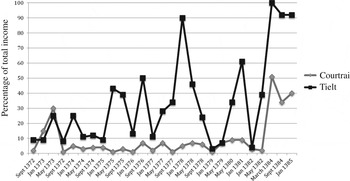
The consistency with which mortmain payments remained under 10 per cent between September 1372 and May 1382 in Courtrai suggests that it did not much matter who held the office of bailiff there. Courtrai had 10 different bailiffs between 1372 and 1382.Footnote 68 Throughout that decade, mortmain remained between one and seven per cent of total income, with no one bailiff posting any particular pattern of success or failure. The ratio of mortmain income to total income was, of course, relative to how much the bailiff could collect from other sources such as the tiendepeninghe, a ‘tenth penny’ payment owed to the Count from any sale of land ostensibly held in feudal tenure,Footnote 69 judicial penalties, which the count usually had to share with other, more local officials,Footnote 70 and customary taxes and income levied on the death of bastards or foreigners.Footnote 71 While the collection of some of these incomes had become systematic in places such as Ghent, incomes based on the death and crime rate tended to be unpredictable. A graph of the ratio of income from mortmain to the total income paid to the bailiffs in Tielt and Courtrai between 1372 and 1385 can be seen in Figure 1.
Income from mortmain as a percentage of total income received by the bailiffs of Courtrai and Tielt; selected dates, 1372–1385. There was no information on mortmain payments for Tielt in May 1383. (Source: Brussels, Algemeen Rijksarchief, Rekenkamer, Rolrekeningen, Courtrai/Tielt, no. 1057–1061, no. 1063–1068, no. 1071–1079, no. 1084–1086, no. 1088, no. 1090–1091, no. 1094.)

While the proportion of mortmain payments generally remained steady in Courtrai, it fluctuated fairly wildly in Tielt. What might have been the reason for this? The explanation may lie in the combination of the proportion of each community's population who were citizens or non-citizens and the relationship that each population had with its bailiff. Generally speaking, bailiffs collected income under the same categories in the two jurisdictions. If the reasons for collection did not differ much, any variation in income must be due to the willingness of the population to pay up, or in the success of the bailiff in making them do so. The likelihood is that those in Courtrai who were subject to comital authority, and therefore obliged to make payments to him, were able to maintain what might be called only minimum compliance, particularly when compared with their counterparts in Tielt.
Up to October 1380, the income from mortmain in Courtrai remained fairly stable, rarely rising above 50 livres, or 1,000 sous, or falling below 5 livres or 100 sous.Footnote 72 This was matched by stability in the number of mortmain entries per accounting period. While four was both the mean and the modal number of mortmain payment entries made in the Courtrai accounts between 1372 and 1380, the ‘typical’ number listed under the same rubrics in Tielt is harder to pin down. Despite the fact that Courtrai was bigger than Tielt, the number of entries referring to mortmain in the former ranged from 3 to 9 per payment period, but in the latter between 3 to 13, probably reflecting the larger and more undefined and thus unstable pool from whom the bailiff would be able to take his exactions.
Long-term stability enabled accounts of all kinds to be to be drawn up more or less in advance and completed at the time of formal reckoning, and the accounts of bailiffs were no exception.Footnote 73 Formulas, after all, represent conventional usage, and by the 1370s those for overarching categories such as income or expenses, as well as for more specific ones such as customs, tiendepeninghe, or wages, were being written in one hand, while details such as the date of reckoning were written in another. A number of accounts have sizable empty spaces left on expensive parchment, indicating that pre-planned expectations did not always match the actual event.Footnote 74 Actual sums were clearly added afterwards: both the hand in which they were written and the ink used were different.Footnote 75 Finally, the wording of the rubrics was formulaic in nature, and, under these circumstances, phrasing did not depend on who was scribe or bailiff.
The number of mortmain payments exacted per account began to rise in 1380, particularly in Courtrai, before taking off substantially in May of 1383, and rising even more dramatically by March of the next year.Footnote 76 The rapid increase in payments exacted, however, was not part of a general increase in revenue. After all, the higher the death rate of a community, generally speaking, the lower the productivity of that community. The lower the death rate, the greater the proportion of his total income a bailiff would earn from other, more lively sources.
The rapid increase in payments was also probably not a reflection of the death rate. There is no question, to be sure, that 1379 to 1385 represented a period of high mortality. Membrane after parchment membrane of names testifies to the high cost in lives resulting from the conflict between the Count and Ghent. Tielt was a rural community, Courtrai a relatively large town, and death rates were almost always higher in the latter.Footnote 77 The proportion of the population subject to mortmain was, on the other hand, higher in Tielt than in a large town like Courtrai. The collection of mortmain in Courtrai represented, after all, the death rate among the non-citizenry. The actual number of those who died might fluctuate wildly, but unless those subject to mortmain died with more or less frequency than those free from it, the proportion of those subject to mortmain would remain stable. Collection of mortmain, therefore, was chiefly influenced by two other factors, less subject to biology: the proportion of people in a community who were obliged to pay it, and the capacity of the local bailiff, or his subordinates, to actually collect it.
It is likely that the steady increase in the number of people paying mortmain after 1380, but particularly in 1383, directly reflects changes involving the latter factor. If the regularity of previous accounts is any indication, something must have happened to break down customary practices that stood between the Count and his attempts to impose his authority on his county. The trauma of disease, but particularly of violent conflict, may well have shocked the citizenry into making payments they hitherto had not had to make.
Evidence that the count attempted to exploit these conditions on an on-going basis can be found in the evolution of the rubric separating mortmain payments from other forms of payment. On the one hand, the formulaic nature of the rubric and particularly its routine use, even in cases where payments were actually made, reflect an emerging assumption that mortmain was not a form of irregular income but of expected revenue. Formulas of the period up to 1380 thus represent ‘before-the-fact activity’. On the other hand, the uncharacteristically ad hoc phrasing after 1379 suggests ‘after-the-fact’ or even reactive justifications.
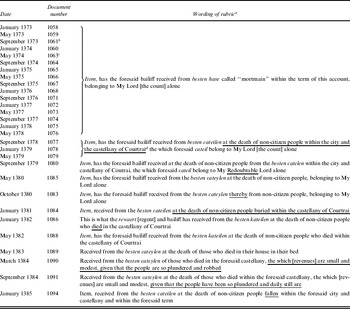
In fact the rubrics included in the eight accounts from 1380 to 1385 are marked by a variety in language not found in previous accounts (see Table 1).
Chronological evolution of the rubric detailing mortmain payments in the accounts of the bailiffs of Courtrai, January 1373 to January 1385

a Author's translation from the Flemish.
b Although the numbering of these documents usually reflects chronological order, errors in dating when they were first inventoried have resulted in disruptions in the document sequence.
c Some of the accounts in this series exist only in fragments, many of which do not include the section on mortmain. These have been omitted, for example, no. 1062.
d Changes from previous rubrics have been underlined.
Source: Brussels, Algemeen Rijksarchief, Rekenkamer, Rolrekeningen, Courtrai.
In the rubric of October 1380, only non-citizens were subject to mortmain – there was no mention of, say, geographic limitations, for example, city versus castellany (the rural areas outside towns) nor, surprisingly, of the need for a death to have occurred. The next rubric, that of January 1381, remedies these omissions, raising, however, the question of whether the Count had previously tried to exact payment from subjects who had not yet died, or whether he, or his bailiff, had exacted items from people outside the castellany. The word gheseten, meaning ‘placed’ or ‘buried’, was inserted in the rubric of 1381.Footnote 78 Given the widespread mortality there could well have been people – even citizens of other towns such as nearby Ghent or Ypres – who were buried in the castellany of Courtrai, a circumstance that the bailiff might have used as justification for seizing their goods. The third permutation of the rubric, that of January 1382, involved replacing gheseten with ghestorven, ‘actually dying’, within the castellany.Footnote 79
The May 1383 account represents perhaps the crucial leap in the generalisation of mortmain. Mention of death is still present, but any mention of ‘non-citizen’ has disappeared and would not reappear until the restoration of order in January 1385.Footnote 80 In the 1383 rubric the only restriction on those under obligation to pay mortmain was that they died in their houses and in their beds. This definition justified an almost 6-fold increase in the number of entries (from the usual 4 to 23) and an increase in revenue of more than 150 per cent. The rubric of 1383 also sees the introduction of the generalised, open-ended phrase ‘from those who…’ (van den ghenen die…), a significant deviation from the highly specific ongheportered (‘without citizenship’) of previous accounts. This usage obtains over the next two accounts of March and September 1384 as well.
That these rubrics underline the need of the Count to justify the unusually broad net he had begun to cast can be demonstrated by comparing the mortmain rubric for Courtrai with that of Tielt in September 1384, a year in which the number of mortmain payments being exacted was exceptionally high in both regions. While the bailiffs were different, the same scribe wrote up both accounts and the first part of the mortmain rubric is almost identical in each case: ‘Received from best chattels of the dead of those who died within the foresaid [circumscription].’Footnote 81 While the Tielt rubric ends there, the one for Courtrai goes further, speaking of the ‘daily’ (daghelix) upheavals. This latter, since it has no direct bearing on who was subject to mortmain, functions at best as a diversionary tactic and at worst as a justification.
Note again in Table 1 that both rubric headings employ van den ghenen die… (‘from those who…’) to describe those subject to mortmain. While the phrase ‘from those who…’ represents a constriction of practice in Tielt – reducing the population liable to pay mortmain from an unmentioned, general population to ‘those who died in the bailiwick’, in Courtrai it represents a considerable loosening of the restrictions on who was liable. The new phrasing meant that practice in Courtrai was being brought into line with that of Tielt: just about everyone dying in Tielt had been subject to mortmain, now almost everyone dying in Courtrai was subject too. Such broadening of those subject to mortmain from non-citizens to anyone who died in either the castellany or the city can be seen in the dramatic rise in the numbers of those who actually paid it; 3 people paid mortmain in January 1382, 4 in May 1382, 23 in May 1383, 299 in March 1384 and 119 in September of that same year.Footnote 82
One could argue that the March and September 1384 accounts were not only the most financially but also the most politically productive in the series. The disappearance of the reiterations of who was subject to mortmain in Courtrai signifies a successful attempt on the part of the Count, through his bailiff, to exploit crises and catastrophe as a means of broadening mortmain obligations from those who were not citizens of Courtrai to, in principle, all ‘those who died’ within his jurisdiction. That the bailiff was able to collect this type of payment from a large number of people, not once, but twice in 1384, reflects his capacity to impose upon a population that was weakened and disoriented – or as both 1384 rubrics put it, ‘robbed and plundered’ – an obligation that they had heretofore successfully resisted: that of handing over personal items as a tangible sign of their personal subjection to comital authority.
6. CONCLUSION
Even in the midst of economic and social tumult, one thing that could be depended upon was that people would die on a regular basis. Evidently Count Louis and his administration were intent upon turning this fact to good account. The emergence of separate rubrics for mortmain payments in some of the accounts of his bailiffs over the course of the 1370s and 1380s – sometimes appearing regardless of whether any such payments had actually been made – indicates that the Count sought to transform the flow of goods occasioned by the death of his subjects from an occasional income into a regular source of revenue. As regularly recurring events chronicled in an essentially managerial record, mortmain payments also reflect comital attempts to pass off as customary the expansion of his authority that these levies represented.
The amounts accruing from the Count's right over the goods of the other specific categories of deceased persons – that is, bastards and foreigners – were, in contrast, idiosyncratic. The goods of bastards and foreigners produced revenue that was routinely listed among payments received from a particular geographical area, as if they were just ‘another local payment’.Footnote 83 The Count's right to collect such payments in almost every part of his domain formed a conceptual bridge between the notion of the count as seigneurial lord throughout the region over which he had authority and his very similar seigneurial right to mortmain. Occasionally, ‘mortmain’ seems to stand in as a cover term for all death charges.Footnote 84 Mortmain, the customary payment upon the death of an individual of the deceased's best item of property, when paid by the general population, was a tax. As such, it served not only as a dependable source of income, but also as a way of expanding and insinuating the principle that the transfer of goods upon the death of any individual within comital authority entitled the Count to a percentage of that property.
Already in the late thirteenth century, counts had taken a decisive step in this direction by taking mortmain payments out of the hands of local officials and confiding them to their bailiffs, comital officials par excellence. Language, over time, reflected this evolution. The subsumption of the various local terms under the single term ‘mortmain’ in the 1370s is visible in most individual entries for such payments in the records of the bailiffs, and more powerfully still when one looks at them en masse.Footnote 85 The linguistic usage functions as a direct, diagrammatic representation of the well-known strategy of acknowledging local custom while consolidating it into a centralised structure of power and authority.Footnote 86
The disturbances of the second half of the fourteenth century – first the rebellion of Ghent under Jacob van Artevelde, followed by a particularly virulent revisitation of the plague in 1368–1372, and then by a reigniting of rebellion, again led by Ghent – may have provided the Count with an excuse for reintroducing seigneurial rights, with mortmain pre-eminent amongst them, as a means of restoring social order, and allowed him to go as far as tailoring the written formulation of these rights linguistically to fit local practice.
The regulation of people's movements – either forcing them to depart from or preventing them from leaving a particular location – is perhaps the ultimate expression of authority. The right to exact the single best item from the estate of a deceased person, whether that item is an animal, a piece of furniture, an implement, or a piece of cloth or clothing, is also indicative of great power and authority.Footnote 87 By yielding such an item, which the overlord may then dispose of as he wished, the subjugated person demonstrates his or her subject status. That any actual mention of the collected item disappears from the bailiffs' accounts of Courtrai and Tielt after social order was restored in 1385 indicates perhaps how serious the crisis in the 1370s and early 1380s had been.
The crises of the late fourteenth-century offered the Count of Flanders an unusual opportunity to absorb and consolidate seigneurial authority. Given that Flanders was one of the earliest regions in Western Europe to lose serfdom, the revival of seigneurial practices there is, on the face of it, surprising. The reassertion of full seigneurial authority that occurred in the fourteenth century was more characteristic of areas such as Catalonia, southern Italy and south-western Germany; in England, it was represented by the revival of feudalism.Footnote 88 While the Flemish Count was never able to demand labour services from peasants, he nevertheless took advantage of the shock, fear and instability endemic during a period of civil war to step up his collection of in-kind mortmain payments – a personal and intrusive sort of obligation reminiscent of the relationship that had formerly bound serfs to their seigneurial lord. If, however, the means were traditional, even reactionary, the administrative decision to place mortmain collection under the jurisdiction of the territory-wide office of the bailiff was part of a broader policy whereby the Count gradually reshaped the relationship between subject and ruler. Traditional local bonds, extended and reinterpreted as part of a new constellation of power, highlighted the emerging authority of the Count as territorial sovereign.
ACKNOWLEDGEMENTS
I thank Kurt Queller and the editors of Continuity and Change for their comments and editorial expertise.