Ultraviolet-C (UV-C) light room decontamination devices are increasingly used as an adjunct to standard cleaning and disinfection in healthcare facilities. Reference Donskey1 Manufacturers typically provide recommendations for device placement and cycle duration. However, patient rooms and contents may vary considerably and the UV-C dose delivered to different locations can be dramatically affected by distance from the light source, shading (ie, indirect exposure to UV-C), and orientation of surfaces. Reference Cadnum, Tomas and Sankar2–Reference Tande, Pringle, Rutala, Gergen and Weber4 Thus, it would be useful to have practical tools to monitor UV-C delivery to different sites and to provide comparative data for different devices. Reference Donskey1 Radiometers can be used to measure UV-C delivery, but measurement of irradiance is not practical for routine monitoring.
Commercial colorimetric indicators have recently become available as tools to assess UV-C delivery. Reference Boyce, Farrel, Towle, Fekieta and Aniskiewicz5–Reference Lindblad, Tano, Lindahl and Huss7 The indicators provide only rough estimates of UV-C delivery, but they have the advantage of being inexpensive and easy to use. Results from colorimetric indicators have been shown to correlate reasonably well with irradiance measured using a radiometer. Reference Boyce, Farrel, Towle, Fekieta and Aniskiewicz5–Reference Lindblad, Tano, Lindahl and Huss7 However, limited data are available on the correlation between colorimetric indicator results and microbial reductions. Here, we evaluated 2 commercially available colorimetric indicators. The color changes of the indicators were correlated with irradiance measurements and log10 reductions in methicillin-resistant Staphylococcus aureus (MRSA) and Clostridioides difficile spores. We also assessed use of the colorimetric indicators in patient rooms being decontaminated with a UV-C device.
Methods
Colorimetric indicators
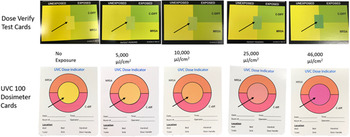
Two commercial colorimetric indicators were studied (Fig. 1). UVC 100 dosimeter cards (Intellego Technologies AB, Gothenburg, Sweden) have a central circular indicator that is yellow in the absence of UV-C exposure. For reference, an outer circle shows orange and pink colors that indicate UV-C doses of ∼50 and 100 mJ/cm2, respectively. According to the manufacturer, a change of the central circular indicator to the orange color indicates a UV-C dose adequate to kill MRSA and other vegetative bacteria, whereas a change to the pink color indicates a dose adequate to kill C. difficile spores.
Pictures of the 2 colorimetric indicators studied showing the color changes associated with increasing doses of ultraviolet-C (UV-C) light. Arrows point to the central rectangles (Dose Verify test cards) or circles (UVC 100 dosimeter cards) that indicate the level of UV-C exposure.

Dose Verify test cards (Ultraviolet Devices, Santa Clarita, CA) have a central rectangular indicator that is yellow in the absence of UV-C exposure. For reference, rectangular areas surrounding the central indicator show yellow (no exposure), light green (MRSA 99% kill), and dark green (C. difficile 99% kill) colors. According to the manufacturer, the indicator is calibrated to the UVDI room decontamination device with the color changes indicating 2 log10 reductions in MRSA and C. difficile spores.
Test organisms
The C. difficile strain was American Type Culture Collection (ATCC) strain 43598. The MRSA strain was a clinical isolate of pulse-field gel electrophoresis (PFGE) type USA800. C. difficile spores were prepared as previously described. Reference Nerandzic and Sensitizing8 The organisms were prepared in phosphate-buffered saline (PBS) or in organic load comprised of 5% albumin, 7% tryptone, and 20% mucin in sterile water. 9
Correlation of UV-C colorimetric indicator results with UV-C doses and log10 reductions in C. difficile and MRSA
We used the low-pressure mercury UVDI-360 room sanitizer (Ultraviolet Devices) for testing because it has been calibrated for the Dose Verify test cards. Testing was performed using the American Society for Testing and Materials standard practice for determining antimicrobial efficacy of ultraviolet germicidal irradiation against microorganisms on carriers with simulated soil (ASTM E3135-18). 9 For each pathogen, 10-μL aliquots containing 106 colony-forming units (CFU) with or without the soil load were spread to cover 20-mm diameter circular stainless-steel carriers and allowed to air dry. The carriers were adhered to glass slides and positioned vertically (parallel to the lamp) at a height of 86.3 cm (34 inches) and 91.4 cm (36 inches) from the center of the UV-C bulb. Colorimetric indicators were placed adjacent to carriers and disks and dosimeters were exposed to UV-C for varying times resulting in UV-C dose or fluence exposures of 5,000, 10,000, 25,000, 46,000, 50,000, 75,000, and 100,000 µJ/cm2. The UV-C doses were calculated based on absolute spectral irradiance measurements taken using an Ocean Optics JAZ spectrometer equipped with a cosine corrector and a UV+VIS grating (200–850 nm) as previously described. Reference Cadnum, Tomas and Sankar2 All tests were performed in triplicate.
After UV-C treatment, the carriers were collected and viable organisms were quantified. Reference Cadnum, Tomas and Sankar2 Reductions in the test organisms were calculated by subtracting organism counts of treated carriers from untreated control. The UV-C doses required to reduce MRSA and C. difficile by ≥2 and 3 log10 CFU were determined. The colorimetric indicators were assessed visually immediately after treatment and pictures were taken. The change in color of the indicators was correlated with the UV-C dose and the log10 CFU reduction in MRSA and C. difficile.
Evaluation of the UV-C 100 dosimeter cards in hospital rooms
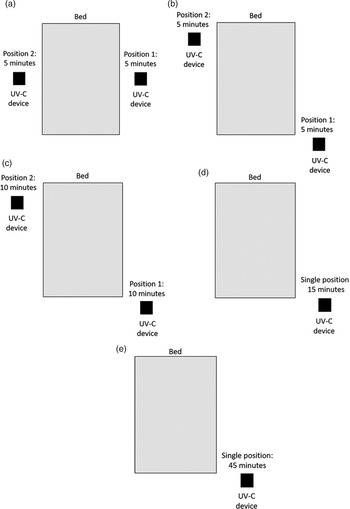
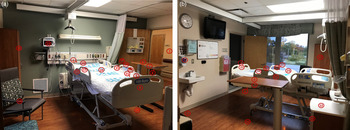
The UV-C 100 dosimeter cards were used to assess dose delivery in patient rooms by the UVDI-360 room sanitizer decontamination device. We tested 5 different variations in device positioning, cycle time, and cycle number (Fig. 2). In the initial test (Fig. 2A), the device was operated as recommended by the manufacturer with two 5-minute cycles on each side of the bed. A test with adjusted positioning of the device for one of the cycles was conducted to assess for improved UV-C delivery to the outer surface of the footboard of the bed (Fig. 2B). A test with two 10-minute cycles was included to determine whether this would increase delivery of UV-C doses adequate to kill C. difficile spores (Fig. 2C). Finally, we tested 2 single-position cycles of 15 minutes (Fig. 2D) and 45 minutes (Fig. 2E). The single-position cycles were tested because one UV-C manufacturer recommends single-position cycles, with a shorter vegetative cycle and a longer spore cycle. Reference Nerandzic, Cadnum, Pultz and Donskey10 In previous testing in our facility, the vegetative cycle required ∼15 minutes and the spore cycle required ∼45 minutes. Reference Nerandzic, Cadnum, Pultz and Donskey10 For each test, 27 colorimetric indicators were placed in multiple locations inside the room, including both vertical and horizontal aspects of surfaces (Fig. 3). The indicators were read after completion of the UV-C treatment. Testing was completed in triplicate.
(A–E) Illustrations showing the 5 different variations in room decontamination device positioning and ultraviolet-C (UV-C) light exposure time that were tested in rooms of patients.

Pictures of the hospital room used for testing with numbers indicating the location of the 27 colorimetric indicators. The numbers correlate with the test sites described in Fig. 5.

Effect of UV-A and UV-B light on the colorimetric indicators
To assess the effect of UV-A light on the indicators, we used a benchtop device with a diffused array of light-emitting diodes producing UV-A light at 365-nm wavelength. Reference Livingston, Cadnum, Benner and Donskey11 The indicators were placed 14 cm from the diffusing optic and the intensity of light output was adjusted to 3 W/m2 with exposure for 10 minutes. To assess the effect of UV-B light, the indicators were placed 6 cm from a black light (Ultra Light UV1, Grizzly Gear, Fort Smith, AR) and exposed for 10 minutes.
Results
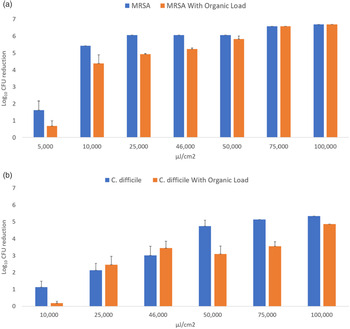
Figure 4 shows the log10 reductions of MRSA and C. difficile at each UV-C dose tested and the corresponding colorimetric indicator results. For both indicators, the reference colors for MRSA and C. difficile reduction corresponded with doses of ∼10,000 µJ/cm2 and 46,000 µJ/cm2, respectively. For MRSA, a dose of 5,000 µJ/cm2 resulted in a 1.6 log10 CFU reduction and a dose of 10,000 µJ/cm2 resulted in >3 log10 CFU reduction. For C. difficile spores, UV-C doses resulting in >2 or 3 log10 CFU reductions were 25,000 and 46,000 µJ/cm2, respectively.
Reduction of methicillin-resistant Staphylococcus aureus (MRSA) (A) and Clostridioides difficile spores (B) with different ultraviolet-C (UV-C) light doses and concurrent changes in color of the 2 colorimetric indicators.

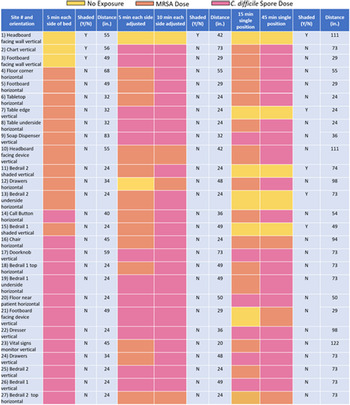
Figure 5 shows the results of the assessment of UV-C dose delivery in patient rooms. The indicator results were the same during 3 separate experiments. For the standard cycle (Fig. 2A), 3 shaded areas remained yellow indicating minimal UV-C exposure, including the headboard of the bed facing the wall, the footboard of the bed facing the wall, and the patient’s chart hanging by the door and out of direct line of site of the UV-C light source. Based on change to pink color, 13 areas received a dose adequate to kill C. difficile spores; all were in direct line of exposure to the UV-C light source. Based on change to orange color, 11 sites received a dose adequate to kill MRSA and other vegetative bacteria but not C. difficile spores. For the adjusted position cycle (Fig. 2B), the number of sites with yellow color was reduced to 2, whereas the number receiving an adequate dose to kill C. difficile spores decreased from 13 to 12. For the adjusted position cycle with the extended cycle duration (Fig. 2C), the number of sites with yellow color was reduced to 1 and the number receiving a C. difficile dose increased to 23.
Ultraviolet-C (UV-C) dose delivery based on colorimetric indicator results for 27 sites in patient rooms treated with a room decontamination device. Five different variations in device positioning and UV-C light exposure time were included (shown in Fig. 2). Yellow, no or minimal UV-C exposure; orange, UV-C dose adequate to kill vegetative bacteria; pink, UV-C dose adequate to kill Clostridioides difficile spores.

For the single position cycles (Figs. 2D and 2E), the number of sites with yellow color was higher than for each of the 2-position tests (5 to 6 vs 1 to 3). The number of sites receiving an adequate dose to kill C. difficile spores was 6 and 19 for the 15- and 45-minute cycles, respectively.
The UVC 100 dosimeter cards changed color from yellow to pink within 10 minutes of exposure to UV-B light from a black light but did not change color after 10 minutes of exposure to UV-A light. The Dose Verify test cards changed color after exposure to both UV-A and UV-B light.
Discussion
There is a need for practical tools for monitoring doses delivered by UV-C devices. In laboratory testing, we demonstrated that UV-C–induced color changes of 2 colorimetric indicators correlated well with log10 reductions in pathogens. For both indicators, the manufacturer’s reference colors for MRSA and C. difficile reduction corresponded with doses of ∼10,000 and 46,000 µJ/cm2; these doses resulted in >3 log10 reductions in MRSA and C. difficile spores, respectively. In patient rooms, use of a colorimetric indicator provided insights into UV-C delivery and highlighted the fact that shaded sites may receive suboptimal dosing.
Our results suggest that colorimetric indicators could be useful tools to compare different devices, assess delivery of UV-C to different sites in patient rooms, and confirm that in-use devices are operating correctly. Reference Donskey1,Reference Boyce and Donskey3 The indicators are relatively inexpensive (∼$2 each for UVC 100 dosimeter cards and $9.50 each for Dose Verify test cards). Use of the indicators by environmental services personnel would provide immediate visual feedback on optimal placement of the UV-C devices and of objects in the room. Such feedback may be particularly beneficial during initial training sessions. Use of the indicators might also lead to modifications of the protocols recommended by manufacturers. For example, our results with the UVDI-360 device suggest that increasing the cycle times from 5 to 10 minutes on each side of the bed might provide more optimal reductions of C. difficile spores.
Our findings provide support for protocols that include operation of UV-C room decontamination devices in 2 different room locations to minimize the impact of shadowing on UV-C delivery. In single-position testing, increasing the cycle time from 15 to 45 minutes increased the number of sites receiving UV-C doses adequate to kill C. difficile spores from 6 to 19. However, the single-position 45-minute cycle was not as effective as the 2-position placement with two 10-minute cycles, which resulted in only 1 inadequately exposed site (ie, yellow indicator color) and delivery of an adequate dose for C. difficile spores to 23 of the 27 indicator sites.
Our study has some limitations. Only 2 organisms were tested. However, reductions in MRSA have been shown to correlate well with reductions in other vegetative bacteria; the emerging fungal pathogen Candida auris is less susceptible to UV-C than MRSA but is more susceptible than C. difficile spores. Reference Cadnum, Tomas and Sankar2,Reference Nerandzic, Cadnum, Pultz and Donskey10,Reference Cadnum, Li, Redmond, John, Pearlmutter and Donskey12,Reference Cadnum, Shaikh and Piedrahita13 The colorimetric indicators were only tested with room decontamination devices. However, previous studies have demonstrated that colorimetric indicators may be useful in assessing other UV-C devices such as UV-C boxes. Reference Cadnum, Li, Redmond, John, Pearlmutter and Donskey12,Reference Cadnum, Li and Jones14 Only low-pressure mercury devices were studied. Additional research is needed to assess the utility of colorimetric indicators for monitoring the dose delivered by pulsed-xenon devices that emit a broad spectrum of light, including UV-C, UV-A, and UV-B. Reference Cadnum, Jencson and Gestrich15,Reference Chatterjee, Choi and Ochoa16 Our findings demonstrate that both indicators may change color upon exposure to UV-B light, whereas the Dose Verify Test Cards also change color on exposure to UV-A light. Bathrooms were not included in the evaluation; most manufacturers of UV-C devices recommend running a separate cycle in bathrooms in addition to 1 or 2 cycles in the patient room. Although our findings suggest that running UV-C devices in 2 room locations may provide more optimal results than a longer single-position cycle, studies were not conducted with a device that specifically recommends a single-position cycle. Further studies are needed with devices that recommend single-position cycles. Reference Nerandzic, Cadnum, Pultz and Donskey10 Finally, we did not assess whether the indicator results correlated with reductions in bacterial contamination on real-world surfaces in hospital rooms.
In conclusion, UV-C-induced color changes for 2 commercial colorimetric indicators correlated well with log10 reductions in pathogens on carriers. In patient rooms, colorimetric indicator results provided rapid and easy-to-interpret information on UV-C delivery to specific sites. Such information could be useful for healthcare facilities seeking to optimize efficacy of UV-C devices and train personnel in their use.
Acknowledgments
We thank the environmental services personnel at the Cleveland VA Medical Center who assisted in the study. Intellego Technologies provided UVC 100 dosimeter cards and Ultraviolet Devices provided Dose Verify test cards for the study. The companies did not provide input on study design and did not contribute to data analysis or interpretation and did not aid in writing or editing the manuscript.
Financial support
This work was supported by a Merit Review grant (no. CX001848) from the Department of Veterans’ Affairs to C.J.D.
Conflicts of interest
C.J.D has received research grants from Clorox, Pfizer, and PDI. All other authors report no conflicts of interest relevant to this article.