




No CrossRef data available.
Article contents
A prospective study of the recovery of attention from acute to 2 years following pediatric traumatic brain injury
Published online by Cambridge University Press: 28 January 2005
Abstract
Limited research has investigated specific attentional sequelae following pediatric traumatic brain injury (TBI), such as sustained, selective, and shifting attention, as well as speed of processing. Little is known about the pattern of recovery of these skills or their interaction with ongoing development. The present study examined attentional abilities at acute, 6-, 12-, and 24-month time points postinjury in a group of 71 children who had sustained a mild, moderate, or severe TBI. Results indicated that children who sustained a severe TBI generally performed poorest, but showed most recovery over time. The pattern of recovery was dependent on the attentional component being measured. Specifically, deficits were most evident on more complex and timed tasks. While a number of areas showed recovery over time, for some attentional components, difficulties persisted to 24 months postinjury. (JINS, 2005, 11, 84–98.)
Information
- Type
- Research Article
- Information
- Journal of the International Neuropsychological Society , Volume 11 , Issue 1 , January 2005 , pp. 84 - 98
- Copyright
- © 2005 The International Neuropsychological Society
INTRODUCTION
Contemporary models describe attention as an integrated system, both cognitively and physiologically, involving a number of separate, but interrelated components (Halperin, 1991; Mirsky et al.,1991; Posner & Peterson, 1990). These models identify several components: (1) sustained attention, or vigilance: the capacity to maintain arousal and alertness; (2) selective attention: the ability to select target information while ignoring irrelevant stimuli; and (3) shifting attention: the ability to change attentive focus in a flexible and adaptive manner. Speed of processing is often included and considered to underpin system efficiency.
Studies of adult TBI suggest that, while attentional deficits are severe in the acute stages postinjury, persisting deficits are also common. Van Zomeren and Brouwer (1994) describe general disruption to attention and information processing following adult TBI, citing clinical reports of forgetfulness, poor ability to concentrate, and slowed responses. Others argue that deficits are more specific, reporting deficits in speed of processing and motor responses, with otherwise intact attentional capacities (Brouwer et al., 1988; Murray et al., 1992; Ponsford & Kinsella, 1992). These results have been extended to suggest that adults with TBI exhibit fluctuating attention which further complicate diagnosis and treatment (Stuss et al., 1989).
While attentional and processing deficits following adult TBI are reasonably well documented, this knowledge is not necessarily generalizable to children. Some authors argue that children recover better from TBI, citing protective physiological factors including the flexibility of the child's skull, the lower frequency of intracranial haematomas, and the plasticity of the developing brain (Lennenberg, 1967). Others propose poorer outcome due to the immaturity of the central nervous system (CNS), in particular the frontal lobes and white matter, and the resultant impact on cognitive skills essential for normal development including attention, memory, and adaptive skills (Anderson & Moore, 1995; Dennis, 1989; Dennis et al., 1995; Ewing-Cobbs et al., 1989; Gronwall et al., 1997). We do know that, despite various pathologic processes, some recovery of function is evident in children, both biologically and functionally. Mechanisms of recovery can be grouped into two general classes—restitution and substitution. Restitution suggests that spontaneous physiological recovery occurs as damaged brain tissue heals, neural pathways are reactivated, and functions are restored. Substitution theories refer to restoration via either system reorganization or compensation (Kolb & Gibb, 1999; Laurence & Stein, 1978; Rothi & Horner, 1983).
To date, the study of recovery following pediatric TBI has been focussed on cognitive outcome (Ewing-Cobbs et al., 1989; Fay et al., 1993; Goldstein & Levin, 1985). Given findings from adult literature, and improved understanding of brain mechanisms involved in recovery, further investigation of the sequelae of attentional and information processing skills appears warranted. From a developmental perspective, these skills are of critical importance during childhood. If such abilities are impaired, the child is at risk of adaptive, social, and academic dysfunction (Cooley & Morris, 1990; Dennis et al., 1995).
Despite the importance of attention in this younger age group, few studies have been reported, and results are inconsistent. Kaufmann et al. (1993) examined 36 children, aged 7–16 years, at 6 months post-TBI and found that children with severe TBI demonstrated poorer attention, in comparison to those with mild and moderate TBI. Similarly, others have reported that TBI participants are less accurate than controls on sustained attention tasks, and exhibit significant vigilance decrements (Catroppa & Anderson, 2003; Robin et al., 1999). Also, when using a sustained attention task of graded difficulty, the more complex tasks requiring speed, accuracy, and decision-making differentiate between the mild and severe TBI groups (Catroppa & Anderson, 2003). Anderson and Pentland (1998) employed a task that divided performance into sequential blocks to study performance fall-off with time. They identified impaired speed of processing, with intact sustained attention. Timmermans and Christensen (1991) investigated 38 children with TBI, aged 5–16 years, and showed evidence for impaired sustained attention, but intact selective attention skills. In contrast, Dennis and associates (1995) have reported that children and adolescents with TBI perform poorly in both these attentional domains.
Each of these studies, while identifying aspects of attentional impairment, has not considered the development trajectories of attentional skills. Previous research (Manly et al., 1999; McKay et al., 1994; Rebok et al., 1997) has shown that selective attention matures to adult levels before age 7. In contrast, shifting attention skills develop rapidly between 7 and 9 years, at which point they reach adult levels. For sustained attention, McKay et al. (1994) and others (Betts et al., under revision; Manly et al., 1999) document little development between 7 and 11 years, but significant progress from age 11 into early adulthood. Speed of processing increases gradually through childhood into early adolescence (Anderson et al., 2001; Kail, 1986). Such developmental differences may be relevant to the pattern of attentional impairment seen post-TBI, with early established attentional skills (e.g., selective attention) more consolidated and thus less vulnerable, and less-developed skills at greater risk of impairment.
The present study aimed to extend our knowledge of outcome following childhood TBI by mapping the recovery of components of attention (sustained, selective, shift, and speed of processing) in the 2 years post-TBI. We investigated whether attentional deficits post-TBI were generalized or specific to aspects of attention during the 24 months postinjury. It was predicted that more severe TBI would be associated with greater attention and information processing deficits, and that while some recovery would occur over time, attention deficits would persist up to 24 months post-TBI. Further, based on the available developmental data (e.g., Manly et al., 1999; McKay et al., 1994; Rebok et al., 1997) and the proposition that CNS insult during childhood, and before the mastery of a skill, will cause deficits in that domain, it was predicted that sustained attention and speed of processing would be characterized by ongoing impairment with time since injury, while early maturing skills of selective and shifting attention would be less vulnerable and show greater recovery.
METHOD
Participants
Between June 1994 and August 1997, 167 children between the ages of 8–12 years were admitted to the Royal Children's Hospital, Melbourne, with a diagnosis of TBI. Of these, 103 children met the inclusion criteria for the study and were approached to participate. Twenty-seven families (26%) declined to participate and 76 (74%) elected to take part. Five children were removed from the sample due to missing data, leaving a sample of 71 children (see Table 1 for the number of participants completing each test at each time point). Of these children 54 were male and 17 were female. Inclusion criteria were (1) aged between 8.0–12.11 years at time of injury; (2) documented evidence of closed head injury, including period of altered conscious state; (3) medical records sufficiently detailed to determine severity of injury, that is, including Glasgow Coma Scale (GCS: Teasdale & Jennett, 1974) Posttraumatic amnesia (PTA) recorded at regular intervals in the patient's medical record by the nursing staff, and defined as the length of time from accident until orientation to person, time and place), neurological and radiological findings; and (4) competent in English. Exclusion criteria were history of neurological disorder, previous TBI, preinjury developmental, learning or attentional disability (including Attention Deficit Hyperactivity Disorder), as documented by a professional health worker.
Number of participants at each time point

Children with TBI were categorized into severity groups as follows: (1) mild TBI (n = 25): GCS on admission 13–15, loss of consciousness (LOC) < 1 hour, PTA < 24 hours, no abnormalities on computed tomography/magnetic resonance imaging (CT/MRI) scan; (2) moderate TBI (n = 30): GCS on admission 9–12, LOC 1–24 hours, PTA 1–7 days; and/or abnormalities on CT/MRI; (3) severe TBI (n = 16): GCS on admission ≤8, LOC > 24 hours, PTA > 7 days; and/or abnormalities on CT/MRI. Implementation of these classifications successfully categorized the majority of children, however, where categorization was not clear, further information from the child's medical file (e.g., presence of neurological signs) was taken into account.
As illustrated in Tables 2 and 3, the groups did not differ with respect to gender, socio-economic status (SES), or family constellation. A significant difference was evident across the groups for age at injury, with the severe TBI group being somewhat older, F(2,68) = 3.20, p = .047. Time interval from injury to first assessment did not differ across groups, F(2,70) = .62, p = .059, although the severe TBI group recorded the longest delay, reflecting longer duration of coma and PTA. As expected, there were significant group differences on all medical variables, with the severe TBI group presenting with most complications, apart from the number of fractures. Severe TBI was mainly due to motor-vehicle accidents. Of the children presenting with neurological signs in the moderate and severe TBI groups, two children had mild left hemiparesis, three children had right- sided weakness, one child was restricted to a wheel-chair and had poor motor control, two children experienced seizures postinjury, and four children presented with hearing loss.
Demographic information

Injury and medical characteristics

Measures
Preinjury and postinjury questionnaires
A. Epidemiological questionnaire: documented parental occupations and educational level, family constellation, and medical and developmental history of the child. SES was recorded according to Daniel's Scale of Occupational Prestige (Daniel, 1983), where a low score reflected high occupational prestige. The scale ranges from 1.0 to 6.9.
B. Medical questionnaire: This questionnaire was based on data recorded in the child's medical record, including GCS scores, period of unconsciousness, duration of PTA, neurosurgical interventions, neurological signs, and radiological results.
C. Vineland Adaptive Behavior Scale: (VABS: Sparrow et al., 1984): a questionnaire completed by parents, on recruitment to the study, based on their child's preinjury abilities. The VABS was readministered at 6, 12, and 24 months postinjury to document changes to adaptive function. It provides a global measure of adaptive functioning, as well as scores for the domains of Communication, Daily Living, Social Skills, and Motor Skills. Each domain is standardized, with a mean of 100 and a standard deviation of 15.
D. Rowe Behavioural Rating Inventory: (RBRI: Rowe & Rowe, 1995): This questionnaire was completed by teachers (16 items) and parents (20 item) acutely (preinjury characteristics) and at 6, 12, and 24 months postinjury, and included the domains of Sociability, Attention, and Restlessness. For the purpose of this manuscript, only the Attention domain was analyzed. Examples of the items include—“persistent, sustained attention span,” and “can concentrate on any particular task.” Raw scores were included in the analyses, with a higher score indicative of poorer performance.
E. Neurobehavioural Rating Scale: (NRS: Levin et al., 1987): This questionnaire was completed by parents at 12 months postinjury, and the attention domain was employed in the analyses. Raw scores were calculated, with a higher score indicative of poorer performance.
Child assessment
A. Intellectual measure: The Wechsler Intelligence Scale For Children–Third Edition (WISC–III: Wechsler, 1991) assessed general intelligence. Full Scale Intellectual Quotient (FSIQ) and Index scores—Freedom from Distractibility (FFD) and Processing Speed (PS)—were used in the analyses. All scores have a mean of 100 and a standard deviation of 15.
B. Attentional measures: Several components of attention were investigated at acute (0–3 months), 6, 12, and 24 months post-TBI:
Sustained attention: The Continuous Performance Task (CPT; modified from Mirsky et al., 1991) was used to examine the ability to maintain performance over time and speed of processing. In this computerized task, stimulus letters were displayed for 500 ms with an interstimulus interval of 1.5 s. Task duration was 20 minutes, during which time 600 stimuli were presented. Children were given practice to ensure they understood task requirements. Two letters flashed on the screen and the child was given a target letter (“c”) on which to focus. The child was given a response box where the yellow “yes” button was to be pressed if a “c” had flashed on the screen, and the blue “no” button if neither letter was a “c”. Scores employed in the analyses were correct responses, reaction time for correct responses, number of omission and commission errors, missed responses, and impulsive responses (reaction time < 200 ms). For each of the variables, scores for the first 5 min (Block 1) and last 5 min (Block 4) of the task were obtained to establish whether performance deteriorated during the task. This version of the CPT was administered during the acute, 6, and 12 months post-TBI/assessments.
Selective attention: (a) Letter Cancellation Test (LCT; Talland, 1965). Children were presented with a sheet displaying rows of letters and instructed to cross out all “C”s and “E”s as quickly as possible. The number of letters correctly cancelled in 1 min was recorded; and (b) Trail Making Test–Part A (Trails A; Reitan & Davison, 1974): children were asked to join a series of numbers in order. Time to completion was recorded and employed in analyses.
Shift: (a) Trail Making Test–Part B (Trails B; Reitan & Davison, 1974). Children were asked to join consecutive alternating letters and numbers, requiring a shift from one sequence to another. Time to completion was recorded; and (b) Contingency Naming Test (CNT; Taylor et al., 1992). This task has four conditions, each one increasing in difficulty level. Children were presented with a stimulus sheet displaying circles, squares, and triangles of different colors, with each stimulus including a color dimension and an internal and external shape. Condition 1 required children to name the color of each shape, and Condition 2 the name of the external shape. Condition 3 involved implementation of two rules: (1) if the internal and external shapes are the same, state the color; (2) if the internal and external shapes are different, state the external shape. Condition 4 becomes more complex as some shapes have an arrow above them, and for these shapes the rule learned in Condition 3 is reversed, while for all other stimuli the correct response is as for Condition 3. For each condition a practice trial is administered to ensure that task is understood. Once the practice trial was completed correctly (maximum of five practice trials), the test condition is administered. The Condition 4 results (time taken for task completion, number of errors) were used in analyses.
Procedure
Parents of children who met selection criteria were invited to participate in the study. The study was introduced and explained in detail and written consent was obtained, according to hospital ethics guidelines. Once the family had given consent for participation, appointment times were scheduled and the epidemiological questionnaire and the VABS (Sparrow et al., 1984) were completed, based on the child's preinjury status. During the acute stage (0–3 months postinjury) the total test battery was administered. The VABS and the attentional measures were then repeated at 6, 12, and 24 months postinjury, and the WISC–III at 12 and 24 months post-TBI. All assessments were conducted by a psychologist and took place over two 1-hr sessions. Order of test administration was fixed, with WISC–III completed in one session and attentional measures in the second session.
Statistical Analysis
The three groups (mild, moderate, severe TBI) were compared on injury and demographic characteristics and on preinjury VABS to identify any differences that could influence postinjury performance. One-way analysis of variance (ANOVA) was conducted to compare scores on cognitive measures across groups during the acute stage. Tukey's (HSD) statistic was used to ascertain specific group differences. Repeated-measures ANCOVA (Group × Time, age at injury as a covariate) was conducted to determine associations between injury severity and test performance at acute, 6, 12, and 24 months postinjury on tests of selective and shifting attention. Repeated-measures ANCOVA (Group × Time × Block) was employed to investigate the association between test performance and injury severity on the sustained attention task, where performances in the first 5 min and last 5 min of the task were compared. Planned contrasts were utilized to ascertain specific group differences on the repeated-measures variables. For some measures, score distributions were unacceptably skewed. In such instances, the child was assigned a score of two standard deviations below the mean for their group for the variable concerned (Tabachnick & Fidell, 1989).
RESULTS
Demographic, Preinjury, and Medical Information
Analysis indicated no group differences on demographic variables, or on preinjury adaptive or attentional measures, suggesting that any differences between the groups could not be explained in terms of these variables (see Tables 2 and 3).
Intellectual Performance and Adaptive Functioning Measures
Table 4 provides results for the intellectual and adaptive measures both at the acute stage and at 1 and 2 years postinjury. Repeated-measures ANOVA revealed a significant Group effect for FSIQ, F(2,65) = 6.1, p = .004. Post-hoc analyses indicated a significant difference between the mild and severe TBI groups (p < .001) and the moderate and severe TBI groups (p = .012) during the acute stage post-TBI. The difference between mild and severe groups persisted at 1 and 2 years postinjury (p = .006, p = .035, respectively). Analysis also revealed a significant main effect of Time, F(2,130) = 18.0, p < .001 and a significant Time × Group effect, F(4,130) = 7.4, p < .001. While the severe TBI group achieved the lowest scores, they improved most over time suggesting that developmental gains and/or recovery occurred over the time span of the study. There was no significant difference between the TBI groups with regard to the FFD Index Score, which taps auditory processing and working memory. However, visual examination of the data suggests greatest improvement in this area for the severe TBI group. When examining the Processing Speed Index, a dose–response relationship was evident. Analysis revealed significant main effects of Group, F(2,63) = 5.4, p = .007 and Time, F(2,126) = 12.2, p < .001, with post-hoc analysis identifying differences between the mild and severe TBI group (p = .001) and the moderate and severe TBI group (p = .033) at the acute stage and between the mild and severe TBI groups (p = .001) at 12 months postinjury, and again at 24 months post-TBI. (p = .021). While the severe TBI group showed most improvement over time, suggestive of developmental gains, and/or the possibility of practice effect, there was no differential improvement for the severe TBI in this instance.
Cognitive and adaptive measures

For the VABS, analysis revealed a significant effect for Time, F(2,112) = 11.1, p < .001) and a significant interaction effect, F(4,112) = 2.6, p = .042, with a trend for the mild TBI group to perform similarly at preinjury and post-TBI stages, suggesting little impact of injury on this measure for this mild end of the spectrum. The moderate TBI group showed some decline over the 2 years of the study (mean = 5 points), with the severe TBI group showing most deterioration (mean = 17.7 points), indicating that parents of these children were reporting a lack of expected development in a number of adaptive functioning areas.
Behavioral Questionnaires (RBRI)
Parent version
With regard to the Attention domain, results indicated significant main effects of Group, F(2,55) = 3.8, p = .029, and a significant Group × Time interaction effect, F(6,165) = 7.0, p < .001. The severe TBI group showed a marked increase in attention problems between acute and 6 months assessments, and remained most inattentive over the 24-month period. Post-hoc analysis indicated differences between mild and severe TBI groups at 6 (p = .022), 12 (p = .023), and 24 (p = .018) months post-TBI, and a significant difference between the mild and moderate groups at 24 months (p = .045) postinjury (see Figure 1). These results indicate a dose–response relationship, where the severe TBI group is showing less adaptive behavior in comparison to the mild and moderate TBI groups.

Rowe Behavioural Rating Inventory–Parent Version: Attention Domain acute to 24 months post-TBI.
Teacher version
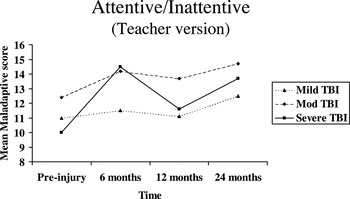
Teachers' responses differed somewhat from parents' results, with the Attentive domain showing a significant Time effect, F(3,156) = 3.8, p = .011. All TBI groups were rated as becoming more inattentive over time (Mild TBI group increased by 1.5 points from acute to 24 months post-TBI, moderate TBI group by 2.3 points, and the severe TBI group by 3.7 points). In general, visual inspection indicated that teachers rated children with moderate TBI children as most inattentive (see Figure 2).

Rowe Behavioural Rating Inventory–Teacher Version: Attention Domain acute to 24 months post-TBI.
Analysis of the NRS Attention domain, completed by parents at 12 months, revealed a significant difference between the TBI groups, χ2(10) = 27.70, p = .002. When parents were asked to indicate whether an attentional problem was evident and then required to rate it ranging from not present to severe, results differed according to severity (mild TBI: 5% moderate–severe difficulty; moderate TBI: 15% moderate–severe difficulty, and severe TBI: 43% moderate–severe difficulty). These results again support a dose–response relationship between injury severity and attentional difficulties 1-year postinjury.
Attention Measures
Sustained attention
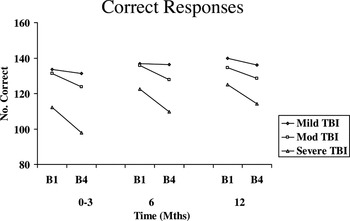
The CPT was analyzed in terms of Group × Time × Block (see Figures 3, 4, 5, 6, 7, and 8) to examine possible reductions in performance over time. For mean number of correct responses, the main effects of Group, F(2,61) = 10.6, p < .001, Time, F(2,122) = 11.1, p < .001, Group × Time interaction, F(4,122) = 2.8, p = .029, Block, F(1,61) = 15.4, p < .001, and Group × Block interaction, F(2,61) = 6.5, p = .003, were each significant. The severe TBI group achieved fewer correct responses in comparison to the mild and moderate TBI groups, however, all the groups showed improvement over time. The severe TBI group also showed the largest discrepancy between Blocks 1 and 4, with significantly fewer correct responses made in Block 4, in comparison to mild and moderate TBI groups. Planned contrasts revealed that, while there was a significant effect of Block, differences were between mild and severe (acute: p < .001; 6 months: p < .001), and mild and moderate (acute: p = .003; 6 months: p = .009) groups at acute and 6 months post-TBI, with significant differences also present between the mild and severe TBI groups at 12 months postinjury (p = .010). These results suggest that while the moderate TBI group performed more poorly than the mild TBI group, the moderate group improved to a degree where it was not significantly different to the mild group by 12 months post-TBI. Thus, as predicted, results suggest greater deficits in sustained attention associated with severe TBI up to 12 months post-TBI.

CPT number of correct responses acute to 12 months post-TBI.

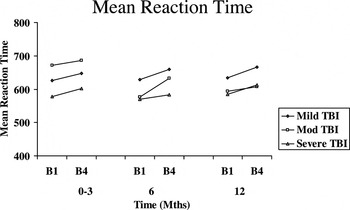
CPT mean reaction time acute to 12 months post-TBI.

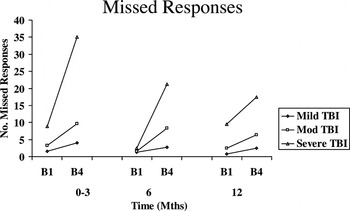
CPT number of missed responses acute to 12 months post-TBI.

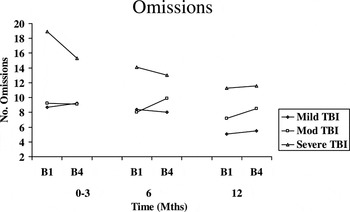
CPT number of omissions acute to 12 months post-TBI.

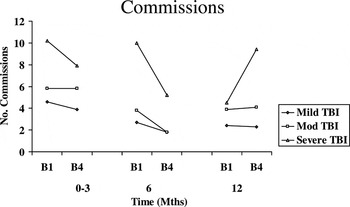
CPT number of commissions acute to 12 months post-TBI.

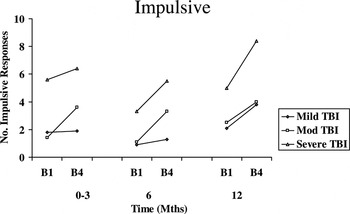
CPT number of impulsive errors acute to 12 months post-TBI.
Mean reaction time scores for the CPT showed no significant Group, F(2,56) = .6, p = .572, or Time effect, F(2,112) = 2.2, p = .114. However, there was a significant Group × Time Interaction, F(4,112) = 3.2, p = .015, and a significant Block effect, F(1,56) = 4.2, p = .044. All TBI groups responded more quickly in Block 4, with more errors recorded by the severe TBI group, suggesting difficulty working quickly and providing correct responses in comparison to mild and moderate TBI groups (see Figure 4).
For missed responses (see Figure 5), a number of significant results emerged. There were significant main effects for Group, F(2,61) = 9.8, p < .001, Time, F(2,122) = 13.6, p < .001 and Block, F(1,61) = 19.8, p < .001. Also significant were interactions for Group × Time, F(4,122) = 6.8, p < .001, Group × Block, F(2,61) = 10.3, p < .001 and Group × Time × Block, F(4,122) = 5.9, p < .001. All TBI groups missed more responses in Block 4, with some improvement from acute to 6–12 months postinjury. The severe TBI group recorded most missed responses in Block 4 at each time point, again suggesting difficulties sustaining attention. Planned contrasts revealed differences for Block 4 between the mild and severe (acute: p < .001; 6 months; p = .002; 12 months: p = .002) and the moderate and severe TBI groups (acute: p = .001; 6months; p = .030; 12 months: p = .021) at all time points.
For omission errors, significant main effects were detected for Group, F(2,61) = 7.5, p = .001 and Time, F(2,122) = 8.8, p < .001. Significant interaction effects were also evident for Group × Time, F(4,122) = 3.0, p = .022 and Group × Block, F(2,61) = 4.4, p = .016. By 12 months postinjury, a dose–response pattern was evident where the mild TBI group made least errors and the severe TBI group most errors, however, over time the severe TBI group tended to make less errors of omission, perhaps due to the fact that they had more missed responses toward the end of the task (see Figure 6). Tukey's (HSD) statistic indicated a significant difference between the mild and severe (p = .038) and moderate and severe TBI groups (p = .031) acutely, and a significant difference between the mild and severe TBI groups at 12 months postinjury, for Block 4 of the CPT task (p = .003).
Errors of commission revealed significant Group, F(2,61) = 8.1, p = .001, and Time effects, F(2,122) = 3.4, p = .036. Interaction effects were evident for Time × Block, F(2,122) = 5.0, p = .008 and Group × Time × Block, F(4,122) = 5.0, p = .001. Mild and moderate TBI groups tended to make similar or fewer commission errors over time, with similar results for Blocks 1 and 4. The severe TBI group also made similar numbers of errors over time, but showed a sharper decline at the acute and 6-month stages, with less errors in Block 4, again possibly a reflection of the higher number of missed responses for this group. However, at the 12-month stage, the severe TBI group made more errors of commission in Block 4 compared with Block 1 (see Figure 7). Post-hoc analysis indicated a significant difference between mild and severe (p = .002) and moderate and severe TBI groups (p = .003) in Block 1 at the 6-month stage, and a significant difference between the mild and severe TBI group for Block 4 at 12 months post-TBI (p = .007).
As seen in Figure 8, for the number of impulsive errors, significant main effects for Group, F(2,61) = 4.2, p = .020, and Block, F(1,61) = 4.5, p = .037, showed that severe TBI was related to more errors at each evaluation. All groups, particularly the severe TBI group, made more errors in Block 4. Post-hoc evaluation indicated differences between the mild and severe TBI groups, at the acute (p = .030) and 6-month stages (p = .009) for Block 4.
Selective attention
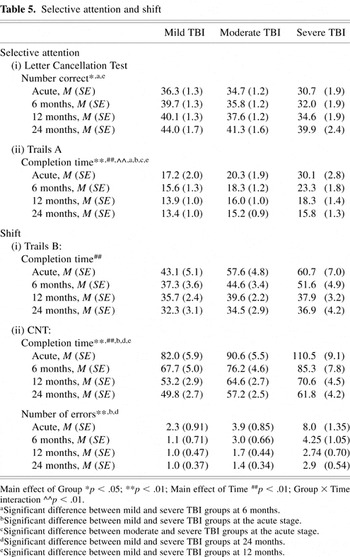
For the LCT, there was a significant main effect for Group, F(2,61) = 4.1, p = .020 indicating that the mild TBI group found more targets in the specified time than the other groups. Significant differences were present between mild and severe TBI groups at 6 (p = .010) and 12 (p = .035) months postinjury. For Trails A, significant effects were found for Group, F(2,62) = 7.8, p = .001, Time, F(3,186) = 4.8, p = .003, and Group × Time, F(6,186) = 3.0, p = .007, with the severe TBI group taking longer to complete the task, but also showing greatest gain (recovery) over time. The mild TBI group did not record any gains, supporting an interpretation that improvements associated with severe TBI are due to recovery rather than practice effects. To further support this interpretation, post-hoc analysis indicated a differences between mild and severe TBI groups at acute (p < .001), 6 (p = .002), and 12 (p = .008) months, but not 24 months, and a significant difference between the moderate and severe TBI groups (p = .002) during the acute stage (see Table 5).
Selective attention and shift

Shifting attention
For Trails B (see Table 5), analysis detected a significant main effect for Time, F(3,186) = 5.3, p = .002, but no Group effect, (F(2,62) = 2.9, p = .060, or interaction, F(6,186) = 1.6, p = .159. The severe TBI group was slowest to complete the task at all time points; however, all groups showed improvement over time, suggesting some practice effect across all groups. Some recovery for the moderate and severe groups was also suggested, with the discrepancy between initial and 24-month results (moderate = 23.1 points; severe = 23.8 points) much larger than for the mild TBI group (mild = 10.8 points). There were main effects of Group, F(2,60) = 6.1, p = .004, and Time, F(3,180) = 5.4, p = .001, on the CNT, Condition 4 (see Table 5). All groups exhibited a trend to quicker completion times at 24-month evaluation, with the mild TBI group performing the quickest and the severe TBI group the slowest. While results also suggest some practice effect, once again the severe TBI group showed the largest discrepancy between acute and 24 months (severe TBI = 48.7 points; moderate TBI = 33.4 points; mild TBI = 32.2 points), representing greatest recovery. Post-hoc analysis indicated differences between mild and severe TBI groups at the acute (p = .019), 12(p < .001), and 24 (p = .008) month stages post-TBI. While the severe TBI group showed most improvement, performances remained below the level of the mild TBI group. A significant difference was detected between mild and moderate TBI groups 1 year postinjury (p = .019). For number of errors, a significant Group effect was evident, F(2,61) = 8.1, p = .001. While all groups showed improvement over the 24 months postinjury, especially the severe TBI group, those with mild injuries achieved fewer errors at each time point in comparison to moderate and severe TBI groups. Post-hoc analysis indicated a difference between mild and severe TBI groups at the acute (p = .007) and 24 months (p = .044).
Parent/Teacher Report and Performance on Clinical Tests of Attention
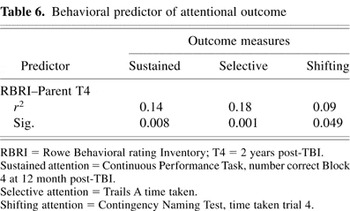
Hierarchical regression analysis (see Table 6) indicated that parental report of attention at 2 years post-TBI is a significant predictor of performance on clinical attention tasks in the areas of sustained, selective, and shifting attention. Conversely, teacher report of attention was not a significant predictor.
Behavioral predictor of attentional outcome

DISCUSSION
These results provide support for the presence of persisting attentional difficulties following TBI sustained during childhood. As all TBI groups were functioning similarly prior to the TBI, any postinjury differences are likely to be attributed to injury-related factors rather than premorbid status.
Intellectual and Adaptive Abilities
As expected, FSIQ results, representing overall level of cognitive functioning, indicated that children with severe TBI were most compromised postinjury. While all TBI groups demonstrated an improvement over time, the increment for the mild and moderate TBI groups was modest in contrast to that recorded by the severe TBI group. Therefore, in keeping with previous research (Chadwick et al., 1981a, 1981b, 1981c; Jaffe et al., 1992, 1993, 1995), this study provides firm evidence that severe TBI is associated with impairments of intellectual function, and that there is a pattern of recovery of these skills for children with severe TBI. In keeping with these findings, the PS Index exhibited an initial dose–response effect, with all groups showing some improvement over time. There was, however, no differential improvement for the severe TBI in this instance, supporting the findings of Donders and Warschausky (1997) who reported that PS Index was impaired following childhood TBI. Subtle coordination difficulties observed post-TBI (Catroppa et al., 1999) may explain the poorer recovery of these processing skills. In contrast, results for the FFD factor showed no significant injury-related trends. There is a need for further follow-up of this group once these skills are fully developed, as subtle difficulty at an early age may be predictive of persistent compromise on tasks requiring higher order skills in the adolescent/adult years, consistent with deficits in executive function post-TBI (Levin et al., 1997).
Adaptive functioning results from the VABS suggested similar skills across groups preinjury, with the mild TBI group performing similarly pre-TBI and post-TBI. In contrast, moderate and severe TBI groups performed more poorly post-TBI, with the severe TBI group showing most “deterioration”. These results suggest that, with regard to adaptive living skills, parents of children who sustained a moderate/severe TBI perceived that their child was not developing at an expected level in a number of adaptive functioning areas.
Behavioral Function
Results on the parent-based RBRI based also indicated a dose–response relationship. Parental ratings indicated that by 6 months postinjury, the degree of maladaptive behavior in the moderate and severe TBI group, but particularly the severe TBI group, had increased from preinjury levels, and that this maladaptive behavior continued to the 24-month period. These results argue that, following more severe TBI, behavioral indices of attention may not recover, but may reflect ongoing impairment in this domain, which may interfere with ongoing development. Interestingly, parental responses on the RBRI predicted performance on clinical tests of attention, suggesting a relationship between observable attentional difficulties in everyday settings and those measured by more standardized measures. Teachers rated the moderate TBI group as most behaviorally compromised. A number of possible explanations for these findings may be considered. First, the perception of acceptable behavior will differ between parents and teachers, biasing responses made to particular questions. Parents and teachers may also differ in the behavior samples they observe. For example, a child with severe TBI may be slow and non-active in class, while at home, such behavior may be considered out of character and problematic for that child. Second, children with severe TBI often receive individual assistance within class and this may mask the level of maladaptive behavior present in less supervised conditions. Further, children with severe TBI and more obvious deficits, may have less expectations placed on them than those with less obvious impairments. However, of importance, both parent and teacher responses indicated that behavioral difficulties are often present following moderate to severe TBI. Finally, both teacher and parent reports indicated that behavior did not improve with time since injury, especially for the moderate and severe TBI groups.
With regard to the NRS, parents of children with severe TBI reported a high frequency of attentional difficulties at 12 months postinjury. Conversely, only a small percentage of children who sustained a mild TBI were reported as having attentional difficulties. A minor limitation to be considered when interpreting the NRS is that there is no preinjury score for comparison. However, both parental reports, the RBRI and NRS, report attentional difficulties to be increasing from preinjury levels for the severe TBI group. Consistent with other findings, these results suggest a dose–response with more severely injured children presenting with more maladaptive behavior.
Attentional Measures
Results on the attentional and information processing tasks indicated a consistent dose–response relationship. In contrast, recovery patterns varied depending on the specific attentional component being measured. This variability in recovery may depend on the specific cerebral region impacted by injury, and its level of maturity at the time of injury. On measures of sustained attention, children with severe TBI achieved fewest correct responses, had problems maintaining attention and working efficiently over time, showed a gradual increase in errors with time on task, and presented with a vigilance decrement.
When considering mean reaction time for correct responses, there were no significant main effects for Group or Time, consistent with much of our previous research. However, with regard to performance between Blocks 1 and 4, the severe TBI group appeared to respond more quickly over time. While this finding may be considered unexpected based on adult and adolescent TBI data, Maule et al. (2000) postulated that this finding may be explained in terms of time pressure and high levels of anxiety and energy, that is during lengthy and complex tasks, children with severe TBI felt more anxious and pressured, and so responded more impulsively. For missed responses, analysis revealed a number of significant results. While a dose–response result was evident, all TBI groups missed more responses at the end of the task, with the severe TBI group achieving the highest number of missed responses in the last 5 min at each time point. Such findings are consistent with a number of previous studies (Timmermans & Christensen, 1991; Kaufmann et al., 1993) where children with TBI demonstrated significant difficulties sustaining attention.
Analysis of omission and commission errors revealed a similar pattern, with best performance by the mild TBI group and poorest by the severe TBI group. Over 6–12 months post-TBI, the severe TBI group tended to make less errors of omission and commission, perhaps due to the fact that they had more missed responses toward the end of the task at each time point postinjury. As suggested earlier, it may be that long periods of time pressure may lead to fatigue, resulting in more errors over time (Maule et al., 2000). For impulsive errors, results revealed that the severe TBI group made more errors at each evaluation, and more errors toward the end of the task. Some may suggest that impulsive errors may in fact be ‘late’ responses (a slow response from the previous stimuli), however, analysis of the data did not support this interpretation.
For selective attention, results were in the expected direction, with significant differences between the severity groups. Results also support the possibility of information processing deficits, as the severe TBI group took longest to complete timed tasks, especially when visuo-motor speed and coordination were integral to the task. The severe TBI group showed substantial improvement over time, suggesting recovery over time rather than a general practice effect for all TBI groups. These findings provide partial support for findings in the adult literature where reduced speed of information processing has been implicated as a confounder on tasks measuring attentional skills (Anderson & Pentland, 1998; Ponsford & Kinsella, 1992; Stuss et al., 1989). However, our results suggest that these problems are specific to visuo-motor performance with simple processing speed (i.e., reaction time) intact.
For both simple and complex tasks of shifting attention, results suggest both practice effect and recovery for moderate and severe TBI groups. Again, results indicate slower performance for those who sustained greater injury, but with a steeper recovery over time. It is difficult to determine whether the poorer performance is one of shifting attention, or whether there is an inability to shift attention in conjunction with slowed visuo-motor processing. Such an interpretation is consistent with Wood's argument, where he stated that head injury may limit attentional capacity. It can reduce the extent to which attention can be divided across stimuli and so may affect one's ability to “shift” their mode of thinking, resulting in slower and even less reliable processing of information (Wood, 1988). For tasks that involve verbal rather than visuo-motor responses, it may be suggested that children who sustained a significant injury presented with an exacerbation of difficulties as shifting attention, working memory, and processing speed all appeared compromised, not surprising, considering the diffuse nature of pathology often associated with TBI. Furthermore, for tasks of high complexity, those with greater injury presented with both slower performance and higher error rate. However, it may be suggested that if the time pressure is removed, then errors may decrease. This pattern was seen using an experimental CPT paradigm (Catroppa & Anderson, 2003), where increasing the interstimulus interval resulted in no significant differences between severity groups.
Summary and Limitations
Traumatic brain injury results in a number of changes to brain tissue, depending on the type of damage incurred, and once a lesion occurs, a number of degenerative events follow, such as the shrinkage of axons and associated neural structures, and the consequent actions of glial cells in repairing the damage as much as possible. Despite these changes, some recovery of function via restitution and/or substitution mechanisms occurs, however, for more severe injuries deficits often persist. Moderate and severe TBI during childhood results in specific attention and information processing deficits up to 24 months postinjury. Not all areas of attention are affected similarly, with factors including the nature of the task (e.g., visuo-motor tasks in comparison to computerized reaction time tasks), task complexity, and speed requirements affecting outcome. Results provide partial support for findings from the adult literature where deficits for speed of processing are reported (Murray et al., 1992; Ponsford & Kinsella, 1992). However, while adult TBI is thought to cause a general disruption to attention and information processing (Van Zomeren & Brouwer, 1994), this current study revealed that deficits seen following severe TBI are not generalized, with simple motor speed relatively intact (inconsistent with Anderson & Fenwick, 1998; Anderson & Pentland, 1998), and visuo-motor processing more impaired, suggesting that speed of processing deficits may be more evident for more complex and multidetermined tasks. In contrast to adult findings, evidence for impairments in sustained attention was also found in our child sample. These deficits were most evident following severe TBI, and may reflect developmental characteristics of the group, that is, that sustained attention is immature at the time of the injury (McKay et al., 1994) and so more vulnerable and at a greater risk following childhood TBI.
With respect to selective and shift measures, dose-related deficits were identified, however, it is difficult to separate attentional effects from visuo-motor processing requirements in these domains. Future research may be directed towards more accurate delineation of these skills. The more widespread attentional difficulties seen in childhood TBI may reflect the relatively immature state of the CNS at the time of injury. Thus, attentional skills not developed (e.g., sustained attention and processing speed) may be more vulnerable and less likely to develop normally and so cumulative deficits may also result after TBI in childhood (McKay et al., 1994).
With regard to behavioral measures, results from parent and teacher reports generally indicated that moderate and severe TBI groups did not improve with time since injury, but that in fact there was a higher frequency of maladaptive characteristics that continued to 2 years post-TBI. It may be suggested that these behavioral indices have different recovery profiles to standardized cognitive measures, and that such maladaptive behavior may in fact impede optimal recovery of other skills in the years following TBI.
The ability of this study to comment on absolute impairments for mild TBI is limited by the lack of a control group. However, each TBI group became their own control as performance was compared over time, and this was the main interest of the study. The restricted age range of the participants may also be seen as a limitation in the ability to generalize findings to other age groups; however, there are a number of advantages in using a limited age range in pediatric samples. In particular, it allowed for the same test battery to be administered to all participants at all stages of the study. Further, developmental issues are consistent across the group.
A further potential limitation of the study is the use of parental and teacher recall of preinjury measures in order to establish preinjury functioning. Such an approach, while somewhat controversial, provides an opportunity to document preinjury abilities. While this may result in some biased response patterns from the parent during this traumatic time (e.g., elevating the child's ability), our data do not suggest this, with score distributions on this measure being consistent with those described in the test manual, and overall group means consistent with those documented in other recent Australian samples.
Future studies may include further follow-up of these children to allow for the systematic monitoring of these and other emerging skills, for example, executive skills, as the participants become adolescents and adults. Furthermore, future studies employing systematic MRI scan techniques during the acute period postinjury will ensure that brain pathology is better documented, particularly for the mild TBI group, enabling research to address the association between brain pathology and behavioral function more accurately.
Conclusions
The present study suggests that attentional deficits do occur and persist following TBI, with degree of impairment related to injury severity. Results show minimal impact of injury for children with mild TBI. In contrast, children sustaining a severe TBI perform more slowly on a range of tasks where speed and visuo-motor coordination are critical for test performance. These children also demonstrate impaired sustained attention, with variability of test results reflecting the difficulties in interpreting performances on multidetermined measures. It is important to look closely at measures of attention in order to ascertain whether they are measuring what they pertain to measure, or whether each task is tapping a number of skills, some of which recover more quickly than others following TBI. It has been argued that deficits in attention and speed of processing may impede future learning and acquisition of knowledge, resulting in current and cumulative deficits, and so it is important to gain a better understanding of the recovery of these skills following childhood insult.
ACKNOWLEDGMENTS
This research was supported by grants from the Australian Research Council, and the Royal Children's Hospital Research Institute. We would also like to acknowledge the Murdoch Childrens Research Institute, Royal Children's Hospital, and the Department of Pediatrics, University of Melbourne, Australia, for their support A special thanks to the children and families who generously contributed their time to this research.
References
REFERENCES
Anderson, V.,
Anderson, P.,
Northam, E.,
Jacobs, R., &
Catroppa, C.
(2001).
Development of executive functions through late childhood and
adolescence: An Australian sample.
Developmental Neuropsychology,
20,
385–406CrossRefGoogle Scholar
Anderson, V. &
Fenwick, T.
(1998).
Attentional skills following traumatic brain injury: A componential
analysis.
Brain Injury,
12,
937–949.Google Scholar
Anderson, V. &
Moore, C.
(1995).
Age at injury as a predictor following pediatric head injury: A
longitudinal perspective.
Child Neuropsychology,
1,
187–202Google Scholar
Anderson, V. &
Pentland, L.
(1998).
Residual attention deficits following childhood head injury:
Implications for ongoing development.
Neuropsychological Rehabilitation,
8,
283–300.Google Scholar
Betts, J.,
McKay, J.,
Maruff, P., &
Anderson, V.
(In Revision).
The development of sustained attention in children: The effect of
age and task load.
Developmental Psychology.
Brouwer, W.H.,
Rothengatter, J.A., &
Van Wolfelaar, P.C.
(1988).
Compensatory potential in elderly drivers. In
J.A. Rothengatter &
R.A. DeBruin (Eds.),
Road user behavior: Theory and research (pp.
296–301).
Van Gorcum, The Netherlands:
Assen.
Catroppa, C. &
Anderson, V.
(2003).
Children's attentional skills two years post-TBI.
Developmental Neuropsychology,
23,
359–373.Google Scholar
Catroppa, C.,
Anderson, V., &
Stargatt, R.
(1999).
A prospective analysis of the recovery of attention following
pediatric head injury.
Journal of the International Neuropsychological Society,
5,
48–57.Google Scholar
Chadwick, O.,
Rutter, M.,
Brown, G.,
Shaffer, D., &
Traub, M.
(1981a).
A prospective study of children with head injuries: II. Cognitive
sequelae.
Psychological Medicine,
11,
49–61.Google Scholar
Chadwick, O.,
Rutter, M.,
Shaffer, D., &
Shrout, P.E.
(1981b).
A prospective study of children with head injuries: IV Specific
cognitive defects.
Journal of Clinical Neuropsychology,
2,
101–120.Google Scholar
Chadwick, O.,
Rutter, M.,
Thompson, J., &
Shaffer, D.
(1981c).
Intellectual performance and reading skills after localized head
injury in childhood.
Journal of Child Psychology and Psychiatry,
22,
117–139.Google Scholar
Cooley, E.L. &
Morris, R.D.
(1990).
Attention in children: A neuropsychologically based model for
assessment.
Developmental Neuropsychology,
6,
239–274.CrossRefGoogle Scholar
Daniel, A.
(1983).
Power, privilege and prestige: Occupations in Australia.
Melbourne, Australia:
Longman Cheshire.
Dennis, M.
(1989).
Language and the young damaged brain. In
T. Boll &
B. Bryant (Eds.),
Clinical neuropsychology and brain function: Research, measurement
and practice. (pp.
85–124).
Washington, DC:
American Psychiatric Association.
Dennis, M.,
Wilkinson, M.,
Koski, L., &
Humphreys, R.P.
(1995).
Attention deficits in the long term after childhood head injury.
In
S.H. Broman &
M.E. Michel. (Eds.),
Traumatic head injury in children (pp.
165–187).
New York:
Oxford University Press.
Donders, J. &
Warschausky, S.
(1997).
WISC–III factor index score patterns after traumatic head
injury in children.
Child Neuropsychology,
3,
71–78.Google Scholar
Ewing-Cobbs, L.,
Miner, M.E.,
Fletcher, J.M., &
Levin, H.S.
(1989).
Intellectual, motor and language sequelae following closed head
injury in infants and preschoolers.
Journal of Paediatric Psychology,
14,
531–547.CrossRefGoogle Scholar
Fay, G.C.,
Jaffe, K.M.,
Polissar, N.L.,
Liao, S.,
Martin, K.M.,
Schurtleff, H.A.,
Rivara, J.B., &
Winn, H.R.
(1993).
Mild paediatric traumatic brain injury: A cohort study.
Archives of Physiological Medical Rehabilitation,
74,
895–901.Google Scholar
Goldstein, F.C. &
Levin, H.S.
(1985).
Intellectual and academic outcome following closed head injury in
children and adolescents: Research strategies and empirical
findings.
Developmental Neuropsychology,
1,
195–214.Google Scholar
Gronwall, D.,
Wrightson, P., &
McGinn, V.
(1997).
Effect of mild head injury during the preschool years.
Journal of the International Neuropsychological Society,
3,
592–597.Google Scholar
Halperin, J.M.
(1991).
The clinical assessment of attention.
International. Journal. of Neuroscience,
58,
171–182.Google Scholar
Jaffe, K.M.,
Fay, G.C.,
Polissar, N.L.,
Martin, K.M.,
Shurtleff, H.A.,
Rivara, J.M.B., &
Winn, H.R.
(1992).
Severity of pediatric traumatic brain injury and early
neurobehavioural outcome: A cohot study.
Archives of Physical Medicine and Rehabilitation,
73,
540–547.Google Scholar
Jaffe, K.M.,
Fay, G.C.,
Polissar, N.L.,
Martin, K.M.,
Shurtleff, H.A.,
Rivara, J.M.B., &
Winn, H.R.
(1993).
Severity of pediatric traumatic brain injury and neurobehavioural
recovery at one year—A cohort study.
Archives of Physical Medicine and Rehabilitation,
74,
587–595.CrossRefGoogle Scholar
Jaffe, K.M.,
Polissar, N.L.,
Fay, G.C., &
Liao, S.
(1995).
Recovery trends over three years following pediatric traumatic
brain injury.
Archives of Physical Medicine and Rehabilitation,
76,
17–26.CrossRefGoogle Scholar
Kail, R.
(1986).
Sources of age differences in speed of processing.
Child Development,
57,
969–987.Google Scholar
Kaufmann, P.M.,
Fletcher, J.M.,
Levin, H.S.,
Miner, M.E., &
Ewing-Cobbs, L.
(1993).
Attentional disturbance after pediatric closed head injury.
Journal of Child Neurology,
8,
348–353.Google Scholar
Kolb, B. &
Gibb, R.
(1999).
Neuroplasticity and recovery of function after brain injury. In
D. Stuss,
G. Winocur, &
I. Robertson (Eds.),
Cognitive neurorehabilitation (pp.
9–25).
New York:
Cambridge University Press.
Laurence, S. &
Stein, D.
(1978).
Recovery after brain damage and the concept of localisation of
function. In
S. Finger (Ed.),
Recovery from brain damage (pp.
369–407).
New York:
Plenum Press.
Lennenberg, E.
(1967).
Biological foundations of language.
New York:
Wiley.
Levin, H.S.,
High, W.M.,
Goethe, K.F.,
Sisson, R.A.,
Overall, J.E.,
Rhoades, H.M.,
Eisenberg, H.M.,
Kalisky, Z., &
Gary, H.E.
(1987).
The neurobehavioral rating scale: Assessment of the behavioral
sequelae of head injury by the clinician.
Journal of Neurology, Neurosurgery and Psychiatry,
50,
183–193.Google Scholar
Levin, H.S.,
Song, J.,
Scheibel, R.S.,
Fletcher, J.M.,
Harward, H.,
Lilly, M.M., &
Goldstein, F.
(1997).
Concept formation and problem-solving following closed head injury
in children.
Journal of the International Neuropsychological Society,
3,
598–607.Google Scholar
Manly, T.,
Anderson, V.,
Robertson, I., &
Nimmo-Smith, I.
(1999).
The test of everyday attention for children.
London, England:
Thames Valley Test Company.
Maule, A.J.,
Hockey, G.R.J., &
Bdzola, L.
(2000).
Effects of time pressure on decision-making under uncertainty:
Changes in affective state and information processing strategy.
Acta Psychologica,
104,
283–301.Google Scholar
McKay, K.E.,
Halperin, J.M.,
Schwartz, S.T., &
Sharma, V.
(1994).
Developmental analysis of three aspects of information processing:
Sustained, attention, selective attention, and response
organization.
Developmental Neuropsychology,
10,
121–132.Google Scholar
Mirsky, A.F.,
Anthony, B.J.,
Duncan, C.C.,
Ahearn, M.B., &
Kellam, S.G.
(1991).
Analysis of the elements of attention: A neuropsychological
approach.
Neuropsychology Review,
2,
109–145.Google Scholar
Murray, R.,
Shum, D., &
McFarland, K.
(1992).
Attentional deficits in head-injured children: An information
processing analysis.
Brain and Cognition,
18,
99–115.Google Scholar
Ponsford, J. &
Kinsella, G.
(1992).
Attentional deficits following closed-head injury.
Journal of Clinical and Experimental Neuropsychology,
14,
822–838.CrossRefGoogle Scholar
Posner, M. &
Peterson, S.
(1990).
The attention system of the human brain.
Annual Review in Neuroscience,
15,
25–42.Google Scholar
Rebok, G.W.,
Smith, C.B.,
Pascualvaca, D.M.,
Mirsky, A.F.,
Anthony, B.J., &
Kellam, S.G.
(1997).
Developmental changes in attentional performance in urban children
from eight to thirteen years.
Child Neuropsychology,
3,
28–46.CrossRefGoogle Scholar
Reitan, R.M. &
Davison, L.
(1974).
Clinical neuropsychology: Current status and applications.
Washington, DC:
Winston & Sons.
Robin, D.A.,
Max, J.E.,
Stierwalt, J.A.G.,
Guenzer, L.C., &
Lindgren, S.D.
(1999).
Sustained attention in children and adolescents with traumatic
brain injury.
Aphasiology,
13,
701–708.Google Scholar
Rothi, L. &
Horner, J.
(1983).
Restitution and substitution: Two theories of recovery with
application to neurobehavioral treatment.
Journal of Clinical Neuropsychology,
3,
73–81.Google Scholar
Rowe, J.K. &
Rowe, K.S.
(1995).
Rowe Behavioural Rating Inventory Profiles User's Guide.
Centre for Applied Educational Research and Department of Paediatrics.
The University of Melbourne,
Victoria, Australia.
Sparrow, S.,
Balla, D.A., &
Cicchetti, D.V.
(1984).
Vineland Adaptive Behavior Scales: Interview Edition. Survey Form
Manual.
Circle Pines, MN:
American Guidance Services.
Stuss, D.T.,
Stethem, L.L.,
Hugenholtz, H.,
Picton, T.,
Pivik, J., &
Richard, M.T.
(1989).
Reaction time after head injury: Fatigue, divided and focussed
attention and consistency of performance.
Journal of Neurology, Neurosurgery and Psychiatry,
52,
742–748.Google Scholar
Tabachnick, B.G. &
Fidell, L.S.
(1989) Using multivariate statistics
(2nd ed.)
New York:
Harper and Row Publishers.
Talland, G.A.
(1965).
Deranged memory.
New York:
Academic Press.
Taylor, G.H.,
Schatsneider, C., &
Rich, D.
(1992).
Sequelae of Haemophilus Influenzae meningitis: Implications for the
study of brain disease and development. In
M.G. Tramontana &
S.R. Hooper (Eds).
Advances in child neuropsychology: Volume 1. (pp.
50–108).
New York:
Springer-Verlag.
Teasdale, G. &
Jennett, B.
(1974).
Assessment of coma and impaired consciousness: A practical scale.
The Lancet,
2,
81–83.CrossRefGoogle Scholar
Timmermans, S.R. &
Christensen, B.
(1991).
The measurement of attention deficits in TBI children and
adolescents.
Cognitive Rehabilitation,
9,
26–31.Google Scholar
van Zomeren, A.H. &
Brouwer, W.
(1994).
Clinical neuropsychology of attention.
New York:
Oxford.
Wechsler, D.
(1991).
Manual for the Wechsler Intelligence Scale for Children 111.
San Antonio, TX:
The Psychological Corporation.
Wood, R.L.
(1988).
Attention disorders in brain injury rehabilitation.
Journal of Learning Disabilities,
21,
327–332.Google Scholar

Number of participants at each time point

Demographic information

Injury and medical characteristics

Cognitive and adaptive measures

Rowe Behavioural Rating Inventory–Parent Version: Attention Domain acute to 24 months post-TBI.
Rowe Behavioural Rating Inventory–Teacher Version: Attention Domain acute to 24 months post-TBI.
CPT number of correct responses acute to 12 months post-TBI.
CPT mean reaction time acute to 12 months post-TBI.
CPT number of missed responses acute to 12 months post-TBI.
CPT number of omissions acute to 12 months post-TBI.
CPT number of commissions acute to 12 months post-TBI.
CPT number of impulsive errors acute to 12 months post-TBI.
Selective attention and shift
Behavioral predictor of attentional outcome
 You have
Access
- 63
- Cited by