Introduction
Depression is a leading cause of worldwide disability, morbidity and diminished quality of life. About one in seven adolescents will experience an episode of major depressive disorder (MDD) prior to adulthood (Kessler, Reference Kessler1994). Given the high prevalence of this disorder and its pervasive impact on youth, there is a crucial need to identify developmental precursors of depressive disorders along with key windows of time in development that create opportunities to prevent depression. Rates of depression increase markedly during adolescence, especially for girls, and evidence suggests that this increase occurs during mid-puberty (Angold et al. Reference Angold, Costello and Worthman1998). The time surrounding pubertal maturation is a promising developmental window to investigate mechanisms of vulnerability.
Current models hold that environmental experiences prior to and during adolescence and genetic and neurobiological risk factors interact with each other to contribute to the onset of depression (Cicchetti & Toth, Reference Cicchetti and Toth1998; Eley et al. Reference Eley, Sugden, Corsico, Gregory, Sham, McGuffin, Plomin and Craig2004; Kendler et al. Reference Kendler, Kuhn, Vittum, Prescott and Riley2005; Kaufman et al. Reference Kaufman, Yang, Douglas-Palumberi, Grasso, Lipschitz, Houshyar, Krystal and Gelernter2006; Lau & Eley, Reference Lau and Eley2008). Nevertheless, a greater understanding is needed about how adolescent development specifically triggers risk for depression, which youth are most likely to become depressed during this period, and what targets should be addressed to reduce the onset or recurrence of depression.
Child anxiety and adolescent depression
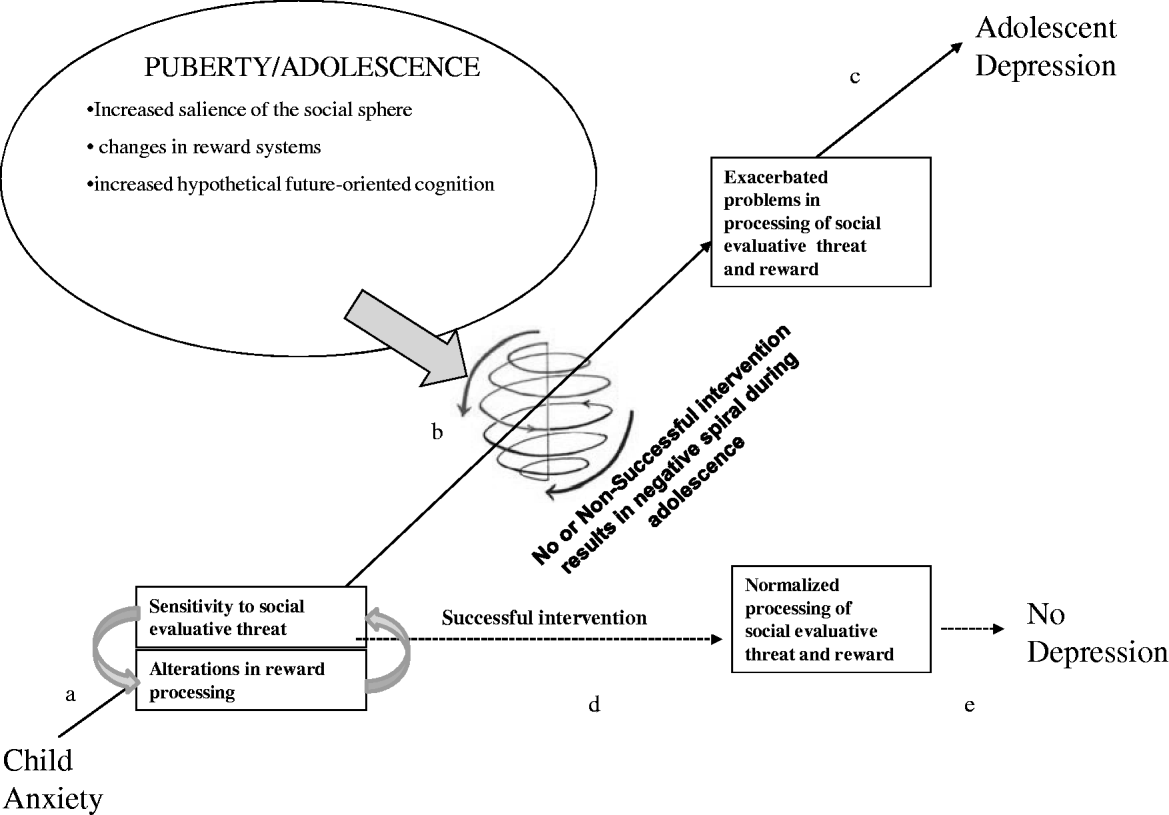
One important lead in identifying early intervention targets comes from the finding that anxiety disorders commonly precede the onset of depression in adolescence (Kovacs et al. Reference Kovacs, Gatsonis, Paulauskas and Richards1989; Brady & Kendall, Reference Brady and Kendall1992; Pine et al. Reference Pine, Cohen, Gurley, Brook and Ma1998). Epidemiological studies reveal that up to 75% of depressed youth have a history of at least one anxiety disorder (Kessler et al. Reference Kessler, Avenevoli and Merikangas2001). Conversely, in a large community study of adolescents, Orvaschel et al. (Reference Orvaschel, Lewinsohn and Seeley1995) found that 42% of youth with a first diagnosis of an anxiety disorder developed a second diagnosis of MDD by the 1-year follow-up. One of the best predictors of the presence of both depression and anxiety in youth is a family history of depression (Weissman et al. Reference Weissman, Fendrich, Warner and Wickramaratne1992, Reference Weissman, Wickramaratne, Nomura, Warner, Verdeli, Pilowsky, Grillon and Bruder2005). A recent meta-analysis of behavioral genetics studies of child anxiety and depression revealed that there is consistent evidence of a partly genetic basis for the co-morbidity between anxiety and depression, with the influence of genetic factors increasing in adolescence (Franic et al. Reference Franic, Middeldorp, Dolan, Ligthart and Boomsma2010). For example, Silberg et al. (Reference Silberg, Rutter, Neale and Eaves2001) showed that depression in adolescent girls is genetically correlated with earlier symptoms of anxiety. This literature points to the strong possibility that inherited neurobehavioral vulnerabilities may represent endophenotypes of risk for experiencing a trajectory from anxiety to depression. This paper highlights two neurobehavioral vulnerability factors that may be involved in the pathway from anxiety to depression in youth. Specifically, the model focuses on altered processing of social evaluative threat and reward as two vulnerabilities that: (a) are likely to be present in many, but not all, anxious youth, and (b) if present, are likely to be exacerbated by peri-pubertal developmental processes in ways that create a potential spiral toward depressive disorder (Fig. 1).
Theoretical model of proposed trajectory from anxiety to depression. This model proposes that many anxious youth experience increased sensitivity to social evaluative threat and altered reward processing (path a), which are also vulnerabilities for depression. These vulnerabilities are exacerbated by normative developmental changes of adolescence (path b), potentially leading to the development of depression in adolescence (path c). Although speculative at this point, the model proposes that successful intervention that alters these vulnerabilities could prevent the development of depression in anxious youth (path d/e).

Social evaluative threat and anxiety
We propose that sensitivity to perceived social threat is a core vulnerability that predisposes youth to early anxiety and later depression. A fundamental human characteristic is the need to preserve the social self, which includes vigilance to threats that may jeopardize social esteem, social status and relative self-worth (Bowlby, Reference Bowlby1969; Maslow, Reference Maslow1987; Baumeister & Leary, Reference Baumeister and Leary1995). Social evaluative threat occurs when a valued aspect of self-identity is, or is feared to be, negatively judged by others (Dickerson & Kemeny, Reference Dickerson and Kemeny2004). Social evaluative threats have been shown to be among the most salient stressors to the human neuroendocrine system (Dickerson & Kemeny, Reference Dickerson and Kemeny2004) and have also been shown to elicit stronger neural reactions among anxious adults than physical threat stimuli (Goldin et al. Reference Goldin, Manber, Hakimi, Canli and Gross2009).
Behavioral evidence for the link between social evaluative threat and anxiety
Biased attention towards threatening information, including social threat, is strongly associated with anxiety during adulthood (Williams et al. Reference Williams, Mathews and MacLeod1996) and several behavioral studies have now demonstrated that anxious children show an attentional bias toward threatening social information, including social threat words and faces (see Vasey et al. Reference Vasey, El-Hag and Daleiden1996; Taghavi et al. Reference Taghavi, Neshat-Doost, Moradi, Yule and Dalgleish1999; Ladouceur et al. Reference Ladouceur, Dahl, Williamson, Birmaher, Axelson, Ryan and Casey2006; Bar-Haim et al. Reference Bar-Haim, Lamy, Pergamin, Bakermans-Kranenburg and van Ijzendoorn2007; Telzer et al. Reference Telzer, Mogg, Bradley, Mai, Ernst, Pine and Monk2008). Anxious children also have a tendency to report more threatening interpretations of ambiguous social scenarios (Barrett et al. Reference Barrett, Rapee, Dadds and Ryan1996; Chorpita et al. Reference Chorpita, Albano and Barlow1996; Creswell et al. Reference Creswell, Schniering and Rapee2005).
Neuroimaging evidence for the link between social evaluative threat and anxiety
Existing neuroimaging research using social stimuli in youth is consistent with this model. Anxious youth show increased amygdala activity to fearful and angry faces relative to healthy controls (Thomas et al. Reference Thomas, Drevets, Dahl, Ryan, Birmaher, Eccard, Axelson, Whalen and Casey2001; McClure et al. Reference McClure, Monk, Nelson, Parrish, Adler, Blair, Fromm, Charney, Leibenluft, Ernst and Pine2007a ; Monk et al. Reference Monk, Telzer, Mogg, Bradley, Mai, Louro, Chen, McClure-Tone, Ernst and Pine2008b ), especially when attention is constrained toward evaluation of one's own emotion. Furthermore, amygdala activity to fearful and angry faces is associated with anxious symptomatology in youth with generalized anxiety disorder (GAD) and in non-clinical samples of adolescents (Killgore & Yurgelun-Todd, Reference Killgore and Yurgelun-Todd2005; Monk et al. Reference Monk, Telzer, Mogg, Bradley, Mai, Louro, Chen, McClure-Tone, Ernst and Pine2008b ).
One emerging research approach that taps more directly into the evaluative component of social threat processing is the use of virtual interaction and feedback paradigms (Guyer et al. Reference Guyer, Lau, McClure-Tone, Parrish, Shiffrin, Reynolds, Chen, Blair, Leibenluft, Fox, Ernst, Pine and Nelson2008a ; Masten et al. Reference Masten, Eisenberger, Borofsky, Pfeifer, McNealy, Mazziotta and Dapretto2009; Silk et al. Reference Silk, Stroud, Siegle, Dahl, Lee and Nelson2012). Guyer et al. (Reference Guyer, Lau, McClure-Tone, Parrish, Shiffrin, Reynolds, Chen, Blair, Leibenluft, Fox, Ernst, Pine and Nelson2008a , Reference Guyer, McClure-Tone, Shiffrin, Pine and Nelson2009) used a virtual chatroom task to investigate youths' neural response to anticipated and rigged feedback from virtual peers they believed had evaluated them as potential interaction partners for an upcoming online chat session. They found that anxious adolescents expected peers to rate them as less desirable and had greater activation in the amygdala than healthy controls when judging how interested the virtual peers would be in chatting with them, especially for peers they did not want to interact with (Guyer et al. Reference Guyer, Lau, McClure-Tone, Parrish, Shiffrin, Reynolds, Chen, Blair, Leibenluft, Fox, Ernst, Pine and Nelson2008a ).
Other relevant research has focused on cooperation and conflict in economic exchange tasks, such as the prisoner's dilemma (PD) game. McClure et al. (Reference McClure, Parrish, Nelson, Easter, Thorne, Rilling, Ernst and Pine2007b ) found that adolescents diagnosed with anxiety and/or depressive disorders were more cooperative in response to cooperative overtures from virtual peers compared to healthy adolescents. In a follow-up neuroimaging study, McClure-Tone et al. (Reference McClure-Tone, Nawa, Nelson, Detloff, Fromm, Pine and Ernst2011) found that anxious youth differed from healthy youth in neural activation during cooperation and conflict in multiple areas involved in self/other reflection and emotional information processing and were more likely than controls to cooperate after being betrayed by the virtual peer. These findings suggest that maintaining non-threatening interpersonal interactions is a salient goal for anxious youth.
Social threat biases have been observed most consistently in youth with GAD (Taghavi et al. Reference Taghavi, Neshat-Doost, Moradi, Yule and Dalgleish1999; Monk et al. Reference Monk, Klein, Telzer, Schroth, Mannuzza, Moulton, Guardino, Masten, McClure, Fromm, Blair, Pine and Ernst2008a ) and social anxiety (Alfano et al. Reference Alfano, Beidel and Turner2006; Guyer et al. Reference Guyer, Lau, McClure-Tone, Parrish, Shiffrin, Reynolds, Chen, Blair, Leibenluft, Fox, Ernst, Pine and Nelson2008a ), with some evidence for post-traumatic stress disorder (Dalgleish et al. Reference Dalgleish, Moradi, Taghavi, Neshat-Doost and Yule2001). However, given the high co-morbidity among anxiety disorders, it is difficult to ascertain whether these findings were due to youth having co-morbid anxiety diagnoses, and little research has been conducted with other types of anxiety-disordered youth. Additional research is needed on the extent to which sensitivity to social evaluative threat characterizes anxious youth who do not have GAD and/or social phobia.
Social evaluative threat and depression
Whereas heightened sensitivity to threat in anxiety disorder includes vigilance for both social and physical threat, depression is more specifically linked to interpersonal concerns. Depression is typically characterized by sensitivity to interpersonal threats such as rejection, defeat and humiliation (Coyne, Reference Coyne1976; Allen & Badcock, Reference Allen and Badcock2003). Major theories of depression highlight the role of interpersonal stress and sensitivity, including the interpersonal theory of depression (Coyne, Reference Coyne1976), attachment theory (Gilbert, Reference Gilbert1992), social competition theory (Price et al. Reference Price, Sloman, Gardner, Gilbert and Rohde1994), social risk theory (Allen & Badcock, Reference Allen and Badcock2003) and life stress models (Brown & Harris, Reference Brown and Harris1978).
Behavioral evidence for the link between social evaluative threat and depression
A large body of research on depressed adults indicates that they seek excessive reassurance about relationships and rely strongly on social approval for a sense of self-worth (Barnett & Gotlib, Reference Barnett and Gotlib1988; Joiner & Metalsky, Reference Joiner and Metalsky1995; Sheppard & Teasdale, Reference Sheppard and Teasdale1996). Interpersonal stressors are prevalent in the peer and family relationships of depressed youth (Messer & Gross, Reference Messer and Gross1995; Sheeber & Sorensen, Reference Sheeber and Sorensen1998; Olsson et al. Reference Olsson, Nordstrom, Arinell and von Knorring1999; Hammen & Brennan, Reference Hammen and Brennan2001; Abela et al. Reference Abela, Hankin, Haigh, Adams, Vinokuroff and Trayhern2005), and these youth are perceived and perceive themselves to be less socially competent than other youth (Connolly et al. Reference Connolly, Geller, Marton and Kutcher1992; Hammen et al. Reference Hammen, Shih and Brennan2004; Seeds et al. Reference Seeds, Harkness and Quilty2010). Life stress research has further shown that interpersonal stressors that threaten social relationships, such as romantic break-ups, often trigger the first episode of depression (Brown & Harris, Reference Brown and Harris1989; Lewinsohn et al. Reference Lewinsohn, Allen, Seeley and Gotlib1999). Research examining depressive symptoms in youth has linked peer rejection (Nolan et al. Reference Nolan, Flynn and Garber2003; Prinstein & Aikins, Reference Prinstein and Aikins2004), perceived lack of support from peers (Galambos et al. Reference Galambos, Leadbeater and Barker2004) and specific social evaluative concerns (Rudolph & Conley, Reference Rudolph and Conley2005) to depressive symptoms in adolescence.
Although interpersonal problems could be a risk factor or a concomitant feature of depression, several longitudinal studies have shown that interpersonal concerns are associated with increases in levels of depressive symptoms over time in community and high-risk samples (Harter & Whitesell, Reference Harter and Whitesell1996; Hammen et al. Reference Hammen, Shih and Brennan2004; Prinstein & Aikins, Reference Prinstein and Aikins2004; Rudolph & Conley, Reference Rudolph and Conley2005; Allen et al. Reference Allen, Insabella, Porter, Smith, Land and Phillips2006; Lee et al. Reference Lee, Hankin and Mermelstein2010). Although these studies support the importance of investigating social evaluative threat in child and adolescent depression, more research is needed examining specific social evaluative concerns in clinical samples of depressed youth.
Neuroimaging evidence for the link between social evaluative threat and depression
Emerging evidence from affective neuroscience research provides further support for altered sensitivity to social threat in depression. For example, Beesdo et al. (Reference Beesdo, Lau, Guyer, McClure-Tone, Monk, Nelson, Fromm, Goldwin, Wittchen, Leibenluft, Ernst and Pine2009) found that youth with MDD showed amygdala hyperactivation to threatening faces when rating their own fear. Furthermore, Killgore & Yurgelun-Todd (Reference Killgore and Yurgelun-Todd2006) and Forbes et al. (Reference Forbes, Phillips, Silk, Ryan and Dahl2011) have shown that increased activity in the medial prefrontal cortex (PFC) when viewing threatening faces is associated with increased depressive symptoms in adolescents. Masten et al. (Reference Masten, Eisenberger, Borofsky, McNealy, Pfeifer and Dapretto2011) have shown, using a virtual ball-tossing task, that greater activity in the subgenual anterior cingulate cortex (ACC) and the dorsomedial PFC during exclusion were associated with increases in depressive symptoms over 1 year in adolescents. Collectively, these findings suggest that depression in youth is associated with increased reactivity in amygdalar and prefrontal circuits in response to social stimuli; however, additional research is needed in clinical samples using explicit social evaluative stimuli, such as peer feedback tasks.
Gender differences in social evaluative threat and depression
Increased sensitivity to interpersonal threat among girls compared to boys may be one mechanism through which the gender difference in rates of depression emerges during adolescence. Females seem to have greater investment in interpersonal relationships and are more concerned about peer evaluation (La Greca & Lopez, Reference La Greca and Lopez1998; Rose & Rudolph, Reference Rose and Rudolph2006), potentially making them more sensitive to the effects of interpersonal stress and evaluation than males (Rudolph, Reference Rudolph2002). Several models have been put forth linking sensitivity to interpersonal stress in girls to the emergence of gender differences in depression (Nolen-Hoeksema, Reference Nolen-Hoeksema1994; Leadbeater et al. Reference Leadbeater, Blatt and Quinlan1995; Cyranowski et al. Reference Cyranowski, Frank, Young and Shear2000; Hammen et al. Reference Hammen, Brennan and Keenan-Miller2008). Future research is needed to determine whether gender differences in interpersonal sensitivity are also present in anxious youth, and can help to explain the gender differences in the trajectory toward depression in this population.
Reward processing and depression
Our model proposes that a second key neurobehavioral risk factor linking anxiety and depression is alterations in reward processing. Key symptoms of depression, such as anhedonia and social withdrawal, are thought to be related to alterations in seeking rewards and experiencing positive affect in anticipation of, and during receipt of, rewards (Forbes & Dahl, Reference Forbes and Dahl2005; Forbes, Reference Forbes2009). Affective neuroscience models highlight the importance of reward processing in the phenomenology and underlying neurobiology of positive affect (Rolls, Reference Rolls1999). Important aspects of reward processing include the motivation to obtain rewards, the execution of reward-seeking behaviors, and the hedonic aspects of experiencing a reward (Forbes & Dahl, Reference Forbes and Dahl2005).
Behavioral evidence for the link between reward processing and depression
Numerous self-report studies have shown that adolescents with depression and/or heightened depressive symptomatology report decreased positive affect relative to healthy adolescents (Chorpita, Reference Chorpita2002; Lonigan et al. Reference Lonigan, Phillips and Hooe2003; Forbes et al. Reference Forbes, Williamson, Ryan and Dahl2004). Laboratory studies focusing on reward processing have also revealed decreased reward-responding behavior in depressed adolescents (Jazbec et al. Reference Jazbec, McClure, Hardin, Pine and Ernst2005; Forbes et al. Reference Forbes, Shaw and Dahl2007). For example, Jazbek et al. (Reference Jazbec, McClure, Hardin, Pine and Ernst2005) found that, whereas healthy adolescents modulated performance on an anti-saccade task as a function of monetary incentives, depressed adolescents' performance was not influenced by manipulations of reward incentives.
Neuroimaging evidence for the link between reward processing and depression
In neuroimaging studies, adult depression has been associated with reduced activation in striatal areas (Lawrence et al. Reference Lawrence, Williams, Surguladze, Giampietro, Brammer, Andrew, Frangou, Ecker and Phillips2004; Surguladze et al. Reference Surguladze, Brammer, Keedwell, Giampietro, Young, Travis, Williams and Phillips2005; Epstein et al. Reference Epstein, Pan, Kocsis, Yang, Butler, Chusid, Hochberg, Murrough, Strohmayer, Stern and Silbersweig2006) and enhanced activation in ventromedial PFC areas related to social cognition and contingency evaluation (Keedwell et al. Reference Keedwell, Andrew, Williams, Brammer and Phillips2005) in response to positive (versus neutral) stimuli. Neuroimaging studies of reward processing in youth also show decreased striatal activity and increased medial PFC activity in depressed youth relative to healthy controls (Forbes et al. Reference Forbes, May, Siegle, Ladouceur, Ryan, Carter, Birmaher, Axelson and Dahl2006, Reference Forbes, Hariri, Martin, Silk, Moyles, Fisher, Brown, Ryan, Birmaher, Axelson and Dahl2009). Forbes et al. (Reference Forbes, Hariri, Martin, Silk, Moyles, Fisher, Brown, Ryan, Birmaher, Axelson and Dahl2009) found that decreased striatal activity was associated with decreased positive affect in the natural environment reported through ecological momentary assessment. Studies have also reported decreased striatal activity in healthy youth at high risk for depression (Monk et al. Reference Monk, Klein, Telzer, Schroth, Mannuzza, Moulton, Guardino, Masten, McClure, Fromm, Blair, Pine and Ernst2008a ).
Reward processing and anxiety
Behavioral evidence for the link between reward processing and anxiety
Less is known about the role of reward processing in anxiety, and most studies have focused on the broader construct of positive affect. Although the tripartite model posits that reduced positive affect is specific to depression rather than anxiety in adults (Clark & Watson, Reference Clark and Watson1991), several investigations have shown reduced positive affect in anxious youth, especially those with social anxiety (Joiner et al. Reference Joiner, Blalock and Wagner1999; Chorpita et al. Reference Chorpita, Plummer and Moffitt2000; Jacques & Mash, Reference Jacques and Mash2004; Anderson et al. Reference Anderson, Veed, Inderbitzen-Nolan and Hansen2010). Other studies, however, have failed to find evidence for reduced positive affect in child anxiety (Lonigan et al. Reference Lonigan, Hooe, David and Kistner1999; Chorpita, Reference Chorpita2002). We argue that disruptions in positive affect and reward processing may be found in a subset of anxious youth, and it is this subset of anxious youth that will be most vulnerable to the development of depression.
In support of this model, several studies have shown evidence of positive affect disruptions in anxiety. One meta-analysis revealed that anxious individuals have a reduced attentional bias toward positive stimuli compared to low-anxiety individuals (Frewen et al. Reference Frewen, Dozois, Joanisse and Neufeld2008). Other studies have shown that young adults with anxiety disorders or heightened anxious symptoms tend to focus on anxious feelings during activities that could generate positive emotion, have lower expression of positive emotions and report elevated fear of positive emotions (Roemer et al. Reference Roemer, Salters, Raffa and Orsillo2005; Turk et al. Reference Turk, Heimberg, Luterek, Mennin and Fresco2005; Kashdan & Steger, Reference Kashdan and Steger2006; Eisner et al. Reference Eisner, Johnson and Carver2009). These alterations in self-reported positive emotion in anxious individuals are found even when controlling for depressive symptoms (Kashdan & Steger, Reference Kashdan and Steger2006; Eisner et al. Reference Eisner, Johnson and Carver2009). In one of the only behavioral studies to focus on reward processing in anxious youth, Jazbec et al. (Reference Jazbec, McClure, Hardin, Pine and Ernst2005) found that incentives improved efficiency of performance on an anti-saccade task for healthy youth but not for youth with GAD. This suggests that enhancement of performance by reward may be attenuated in anxious youth who are overly cautious about making errors.
Neuroimaging evidence for the link between reward processing and anxiety
Consistent with these findings, Forbes et al. (Reference Forbes, May, Siegle, Ladouceur, Ryan, Carter, Birmaher, Axelson and Dahl2006) have shown similarities between anxious and depressed youth during reward processing on a monetary reward task. Both showed blunted response in the left caudate but increased amygdala activity to high-reward outcomes relative to healthy controls. Forbes et al. (Reference Forbes, May, Siegle, Ladouceur, Ryan, Carter, Birmaher, Axelson and Dahl2006) also found that, unlike depressed youth, anxious youth showed heightened orbitofrontal cortex (OFC) activity during anticipation of high-magnitude rewards, potentially suggesting enhanced sensitivity to contingencies (Forbes et al. Reference Forbes, May, Siegle, Ladouceur, Ryan, Carter, Birmaher, Axelson and Dahl2006). Two studies have also shown that adolescents who were characterized as behaviorally inhibited as young children show increased striatal response to contingent monetary rewards relative to healthy controls (Guyer et al. Reference Guyer, Nelson, Perez-Edgar, Hardin, Roberson-Nay, Monk, Bjork, Henderson, Pine, Fox and Ernst2006; Bar-Haim et al. Reference Bar-Haim, Fox, Benson, Guyer, Williams, Nelson, Perez-Edgar, Pine and Ernst2009). These studies point to alterations in reward processing in anxious youth, but additional research is needed to clarify conditions under which anxious youth may be hyper- and hypo-responsive to reward and whether there are differences based on anxiety subtype. Furthermore, little research has been conducted using socially relevant stimuli.
Potential for threat processing to interfere with reward processing
Based on the findings reviewed above, we propose that anxious youth have an intact or even increased capacity to experience reward in non-threatening contexts. However, reward seeking and processing for some anxious youth may be inhibited or interrupted in social contexts by self-referential and threat-processing systems that bring fear of failure, negative evaluation and avoidance to the cognitive forefront. This is consistent with evidence that social comparison plays a key role in reward processing (Fliessbach et al. Reference Fliessbach, Weber, Trautner, Dohmen, Sunde, Elger and Falk2007). Furthermore, it is known that threat and reward processing are performed by distinct and sometimes competing attentional systems, and that threat processing ‘trumps’ or interrupts reward processing, even in healthy individuals (Kahneman & Beatty, Reference Kahneman and Beatty1966; Frewen et al. Reference Frewen, Dozois, Joanisse and Neufeld2008). For example, in behavioral economics research, fundamental human risk aversion leads healthy adults to predictably choose a safe option over a high reward option that carries potential loss or punishment (Kahneman & Tversky, Reference Kahneman, Tversky, Arrow, Mnookin, Ross, Tversky and Wilson1995). Similarly, in a task that includes cues for reward, punishment and an ambiguous cue that could signal reward or punishment, we have found that healthy youth rarely respond to the ambiguous cue (Schlund et al. Reference Schlund, Siegle, Ladouceur, Silk, Cataldo, Forbes, Dahl and Ryan2010).
These findings suggest that when threat and reward are in conflict, threat typically wins. In the short run, it is adaptive to notice and respond to threats. However, too many small threats that pull for fast attention may begin to override the reward system in the long run. This process is present in healthy individuals but is likely to be more problematic for anxious individuals, for whom threat cues are prevalent even in ambiguous and sometimes innocuous social scenarios (Creswell et al. Reference Creswell, Schniering and Rapee2005). Adolescence, in particular, is filled with ambiguous social cues that may easily be misinterpreted by vigilant youth. As a result of differences in fear learning and fear conditioning (see Britton et al. Reference Britton, Lissek, Grillon, Norcross and Pine2011), anxious youth may also have difficulties perceiving ‘safety’ cues present in social situations that might otherwise allow them to enjoy the situation without fear. This conceptualization is consistent with clinical reports of anxious youth who are often too fearful to engage in mildly risky but rewarding activities such as going to a party, sleeping away from home, or going on amusement park rides.
Developmental changes in processing of social evaluative information in adolescence
From a developmental psychopathology framework, an examination of normative developmental processes can provide important information about processes that may go awry in atypical development, potentially resulting in psychopathology (Cicchetti, Reference Cicchetti1993). Alterations in both social evaluative threat and reward processing could be amplified in anxious youth by normative developmental processes in ways that may further increase the likelihood of developing depression during adolescence. Changes in the social context contribute to increased salience of the social sphere and perceived social evaluation in daily life. Parent–child conflict increases around the onset of pubertal maturation (Steinberg, Reference Steinberg1988). Social affiliation with peers and romantic interests becomes increasingly important and emotionally charged (Larson & Asmussen, Reference Larson, Asmussen, Colten and Gore1991). Adolescent peer and romantic relationships are unstable and volatile and involve increasingly complex and salient social hierarchies (Connolly et al. Reference Connolly, Furman and Konarski2000; Brown, Reference Brown, Lerner and Steinberg2004). Social comparison and even mocking of lower status individuals becomes entrenched in daily life, making adolescents particularly sensitive to cues of social acceptance, rejection and reputation (Adler & Adler, Reference Adler and Adler1998; Brown, Reference Brown, Lerner and Steinberg2004).
The adolescent brain also undergoes significant remodeling during adolescence (Spear, Reference Spear2000). Some of these changes seem to be associated with pubertal development through the activational influences of steroid hormones (see Sisk & Foster, Reference Sisk and Foster2004; Nelson et al. Reference Nelson, Leibenluft, McClure and Pine2005; Patton & Viner, Reference Patton and Viner2007). There is some evidence that change in regions of the brain involved in emotional reactions such as responding to social stimuli may be particularly linked to pubertal maturation (see Nelson et al. Reference Nelson, Leibenluft, McClure and Pine2005; Steinberg, Reference Steinberg2007; Forbes et al. Reference Forbes, Phillips, Silk, Ryan and Dahl2011). The brain systems that respond to social information and emotions seem to become more sensitive and/or active during puberty (see Spear, Reference Spear2000; Dahl, Reference Dahl2001; Nelson et al. Reference Nelson, Leibenluft, McClure and Pine2005; Steinberg, Reference Steinberg2007; Silk et al. Reference Silk, Siegle, Whalen, Ostapenko, Ladouceur and Dahl2009). For example, Silk et al. (Reference Silk, Stroud, Siegle, Dahl, Lee and Nelson2012) found evidence for increased sensitivity to social evaluation across adolescence in a virtual peer interaction chatroom task. Specifically, pupillary reactivity to peer rejection and visual biases toward acceptance stimuli increased linearly with age among 9- to 17-year-olds.
Several neuroimaging studies show increased neural activity on emotional face-processing tasks in adolescents compared to adults. Adolescents have been found to have greater amygdala reactivity relative to adults to sad and fearful faces (Killgore & Yurgelun-Todd, Reference Killgore and Yurgelun-Todd2007; Guyer et al. Reference Guyer, Monk, McClure-Tone, Nelson, Roberson-Nay, Adler, Fromm, Leibenluft, Pine and Ernst2008b ) and greater activation in the amygdala, medial PFC and ACC compared to adults during passive viewing of emotional faces (Monk et al. Reference Monk, McClure, Nelson, Zarahn, Bilder, Leibenluft, Charney, Ernst and Pine2003). Monk et al. (Reference Monk, McClure, Nelson, Zarahn, Bilder, Leibenluft, Charney, Ernst and Pine2003) observed that adolescents were more sensitive to the emotional content than to the attentional demands of a face-processing task, whereas adults showed the opposite pattern. Furthermore, amygdala activity in adolescence seems to be strongly related to social dimensions of anxiety (Killgore & Yurgelun-Todd, Reference Killgore and Yurgelun-Todd2005). Research is lacking, however, on neurodevelopmental changes in sensitivity to social and emotional stimuli during the transition from childhood to adolescence. One study has shown increased amygdala activity to interfering emotional faces in adolescents compared to younger children and adults (Hare et al. Reference Hare, Tottenham, Galvan, Voss, Glover and Casey2008), but most existing neuroimaging research compares adolescents to adults but not to children.
Developmental changes in reward processing in adolescence
Normative development and reward processing
Adolescence is also associated with a sharp increase in reward seeking and risk-taking behavior across species (see Spear, Reference Spear2000, Reference Spear2011). Adolescents seek out experiences that create high-intensity feelings and are more prone to risk taking (e.g. Martin et al. Reference Martin, Kelly, Rayens, Brogli, Brenzel, Smith and Omar2002). Increased sensation seeking is linked to pubertal maturation and shown to increase between the ages of 10 and 15 years (Steinberg et al. Reference Steinberg, Albert, Cauffman, Banich, Graham and Woolard2008). This behavioral change is thought to be related to changes in dopaminergic systems in adolescence, including changes in the firing rates, density and concentration of dopamine fibers and receptors and a shift in the balance of dopamine receptors across brain regions (see reviews by Ernst et al. Reference Ernst, Romeo and Andersen2009; Galvan, Reference Galvan2010; Wahlstrom et al. Reference Wahlstrom, Collins, White and Luciana2010).
Forbes et al. (Reference Forbes, Ryan, Phillips, Manuck, Worthman, Moyles, Tarr, Sciarrillo and Dahl2010) examined puberty-specific changes in reward responding based on a large sample of early adolescents matched for age but differing in pubertal status. They found that adolescents more advanced in pubertal maturation exhibited less striatal reactivity to reward receipt than adolescents in pre- or early pubertal stages. Additionally, more pubertally mature adolescents exhibited more medial PFC activity during reward outcome than pre-/early pubertal age-matched adolescents (Forbes et al. Reference Forbes, Ryan, Phillips, Manuck, Worthman, Moyles, Tarr, Sciarrillo and Dahl2010). Increased reward seeking among typical adolescents could be a compensatory behavior for decreased dopaminergic striatal reactivity (Spear, Reference Spear2000). However, although several studies have observed hypo-reactivity to reward in adolescents (Bjork et al. Reference Bjork, Knutson, Fong, Caggiano, Bennett and Hommer2004, Reference Bjork, Smith, Chen and Hommer2010; Forbes et al. Reference Forbes, Ryan, Phillips, Manuck, Worthman, Moyles, Tarr, Sciarrillo and Dahl2010), other studies have reported evidence of hyper-reactivity (Ernst et al. Reference Ernst, Nelson, Jazbec, McClure, Monk, Leibenluft, Blair and Pine2005; Galvan et al. Reference Galvan, Hare, Parra, Penn, Voss, Glover and Casey2006). Spear (Reference Spear2011) and Galvan (Reference Galvan2010) suggest that these discrepant findings may be related to differences in responding to reward anticipation versus receipt of reward and other contextual features such as the type and magnitude of the reward.
Although the precise neural mechanisms are in need of further clarification, it remains clear that increased reward-seeking behaviors are normative in adolescence. Anxious youth may find it particularly difficult or aversive to engage in adolescent-normative sensation-seeking behaviors because of excessive worrying, vigilance and avoidance behaviors. Avoidance of age-normative risky and sensation-seeking behaviors that are high in reward value may result in lower levels of positive affect relative to healthy peers along with increased social isolation and withdrawal. These differences in motivation, mood and social interaction could emerge as precipitators or early symptoms of depression.
Adolescent development and reward processing: links to depression
Davey et al. (Reference Davey, Yucel and Allen2008) present a complementary model describing how the maturation of the PFC during adolescence may also influence reward processing and depression. Cognitive changes in early adolescence, such as advanced hypothetical thinking, allow for representation of increasingly complex social and future-oriented rewards. These cognitive changes converge with the biological and social changes reviewed above to place a premium on abstract social rewards (i.e. becoming ‘popular’, falling in love, being successful), which are also tenuous and easily frustrated. Davey et al. (Reference Davey, Yucel and Allen2008) point out that repeated failure or frustration of social rewards could lead to suppression of the reward system, eventually resulting in anhedonia (Bogdan & Pizzagalli, Reference Bogdan and Pizzagalli2006; Frewen et al. Reference Frewen, Dozois, Joanisse and Neufeld2008). Animal studies demonstrate that the reward system is suppressed when an expected reward is omitted (Hollerman & Schultz, Reference Hollerman and Schultz1998; Schultz, Reference Schultz1998). Additionally, stress has been shown to increase anhedonic behavior (Zacharko et al. Reference Zacharko, Bowers, Kokkinidis and Anisman1983; Berenbaum & Connelly, Reference Berenbaum and Connelly1993; Wise, Reference Wise2004; Malkesman et al. Reference Malkesman, Braw, Zagoory-Sharon, Golan, Lavi-Avnon, Schroeder, Overstreet, Yadid and Weller2005; Willner, Reference Willner2005; Bogdan & Pizzagalli, Reference Bogdan and Pizzagalli2006). For example, Bogdan & Pizzagalli (Reference Bogdan and Pizzagalli2006) found decreased reward responding in adult humans during a laboratory stressor involving social evaluation. Relatedly, first episodes of depression often result from the frustration or omission of highly anticipated social rewards (Davey et al. Reference Davey, Yucel and Allen2008).
We argue that the Davey et al. (Reference Davey, Yucel and Allen2008) model is particularly relevant to anxious youth at risk for depression. Anxious youth desire complex social rewards just like other adolescents, but fearful avoidance inhibits many anxious youth from seeking and ultimately attaining such rewards. Thus, anxious adolescents who are less likely to seek and obtain social and high-risk rewards, and are also more sensitive to social evaluation regarding reward status, are at especially high risk for distress related to failure to obtain reward. Repeated and chronic suppression of the dopaminergic reward system due to fear, avoidance and related stress may therefore lead to anhedonia over time, providing a link between anxiety and depression. Again, this process may be heightened for girls because affiliative rewards are known to have greater salience for females than males (Davey et al. Reference Davey, Yucel and Allen2008).
Conclusions
We have reviewed evidence that the processing of social evaluative threat and reward may play a role in the trajectory from anxiety to depression in adolescence, but additional research is needed to validate this model. First, although existing research suggests that anxious and depressed youth are both reactive to threatening or negative socio-emotional stimuli, research is needed using ecologically valid paradigms that can more specifically assess reactions to social evaluation. Second, although there is strong evidence of alterations in reward processing in adolescent depression, the role of reward processing in child anxiety is not as well understood. Additional research is needed to understand whether there are subtypes of anxious youth who show altered reward processing, and specific conditions in which anxious youth show altered reward processing. Third, prospective longitudinal research is needed to determine whether anxious youth with greater behavioral and neural alterations in responses to social evaluative and reward-related stimuli are more likely than other anxious and healthy youth to develop depression during the transition to adolescence.
Another important direction is to consider how reactivity to social evaluative threat and reward may interact with each other. For example, Gardner & Steinberg (Reference Gardner and Steinberg2005) have shown that the presence of peers makes adolescents more likely to engage in high-risk/high-reward behaviors. Spear (Reference Spear2011) proposes that cross-reactivity between circuitry involved in the processing of reward-relevant and threatening stimuli may be particularly high in adolescence. Heightened interactivity between these systems during adolescence could further help to explain the spiral toward depression among vulnerable youth.
One crucial question for future research is whether providing early intervention for anxious youth that addresses alterations in social evaluative threat and reward processing could prevent the onset of later depressive disorders in these youth. Existing research on depression prevention reveals that programs targeted at individuals at specific risk are more effective than universal prevention (Horowitz & Garber, Reference Horowitz and Garber2006). Bolstering or directing treatment efforts towards anxious youth, particularly those with deficits in these areas, could be a cost-effective and efficacious approach for depression prevention.
This model also suggests that existing treatments for child anxiety might benefit from increased attention to social evaluative concerns and reward processing. Cognitive behavioral therapy (CBT) for child anxiety typically involves completion of exposures to a hierarchy of feared situations. Although social evaluative fears are common in anxious youth, it is difficult to create exposures in the clinic that capture the types of peer-related social concerns that adolescents encounter in daily life. Creative use of new social media technologies may provide one means for integrating peer interaction into clinic-based exposures. Approaches that address positive affect and reward processing (e.g. pleasant event planning) have been incorporated into treatments for adolescent depression, but positive affect is rarely addressed explicitly in treatments for child anxiety. Interventions that help anxious youth not only to plan and engage in pleasant events but also to sustain positive affective states through strategies such as savoring may be useful to consider (Bryant & Veroff, Reference Bryant and Veroff2006; McMakin et al. Reference McMakin, Siegle and Shirk2011). For example, anticipating the positive aspects of an upcoming event (e.g. anticipatory savoring), such as a sleepover, may increase appetitive drives and help to overcome perceived threats (e.g. negative evaluation) related to the event. It may also be helpful to teach youth who have a tendency to get thwarted by perceived threat or anxious feelings in otherwise positive situations to use strategies to flexibly switch back toward positive affective states. Using strategies such as these to sustain positive affective states may help to stimulate mesolimbic areas involved in activating positive emotions and appetitive drives, and also potentially improve or strengthen connections between mesolimbic reward-related areas and prefrontal regulatory control areas. Importantly, these are the same areas that undergo remodeling during the adolescent period, suggesting that there may be an enhanced opportunity for such strategies to alter developmental trajectories of reward related circuitry.
Future research on components of this model may also provide information about the optimal timing of interventions. Successful interventions that occur prior to the destabilizing effects of pubertal development may be more effective at preventing future depressive symptoms by resolving problems in threat and reward processing before they have a chance to interact with the exacerbating developmental features of adolescence.
Acknowledgments
This research was supported by National Institute of Mental Health (NIMH) Grant R01 MH091327 (P.I.: Silk).
Declaration of Interest
None.