





Introduction
Civil society is a major site of opposition against populist parties in Europe, as a recent survey of initiatives opposing Fidesz in Hungary, Law and Justice in Poland, Alternative for Germany, League and Five Star Movement in Italy, Vox and Podemos in Spain, the Sweden Democrats and the Danish People’s Party has shown (see Initiatives Opposing Populist Parties in Europe (IoPP) dataset, Bourne et al. Reference Bourne, Moroska-Bonkiewicz, Domagała, Tyszka, Laumond, Campo and Nicolaisen2024; Bourne Reference Bourne2024a). Civil society actors are conceived, following Keane, as ‘legally protected non-governmental institutions that tend to be non-violent, self-organizing, self-reflexive, and permanently in tension with each other and with the state institutions that “frame”, constrict and enable their activities’ (Reference Keane1998, 6). Civil society groups have organized demonstrations and denounced or demonized populist policies in the public sphere. They have investigated and publicized allegations of wrongdoing, taken populist parties to court, criticized and lampooned them in art, and excluded them from membership or events on principled grounds. Political violence was sometimes used – or threatened – against populist parties, and their property was damaged. Networks of transnational organizations have monitored, reported on, and critiqued populist parties in the public sphere.
Despite this clear evidence of extensive mobilization, studies of civil society’s opposition to populist parties are relatively rare. Populists are conceived as those invoking a vision of society sharply divided between ‘the people’ and ‘elite’ (eg Mudde and Rovira Kaltwasser Reference Mudde and Rovira Kaltwasser2017; Laclau Reference Laclau2005). The literature on responses to populist parties is overshadowed by analysis of responses by political parties (eg van Spanje Reference Van Spanje2018; Albertazzi and Vampa Reference Albertazzi and Vampa2021); national public authorities, such as courts and internal security services (eg Bleich Reference Bleich2011); and the European Union’s handling of the ‘rule of law’ crisis and democratic backsliding (eg Closa Reference Closa2021; Coman Reference Coman2022). Yet in addition to the IoPP dataset, several case studies document important instances of that opposition, such as large-scale mobilizations, such as The Sardine mobilizing against League in Italy (Hamdaoui Reference Hamdaoui2021), and the Polish Law and Justice government’s judicial reforms by the Committee for the Defence of Democracy and the women’s Black Protests in 2016 (Bojarski Reference Bojarski2021; Gwiazda Reference Sommer, McCoy and Luke2021). While several studies consider civil society actors as one among several types of opponents (see, for example, Rummens and Abts Reference Rummens and Abts2010, 652; Rovira Kaltwasser and Taggart Reference Rovira Kaltwasser and Taggart2016; Bourne Reference Bourne2023, Reference Bourne2024a), few focus specifically on civil society actors as opponents to increasingly successful populist parties (for exceptions see Campo Reference Campo2023, Moroska-Bonkiewicz and Domagała Reference Moroska-Bonkiewicz and Domagała2023).
Understanding the impact of civil society is challenging both empirically and methodologically. Specialists on social movements, for example, acknowledge that ‘the capacity… to realize their general aims has been considered low’ (della Porta and Diani Reference Jacobs and van Spanje2020, 239; Amenta and Caren Reference Amenta, Caren, Snow, Soule and Kriesi2007, 462). States and political parties targeted by civil society actors typically ‘dwarf social movements in terms of size, resources, and power’ (Amenta and Caren Reference Amenta, Caren, Snow, Soule and Kriesi2007, 462). It can also be challenging to identify the independent effects of mobilization by civil society actors on outcomes of interest (Giugni Reference Giugni, Giugni, Tilly and McAdam1999; Rochon Reference Rochon2018, 48–50). Nevertheless, as I show in this article, existing research provides many insights on the effect of mobilization by civil society actors more generally, which can be applied in the case at hand. The main contribution is to systematically review this literature, identifying theories, concepts, and illustrative examples to guide future research more generally, and several articles in this Special Issue more specifically. The article’s predominant focus on right-wing populist parties mirrors the predominance of such parties in Europe, although left-wing and ‘valence’ populists (Zulianello Reference Zulianello2020) like Podemos in Spain, SMER in Slovakia, and Five Star Movement in Italy are also addressed.
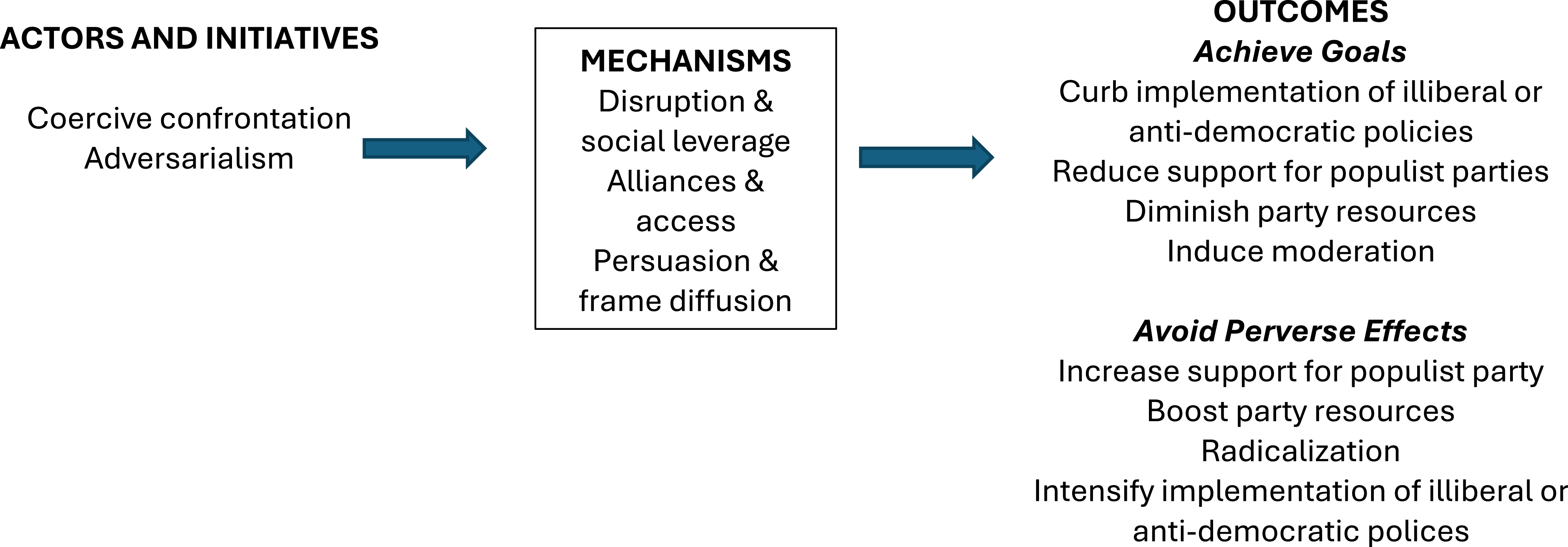
The argument I present here draws on a broader framework, also including national public authorities and international organizations, and national and transnational political parties (Bourne Reference Bourne2023). In this work, effective opposition is conceived as the achievement of one or more goals typically pursued by the opponents of populist parties without achieving perverse effects. As Figure 1 shows, goals of opposition are reducing support for populist parties; diminishing their material, organizational, and moral resources; ideological moderation; and, where relevant, curbing their ability to implement illiberal or undemocratic policies. Perverse effects, from the point of view of opponents, are increased support for populist parties, boosting populist party resources, and the ideological radicalization of populist parties. Empirical findings in Tyszka and Olsen’s article in this Special Issue, showing a deterioration in illiberal policies and practices in light of civil disobedience against Hungary’s former governing Fidesz party, lead to an extension of this framework. It now includes an additional perverse effect, namely intensifying implementation of illiberal or undemocratic policies.
Effective opposition to populist parties by civil society actors.

As Figure 1 shows, disruption, alliances, and persuasion are central theoretical constructs in the framework. They emerged in an abductive process starting with an analysis of secondary literature of high-profile civil society actors, movements, and events discovered in the IoPP dataset (Bourne et al. Reference Bourne, Moroska-Bonkiewicz, Domagała, Tyszka, Laumond, Campo and Nicolaisen2024), from country case studies analyzing that data (Bourne Reference Bourne2024a), and a systematic review of the Political Data Yearbook for countries with populist party-led governments. Analysis of secondary literature was then combined with a reading of the literature on effects of social movement mobilization, which is the most systematic body of work on the effects of civil society strategies.
A second contribution is to bridge the literature on civil society opposition to populist parties with work on democratic resilience. Democratic resilience is the capacity to withstand, adapt to, and/or recover from pressures, shocks, or threats to democratic institutions and practices (Boese, Edgell, Hellmeier et al. Reference Boese, Edgell, Hellmeier, Maerz and Lindberg2021; Merkel and Lührmann Reference Merkel and Lührmann2021; Croissant and Lott Reference Croissant and Lott2025). While themes of ‘democratic defence’ are a master frame of opposition by civil society actors to populist parties (Bourne Reference Bourne2024b and Reference Bourne2025) and some populist parties do threaten liberalism, democracy or both (Nord, Altman, Angiolillo et al. Reference Nord, Altman, Angiolillo, Fernandes, Good God and Lindberg2025), the article does not assume that populist parties are necessarily a threat to liberal democracy. Nor does it assume that opponents are necessarily anti-populists, pursuing a strategy that vilifies populists to ‘strip them of any morally redeemable quality in the contest of electoral politics’ (Stavrakakis Reference Stavrakakis2018, 53). Some have used this strategy, but not all (Bourne Reference Bourne2024b). In the article, I argue that despite many conceptual overlaps with recent work on democratic resilience, the theoretical framework presented offers a broader perspective – if and when – civil society needs to act to prevent threats to liberal democracy. That is, the theoretical framework extends the focus of analysis beyond governing elites to also consider non-governing, but influential actors such as salient opposition parties. It also conceives of effectiveness as not just a strategic, rational reaction by targeted parties to changing incentives, but considers the impact of constructivist processes of framing and diffusion of new ideas.
The article is structured around a discussion of theory and illustrative examples of the three mechanisms of effective opposition to populist parties, namely disruption and social leverage, alliances and access, and persuasion and frame diffusion, with reflections on democratic resilience developed in the conclusion.
Disruption and social leverage
Disruption occurs, as Fox Piven and Cloward argue, when ‘people cease to conform to accustomed institutional roles; they withhold their accustomed cooperation, and by doing so, cause institutional disruptions’ (Reference Fox Piven and Cloward1978, 24). This defiance obstructs ‘normal operation of institutions’ as well as ‘routine activities of opponents, bystanders, or authorities’: factories may shut down when employees walk out, protesters demanding new benefits may create chaos for social services, and landlords lose money in a rent strike (Ibid). Online sabotage may disrupt the normal operation of public or private institutions (Earl Reference Earl, Bosi, Giugni and Uba2016, 275–384). Disruption not only ‘challenges authorities’, but ‘emboldens supporters, and keeps the public interested and amused’ (Tarrow Reference Tarrow2011, 101, 104). Its effectiveness depends on whether ‘the contribution withheld is crucial to others’, ‘those who have been affected by the disruption have resources to be conceded’ and ‘the obstructionist group can protect itself adequately from reprisals’ (Fox Piven and Cloward Reference Fox Piven and Cloward1978, 25). However, disruption may also be ignored or repressed if ‘the disruptive group has little political leverage in its own right’ or if the ‘disrupted institution is not central to the society as a whole’, especially during periods of political stability (Ibid, 26–27; Kolb Reference Kolb2007, 74).
Disruptive protest entails ‘the withdrawal of a crucial contribution on which others depend, and it is therefore a natural resource for exerting power over others’ (Fox Piven and Cloward Reference Fox Piven and Cloward1978, 24). Indeed, as Tarrow argues, insofar as it ‘spreads uncertainty and gives weak actors leverage against powerful opponents’, disruption is ‘the strongest weapon of social movements’ (Reference Tarrow2011, 103). If disruptive protest ‘jeopardizes something the government values – for example a certain reputation, social peace, or their continued electoral success’, protestors are more likely to be able to ‘extract material compensations in exchange for restoring order’ (Kolb Reference Kolb2007, 74). If disruption becomes a broader political crisis, it can create a new sense of urgency, prioritizing the demands of opponents; create the fear that a failure to respond may ultimately endanger lives or property; or discredit incumbents, usher in a new government to enact extensive reform, or even result in regime change (Ibid, 76). In highly competitive or crisis situations, political elites are more vulnerable to institutional disruption because the ‘relationship with their constituents is likely to become uncertain’ and it is ‘more likely that previously uninvolved groups will be activated’ (Fox Piven and Cloward Reference Fox Piven and Cloward1978, 28; Kolb Reference Kolb2007, 74–75). Similarly, ‘when the disrupted institutions are central to economic production or the stability of social life, it becomes imperative that normal operations be restored if the regime is to maintain support among its constituents’ (Fox Piven and Cloward Reference Fox Piven and Cloward1978, 29). ‘Elite reaction is’, thus, ‘ultimately focused in a self-interested way on ending protest’ (Fox Piven and Cloward Reference Fox Piven and Cloward1978, 30).
Coercive confrontation, an intolerant form of opposition to populist parties by civil society actors involving ‘collective violence’, which ‘inflicts physical damage on persons and/or objects’ (Tilly Reference Tilly2003, 3; Bourne Reference Bourne2023, Reference Bourne2024a), typically disrupts the ability of targeted parties to undertake party activities in an orderly manner. Examples include damage to property, like election material or advertisements belonging to Alternative for Germany, the Danish People’s Party and the Sweden Democrats; damage to cars of Danish People’s Party and Alternative for Germany leaders; or hacker attacks against the Five Star Movement and League (Laumond Reference Laumond and Bourne2024; Nicolaisen Reference Nicolaisen and Bourne2024a, Reference Nicolaisen and Bourne2024b; Campo Reference Campo and Bourne2024b). Examples of diffuse threats of violence include opposition groups physically blocking the movement of League and Alternative for Germany representatives attending rallies or events, and the throwing of food or smoke bombs at counterdemonstrations targeting League (Laumond Reference Laumond and Bourne2024; Campo Reference Campo and Bourne2024b). Examples of political violence include physical fights between supporters and opponents of League and Alternative for Germany, and physical assault of politicians from the Danish People’s Party, Alternative for Germany and Vox (Ibid; Campo Reference Campo and Bourne2024a). Coercive confrontation may reduce incentives to continue supporting a party by generating negative social and material consequences for rank-and-file party members who find themselves subject to, or threatened with, violence. Party supporters involved in physical confrontations with opponents at rallies, for example, may find themselves in court facing ‘large legal fees, lost wages and other pecuniary losses’, ‘reputations can be tarnished or destroyed in the public arena’, and those imprisoned may be ‘so traumatized as to drop their dissident stances or temporarily put them on hold’ (Boykoff Reference Boykoff2007, 289). Support for the party may be further reduced through deterrence if ‘current supporters and potential supporters in bystander publics are discouraged from putting forth dissident views’ (Ibid). Coercion, Boykoff argues, ‘imposes a new logic’ on a social organization, forcing participants to ‘look internally’ and reconsider strategic choices (Reference Boykoff2007, 299–300), which in itself ‘may contribute in significant ways to foster inter- and intra-group strife and strain’ (Ibid, 298; see also van Donselaar Reference Van Donselaar, Merkl and Weinberg2017). Repeated acts of coercive confrontation may thus diminish party organizational resources, including their ability to maintain solidarity, recruit members, cultivate leaders, and run effective campaigns (Ibid, 294). On the other hand, coercive confrontation may perversely bolster organizational resources if they produce ‘sectarian closure’, where ‘members of an organization become a cult of true believers’ and ‘substitut[e] intense subcultural solidarity for the support they lack among the mass public’ (Levite and Tarrow Reference Levite and Tarrow1983, 298). It may induce radicalization if strengthened internal cohesion sharpens a sense of injury or victimhood, as well as distance from and distrust of the political mainstream among supporters.
Adversarial, or non-coercive, forms of civil society opposition to populist parties (Bourne Reference Bourne2023, Reference Bourne, Moroska-Bonkiewicz, Domagała, Tyszka, Laumond, Campo and Nicolaisen2024), which ‘demonstrate a claim, either to objects of the claim, to powerholders, or to significant third parties’ (Tarrow Reference Tarrow2011; 98), may also be disruptive.
Classic modes of protest, which include public demonstrations, civil disobedience, strikes, and boycotts, may be highly disruptive and may be a way for opponents of populists in government to address power imbalances. In this Special Issue, Laumond argues that initiatives by private actors denying the Alternative for Germany (AfD) access to venues, such as restaurants or events, have disrupted the party’s ability to conduct its daily business. In some cases, this diminished party resources by increasing material costs of finding alternatives, preventing completion of ordinary organizational activities, and reducing opportunities for network building. In another article contributing to the Special Issue, Tyszka and Olsen study teachers’ civil disobedience campaigns opposing the former ruling Fidesz party’s education reforms and restrictions on civil and political rights. The authors argue that especially under conditions of electoral democracy in Hungary under Fidesz rule, civil disobedience can lead, as in the case of teacher protests, to reprisals, further restrictions, and ultimately an intensification in the implementation of illiberal or undemocratic politics.
Illustrating the potential of disruption are several large-scale anti-government protests, which sought to curb illiberal and undemocratic politics and reduce support for populist parties to the extent they were forced out of government. In 2013, a wave of protests against the austerity policies of the governing right-wing populist Slovenian Democratic Party led to a vote of no-confidence, thus removing it from power (Fink-Hafner and Krasovec Reference Fink-Hafner and Krasovec2014). Protestors across the country occupied public spaces in largely peaceful protests, although some responded to police repression with violence and damage to property, and there was a general strike (Bucik Reference Bucik2013). In both 2013 and 2020, anti-government protests led to the resignation of the right-wing populist Citizens for European Development of Bulgaria (GERB)-led government (Spirova and Sharenkova-Toshkova Reference Spirova and Sharenkova-Toshkova2021). In 2013, highways were blocked, there were clashes with police, a tragic wave of self-immolation, and at one point, hundreds of thousands of people mobilized in more than 35 cities. In 2020, protestors gathered in the capital Sofia every evening for several months in demonstrations, sometimes numbering 10,000, and there were clashes with police, and dozens of people were hospitalized (Dzhambazova Reference Dzhambazova2020; Oliver Reference Oliver2020). In Slovakia in 2018, protests described as ‘the biggest protests in the country since the end of communism’ (Bútorová and Bútora Reference Bútorová and Bútora2019; Láštic Reference Láštic2019) following the murder of a journalist investigating allegations of fraud and corruption linked to the ruling Social Democracy – Direction (SMER-SD) led to the resignation of Prime Minister Robert Fico, among others (Ibid). Waves of non-violent rallies were held in and outside Slovakia, and the campaign was supported by the media, the President, the parliamentary opposition, and a junior governing partner (Láštic Reference Láštic2019, 2478). Each of these governing populist parties also lost many votes in subsequent elections.
The longer-term impact of concessions made in response to disruption can be withdrawn, diluted, or poorly implemented once turmoil subsides, however (Fox Piven and Cloward Reference Fox Piven and Cloward1978, 34). In Poland, mass protests and the Women’s Strike against Law and Justice abortion reforms led the government to rethink the reforms but only temporarily (Hall Reference Hall2019, Gwiazda Reference Sommer, McCoy and Luke2021, 589). Similarly, while Polish President Andrzej Dudas vetoed aspects of the government’s judicial reforms following large protests, amendments passed a few months later remained highly controversial in Poland and beyond (Bojarski Reference Bojarski2021). As Tyszka argues, Hungarian teachers’ protest and civil disobedience, supported by trade unions, students, and parents, opposing education reforms, were only partially successful: ‘The government decided to increase teachers’ salaries, but on a smaller scale than expected…[but] passed the so-called Status Change Act, which would significantly hamper teacher protests in the future’ (Reference Tyszka and Bourne2024, 140). The above-mentioned Slovenian, Bulgarian, and Slovakian parties and leaders forced out of power following disruptive protest eventually made their way back to government.
Political allies and access
Civil society actors can influence political outcomes through influential allies and access to decision-fora, a claim central to political process approaches to social movements (eg Kriesi, Koopmans, Dyvendak et al. Reference Kriesi, Koopmans, Dyvendak and Giugni1995; Tarrow Reference Tarrow2011, 163, 166). Allies provide an important ‘external resource’ for civil society actors, especially when they ‘act as friends in court, as guarantors against repression, or as acceptable negotiators on their behalf’ (Tarrow Reference Tarrow2011, 166, 169). Political access targets the ‘judicial, legislative and executive branch of government as well as institutions of interest mediation such as political parties’ (Kolb Reference Kolb2007, 81).
Political parties
Alliances with political parties can help civil society actors achieve their goals because ‘by entering parties’ agendas [their] demands gain wider attention, and are more likely to produce broader, possibly long-term societal and political consequences’ (Burstein, Einwohner and Hollander Reference Burstein, Einwohner, Hollander and Jenkins1995; Jenkins, 289; Piccio Reference Piccio, Bosi, Giugni and Uba2016, 279). Movements can become proactive during an election campaign, or in reacting to election results, may escalate protests (McAdam and Tarrow Reference McAdam and Tarrow2010, 533). Movements may form within parties, potentially producing splits, and alternatively, may themselves turn into parties, ‘thereby exerting considerable influence over domestic politics by running for office’ (McAdam and Tarrow Reference McAdam and Tarrow2010, 533). For parties themselves, protest may present opportunities, if ‘politicians seize the opportunity created by challengers to proclaim themselves tribunes of the people’ (Tarrow Reference Tarrow2011, 168). Political parties tend to be more open to influence in unstable or volatile situations, where there is uncertainty about who supports them or the election outcomes are close (Kolb, Reference Kolb2007, 83; Tarrow Reference Tarrow2011, 165). Similarly, if civil society groups represent a voter segment they are dependent on ‘to form or sustain their electoral coalition, they might offer concessions’ (Amenta and Caren Reference Amenta, Caren, Snow, Soule and Kriesi2007; Kolb Reference Kolb2007, 82). Nevertheless, parties will ‘filter social movements’ demands…distorting and transforming them, through their individual logics and institutional priorities’ (Piccio Reference Piccio, Bosi, Giugni and Uba2016, 280).
Social network analysis drawing on the IoPP dataset mentioned above shows political parties were central actors in networks of opposition and often cooperated with civil society actors (Bourne Reference Bourne2024b). Civil society-dominated clusters, ‘typically only loosely connected to other types of actors such as political parties’ were frequent in networks targeting Fidesz, Alternative for Germany, Danish People’s Party, Sweden Democrats, and League (for more details see Bourne Reference Bourne2024b, 111–112). Mixed actor clusters ‘involving a significant portion of two or more different types of actors’, namely public authorities, political parties, and civil society actors, were most common in networks targeting Law and Justice, and to a lesser extent Fidesz and the Five Star Movement and League (Ibid). The most important mixed cluster targeting Law and Justice involved extensive cooperation between the main opposition parties and looser ties with major pro-democracy and women’s rights groups, among others (Ibid, 112; Domagała and Moroska-Bonkiewicz Reference Domagała, Moroska-Bonkiewicz and Bourne2024). The most important mixed cluster targeting Fidesz involved the main Hungarian opposition parties and a diverse set of civil society actors, such as the Federation of Hungarian Jewish Committees, the Hungarian Trade Union Federation, and environmental groups (Bourne Reference Bourne2024b, 112; Tyszka Reference Tyszka and Bourne2024). A large mixed cluster of mostly civil society actors and smaller political parties jointly participated in a campaign opposing a Five-Star Movement-League government policy of closing Italian harbours to NGO vessels rescuing refugees in the Mediterranean Sea (Bourne Reference Bourne2024a, 112–113; Campo Reference Campo and Bourne2024b).
Mixed-actor opposition campaigns such as these may help achieve opposition goals, including reducing support for populist parties. In Poland, where, as Domagała and Moroska-Bonkiewicz Reference Domagała, Moroska-Bonkiewicz and Bourne2024 argue, ‘cooperation among political parties and non-governmental organizations was often at the invitation of NGOs’, opposition parties frequently participated in civil society-organized public demonstrations, combined with parliamentary initiatives (Reference Domagała, Moroska-Bonkiewicz and Bourne2024, 160–163). As several argue, such campaigns helped mobilize many voters in support of opposition parties both before and during the 2023 election campaign, which ended eight years of Law and Justice rule (Houghton, Pomorska, Malova et al. Reference Houghton, Pomorska, Malova and Deegan2024, 5, 13; Markowski Reference Markowski2024, 1673–1674). Mobilization on issues such as abortion and LGBTIQ rights, widely linked to ‘overarching political concerns, including inclusivity, the re-establishment of pluralism, adherence to core democratic principles’, ‘galvanized particularly younger, educated women residing in urban areas, who constituted a significant portion of the electorate’ and typically supported opposition parties (Markowski Reference Markowski2024, 1674, 1677; see also Moroska-Bonkiewicz in this Special Issue). In Hungary, as Tyszka argues, cooperation between civil society and political parties in opposition to Fidesz ‘oscillat[ed] between competition and cooperation’ (Reference Tyszka and Bourne2024, 141). Nevertheless, parties and civil society jointly challenged Fidesz’s labour reforms (called the ‘Slave Law’ by opponents) in parliament and on the streets, bringing together actors ‘who had not previously worked closely together, including students, labour unions, and most of all political parties’ (Ibid 2024). Among other things, Tyszka argues, ‘this cooperation led the opposition to achieve a very good result in the local elections in 2019’ (Ibid, 141). It also led opposition parties to ‘run on one list and with a joint candidate for prime minister in 2022 parliamentary elections’, which Fidesz won, but it was significant given a history of fragmented opposition (Ibid).
International allies
International alliances may contribute to achieving opposition goals through ‘externalization’ strategies’, where international actors are urged to influence national politics on their behalf (della Porta and Caiani Reference Della Porta and Caiani2009, 51). Transnational advocacy coalitions may also help tilt the balance of influence in the direction of national oppositions with limited political influence at home. Activists create transnational networks to ‘further their organizational missions – by sharing information, attaining greater visibility, gaining access to wider publics, multiplying channels of institutional access’ (Keck and Sikkink Reference Keck and Sikkink1998: 14, 25). Such ‘international contacts can amplify the demands of domestic groups, pry open space for new issues and then echo these demands back to the domestic arena’ (Ibid, 13). It may also add to what Tarrow, McAdam, and Tilly call ‘certification’ or the selective ‘validation of actors, their performances and claims by external actors’, helping to constitute their ‘rights to exist, act, make claims and/or draw routinely on government-controlled resources’ (Reference Tarrow, McAdam and Tilly2001, 146).
The IoPP dataset includes many initiatives by international organizations, governments of other states, transnational party federations, and NGOs, particularly targeting Fidesz, Law and Justice, the Five Star Movement, and League (Bourne et al. Reference Bourne, Moroska-Bonkiewicz, Domagała, Tyszka, Laumond, Campo and Nicolaisen2024). The European Commission, EU Council, and European Parliament have repeatedly reacted to policy controversies, particularly in Hungary and Poland, sometimes condemning the actions of populist parties, other times entering dialogue through mechanisms such as Article 7 Treaty on European Union hearings, launching court cases, or using sanctions such as withholding EU funds. Transnational civil society actors, including Amnesty International, Freedom House, Transparency International, Reporters Without Borders, and Oxfam, have also campaigned against the populist parties studied. Social network analysis showed these initiatives did not take place in isolation from civil society (see Bourne Reference Bourne2024b, 113).
Case studies of Polish NGOs mobilizing against democratic backsliding in Poland describe a deliberate strategy of externalization aiming to curb implementation of illiberal or anti-democratic policies. Moroska-Bonkiewicz and Domagała describe domestic protests framed as ‘defence of European values’ and appealing for EU and international responses, which were ‘carried forward by international NGOs (eg Amnesty International, International Women’s Strike, European Network of Councils of the Judiciary), who wanted to draw attention to and intervene in the crisis of the rule of law and human rights violations in Poland’ (Reference Moroska-Bonkiewicz and Domagała2023, 823). Transnational advocacy coalitions for democratic defence in Europe – exhibited, for example, in the so-called March of 1000 Robes involving judges from 20 countries in Warsaw in 2020 – according to several authors, forged a sense of identity, helping stigmatized opposition figures cope with pressures of home (Ibid, 830; Pospieszna and Pietrzyk-Reeves Reference Pospieszna and Pietrzyk-Reeves2022, 538). Polish NGOs also used formal and informal contacts with the Commission and European Parliament to lobby, among other things, for Commission-initiated infringement proceedings and a new law introducing rule of law budget conditionality (Ibid, 824).
International initiatives may nevertheless provoke a ‘populist backlash’ which may perversely increase support for populist parties. International initiatives are often met by ‘sovereignty counter-discourses’, insisting that international norms invoked are incompatible with domestic norms (Risse and Ropp Reference Risse, Ropp, Risse, Ropp and Sikkink2013, 21), which easily resonate with populist appeals to the ‘sovereignty’ of the people. Where sovereignty counter discourses are deployed to ‘rally-round-the flag’, they may increase support for a government (Closa Reference Closa2021, 4) or be used to ‘de-certify’ or ‘invalidate actors making appeals against the government’ (Tarrow, McAdam and Tilly Reference Tarrow, McAdam and Tilly2001,158). These kinds of discourses have been widely used in response to domestic actors cooperating with international actors, including civil society organizations (Moroska-Bonkiewicz and Domagała Reference Moroska-Bonkiewicz and Domagała2023; 829–830; Houghton, Pomorska, Malova et al. Reference Houghton, Pomorska, Malova and Deegan2024, 3, 8).
Litigation
Litigation gives civil society actors access to ‘the judicial mechanism’ (Kolb Reference Kolb2007, 86), which may help curb the implementation of illiberal or anti-democratic policies and activities. The IoPP dataset includes many civil society legal initiatives, including initiation of proceedings for discrimination, hate speech, or incitement to ethnic hatred against the Danish People’s Party, Sweden Democrats, or Podemos, and allegations of reputation-damaging ordinary criminality against the Danish People’s Party, Sweden Democrats, Podemos, Vox, and Fidesz (Campo Reference Campo and Bourne2024a; Nicolaisen Reference Nicolaisen and Bourne2024a, Reference Nicolaisen and Bourne2024b; Tyszka Reference Tyszka and Bourne2024). Hungarian trade unions, civil liberties organizations, representatives of the Roma, and scientific bodies, among others, challenged Fidesz government policies seen as illiberal and antidemocratic in constitutional and ordinary courts (Bourne et al. Reference Bourne, Moroska-Bonkiewicz, Domagała, Tyszka, Laumond, Campo and Nicolaisen2024; see also Tyszka Reference Tyszka and Bourne2024). Similarly, Polish civil rights groups, legal professionals and judges, LGBTQ+ NGOs, and unorganized citizens also used access to the courts to challenge Law and Justice policies (Domagała and Moroska-Bonkiewicz Reference Domagała, Moroska-Bonkiewicz and Bourne2024; see also Moroska-Bonkiewicz in this Special Issue). Outcomes of such cases varied, with some never reaching a final verdict, while in others the costs of litigation could be high, including prohibition, temporary bans from public office, fines, and jail terms (Bourne Reference Bourne2023, 116). Court rulings can also strike down illiberal or undemocratic policies, although this is less likely where judicial appointments become politicized. In Hungary, Italy, and Poland, the survey included cases by civil society actors appealing to the European Court of Human Rights (Ibid, Tyszka Reference Tyszka and Bourne2024; Campo Reference Campo and Bourne2024a), some of which resulted in rulings against populist governments (see Bourne Reference Bourne2023, 223–225).
For both governing and non-governing parties, court proceedings may have costs and benefits: fines or exclusion from state funding diminish material resources and scare off potential funders (Boykoff Reference Boykoff2007, 295). Trials may diminish organizational resources if top leaders are dragged through the courts, and conflict over strategy undermines internal party cohesion (van Donselaar Reference Van Donselaar, Merkl and Weinberg2017, 734). Court cases may diminish a party’s moral resources if allegations challenge the veracity of core party claims – eg corruption charges for populists mobilizing against a ‘corrupt elite’ – or in a society where democratic principles are valued, evidence of discrimination or hate speech (Jacobs and van Spanje Reference Jacobs and van Spanje2020, 914). In this Special Issue, Moroska-Bonkiewicz argues that the accumulation of coordinated actions by civil society organizations and the courts did just that, delegitimizing Law and Justice’s judicial reforms undermining freedom of assembly and independence of the judiciary. To avoid negative outcomes, parties have an incentive to moderate. Lucardie et al., for example, argue that at least superficial moderation or ‘mainstreaming in terms of detoxifying a racist reputation’ was an important response to the racism conviction against the Flemish Block (VB) in 2004 (Reference Lucardie, Akkerman, Pauwels, Bale and Rovira Kaltwasser2021, 217).
Litigation may, on the contrary, perversely boost organizational resources by providing ‘free publicity’ for widely publicized cases and increase support for a party by enhancing a party’s ‘issue ownership’ on controversial topics (such as integration and migration), or reinforcing anti-elitist appeals (Van Spanje and de Vreese Reference Van Spanje and de Vreese2015, 117–118; Jacobs and van Spanje Reference Jacobs and van Spanje2020, 914). As Van Spanje and de Vreese argue, for example, the 2009 decision of a Dutch court to permit the trial of the Dutch Party for Freedom (PVV) leader Geert Wilders for hate speech increased party support and probably ‘helped him in the electoral arena, both in the short run and in the longer run’ (Reference Van Spanje and de Vreese2015, 125). Litigation may also unintentionally lead to radicalization if those targeted decide to retreat from political engagement with the political mainstream.
Persuasion and frame diffusion
Persuasion is another mechanism for civil society influence, potentially convincing populist party supporters or the public more generally to take a critical stance. Contestation of prevailing cultural practices, values, and beliefs – about slavery, racism, gender roles and sexuality, war and peace, the environment – has a long history (Rochon Reference Rochon2018). Cultural changes occur in different domains: shared beliefs, values, and meanings held by individuals; the web of symbols and the meanings they signify in language, rituals, and institutional rules; and broader social identities encompassing world views, social practices, and beliefs of entire communities (Earl Reference Earl, Snow, Soule and Kriesi2007, 510). Indeed, Rochon claims that ‘cultural change is the common denominator behind all movement goals’ and ‘the best criterion by which movement impacts can be judged’ (Reference Rochon2018, 50–51).
‘Framing’ and ‘diffusion’ are mechanisms through which cultural change can occur. As ‘action-oriented sets of beliefs and meanings’, produced through the negotiation of shared meaning, collective action frames ‘inspire and legitimate the activities and campaigns of a social movement organization’ (Benford and Snow Reference Benford and Snow2000, 614). ‘Diagnostic’ framing problematizes and focuses attention on an issue, helps shape how the issue is perceived, and ‘identifies who or what is culpable, thereby identifying the targets or sources of the outcomes sought’ (Ibid, 615–616). ‘Prognostic’ framing ‘stipulates specific remedies or goals for the SMO to work towards and the means or tactics for achieving these objectives’ (Ibid, 616). ‘Motivational’ framing ‘provides a “call to arms” or rationale for engaging in ameliorative collective action, including the construction of appropriate vocabularies of motive’ (Ibid, 617). New cultural values or frames may, on the one hand, be directly ‘transmitted through interpersonal contacts, organizational linkages or networks’, which facilitate learning, borrowing, and adaptation of new ideas (Givan, Roberts and Soule Reference Givan, Roberts, Soule, Givan, Roberts and Soule2010, 2). Indirect forms of diffusion work through ‘demonstration effects’ broadcast by the mass media or global communication networks, whereby activists who define themselves or their situation as similar to others imitate the actions of others (Ibid, 2, 11).
Most civil society initiatives in the IoPP dataset were speech-based, persuasive acts: namely, challenging speech and communication, including demonizing discourse, condemnation, symbolic protest, political art, investigations such as reports, or NGO studies and acts of exclusion; and appeals for change and intervention and factual statements with appeals, dialogue, declarations, or reform proposals. Content analysis of critical claims in these speech-based initiatives, among others, identified a 33-keyword cluster in three main master frames (Bourne 2024, Appendix A). The ‘democratic defence’ frame directly linked opposition to democratic defence, including claims that a populist party, its actions or leaders are ‘undemocratic, illiberal, unconstitutional, authoritarian, Nazis, fascists or communists’ (Bourne Reference Bourne2024a, 88). The ‘failure to respect core liberal democratic principles and values’ frame, included claims that the party was ‘discriminatory, xenophobic, racist, antisemitic, Islamophobic, intolerant, intimidatory, extremist, engages in hatred, behaves illegally, is corrupt, politically biased, or lies’ (Ibid). The ‘undesirable attributes’ frame, included claims that the party was ‘immoral or inhumane, dangerous, incompetent, inappropriate, manipulative, unwelcome, sick, antiworker, unpatriotic or unEuropean’ (Ibid). ‘Anti-populist’ frames, which depict populists as the ‘enemy’, seeking to ‘delegitimize, discredit, stigmatize and demonize populists’ (Stavrakakis Reference Stavrakakis2018, 53; Hamdaoui Reference Hamdaoui2021) were another observable framing.
Such negative framing may reduce support for populist parties. For example, Houghton et al. argue that the defeat of Law and Justice in the 2023 Polish elections ‘owed much to the way the opposition framed the election…as the last chance to save Poland’s democracy’, a fear itself ‘at the heart of several big demonstrations over several years’ (Reference Houghton, Pomorska, Malova and Deegan2024, 4–5). In addition, several studies have shown that frames demonizing (mostly radical right) populist parties as Nazis, fascists, or racists may reduce their support by undermining their moral resources or legitimacy. Van Heeden and van der Brug argue that the demonization of the Dutch Freedom Party (PVV) initially lost them votes, but less so over time as the party’s legitimacy grew when it became a governing support party (Reference Van Heerden and van der Brug2017, 43; see also van Spanje and Azrout Reference Van Spanje and Azrout2019, 238, 297). Explicitly anti-populist frames may reduce support for populist parties and diminish their moral resources, because they ‘strip[s] them of any morally redeemable quality in the contest of electoral politics’ (Stavrakakis Reference Stavrakakis2018, 53). For example, Stavrakakis has argued that during Greece’s prolonged economic crisis from 2010, anti-populist denunciation of left-wing populist parties such as SYRIZA, and others who ‘diverge[d] from the dominant neoliberal administration of the crisis’ as an ‘irresponsible populist, an enemy of European values’, anti-populism ‘sabotaged’ egalitarian political projects of the left and helped usher in an era of austerity politics (Stavrakakis Reference Stavrakakis2018, 52).
Conclusion: civil society and democratic resilience
Democratic resilience is the capacity to withstand, adapt to, and/or recover from pressures, shocks, or threats to liberal democratic institutions and practices (Boese, Edgell, Hellmeier et al. Reference Boese, Edgell, Hellmeier, Maerz and Lindberg2021; Merkel and Lührmann Reference Merkel and Lührmann2021; Croissant and Lott Reference Croissant and Lott2025). Civil society is widely considered a core actor in efforts to create democratic resilience, principally through what is often referred to as ‘social’ or ‘diagonal’ accountability (Bernhard, Hicken, Reenock et al. Reference Bernhard, Hicken, Reenock and Lindberg2020; Lührmann, Marquardt and Mechkova Reference Lührmann, Marquardt and MEchkova2020, see also O’Donnell Reference O’Donnell1998). These concepts capture the way that public demonstrations, critical public claim-making, media information campaigns, and litigation of the kind used by civil society actors to oppose populist parties can constrain governing parties from undertaking or contemplating acts that undermine liberal democracy. Importantly, ‘social’ and ‘diagonal accountability’ are conceived as ‘intermediary’ mechanisms, which amplify or work through two other accountability mechanisms (eg Bernhard, Hicken, Reenock et al. Reference Bernhard, Hicken, Reenock and Lindberg2020). In the governmental arena, public officials, such as judges and oversight agencies, mobilize ‘horizontal accountability’, or institutional checks and balances constraining other public office holders. In the electoral arena, ‘vertical accountability’ channeled through competition between, and sometimes within, political parties, allows citizens to replace political leaders through elections. Civil society actors contribute to vertical accountability, for example, by constraining governments between elections, and horizontal accountability, by monitoring government activities or initiating court cases and parliamentary petitions. The inter-linked nature of accountability mechanisms is reflected in the theoretical framework presented in this article. More specifically, it captures the importance of alliances between civil society actors, political parties, and international actors as a mechanism through which those opposing populist parties can achieve their goals. Finally, in contrast to the literature on militant democracy, which tends to focus on exceptional responses to political extremists (Loewenstein Reference Loewenstin1937; Müller Reference Müller, Rosenfeld and Sajó2012), the literature on democratic resilience theorizes responses to both democratic emergencies and everyday struggles for power within stable liberal democracies. The theoretical framework presented here also captures this dual role, combining what Bernhard calls ‘firewall civil society’ (Reference Bernhard2020), engaging with the rapid democratic backsliding in Hungary and Poland, as well as more routine tactics of ‘normal politics’ (Bourne Reference Bourne2024a). These include action repertoires used by opponents of all kinds of political parties in a liberal democracy, including disruption of electoral campaigns or other public events, investigating and disseminating evidence of wrongdoing, or launching resource-diminishing or reputation-damaging litigation.
In addition, the theoretical framework presented here provides a broader lens for conceptualizing the role of civil society for democratic resilience – if and when – opponents of populist parties act to prevent acts undermining liberal democracy. Firstly, the literature on democratic resilience tends to focus on accountability mechanisms targeting governing elites. The theoretical framework presented here shows how civil society actors also target parties of opposition and can contribute to democratic resilience, where relevant, by reducing their support, creating incentives for moderation or diminishing party organizational, moral, or material resources. Secondly, the literature on democratic resilience tends to conceive accountability mechanisms through a strategic or rational choice lens. To achieve resilience, it is assumed that accountability mechanisms stabilize or repair democracies under challenge by imposing costs – loss of office, legal sanctions, career damage – which deter elites from pursuing illiberal or undemocratic policies (O’Donnell Reference O’Donnell1998; Lührmann Reference Lürhmann2021; Læbens and Lührmann Reference Læbens and Lührmann2021; Bernhard, Hicken, Reenock et al. Reference Bernhard, Hicken, Reenock and Lindberg2020). The theoretical literature presented here shows that persuasion and ideational frames may contribute to democratic resilience, where relevant, by reducing party support, diminishing moral resources or the ability to implement policies which damage liberal democracy.
And finally, the article provides insights into how opposition to populist parties may contribute to destabilizing and democracy-damaging ‘pernicious polarization’ (McCoy, Rahman and Somer Reference McCoy, Rahman and Somer2018). Polarization is generally seen as a problem for democratic resilience because it erodes shared belonging, undermines compromise, and encourages citizens to overlook anti-democratic behavior (Merkel and Lührmann Reference Merkel and Lührmann2021; Croissant and Lott Reference Croissant and Lott2025). Pernicious polarization is particularly grave because it collapses many social differences into a single, reinforcing divide that turns politics into an ‘Us versus Them’ struggle that damages democracy (McCoy, Rahman and Somer Reference McCoy, Rahman and Somer2018; Sommer, McCoy and Luke Reference Sommer, McCoy and Luke2021). Civil society opposition strategies of ‘coercive confrontation’, litigation, or demonizing ‘anti-populist discourses’ may have the perverse effect of bolstering organizational resources and party radicalization if acts of collective violence and derogatory, delegitimizing discourses against party members or their property strengthen cohesion and distrust of the political mainstream. Such responses may contribute to a growing disinclination to vote across political camps (negative partisanship) (Meléndez and Rovira Kaltwasser Reference Meléndez and Rovira Kaltwasser2021) and mutual dislike of opponents’ supporters (affective polarization) (Harteveld, Mendoza and Rooduijn Reference Harteveld, Mendoza and Rooduijn2022), which have been linked to the rise of the radical right populists and anti-populist responses.
Data availability statement
The dataset referred to in this article is available online: Bourne, Angela; Aleksandra Moroska-Bonkiewicz; Katarzyna Domagała; Franciszek Tyszka; Bénédicte Laumond; Francesco Campo; Mathias Holst Nicolaisen, 2024, “Initiatives Opposing Populist Parties (IoPP) in Europe Dataset”, https://doi.org/10.7910/DVN/V4TEB2, Harvard Dataverse, V1.
Funding statement
Research for this article was funded by Carlsberg Foundation, Populism and Democratic Defence in Europe CF20-0008).
Competing interests
The author states there is no conflict of interest.

 Open access

