Introduction
Lung flukes of the genus Paragonimus parasitize the lungs of animals and/or humans, causing a typical food-borne zoonosis called paragonimiasis. More than 50 nominal species of the genus have been described morphologically (Blair et al., Reference Blair, Xu and Agatsuma1999). Recent molecular data, however, placed some species as synonyms or subspecies of others, and closely related species in a single clade form a species complex, such as P. westermani, P. skrjabini and P. bangkokensis/P. harinasutai complexes (Blair et al., Reference Blair, Xu and Agatsuma1999, Reference Blair, Chang, Chen, Cui, Wu, Agatsuma, Iwagami, Corrlis, Fu and Zhan2005; Doanh et al., Reference Doanh, Shinohara, Horii, Habe, Nawa and Le2008, Reference Doanh, Shinohara, Horii, Habe and Nawa2012). On the other hand, new Paragonimus species, such as P. vietnamensis from Vietnam (Doanh et al., Reference Doanh, Shinohara, Horii, Habe, Nawa and Le2007a) and P. pseudoheterotremus from Thailand (Waikagul, Reference Waikagul2007), have been described recently. Of these, P. pseudoheterotremus is morphologically and genetically similar to P. heterotremus. Both of them have small metacercariae ( < 300 μm in the length/width of cyst walls). In a comparison of Thai samples, P. pseudoheterotremus has metacercariae slightly smaller than, and is genetically distant from P. heterotremus inferred from the mitochondrial cytochrome oxidase subunit 1 (CO1) gene, but almost completely identical in the nuclear ribosomal second internal transcribed spacer region (ITS2) (Waikagul, Reference Waikagul2007; Thaenkham & Waikagul, Reference Thaenkham and Waikagul2008). During our surveys for Paragonimus spp. in Vietnam, we found variably sized small metacercariae which appeared to be of P. heterotremus and P. pseudoheterotremus. However, the adults obtained separately by experimental infection with different sizes of metacercariae were morphologically homogeneous, and all of them were identified as P. heterotremus with the strong support of molecular data. The aim of this study is, therefore, to clarify the taxonomic status and phylogenetic relationship of P. heterotremus and P. pseudoheterotremus based on morphological and molecular analyses of all available P. heterotremus populations from India, Thailand, Vietnam and China, and P. pseudoheterotremus from Thailand. Their phylogenetic relationship and taxonomic status are discussed in detail.
Materials and methods
Collection of metacercariae from mountain crabs
Paragonimus metacercariae were collected from mountain crabs, Indochinamon tannanti, caught from two distant locations (about 400 km apart; Luc Yen district, Yen Bai province and Cam Thuy district, Thanh Hoa province, Vietnam), by the method described previously (Doanh et al., Reference Doanh, Shinohara, Horii, Habe, Nawa, The and Le2007b). Paragonimus metacercariae of small size (maximum diameter < 300 μm), which were supposed to be of P. heterotremus and P. pseudoheterotremus, were tentatively separated further into two groups by size. Since metacercariae from Thanh Hoa province were more uniform and the diameter of the inner cyst was smaller than 200 μm, these samples were placed in one group. Conversely, the metacercariae from Yen Bai province were also small but exhibited some variation and were divided into two groups by the inner cyst wall diameter of smaller and larger than 200 μm. The morphometric measurements (length/width of cyst walls, length/width ratio, thickness of the inner cyst wall) of metacercariae from both provinces were statistically compared by paired t-test.
Experimental infection
Four cats, all of which were free of Paragonimus eggs before infection, were orally administered with small metacercariae which were supposed to be P. heterotremus and P. pseudoheterotremus. Cat 1 and cat 2 were infected with metacercariae from Thanh Hoa province; while cats 3 and 4 were administered with metacercariae of < 200 and >200 μm from Yen Bai province, respectively. This experiment was approved by the Ethical Committee for Animal Experiments, Institute of Ecology and Biological Resources, Vietnam Academy of Sciences and Technology, and all procedures of the experiment followed the National Guidelines in Vietnam. The presence of Paragonimus eggs in faeces of the infected cats was examined 1 month post-infection (PI) and thereafter. The cats were sacrificed 70 days after being infected to collect adult flukes. A small piece of about 2 mm2 of the posterior end of each fluke was cut, separately fixed in 100% ethanol and stored at − 20°C for DNA extraction. For morphological identification the remainder of each fluke was flattened between two glass slides and fixed in 70% ethanol for about 2 weeks, and these were then stained with carmine, cleared in xylene, mounted individually on to a glass slide with Canada balsam, and covered with a cover slip for permanent preparation.
Phylogenetic analyses
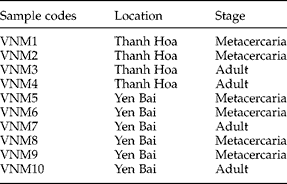
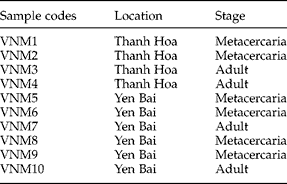
Four samples (two metacercariae and two adults) from Thanh Hoa province and six samples from Yen Bai province, including two metacercariae and one adult fluke from each size group of metacercariae ( < 200 and >200 μm) were subjected to molecular phylogenetic analyses (table 1).
Samples of metacercariae and adults of Paragonimus heterotremus examined for molecular analyses, with the inner cyst wall diameter of metacercariae being <200 μm (VNM1–7) or >200 μm (VNH8–10).
The ITS2 and CO1 gene were amplified by polymerase chain reaction (PCR) (Doanh et al., Reference Doanh, Shinohara, Horii, Habe, Nawa, The and Le2007b) using primer pairs 3S and A28 (Bowles et al., Reference Bowles, Blair and McManus1995) and JB3 and JB4.5 (Bowles et al., Reference Bowles, Hope, Tiu, Liu and McManus1993), respectively. The PCR products were purified using Qiaquick PCR purification Kit (Qiagen Inc., Tokyo, Japan). Both strands were directly sequenced by Genetic Analyzer 3130 (Applied Biosystems Japan Ltd, Tokyo, Japan) using the PCR primers as sequencing primers and a Big-Dye terminator cycle sequencing kit v3.1 (Applied Biosystems). For the phylogenetic analyses, we downloaded from GenBank all ITS2 and CO1 sequences registered as P. heterotremus/P. pseudoheterotremus from India, China, Thailand and Vietnam,. Those of P. vietnamensis were used as an outgroup. The ITS2 and CO1 sequence data sets for phylogenetic analyses were prepared and aligned using Clustal-W (Thompson et al., Reference Thompson, Higgins and Gibson1994) with default options. Evolutionary analyses were performed using the MEGA5 software package (Tamura et al., 2011). The best model of nucleotide substitution for each sequence dataset was tested, and maximum likelihood trees were reconstructed using the Kimura 2-parameter model for the ITS2 tree and Hasegawa–Kishino–Yano + invariant site substitution model for the CO1 tree. The statistical confidence of branching patterns was evaluated by the bootstrap test with 1000 replications.
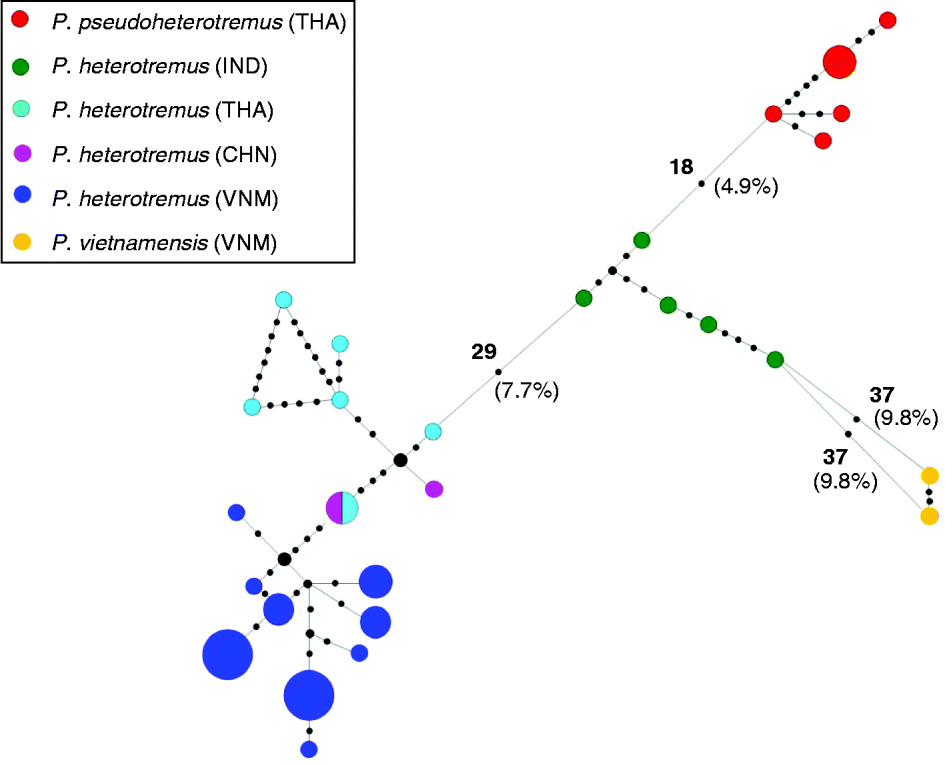
For inferring intraspecific phylogenies, the haplotype network of P. heterotremus and P. pseudoheterotremus was generated based on CO1 sequences using SplitsTree 4 (Huson & Bryant, Reference Huson and Bryant2006).
Results
Morphological variation of P. heterotremus metacercariae
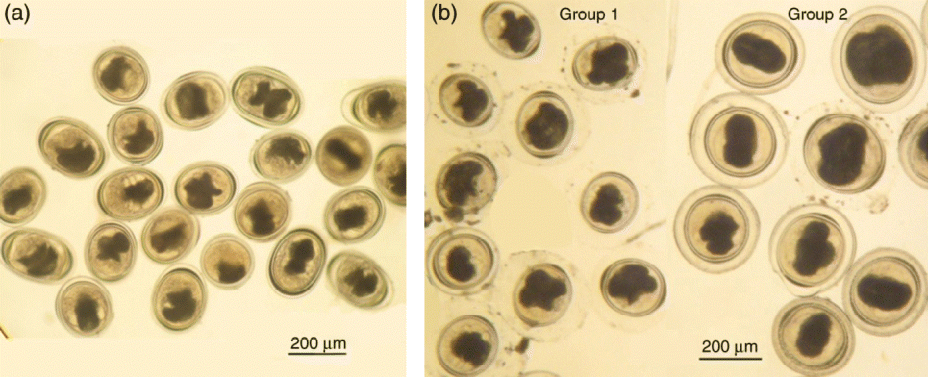
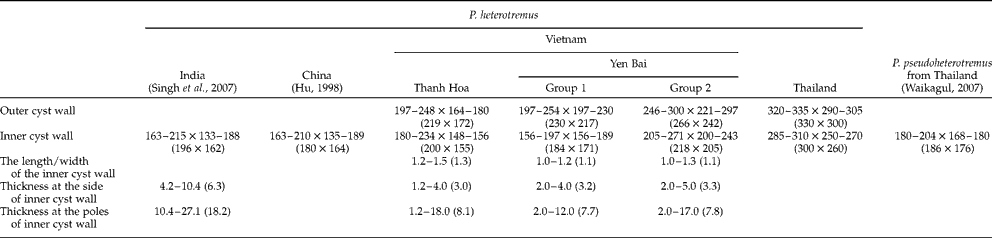
Metacercariae collected from Thanh Hoa province were oval or spherical in shape with the outer cyst wall 197–248 × 164–180 μm (mean 219 × 172; n= 50), the inner cyst wall 180–234 × 148–156 μm (mean: 200 × 155), and the length/width ratio ranging between 1.2 and 1.5 (mean: 1.3); the thickness of the inner cyst wall was variable with or without bipolar thickening, measuring 1.2–4.0 μm (mean 3.0) at the side and 1.2–18.0 μm (mean 8.1) at the poles (fig. 1a, table 2). In contrast, metacercariae collected from Yen Bai province were rounder and more variable in size (fig. 1b), the outer cyst wall measuring 197–300 × 197–297 μm (mean: 256 × 235; n= 50) and the inner cyst wall 156–271 × 156–243 μm (mean: 205 × 182). The length/width ratio ranged between 1.0 and 1.2 (mean: 1.1); the thickness of the inner cyst wall was also variable with or without bipolar thickening, measuring 2.0–5.0 μm (mean 3.3) at the side and 2.0–17.0 μm (mean 7.8) at the poles. The width and length/width ratio, but not the thicknesses of the inner cyst wall, of metacercariae from Thanh Hoa and from Yen Bai provinces were significantly different (P< 0.05).
Metacercariae of Paragonimus heterotremus from crab hosts in the provinces of Thanh Hoa (a) and Yen Bai (b), Vietnam.

Morphometric data (μm) of P. heterotremus and P. pseudoheterotremus metacercariae from different geographical regions in India, China, Vietnam and Thailand.
Numbers in parentheses indicate mean values.
Metacercariae from Yen Bai province were divided into two groups based on the diameters of the inner cyst wall, with measurements of group 1 being < 200 μm (156–197 × 156–189; mean 184 × 171); and group 2 >200 μm (205–271 × 200–243; mean 218 × 205) (table 2). Both groups of metacercariae from Yen Bai and the group from Thanh Hoa were administered separately to four cats, all of which showed eggs in the faeces between 50 and 55 days post-infection. Adult flukes obtained from the cats were all identical with each other and shared the morphological characteristics of P. heterotremus (data not shown).
Molecular phylogenetic analyses
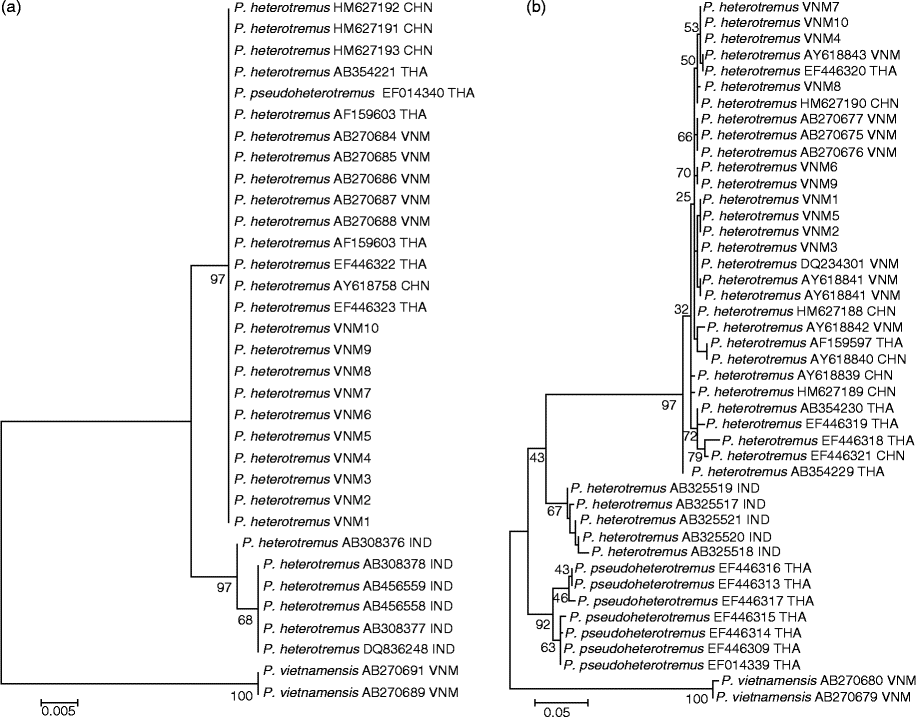
We successfully obtained a total of ten ITS2 and ten CO1 sequences, which are deposited in GenBank with accession numbers AB827360–AB827379. The results of molecular analyses showed that all metacercariae and adults from Thanh Hoa and Yen Bai provinces were completely and almost completely identical with each other in ITS2 and CO1 sequences, respectively. They were also identical with P. heterotremus from China, Thailand and from other locations in Vietnam, forming a single cluster (fig. 2). However, P. heterotremus specimens from India differed markedly (1.5% and 9.0% differences in ITS2 and CO1, respectively) from other populations, forming a separate group in both trees. In contrast, ITS2 sequences of P. pseudoheterotremus were almost completely identical (99.7% similarity) with those of P. heterotremus from China, Thailand and Vietnam and were clustered in this group; however, the CO1 sequences of P. pseudoheterotremus were considerably different (10.4%) from the Chinese, Thai and Vietnamese P. heterotremus populations, and relatively closer (5.7% difference) to the Indian P. heterotremus population.
Maximum likelihood trees reconstructed from (a) ITS2 and (b) CO1 sequences; bootstrap scores expressed as percentages of 1000 replications are given at each node, new sequences given as VNM1–10, and the remainder with the accession numbers from GenBank.
The haplotype network (fig. 3) revealed that all P. heterotremus/P. pseudoheterotremus isolates were genetically divided into three groups, namely P. heterotremus from India, P. heterotremus from China, Thailand and Vietnam and P. pseudoheterotremus from Thailand. The genetic distance between the Indian P. heterotremus population and other populations of this species from Vietnam, China and Thailand was 7.7%, which was larger than the distance (4.9%) between P. heterotremus from India and P. pseudoheterotremus from Thailand. On the contrary, there was a larger genetic distance of 13.0% between P. pseudoheterotremus from Thailand and P. heterotremus from China, Thailand and Vietnam.
The median joining network of P. heterotremus species complex determined by CO1 sequences.
Discussion
The traditional taxonomic classification of Paragonimus species has been based on morphological characteristics of adults and metacercariae (Blair et al., Reference Blair, Xu and Agatsuma1999). However, morphology-based classification often produces difficulties and complexity in identification, particularly in species that exhibit only minor morphological differences. Fortunately, the application of DNA sequence analysis to taxonomy has helped to clarify the phylogenetic relationship between species and their taxonomic status (Blair et al., Reference Blair, Xu and Agatsuma1999, Reference Blair, Chang, Chen, Cui, Wu, Agatsuma, Iwagami, Corrlis, Fu and Zhan2005; Doanh et al., Reference Doanh, Shinohara, Horii, Habe, Nawa and Le2008, Reference Doanh, Hien, Nonaka, Horii and Nawa2012). However, the use of molecular differences for taxonomy has brought about a trend to describe new species based on differences of only a few nucleotides in their ribosomal spacer DNA sequences (Kunz, Reference Kunz2002).
In the genus Paragonimus, a new Paragonimus species, named P. pseudoheterotremus, has been described recently from Thailand, although it is very similar to P. heterotremus in both morphology and ITS2 sequences (Waikagul, Reference Waikagul2007; Thaenkham & Waikagul, Reference Thaenkham and Waikagul2008). Since both of these species have been reported to cause human paragonimiasis (Pariyanonda et al., Reference Pariyanonda, Maleewong, Pipitgool, Wongkham, Morakote and Intapan1990; Blair et al., Reference Blair, Xu and Agatsuma1999; Le et al., Reference Le, De, Blair, McManus, Kino and Agatsuma2006; Devi et al., Reference Devi, Naraina, Bhattacharya, Negmub, Agatsuma, Blair, Wickramashinghe and Mahanta2007; Singh et al., Reference Singh, Sugiyama, Rangsiruji and Devi2007; Yahiro et al., Reference Yahiro, Habe, Duong, Odermatt, Barennes, Strobel and Nakamura2008; Intapan et al., Reference Intapan, Sanpool, Thanchomnang, Imtawil, Pongchaiyakul, Nawa and Maleewong2012), clarification of the taxonomic status of these two species is very important. According to the original description, the prominent morphological differences between P. pseudoheterotremus and P. heterotremus were the sizes of metacercariae and the body spines of adults: metacercariae of P. pseudoheterotremus were slightly smaller than those of P. heterotremus; in contrast, the body spines of adults of the former species were slightly bigger than those of the latter species (Waikagul, Reference Waikagul2007). However, the sizes of body spines and metacercariae have limitations for distinguishing Paragonimus species because of the change of body spines during maturation in the definitive host and their variation across the body surface (Blair et al., Reference Blair, Xu and Agatsuma1999). Also, metacercarial polymorphisms of Paragonimus species have been reported, as can be seen in P. westermani metacercariae (Sugiyama et al., Reference Sugiyama, Morishima, Binchai, Rangsiruji and Ketudat2007; Devi et al., Reference Devi, Narain, Mahanta, Nirmolia, Blair, Saikia and Agatsuma2013). The size of P. pseudoheterotremus metacercariae was reported to be smaller than those of P. heterotremus from Thailand only (Waikagul, Reference Waikagul2007). In fact, the size of P. pseudoheterotremus metacercariae was compatible with those of P. heterotremus from China (Hu, Reference Hu1998), India (Singh et al., Reference Singh, Sugiyama, Rangsiruji and Devi2007) and Thanh Hoa province of Vietnam in this study (table 1). Not only the size but also the thickness of the cyst walls of metacercariae may be used to distinguish species (Chung et al., Reference Chung, Ho, Ts'ao, Hsu and Kao1975; Blair et al., Reference Blair, Xu and Agatsuma1999). The bipolar thickening of the inner cyst wall has been reported in P. heterotremus and P. pseudoheterotremus metacercariae (Chung et al., Reference Chung, Ho, Cheng and Ts'ao1964; Singh et al., Reference Singh, Sugiyama, Rangsiruji and Devi2007; Waikagul, Reference Waikagul2007). However, this characteristic was not always observed in all P. heterotremus (fig. 1) or P. pseudoheterotremus metacercariae (Waikagul, Reference Waikagul2007). The thickness of the inner cyst wall of P. heterotremus from Vietnam seems to be much less than in specimens from India, but a similar thickness (1.2–17.0 μm; mean at poles 12 μm) to P. tuanshanensis from China (Chung et al., Reference Chung, Ho, Cheng and Ts'ao1964), which was considered a synonym of P. heterotremus (Blair et al., Reference Blair, Xu and Agatsuma1999). Thus, the shape, size and thickness of the inner cyst wall of P. heterotremus metacercariae seem to represent different geographical populations, indicating the metacercarial polymorphism of P. heterotremus. The measurements and characteristics of P. pseudoheterotremus metacercariae are within the range of P. heterotremus. Moreover differences in the coefficients of P. heterotremus and P. pseudoheterotremus metacercariae were higher than those among subspecies (Waikagul, Reference Waikagul2007), but differences in adult worms did not support the separation of these species. It is, therefore, difficult to find sufficiently clear morphological differences between P. heterotremus and P. pseudoheterotremus to separate them as distinct species.
Genetically, when comparing P. pseudoheterotremus with P. heterotremus from within Thailand, Thaenkham & Waikagul (Reference Thaenkham and Waikagul2008) observed only one base difference of 0.3% in the ITS2 sequences and a considerable difference of 10.6% in the CO1 sequences. As highlighted by Blair et al. (Reference Blair, Xu and Agatsuma1999), the ITS2 sequence is a good marker for inter-species and the CO1 sequence is a good marker for intra-species for identification of Paragonimus species, and the extensive study of Blair et al. (Reference Blair, Chang, Chen, Cui, Wu, Agatsuma, Iwagami, Corrlis, Fu and Zhan2005) revealed a large variation of ITS2 sequences in P. skrjabini (0–6 variable sites in 363 nucleotides) and P. westermani (1–11 variable sites in 363 nucleotides). Thus, the difference of only one base in ITS2 sequence of P. pseudoheterotremus and P. heterotremus is not sufficient for separating P. pseudoheterotremus as a distinct species. Moreover, the molecular analyses in this study, based on an extensive collection of P. pseudoheterotremus and P. heterotremus populations from different countries, revealed that the differences between geographical populations (India and other countries) of P. heterotremus were even larger than those between P. heterotremus and P. pseudoheterotremus within Thailand. In the phylogenetic trees, P. pseudoheterotremus was clustered with P. heterotremus from China, Thailand and Vietnam to make a group separated from the Indian P. heterotremus population in the ITS2 tree. However, in the CO1 tree, P. pseudoheterotremus formed a separate group closer to the Indian P. heterotremus population. In the CO1 tree and the haplotype network, three groups (P. heterotremus from India; P. heterotremus from China, Thailand and Vietnam; and P. pseudoheterotremus from Thailand) were clearly differentiated. Although their CO1 sequence variations were markedly different, the genetic distances were either less than, or similar to, those observed in the P. skrjabini (9.5–11.5%) or P. westermani (29.5%) complexes (Blair et al., Reference Blair, Chang, Chen, Cui, Wu, Agatsuma, Iwagami, Corrlis, Fu and Zhan2005; Doanh et al., Reference Doanh, Shinohara, Horii, Habe and Nawa2009, Reference Doanh, Hien, Nonaka, Horii and Nawa2013). Therefore, these three groups of P. heterotremus and P. pseudoheterotremus should be considered as members of a species complex, P. heterotremus, with the results of the haplotype network suggesting the Indian P. heterotremus group be considered as the root of the cluster.
In conclusion, using an expansive collection of different geographical populations, the morphological and molecular analyses performed in this study clearly showed that P. heterotremus exhibits metacercarial polymorphism and genetic variation as reported in other Paragonimus species complexes. In addition, the findings suggested that P. pseudoheterotremus couldn't be considered a distinct species; instead, it should be considered a geographical variation in the P. heterotremus complex.
Financial support
This research is funded by the Vietnam National Foundation for Science and Technology Development (NAFOSTED) under grant number 106.12-2012.52.
Conflict of interest
None.
Ethical standards
This work was approved by the Ethical Committee for Animal Experiments, Institute of Ecology and Biological Resources, Vietnam Academy of Sciences and Technology, and all procedures followed the National Guidelines in Vietnam.