INTRODUCTION
Mexico City was originally a closed basin whose waters had no natural outlet toward lower lands or the sea. Until the Spanish conquest, this basin housed several lakes of different sizes, within which existed some islands. The topography, in addition to a benign climate as a consequence of being located in the intertropical zone at 2250 m above sea level, favored the diversity of animal and plant species. Several populations have occupied the region since ancient times. Today, their cultural heritage lies beneath modern Mexico City, one of the largest cities in the world, with 22 million inhabitants and an area of 2000 km2. In the same space we can find cultural elements from prehistoric, pre-Hispanic, Colonial, and modern periods. However, the continuous expansion of Mexico City necessarily has been affecting the cultural heritage in the subsoil.
In the 1960s, the National Institute of Anthropology and History (Instituto Nacional de Antropología e Historia or INAH) created the Archaeological Rescue Department (Dirección de Salvamento Arqueológico or DSA) to prevent the loss of crucial objects. Since then, archaeological research projects have been carried out in advance of new construction projects, oriented toward preserving cultural heritage. Objectives and methodological aspects are proposed, and activities are scheduled regardless of whether it is a small settlement or an entire region. In addition, legal and administrative links are established with various units responsible for architectural works and research, to address problems with a multidisciplinary approach. This cooperation between DSA and construction companies has facilitated the research in remote areas of Mexico that have been explored very little or not at all. In urban areas such as Mexico City, DSA’s work faces enormous challenges. Thanks to DSA, much has been learned about the past of the Mexico City Basin: who inhabited it and cultural aspects such as customs, daily life, arts, techniques, and rituals.
In 2013, the Accelerator Mass Spectrometry National Laboratory (LEMA) was established at the Institute of Physics of UNAM (Solís et al. Reference Solís, Chávez-Lomelí, Ortiz, Huerta, Andrade and Barrios2014). Among LEMA’s objectives is dating archaeological and cultural heritage objects using the accelerator mass spectrometry radiocarbon (AMS 14C) technique. The advantage of analyzing small samples in a fast way is of great value in salvage projects, where decisions like whether to continue or to stop a construction project must be made in a short period of time.
In this work, we present two cases of archaeological intervention made by DSA in Mexico City: (1) Reforma Hidalgo Office Complex in the Teocaltitlán neighborhood, and (2) La Otra Banda Site. In both cases, some selected organic samples were dated by the AMS 14C technique with the aim to establish the temporality of the occupation of the sites.
STUDY SITES
Project of the Reforma-Hidalgo Office Complex
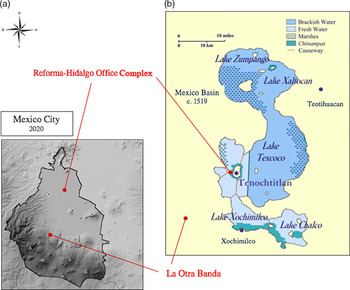
Mexico Basin, formed by Zumpango, Xaltocan, Texcoco, Xochimilco, and Chalco Lakes, is a closed hydrographic system of 1000 km2 (Figure 1b). The surrounding lands have been inhabited for at least 10,700 years (Gonzalez et al. Reference Gonzalez, Jiménez-López, Hedges, Huddart, Ohman, Turner and Padilla2003). Mexica’s city, Mexico-Tenochtitlan, was stablished on an island surrounded by these lakes in 1325, as is narrated in the Boturini Codex (Reference Boturini1964) (Alvarado Tezozomoc Reference Alvarado Tezozómoc1992) (Figure 1b). At the arrival of the Spaniards, in 1519, Tenochtitlan was the largest city in the Americas. In need of more land for agriculture and homes, the Mexicas developed the chinampa, an intensive and highly productive farming system. Chinampas were built in the lake, with wooden posts that supported a network of vegetal fiber where soil and lake’s sediments were deposited, to expand the land area over the lake.
(a) Current topographic map of Mexico City; (b) old map of Mexico Basin ca. 1519.

The Archaeological Rescue Project of the Reforma-Hidalgo Office Complex was carried out between August 2016 and December 2017 (Flores Montes de Oca Reference Flores Montes de Oca2018). The site is located north of modern Mexico City (Figure 1a, b), within the Teocaltitlán Mexica neighborhood (Caso Reference Caso1956). The site could be either part of the lake or expanded land by chinampas.
According to the narratives, on June 30, 1520, the date known as “The Sad Night,” a battle between Mexicas and Spaniards occurred near this area. The Spaniards, guided by Hernan Cortés, were escaping from Mexico-Tenochtitlan, loaded with great amounts of gold and silver (León-Portilla and Garibay-Kintana Reference León-Portilla and Garibay-Kintana1976). In 1981, in front of the property, a 1.9-kilo gold bar was discovered, just across the street. After cross referencing documentary and archaeological information as well as several chemical analyses, it is accepted that this object was thrown away during the flight of the Spanish soldiers (López Luján and Ruvalcaba Reference López Luján and Ruvalcaba2020). This area has always generated intense academic interest and has great archaeological potential.
La Otra Banda Site
In a property located south of Mexico City, during archaeological rescue activities carried out before the construction of new buildings, the archaeologists of DSA reported the remains of a rural house from the late 19th century at a site called La Otra Banda (Figure 1a, b). On a lower level of the house’s foundations, 29 pre-Hispanic excavated pits in the shape of truncated cones were found. Based on archaeological evidence, they correspond to two phases of the Preclassic period: Tetelpan (800 BC–700 BC) and Zacatenco (700 BC–400 BC) (Balcorta and Alavez Reference Balcorta and Alavez2018). The site is a settlement founded around Cuicuilco (4 km away), with whom it also shares cultural features (Niederberger Reference Niederberger1987). Cuicuilco is considered one of the most important ancient populations of the Basin of Mexico. Its development belongs to the Preclassic Period, from 800 to 150 BC (Pérez Campa et al. Reference Pérez Campa, Rangel Guajardo and Sandoval Aguilar2002).
Nowadays, the whole area is covered with 80 km2 of exposed basaltic lava flows left by the eruption of Xitle, a monogenetic volcano. To find out the time of the lava emplacements, more than 30 14C dates have been obtained over several decades. Ages fluctuate around 2000 BP (˜80 BC–70 AD) (e.g., Deevey et al. Reference Deevey, Gralenski and Hoffren1959; Fergusson and Libby Reference Fergusson and Libby1963; White et al. Reference White, Reyes-Cortés, Ortega-Ramírez and Valastro1990; Córdoba et al. Reference Córdoba, Martin del Pozzo and López Camacho1994). More recently, dated coal samples produced by forest fires caused by the eruption itself yielded an age of 1670 ± 35 BP (around 255–430 cal AD) (Siebe Reference Siebe2000).
La Otra Banda Site was not affected by lava emplacements since it is located at the top of a hill at 2230 m above sea level. Archaeological findings have shown that after the abandonment of the site, there is a period of almost two thousand years with few human activities until the end of 19th century. The lava flows of the Xitle buried many shreds of evidence of daily life and rituals of the ancient inhabitants of this area. The discoveries of La Otra Banda were preserved unaffected, a fact that has greatly contributed to the study of daily life and rituals in this site (Balcorta and Alavez Reference Balcorta and Alavez2018).
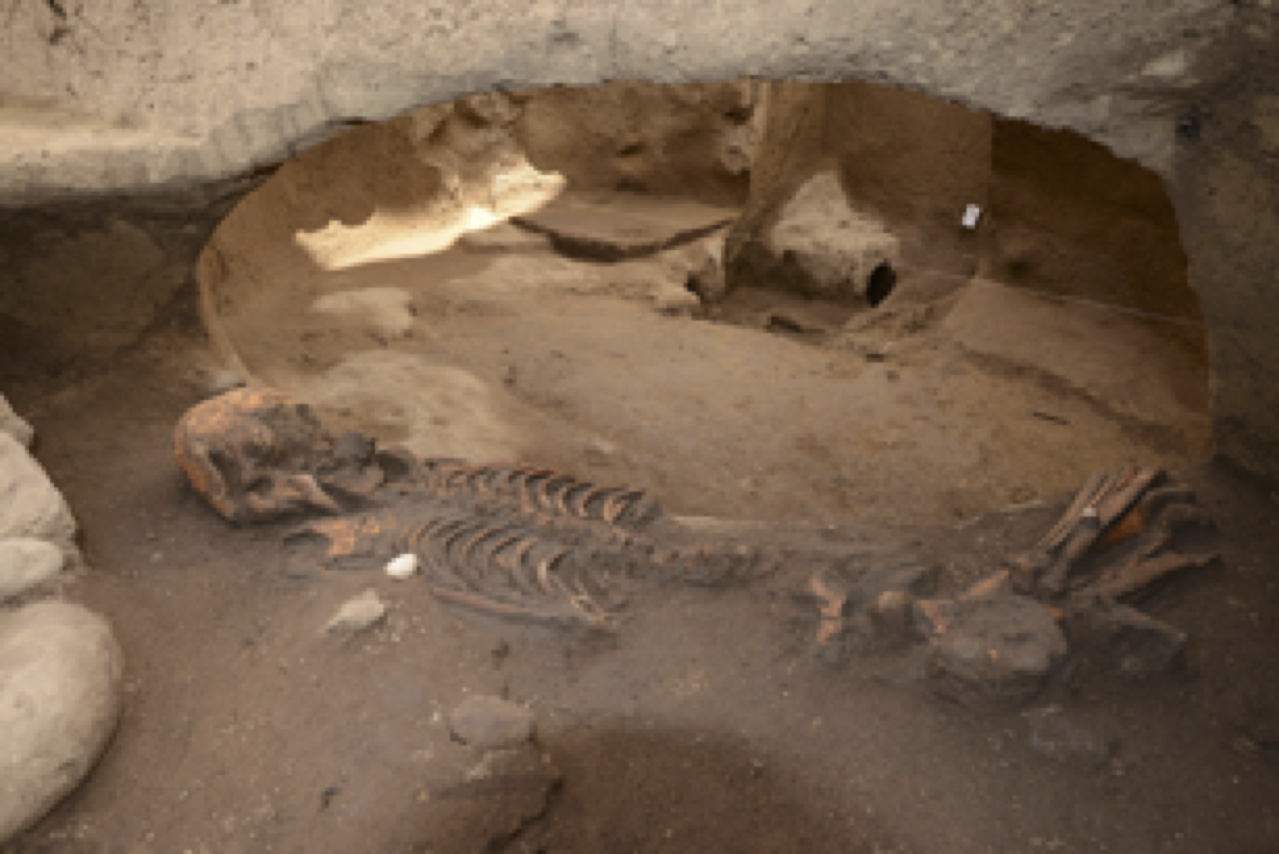
Figure 3 shows one of the 29 excavated pits below the floor level of the 19th century house. These spaces served as storage places for food and products, as well as for human burials, as demonstrated by the materials found inside (Balcorta and Alavez Reference Balcorta and Alavez2018). Others have an architecture that suggests they were used as steam baths. These pits have a semicircular shape formed by boulders and basalts bonded to the wall, mixed with traces of charcoal. Some of the boulders were fractured or broken with traces of constant exposure to fire. More than 130 figurines were found within the pits, representing mostly pregnant women and infants to a lesser extent. The pieces showed pigmentation on the face, neck, belly, navel, hands, and legs. These characteristics may indicate daily work performed by women in steam baths during perinatal care (Balcorta and Alavez Reference Balcorta and Alavez2018).
SAMPLE SELECTION
Project of the Reforma-Hidalgo Office Complex
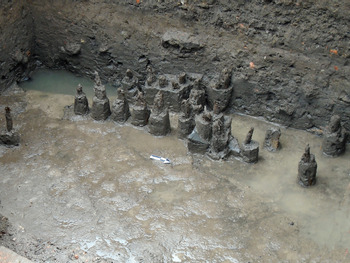
Several test squares were dug on the property. Thirty wooden posts were located in unit N5E4, squares N5E3-05, and N5E3-10 (Flores Montes de Oca Reference Flores Montes de Oca2018). The posts were found between 2.7 and 3.2 m below ground level and emerging from a very compact layer of sand (Figure 2). These elements were in two forms: rectangular section finished in stake (type “s”) and circular section, finished in a blunt end (type “c”). The posts were buried and exposed to high humidity. From these posts four were selected for radiocarbon dating: LEMA 653 and 667 (type “s”) and LEMA 654 and 662 (type “c”). Although these materials might seem a very minor finding and with little historical value, the posts with a rectangular section and with a sharp point at the end, suggests that they were manufactured with more sharpened tools, probably introduced by Spaniards. In the S3O2 quadrant (wells 12 and 13), 11 posts type “c” were found between 3.00 and 4.00 m below ground level. The posts were supporting a masonry wall and were classified as architectural piles. They were associated with ceramic and stones from pre-Hispanic and Hispanic Contact. Samples LEMA 790, 791, and 792 were taken from this quadrant. The purpose of the analysis was to know if they had been part of chinampas or were part of the foundations of colonial construction.
Wooden posts placed in two parallel rows.

One of the 29 excavated cone-shaped holes used for burial in La Otra Banda. (Balcorta and Alavez Reference Balcorta and Alavez2018.)

Wood samples with little deterioration were taken, but no traces of the annual growth rings were present. Therefore, it was impossible to do a wiggle-match dating with different rings from the same sample.
La Otra Banda Site
In some of the pits, human burials were found with objects left as offerings, such as green and flint stones, and ceramic pieces. Some human bones (LEMA 1049, LEMA 1050, and LEMA 1051), belonging to these pits, were selected to be dated by AMS 14C. In the pits that showed constant exposure to fire, charcoal fragments samples that were mixed with stones or soil were also dated (LEMA 1053 and LEMA 1054).
METHODS
Sample Preparation
Cellulose was extracted from wood samples, beginning by cleaning in ultrasonic bath with ultrapure water. Then a protocol for cellulose extraction was followed, using a base-acid-base-acid-bleaching procedure at high temperature, according to Němec et al. (Reference Němec, Wacker, Hajdas and Gäggeler2010). Finally, samples were freeze-dried overnight.
Ultra-filtered collagen was extracted from bones according to a method proposed by Hajdas et al. (Reference Hajdas, Michczynski, Bonani, Wacker and Furrer2009) based in a modified Longin method (Longin Reference Longin1971): bones were cleaned in an ultrasonic bath. Once dried, the external surface was removed and then they were mashed in a mortar. Powdered bones underwent a chemical procedure with HCl 0.5 M at low temperature, to dissolve the mineral phase and remove the carbonates. The gelatinization procedure was carried out using an acidic treatment with HCl 0.2 M at high temperature for 10–12 hr. Ultrafiltration was done using a Millipore Amicon Ultra 30 KDa filter (Merck), to remove the low molecular weight contaminants and degraded collagen. Finally, samples were lyophilized.
Charcoal samples were cleaned in ultrasonic bath, submitted to an acid-base-acid treatment, to eliminate carbonates, other organic contaminants and dissolved atmospheric carbon dioxide that may have been absorbed during the base step (Goh and Molloy Reference Goh and Molloy1972).
AMS Analysis
One-mg graphite tablets were obtained from the cleaned samples in an automatized graphitization equipment AGEIII (Ion Plus), where samples are combusted in a coupled elemental analyzer (Wacker et al. Reference Wacker, Němec and Bourquin2010).
Graphite samples were pressed in aluminum cathodes, before AMS analyses were performed in the High Voltage Engineering Europa (HVEE) AMS system at LEMA, UNAM.
Oxalic acid (NIST SRM4990C Oxalic Acid II) was employed as a primary standard for normalization, while Phthalic acid (C8H6O4), with no 14C, was used as a blank for the background correction.
The measured 14C/12C isotopic ratios were corrected for isotopic fractionation using the 13C/12C isotopic ratios measured in the AMS system. 14C age was expressed as Fm, and 14C ages calculation was performed as described in Solis et al. (Reference Solís, Chávez-Lomelí, Ortiz, Huerta, Andrade and Barrios2014), using computer codes developed at LEMA. Calendar ages were obtained by the calibration of the 14C ages, with OxCal v4.2 program (Bronk Ramsey Reference Bronk Ramsey2009) using the IntCal13 calibration curve (Reimer et al. Reference Reimer, Bard, Bayliss, Beck, Blackwell, Bronk Ramsey, Grootes, Guilderson, Haflidason, Hajdas, Hatté, Heaton, Hoffmann, Hogg, Hughen, Kaiser, Kromer, Manning, Niu, Reimer, Richards, Scott, Southon, Staff, Turney and van der Plicht2013).
RESULTS AND DISCUSSION
Project of the Reforma-Hidalgo Office Complex
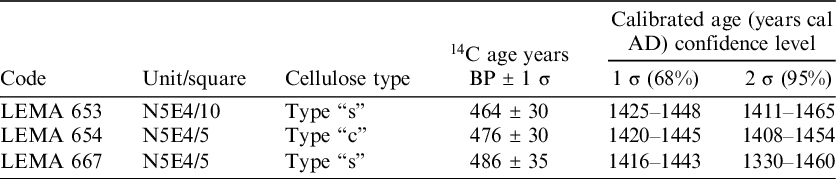
The 30 posts recovered from unit N5E4 were associated with remains of pre-Hispanic ceramics and the Hispanic Contact Era. Tables 1 and 2 show ages obtained for four posts recovered from this unit. Samples 653, 654, and 667 (Table 1) correspond to the Late Postclassic Pre-Hispanic Period (1300–1520 AD) (Hosler and Macfarlane Reference Hosler and Macfarlane1996). Sample 662 showed a wide interval of ages with the highest probability at 2 σ around the Colonial period. The posts from quadrant S302, samples 790, 791, and 792, yielded dates that also correspond to the Late Postclassic period (1300–1520 AD) (Hosler and Macfarlane Reference Hosler and Macfarlane1996) (Table 3). As in the unit N5E4, they were found associated with materials from pre-Hispanic and Hispanic Contact periods.
AMS 14C dating results of selected wooden posts from unit N5E4.

AMS 14C dating results of sample LEMA 662 from unit N5E4.

AMS 14C dating results of selected wooden posts from S3O2 quadrant.

We originally stated that Spaniards introduced sharp wooden posts. However, the 14C dating indicates that, except sample LEMA 662, both kinds of posts (circular with a blunt tip and rectangular stakes) come from trees with very similar pre-Hispanic ages. Additionally, shells attached to the posts and the stratum from which they were extracted (corresponding to the bottom of the lake) inferred that these were most likely supports of Chinampas. Therefore, the results suggest that both types of posts were already used since pre-Hispanic times. The fact that the posts were supporting a masonry wall and associated with ceramic from the Hispanic contact period, suggests that they were reused as construction materials.
These wooden objects are a manifestation of the moment of contact between the Mexican and Spanish cultures. At that time of scarcity, the natural thing was to reuse the available materials in new constructions. During the excavation project at this site, the lack of significant archaeological remains allowed the modern construction to continue on the site.
La Otra Banda Site
Table 4 shows obtained dates for samples from this site. Calibrated ages range from 2500 to 2440 BP (803–409 cal BC), which means that the pits were built and used during the Tetelpan (800 BC–700 BC) and Zacatenco (700 BC–400 BC) phases.
AMS 14C dating results of bone and charcoal samples.

They would probably have fallen into disuse in the early years of the Ticoman phase (400–200 BC), giving way to another type of architecture on the site until the time of abandonment, which occurred around 100 BC, according to archaeological data (Balcorta and Alavez Reference Balcorta and Alavez2018). The dates obtained allow us to give a chronological frame to the construction of the truncated cone pits, as well as to contextualize the corresponding material remains and the activities carried out in these spaces, which became specialized, contributing to the development of complex societies in Mexico. These let us situate in time the appearance of techniques and knowledge them among the population that settled in the southern part of the Basin of Mexico.
CONCLUSIONS
The Archaeological Rescue Project of the Reforma-Hidalgo Office Complex allowed the retrieval of information on a site, which, due to its location, presented a high possibility of registering archaeological remains from the pre-Hispanic era.
The resulting ages of the wooden samples, corresponding to the Late Postclassic period, indicate that they are very likely chinampa supports that were reused during the colony’s first and posterior stages. This conclusion is reinforced by the fact that the posts were associated with colonial building foundations and various stone and ceramic objects from the Transition Period. No more significant pre-Hispanic remains or objects were found.
The case study of La Otra Banda shows that spaces for specialized work and specific activities were already available in the pre-classical period. The discovery of human burials inside truncated cone pits at this site is a recurring practice in sites from the same period in the Basin of Mexico; however, the context presented at some of the pits is unique, and particular, it suggests the use of steam baths as well as the specialization of activities such as perinatal care. These findings show that the group that settled in this place had a complex organization with care specifically for pregnant women and specialized work since at least 800 years before Christ.
ACKNOWLEDGMENTS
The authors thank Arcadio Huerta for maintenance and operation of the AMS system, and Sergio Martínez for laboratory assistance. This project was financed by CONACyT grants 299073 and 314857, DGAPA-UNAM grant IG100619 and CIC-UNAM.