Introduction
Monozygotic multiple pregnancy (MMP), a well-recognized complication of assisted reproductive technology (ART), has been associated with increased maternal and perinatal risks, including preterm birth, low birth weight and obstetric complications such as intrauterine death (Hack et al., Reference Hack, Derks, Elias, Franx, Roos, Voerman, Bode, Koopman-Esseboom and Visser2008; Takeshima et al., Reference Takeshima, Jwa, Saito, Nakaza, Kuwahara, Ishihara, Irahara, Hirahara, Yoshimura and Sakumoto2016, Yan et al., Reference Yan, Wang, Chen and Zhang2023). Although the widespread adoption of single embryo transfer (ET) has substantially reduced the incidence of dizygotic multiple pregnancies, the prevalence of MMPs after single ET remains higher with ART-conceived pregnancies (1.01–2.24%) than with natural conception (0.40–0.45%) (MacGillivray, Reference MacGillivray1986; Derom et al., Reference Derom, Vlietinck, Derom, Van den Berghe and Thiery1987; Kawachiya et al., Reference Kawachiya, Bodri, Shimada, Kato, Takehara and Kato2011; Nakasuji et al., Reference Nakasuji, Saito, Araki, Nakaza, Nakashima, Kuwahara, Ishihara, Irahara, Kubota, Yoshimura and Sakumoto2014; Kanter et al., Reference Kanter, Boulet, Kawwass, Jamieson and Kissin2015; Ikemoto et al., Reference Ikemoto, Kuroda, Ochiai, Yamashita, Ikuma, Nojiri, Itakura and Takeda2018).
Previous studies have suggested that several ART-related factors may promote MMP, including extended in vitro culture, blastocyst transfer and zona pellucida manipulation, such as intracytoplasmic sperm injection (ICSI), embryo biopsy and assisted hatching (Alikani et al., Reference Alikani, Noyes, Cohen and Rosenwaks1994; da Costa et al., Reference da Costa, Abdelmassih, de Oliveira, Abdelmassih, Abdelmassih, Nagy and Balmaceda2001; Skiadas et al., Reference Skiadas, Missmer, Benson, Gee and Racowsky2008; Saravelos et al., Reference Saravelos, Zhang, Chung, Sun, Sun, Li and Chen2016; Ikemoto et al., Reference Ikemoto, Kuroda, Ochiai, Yamashita, Ikuma, Nojiri, Itakura and Takeda2018). In particular, laser-assisted hatching (LAH) has been widely used in frozen-thawed ET; however, the mechanisms underlying its potential association with increased MMP risk remain incompletely understood.
One leading hypothesis suggests that inner cell mass (ICM) splitting occurs during the hatching process, particularly when the blastocyst herniates through an artificial opening in the zona pellucida (Vitthala et al., Reference Vitthala, Gelbaya, Brison, Fitzgerald and Nardo2009; Jin et al., Reference Jin, Han and Zenker2024) (Figure 1). According to this theory, the size and configuration of the zona opening may influence mechanical stress on the ICM during hatching, thereby increasing the likelihood of MMP. Despite this biologically plausible mechanism, limited clinical data are available regarding the relationship between the extent of zona opening created by LAH and the risk of MMP. Therefore, the present study aimed to investigate whether the size of the zona pellucida opening created by LAH influences the prevalence of MMP in frozen-thawed single blastocyst transfer (SBT) cycles using a large multicentre cohort.
Proposed mechanism linking laser-assisted hatching to monozygotic multiple pregnancy (MMP). The most widely accepted hypothesis explaining the increased risk of MMP following assisted hatching is that, as the blastocyst hatches through the artificial zona opening created by assisted hatching, the embryo undergoes herniation through the opening. This process is thought to place mechanical stress on the inner cell mass, potentially leading to its splitting and, consequently, the development of MMP.

Figure 1. Long description
The figure illustrates a proposed mechanism linking laser-assisted hatching to monozygotic multiple pregnancy. A blastocyst hatches through an artificial opening created in the zona pellucida by laser-assisted hatching. As the blastocyst herniates through the opening, mechanical stress may be placed on the inner cell mass. This stress is hypothesized to contribute to splitting of the inner cell mass, potentially resulting in monozygotic multiple pregnancy.
Materials and methods
Patient selection
A flowchart showing the patient selection process is provided in Figure 2. Among the 34,377 ET cycles performed between January 2020 and October 2024 at Sugiyama Clinic Marunouchi and Sugiyama Clinic Shinjuku, 13,271 clinical pregnancies were recognized. Among these pregnancies, 9494 achieved through SBT using LAH were recruited. After excluding 39 ectopic pregnancies and 3 hydatidiform molar pregnancies, a total of 9452 pregnancies were included in the final analysis. Prior to January 2021, the zona opening was limited to 30° and centred on the embryo, corresponding to an arc length of approximately 40–50 μm. From January to May 2021, the opening size was expanded to 90°, corresponding to an arc length of approximately 130–150 μm (Figure 3). The 30° opening represented the conventional minimal opening used in our laboratory, whereas the 90° opening was introduced to prevent excessive blastocyst herniation and minimize mechanical constraint during hatching. The prevalence of MMP was then compared between the 30° and 90° zona opening groups.
Flowchart of patient selection. Among the 34,377 embryo transfer cycles performed between January 2020 and October 2024, 13,271 clinical pregnancies were recognized. Among the 9494 pregnancies following single blastocyst transfer using laser-assisted hatching, 9452 were recruited after excluding 39 ectopic and 3 molar pregnancies. One, two and three gestational sacs were detected in 9351 (98.9%), 99 (1.0%) and 2 (0.02%) pregnancies, respectively. The total multiple pregnancy rate was 1.85% (175 pregnancies).

Figure 2. Long description
The flowchart shows the selection of pregnancies for the study. Between January 2020 and October 2024, 34,377 embryo transfer cycles were performed, resulting in 13,271 clinical pregnancies. Of these, 9,494 pregnancies resulted from single blastocyst transfer using laser-assisted hatching. After exclusion of 39 ectopic pregnancies and 3 hydatidiform molar pregnancies, 9,452 pregnancies were included in the final analysis. Among these pregnancies, 9,351 had one gestational sac including 73 with two foetuses and 1 with three foetuses, 99 had two gestational sacs, and 2 had three gestational sacs. Overall, 175 pregnancies were classified as multiple pregnancies, corresponding to a prevalence of 1.85%.
Zona opening size using laser-assisted hatching. Between January and May 2021, laser-assisted hatching opening of the zona pellucida was expanded from 30° (left panel) to 90° (right panel), with the opening centred on the embryo.

Figure 3. Long description
The figure compares the two zona pellucida opening sizes created by laser-assisted hatching. The left panel shows a 30° opening and the right panel shows a 90° opening centred on the embryo. The 30° opening represented the smaller conventional opening, whereas the 90° opening represented the enlarged opening introduced between January and May 2021
Clinical pregnancy was defined as the presence of an intrauterine gestational sac (GS) detected via transvaginal ultrasound. A miscarriage was diagnosed as the loss of a clinical pregnancy, excluding biochemical and ectopic pregnancies. Singleton pregnancy was defined as the presence of zero or one foetus within a single GS. MMP was defined as the presence of ≥2 GSs and/or ≥2 foetuses following SBT. This included monozygotic mono-, di- and tri-amniotic twins and triplets, defined as two or three foetuses within a single GS, 0–3 foetuses across two GSs and 0–3 foetuses across three GSs, respectively. Chorionicity and amnionicity were assessed by ultrasound at 6–8 weeks of gestation. Natural conception could not be completely excluded; however, patients were advised to avoid intercourse during a natural ovulation ET cycle. This retrospective observational study was approved by the local ethics committee of Sugiyama Clinic (No. 25-001).
Procedures for thawing frozen blastocysts and LAH
All patients included herein underwent frozen-thawed SBT with LAH during spontaneous ovulation or hormonal replacement cycles using expanded blastocysts (grade 4 or more on the Gardner classification) cryopreserved 5–6 days after fertilization. Overall, 972 women underwent ET using euploid or mosaic blastocysts after preimplantation genetic testing for aneuploidy.
LAH was performed immediately after thawing using a 1480-nm diode laser (RI Saturn 5TM Active Laser System; CooperSurgical, Inc., Trumbull, United States) integrated into an inverted microscope. An opening in the zona pellucida was created at a site with a relatively wide perivitelline space. Consecutive laser pulses ranging from 0.35 to 0.5 ms were applied according to the width of the perivitelline space. The LAH procedure lasted for approximately 1 min per blastocyst. Following LAH, blastocysts were cultured and assessed for re-expansion 1 h before ET, and ET was performed at least 2 h after thawing.
Statistical analyses
All statistical analyses were performed using Statistical Analysis System version 9.4 (SAS Institute, Cary, NC, United States). To identify possible factors affecting the prevalence of MMP, multiple logistic regression analysis was performed using singleton pregnancy after SBT as the control group. Potential clinical risk factors for MMP included in the multivariate model were then examined, including age (reference: ≤34 years), fertilization method (reference: conventional IVF), grade of the ICM and trophectoderm (TE) of the blastocyst (reference: grade A or B), culture time until expanded blastocyst (reference: 5 days), embryo biopsy (reference: no) and zona opening size by LAH (reference: 90° zona opening). In all statistical analyses, the level of significance was set at p < 0.05. The unit of analysis in this study was each pregnancy rather than each woman considering that both the outcome (MMPs) and exposures of interest were pregnancy-specific. Therefore, each pregnancy was treated as an independent event during analysis. Although some women contributed more than one pregnancy, the proportion was small. Cases with missing data for any of the variables included in the multivariate model were excluded, and analyses were conducted using a complete-case approach. Odds ratios (ORs) and 95% confidence intervals (CIs) were determined. Differences in characteristics were assessed using the Mann–Whitney U test or Fisher’s exact test, as appropriate, comparing (1) singleton pregnancies and MMPs and (2) pregnancies with zona opening sizes of 30° and 90°.
Results
Prevalence of twin and triplet pregnancies after blastocyst transfer
Among the 9452 normal clinical pregnancies after SBT, 1, 2 and 3 GSs were detected in 9351 (98.9%), 99 (1.0%) and 2 (0.02%), respectively (Figure 2). The prevalence of twin pregnancies was 1.79% (169 pregnancies), including 120 pregnancies with 2 foetuses in 1–2 GSs and 49 pregnancies with 0–2 foetuses in 2 GSs. The prevalence of triplet pregnancies was 0.06% (6 pregnancies), including 5 pregnancies with 3 foetuses in 1 to 3 GSs and 1 pregnancy with 3 GSs without a foetus. The total MMP rate following SBT was 1.85% (175 pregnancies).
Transition in the prevalence of multiple pregnancy following enlargement of the zona opening
The annual transition in the prevalence of MMP following SBT is presented in Figure 4. The LAH opening size was enlarged from 30° to 90° in the first half of 2021. The prevalence of MMP was high in 2020 and 2021 (2.24–2.27%) but declined from 2022 onwards, reaching 1.57–1.60% in 2023 and 2024. The prevalence of MMP with 1 GS and 2 or 3 GSs decreased from 0.95% in 2020 to 0.67% in 2024 and from 1.32% in 2020 to 0.90% in 2024, respectively; however, no significant differences were observed between the years.
Annual transition in the prevalence of multiple pregnancy following single blastocyst transfer. The prevalence of multiple pregnancy was high in 2020 and 2021 (2.24–2.27%) but declined from 2022 onward, reaching 1.57–1.60% in 2023 and 2024. The prevalence of multiple pregnancy with 1 gestational sac (GS) and 2 or 3 GSs decreased from 0.95% in 2020 to 0.67% in 2024 and from 1.32% in 2020 to 0.90% in 2024, respectively.

Figure 4. Long description
The figure shows the annual prevalence of multiple pregnancy following single blastocyst transfer from 2020 through 2024. The prevalence of multiple pregnancy was 2.24% in 2020 and 2.27% in 2021, and decreased from 2022 onward, reaching 1.57%–1.60% in 2023 and 2024. Multiple pregnancies associated with one gestational sac decreased from 0.95% in 2020 to 0.67% in 2024. Multiple pregnancies associated with two or three gestational sacs decreased from 1.32% in 2020 to 0.90% in 2024. No significant differences in prevalence were observed between years.
Prevalence and risk factors for MMP
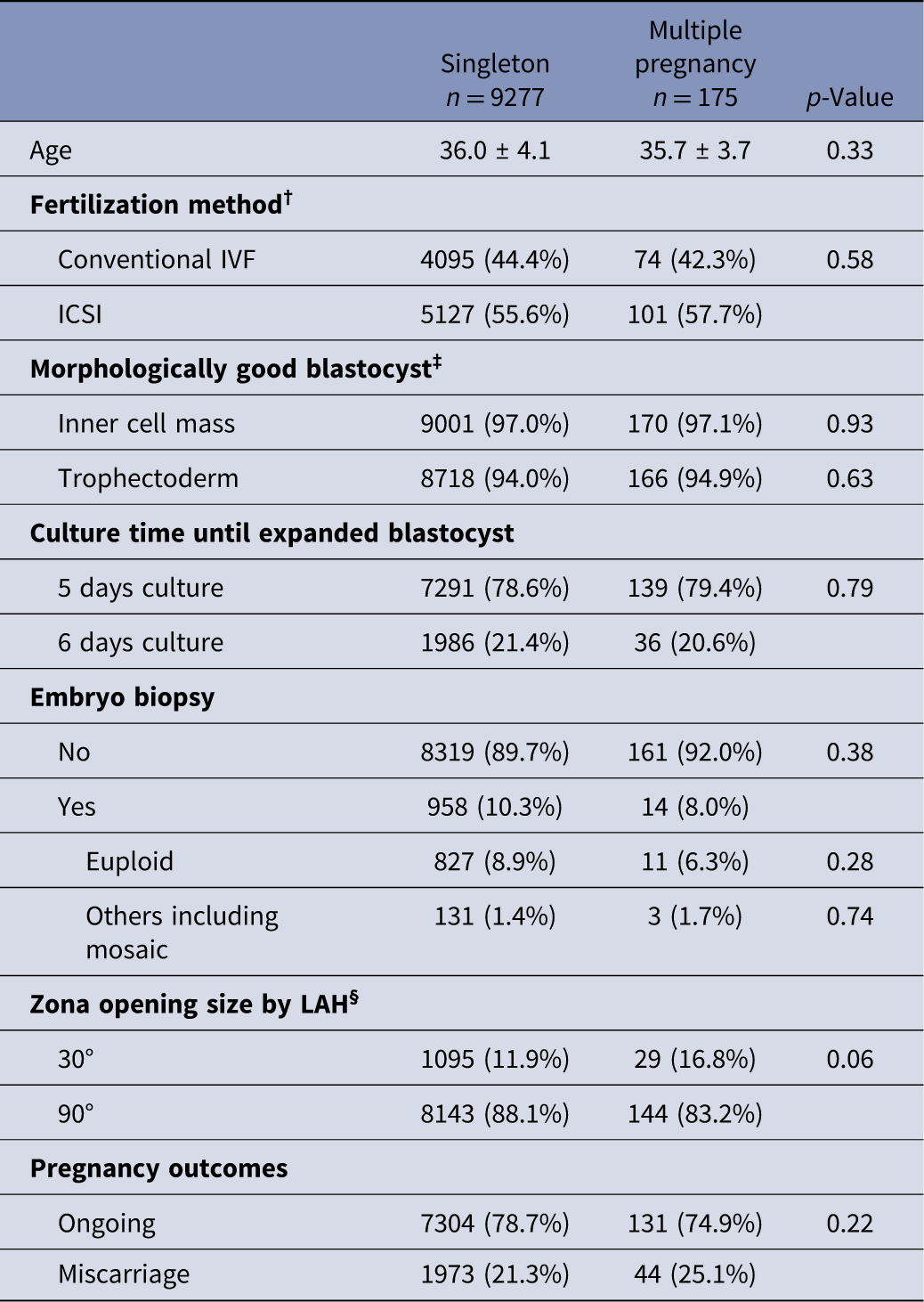
The characteristics of the patients with 9277 singletons and 175 multiple pregnancies are summarized in Table 1. No significant differences in maternal age, fertilization method (conventional IVF vs. ICSI), blastocyst grade, culture time until expanded blastocyst and embryo biopsy rate were observed between singleton and multiple pregnancy cases. The proportion of women with a small zona opening size of 30° by LAH was higher in the multiple pregnancy group (16.8%) than in the singleton group (11.9%); however, this difference did not reach statistical significance (p = 0.06). Multiple pregnancy rates in women with 30° and 90° openings were 2.6% and 1.7%, respectively (p = 0.06, Table 2). We also examined whether the zona opening size affected amnioticity; however, no significant differences in the prevalence of monoamniotic and di- or tri-amniotic multiple pregnancies were observed between women with 30° and 90° openings (p = 0.28 and 0.12, respectively; Table 2).
Characteristics of the patients with singleton and multiple pregnancy

Table 1. Long description
The table compares 9,277 singleton pregnancies with 175 multiple pregnancies. Variables include maternal age, fertilization method, blastocyst morphology, culture time until expanded blastocyst, embryo biopsy, zona opening size by laser-assisted hatching, and pregnancy outcome. Maternal age and continuous variables are presented as mean ± standard deviation, while categorical variables are presented as number and percentage. There were no statistically significant differences between singleton and multiple pregnancies in maternal age, fertilization method, blastocyst morphology, culture duration, embryo biopsy, zona opening size, or pregnancy outcome. The proportion of pregnancies with a 30° zona opening was 11.9% in singleton pregnancies and 16.8% in multiple pregnancies (p = 0.06).
Note: Date are shown as mean ± standard deviation or n (%).
ICSI = intracytoplasmic sperm injection; LAH = laser-assisted hatching.
† Regarding fertilization method, 55 cases in singleton group are unknown.
‡ Morphologically good blastocysts are diagnosed as blastocysts except for grade C of inner cell mass and/or trophectoderm of the Gardner classification.
§ Regarding zona opening size by LAH, 39 cases in the singleton group and two cases in the multiple pregnancy group are unknown.
Prevalence of multiple pregnancy in women with zona opening size of 30° and 90°

Table 2. Long description
The table compares pregnancy outcomes according to zona opening size by laser-assisted hatching. Among pregnancies with a 30° opening, 1,095 of 1,124 pregnancies were singleton pregnancies and 29 were multiple pregnancies, corresponding to rates of 97.4% and 2.6%, respectively. Among pregnancies with a 90° opening, 8,143 of 8,287 pregnancies were singleton pregnancies and 144 were multiple pregnancies, corresponding to rates of 98.3% and 1.7%, respectively. The difference in multiple pregnancy prevalence was not statistically significant (p = 0.06). Monoamniotic multiple pregnancy occurred in 1.1% of pregnancies with a 30° opening and 0.7% with a 90° opening (p = 0.28). Di- and tri-amniotic multiple pregnancy occurred in 1.5% with a 30° opening and 1.0% with a 90° opening (p = 0.12).
Note: Date are shown as n (%).
GS = gestational sac.
Zona opening size in 39 cases in singleton and two cases in di- and tri-amniotic multiple pregnancy are unknown.
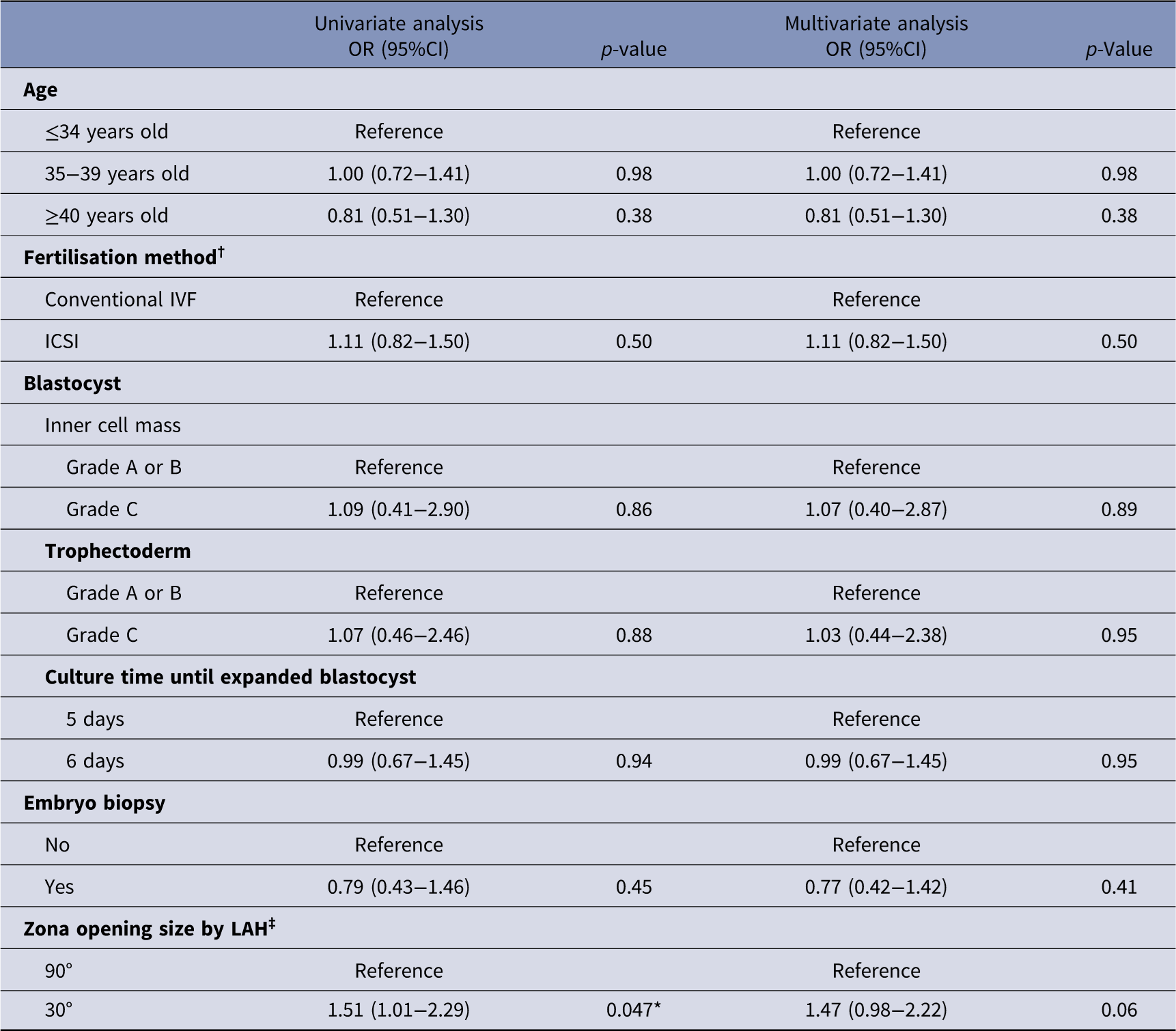
To clarify the risk factors for MMP after frozen-thawed SBT, women with singleton and multiple pregnancies were analysed using univariate and multivariate analyses (Table 3). Univariate analysis identified a small zona opening size of 30° (OR = 1.51, 95% CI = 1.01−2.29, p = 0.047) as a risk factor for MMP; however, multivariate analysis failed to identify a small zona opening size of 30° as a significant independent risk factor for MMP (OR 1.47, 95% CI 0.98–2.22, p = 0.06).
Univariable and multivariable risk factors for multiple pregnancy in all embryo transfer cycles

Table 3. Long description
The table presents odds ratios, 95% confidence intervals, and p-values from univariable and multivariable logistic regression analyses evaluating potential risk factors for multiple pregnancy. Variables evaluated include maternal age, fertilization method, inner cell mass and trophectoderm grade, culture time until expanded blastocyst, embryo biopsy, and zona opening size by laser-assisted hatching. In the multivariable analysis, the reference categories were age <34 years, conventional IVF, inner cell mass and trophectoderm grades A or B, 5-day culture, no embryo biopsy, and a 90° zona opening. A 30° zona opening was associated with multiple pregnancy in univariable analysis (OR 1.51, 95% CI 1.01–2.29, p = 0.047), but not in multivariable analysis (OR 1.47, 95% CI 0.98–2.22, p = 0.06).
Note: Date are shown as mean ± standard deviation or n (%).
ICSI = intracytoplasmic sperm injection; LAH = laser-assisted hatching; OR = odds ratio; CI = confidence interval.
Corrected for the effects of confounding by some of these demographic factors, a logistic regression model was developed for the risk of monozygotic multiple pregnancy with the following variables as covariates: age, fertilisation method, embryo grade (inner cell mass and trophectoderm) of blastocysts, culture time until expanded blastocyst and zona pellucida opening size by LAH.
† Regarding fertilisation method, 55 cases are unknown.
‡ Regarding zona opening size, 41 cases are unknown.
* p < 0.05.
Discussion
Although assisted hatching has been a well-known risk factor for MMP in ART (Li et al., Reference Li, Yang, An, Jiao, Zhou, Wu and Wang2016; Ikemoto et al., Reference Ikemoto, Kuroda, Ochiai, Yamashita, Ikuma, Nojiri, Itakura and Takeda2018; Zeng et al., Reference Zeng, Su and Li2018; Lacey et al., Reference Lacey, Hassan, Franik, Seif and Akhtar2021), this study is the first to investigate the impact of zona opening size on the occurrence of MMP in a large multicentre cohort of frozen-thawed SBT cycles with routine LAH. To our knowledge, no study has evaluated the impact of LAH opening size on MMP in fresh ET cycles. Despite the widespread adoption of elective SBT with assisted hatching to maximize the embryo’s reproductive potential (Kuroda, Reference Kuroda2024), monoamniotic and higher-order MMPs remain an unresolved clinical concern, underscoring the importance of identifying modifiable ART-related risk factors. Our univariate analysis suggested that a small zona opening size of 30° showed a trend towards an increased risk of MMP; however, this association did not persist after adjusting for potential confounders during multivariate analysis.
The overall prevalence of multiple pregnancy after SBT in our cohort was 1.85%, including 1.79% of twins and 0.06% of triplets, which is consistent with previously reported rates of MMP following single ET (Blickstein et al., Reference Blickstein, Jones and Keith2003; Kawachiya et al., Reference Kawachiya, Bodri, Shimada, Kato, Takehara and Kato2011; Nakasuji et al., Reference Nakasuji, Saito, Araki, Nakaza, Nakashima, Kuwahara, Ishihara, Irahara, Kubota, Yoshimura and Sakumoto2014; Kanter et al., Reference Kanter, Boulet, Kawwass, Jamieson and Kissin2015; Ikemoto et al., Reference Ikemoto, Kuroda, Ochiai, Yamashita, Ikuma, Nojiri, Itakura and Takeda2018; Vega et al., Reference Vega, Zaghi, Buyuk and Jindal2018). With respect to zona opening size, multiple pregnancy rates were 2.6% and 1.7% in women with a 30° and 90° opening, respectively. This modest absolute difference of 0.9% may have limited the statistical power to detect a significant association between a small zona opening and MMP during multivariate analysis. Notably, however, the multiple pregnancy rate of 2.6% following a 30° LAH opening was higher than that reported in previous studies (1.01–2.24%) (MacGillivray, Reference MacGillivray1986; Derom et al., Reference Derom, Vlietinck, Derom, Van den Berghe and Thiery1987; Kawachiya et al., Reference Kawachiya, Bodri, Shimada, Kato, Takehara and Kato2011; Kanter et al., Reference Kanter, Boulet, Kawwass, Jamieson and Kissin2015; Nakasuji et al., Reference Nakasuji, Saito, Araki, Nakaza, Nakashima, Kuwahara, Ishihara, Irahara, Kubota, Yoshimura and Sakumoto2014; Ikemoto et al., Reference Ikemoto, Kuroda, Ochiai, Yamashita, Ikuma, Nojiri, Itakura and Takeda2018). Hence, further collection of detailed information on LAH opening size from larger cohorts, such as nationwide registries, might lead to the detection of a significant association on multivariate analyses.
Although the precise mechanism by which MMP occurs remains unknown, one proposed hypothesis involves the division of the ICM during figure-eight-shaped hatching of the blastocyst through the zona pellucida (Vitthala et al., Reference Vitthala, Gelbaya, Brison, Fitzgerald and Nardo2009; Jin et al., Reference Jin, Han and Zenker2024). Monozygotic twinning in spontaneous pregnancy is conventionally classified into three types according to the timing of embryonic division: (1) monochorionic monoamniotic twins, resulting from embryonic splitting after amnion formation, accounting for 1–2% of monozygotic twins; (2) monochorionic diamniotic twins, arising from division at the blastocyst stage, accounting for 70–75% of such cases; and (3) dichorionic diamniotic twins, resulting from division soon after fertilization, accounting for 20–30% of such cases (Aston et al., Reference Aston, Peterson and Carrell2008, Sobek et al., Reference Sobek, Prochazka, Klaskova, Lubusky and Pilka2016). ICM division prior to ET was not observed in our previous report on 122 triplets and 1 quadruplet following single ET (Yamashita et al., Reference Yamashita, Ikemoto, Ochiai, Yamada, Kato, Ohno, Segawa, Nakaoka, Toya, Kawachiya, Sato, Takahashi, Takeuchi, Nomiyama, Tabata, Fujiwara, Okamoto, Kawamura, Kawagoe, Yamada, Sato, Marumo, Sugiyama and Kuroda2020). Furthermore, time-lapse imaging studies have demonstrated ICM splitting occurring during herniation through a zona opening (Sutherland et al., Reference Sutherland, Leitch, Lyall and Woodward2018). Therefore, despite the exceedingly rare occurrence of dichorionic diamniotic multiple pregnancy in ART practice, enlarging the zona opening size during assisted hatching may reduce the proportion of monochorionic diamniotic multiple pregnancy. However, the present study found that enlargement of the zona opening size was associated with a reduction in not only monoamniotic multiple pregnancies (from 1.1% to 0.7%) but also di- or tri-amniotic multiple pregnancies (from 1.5% to 1.0%). These findings suggest that enlargement of the zona opening size may reduce ICM stress caused by blastomere herniation, thereby decreasing ICM division at the blastocyst stage or later.
Previous meta-analyses have reported that assisted hatching was a risk factor for multiple pregnancy, with ORs ranging from 1.38 to 2.30 (Li et al. Reference Li, Yang, An, Jiao, Zhou, Wu and Wang2016; Zeng et al., Reference Zeng, Su and Li2018; Lacey et al. Reference Lacey, Hassan, Franik, Seif and Akhtar2021). Although no prior studies have specifically focused on zona opening size, (Li et al., Reference Li, Yang, An, Jiao, Zhou, Wu and Wang2016) reported that complete removal of the zona pellucida was associated with an increased risk for multiple pregnancy (OR 2.64, 95% CI 1.02–6.85) compared to standard assisted hatching (OR, 1.32–1.57). Loosening of cell-to-cell binding within the ICM has also been proposed as a contributing factor to zygotic splitting (Jin et al., Reference Jin, Han and Zenker2024); therefore, complete zona removal may exacerbate this process by further destabilizing ICM integrity. Enlargement of the zona opening while preserving the surrounding zona pellucida may mitigate the risk of MMP after assisted hatching.
Several limitations of this study should be acknowledged. First, the retrospective design limits control over unmeasured confounders, including subtle variations in embryo handling or laboratory conditions over time. Second, although LAH opening size was standardized within defined periods, other qualitative aspects of the procedure, such as the precise location of the opening relative to the ICM, were not evaluated. Third, although patients were advised to avoid intercourse in a natural ovulation ET cycle, multiple pregnancies with two or more GSs may include multizygotic conceptions after SBT combined with sexual intercourse. Furthermore, because our clinics specialize in infertility treatment and do not provide obstetric care, postnatal information was not systematically available, precluding confirmation of zygosity after birth. Even when postnatal information is available Moreover, same-sex dizygotic twins cannot be reliably distinguished from monozygotic twins with two GSs during pregnancy or even postpartum after birth (Blickstein et al., Reference Blickstein, Jones and Keith2003). Moreover Furthermore, in cases without a detectable foetus within the GS, we could not definitively confirm whether GS-like structures detected using ultrasound were true GSs. Finally, some women may have contributed more than one pregnancy during the study period, because the unit of analysis was clinical pregnancy. However, the proportion of such cases was small and unlikely to substantially influence the results.
In conclusion, this study suggests that a small zona opening created by LAH showed a trend towards an increased risk of MMP and warrants further investigation. These findings provide clinically relevant evidence to inform ART practice and contribute to a more nuanced understanding of MMP following ART.
Acknowledgements
We thank Drs. Yasushi Kuribayashi, Ryo Tsutsumi, Hiroshi Motoyama and Rutsuko Hobo of Sugiyama Clinic Marunouchi and Satoru Takamizawa, Yuko Ojiro, Tetsuo Maruyama, Hiroyasu Juen, Hisayo Kataoka, Hiroko Harada, Shunsuke Ishiyama, Rika Hayashi, Keisuke Shiobara, Takuya Tani, Akiko Itakura, Yoko Gekka, Kazuki Nakao and Yuko Nagura of Sugiyama Clinic Shinjuku for recruiting the patients who underwent ART treatment. We also would like to thank Enago (www.enago.jp) for the English language review. Keiji Kuroda was supported by JSPS KAKENHI grant 24K12542.
Competing interests
Conflict of interest: All authors have no conflicts of interest to declare relevant to this study. This study was approved by the local ethics committee of Sugiyama Clinic (No. 25-001). The data that support the findings of this study are available on request from the corresponding author. Keiji Kuroda was supported by JSPS KAKENHI grant 24K12542.