In 1949, Life magazine collaborated with the editor of Harper's, Russell Lynes, to create a chart that humorously depicted the perceived cultural hierarchy Lynes and other critics had increasingly addressed in their writing. On the chart, Lynes distinguished between “highbrow,” “upper middlebrow,” “lower middlebrow,” and “lowbrow,” representing each stratum's tastes with cartoon illustrations and captions that indicated preferences in clothing, furniture, useful objects, entertainment, salads, drinks, reading, sculpture, records, games, and causes. In entertainment, for example, the chart claimed that the highbrow prefer ballet, while the upper middlebrow prefer theater, the lower middlebrow prefer musical extravaganza films, and the lowbrow prefer western movies. In a brief preface to the chart, Lynes voiced a populist critique of highbrow preferences, describing a person who held them as “a cultural snob of the worst sort . . . [who] cherishes obscure trends in thought and art and fights to keep them pure, noncommercial and within his own limited circle.” He equally lampooned the other brows:
The upper middle-brow . . . is the cultural do-gooder who reads Toynbee, goes to foreign films and never calls curtains “drapes.” By his pretended culture he seems determined to coarsen highbrow treasures. But these are safe from the lower middle-brow who, hell-bent on improving his mind, aspires only as high as the book clubs and magazines edited by upper middle-brows. He lives in a world of washers and sedans, likes reproductions of hunting prints and gives barbecue parties. He secretly thinks he has good taste but does not dare talk about it.Footnote 1
By describing each brow in derogatory terms, Lynes suggested that “highbrow,” “middlebrow,” and “lowbrow” were not labels many would want to have applied to their tastes. Instead, the chart suggested that the labels functioned to denigrate the tastes of others. Much of the chart's humor rests in its irony. Despite claiming to depict the totality of the art-appreciating audience, very few people would associate themselves with any of the chart's categories, for doing so would require one to accept the denigration of his or her preferences. Lynes thus wittily exposed the slipperiness of such categories and offered a critique of the prevalence of the attitudes they reflected.
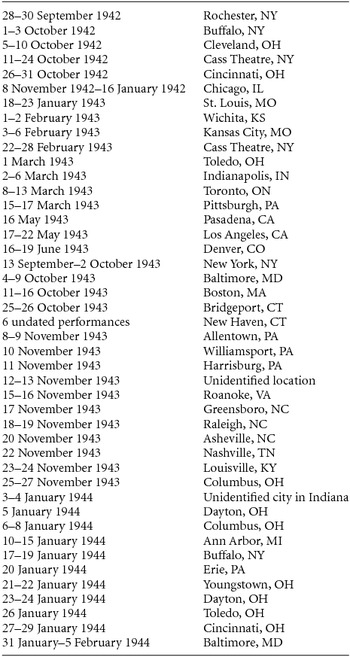
These attitudes posed serious obstacles for American artists at the time, and the stakes were particularly high in the commercial theater, where success often depended on attracting a diverse audience that included patrons who resented highbrow preferences as well as those who rejected art seen as middlebrow. This essay analyzes a 1941 revival of Porgy and Bess to investigate how artists navigated such divergent attitudes, and to demonstrate how these artistic values could be entangled with questions of race. Produced by Cheryl Crawford, the production under present examination opened in Maplewood, New Jersey, in 1941, moved to Broadway in January 1942, and was taken on a national tour that extended the production into 1944 (for a list of the tour destinations see Appendix 1).
Crawford's production represents an important moment in the opera's reception history. Porgy and Bess had first been premiered in Broadway's Alvin Theatre in 1935 to mixed reviews and closed after 124 performances, failing to earn back its initial investment. While not commercially successful, it would be inaccurate to conclude that the opera was a complete failure. Its run had, after all, greatly exceeded the number of performances any opera had received at a traditional opera house in a single season,Footnote 2 and in addition to its performances on Broadway, it was seen in tryouts in Boston and on tour in Philadelphia, Pittsburgh, Chicago, Detroit, and Washington, D.C. Audiences and performers continued to express an interest in the work after the tour had concluded. Excerpts were featured in a major concert at Lewisohn Stadium (9 July 1936) and in concerts by the Los Angeles Philharmonic (10 and 11 February 1937), and early recordings popularized many of the work's songs. In 1936 alone, both Billie Holiday and Bing Crosby released recordings of “Summertime,” and Crosby also released “I Got Plenty o’ Nuttin’” and “It Ain't Necessarily So.”Footnote 3 With interest in the opera growing, Merle Armitage revived it for a tour of the west coast in 1938, and Crawford turned to the opera in 1941. Richard Crawford notes that with her revival “the popularity of Porgy and Bess gradually established itself, and the work became part of the continuing repertory in the United States, gradually finding its way into some European opera houses as well.”Footnote 4
Despite its significant role in the development of the work's popularity, Cheryl Crawford's revival has received little scholarly attention. The predilection of many musicologists to study the composer's intentions has caused much of the literature to emphasize the original production, which was the only production overseen by composer George Gershwin before his death in 1937.Footnote 5 The three book-length studies of the performance history of the work, moreover, pay surprisingly little attention to Crawford's revival, emphasizing reception in the press and offering generalizations about the revisions. These studies contain in-depth analyses of only the original production, Robert Breen's productions in the 1950s, the film of 1959, and the Houston Grand Opera revival in 1976.Footnote 6 With the discovery of a prompt book and other miscellaneous notes at the New York Public Library for the Performing Arts and the Library of Congress, I have been able to largely reconstruct Crawford's score and text. A close analysis of the text and its marketing dispels many of the myths that have extended from generalizations about the revival, and illuminates Crawford's aesthetic values and concerns about the commercial viability of opera.
My study of how Crawford positioned Porgy and Bess within attitudes regarding cultural hierarchy builds on musicologist James O'Leary's recent work on Rodgers and Hammerstein's Oklahoma! (1943). O'Leary argues that Rodgers and Hammerstein marketed the musical to a diverse audience by avoiding conventional genre labels like “musical comedy” and “opera.” Instead the team referred to the work as a “musical play,” which they defined as a theatrical work in which book, lyrics, music, and dance are “integrated” into a cohesive musical drama. The formalism of this rhetoric invoked highbrow ideals and linked Oklahoma! to issues of nationalism and World War II politics, allowing critics like Olin Downes to nationalistically celebrate the “integrated musical” as marking the arrival of a mature form of American theater that could be seen “as the successor to an international tradition of opera.”Footnote 7 In her marketing of Porgy and Bess, Crawford predated Rodgers and Hammerstein's use of ambiguous rhetoric that invoked highbrow ideals. Doing so implicated Porgy and Bess in the same debates that later involved Oklahoma! But Porgy and Bess is a very different work than Oklahoma!, and by 1941 it had already amassed considerable cultural baggage. Thus Crawford's Porgy and Bess was situated within a unique nexus of cultural debates regarding the essence of opera, the institutions best suited for opera production, and the appropriateness of an opera based on an African American subject. With regard to Porgy and Bess, these debates emerged in the critical reception of the original production, and were shaped by New York's most significant operatic institution, the Metropolitan Opera House. After a brief survey of this discourse, this essay details Crawford's revisions and publicity, revealing how they responded to the initial reactions to the work.
The First Production of Porgy and Bess and Perceptions of Opera
Days after its premiere in 1935, Gershwin took to the pages of the New York Times to respond to criticisms of the opera. His article provides a useful entrée into the discussions surrounding the work in the 1930s and 40s. Several critics had expressed confusion over what exactly Porgy and Bess was—an opera or a Broadway musical. Gershwin asserted that Porgy and Bess was a number opera with songs in a folk style, and therefore a “folk opera.”Footnote 8 Interestingly, he did not mention the work's web of leitmotifs, thus dissociating the opera from Wagnerian music drama. He dwelled instead on its songs. “Songs are entirely within the operatic tradition,” he wrote. “Nearly all of Verdi's operas contain what are known as ‘song hits.’ Carmen is almost a collection of song hits.” Gershwin also worked to assure his readers that Porgy and Bess contained the comedy, dance, and general stage action they had become accustomed to on Broadway. He wrote, “Because Porgy and Bess deals with Negro life in America it brings to the operatic form elements that have never before appeared in opera and I have adapted my method to utilize the drama, the humor, the superstition, the religious fervor, the dancing and the irrepressible high spirits of the race.”Footnote 9
Why did Gershwin distance Porgy and Bess from Wagnerian opera and emphasize its racialized humor and stage action? Thus far, scholars have studied Gershwin's assertions in the immediate context of the reviews to which they responded. Most recently, for example, O'Leary argues that Gershwin's strategy was to focus on the number opera format to follow “the rhetoric of his critics with regard to the form of Porgy and Bess and [concede] that the show did not resemble an integrated music drama as much as it did an Italian ‘number’ opera.”Footnote 10 This statement is undoubtedly true, but the critical discussion of Porgy and Bess intersected with debates about music theater that far exceeded any single opera. In fact, Gershwin's response not only addressed the critics’ reactions to Porgy and Bess, but also more general perceptions of opera in New York that had been shaped by decades of operatic practice at the Metropolitan Opera House.Footnote 11
Gershwin's avoidance of Wagnerian aesthetics in his New York Times article can be seen as an attempt to distance Porgy and Bess from the aesthetics of the Metropolitan. The opera house had displayed a Wagnerian bias since its second season (1884–85), when general manager Leopold Damrosch's repertoire consisted mostly of operas by Wagner with a sampling of other operatic standards in German translation. This approach proved popular among the city's growing German population in the late nineteenth century and was lucrative for the opera house, leading Damrosch's successor, Edmund Stanton, to produce strictly “German” opera through the 1890–91 season.Footnote 12 Even after this “German Period” at the Metropolitan, the popularity of Wagner and the widespread acceptance of his aesthetic ideals caused the management to largely pass over number operas in favor of serious and through-composed works like those by Wagner himself, Puccini, and the late operas of Verdi, which were commonly perceived as dramaturgically similar.Footnote 13 The preference for Wagnerian drama is exhibited even in the new works the Metropolitan commissioned from American composers between 1910 and 1935. As Carolyn Guzski has demonstrated, most of the company's fifteen American operas in these years adhered to Wagnerian principles.Footnote 14
Under general manager Giulio Gatti Casazza (1908–35), in the 1920s and 30s the Metropolitan's production methods came to be seen as dated, slow, and dull, as critics noted with increasing frequency that the opera house had neglected advances in the visual and mechanical aspects of theater production. For example, in his review of Jonny Spielt Auf in 1929, Downes informed his readers, “If it is desired to see a presentation of a modern opera, reflective of modern life and the age of movement and speed and contemporaneous appliances, go to little Leipzig; watch the spectacle contrived by Walter Brügmann. Here in New York, in the center of the swiftness and modernism which are inside our houses and outside our doors, we fall short beside it. . . . Mechanically this production is slow-moving.”Footnote 15 The Metropolitan's dated techniques contrasted with Broadway productions. Striving to be “up-to-the-minute” in all elements of style and execution, Broadway production designers like Hassard Short used technologies like revolving turntables to create rapid scene changes.Footnote 16 Alongside these developments, in the 1930s critics of the Metropolitan like Irving Kolodin ridiculed “the antique stage, the ugly and tasteless sets, the unimaginative lighting, [and] the vast spaces which discourage any but the most rudimentary dramatic effects.” Undoubtedly like some mid-1930s audience members, Kolodin associated the Metropolitan's slow and dull productions with what he perceived as the institution's “highbrow” attitude. He recognized that the popular theater had surpassed the Metropolitan and advocated for the company to move to the recently opened Radio City Music Hall, a topic of frequent discussion at the time. He wrote, “Installed here, then, the imaginative vigor of our native designers could achieve the results which they are accustomed to accomplish, as a matter of course, in the despised ‘commercial’ theatre” (emphasis added).Footnote 17
Stressing the stage action and the elements of Porgy and Bess that departed from Wagnerian procedures, therefore, allowed Gershwin to distance the opera from the “old-fashioned” Metropolitan and defend it from accusations of highbrow pretension. In fact, attitudes about opera that had been shaped by the Metropolitan had informed many of the critical responses to Porgy and Bess.Footnote 18 Critics tended to praise the aspects of the show they saw as theatrical and noted that such features were uncommon in opera. Time’s preview of the tryout run in Boston celebrated that “audiences will at least see and hear something different” from traditional opera, contrasting Porgy and Bess’s performers with opera's stereotypical “fat, formal singers decked with feathers and emitting feeble whoops.”Footnote 19 In the New York Times, Downes noted that much of the production was “uncommonly interesting, particularly to a reviewer accustomed to the methods of the opera stage.” Claiming that operatic stagings “are usually as out of date as the dodo,” he hoped that the Metropolitan would adopt some of the procedures of staging utilized in Porgy and Bess. He wrote, “If the Metropolitan chorus could ever put one-half the action into the riot scene in the second act of Meistersinger that the Negro cast put into the fight that followed the crap game, it would be not merely refreshing but miraculous.”Footnote 20 Additionally, many critics found the Broadway-style songs to be the most rewarding parts of the score, contrasting them with the operatic sections. For example, Brooks Atkinson claimed, “In sheer quality of character they are worth an hour of formal music transitions.”Footnote 21 Atkinson attacked such “formal music transitions” along the lines of the Metropolitan productions’ frequent critiques—as nondramatic, slow, and pretentious. Describing himself as “a reviewer so inured to the theatre that he regards operatic form as cumbersome,” Atkinson most famously ridiculed the recitatives:
Turning Porgy into opera has resulted in a deluge of casual remarks that have to be thoughtfully intoned and that amazingly impede the action. Why do composers vex it so? ‘Sister, you goin’ to the picnic?’ ‘No, I guess not.’ Now, why in heaven's name must two characters in an opera clear their throats before they can exchange that sort of information? What a theatre critic probably wants is a musical show with songs that evoke the emotion of situations and make no further pretensions. Part of the emotion of a drama comes from the pace of the performance.Footnote 22
Gershwin's defense of the opera's “black” subject matter also distinguished Porgy and Bess from the Metropolitan, where African Americans were not cast in lead roles until 1955.Footnote 23 As many scholars have noted, critical responses to Porgy and Bess were entangled with issues of race.Footnote 24 To some white reviewers, the story of the fictitious African American community of Catfish Row was appropriate for an opera because of the perception that blacks were inherently musical. To E. F. Harkins, for example, the characters in Porgy and Bess were “folks who naturally turn their joys and sorrows into song.”Footnote 25 Historian Ellen Noonan reveals that “many [reviewers] juxtaposed the supposed ‘primitive’ nature of the fictional material with the sophisticated operatic form in which it was delivered,” resulting in mixed opinions about the appropriateness of African American characters singing in an operatic style.Footnote 26 For example, the Boston American reported that “Catfish Row and its childlike primitives . . . grew to momentous stature,” while Warren Storey Smith wrote in the Boston Post, “The sophisticated atmosphere and idiom of opera scarcely suits the protagonists of Porgy.”Footnote 27 In the face of varying attitudes about race in Porgy and Bess, Gershwin did not avoid the issue, as he had Wagnerian aesthetics, but rather defended the opera's subject matter and performers. Relying on common stereotypes, he wrote that African Americans “are ideal for my purpose because they express themselves not only by the spoken word but quite naturally by song and dance,” and he further suggested that the performers, especially Todd Duncan and Anne Brown, gave the score “intense dramatic value . . . because what we wanted from them lies in their race.” Although many at the time were rightly offended by Gershwin's stereotypes, when viewed as a response to perceptions of opera as shaped by the Metropolitan, Gershwin's emphasis on the “blackness” of his opera can be seen as a strategy to distinguish his work as more progressive than traditional productions mounted in New York.Footnote 28
Porgy and Bess’s subject matter, according to Gershwin, allowed him to create a work that was dramatically, stylistically, and racially distinct from opera as it was produced by what he called “the usual sponsors of opera”—in New York, of course, meaning none other than the Metropolitan. As the following discussion will demonstrate, Crawford's revisions can be seen as extending Gershwin's response by further highlighting the same musical, dramatic, and racial characteristics that the composer had stressed in his article. Crawford departed from Gershwin in one respect, however. Whereas the composer had defended Porgy and Bess as an opera, albeit a “number” or “folk” opera, Crawford avoided labels altogether and adopted ambiguous language that simultaneously invoked and distanced her Porgy and Bess from the “highbrow” genre.
Repackaging Porgy and Bess in 1941
Crawford first made a name for herself in the New York theater when she worked with the Theatre Guild. After leaving the Guild, she cofounded the Group Theatre with Lee Strasbourg and Harold Clurman in 1931. The Group aimed to produce leftist plays of social significance, and Clifford Odets's Waiting for Lefty is perhaps the most remembered of the Group's productions today. In the late 1930s Crawford left the Group, first embarking on a career as a solo producer and then entering a partnership with attorney John Wildberg to form the Crawood Corporation. They began producing plays in 1940 in Maplewood, New Jersey, and after two successful seasons Crawford decided to mount a large-scale production in the fall of 1941. She settled on Porgy and Bess but believed the undertaking would require significant revisions to make it profitable and appealing to a wide audience. Due to only a small amount of extant documentary evidence and little reference to it in the creators’ personal reflections, it is impossible to discern the exact process through which Crawford and her assistants revised the work. Documents do bear witness, however, to the fact that revising Porgy and Bess was an undertaking that revolved around a careful negotiation of artistic and financial considerations, both of which were informed by the reception and financial loss of the original production, as well as Gershwin's intentions and opinions, as expressed in the New York Times and elsewhere.
Ira Gershwin's correspondence suggests that Crawford sought to decrease the number of musicians in the orchestra to reduce expenses. In order to move forward with the project, Crawford needed consent from the rights holders: the Theatre Guild, which had mounted the original production; Ira Gershwin, who had contributed many of the lyrics; and Dorothy Heyward, who had represented author DuBose Heyward's interests since his death in 1940. Warren P. Munsell, the Theatre Guild's business manager, negotiated with the Crawood Corporation only after carefully consulting with Ira, who withheld his consent in order to influence the alterations made to the orchestration. The earliest surviving piece of correspondence related to the production is an unsigned letter from the Crawood Corporation to Munsell, stating that that to proceed with a revival of Porgy and Bess, Crawood wished to “decrease the production expenses to a size where profits could turn over more quickly and that would make a road tour practical.” They suggested hiring Kurt Weill to rewrite the role of Porgy to suit Paul Robeson's voice and reduce the instrumentation “for a fifteen or sixteen piece orchestra.”Footnote 29 In September of that year, Weill wrote to Ira. Although the letter primarily concerned the casting of his upcoming Lady in the Dark, Weill appears to have revealed Crawford's plans in a brief parenthetical aside: “I have found (through Cheryl Crawford who, by the way is planning a revival of Porgy and Bess) a young actor whom we all like very much for Charlie Johnson.”Footnote 30 Busy with Lady in the Dark and then One Touch of Venus, Weill never worked on Porgy and Bess. Indeed, the project appears to have been set aside until August 1941, when Ira responded to a now-lost letter from Munsell that laid out the terms for a contract with the Crawood Corporation. Ira accepted the general terms, but made sure to voice his concerns about the proposal to reduce the orchestra to twenty members—already a higher number than discussed a year earlier. He wrote, “[Alexander] Steinert tells me you cannot get any effect with twenty men which is the number I hear they expect to use. For Maplewood they may get by with so small a unit but it would sound pretty awful in New York.”Footnote 31 Munsell's reply to Ira was conciliatory—“I too am doubtful about the twenty piece orchestra proposition”—but he also reminded Ira that a reduced orchestration had been successful in Armitage's West-Coast revival. Munsell urged Ira to provisionally authorize the Maplewood production while retaining the right to prohibit its move to New York: “If you can come to Maplewood to see the production and would like to decide at that time whether the orchestration is satisfactory for New York, I will try to make a deal with Crawford and Wildberg to have the New York engagement subject to your approval, or if you cannot come you will have it subject to your approval.”Footnote 32
Ira's correspondence with Alexander Smallens, who conducted both the original production and Crawford's, reveals that the lyricist's concerns had exerted an influence by September. Smallens wrote to Ira on 5 September 1941 with his thoughts on the reduced orchestra, proposing a larger number of musicians than previously discussed and justifying the premise by invoking the project's finances. “In looking over the score I come to the conclusion that the orchestration should be condensed for a smaller body of men—I would suggest 26 at the most,” he wrote. “Doing this would make the producing of Porgy feasible and practical as far as theatrical enterprises are concerned.”Footnote 33 This letter seems to have eased Ira's concerns, for he responded optimistically in a letter dated 11 September 1941. “About the revival of Porgy and Bess,” he wrote, “I think it's a good idea,” and he proceeded to offer his suggestions on the orchestration:
About the orchestration: when “P.&B.” was produced out here [in Los Angeles] a couple of years ago and was compared quite favorably to the New York production they tell me that while the orchestra probably didn't have quite the richness of the New York performance it was most adequate. The point is that I'm sure the orchestra was already reduced to about 26 men and still sounded pretty full. I wasn't here at the time, so don't know exactly how it was done, but since it was done (and successfully) I don't see why that particular reduced scoring can't be done again. I don't know where those parts are at present but probably Steinert or Merle Armitage would know.Footnote 34
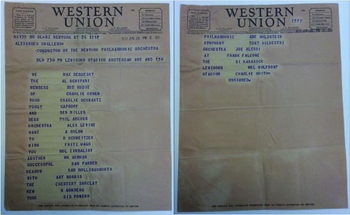
As this letter confirms, Munsell's reasoning prevailed. Since a reduced orchestra of about twenty-six had succeeded in 1938, Ira was confident it would suffice for the Maplewood revival. In the end, the exact number of musicians who played in the orchestra is impossible to ascertain with certainty because the musicians’ contracts and parts are lost.Footnote 35 However, a telegraph dated 26 June 1942 to Smallens, which wished him “another successful season with the New York Philharmonic Symphony Orchestra at the Lewisohn Stadium,” was signed by “the members of your Porgy and Bess orchestra,” and listed twenty-seven names (see Figure 1).Footnote 36 Nevertheless, with a plan for the orchestration arranged to everyone's satisfaction, Munsell negotiated the contract with the Crawood Corporation, which included a clause allowing Ira to reject a New York production if he deemed the revisions unworthy. All parties signed the agreement on 24 September 1941, and with no further negotiating they signed a second contract on 8 November of that year, allowing the show to move to Broadway.Footnote 37
Telegram to Alexander Smallens signed by twenty-seven members of the Porgy and Bess orchestra, 26 June 1942. Alexander Smallens Papers, series I, Music Division, New York Public Library for the Performing Arts.

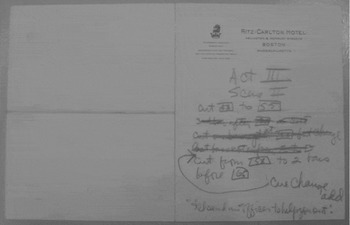
Beyond Ira's correspondence, little record of the revision process survives. Smallens likely made the changes to the orchestration himself, but the record is unclear on the matter. Although a 1953 profile of Smallens said he recalled agreeing to participate in Crawford's revival on the condition that he be “permitted to liberate the piece from its own shackles—to get rid of the recitative and to reorchestrate,” surprisingly there is no mention of reorchestrating the work in Smallens's contract.Footnote 38 It is also unclear who exactly determined what was to be cut from the score. In her memoirs Crawford recalls, “Smallens and I sat in the theatre with a score between us and carefully cut recitatives we thought were out of place or unnecessary.”Footnote 39 Despite this testimony, however, no evidence suggests Crawford had a direct role in making the revisions; the only surviving lists of cuts (to act 1; act 2; act 3, scene 2; and act 3, scene 3) are in Smallens's handwriting (see Figure 2).Footnote 40 A prompt book in the Cheryl Crawford Papers at the New York Public Library for the Performing Arts indicates that all of the cuts on these lists found their way into the production, but the book contains additional cuts as well.Footnote 41 Perhaps Crawford dictated the listed cuts to Smallens, or perhaps she herself made the additional cuts not on the surviving lists, but no documents specify who proposed and ultimately settled on the cuts that were made.
One of Alexander Smallens's lists of cuts for the revival of Porgy and Bess. Alexander Smallens Papers, series V, folder 4, Music Division, New York Public Library for the Performing Arts.

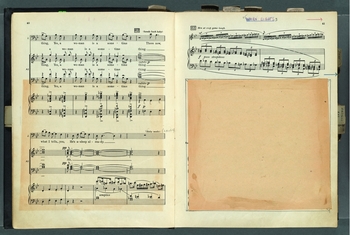
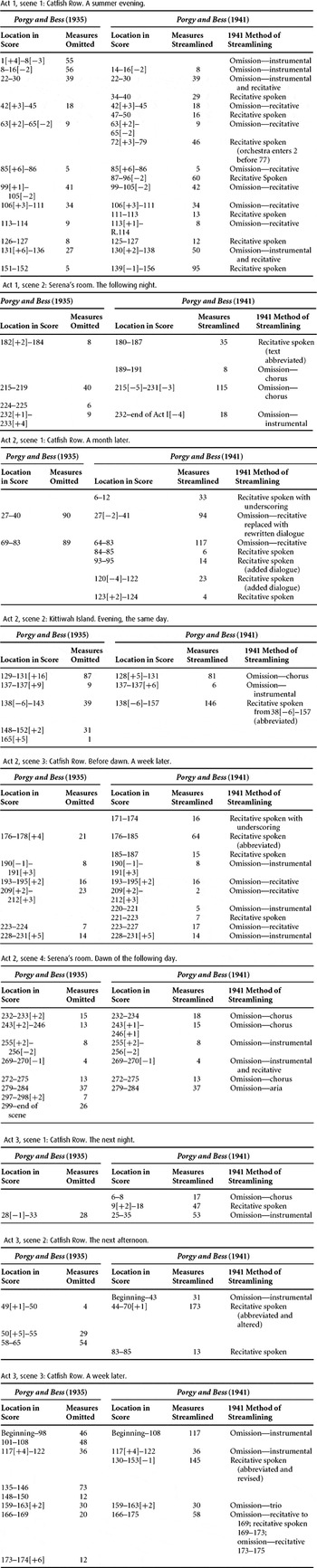
The prompt book—an amended version of the 1935 vocal score—documents all of the cuts, alterations to dialogue, lighting cues, stage directions, and other notes for the revival. It does not indicate any recomposition that likely smoothed the transitions around the excised material, for the cuts are only crudely indicated through measures crossed out in pencil, clips and tape that bind together multiple-page omissions, and most commonly, paper pasted over cut measures (Figure 3). While it does not reveal the process through which these revisions were made or provide a performable edition, the prompt book complements Ira's correspondence, revealing that alterations were made for reasons other than the bottom line. Indeed, the prompt book suggests that the revisions were also made with an eye toward increasing the pace of the production and responding to concerns about the perceived veracity of poor African American characters singing in an operatic style. Crawford's team made three types of revisions to Gershwin's score: omissions, recitative replaced with the original text delivered in spoken dialogue, and recitative replaced with the text of the original libretto spoken over the original orchestral music, now played as underscoring. The revisions are listed in Appendix 2, where they are referred to as “streamlined” passages because they involved more than simply cutting sections of the score. With that said, cuts were significant. Of the fifty-five total revised passages, thirty-six of them—approximately 65 percent—simply cut material. Allowing overlap between types of omissions, sixteen of the thirty-six cuts consist entirely or contain passages of recitative, fourteen consist entirely or contain extended passages of instrumental music, eight consist entirely or contain extended passages of choral material, two excise entire songs (“Buzzard Song” and “I Hates Yo’ Struttin’ Style”), and one is a short cut to a trio (“Oh, Bess, Where's My Bess?”).
A passage in the revival's prompt book showing a cut by the placement of paper over excluded measures. Porgy and Bess prompt book, box 15, Cheryl Crawford Papers, Billy Rose Theatre Division, New York Public Library for the Performing Arts.

The cuts achieved multiple objectives. All of them expedited the drama by trimming the types of music and text—particularly recitative—that had been criticized in 1935. Years later, Crawford channeled Atkinson's critique, writing in her memoir that cutting the recitatives “may seem sacrilegious to some, but I never got a thrill out of a recitative like ‘Oh God! Don't let them take Bess to the hospital!’” She claimed that with these revisions, “the show became more of a piece and flowed swiftly and tunefully.”Footnote 42 The “tuneful” parts of the show to which Crawford referred were likely the songs, which Gershwin had singled out in his New York Times article. By trimming the recitatives, Crawford's version further highlighted the songs, and thus further distinguished Porgy and Bess from Wagnerian opera and the Metropolitan. With such revisions, moreover, Crawford also reduced the amount of operatic material that these African American characters sang, thus alleviating concerns that it was unrealistic for African Americans—who had never been seen on the Metropolitan's stage—to sing in the “sophisticated” style of opera. Indeed, in her memoirs, Crawford displayed an acute awareness of the racial issues surrounding the original production: “When I had seen the 1932 [sic] production I had been critical of only one element, the recitatives, which, I felt, were out of keeping with the black milieu.”Footnote 43
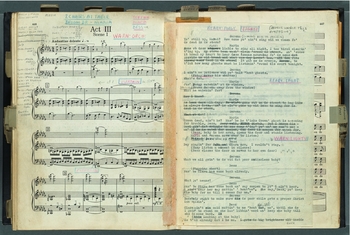
While the majority of the revisions consisted of cuts, the prompt book reveals additions Crawford's team made to presumably enliven what they perceived as dull moments and thus enhance the work's “entertainment for the eye” that Gershwin had touted in 1935. For example, the original act 3, scene 1 consisted of the chorus mourning the deaths of Clara, Jake, and Crown as they sang “Clara, Clara Don't You Be Downhearted.” Crawford's prompt book reveals that additional dialogue derived from the Heywards’ 1927 play Porgy was spoken over the chorus, pushing the music to the background (Figure 4). In the new dialogue, Serena and Maria discuss how Porgy awaits the return of Crown. Bess, now caring for Clara's baby, then joins them and says, “Dis baby know already dat Bess make him a good ma.” Serena agrees and exits with Bess, leaving Maria onstage with Sporting Life, who suggests that Crown would return and violently steal Bess from Porgy. In addition to foreshadowing Crown and Porgy's violent confrontation and explicitly revealing that Bess was caring for Clara and Jake's baby—a development left more implicit in the original production—the alterations to this scene injected stage activity into what was originally a relatively static choral number, de-emphasizing the music, enlivening the scene by moving the story along, and distancing the production from the perception of operatic dramaturgy.
Dialogue from Dubose Heyward's 1927 play, Porgy, added to act 3, scene 1 of Porgy and Bess. Porgy and Bess prompt book, box 15, Cheryl Crawford Papers, Billy Rose Theatre Division, New York Public Library for the Performing Arts.

A passage from act 1, scene 1 as revised for Crawford's production. In this excerpt the recitative and orchestral accompaniment were retained, preserving the introduction of Porgy's leitmotif. Cheryl Crawford Papers, Billy Rose Theatre Division, New York Public Library for the Performing Arts. Transcription by author.

A passage from act 1, scene 1 as revised for Crawford's production. In this excerpt the original recitative was spoken over the orchestral accompaniment, which preserved the introduction of Porgy's loneliness motif and Crown's leitmotif. Cheryl Crawford Papers, Billy Rose Theatre Division, New York Public Library for the Performing Arts. Transcription by author.

Crawford developed a consistent and propagandistic strategy to emphasize the effect of these revisions and redefine Porgy and Bess before the critics could once again critique its pacing and operatic procedures. A publicity flyer advertised the work as unlike traditional opera, claiming it was “improved . . . greatly” because it was “no longer an opera, in the conventional sense, but now utilizes freely the full dramatic power of a strong story against the background of wonderful Gershwin music.” The advertisement alerted the public that Porgy and Bess was not “dull” music drama; relocating the music to the background ensured that it was lively theater with a strong story. Moreover, unlike the perception of opera at the Metropolitan, the flyer proclaimed the revised Porgy and Bess to be “most impressive, stirring, entertaining and even thrilling.”Footnote 44 In its announcement of the show's opening that appeared on the morning of the premiere, the New York Times absorbed Crawford's rhetoric. The newspaper reported that “much of the recitative . . . has been eliminated” and “more stress is put on the play by DuBose and Dorothy Heyward from which the show is derived. The running time is now about two hours and twenty minutes, slicing forty-five minutes off the original.”Footnote 45
Crawford's publicity billed the show as “George Gershwin's Porgy and Bess,” which suggested to potential audiences that it honored the composer's intentions.Footnote 46 The prompt book displays the team's awareness of precise cuts made to the printed vocal score during the original production, providing further evidence that Smallens, who had conducted in 1935, was responsible for many of the 1941 revisions. In Appendix 2 I list the 1941 revisions alongside the 1935 cuts made between the publication of the vocal score and the premiere, cuts that Charles Hamm first identified in 1987.Footnote 47 To be sure, inconsistencies existed between the two productions. Nineteen cuts were new in 1941, three passages cut in 1935 were not cut in 1941 (in act 1, scene 1; act 2, scene 2; and act 2, scene 4), and two cuts in 1935 were longer than cuts to the same passages in the revival (act 1, scene 1; and act 2, scene 2). While the new cuts were surely made to shorten the work and speed along the drama, the restorations are unexplainable. It is conceivable that Crawford's team simply overlooked prior cuts, or that the restorations were necessitated by issues related to the staging of the work, but no documentation exists to substantiate such speculation. Nevertheless, most of the revisions were based on changes made in 1935. Nineteen cuts in 1941—including two complete numbersFootnote 48 —were nearly identical to cuts made under Gershwin's supervision, and seventeen cuts expanded cuts already made in the premiere production. Basing the revisions in 1941 upon earlier cuts helped to ensure that the show retained what had become known as the musical highlights of the opera, and also helped Crawford position the show as “Gershwin's.”Footnote 49
The passages of recitative that were converted to spoken dialogue, however, clearly departed from Gershwin's intentions, for Gershwin had rejected this type of revision altogether. As Hamm reports, when first crafting the libretto Heyward advised the composer that “all dialogue should be spoken” because “this will give the opera speed and tempo,” but Gershwin “rejected the writer's suggestion of spoken dialogue in favor of continuous recitative, for all save his white characters.”Footnote 50 In all, in 1941 there were twenty-three instances in which recitative was converted to spoken text, and all of these excerpts immediately preceded, followed, or overlapped with passages that were first cut in 1935.Footnote 51 The proximity of the converted recitative to cuts made under Gershwin's supervision suggests that these might have been areas the original collaborators had agreed were weak but that Gershwin had refused to change to spoken text. Although it is impossible to document, it is possible that Smallens wanted to make these alterations during the original production, and the revival finally allowed him to do so. Speculation aside, the irresolvable issues of authorship do not justify or condemn the 1941 revisions. Rather, they underscore that Crawford's assertion that the altered Porgy and Bess honored Gershwin's intentions was a rhetorical strategy—a marketing technique—rather than a reflection of clear-cut issues of authorial intent.
The rhetoric, however, relied on the fact that the alterations respected certain aspects of Gershwin's conception. In fact, contrary to how it is frequently reported, not all of the recitatives were omitted in the new production, and many were retained to keep Gershwin's distinction between black and white characters.Footnote 52 Although the 1941 revisions had African Americans speak some of their lines, it honored Gershwin's vision by representing the African Americans as generally musical—just not omni-musical—to differentiate them from the white characters. In act 2, scene 1, Frazier, an African American lawyer, arrives in the community and tricks Porgy into purchasing a divorce for Bess, misleading them into believing it necessary in order for her to legally live with Porgy. In Crawford's version this entire scene is performed with Gershwin's original recitative. By leaving it intact, it provides an important juxtaposition with the previous scene in which the speaking white policemen—other outsiders—arrive to investigate Robbins's murder.Footnote 53 This juxtaposition makes clear that all African Americans in Porgy and Bess—not simply the Catfish Row residents—are musical, and whites are not. Thus the revisions to the work's recitative honored some of Gershwin's intentions while addressing two issues of race raised during the original production: the revisions reduced the amount of operatic material that many had found unrealistic in the context of Catfish Row, but simultaneously played into the stereotype that African Americans were inherently musical by strategically leaving some of the operatic material in place.
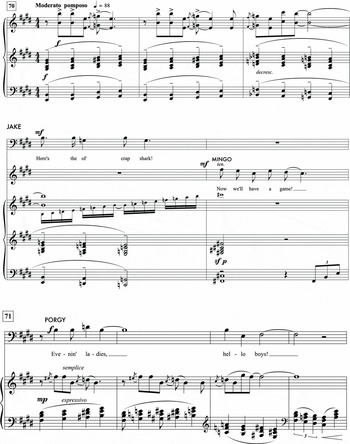
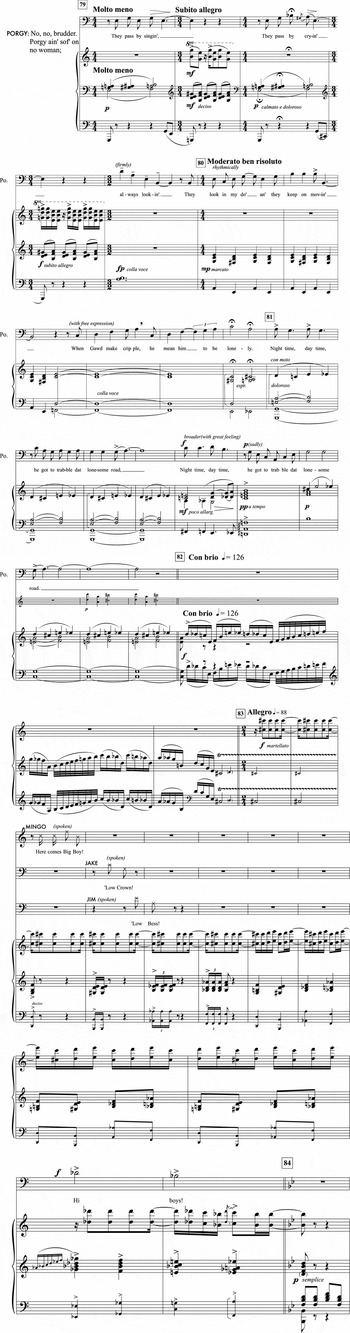
In addition to maintaining Gershwin's method of distinguishing the characters along racial lines, Crawford's team worked to maintain the composer's leitmotifs. For example, following Jake's “A Woman Is A Sometime Thing” in act 1, scene 1, the actors continue to sing recitative. While this text is not altogether important—“Here's the ol’ crap shark! / Now we'll have a game! / Evenin’ ladies, hello boys!”—the orchestral accompaniment introduces Porgy's leitmotif—one of the most significant in the show—when the character first enters (rehearsal 70; see Example 1). Then the accompaniment ceases and, as is done wherever recitative was replaced with spoken dialogue, the actors speak the original text (three mm. after 71). The orchestra reenters to underscore spoken dialogue (two mm. before 77) until Porgy sings what Geoffrey Block calls his “loneliness” motif (rehearsal 79), and proceeds to accompany recitative through the introduction of Crown's leitmotif (two mm. before 84; see Example 2).Footnote 54 After the introduction of this motif, the orchestra then again withdraws and the characters speak the text originally written as recitative.
The revisions to the choruses—most of which were shortened but all of which were at least heard in part—reveal how Crawford's team worked to balance the perceived need to cut the opera and “improve” its pacing with the desire to represent as much of Gershwin's score as possible. Many in the audience would certainly have missed the ways Gershwin varies the chorus “Oh, Doctor Jesus” in its second appearance at the beginning of act 2, scene 4, but Crawford and her team chose to present only its first and third iterations. We might presume that Crawford found the second “Oh, Doctor Jesus” to be dramatically unimportant, believing that the rest of the choruses in the scene—“Oh, De Lawd Shake De Heavens,” “Oh, Dere's Somebody Knockin’ At De Do’,” and a significantly abridged third iteration of “Oh, Doctor Jesus”—amply represent the residents of Catfish Row as they pray for the hurricane to safely pass. By removing perceived redundancies, Gershwin's perfectly rounded musical scene—in the sense that he bookends it with “Oh, Doctor Jesus”—was transformed into a shorter scene that, stripped of recurrences, continuously moves forward.
Perhaps because he was involved in both the original production and the revival, Smallens was the most vocal member of Crawford's team to position the revisions as honoring Gershwin's intentions. Paraphrasing Smallens, Irving Drutman asserted that when revising the work “none of the set pieces was touched, nor were any of Ira Gershwin's lyrics eliminated.”Footnote 55 This statement, of course, was not true. But the claim was based on the fact that every number that had been heard in New York in 1935 was still represented, at least in part, in the revised score. Furthermore, a draft of a press release includes an interview with Smallens in which he tells an uncorroborated story that situates the revisions as commensurate with Gershwin's conception:
[George Gershwin] admittedly was at a loss when it came to setting the ordinary language of the play to music, and partly because of this the first production of Porgy and Bess was somewhat heavy. There was too much music and much of the recitative was sung, which slowed up movement of the drama. There used to be long discussions about this dialogue, and George finally became convinced that it should be spoken rather than sung. But the changes never were made and poor George passed on without ever seeing Porgy and Bess as it is now and as I know he wanted it—alive, compact, and dramatic.Footnote 56
Smallens spoke to the belief that Gershwin had erred in his deployment of recitative, suggesting, like Atkinson, that it had hindered the dramatic momentum. His suggestion that Gershwin wanted the recitative converted to dialogue appears to be false, for extant evidence reveals only that Gershwin refused to alter his recitatives. Furthermore, on another occasion Smallens told a different story about his collaboration with Gershwin. He claimed:
We couldn't . . . think what to do about [the recitatives]. At the tryout in Boston we all sat around with the Theater [sic] Guild directors until 4 in the morning, listening to some of the craziest suggestions you ever heard. We couldn't eliminate the recitatives because they were essential to the plot, yet no one could think how to improve them. When we opened in New York they received unanimous condemnation from the reviewers. We ran for four months, and although we made some cuts at the time, the production was still so slow-paced that I became bored with my job.Footnote 57
Unlike in Smallens's other tale, in this recollection Gershwin did not agree that the recitatives should be removed, but merely recognized them as problematic. Clearly, the actual history of the creative process of Porgy and Bess was not the point of Smallens's publicity. We can say with near certainty that Gershwin did not agree to remove the recitatives—and whether he did or not was unimportant to Smallens when publicizing the work. What was important in the messaging—and likely false—was what remained consistent between the stories: the notion that Gershwin agreed that the recitatives were problematic and needed to be revised.
By distancing the work from opera and the Metropolitan while positioning it as true to Gershwin's intentions, Crawford and her team simultaneously situated their version of Porgy and Bess as a more conventional Broadway musical and invoked the highbrow—or operatic—notion that it was a product of a single author: the composer. Such ambiguous marketing was a crucial element of Crawford's strategy to reach out to a broad audience. Note that even the aforementioned flyer, which claimed that the work was “no longer an opera, in the conventional sense,” was open to multiple interpretations. The wording allowed those who liked opera to see the revised work as a new kind of opera—an opera, in fact, that addressed the concerns about the genre that critics like Atkinson and Kolodin had raised for nearly a decade. On the other hand, the flyer also allowed readers who did not care for the genre to assume that the new Porgy and Bess was simply “no longer an opera,” and due to its “entertaining” and “thrilling” qualities, was more of a traditional Broadway entertainment. Even the work's billing distanced it from its original associations with opera while still invoking the highbrow genre of opera. Advertisements for the original production in 1935 had referred to “George Gershwin's American Folk Opera Porgy and Bess.” Crawford's billing of the work as “George Gershwin's Porgy and Bess” avoided the word “opera” altogether, presumably to appease those who had misgivings about the genre. Yet the label continued to invoke highbrow ideals of opera by promoting it as the product of its composer. This label also balanced the publicity cited above that claimed the music was now in the “background”; opera fans could be assured that this was still Gershwin's Porgy and Bess. Crawford thus reached out to those with competing perceptions about art and opera by marketing the work in an ambiguous manner that allowed potential theatergoers to interpret descriptions of the show in accordance with their own personal values and interests.
Crawford's propaganda succeeded in creating the framework and terms critics would employ in their assessments of the work. Burns Mantle deemed it “smoother . . . than the original”; while he found the 1935 version monotonous because of “the strain and tenseness of that score,” he believed the revival benefitted from cuts that “help[ed] a lot in sustaining audience interest.”Footnote 58 Richard Watts, Jr. felt that “in the original presentation there was an occasional suggestion of the pretentious,” and “it had a way of dawdling, but in this admirable revival most of them have been done away with. . . . All the touches of pretentiousness are gone, the pace has been quickened and the editing has been sagely managed, so that the work moves more confidently, more dramatically and more honestly than ever before.”Footnote 59 Aesthetically, then, Crawford's Porgy and Bess succeeded where the original had failed. Just as the opera and its music were becoming more familiar throughout the country, Crawford's presentation of Porgy and Bess escaped the negative opinions of opera and opera production that had been shaped by the Metropolitan. Politically, however, the work remained problematic, in retrospect perhaps even more so due to its increased emphasis on the African American characters as naturally musical and the reduction of the operatic content that many had interpreted as in the spirit of racial uplift. Noonan notes that “African American criticism of the show's stereotypes grew a little louder” as writers like Abe Hill complained about the show's depiction of African Americans as possessing “childlike characteristics.”Footnote 60 But most reviews followed Crawford's lead and emphasized the revisions and the opportunities the work afforded black artists, avoiding the racial issues that would become especially contested in the wake of the 1959 movie adaptation, and allowing Crawford's production to become a hit.Footnote 61
Gershwin claimed he had “created a new form, which combines opera with theatre,” and much of Crawford's success was owed to the manner in which she further blurred the line between the genres by shortening the work, quickening the pace, highlighting the song numbers, and playing into widespread racial attitudes.Footnote 62 But Crawford did not completely abandon Gershwin's vision or all of the operatic procedures he had utilized. Geoffrey Block recently asserted that “in contrast to the 1935 operatic form, the 1942 [Broadway] revival presented a Broadway opera shorn of its operatic accoutrements, that is, without recitatives”Footnote 63 —an assertion we can now understand as myth, or worse, as buying into one of Crawford's propagandistic messages: Porgy and Bess was “no longer an opera.” Of course, the other message—that Porgy and Bess was “no longer an opera, in the conventional sense” (emphasis added)—was key to the work's success.
What is important to the historian is not whether Crawford's Porgy and Bess was or was not an opera, but that Crawford and her team marketed the work to potential audience members with divergent opinions about the genre, encouraging each member to individually determine—on his or her own terms—how or even whether to classify the show. By avoiding explicit labels and classifications that might alienate potential ticket buyers, Crawford and her team developed a means of successfully navigating divergent notions of cultural hierarchy, reaching out to those who saw “highbrow” art as pretentious, as well as those who disliked art they perceived as middlebrow. Crawford's team's ambiguous advertising, therefore, contributed to Porgy and Bess’s growing appeal, popularizing the work and helping prepare the way for its eventual acceptance in the international repertoire.
Tour Destinations and Dates for Crawford's Porgy and Bess Footnote 64

Cuts from Porgy and Bess in 1935 and 1941 (by scene)