Public finances are the sinews of state power. A growing theoretical literature examines the interplay between wars, fiscal policy, and economic development.Footnote 2 This literature takes inspiration from historical works that investigate the relationship between external conflicts and fiscal innovations that enabled states to gather greater wartime funds.Footnote 3 It is also motivated by works in political science that study the state's ability to raise tax revenues and provide growth-promoting public services.Footnote 4 Taken as a whole, the new theoretical literature links the demands of war with fiscal and political improvements, and greater fiscal strength with superior public services and thus better economic outcomes. While the key advantage of the new theoretical literature is formal rigor, so far there are only partial empirical tests of it.
To help fill this gap, this article examines the fiscal evolution of Italian states from the end of the Napoleonic era in 1815 to political unification in 1861. Called the Risorgimento, the unification process was one of the major changes in the geopolitical landscape in nineteenth-century Europe. More generally, the institutional variety at the regional level makes pre-unitary Italy a unique testing ground for comparative work. Using a comprehensive new database, we argue that external and internal threat environments had significant implications for the demand for military might, which in turn had important ramifications for fiscal policy and the likelihood of constitutional reform and related improvements in the provision of nonmilitary public services.
By investigating the precise links between threat exigencies, military and fiscal decisions, and political change in a specific historical context, our analytic narrative provides a novel empirical counterpart to the burgeoning theoretical literature. Our case-oriented approach also complements recent econometric works that test for the broad economic and political effects of warfare and taxation across many countries and years.Footnote 5 Finally, our focus on the fiscal features of pre-unitary states offers a new perspective on the forces underlying political unification on the Italian peninsula. Most recent works on the Risorgimento downplay fiscal factors, instead emphasizing cultural and social conditions and the development of a shared national identity.Footnote 6 We do not deny the importance of non-fiscal features. However, Italian unification was at base the result of a set of successful wars. Our investigation shows how differences in pre-unitary fiscal policies shaped this outcome.Footnote 7
The article proceeds as follows. We first develop a simple analytic framework that interprets military and fiscal differences in the context of European history in terms of diverse political conditions, and in particular the magnitude of external and internal threats that absolutist rulers faced, along with their foreign ambitions. Our framework yields several implications about the relationships between threat exigencies and military strength, between military strength and fiscal policy, and between constitutional reform and the provision of nonmilitary public services. We next describe the domestic and foreign political contexts in which the Risorgimento took place and document the main events. Drawing on our new database, we then evaluate the implications of our framework with a detailed quantitative investigation of the Risorgimento, which we follow up with a simple regression analysis that exploits the panel nature of the data. Overall, our examination confirms the framework's implications. We conclude by evaluating our findings with respect to the new theoretical literature.
ANALYTIC FRAMEWORK
We claim that external and internal political environments determined the desired level of military strength, which then influenced fiscal policy. Depending on circumstances, fiscal imperatives induced constitutional reform and related investments in public services such as infrastructure.
In the first link in this chain, threat environments influenced the demand for military might. Philip Hoffman and Jean-Laurent Rosenthal argue that the one true goal of absolutist monarchs in European history was to wage war for personal glory and for homeland defense.Footnote 8 We thus claim that decisions about military spending reflected most importantly assessments by rulers of opportunities for territorial expansion and threats of outside attack. The greater were these opportunities or threats, then the greater were military expenditures. The military also protected rulers from internal risks of overthrow. All states invested in secret police to uncover conspiracies, and the military was called in to repress popular revolts.
The second link was from military demands to fiscal policy. Military expenses including debt service to pay for past wars dominated state budgets in preindustrial Europe.Footnote 9 States did not typically pursue industrial policies until the second half of the nineteenth century, and they spent little on social programs of any kind before the twentieth century.Footnote 10
Rulers had three basic options to gather revenues, which they implicitly ordered in terms of political expediency. The least likely to spark internal turmoil was to borrow funds on domestic and international bond markets. Borrowing opportunities were limited, however, because the creditworthiness of rulers ultimately depended on their ability to collect sufficient tax amounts. Large ratios of debt to taxes were bound to negatively affect the ability of sovereigns to borrow new funds.Footnote 11
A sounder but more controversial option was to increase indirect taxes, starting with customs duties, which were less transparent than outright consumption taxes. Indirect taxes typically affected the population at large, who had no formal political voice but could always stage a revolt. Hence, rulers could only levy new indirect taxes up to a limit. Too drastic a rise in indirect taxation increased the risk of uprisings. This risk was larger, and thus the threshold for popular revolt smaller, if new tax funds were spent on warfare, since the masses provided the bulk of military recruits and took the greatest casualties while gaining no clear benefits from fighting.
A lucrative but particularly controversial option was to increase direct taxes, which typically affected powerful elites. The landowning aristocracy was an important part of the traditional order upon which the legitimacy of absolute monarchs rested. Furthermore, rulers required the expertise of elites to help manage state bureaucracies and to prevent or quell popular uprisings. Levying new direct taxes thus increased the risk that elites would support or even provoke popular revolts. Imposing direct taxes was also technically complex in terms of administration and enforcement.
The traditional aristocracy directly benefited from the rent-generating state jobs that the military offered. Merchant elites, by contrast, did not profit as such from military spending. These elites may have desired more public services, and in particular investments in transportation networks that would promote trade by reducing transaction costs. If so, then there was the impetus for the sort of parliamentary bargain characterized by Hoffman and Rosenthal and Mark Dincecco, whereby merchant elites agreed to pay higher direct taxes in exchange for greater spending on nonmilitary items such as infrastructure.Footnote 12
To make this bargain (the third and fourth links in our chain) credible, it had to be enshrined in a liberal constitution that granted elites regular budgetary authority through parliament. Since they now controlled how tax revenues would be spent, elites could devote a portion of new funds to infrastructure investments that they valued. Meanwhile, the ruler gained greater revenues for military purposes, as nascent constitutional monarchs still exerted significant power over foreign affairs. Indeed, Kenneth Schultz and Barry Weingast argue that the ability of liberal states to make credible spending commitments offered critical military advantages over absolutist ones in European history.Footnote 13
Key Implications
Summarizing, we identify five key implications from our framework that will guide our analysis: (1) States with high ambitions for territorial expansion or that faced high threats of foreign attack spent greater sums on the military. (2) States that spent greater military sums had to gather larger tax revenues. (3) States borrowed when possible and preferred increasing indirect taxes on popular consumption rather than direct taxes on elite incomes. (4) Parliamentary regimes gathered larger direct taxes than absolutist regimes. (5) Parliamentary regimes spent greater amounts on nonmilitary items, and in particular infrastructure, than absolutist regimes.
OVERVIEW OF THE RISORGIMENTO
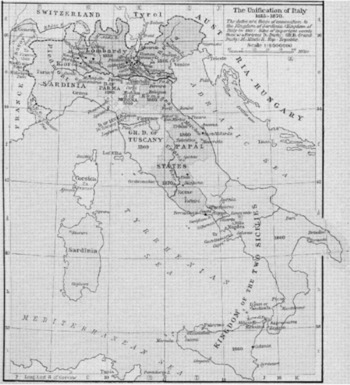
Figure 1 displays a political map of the Italian peninsula at the end of the Napoleonic Wars in 1815. Representatives at the Congress of Vienna divided the peninsula into five major political units: the Kingdom of Sardinia, which despite its official name was constituted mainly of Piedmont and Liguria in the northwest (and thus referred to as Piedmont from here on); the Kingdom of Lombardy-Venetia in the northeast; the Grand Duchy of Tuscany in the center-north; the Papal States in the center-south; and the Kingdom of the Two Sicilies in the south; and three minor ones: the Duchies of Lucca (absorbed by Tuscany in 1847), Modena, and Parma in the center-north. The Two Sicilies was the largest pre-unitary polity in size and population, followed by Lombardy-Venetia, Piedmont, the Papal States, Tuscany, Modena, and Parma.
MAP OF PRE-UNITARY ITALY IN 1815

Rulers in each of these states were absolutists, their power having been restored in 1815. The Kingdom of Lombardy-Venetia formed part of the Austrian Empire. Though officially governed by a viceroy in Milan, this figure was not autonomous and behaved in strict accordance with crown orders from Vienna. The Grand Duchy of Tuscany and the Duchies of Modena and Parma were ruled by branches of the Austrian Habsburg dynasty or by local dynasties related to the Habsburgs. Austria thus exercised direct or indirect rule over nearly 35 percent of the peninsula's territory and population. As one of the Great Powers of Europe, it was well-poised to defend the status quo political order as established by the Congress of Vienna against foreign or domestic threats.
Both the pope and the king of the Two Sicilies shared Austria's conservative aims. The pope's position as the supreme leader of the Catholic Church restricted any serious territorial ambitions. His religious status also protected the Papal States from foreign invasion, which would have prompted an immediate response by the Catholic Great Powers Austria and France. Led by a native Bourbon dynasty, the only land border of the Two Sicilies was with the Papal States, which for politico-religious reasons it could not invade. In the words of King Ferdinando I, the Two Sicilies was thus situated “between holy water and salt water.”Footnote 14
Strategically located between France and Austria, the Kingdom of Sardinia was the sole threat to the traditional political order. Though either Great Power could have conquered Piedmont, both preferred a small buffer state at their borders, which made attack by one another more difficult. Thus, Piedmont did not face any serious external threats so long as it accepted the current state of affairs. Tolerating the status quo, however, was in stark contrast with the enduring territorial ambitions of the House of Savoy, which had ruled Piedmont since the tenth century. The Savoys had begun as feudal leaders of a small Alpine fiefdom subject to France, which became a dukedom at the start of the fourteenth century. Skillfully exploiting rivalries among the Great Powers, the Savoys gradually expanded their territory into both the Po Valley and Southern France. Piedmont became a kingdom at the end of the War of the Spanish Succession (1701–1714).Footnote 15 The Savoys were later awarded the province of Liguria including Genoa, the most important northern Italian port, at the Congress of Vienna. In the following decades, the Savoy remained quiet, but their long-standing goal of state expansion proved to be critical in the push towards Italian unification from the 1840s onward.
The Patrioti and Internal Discontent
Not all Italians supported the absolutist political order that the Congress of Vienna had restored.Footnote 16 The political situation on the peninsula after 1815 was thus less settled than it may have appeared. One portion of elites, inspired by the eighteenth-century Enlightenment and known as the patrioti, desired the establishment of liberal political regimes. The most radical of them nurtured the desire for the political unification of the entire peninsula.
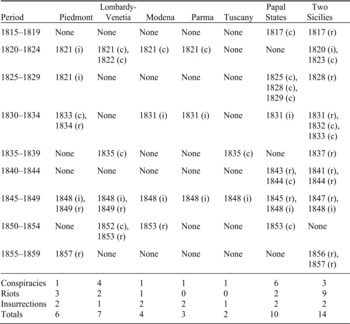
INTERNAL CONFLICTS IN PRE-UNITARY ITALY, 1815–1859

Note:
Internal conflicts include conspiracies (c), riots (r), and insurrections (i).
Sources:
Spellanzon and Di Nolfo, Storia del Risorgimento; Candeloro, Storia dell'Italia; and Hearder, Italy.
Starting at the end of the 1810s, the patrioti began to form plots against absolutist rulers. Their aim was to overthrow traditional authorities through popular revolts supported by urban workers and lower military ranks. Table 1, which describes all major instances of domestic turmoil during the Risorgimento, indicates that subversive acts came in three waves: 1820/21, 1830/31, and 1848. Each wave coincided with larger social upheavals throughout Europe. All of these initiatives ultimately failed, sometimes due to the intervention of the Austrian military. Finally, Table 1 indicates that internal conflicts were most severe in the Papal States and the Two Sicilies.
Wars of Unification and Political Change
The 1848 wave of insurrections in Europe was by far the most important of the pre-unitary period. The Italian portion of this wave, which began in January in the Two Sicilies and Tuscany, had by February advanced to Piedmont and the Papal States. In March, the wave spread to Lombardy-Venetia after its citizens learned of the revolutions in Vienna and Hungary. During these insurrections, patrioti leaders pressured pre-unitary rulers throughout the Italian peninsula to grant liberal constitutions and participate in a war of independence against Austria led by King Carlo Alberto of Piedmont. None of the Italian rulers—with the possible exception of Carlo Alberto himself—were keen on becoming constitutional monarchs or on waging war on Austria. As soon as the revolutionary fervor had died down, all pre-unitary rulers withdrew from the Piedmont-led war alliance and revoked their liberal constitutions, returning to absolutist power. Piedmont continued the war effort but was badly defeated not once but twice, first in July of 1848 and second, following a long armistice, in March of 1849.
In the aftermath of the second defeat, Carlo Alberto abdicated in the hope that his successor Vittorio Emanuele II would receive better peace terms from Austria. Unlike other pre-unitary rulers, Vittorio Emanuele II decided to uphold the liberal constitution, called the Statuto Albertino.Footnote 17 Over the short run, the new king feared that the liberal revolt that had erupted in Genoa upon learning of the military loss would spread to the rest of Piedmont. In that case, Vittorio Emanuele II would be forced to request Austrian troops to repress the insurrection, thereby forfeiting any hope of future support by the patrioti for his long-run territorial ambitions. We thus claim that the dominant factor in the king's choice to retain the Statuto was his goal of state expansion.Footnote 18
Vittorio Emanuele II's decision to honor the liberal constitution was a turning point in the Risorgimento. Before 1848 the absolutist rule of the Savoys along with the institutionalized power of the Catholic Church in Piedmont had disturbed many patrioti. By contrast, the new constitutional monarchy became a beacon of freedom for liberal exiles from other pre-unitary states and a renewed source of optimism for political unification.
The Statuto had far-reaching consequences for Piedmontese political institutions. According to its text, the role of parliament was small. The king had the power to appoint the prime minister, the upper chamber (Senato), and cabinet officials, and wielded great power over foreign policy. However, the lower chamber (Camera dei Deputati) was elected and had the key right to approve the yearly budget. In the words of Douglass North and Barry Weingast, constitutional reform thus established the “fiscal supremacy” of the parliament in Piedmont.Footnote 19
Both the king and elites should have benefited from this parliamentary bargain. Merchant elites, a group whose economic interests diverged from those of the traditional land-owning aristocracy, gained political representation for the first time. These elites—most notably Genoese merchants—desired investments in transportation infrastructure to foster trade with the Po Valley. Parliamentary budgetary authority would enable them to devote greater funds to valued public services. Likewise, the king would be able to put a portion of the new tax revenues generated by parliamentary government towards military purposes (including transportation networks, which also had military functions). His hopes for future military triumphs over Austria were thus kept alive.
During the 1850s parliament's power relative to the king grew steadily.Footnote 20 Count Camillo di Cavour, who became prime minister in 1852, was the dominant figure in Piedmontese politics. Recognizing that Piedmont alone could not match Austria militarily, Cavour sought alliances with France, Piedmont's northwesterly neighbor, and the United Kingdom. To win their favor, he devised Piedmont's participation in the Crimean War (1853–1856). Cavour's strategy was a success. Two years later, he signed a secret pact with Napoleon III to wage battle against Austria. In the summer of 1859, the two allies defeated the Austrian military in Lombardy.
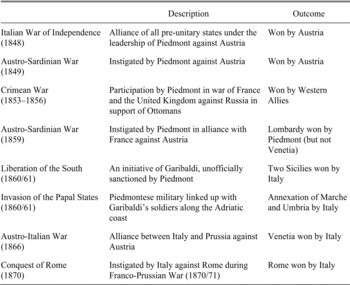
This victory triggered insurrections in Tuscany and the Papal States, the military leader Giuseppe Garibaldi's conquest of the South, and Piedmont's successful invasion of the Papal States. A new unified Kingdom of Italy was proclaimed in March of 1861. Table 2, which summarizes all external conflicts related to Italian unification, highlights Piedmont's role as the chief aggressor on the peninsula and Austria's as the main defender of the status quo political order.
EVIDENCE FROM THE PRE-UNITARY DATABASE
Military and Fiscal Prowess
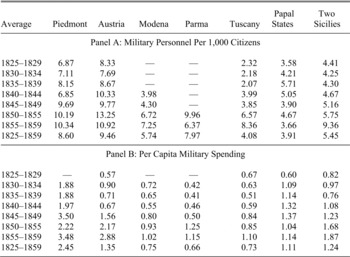
To support it ambitious strategy, Piedmont maintained a large and growing military. Average military personnel as a portion of total population in Piedmont was typically one and one-half to two times bigger than for any other pre-unitary state, and military size in Piedmont increased from roughly 29,000 personnel in the late 1820s to 52,000 by the late 1850s (Panel A of Table 3). A large military was costly. Piedmont's military expenditures per capita were on average two to four times higher than elsewhere, and doubled from 1.88 gold grams in the early 1830s to 3.48 on the eve of unification (Panel B).Footnote 21 Only Austria, a Great Power, matched Piedmont in military size as a portion of total population, but not in terms of military spending per head.Footnote 22
MILITARY SIZE AND SPENDING IN PRE-UNITARY ITALY, 1825–1859

Notes:
Expenditure figures are in gold grams. Military personnel and spending data for the Austrian Empire are used for Lombardy-Venetia (these data are not available at the sub-empire level).
Source:
See the Appendix.
Low military size and expenditures in other pre-unitary states, by contrast, reflected the non-expansionist foreign policies that they pursued. However, there were still notable differences in military strength. On average the Papal States and the Two Sicilies spent 50 percent more per head on the military than Tuscany and 80 percent more than Modena or Parma. We largely attribute these differences to high levels of domestic unrest in the center-south and south.
Piedmont supported its large military by levying higher taxes than any other pre-unitary state.Footnote 23 Average tax revenues per head in Piedmont were 20 percent larger than in the Papal States and nearly three times higher than in Lombardy-Venetia (Panel A of Table 4). Per capita tax revenues in the Papal States were also relatively large due to high debt payments on government loans, some of which dated back to the period before the French Revolution of 1789. The combination of high taxes and high debt service with low spending on the military or infrastructure helps explain the high level of internal conflict in the Papal States. Although Lombardy-Venetia was one of the most developed parts of the Austrian Empire, it paid just 40 percent of the Austrian average in per capita tax revenues.Footnote 24 We speculate that Vienna kept taxation low in its Italian domains to appease local elites, who threatened to defect in favor of Piedmont. Finally, tax differences between Piedmont and other pre-unitary states grew over time. While per capita tax revenues increased by roughly one-third in the Two Sicilies, by one-half in Tuscany and Lombardy-Venetia, and by two-thirds in the Papal States from the late 1820s to the late 1850s, in Piedmont they more than doubled from 3.75 to 8.37 gold grams.
PER CAPITA TAXES IN PRE-UNITARY ITALY, 1825–1859

Notes:
Tax figures are in gold grams. Tuscan data do not distinguish between trade taxes and other indirect taxes.
Source:
See the Appendix.
Tax differences between Piedmont and other pre-unitary states were not because Piedmont was significantly wealthier. There are no data on per capita GDP data for the pre-unitary period, but we can obtain state-level estimates for 1871 (the earliest available year) by grouping regional GDP data according to pre-unitary borders and scaling by population.Footnote 25 These calculations indicate that post-unification GDP differences were small. Piedmont, Lombardy-Venetia, Tuscany, and the Papal States were 4 to 6 percent richer than average, while the Two Sicilies was 10 percent poorer. Furthermore, the GDP for the center-north as a whole was just 7 percent higher than in the south. According to Vittorio Daniele and Paolo Malanima, this gap did not appear until the mid-1860s, which implies that GDP per capita did not differ between the center-north including Piedmont and the south at the time of unification.Footnote 26
Similarly, tax differences between Piedmont and other pre-unitary states did not reflect fundamental differences in tax systems. French conquest during the Napoleonic Wars from 1803 to 1815 led to the establishment of similar fiscal institutions throughout the Italian peninsula. Regions like Liguria, Piedmont, and Tuscany were directly annexed to France, while others were formally independent but under French rule. As was the case throughout much of Europe, the French imposed their fiscal code along with other extensive reforms.Footnote 27 The restored Italian rulers abolished many pieces of French legislation after Napoleon's final defeat, but they retained the French tax system because it yielded much greater revenues. A comparison between the island of Sicily, which the French did not conquer and which therefore kept its traditional fiscal code, and the French-controlled mainland of the Two Sicilies illustrates this difference. Despite partial reform in 1806, Sicilian tax revenues per capita were only 45 percent of mainland ones through the mid-1840s, and only 21 percent from the late 1840s to the eve of unification. There was a similar disparity in Piedmont between the mainland and the island of Sardinia, where the French-based tax code was not extended until the 1850s.
The basic features of the French fiscal system remained across Italy through unification. Several minor variations in tax codes existed among pre-unitary states, but major differences were few. Consistent with our analytical framework, over 50 percent of total tax revenues typically came from indirect taxes. Consumption taxes on salt and tobacco and sales of foodstuffs in urban markets (dazio consumo) provided the largest source of indirect revenues. Consumption taxes on business transactions affecting middle-class entrepreneurs were also significant. Trade taxes were typically imposed on colonial goods and manufactures rather than on basic foodstuffs such as grain; only Piedmont taxed wheat through the 1840s. Finally, some states gathered revenues from government-owned land and enterprises (for example, mines), which were often local monopolies.
Direct taxes typically accounted for 25 percent of revenues (and up to 40 percent in Lombardy-Venetia). The most important direct tax was a flat tax based on land values (imposta fondiaria or prediale). Since land ownership was heavily concentrated throughout the peninsula, this tax typically affected traditional agrarian elites. Urban merchant elites, by contrast, typically escaped direct taxation through the 1850s, when most pre-unitary states introduced new direct taxes. Although the imposed French tax code was centralized, actual rates on the direct land tax could differ even if they were officially uniform. In fact, the amount to be paid depended on the taxable rent that the land generated, which in principle was to be assessed by government surveyors according to uniform criteria. Lombardy pioneered the use of a modern cadastre in the eighteenth century. Tuscany, Venetia, and even the Papal States followed suit over the first half of the nineteenth century, although with mixed results.Footnote 28 Piedmont did not begin its new survey until the 1850s and accomplished little by unification.
Borrowing and Indirect Taxes
Though systematic debt data are not available, there is ample evidence that rulers took out large loans to meet short-term fiscal needs. King Ferdinando I of the Two Sicilies borrowed heavily in 1815/16 to pay for expenses related to the Congress of Vienna, including a large bribe to the foreign diplomats that had helped him to retain his throne.Footnote 29 The king also took out loans to reimburse the Austrian soldiers who had restored him after the 1820 insurrection. Similarly, the Grand Duke of Tuscany, Leopoldo II, funded the Austrian garrison that secured his political position from 1849 to 1855 with a major loan from the Rothschilds.Footnote 30 The most compulsive borrower was the pope, since papal budgets were typically in deficit. At 1.42 gold grams per head, average debt service for the Papal States over the pre-unitary period absorbed roughly one-third of annual tax revenues, and was nearly 20 percent higher than in Piedmont, over 200 percent higher than in Parma, and 330 percent higher than in Modena.Footnote 31 Piedmont also took out major loans in the 1850s to help fund infrastructure projects.Footnote 32 By 1860 it had accumulated debts equal to nearly five times its annual revenues, or roughly half of all of the debts of pre-unitary states.Footnote 33 Political unification arguably saved Piedmont from serious financial troubles, which would have rendered its ambitious foreign policy impossible.
Though differences in tax composition and collection between Piedmont and other pre-unitary states were small through most of the pre-unitary period, Piedmont still squeezed out greater trade taxes and other indirect taxes per head (Panels B and C of Table 4). On average, trade taxes were 55 percent larger in Piedmont than in the Papal States (the second highest) and five times larger than in Lombardy-Venetia (the lowest). Customs revenues in Piedmont even increased during the 1850s, when trade was liberalized and only “fiscal” duties on colonial goods were kept.Footnote 34 Meanwhile, other indirect taxes were 15 percent larger in Piedmont than in the Papal States, the second highest, and the rest of the ranking was similar as before.
Parliamentary Government, Direct Taxes, and Expenditure Patterns
At around 0.80 gold grams per head, direct tax levels in absolutist Piedmont were roughly similar to those in other pre-unitary states through the late 1840s (Panel D of Table 4). However, in 1851—just after the establishment of parliamentary government—Piedmont implemented a new, non-land direct tax called the richezza mobile.Footnote 35 This tax, which hit salaries derived from nonagricultural occupations and investment income, typically affected merchant elites.Footnote 36 Parliamentary reform was thus associated with a substantial increase in per capita direct taxes, which doubled to 1.61 gold grams by the late 1850s. Indeed, direct taxes on the eve of unification were 15 percent larger in constitutional Piedmont than in Modena or Parma (the second highest) and nearly twice as large as in Lombardy-Venetia (the lowest).
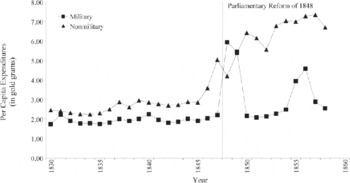
Furthermore, the political change that granted parliamentary budgetary authority to elites coincided with a dramatic increase in nonmilitary expenditures in Piedmont. Though Piedmont borrowed and spent heavily to cover its participation in the Crimean War (1855/56), peacetime military expenditures remained at the levels of previous decades (Figure 2). Nonmilitary expenditures, by contrast, jumped from roughly 2 to between 6 and 8 gold grams per head over the 1850s. The most notable feature was the increase in infrastructure investment. Through the early 1840s, average annual spending on infrastructure in Piedmont was less than 0.20 gold grams per capita, just more than in the Papal States and less than in Modena or Parma. Over the next 15 years, however, infrastructure expenditures in Piedmont grew fivefold to more than 1 gold gram.
Railways were arguably the most important sort of infrastructure that liberal nineteenth-century governments provided.Footnote 37 The majority of infrastructure funds in Piedmont were put towards the construction of a comprehensive railway network, which by 1859 amounted to 850 kilometers, or roughly half of the total for the entire peninsula. By investing in railways, moreover, Piedmont compensated for a historical deficiency in roadways.Footnote 38 At 522 total kilometers, the second-largest railway network on the eve of unification belonged to Lombardy-Venetia. Roughly 20 percent of Austria's railway system in the 1850s was located there, although Lombardy-Venetia comprised just 14 percent of the empire's total population. These railways were necessary to transport soldiers in case of domestic revolts or invasion by Piedmont. Furthermore, we speculate that the large railway network was, like low taxes, another type of economic perk to appease local elites. The pope, by contrast, invested little in infrastructure.Footnote 39 By 1859 there were only 101 total railway kilometers in the Papal States. Similarly, the lack of a comprehensive railway network in the south reflected its conservative approach. The Two Sicilies possessed just 99 total railway kilometers on the eve of unification.
PER CAPITA MILITARY AND NONMILITARY EXPENDITURES, PIEDMONT, 1830–1859

REGRESSION ANALYSIS
Regression analysis is a concise way to quantify the magnitudes of key relationships—as summarized by the five implications of our analytic framework—after controlling for confounding factors. Our regression method is ordinary least squares (OLS) with first-order autoregression-robust standard errors.Footnote 40 We include state-fixed effects to capture constant but unmeasured features of pre-unitary polities such as geography, size, and culture, and time-fixed effects to account for Italy- and Europe-wide shocks.
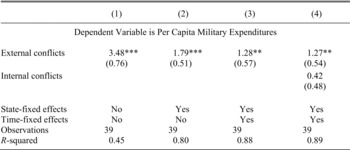
REGRESSION RESULTS FOR EXTERNAL CONFLICTS AND MILITARY SPENDING IN PRE-UNITARY ITALY, 1825–1859

**indicates significance at the 5 percent level.
***indicates significance at the 1 percent level.
Notes:
Data use five-year averages. Expenditure figures are in gold grams. External (internal) conflict variable measures the share of years per five-year period that states participated in external (internal) wars according to Table 2 (Table 1). Estimation is by OLS with heteroskedasticity-robust standard errors.
Source:
See the Appendix.
The first implication of our analytic framework relates external threats to military spending. To measure warfare, we use the share of years per five-year period that states participated in external wars. The results in Table 5 indicate that wartime was associated with significantly larger levels of per capita military expenditures than peacetime, even after controlling for state-fixed effects (columns 2 to 4), time-fixed effects (columns 3 and 4), and internal conflicts (column 4). Participating in the most external conflicts (0.60 for Piedmont for the 1855–1859 period) versus nonparticipation increased military spending by 0.76 to 2.09 gold grams per head per five-year period. Internal conflicts had a negligible effect.
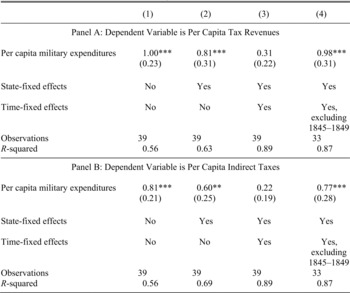
REGRESSION RESULTS FOR MILITARY SPENDING AND TAXES IN PRE-UNITARY ITALY, 1825–1859

**indicates significance at the 5 percent level.
***indicates significance at the 1 percent level.
Notes:
Data use five-year averages. Expenditure and tax figures are in gold grams. Estimation is by OLS with first-order autoregression-robust standard errors.
Source:
See the Appendix.
The second and third implications of our analytic framework relate the demand for military spending to tax policy, and in particular to indirect taxes which typically affected the population masses. The results in column 1 of Panel A of Table 6 indicate that greater per capita military spending was associated with significantly larger levels of total tax revenues per capita. The corresponding results in Panel B indicate that the same was true for per capita indirect taxes including trade taxes. These findings also held after controlling for state-fixed effects (column 2). Although these effects remained positive once time-fixed effects were included as in column 3, they were notably smaller and statistically insignificant. The tumultuous period from 1845 to 1849, when military expenditures shot up and tax collection systems temporarily collapsed, drives this result. Indeed, when the 1845–1849 period is left out as in column 4, the significant positive relationship between military spending and tax policy is restored even after controlling for time-fixed effects. For columns 1, 2, and 4, a one gold gram increase in per capita military expenditures was matched by an increase in per capita total tax revenues of 0.81 to 1.00 gold grams per five-year period.
The final two implications of our analytic framework relate parliamentary regimes to direct taxes and spending on nonmilitary items such as infrastructure. To measure parliamentary government, we use the share of years per five-year period that pre-unitary states had liberal constitutions. This coding captures the parliamentary regime in Piedmont from 1848 onward, since the constitutions that were established elsewhere during the 1848 insurrections were too short-lived to have had notable budgetary effects. Since the provision of railways was a hallmark of nineteenth-century liberal governments, we use cumulative railway kilometers as our measure of infrastructure.
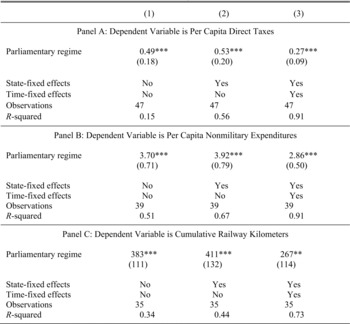
The results in Panel A of Table 7 indicate that the establishment of a parliamentary regime was associated with a significant increase in per capita direct taxes of 0.27 to 0.53 gold grams per five-year period relative to absolutist regimes. Similarly, having a parliamentary regime was associated with a significant increase in nonmilitary expenditures of 2.86 to 3.92 gold grams per capita (Panel B), and a significant increase in cumulative railway kilometers of 267 to 411 kilometers (Panel C). These findings also held after controlling for fixed effects by state (columns 2 and 3) and time (column 3).
CONCLUSION
Pre-unitary states during the Italian Risorgimento pursued different military, fiscal, and political policies in response to diverse external and internal threat environments. Low threats of invasion and high domestic turmoil led the Papal States, Tuscany, and the Two Sicilies to pursue conservative overall policies. While Lombardy-Venetia and Piedmont took more ambitious military and fiscal approaches, there was a critical difference between these two polities. The key goal of Austria and thus of Lombardy-Venetia was to defend the status quo political order in Europe. After military defeats at the hands of Austria in 1848/49, however, Piedmont adopted a new expansionist strategy that included parliamentary change and large infrastructure investments.
REGRESSION RESULTS FOR PARLIAMENTARY REGIMES AND FINANCES IN PREUNITARY ITALY, 1825–1859

**indicates significance at the 5 percent level.
***indicates significance at the 1 percent level.
Notes:
Data use five-year averages. Tax and expenditure figures are in gold grams. Parliamentary regime variable measures the share of years per five-year period that states had liberal constitutions (that is, Piedmont from 1848 onward). Estimation is by OLS with first-order autoregression-robust standard errors.
Source:
See the Appendix.
The results of our analytic narrative are consistent with the thrust of the new theoretical literature described in the introduction. Yet they also raise several counterfactual questions. For instance, what if Piedmont had not had a long history of territorial expansion or had not been strategically situated as a buffer between France and Austria? What if the Two Sicilies had not been positioned between “holy water and salt water?” How did Piedmont's medium size influence its willingness to strike a parliamentary bargain, as well as its effectiveness? Would such a deal have made a difference in a state as small as Modena or Parma? These hypothetical scenarios suggest that idiosyncratic factors such as ambition, geography, and size have important effects on policy outcomes that future theoretical models should incorporate.
Finally, the case of Piedmont indicates that military imperatives had key impacts on nascent democracy and economic development. Our results, however, do not imply that warfare always has positive effects. If the Congress of Vienna had not granted the Savoys the key port of Genoa in 1815, then the merchant class in Piedmont would have been much smaller, and there may not have been the impetus for later parliamentary reform. The growing clout of the merchant class generally, moreover, was related to the Industrial Revolution in continental Europe. The broad historical juncture was thus of fundamental importance for the ways in which the Risorgimento took shape. Future work that examines the links between military, fiscal, and political policies in other contexts would prove useful to compare and contrast with the Italian case.
Appendix
The database is downloadable from the website, http://sites.google.com/site/mdincecco/. Data for Lucca are not available.
Tax Revenues
Total tax revenues are the sum of direct taxes (typically, dative reali, personale, prediale, and altre) and indirect taxes on trade (typically, dogane), consumption (typically, dazi consumo, sale, and tabacchi), and transfers (typically, bollo, tasse affairi, trasferimenti, and altre). They exclude income from state properties. Michael Pammer provided the tax data for Lombardy and Venetia. Totals for Lombardy-Venetia sum each series. Data for the Papal States are from Felisini, Finanze pontificie. Data are from Romani, Storia economica, for Parma (table 19), Modena (table 20), and Tuscany (table 21). Data for the Kingdom of Sardinia-Piedmont are from Felloni, “Stati Sabaudi,” and sum total tax revenues for the mainland and Sardinia. Data for the Kingdom of the Two Sicilies are from Ostuni, Regno delle Due Sicilie (appendix v, table 1) and sum total tax revenues for the mainland and Sicily.
To facilitate cross-state comparisons, the tax revenue data were converted into gold grams as follows. First, tax revenues in home currencies were converted into Austrian lire. Second, tax revenues in Austrian lire were converted into real 1861 prices using the price indices for Northern and Southern Italy from Malanima, “Age” (appendix 1). Third, real tax revenues in Austrian lire were converted into British pounds. Fourth, tax revenues in British pounds were converted into gold troy ounces using the series from Officer, “Price.” Fifth, tax revenues in gold troy ounces were converted into revenues in gold grams by multiplying by 31.10. The exchange rate data for the first and third steps are from Federico, “Invasion.”
Population
Pammer provided the population data for Lombardy and Venetia. Totals for Lombardy-Venetia sum each series. Data for Parma, Modena, the Kingdom of the Two Sicilies, and Tuscany are from Romani, Storia economica (table 1). Data for the Kingdom of the Two Sicilies sum the populations for the mainland and Sicily. Due to availability, data for the Kingdom of Sardinia-Piedmont and the Papal States are from SVIMEZ, Secolo. Data for the Kingdom of Sardinia-Piedmont sum the populations for the mainland and Sardinia. In all cases, population data between census years were linearly interpolated.
Military Personnel and Expenditures
Pammer provided the military expenditure data for Austria. Military and total expenditure data for the Papal States are from Felisini, Finanze pontificie. Military expenditures sum esercito, truppe straniere, and polizia. Data are from Romani, Storia economica, for Parma (table 19, oneri per la difesa), and Modena (table 20, oneri per la difesa). Data for the Kingdom of Sardinia-Piedmont are from Felloni, “Stati Sabaudi,” and sum military and total expenditures for the mainland and Sardinia. Data for Tuscany are from Manetti, “Civil difesa” (tables 3, 6, and 14). Data for the Kingdom of the Two Sicilies are from Ostuni, Regno delle Due Sicilie (appendix v, table 2) and sum military (polizia, guerra, and marina) and total expenditures for the mainland and Sicily. Expenditures were converted into gold grams following the methodology described above.
Nonmilitary expenditures were computed as the differences between total and military expenditures.
The military personnel data are from Singer, “Reconstructing.”Footnote 41 The variable name is “milpop.”Footnote 42
Urbanization
Paolo Malanima provided the urbanization data for Italian cities in 1800 and 1861.
Railways
The railway data for pre-unitary Italian states are from Romani, Storia economica (table 25). Data for Austria are from Mitchell, International Historical Statistics.