Introduction
Involvement of the temporal bone by carcinomas is rare, with an estimated incidence of 1–6 per one million population per year.Reference Lobo, Llorente and Suarez1 Tumours may arise within the external auditory canal or peri-auricular skin, or may extend from the parotid gland into the temporal bone. The most commonly occurring cancer type in the external auditory canal is squamous cell carcinoma (SCC), approximately four times more common than basal cell carcinoma (BCC).Reference Lobo, Llorente and Suarez1 The parotid gland is also a common site of nodal metastases of cutaneous head and neck SCC; from here, they can then extend into the extra-parotid tissues and into the temporal bone via the fissures of Santorini. As these tumours are rare, the literature is mainly limited to retrospective, single-institution case series, though some larger population-based cancer databases have been evaluated.Reference Seligman, Sun, Ten Eyck, Schularick and Hansen2–Reference Shen, Sakamoto and Yang5 There is a paucity of evidence relating to the outcomes and survival for patients with primary and metastatic cutaneous SCC and BCC involving the temporal bone.
Lateral temporal bone resection surgery is indicated for tumours lateral to the tympanic membrane and involving the bony external auditory canal, either directly or by extra-nodal extension. This approach permits en bloc resection with oncological margins. However, it results in complete conductive hearing loss, and exposes the patient to additional potential short- and long-term complications. Because of concerns regarding morbidity in patients undergoing temporal bone resection and a scarcity of outcome data, some institutions have moved away from lateral temporal bone resection in favour of organ preservation approaches. In order to identify which patients are more likely to benefit from this procedure, it is vital to understand the oncological outcomes of lateral temporal bone resection, as well as predictors of failure.
This study aimed to evaluate the clinical characteristics, and survival and oncological outcomes in patients who underwent lateral temporal bone resection surgery for cutaneous SCC and BCC across the three tertiary public hospitals offering head and neck oncological surgery in Western Australia.
Materials and methods
Patient selection
After receiving institutional review board approval from Fiona Stanley Hospital, Royal Perth Hospital and Sir Charles Gairdner Hospital (Western Australia), patients were identified by searching hospital databases using the Australian Classification of Health Interventions code for lateral temporal bone resection surgery and the International Classification of Diseases (10th revision) codes for cutaneous SCC and BCC between 2007 and 2019.
The inclusion criteria were: patients who underwent lateral temporal bone resection surgery for histopathologically proven SCC or BCC, of suspected or proven cutaneous origin, involving the external auditory canal or temporal bone. Exclusion criteria were: histological diagnoses other than SCC or BCC, and patients who did not undergo surgical resection as a treatment modality.
Data extraction
A retrospective chart review was conducted of the electronic and hard copy medical records of our study population. Records were reviewed for: basic patient demographics (age, sex and immunosuppression status), tumour characteristics (histology, location, tumour–node–metastasis (TNM) stage, and primary vs recurrence), facial nerve status (clinically or radiologically involved pre-operatively, House–Brackmann facial nerve function grade pre- and post-operatively), surgical details (extent of surgical resection, margin status, and the presence of perineural or lymphovascular invasion), adjuvant therapies, and recurrence and survival data.
Patients were considered immunodeficient if they met one of the following criteria (which were chosen because of their incorporation in the Charlson Comorbidity IndexReference Charlson, Pompei, Ales and MacKenzie6): known diagnosis of primary immunodeficiency; secondary immunodeficiency (human immunodeficiency virus, poorly controlled type II diabetes mellitus or organ transplant performed); immunomodulator medications or long-term, high-dose steroid therapy; and presence of concurrent haematological malignancy.
Tumours were staged using the American Joint Committee on Cancer staging manual, eighth edition.Reference Amin, Edge, Greene, Byrd, Brookland and Washington7 For those with no such documented cancer staging details, we used the available clinical information, imaging, pathology, operative reports and histopathology to retrospectively stage these patients.
Surgical procedure
Lateral temporal bone resection was performed for malignant tumours involving the bony external auditory canal, but not extending medial to the tympanic membrane or into the middle ear. Tumour extent was assessed with a combination of clinical examination and radiological imaging (computed tomography with or without magnetic resonance imaging (MRI)). The entire osseous and cartilaginous external auditory canal, tympanic membrane, malleus and incus were resected en bloc. The procedure was extended as necessary to include parotidectomy, partial or total pinnectomy, infra-temporal fossa or jugular foramen dissection, or mandibular condylectomy, depending on the extent of the disease. Comprehensive neck dissection was performed in all patients with a diagnosis of SCC, regardless of the nodal classification. Reconstruction of the surgical defect entailed either a local or a free flap, depending on the size and location of the defect.
Outcomes assessment
Follow up was initially performed at three-monthly intervals, with the time between visits extended as the time period following their treatment increased. Follow-up visits involved clinical examination in all cases, and radiological imaging in some cases, depending on disease factors and surgeon preference. Date of recurrence was defined as the first date of documented clinical or radiological evidence of local, regional or distant disease, which was then often confirmed by pathological analysis. Date and cause of death were extracted from the medical records, and used to determine overall and disease-specific survival. Recurrence and survival outcomes were measured from the date of surgery.
Statistical analysis
Analysis was conducted on the patient group as a whole, and then on histological subgroups of SCC and BCC. Categorical variables were compared using the chi-square test. Survival curves were calculated using the Kaplan–Meier method, with analysis beginning at the surgical date. The log-rank test was used to compare survival curves. Multivariate analysis was performed using Cox regression models. Statistical analysis was performed using SPSS software, version 26.0.0.1 (IBM, Armonk, New York, USA). Results were considered statistically significant for p-values less than 0.05.
Results
Patient characteristics
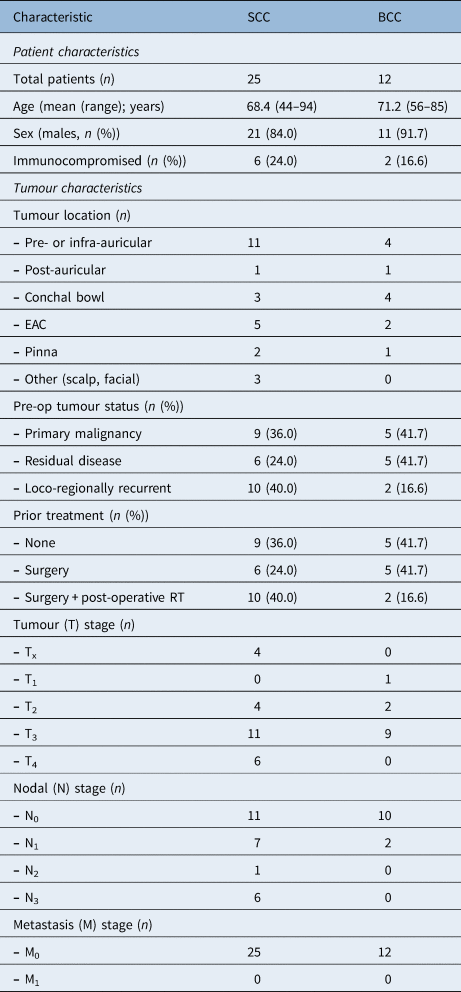
During our 2007–2019 study period, 37 patients had lateral temporal bone resection surgery for cutaneous SCC or BCC. The median age was 69 years (range, 44–94 years), with 32 male patients and 5 female patients (Table 1). Eight patients were classified as immunocompromised (21.6 per cent). The median follow-up duration was 22 months (range, 1–101 months).
Characteristics of patients with cutaneous malignancies undergoing lateral temporal bone resection

SCC = squamous cell carcinoma; BCC = basal cell carcinoma; EAC = external auditory canal; pre-op = pre-operative; RT = radiotherapy
Of the 37 patients, 25 had a diagnosis of SCC and 12 had a diagnosis of BCC. Tumour location was predominantly pre- or infra-auricular (n = 15), conchal bowl (n = 7), or external auditory canal (n = 7) (Table 1). Lateral temporal bone disease represented the first presentation of malignancy in 14 patients, residual disease from previous peri-auricular lesions in 11 patients and recurrent disease in 12 patients. Of the 11 pre-auricular SCC lesions, 5 were primary tumours, 2 represented residual disease and 4 were metastatic tumour recurrences. Fourteen patients with SCC had metastatic nodal disease. Two patients with BCC had nodal disease; one had a basosquamous variant and the other had a large (110 mm) primary tumour with aggressive histological features. Twenty-three patients had a history of prior head and neck cancer treatment (12 had undergone prior surgery with adjuvant radiotherapy; 11 had received radiotherapy alone).
Treatment details
In addition to lateral temporal bone resection, 26 patients had undergone neck dissection (25 patients had ipsilateral neck treatment, whilst 1 patient had bilateral neck dissections for T4bN2c disease). Twenty-nine patients had a parotidectomy (21 superficial and 8 total parotidectomies). Those who did not have a parotidectomy had cutaneous primaries not intimately related to the gland (posterior auricular, posterior external auditory canal, peri-orbital and facial). Eleven patients required a pinnectomy. Thirty-one patients had free flap reconstruction, three patients had locoregional flaps and three had primary closure of their surgical defect. Median length of stay in hospital was 11 days (range, 2–75 days).
Post-operative histology revealed that the median tumour size in maximal dimension was 30 mm (range, 5.5–115 mm). Fifteen patients had perineural invasion and nine had lymphovascular invasion. Clear surgical margins were achieved for 23 patients, with microscopically involved margins in 12 patients and macroscopically involved margins in 2 patients.
Eight patients (21.6 per cent) experienced a severe post-operative complication requiring a return to the operating theatre (Clavien–Dindo grade III and above).Reference Dindo, Demartines and Clavien8 These were all related to free flap associated haematoma, seroma or infection. There were no peri-operative deaths in the study cohort.
Nineteen patients (51 per cent) had post-operative radiotherapy. The average post-operative radiotherapy dose was 75.2 Gy (range, 35–137.5 Gy). Eight patients were not considered for post-operative radiotherapy because of prior head and neck radiotherapy. No patients received adjuvant chemotherapy.
Facial nerve management
Clinical pre-operative facial nerve function was recorded for all patients but one (n = 36). Normal facial nerve function (House–Brackmann facial nerve function grade I) was present in 27 patients, low-grade paresis (House–Brackmann grade II–III) in 5 patients, high-grade paresis (House–Brackmann grade IV–V) in 2 patients, and complete paralysis (House–Brackmann grade VI) in 2 patients. One patient with BCC had House–Brackmann grade II function; all other BCC patients had House–Brackmann grade I function (n = 11).
Radiological assessment of the facial nerve pre-operatively was conducted using MRI in 25 patients. Abnormal appearance of the nerve was reported in eight patients (32 per cent of patients scanned); all these patients had SCC. There was radiological suspicion of facial nerve involvement in four patients who had clinically normal facial nerve function and in an additional four who had clinical weakness. Five patients who had clinical facial nerve weakness as a result of previous surgery (rather than an active tumour) did not show radiological changes.
The facial nerve was sacrificed intra-operatively in 16 patients because of: clinical weakness (n = 9), radiological suspicion of perineural disease (n = 4) or macroscopic involvement of the nerve intra-operatively (n = 3). Four of these patients underwent immediate nerve reconstruction. Only one of these patients had BCC, with facial nerve sacrifice because of macroscopic tumour involvement intra-operatively; this patient did not have nerve reconstruction.
Post-operative House–Brackmann grades were variable: 10 patients were grade I, 5 were grade II, 5 were grade III, 1 was grade IV, 4 were grade V and 9 were grade VI. Post-operative House–Brackmann grades were not available for three patients. Of the four patients who underwent facial nerve reconstruction intra-operatively, two were left with total paralysis (grade VI) and two with high-grade paresis (one with grade V and one with grade IV function).
Survival outcomes
Fourteen patients developed recurrent disease (SCC = 12, BCC = 2); this was locally recurrent in three patients (8.1 per cent) and regionally recurrent in four patients (10.8 per cent), with distant metastatic spread in seven patients (18.9 per cent, including both BCC patients). Mean time to recurrence from the date of surgery was 4.5 months (range, 1–43 months). Of the 14 patients who developed recurrent disease, this occurred within the first 12 months post-operatively in 13 patients.
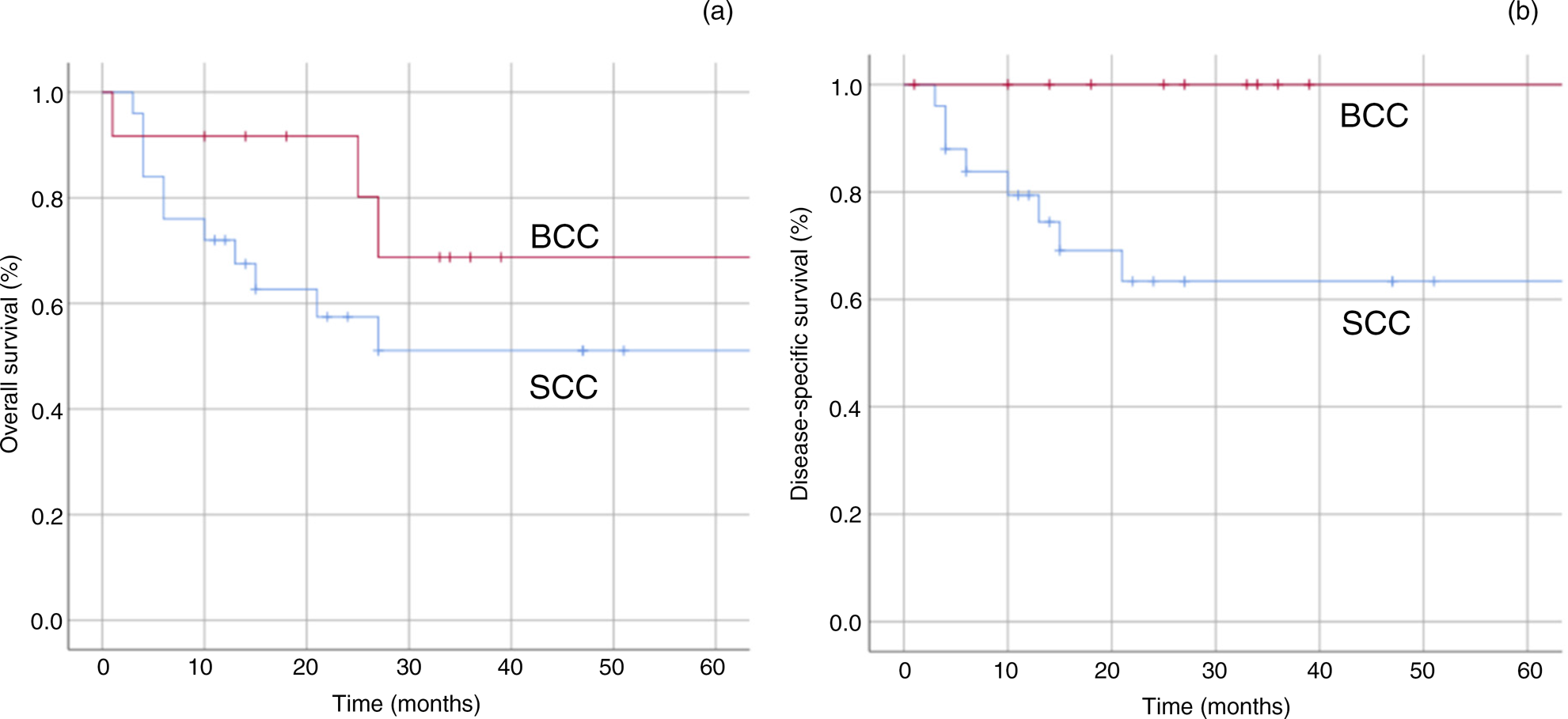
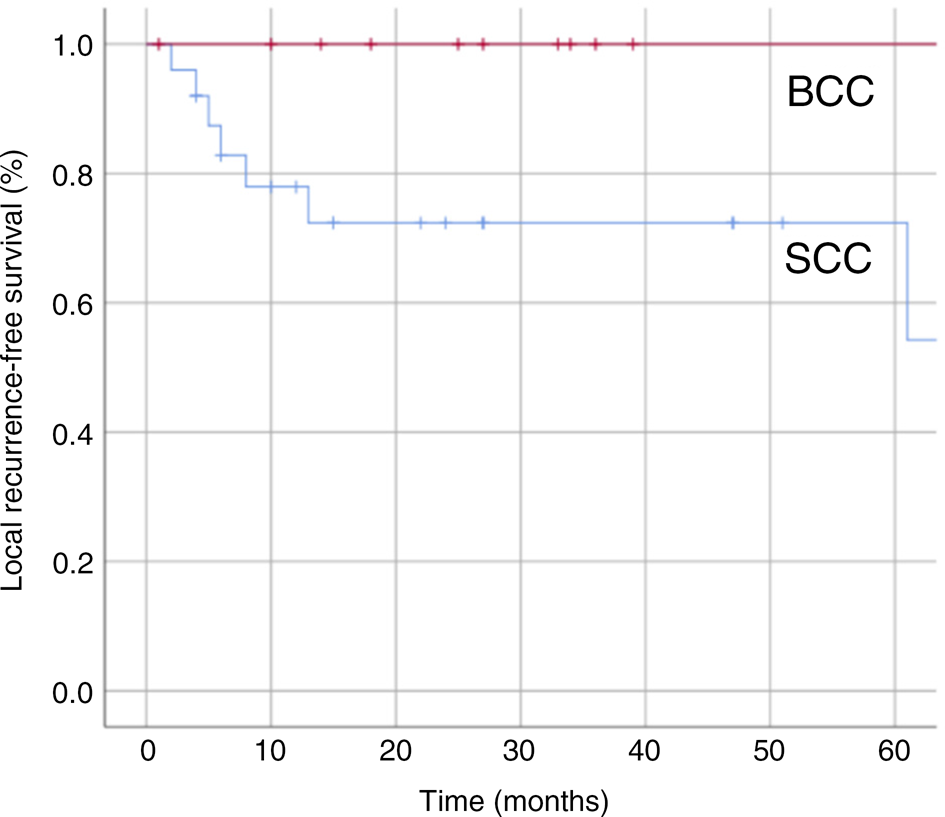
With respect to our SCC cohort, the median overall survival rate was 78.4 per cent at one year from the date of surgery and 68.5 per cent at two years. The disease-specific survival rate was 85.8 per cent at one year and 75 per cent at two years (Figure 1). The locoregional recurrence-free survival rate was 85.2 per cent at one year and 81.6 per cent at two years (Figure 2).
Overall survival (a) and disease-specific survival (b) for patients with cutaneous malignancies undergoing lateral temporal bone resection. BCC = basal cell carcinoma; SCC = squamous cell carcinoma

Local recurrence-free survival for patients with cutaneous malignancies undergoing lateral temporal bone resection. BCC = basal cell carcinoma; SCC = squamous cell carcinoma

With respect to the smaller cohort of BCC patients, the overall survival rate was 83.3 per cent at one year and the same at two years (Figure 1). Both the disease-specific survival and locoregional recurrence-free survival rates were 100 per cent at the one- and two-year time points (Figures 1 and 2).
Discussion
This study summarises the clinical characteristics, and survival and oncological outcomes for all patients who underwent lateral temporal bone resection surgery for cutaneous SCC and BCC in Western Australia over the past 13 years. The study aimed to identify predictors of survival and treatment failure, and to help distinguish those patients in whom this surgery can provide the best oncological outcomes.
Cancers involving the lateral temporal bone can be aggressive and have a poor prognosis, with five-year survival rates as low as 10 per cent, depending on stage of disease and treatment protocol.Reference Pfreundner, Schwager, Willner, Baier, Bratengeier and Brunner9 These tumours often present late and at an advanced stage. Essig et al. studied 35 patients who underwent lateral temporal bone resection for metastatic cutaneous SCC, the majority of whom had T3 or T4 disease, and found two- and five-year overall survival rates of 72 per cent and 49 per cent, respectively.Reference Essig, Kitipornchai, Adams, Zarate, Gandhi and Porceddu10 This is reflected in our data, with most patients presenting with T3 or T4 disease (n = 26; 70.3 per cent), and with an overall survival rate of 68.5 per cent at two years in our SCC group. We used overall survival as our primary outcome measure, as opposed to disease-specific survival or locoregional recurrence-free survival, to account for the morbidity related to surgery and its implications for survival.
The treatment of tumours involving the temporal bone is controversial, and data related to the management of these tumours are relatively limited. Generally, early- and late-stage tumours involving the external auditory canal are treated with lateral temporal bone resection surgery. More advanced tumours are often treated with adjuvant radiotherapy, with or without chemotherapy. There was a relatively low rate of adjuvant radiotherapy in our patient cohort of 51 per cent; in some cases, this was because the patients received prior radiotherapy to the region. Definitive chemoradiotherapy has been used for T3–4 tumours, with the stated advantage of organ preservation.Reference Seligman, Sun, Ten Eyck, Schularick and Hansen2
For far-advanced tumours, there is ongoing debate as to whether aggressive surgical resection offers survival benefit, with some now suggesting definitive chemoradiotherapy as a first-line treatment for advanced stage or unresectable disease.Reference Shiga, Ogawa, Maki, Amano and Kobayashi11–Reference Shinomiya, Hasegawa, Yamashita, Ejima, Kenji and Otsuki14 Morita et al. found similar five-year overall survival rates in organ preservation and surgical treatment groups (52.1 per cent vs 55.6 per cent, respectively).Reference Morita, Homma, Nakamaru, Sakashita, Hatakeyama and Kano12 Achieving widely clear surgical margins is a challenge during lateral temporal bone surgery. The definition of unresectable disease is variable, though it commonly includes involvement of the petrous apex, carotid canal, dura or brain parenchyma.Reference Seligman, Sun, Ten Eyck, Schularick and Hansen2 Some studies, however, challenge this, demonstrating favourable survival outcomes with surgical resection for patients with intra-cranial or dural tumour extension.Reference Dean, White, Carter, Desmond, Carroll and McGrew15,Reference Ducic, Miles and Sabatini16
In Western Australia, for extra-cranial SCC or BCC involving the temporal bone, first-line therapy is lateral temporal bone resection surgery with or without adjuvant radiotherapy. Our study demonstrates survival and oncological outcomes that are comparable to the published literature, with an overall survival rate at two years of 68.5 per cent in our SCC subgroup, and locoregional tumour control in 81.1 per cent of patients.Reference Seligman, Sun, Ten Eyck, Schularick and Hansen2,Reference Gidley, Thompson, Roberts, DeMonte and Hanna17,Reference Moore, Deschler, McKenna, Varvares and Lin18
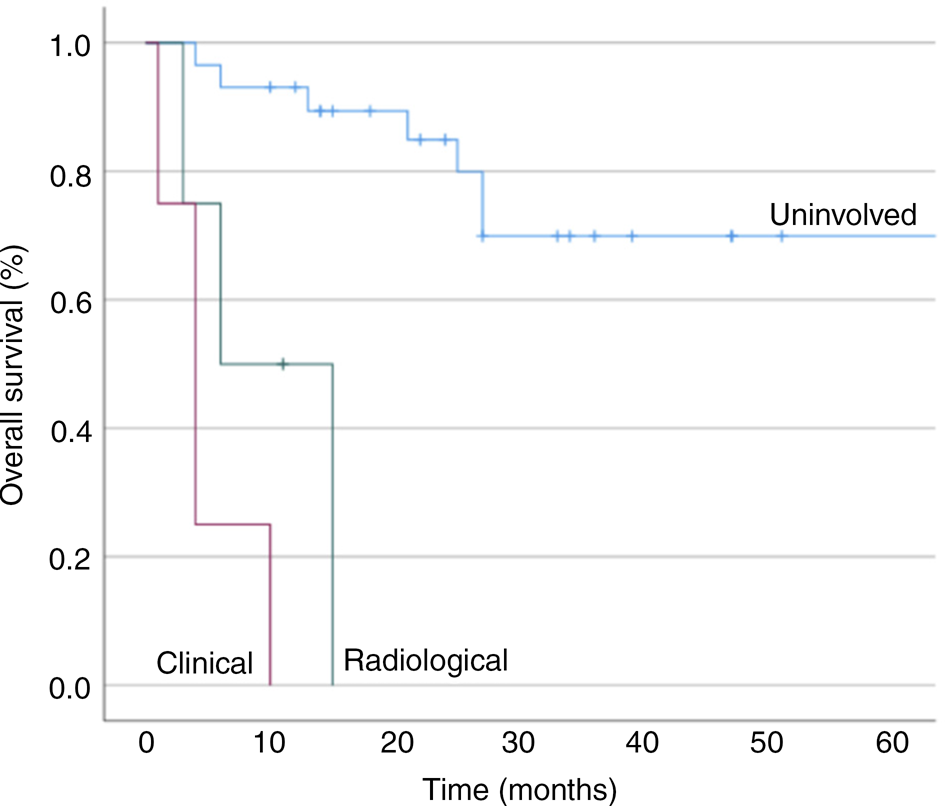
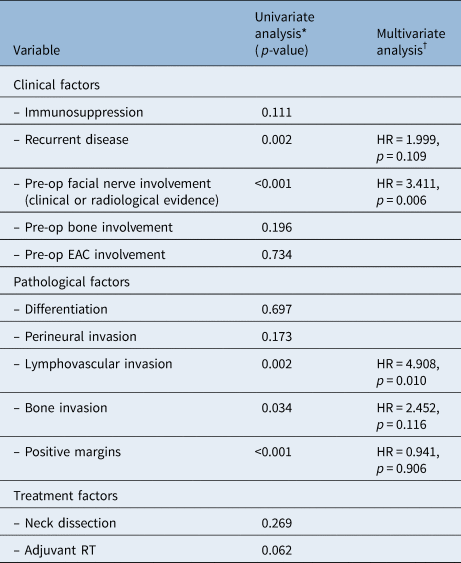
Disease factors shown to be related to poor prognosis in temporal bone malignancy include advanced stage, nodal disease, facial nerve paralysis, poorly differentiated cell type, positive surgical margins and recurrence.Reference Lobo, Llorente and Suarez1,Reference Essig, Kitipornchai, Adams, Zarate, Gandhi and Porceddu10,Reference Gidley, Roberts and Sturgis19–Reference Leong, Youssef and Lesser21 In our study, with respect to patients with SCC, we identified pre-operative facial nerve tumour involvement (determined via clinical or radiological evidence) to be a statistically significant direct predictor of mortality (hazard ratio = 3.411, p = 0.006), with all patients dying before two years post-operatively (Figure 3).
Overall survival for patients with cutaneous malignancies undergoing lateral temporal bone resection, stratified according to pre-operative facial nerve involvement.

Gidley et al. identified pre-operative clinical facial nerve deficit as a predictor of mortality, and this is reflected in other similar works.Reference Gidley, Thompson, Roberts and Weber22,Reference Shao, Wong, McIvor, Mylnarek, Chaplin and Izzard23 Our study investigated both clinical and radiological evidence for facial nerve involvement, and has important clinical implications. A third of those patients who underwent MRI in our cohort had facial nerve enhancement. Evidence suggests that the accuracy of MRI in detecting facial nerve perineural invasion, based on post-operative histopathology findings, is between 83 and 87 per cent.Reference Nader, Ginsberg, Bell, Roberts and Gidley24,Reference Gandhi, Panizza and Kennedy25 We believe MRI should be a routine part of the pre-operative investigation for patients with temporal bone malignancy. Further research is required, however, to investigate findings of clinical versus radiological facial nerve involvement, and their relative importance for predicting survival outcomes in this patient group.
We also found lymphovascular invasion to be a predictor of mortality (hazard ratio = 4.908, p = 0.010). Other factors identified as predictors of mortality on univariate analysis, but that did not reach statistical significance, were histological bone invasion, positive surgical margins and clinically recurrent disease (Table 2). It is likely that these factors, and others expected to influence mortality, did not reach statistical significance because of our limited sample size.
Variables associated with overall survival in SCC patients undergoing lateral temporal bone resection

*Log-rank; †Cox regression. SCC = squamous cell carcinoma; HR = hazard ratio; pre-op = pre-operative; EAC = external auditory canal; RT = radiotherapy
The limitations of the present study include those of any retrospective review of clinical data, in which treatment selection bias is hard to trace, and information is reliant on the accuracy and completeness of the medical records. We have been careful to ensure the quality of our data and statistical analysis by having at least two clinicians review the data. In addition, the House–Brackmann scale for facial nerve function is subjective and susceptible to user error. There was also inconsistent timing in documenting post-operative House–Brackmann grades, meaning that we did not have a standardised time point from which to describe post-operative facial nerve function. Nevertheless, the House–Brackmann grading system is one of the most commonly used clinical tools to measure and record facial nerve function, and therefore we hope that including it in our results will be helpful to the practising surgeon.
• Temporal bone involvement by carcinomas is rare, with an estimated incidence of 1–6 per one million population per year
• There is a paucity of evidence relating to outcomes and survival for these patients
• Lateral temporal bone resection surgery is indicated for tumours lateral to the tympanic membrane and involving the bony external auditory canal, either directly or by extra-nodal extension
• Cutaneous malignancy involving the external auditory canal or temporal bone represents advanced stage disease
• Lateral temporal bone resection offers acceptable local control rates and survival in this patient cohort
• This surgery should be offered cautiously to patients with clinical or radiological evidence of facial nerve involvement given relatively poorer survival outcomes in this subgroup
Conclusion
Cutaneous malignancy involving the external auditory canal or temporal bone represents advanced stage disease, and lateral temporal bone resection offers acceptable local control rates and survival in this cohort of patients. Caution should be used in offering this surgery to patients with clinical or radiological evidence of facial nerve involvement, because of the relatively poorer survival outcomes in this subgroup.
Competing interests
None declared