Introduction
Emerging (Copper et al. Reference Copper, Goldenberg, Das, Elder, Swain, Norman, Ramsey, Cotroneo, Collins, Johnson, Jones and Meier1996; Hedegaard et al. Reference Hedegaard, Henriksen, Secher, Hatch and Sabroe1996; Nordentoft et al. Reference Nordentoft, Lou, Hansen, Nim, Pryds, Rubin and Hemmingsen1996; Rosenberg et al. Reference Rosenberg, Palmer, Wise, Horton and Corwin2002; Dole et al. Reference Dole, Savitz, Hertz-Picciotto, Siega-Riz, McMahon and Buekens2003, Reference Dole, Savitz, Siega-Riz, Hertz-Picciotto, McMahon and Buekens2004; Mustillo et al. Reference Mustillo, Krieger, Gunderson, Sidney, McCreath and Kiefe2004; Khashan et al. Reference Khashan, McNamee, Abel, Mortensen, Kenny, Pedersen, Webb and Baker2009; Class et al. Reference Class, Lichtenstein, Långström and D'Onofrio2011; Mendez et al. Reference Mendez, Hogan and Culhane2014), though not consistent (Krabbendam et al. Reference Krabbendam, Smits, de Bie, Bastiaanssen, Stelma and van Os2005; Kramer et al. Reference Kramer, Lydon, Séguin, Goulet, Kahn, McNamara, Genest, Dassa, Chen, Sharma, Meaney, Thomson, Van Uum, Koren, Dahhou, Lamoureux and Platt2009; Niedhammer et al. Reference Niedhammer, O'Mahony, Daly, Morrison and Kelleher2009; Abeysena et al. Reference Abeysena, Jayawardana and de A Seneviratne2010; Larsen et al. Reference Larsen, Hannerz, Juhl, Obel, Thulstrup, Bonde and Hougaard2013; Mendez et al. Reference Mendez, Hogan and Culhane2014), evidence from prospective studies suggests that maternal psychological stress during pregnancy is associated with a modestly increased risk of preterm delivery (PD). Most investigations have focused on overall risk of PD, but PD is a heterogeneous condition and its association with stress could vary according to subtypes of PD (Wadhwa et al. Reference Wadhwa, Entringer, Buss and Lu2011).
It has often been suggested that stress – studied generally in terms of stressful life events, perceived stress or racism – may primarily affect the risk of spontaneous PD. The suggested mechanisms include elevations in stress hormones, changes in health behavior, increased susceptibility to infections, pro-inflammatory changes, uteroplacental ischemia and impaired fetal growth (Wadhwa et al. Reference Wadhwa, Entringer, Buss and Lu2011). Studies of the effect of stress on the risk of spontaneous preterm birth show mixed results (Berkowitz & Kasl, Reference Berkowitz and Kasl1983; Copper et al. Reference Copper, Goldenberg, Das, Elder, Swain, Norman, Ramsey, Cotroneo, Collins, Johnson, Jones and Meier1996; Hedegaard et al. Reference Hedegaard, Henriksen, Secher, Hatch and Sabroe1996; Rosenberg et al. Reference Rosenberg, Palmer, Wise, Horton and Corwin2002; Dole et al. Reference Dole, Savitz, Hertz-Picciotto, Siega-Riz, McMahon and Buekens2003, Reference Dole, Savitz, Siega-Riz, Hertz-Picciotto, McMahon and Buekens2004; Heaman et al. Reference Heaman, Blanchard, Gupton, Moffatt and Currie2005; Kramer et al. Reference Kramer, Lydon, Séguin, Goulet, Kahn, McNamara, Genest, Dassa, Chen, Sharma, Meaney, Thomson, Van Uum, Koren, Dahhou, Lamoureux and Platt2009; Sanchez et al. Reference Sanchez, Puente, Atencio, Qiu, Yanez, Gelaye and Williams2013; Barrios et al. Reference Barrios, Sanchez, Qiu, Gelaye and Williams2014). Stress could also contribute to medically indicated PD by increasing the risk of pre-eclampsia (László et al. Reference László, Liu, Svensson, Wikström, Li, Olsen, Obel, Vestergaard and Cnattingius2013a ), placental abruption (László et al. Reference László, Ananth, Wikström, Svensson, Li, Olsen, Vestergaard, Obel and Cnattingius2014) and fetal growth restriction (Khashan et al. Reference Khashan, McNamee, Abel, Mortensen, Kenny, Pedersen, Webb and Baker2009; Class et al. Reference Class, Lichtenstein, Långström and D'Onofrio2011) through changes in some of the lifestyle and physiological factors mentioned above. We are aware of only one study investigating the effect of stress on medically indicated PD. This study found an increased risk only in women exposed to life events with a negative impact, but not in case of other investigated sources of stress (Dole et al. Reference Dole, Savitz, Hertz-Picciotto, Siega-Riz, McMahon and Buekens2003).
It has been suggested that the role of stress in PD may differ also according to the severity of prematurity (Wadhwa et al. Reference Wadhwa, Entringer, Buss and Lu2011). Only a few studies have investigated this question and findings have been inconsistent, possibly due to limited statistical power (Kramer et al. Reference Kramer, Lydon, Séguin, Goulet, Kahn, McNamara, Genest, Dassa, Chen, Sharma, Meaney, Thomson, Van Uum, Koren, Dahhou, Lamoureux and Platt2009) or retrospective assessment of stress (Sanchez et al. Reference Sanchez, Puente, Atencio, Qiu, Yanez, Gelaye and Williams2013; Barrios et al. Reference Barrios, Sanchez, Qiu, Gelaye and Williams2014). The largest study found a slightly higher risk of very PD (<33 weeks) than of any PD (<37 weeks) after maternal exposure to death or severe illness affecting children, but not in case of events affecting other close relatives (Khashan et al. Reference Khashan, McNamee, Abel, Mortensen, Kenny, Pedersen, Webb and Baker2009).
We constructed a cohort of approximately 5 million births by linking individual-level data from several Danish and Swedish population-based registries. We used this cohort to investigate whether the association between maternal bereavement the year before or during pregnancy and the risk of PD differs (1) according to gestational age at delivery, and (2) between spontaneous and medically indicated PD.
Methods
Study population and design
We included information on 5 186 313 live singleton births from the Danish Medical Birth Register (DMBR, during 1978–2008), and from the Swedish Medical Birth Register (SMBR, during 1973–2006). Both registries contain computerized data on more than 98% of the deliveries in the country since 1973; the DMBR includes information on gestational age since 1978 (Knudsen & Olsen, Reference Knudsen and Olsen1998; National Board of Health and Welfare, 2003). After excluding births with (1) a gestational age shorter than 22 weeks, longer than 45 weeks in Denmark/46 weeks in Sweden or missing information on gestational age (n = 72 067) and/or (2) a previous PD in the two birth registries (n = 173 856), our study population consisted of 4 940 764 births. The reason for excluding women who had a record of a previous PD in the birth registries was to reduce the possibility that the association between death of a child and PD was due to the mother's biological vulnerability to recurrent PD; a history of PD is an important risk factor for both PD (Goldenberg et al. Reference Goldenberg, Culhane, Iams and Romero2008) and the death of an older child (Moster et al. Reference Moster, Lie and Markestad2008; Crump et al. Reference Crump, Sundquist, Sundquist and Winkleby2011). Thus, if a woman had a PD in the two birth registers, her subsequent deliveries were not included in the analyses.
The cohort was linked to several population-based registries to obtain information on death of family members and on maternal demographic and health-related factors using the unique personal identification number assigned to all residents; a description of the registries included in the linkage has been provided elsewhere (Li et al. Reference Li, Vestergaard, Obel, Cnattingus, Gissler and Olsen2011; László et al. Reference László, Liu, Svensson, Wikström, Li, Olsen, Obel, Vestergaard and Cnattingius2013a , Reference László, Svensson, Li, Obel, Vestergaard, Olsen and Cnattingius b , Reference László, Ananth, Wikström, Svensson, Li, Olsen, Vestergaard, Obel and Cnattingius2014, Reference László, Olsen, Li, Persson, Vestergaard, Svensson, Obel and Cnattingius2015).
The study was approved by the Scientific Ethics Committee of Central Region Jutland, the Danish Data Protection Agency in Copenhagen and the Research Ethics Committee at Karolinska Institutet in Stockholm. The authors assert that all procedures contributing to this work comply with the ethical standards of the relevant national and institutional committees on human experimentation and with the Helsinki Declaration of 1975, as revised in 2008.
Study variables
Bereavement
Women were linked to their close family members, i.e. older live-born children, parents, siblings and partner (the index child's father) through the Danish Civil Registration System and the Swedish Multigeneration Register. In Denmark during 1968–1978 registry linkage to parents, and thus to siblings, was possible if the woman was a Danish resident, was younger than 15 years, lived with her parents, and was unmarried and did not have children (Pedersen et al. Reference Pedersen, Gotzsche, Moller and Mortensen2006). After 1978, linkage to family members registered in Denmark was based on biological relationships (Pedersen et al. Reference Pedersen, Gotzsche, Moller and Mortensen2006). In Sweden, linkage to parents, and consequently to siblings, required that the woman was a Swedish resident, was born in 1932 or later, and that family members also had been registered in Sweden at some time since 1947 (Statistics Sweden, 2010; László et al. Reference László, Svensson, Li, Obel, Vestergaard, Olsen and Cnattingius2013b ). Information on family members' death was retrieved from the Danish Civil Registration System and from the Swedish Cause of Death Register. We considered women exposed if they lost a close family member the year before or in the first 36 weeks of pregnancy. We categorized exposed women according to (1) their relationship to the deceased (older live-born child, partner, sibling, parent), (2) time of death (7–12 months before pregnancy, 0–6 months before pregnancy, first, second and third trimester of pregnancy), and (3) cause of death of the relative (unnatural and natural death) (László et al. Reference László, Liu, Svensson, Wikström, Li, Olsen, Obel, Vestergaard and Cnattingius2013a , Reference László, Svensson, Li, Obel, Vestergaard, Olsen and Cnattingius b , Reference László, Ananth, Wikström, Svensson, Li, Olsen, Vestergaard, Obel and Cnattingius2014). We defined unnatural deaths as losses due to violence, suicide, accident, complication of medical and surgical care, and other sudden unnatural deaths (László et al. Reference László, Liu, Svensson, Wikström, Li, Olsen, Obel, Vestergaard and Cnattingius2013a , Reference László, Svensson, Li, Obel, Vestergaard, Olsen and Cnattingius b , Reference László, Ananth, Wikström, Svensson, Li, Olsen, Vestergaard, Obel and Cnattingius2014), using International Classification of Diseases (ICD) codes (Supplementary Table S1).
Preterm delivery
We obtained information on length of gestation from the birth registries. Gestational age was estimated based on ultrasound scans performed generally early in the second trimester or, when this information was unavailable, based on the first day of the last menstrual period (National Board of Health and Welfare, 2003; Danish Health and Medicine Authority, 2013). Since the early 1990s, all pregnant women in Denmark and Sweden are invited to attend an ultrasound examination before the 20th week of gestation free of charge (National Board of Health and Welfare, 2003; Danish Health and Medicine Authority, 2013). In Sweden, 95% of the women accept this offer (Høgberg & Larsson, Reference Høgberg and Larsson1997). Gestational age has been recorded in weeks in the DMBR until 1996 and in days afterwards; in the SMBR, gestational age has been registered in days.
Deliveries before the completion of the 37th week of gestation were categorized as preterm. We further classified PDs as very and moderately preterm (<32 and 32–36 completed gestational weeks, respectively). In addition, in Sweden PDs can, since 1990, be classified also as medically indicated (i.e. cesarean section before onset of labor or induced labor because of maternal or fetal concerns), and spontaneous, using information recorded in checkboxes by the midwives attending the delivery. In addition, PDs with a diagnosis of preterm premature rupture of membranes (defined using the ICD codes presented in Supplementary Table S1) were always considered spontaneous PDs.
Covariates
Information on the offspring's date of birth, sex and birth weight, maternal age at delivery, parity and smoking in early pregnancy (since 1991 in Denmark and 1982 in Sweden) was obtained from the two birth registries. Data on maternal height and weight in early pregnancy are available in the SMBR since 1982 and 1992, respectively. Body mass index (BMI) was calculated by dividing height in kilograms with the square of the height in meters. We defined small for gestational age (SGA) as having a birth weight that was 2 standard deviations below the sex and gestational age-specific Swedish standard normal fetal growth curve (Marsál et al. Reference Marsál, Persson, Larsen, Lilja, Selbing and Sultan1996).
Data on maternal chronic hypertension, pre- and gestational diabetes, pre-eclampsia and placental abruption were obtained from the Danish National Hospital Register and from the SMBR. Information on maternal psychiatric diagnoses was retrieved from the Danish Central Psychiatric Register and from the Swedish Patient Register. The ICD codes used are presented in Supplementary Table S1. The Danish National Hospital Register includes data on all the inpatient diagnoses in Denmark since 1977 and on all the outpatient diagnoses since 1995 (Andersen et al. Reference Andersen, Madsen, Jorgensen, Mellemkjoer and Olsen1994). The Danish Central Psychiatric Register contains information on all inpatient psychiatric care in Denmark since 1969 and all outpatient care since 1995 (Munk-Jorgensen & Mortensen, Reference Munk-Jorgensen and Mortensen1997). The Swedish Patient Register covers all psychiatric inpatient care since 1973 in Sweden, except for five of the 26 counties where coverage became complete in the 1980s (National Board of Health and Welfare, 2009).
Data on the mother's country of origin was obtained from the Danish Integrated Database for Longitudinal Labour Market Research and from the SMBR. Information on maternal education was from the Danish Integrated Database for Longitudinal Labour Market Research and from the Swedish Education Register.
Statistical analysis
We performed Cox regression models to analyze the association between antenatal exposure to bereavement and PD. Follow-up started upon completion of the 22nd week of gestation and ended at the time of PD or the end of the preterm period. The SAS cowsandwich option was applied to account for the correlation among deliveries by the same woman. Analyses were performed with (1) any type of PD, and with PD categories according to (2) gestational age at delivery, and (3) the precursor of PD (in Sweden only, since 1990).
We treated exposure after the 22nd week of gestation as a time-dependent variable. In case of women who were unexposed or who experienced the death of a close family member the year before or during the first 21 weeks of pregnancy, exposure did not change during follow-up. Women who became bereaved between the 22nd and the 36th week of pregnancy contributed with time to the unexposed group until the day of exposure and to the exposed group afterwards (Precht et al. Reference Precht, Andersen and Olsen2007; László et al. Reference László, Liu, Svensson, Wikström, Li, Olsen, Obel, Vestergaard and Cnattingius2013a ). In case of several losses during the exposure period, we considered the earliest death in the primary analysis. We conducted analysis with (1) any loss during the exposure period, and with exposure categorized according to the (2) relative's time of death, (3) cause of death, and (4) the mother's relationship to the deceased. The effect of loss of a child was estimated among women with at least one living child 1 year before pregnancy, whereas the effect of spousal bereavement was estimated among women with registry links to the index child's father. Analyses regarding parental and sibling loss were performed among women with registry links to at least one parent and at least one sibling, respectively, living at the start of the exposure period.
In the primary models, we adjusted for country, year of delivery, parity, mother's age, education, country of origin, chronic hypertension, psychiatric disorder before the exposure period and record of pre-eclampsia, placental abruption or a SGA infant in a previous pregnancy. In addition, we controlled for (1) maternal BMI in early pregnancy among women delivering in Sweden in 1992 or later, and for (2) height among women with deliveries in Sweden since 1982. To investigate whether the association between bereavement and medically indicated PD was due to pre-eclampsia, placental abruption or diabetic diseases, we repeated these analyses after excluding women with a record of these conditions in the index pregnancy. Similarly, we repeated the main analyses after excluding women who smoked in early pregnancy. We conducted stratified analysis and tests of multiplicative interaction to investigate effect modification. We repeated analyses regarding the association between any type of bereavement and bereavement by type of relative after – in case of women who experienced several losses during the exposure period – we gave coding priority according to the relationship to the deceased (i.e. loss of a child, partner, sibling, parent).
As infants born early term, i.e. at 37–38 gestational weeks, have higher mortality and morbidity than full-term infants (Crump et al. Reference Crump, Sundquist, Winkleby and Sundquist2013), we also estimated the association between bereavement and the risk of early term delivery.
Analyses were conducted using SAS v. 9.4 (SAS Institute Inc., USA) and SPSS for Windows v. 19 (IBM Corp., USA).
Results
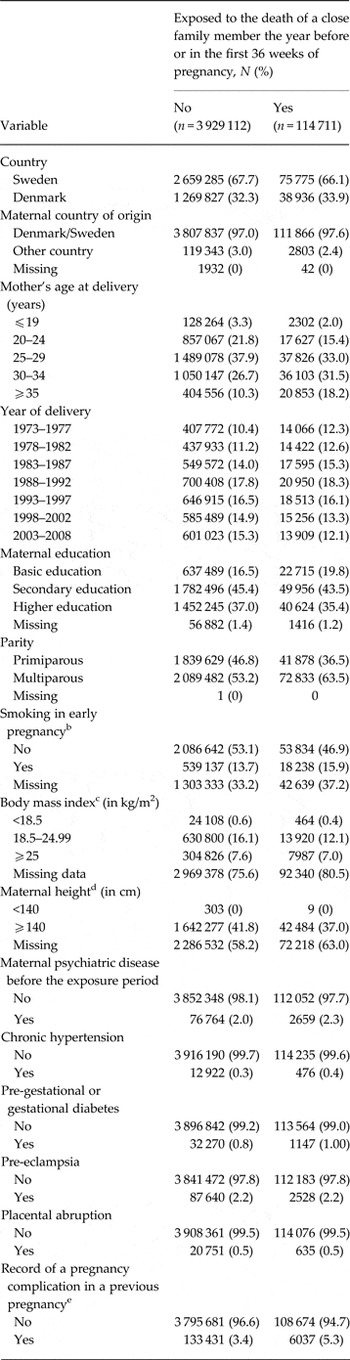
In the cohort of 4 940 764 pregnancies, 114 711 experienced the loss of a close relative the year before or in the first 36 weeks of pregnancy. The corresponding figures by type of loss were: (1) 33 621 deaths 7–12 months before pregnancy, 36 232 deaths 0–6 months before pregnancy, 16 529 deaths in the first, 17 323 in the second and 11 006 in the third trimester of pregnancy; (2) 13 343 deaths due to unnatural and 100 904 due to natural causes; (3) 11 816 deaths of children (among women with at least a live child at the start of the exposure period), 1265 partner deaths (among women with register linkage to the partner), 6518 sibling deaths (among women with register linkage to parents and at least a live sibling at the start of the exposure period), and 99 257 parental deaths (among women with register linkage to parents and at least a live parent at the start of the exposure period). Compared to unexposed women, bereaved women were older, more likely to give birth in earlier years of the study period, have a short education, be multiparous, smoke in early pregnancy, and have a placental dysfunction disorder in a previous pregnancy (Table 1).
Comparison of the exposed and the unexposed group according to the study variables a

a Analyses were performed among women who had register links to parents and to the partner.
b Data were recorded since 1982 in Sweden and since 1991 in Denmark.
c Data are available only in Sweden since 1992.
d Data were registered only in Sweden, since 1982.
e Pregnancy complications in a previous pregnancy include pre-eclampsia, placental abruption, or small for gestational age.
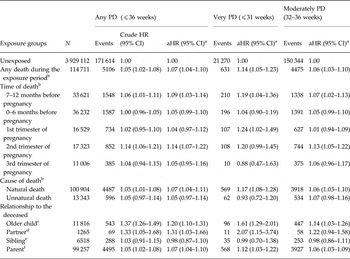
In the cohort of 4 940 764 births, we identified 221 912 (4.5%) PDs of whom 29 346 (0.6%) were very preterm and 192 566 (3.9%) were moderately preterm. Compared with unexposed women, women who lost a close family member the year before or during pregnancy had an increased risk of PD [hazard ratio (HR) with 95% confidence intervals (CIs) 1.07 (1.04–1.10)] (Table 2). The point estimates did not differ substantially when exposure was stratified according to time or cause of death, albeit in some analyses the CIs included 1. The risk of PD was increased among women who lost a child, the partner or a parent, but not among those who lost a sibling. Death of a child and death of the partner was associated with higher risks of very PD than of moderately PD.
Hazard ratios (HR) for any preterm delivery (PD) and for PD by gestational age at delivery according to bereavement

N, Number; aHR, adjusted hazard ratio; CI, confidence interval.
a Adjusted for country, year of delivery, maternal age, education, country of origin, parity, psychiatric disorder before the exposure window, chronic hypertension and record of pre-eclampsia, placental abruption or a small for gestational infant in a previous pregnancy.
b Analyses were performed among women with register linkage to parents and to the father of the index child (n = 4 043 823).
c Analyses were performed among women who had at least a live child at the start of the exposure window (n = 2 703 085).
d Analyses were performed among women with register linkage to the father of the index child (n = 4 880 467).
e Analyses were performed among women with register linkage to parents and at least a live sibling at the start of the exposure window (n = 3 728 964).
f Analyses were performed among women who had register linkage to parents and at least a live parent at the start of the exposure window (n = 4 049 131).
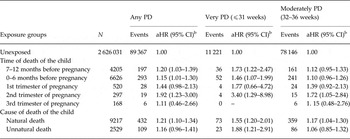
When exposure to death of a child was categorized according to time of death, the highest HR tended to be in the second trimester (Table 3). Both natural and unnatural deaths of children were associated with increased risks of very PD, whereas the risk of moderately PD was only increased after natural deaths. It was not possible to perform similar analyses with partner death, due to limited number of events.
Hazard ratios for preterm delivery (PD) according to the time and the cause of the death of the older child a

N, number; aHR, adjusted hazard ratio; CI, confidence interval.
a Analyses were performed among women who had at least a live child at the start of the exposure window (n = 2 703 085).
b Adjusted for country, year of delivery, maternal age, education, country of origin, parity, psychiatric disorder before the exposure window, chronic hypertension and record of pre-eclampsia, placental abruption or a small for gestational infant in a previous pregnancy.
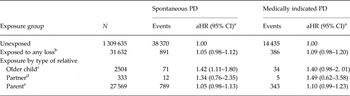
The associations between loss of any relative, loss of a child, partner or parent the year before or in the first 36 weeks of pregnancy did not differ substantially between spontaneous and medically indicated PD (Table 4). However, only the association between loss of a child and spontaneous PD was statistically significant. Repeating our analysis regarding the association between death of a child and medically indicated PD after excluding women with pre-eclampsia, placental abruption or diabetes did not weaken this association [HR (95% CI) 1.70 (1.11–2.61)].
Hazard ratios for induced and spontaneous preterm delivery (PD) according to maternal bereavement among deliveries in Sweden during 1990–2006

N, Number; aHR, adjusted hazard ratio; CI, confidence interval.
a Adjusted for year of delivery, maternal age, education, country of origin, parity, psychiatric disorder before the exposure window, chronic hypertension and record of pre-eclampsia, placental abruption or a small for gestational infant in a previous pregnancy.
b Analyses were performed among women who had links to parents and to the father of the index child, and in case their delivery was preterm, had information on the precursor of delivery (n = 1 341 267).
c Analyses were performed among women who had at least a live child at the start of the exposure window, and in case their delivery was preterm, had information on the precursor of delivery (n = 865 082).
d Analyses were performed among women with register linkage to the father of the index child, and in case their delivery was preterm, had information on the precursor of delivery (n = 1 566 083).
e Analyses were performed among women who had register linkage to parents and at least a live parent at the start of the exposure window, and in case their delivery was preterm, had information on the precursor of delivery (n = 1 337 466).
The associations between loss of any relative or loss of a child, partner or parent and the risk of PD did not change substantially after (1) adjusting for BMI in early pregnancy (in Sweden since 1992), (2) adjusting for maternal height (in Sweden since 1982), or (3) excluding women who smoked in early pregnancy (in Sweden since 1982 and in Denmark since 1991) (data not shown). The relation between loss of any relative and the risk of overall PD and of PD by subtype did not change substantially, when in case of women who experienced several losses during the exposure period (n = 1808), we gave coding priority according to the following hierarchy: loss of a child, partner, sibling or parent (data not shown). There were minor differences between the loss of any relative during the exposure period and the risk of PD by year of delivery, maternal age, mother's country of birth, maternal education, chronic hypertension and psychiatric diagnosis before the exposure period (Supplementary Table S2).
Bereavement the year before pregnancy or in the first 38 gestational weeks was associated with an increased risk of early term delivery [HR (95% CI) 1.08 (1.06–1.09)]. The risks were highest in case of losses of older children and the partner [HR (95% CI) 1.50 (1.06–1.09) and 1.33 (1.17–1.50), respectively] (Supplementary Table S3) and were confined to medically indicated deliveries [HR (95% CI) 2.73 (2.46–3.04) and 2.47 (1.79–3.40), respectively] (Supplementary Table S4).
Discussion
We found that loss of a close relative the year before or in the first 36 weeks of pregnancy was associated with an increased risk of PD, especially if the loss was of an older child or of the partner. These losses tended to be associated with higher risks of very PD than of moderately PD. There were no substantial differences in the association between the loss of a child or partner and the risk of spontaneous and medically indicated PD.
Comparison with previous studies
This large population-based study allowed us to investigate with better precision and in more detail than previous studies whether the association between stress and PD differs by gestational age. Our study corroborated and extended on the findings by Khashan et al. (Reference Khashan, McNamee, Abel, Mortensen, Kenny, Pedersen, Webb and Baker2009) who reported that risk of PD was foremost increased among women experiencing adverse life events (death or severe illness) affecting older children, and risks were higher for very PD than for moderately PD. In addition to their findings, we could detect a modest association also for the loss of a partner during pregnancy, which also was stronger for very preterm compared to moderately PD. These findings are in line with those of two earlier investigations suggesting somewhat stronger association between depression – another condition related to hypothalamic pituitary adrenal axis dysregulation – and the risk of overall PD (Straub et al. Reference Straub, Adams, Kim and Silver2012) or of medically indicated PD at earlier than at later gestations (Gavin et al. Reference Gavin, Holzman, Siefert and Tian2009). Results from other studies in this area have been mixed. One study reported an association between prenatal stress and an increased risk of PD only at 32–34 weeks of gestation (Buzaglo et al. Reference Buzaglo, Sheiner, Harlev, Weintraub and Novack2012), while other investigations did not find consistent differences in the association between stress or depression and the risk of PD by gestational age (Neggers et al. Reference Neggers, Goldenberg, Cliver and Hauth2006; Eskenazi et al. Reference Eskenazi, Marks, Catalano, Bruckner and Toniolo2007; Kramer et al. Reference Kramer, Lydon, Séguin, Goulet, Kahn, McNamara, Genest, Dassa, Chen, Sharma, Meaney, Thomson, Van Uum, Koren, Dahhou, Lamoureux and Platt2009; Yonkers et al. Reference Yonkers, Norwitz, Smith, Lockwood, Gotman, Luchansky, Lin and Belanger2012; Sanchez et al. Reference Sanchez, Puente, Atencio, Qiu, Yanez, Gelaye and Williams2013; Barrios et al. Reference Barrios, Sanchez, Qiu, Gelaye and Williams2014). Differences in study designs, statistical power, assessment of stress, coping options, study populations or health care are likely to have contributed to differences in findings among these studies.
Our finding that death of an older child in the prenatal period was associated with an increased risk of spontaneous PD is in line with those of several case-control studies (Berkowitz & Kasl, Reference Berkowitz and Kasl1983; Heaman et al. Reference Heaman, Blanchard, Gupton, Moffatt and Currie2005; Sanchez et al. Reference Sanchez, Puente, Atencio, Qiu, Yanez, Gelaye and Williams2013; Barrios et al. Reference Barrios, Sanchez, Qiu, Gelaye and Williams2014) and of one follow-up study regarding stress and risk of spontaneous PD (Copper et al. Reference Copper, Goldenberg, Das, Elder, Swain, Norman, Ramsey, Cotroneo, Collins, Johnson, Jones and Meier1996). Furthermore, two follow-up studies found an association between negative life events and spontaneous PD only if the events were perceived as very stressful (Hedegaard et al. Reference Hedegaard, Henriksen, Secher, Hatch and Sabroe1996; Dole et al. Reference Dole, Savitz, Hertz-Picciotto, Siega-Riz, McMahon and Buekens2003), whereas a follow-up study of racial discrimination reported increased risks of spontaneous PD in case of some, but not all, investigated discrimination measures (Rosenberg et al. Reference Rosenberg, Palmer, Wise, Horton and Corwin2002). In contrast, a cohort study by Kramer et al. (Reference Kramer, Lydon, Séguin, Goulet, Kahn, McNamara, Genest, Dassa, Chen, Sharma, Meaney, Thomson, Van Uum, Koren, Dahhou, Lamoureux and Platt2009) reported no significant association between any of the analyzed measures of prenatal stress and spontaneous preterm birth. Findings from prospective studies regarding the link between anxiety and depression and spontaneous PD risk have been mixed, with some studies reporting positive (Orr et al. Reference Orr, James and Blackmore Prince2002; Kramer et al. Reference Kramer, Lydon, Séguin, Goulet, Kahn, McNamara, Genest, Dassa, Chen, Sharma, Meaney, Thomson, Van Uum, Koren, Dahhou, Lamoureux and Platt2009), others mixed (Dayan et al. Reference Dayan, Creveuil, Herlicoviez, Herbel, Baranger, Savoye and Thouin2002, Reference Dayan, Creveuil, Marks, Conroy, Herlicoviez, Dreyfus and Tordjman2006; Dole et al. Reference Dole, Savitz, Hertz-Picciotto, Siega-Riz, McMahon and Buekens2003; Ibanez et al. Reference Ibanez, Charles, Forhan, Magnin, Thiebaugeorges, Kaminski and Saurel-Cubizolles2012) or no association (Copper et al. Reference Copper, Goldenberg, Das, Elder, Swain, Norman, Ramsey, Cotroneo, Collins, Johnson, Jones and Meier1996; Andersson et al. Reference Andersson, Sundström-Poromaa, Wulff, Aström and Bixo2004; Neggers et al. Reference Neggers, Goldenberg, Cliver and Hauth2006; Gavin et al. Reference Gavin, Holzman, Siefert and Tian2009; Fransson et al. Reference Fransson, Ortenstrand and Hjelmstedt2011; Straub et al. Reference Straub, Adams, Kim and Silver2012; Yonkers et al. Reference Yonkers, Norwitz, Smith, Lockwood, Gotman, Luchansky, Lin and Belanger2012).
The link between stress and the risk of medically indicated PD has received considerably less attention, despite some overlap in risk factors with spontaneous preterm birth (Berkowitz et al. Reference Berkowitz, Blackmore-Prince, Lapinski and Savitz1998; Savitz et al. Reference Savitz, Dole, Herring, Kaczor, Murphy, Siega-Riz, Thorp and MacDonald2005; Klebanoff & Keim, Reference Klebanoff and Keim2011), and the fact that medically indicated PDs represent an important proportion of all PDs (Goldenberg et al. Reference Goldenberg, Culhane, Iams and Romero2008). The only study, which to our knowledge, analyzed this question reported a two- to three-fold increased risk of medically indicated PD following life events with a negative impact on the woman's life, but no association in case of other measures of stressful life events, perceived neighborhood safety, racial or gender discrimination (Dole et al. Reference Dole, Savitz, Hertz-Picciotto, Siega-Riz, McMahon and Buekens2003). The corresponding point estimates were generally higher than those observed in case of spontaneous PD (Dole et al. Reference Dole, Savitz, Hertz-Picciotto, Siega-Riz, McMahon and Buekens2003). With some exception (Gavin et al. Reference Gavin, Holzman, Siefert and Tian2009), the few prospective studies analyzing the link between depression or anxiety and the risk of medically indicated PD do not provide support for such an association (Dole et al. Reference Dole, Savitz, Hertz-Picciotto, Siega-Riz, McMahon and Buekens2003; Neggers et al. Reference Neggers, Goldenberg, Cliver and Hauth2006; Fransson et al. Reference Fransson, Ortenstrand and Hjelmstedt2011; Ibanez et al. Reference Ibanez, Charles, Forhan, Magnin, Thiebaugeorges, Kaminski and Saurel-Cubizolles2012; Straub et al. Reference Straub, Adams, Kim and Silver2012; Yonkers et al. Reference Yonkers, Norwitz, Smith, Lockwood, Gotman, Luchansky, Lin and Belanger2012). Interestingly, we found a relatively strong association between the loss of a child and partner and the risk of medically indicated, but not spontaneous, early term delivery, suggesting that many inductions are postponed to this period.
Linking mechanisms
Our finding that bereavement of a child and partner was more closely related to the risk of very preterm than of moderately PD indicates that infection and inflammation may link stress to PD; the role of infection and inflammation in the etiology of PD increases with decreasing gestational age (Goldenberg et al. Reference Goldenberg, Hauth and Andrews2000, Reference Goldenberg, Culhane, Iams and Romero2008). Emerging, though not consistent evidence (Culhane et al. Reference Culhane, Rauh, McCollum, Hogan, Agnew and Wadhwa2001; Coussons-Read et al. Reference Coussons-Read, Okun, Schmitt and Giese2005, Reference Coussons-Read, Okun and Nettles2007; Harville et al. Reference Harville, Hatch and Zhang2005, Reference Harville, Savitz, Dole, Thorp and Herring2007; Kramer et al. Reference Kramer, Lydon, Séguin, Goulet, Kahn, McNamara, Genest, Dassa, Chen, Sharma, Meaney, Thomson, Van Uum, Koren, Dahhou, Lamoureux and Platt2009) suggests that maternal stress during pregnancy increases the risk of genital tract infections and of pro-inflammatory activity. Cytokines may stimulate corticotropin-releasing hormone and prostaglandin production, uterine contractility and spontaneous PD (Gennaro & Hennessy, Reference Gennaro and Hennessy2003; Borzychowski et al. Reference Borzychowski, Sargent and Redman2006). In addition, they may also increase the risk of medically indicated PD through their effect on pre-eclampsia (Borzychowski et al. Reference Borzychowski, Sargent and Redman2006).
Our finding that the point estimate corresponding to the association between death of a child the year before or during pregnancy and medically indicated PD was not substantially altered after exclusion of women with pre-eclampsia, placental abruption or diabetes is somewhat intriguing. We recently reported that death of an older child was associated with increased risks of early onset pre-eclampsia (László et al. Reference László, Liu, Svensson, Wikström, Li, Olsen, Obel, Vestergaard and Cnattingius2013a ) and placental abruption (László et al. Reference László, Ananth, Wikström, Svensson, Li, Olsen, Vestergaard, Obel and Cnattingius2014), and these pregnancy complications are the most important indications for induced PDs (Ananth & Vintzileos, Reference Ananth and Vintzileos2006; Goldenberg et al. Reference Goldenberg, Culhane, Iams and Romero2008). One potential explanation may be that women who lost a child shortly before or during pregnancy may have undergone antenatal examinations more often (László et al. Reference László, Svensson, Li, Obel, Vestergaard, Olsen and Cnattingius2013b ), and the threshold for preterm induction of delivery – even in the absence of pre-eclampsia or placental abruption – may be lower in this group than among unexposed women.
We found no evidence that smoking may be part of the explanation of the association between loss of any relative and the risk of PD. Whether other potential mediators such as additional lifestyle factors, mood disorders, specific type of infections or placental ischemia contribute to the investigated association needs further examination.
Strengths and limitations
Our study has several strengths, including use of prospective data, large sample size and the high quality of data on death in Danish and Swedish population-based registries. The registration of bereavement before and independent of PD excludes the possibility of recall bias and reverse causation, which are possible sources of bias in several earlier investigations (László et al. Reference László, Liu, Svensson, Wikström, Li, Olsen, Obel, Vestergaard and Cnattingius2013a ). The death of a close relative is an objective and well defined source of stress that is likely to cause physiological arousal in most individuals, irrespective of the available coping resources (Khashan et al. Reference Khashan, McNamee, Abel, Mortensen, Kenny, Pedersen, Webb and Baker2009; László et al. Reference László, Liu, Svensson, Wikström, Li, Olsen, Obel, Vestergaard and Cnattingius2013a , Reference László, Svensson, Li, Obel, Vestergaard, Olsen and Cnattingius b , Reference László, Ananth, Wikström, Svensson, Li, Olsen, Vestergaard, Obel and Cnattingius2014); this further limits the possibility of exposure misclassification. The large sample size allowed us to consider a high number of possible confounders (including the strongest risk factor for PD, i.e. a history of PD) and to stratify the outcome by gestational age at delivery or by mode of delivery onset.
Our study also has some limitations. First, although we considered a large number of potential confounders, the possibility of residual confounding from unmeasured socioeconomic, lifestyle and health-related factors shared by family members or by women across pregnancies, cannot be excluded. Second, though the overall study population was large, the statistical power to detect modest effects may have been limited by the rarity of exposure in some of our sub-analyses, particularly in the analyses of spontaneous and medically indicated PDs. Third, some misclassification of the outcome, primarily during the period when the estimation of gestational age was based on the last menstrual period is possible. However, there were no substantial differences in the association between death of any relative and the risk of PD by year of delivery. Fourth, as we did not have information on death of family members residing outside the two investigated countries, our findings regarding bereavement of parents and siblings may be generalized only to women with families living in Denmark and Sweden in a limited time period.
Conclusions
Our results provide support for the hypotheses that severe stress increases risks of very and moderately PD, as well as of spontaneous and medically indicated PD. The finding that bereavement was foremost associated with increased risk of very PD points to the role of infection and inflammation as potential linking mechanisms. As the prevalence of maternal bereavement in the antenatal period is low and the observed associations are modest, the public health implications of our findings are limited. Large prospective studies are needed to estimate the effect of less severe, but more frequent sources of stress during pregnancy on risks of PD by gestational age and by precursors of birth onset and to investigate the mediating role of infection and inflammation in these associations.
Supplementary material
For supplementary material accompanying this paper visit http://dx.doi.org/10.1017/S0033291715002688
Acknowledgements
This work was supported by the Swedish Council for Working Life and Social Research (S.C., Grant no. 2010-0092); the European Research Council (J.L., ERC-2010-StG no. 260242) and the Lundbeck Foundation (M.V., Grant no. R155-2012-11280).
Declaration of Interest
None.