Introduction
Alberto Perez-Gomez states, ‘regardless of culture, age, wealth and social status, humans suffer from a lack, which is also a gift,’ and that ‘throughout our lives we constantly look for “something,” something that is missing and that might complete us – be it the physical presence of another, the acquisition of knowledge, or the experience of art and architecture’.Reference Perez-Gomez1 The root word of religion is reliquare, ‘to bind together,’ suggesting its principal role of connecting and completing.2 A sentiment that recurs in numerous religious traditions is an insistence that connections to deeper ways of being in the world are only possible through belief and participation in religion. The ‘holy’ is the ‘whole’ – the re-connection of humans with their god(s). Religious beliefs and practices from around the world, in all their variety, share a goal of connecting the individual to broader communal, cultural and theological contexts. In this context, religion is a mediator; its beliefs and rituals serving to interconnect the individual, the community, the understandings they seek, and the god's they worship.Reference Barrie3
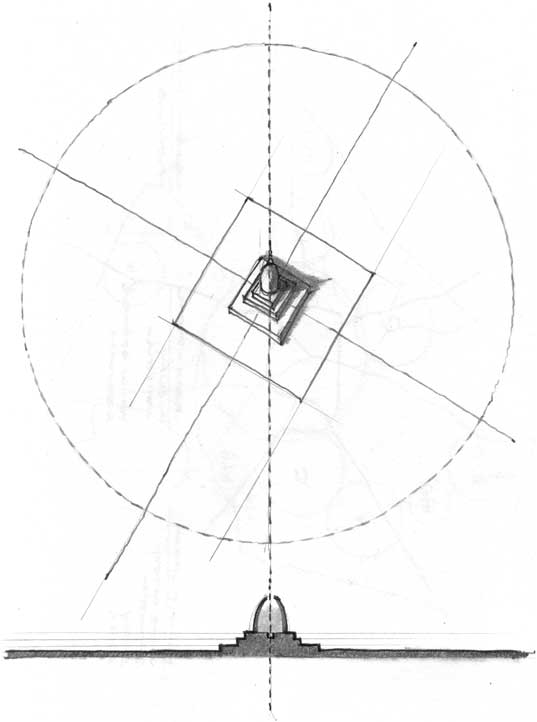
Traditionally, religion and religious practices, in all of their forms, have articulated questions regarding the meaning and significance of human existence and mollified feelings of isolation and alienation. They can be understood as intrinsic to the archetypal human endeavor of establishing a ‘place’ in the world. Sacred architecture has incorporated similar agendas – providing meaningful places that embody symbolic content, often precisely built at specific locations with the hope that connections would result and the otherwise inaccessible accessed. Religious figures, texts, and practices have served to mediate between humans and the understandings they seek or the gods they worship: themes that were also symbolized by sacred architecture. In this context, analogous to scripture, prayer, worship, teachers, holy persons, oracles, shamans, and other mediums, the sacred place was (and often still is), an intermediate zone believed to have the ability to join, to connect, to unveil. Sacred architecture performed, and in some cases continues to perform, a critical role in embodying religious symbols and facilitating communal rituals – with the goal of creating a middle ground, a liminal zone, that mediates between humans and that which they seek, revere, fear or worship (see Figure 1).Reference Barrie4
Analogous to scripture, prayer, worship, teachers, holy persons, oracles, shamans, and other mediums, the sacred place was (and often still is), an intermediate zone believed to have the ability to join, to connect, to unveil. The Mediating Roles of Architecture.

The in-between articulated by the architecture
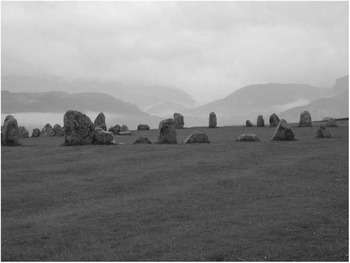
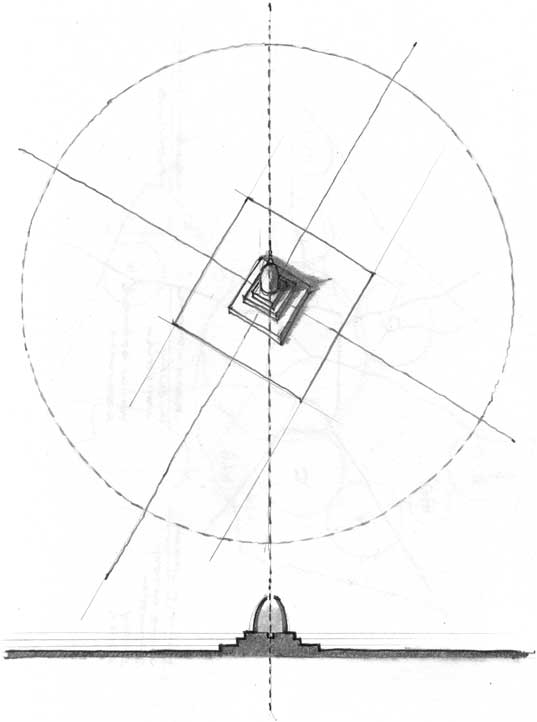
Sacred architecture has typically utilized a variety of means to establish a place that is both separated and connected to its contexts. These include: a clear delimitation of place, an articulate approach, entry and path sequence, the ordering of the place through geometry and proportion and the use of diverse representational and symbolic media. The delimiting of boundaries was often the first task of sacred places – in-between zones that distinguished the sacred from the profane.5 From sparse stone circles to elaborate complexes, the marking of a place to distinguish it from other places can be understood as a fundamental human and architectural act. Attendant to the clear delimiting of sacred space are the approaches, paths and thresholds to enter it, and the effective choreographing of approach, threshold, spatial sequence and arrival has a long and recognized history.6 Additionally, the ordering of the sacred place in some examples represented a ‘perfected world’ that symbolized the perfection of the divine while providing a place required by the divine ‘to dwell’ there.7 Furthermore, surface, scenographic and epigraphic elements contributed to the creation of an architectural cosmogram in the service of its symbolic agendas (Figures 2 and 3).
The delimiting of boundaries was often the first task of sacred places – in-between zones that distinguished the sacred from the profane. Axis Mundi.
From sparse stone circles to elaborate complexes, the marking of a place to distinguish it from other places is a fundamental human and architectural act. Castlerigg Stone Circle, Cumbria, UK. Photo by Andrew Crompton.

Connections deepened through ritual
One definition of the ‘meaning’ of architecture is its ability to lead one to more substantive ontological understandings. Sacred architecture was traditionally believed to have the capacity to connect one with a deeper understanding of oneself, one's relationship to others, and to one's place in the cosmos. However, it was through the practice of participation with sacred architecture that its often-nuanced meanings were more substantively accessed. As Lindsay Jones cogently states, ‘The daunting fact… is that buildings in and of themselves do not “mean” anything!’ but only ‘in the negotiation or the interactive relation that subsumes both the building and the beholder – in the ritual-architectural event in which buildings and human participants are involved’.Reference Jones8 Meaning in architecture can be understood as the result of an intimate connection (whether it is individually or collectively) that engages one sensually and intellectually. Sacred architecture often provided potent settings to facilitate the deep internal and external connections intrinsic to the religious experience.
In traditional ritual activities, participants occupy a liminal place between the sacred and the profane; the present and the past, and the god(s) they worship. This sacred time, set in a sacred place, symbolizes a bridge to the divine and is often believed to be a portentous setting for transcendent experiences. Moreover, rituals are deepened by their settings: otherwise they may lose their potency and risk becoming meaningless. Whether it is a temporary altar, a simple forest clearing or an immense temple, the sacred setting often provides the stage for ritual and, it is presumed, a threshold to the gods or the understandings that are sought. Sacred sites are often animated places, vivified by the anticipation of, or belief in, the presence of gods, divine ancestors, or spirits, their dynamism further deepened through ritual activities. Just as the architecture was typically believed to serve as a receptor and vessel for the divine, it was also built to receive its creators in the hope of bringing the two together (Figure 4).
Sacred sites are often animated places, vivified by the anticipation of, or belief in, the presence of gods, divine ancestors, or spirits, their dynamism further deepened through ritual activities. Western Wall, Jerusalem, Israel.

Architecture built to serve ritual, as sacred architecture nearly always is, needs those individual and communal rituals to complete them – they depend on humans to animate their spaces and articulate their meaning.Reference Kostof9 Rituals may at times serve as mediums of transition from one mode of being to another. Just as life passages, such as puberty, marriage and death, are often negotiated by ritual, sacred architecture serves a similar linking function. Devotional sites receive the religious aspirants they are built for, and serve as the setting for individual and communal rituals – both setting and ritual serve as mediators between participants and the transformation they hope for. In all, the sacred place, the ritual, and their interrelationship, create what is believed to be an irruption in the mundane world. Through place and action – setting and ritual – participation and belief – this liminal place promises a link with the divine.
Architecture as a communicative media/ium
An important aspect of architecture is its role as a cultural artifact that responds to social, political, economic and environmental contexts and expresses a complex matrix of cultural beliefs and imperatives. According to Dalibor Veseley ‘What the book is to literacy, architecture is to culture as a whole,’Reference Veseley10 and, like other arts, it speaks many languages and idioms.Reference Dewey11 Traditionally architecture articulated its creator's place in the world and therefore can best be understood as a communicative activity. Even in contemporary cultures that are dominated by heterogeneous and positivist hegemonies, architecture can still perform communicative roles, however nuanced, subtle and multifarious they may be.
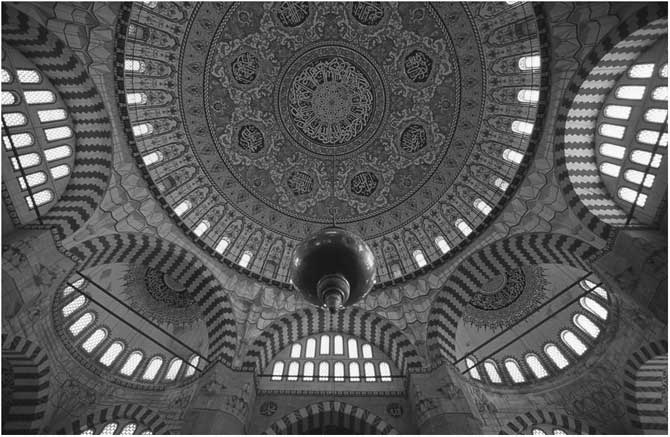
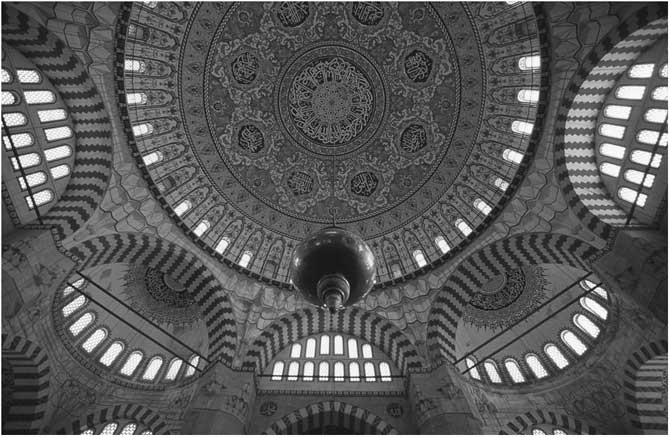
As Bernard Tschumi has argued, architecture can be considered as a ‘form of knowledge’.Reference Tschumi12 Traditionally, sacred architecture utilized a broad range of surface and spatial media to perform its communicative roles – its content ranging from the historical and textural, to didactic, exhortative and even coercive elements. In many cases the form, scale and placement of the architecture established formal hierarchies that underlined the significance of the sacred place. Often external and internal surfaces served to communicate symbolic content, and spatial relationships and sequences choreographed its dynamic serial experience. In the most significant examples, sacred architecture was didactic, pedagogical and a means to affect, coerce or transform its participants.Reference Jones13 In this context its ontological significance served as an agent to transform an individual's perspective and engender spiritual insights (Figure 5).
In sacred architecture, external and internal surfaces served to communicate symbolic content, and spatial relationships and sequences choreographed its dynamic serial experience. Dome, Selimiye Mosque, Edirne, Turkey. Photo by Aras Neftçi.
It is important to recognize that symbolic representation is only one of the means employed to communicate content and elicit responses. Particular physiological and psychological responses are often engendered by sacred settings, consistent with their symbolic agendas. Any space that heightens or deprives the senses can produce feelings of discomfort or ease, anxiety or peace. A cadence of light and dark as one ambulates through a series of spaces can serve to underline the experience of passage and progress towards the goal. Modulating the quality of light can also produce feelings of comfort or discomfort, depending on its intensity and whether one gradually approaches the luminous or is abruptly plunged into darkness. Similarly, the scale of the form and spaces of the architecture can produce empathetic responses ranging from grandeur to insignificance. Critical understandings of the more intangible, ephemeral and immaterial aspects of sacred architecture can serve to reveal the full breadth of its effects (Figure 6).
A cadence of light and dark as one ambulates through a series of spaces can serve to underline feelings of passage and progress towards the goal. Entry path, Beomeo Zen Buddhist Monastery, Korea.

Sacred places are typically viewed as peaceful settings for the cultivation of devotion and spiritual connection, and the belief in personal improvement through the positive experience engendered by sacred architecture is a popular and predominant position. What is less prevalent is the dark side of the politically motivated and socially coercive roles of some places.Reference Coldrake14 However, in the context of understanding how the medium of architecture served to communicate content and produce responses, emotions and outcomes, places that invite and inspire or coerce and oppress have equal interest.Reference Jones15 The fact is, many places do both, and more, and that is what makes them particularly potent. We need to accept the ‘dark side’ of architecture's complicity with political propaganda and social coercion to emancipate it from its conventional cultural fetters and perhaps establish more holistic transcendent functions for contemporary iterations.
Extant and active religious sites are positioned as dynamic places where content is communicated through the media of the architecture (in all of its surface, formal and spatial aspects), and further vivified through rituals. The media of architecture is both a means of communication and a medium of spiritual engagement. These two aspects are not separate, but can be understood as part of the integrated agendas of sacred architecture as a mediator – an intermediary believed to co-join otherwise separate worlds. Our understandings of sacred architecture are enriched and expanded by the inclusion of their past and present active roles, and the dynamic interplay of place and participant. All of which suggests the enduring power of architecture and the built environment to embody content – to inform, elucidate and even change us.
Contemporary Positions: The Cathedral of Christ in Light, Oakland, California
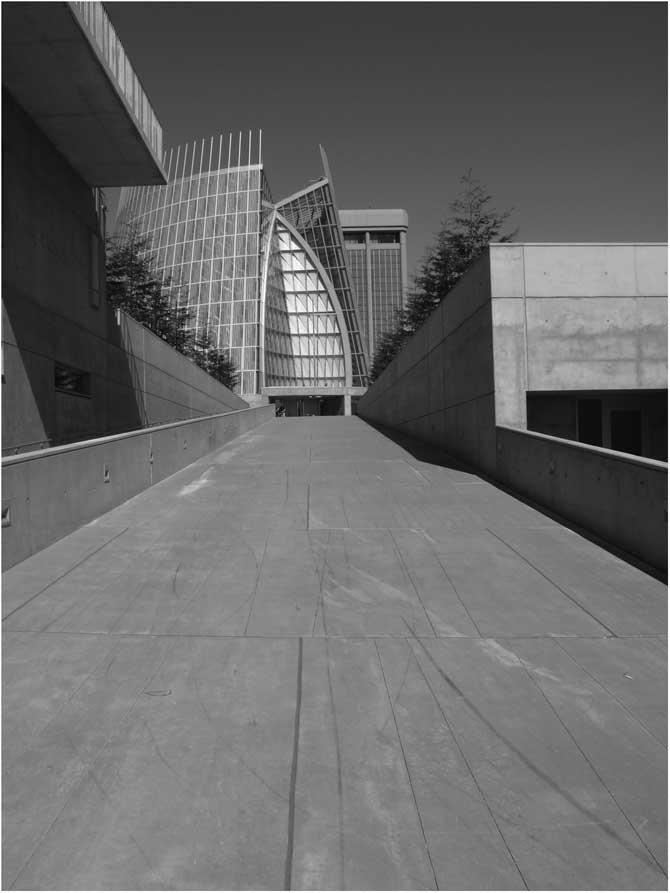
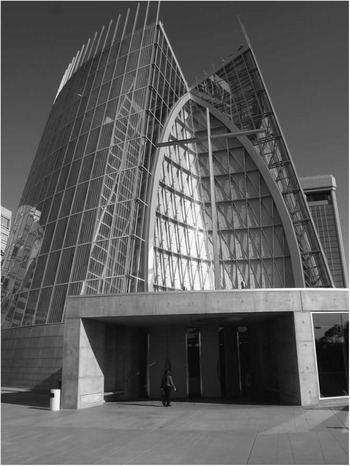
The Cathedral of Christ in Light in Oakland California, designed by Craig Hartman of the San Francisco office of Skidmore Owings and Merrill (SOM) and completed in 2008, appropriates and repositions symbols of sacred architecture previously outlined including: the clear delimiting of the sacred precinct, an articulate entry sequence, proportion and geometry, and a diverse range of representational and symbolic media – but represents them through the language of contemporary architecture. In particular, it creates a physical, symbolic and ritual pilgrimage path to the sacred center. Throughout its sequences, there are both overt and oblique references to scripture and belief, reinforced by the appropriation of an accessible Christian symbolic language. The site, facing a manmade lagoon in an urban neighborhood, does not immediately suggest an elongated entry sequence. However, the cathedral sits atop a raised podium (that contains clinics, administrative offices, a conference center and the crypt beneath the church), which allows for a sloped ramp, appropriately called the Pilgrim Path, to ascend to the cathedral in a manner reminiscent of pilgrimage churches (Figure 7).
The Pilgrim Path, the Cathedral of Christ in Light, Oakland, CA. SOM San Francisco/Craig Hartman, 2008.
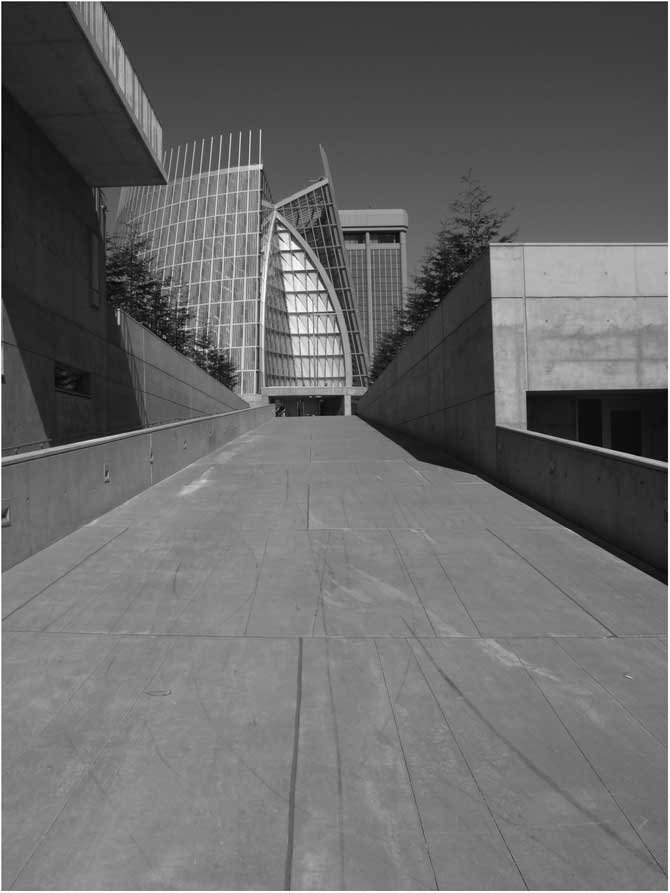
The path sequence is surprisingly rich considering the relatively small urban site. It begins at street level and gradually but steadily rises toward the entrance. Walls of dissimilar height and fractured patterning in the concrete walk create a dynamic spatial and kinesthetic environment. Centered on the path is a cross that appears to hover over a low exterior entry space. As one enters this space it becomes apparent that the cross uneasily rests at the center of an open skylight. A popular passage from the Gospel According to John, ‘I am the door: whoever enters by me will be saved,’ is etched in the walk, further demarking the threshold. Two asymmetrically positioned pairs of doors lead to the narthex. Once inside it is clear that the path is axially aligned with the baptismal font, prominently placed (consistent with its liturgical significance), and serving as a formal means of realigning the path. The narthex is clearly articulated as a separate space, ringed at its perimeter by windows and skylights. The compression of the entry and narthex spaces dramatically expands once one enters the nave. Here, the symmetrical plan underscores the axial path that leads to the ambo. The sense of enclosure is delineated by the surrounding concrete ‘crypt walls’ – its luminous verticality by the soaring wood columns. Chapels ring the space, hollows within the concrete walls, strategically lit by skylights or side windows (Figures 8, 9 and 10).
Entrance, the Cathedral of Christ in Light, Oakland, CA. SOM San Francisco/Craig Hartman, 2008.

Entry doors, the Cathedral of Christ in Light, Oakland, CA. SOM San Francisco/Craig Hartman, 2008.

Procession along ambulatory, the Cathedral of Christ in Light, Oakland, CA. SOM San Francisco/Craig Hartman, 2008.

The geometry of the cathedral itself is organized according to the common Christian symbol of the Vesica Piscis, the almond-shaped form created by the intersection of two circles at their midpoints. This geometry is also suggested in the section and form of the cathedral, which is actually two shells – an exterior steel and fritted glass enclosure that establishes the symmetrical, truncated, conical form of the cathedral, and an inner wall of Douglas fir laminated beams that define the interior space. Terminating the central nave is a wall of white metal panels, set within a vesica-like frame created by the inner walls, within which an image of Christ (from a photograph of the tympanum of the Royal Portal of the west front of Chartres Cathedral) appears by means of perforations in the metal. Here, northern light filtered through the frosted glass of what is called the ‘Omega Window’ creates even illumination of this hologram-like image that appears to hover above the sanctuary (Figures 11 and 12).
Nave, the Cathedral of Christ in Light, Oakland, CA. SOM San Francisco/Craig Hartman, 2008.

Ceiling, the Cathedral of Christ in Light, Oakland, CA. SOM San Francisco/Craig Hartman, 2008.

At special celebrations, processionals at the Oakland Cathedral traverse the Pilgrim's Path and process through the narthex and nave. During regular services, the cross and the holy book are ritually carried from the sacristy near the ambo, along the surrounding ambulatory to the narthex, before turning and descending the gentle slope of the nave. This ritual way is further reinforced by the 14 Stations of the Cross that are marked on the crypt walls. The rectangular altar, raised on a round stone platform, rests in the center of a round glass-covered opening that provides light to the crypt below. Indeed, the high altar is situated directly above the place where caskets are placed during funerals.Reference Stephens16 And so, in this contemporary setting, the sacred center symbolizes both an arrival point for personal redemption and a threshold to the post-mortem paradise promised to the devout (Figures 13, 14 and 15).
Procession in nave, the Cathedral of Christ in Light, Oakland, CA. SOM San Francisco/Craig Hartman, 2008.

Altar, the Cathedral of Christ in Light, Oakland, CA. SOM San Francisco/Craig Hartman, 2008.

Crypt, the Cathedral of Christ in Light, Oakland, CA. SOM San Francisco/Craig Hartman, 2008.

Conclusion
We live in an age that may be understood to have lost some of its ability to understand nuance or value the immeasurable. Some of the imagery of Oakland Cathedral evidences this prejudice, perhaps most directly in the hologram-like image of Christ on the Omega Wall. In other areas, however, traditional elements find new settings and traditional rituals may discover new consonance. Overall, at is best, the entry path and its destinations serve to mediate between the past and future and, in part, seek their reconciliation. Moreover, the symbolic content and ritual use of the cathedral suggest the roles sacred places may play in secular societies. The Oakland Cathedral provides public spaces in a displaced American city and employs a range of formal, kinesthetic and symbolic means to establish its portentous presence. Its diverse congregation (services are conducted in English, Spanish and Vietnamese) reflects the heterodox condition of contemporary religion and sacred architecture, and suggests the need for new interpretations of traditional symbolism and rituals.
The hegemony of orthodox religions (that produced some the world's most significant sacred architecture), may have waned and lost their privileged positions (especially in the so-called West), but the religious impetus has not. This is not surprising given that, with all of the advances of human communication and knowledge, our lives remain essentially precarious and death retains its inscrutable mystery. We seek to reconcile the known with the unknown by the means that have served humans for millennia, that is (either consciously or unconsciously) by symbolism. Symbolism was essential to the religious beliefs of archaic societies and served, in part, as a means for them to explain their position in the world. The sentient and ephemeral nature of human existence is a bountiful font of artistic output. In the words of Ralph Waldo Emerson, ‘The production of a work of art throws a light upon the mystery of humanity’.Reference Atkinson17 Architecture, along with the arts, has traditionally addressed enduring questions of existence and meaning, a role it can still play today.
The potency of architecture to deliver its symbolic content remains because of the enduring conditions it articulates, which transcend doctrine and liturgy. In this way, enduring symbols have the capacity to be re-interpreted and repositioned in ways appropriate to today. We still need symbols to materialize the unknown and structure our (often inadequate) understandings. What also remain fundamentally unchanged from our distant ancestors are our bodies. Our embodied consciousness still interacts with its physical settings in ways intrinsic to the act of structuring meaning. Architecture in this context retains its potency to engage, elucidate and inspire.
Steven Holl argues,
Architecture, more fully than any other art forms, engages the immediacy of our sensory perceptions. The passage of time; light, shadow and transparency; color phenomena, texture, material and detail all participate in the complete experience of architecture … only architecture can simultaneously awaken all the senses – all the complexities of perception.Reference Holl, Pallasmaa and Perez-Gomez18
The roles of sacred spaces in secular societies will most likely remain diverse and heterogeneous, but that doesn't mean they must be undefined. We still need places that articulate our shared human condition and facilitate personal connection and even transformation. Indeed, in a rapidly changing world, the need for individual and communal transcendence may be ascendant. Contemporary sacred space does not need to be exclusively ecclesiastical or doctrinal (or even be religiously affiliated at all). What it does need to be is a place of connection consistent with the enduring mediating roles of sacred architecture. It can serve as a refuge from the more discordant and conflicted aspects of contemporary culture and the built environment, while retaining the nuance and depth attendant to multifarious embodied engagements. In this manner, public and sacred spaces may be reciprocal in their diverse and participatory roles, and their capacity to accommodate individual and communal rituals. Consequently, we might create places that confirm the continuity of human existence while providing evocative, engaging and meaningful settings for contemporary use.
Note
All drawings and photos by the author, unless noted.
Thomas Barrie, AIA, is a Professor of Architecture at North Carolina State University where he served as School Director from 2000–2007. Professor Barrie's scholarship on the symbolism, ritual use and cultural significance of architecture has brought him to sacred places around the world, and he has published and lectured extensively in his subject area. He is an award-winning architect and the author of The Sacred In-Between: The Mediating Roles of Architecture (Routledge, 2010) and Spiritual Path, Sacred Place: Myth Ritual and Meaning in Architecture (Shambhala, 1996).