The first paediatric cardiac ICU in the United States opened in 1973 at Boston Children’s Hospital (personal communication, Dr Peter Lang). Over the last several decades, as new techniques and surgeries developed for children with congenital and acquired heart disease, the volume and complexity of patients grew substantially, leading to a growth of specialised paediatric cardiac ICUs and sub-specialty trained medical providers.Reference Horak, Griffin, Brown and et.1,Reference Morrow, Fang and Fintel2 Many paediatric heart programmes have developed dedicated paediatric cardiac ICUs while others have partitioned multi-disciplinary paediatric ICUs into cardiac and non-cardiac areas. Due to its relatively recent inception, there is a lack of standardisation in work hours and clinical coverage across the field. We sought to understand details about the current demographics of the physician workforce, scope of clinical work, and current coverage models in paediatric cardiac care units.
Materials and methods
Study design
We developed and distributed a survey of medical directors (“directors”) and their associated faculty who provide care for paediatric cardiac patients in ICUs in the United States. The study was deemed exempt by the Nationwide Children’s Hospital Institutional Review Board as survey respondents were anonymous.
Study institutions and populations
Eligible subjects included paediatric cardiac critical care directors and faculty at the 120 centres in the United States where congenital heart surgery was performed, and related data were submitted to the Society of Thoracic Surgeons Congenital Heart Surgery Database in 2019.
Survey design
The survey was developed by the co-investigators and pilot tested to refine content and improve face validity. The survey questions described in this manuscript included personal demographics, and current clinical duties within and outside of the ICU, including daytime and night service. In addition to the questions asked about faculty, directors were asked to provide details on unit structure and faculty numbers (Supplemental Digital Content 1, 2). Additional information on training pathways and workforce predictions will be reported in an accompanying manuscript.
Data collection
The survey administration, data collection, and management were completed using Research Electronic Data Capture tools, hosted at Nationwide Children’s Hospital. Between May and August, 2019, invitations were sent electronically via email through the Research Electronic Data Capture Survey Distribution Tool to each director at the 120 Society of Thoracic Surgeons Congenital Heart Surgery Database in 2019 centres. Faculty email addresses were solicited from each director. Reminder emails were sent to encourage survey completion. The survey was closed on September, 2019.
Additional demographic data for each of the 120 cardiac centres were obtained from a prior study by a co-investigator to allow comparisons of responding and non-responding centres.Reference Horak, Alexander and Amirnovin3 A cardiac ICU was defined as an ICU that cares exclusively for critically ill cardiac medical and/or surgical patients, by a core team of care providers, in a separate geographical location from a paediatric ICU. If ICU beds were routinely used for non-cardiac patients, the unit was considered to be a multi-disciplinary paediatric ICU. Service weeks were defined as weeks that faculty worked in his/her primary ICU. Centres were categorised regionally into one of four geographical areas based on the United States Census designation.4
Statistical analysis
Descriptive statistics were summarised for directors and faculty. Summary statistics were mean and standard deviation or median and interquartile range for continuous variables, depending on the normality of the distributions; and counts and percentages for categorical variables. Survey open text responses from the “other” category were re-grouped to existing choices when appropriate. For certain demographics, “declined to answer” responses were excluded from analyses. Percentages were calculated using total non-missing responses as the denominator. Two-group comparisons were completed using either two-sample t-test or Wilcoxon Rank-sum test for continuous variables depending on the normality of data and Chi-square test or Fisher’s exact test for categorical variables depending on cell counts. Group comparisons between regions were done by one-way ANOVA test or Kruskal–Wallis test for continuous variables depending on the normality of data and Chi-square test or Fisher’s exact test for categorical variables depending on the cell counts. P-values less than 0.05 indicated statistical significance. Data analyses and output were generated with SAS v9.4 (SAS Institute Inc., Cary, NC, USA). Graphs were generated using Stata v16.1 (StataCorp, College Station, TX).
Results
Response rate
Complete survey responses were received from 66% (79/120) of directors. Sixty-one directors provided a current faculty email list. We received more faculty email addresses from cardiac ICU directors (68%) compared to multi-disciplinary paediatric ICUs (35%; p < 0.001). In total, 477 faculty received the survey, of whom 294 responded (62%). Faculty response rate by centre averaged 59% (range 14–100%). There were no significant differences in response rate by geographical region.
Survey response rate was higher from directors of cardiac ICUs (48/60 cardiac ICUs, 80%) compared to multi-disciplinary paediatric ICUs (31/60 paediatric ICUs, 52%; p = 0.004) and directors from larger ICUs (mean cardiac ICU beds 20 ± 8.2 in responders versus 13.5 ± 5.3 in non-responders, p = 0.01; mean multi-disciplinary paediatric ICU beds 22.4 ± 8.1 in responders versus 19.3 ± 4.5 in non-responders, p = 0.07). A larger percentage of responding faculty reported working in a cardiac ICU (67%) versus a multi-disciplinary paediatric ICU (32%).
Respondent demographics
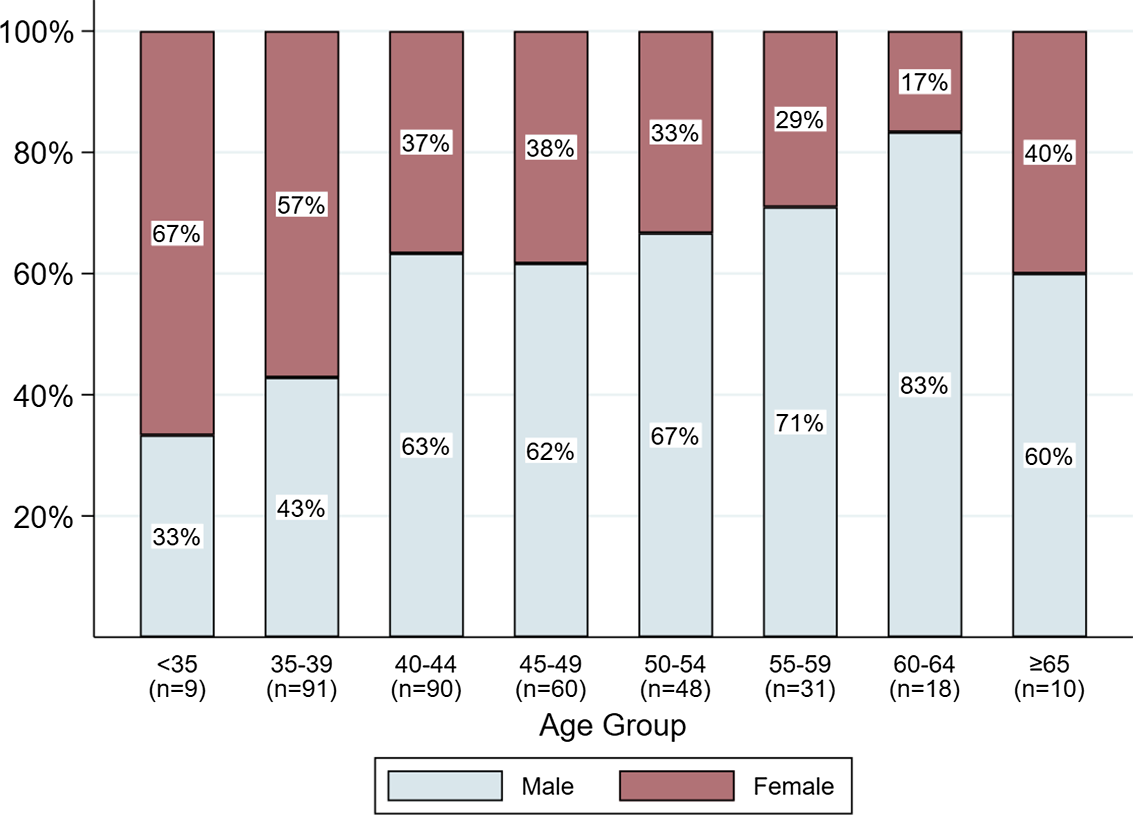
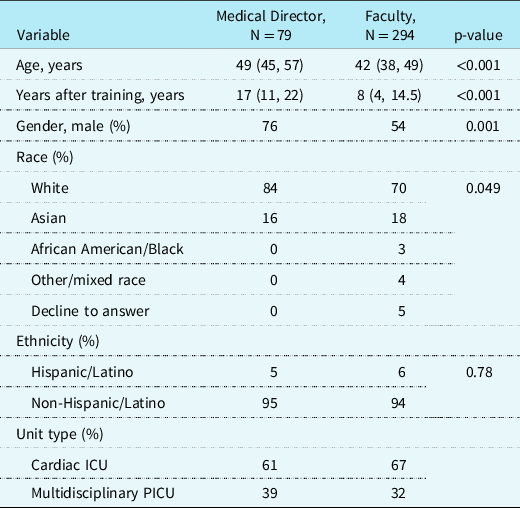
Basic respondent demographics are shown in Table 1. As expected, directors are significantly older than faculty and have been in practice significantly longer. While the majority of both directors and faculty are male, a significantly higher percentage of directors are male compared with faculty (75% versus 54%, p = 0.001). However, a shift has occurred over time such that while only 25% of paediatric cardiac critical care faculty over 60 years of age are female, 58% of those under 40 years of age are female (Fig 1). In the >45-year age group, there are more male directors by number, but equivalent percentages of each gender have attained director positions [43/112 (38%) males versus 17/55 (31%) females, p = 0.34]. However, in respondents <45 years of age, more males than females are directors, both by number and percentages [14/99 (14%) males versus 2/91 (2%) females, p = 0.003].
Gender distribution of responding cardiac intensivists by age, expressed as percentages. n = 357, not plotted n = 15 age missing, n = 1 gender not provided.

Characteristics of survey respondents

Values are reported as median (interquartile range) or percentage.
p-value indicates difference between Medical Director versus Faculty.
PICU = paediatric ICU.
The versus majority (84%) of directors are White and the remaining 16% are Asian race. Five percent identify as Hispanic or Latino ethnicity. Of non-director faculty, 70% are White, 18% are Asian, 3% are Black, 4% are Other/Mixed Race and 5% declined to answer. Six percent identify as Hispanic or Latino ethnicity. Respondent demographics were similar between geographical regions.
ICU level demographics
The majority of the responding directors report working in an academic centre (89%) and in a dedicated cardiac ICU (62%). Directors report categorical fellowship training at their centre in paediatric critical care medicine (67%) and paediatric cardiology (60%), while 20% work in centres without either fellowship. Nineteen (24%) directors, all in cardiac ICUs, report an advanced paediatric cardiac critical care fellowship. Median bed count in both cardiac ICUs and multi-disciplinary paediatric ICUs (accounting for all beds) is 20 (IQR 16, 25) with a median of 7 full-time-equivalent intensivists (IQR 5.1, 8.4), or 3.5 full-time equivalents for every 10 beds (IQR 2.5, 4.4). Though bed numbers are similar between unit types, median number of full-time equivalents are higher in multi-disciplinary paediatric ICUs compared to cardiac ICUs [8 (IQR 6,9) versus 6.9 (IQR 5,8), p = 0.029].
Medical director and faculty scope of clinical practice
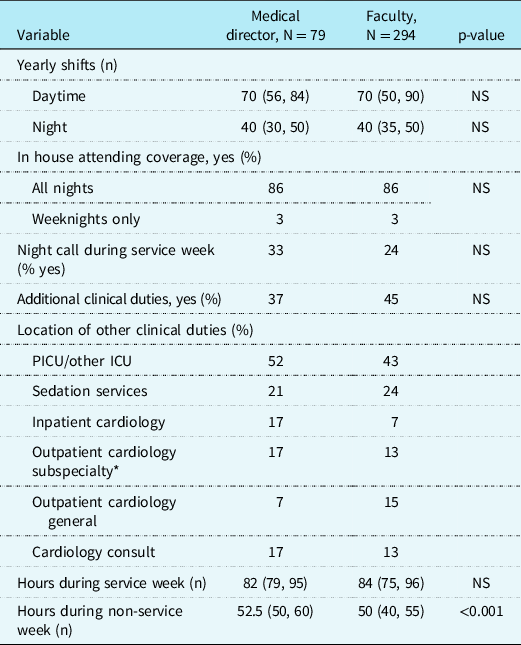
The scope of clinical work for paediatric cardiac critical care faculty is summarised in Table 2. Directors and faculty both report a median of 14 annual weeks of ICU service (IQR 12,16) is considered by their programme to be one clinical full-time equivalent. Night service is included in programmatic clinical full-time equivalent expectations in 45.7% of programmes. In programmes that include night service in the clinical full-time equivalent expectation, mean weeks of service per clinical full-time equivalent was significantly higher at 16.4 ± 6.8 weeks compared with 13.6 ± 2.5 weeks in those that do not include night service in the calculation (p = 0.025). Directors and faculty report working a similar number of ICU shifts during the year, with a median total of 110 shifts (70 day and 40 night shifts), which calculates to 15.7 weeks per year, assuming 1 shift per day. Directors and faculty report high work hours during service weeks (82 and 84 hours per week, respectively). Reported hours are less during weeks not on service but remain high in both groups and higher in directors [52.5 hours (IQR 50, 60)] versus faculty [50 hours (IQR 40, 55), p < 0.001]. There were no gender differences in work hours or number of annual day/night shifts. Older faculty had lower number of shifts per year, with a median of 80 daytime shifts (IQR 58, 98) in faculty <45 years versus 56 (IQR 42, 84) in those ≥45 years (p < 0.001) and 40 (IQR 35, 50) night shifts in faculty <45 years versus 38 (IQR 28, 48) in those ≥45 years (p = 0.047).
Clinical responsibilities for responding cardiac intensivists

Continuous variables reported as median (interquartile range) or percentage.
P-value indicates difference between Medical Directors and Faculty.
PICU = pediatric ICU.
* Single ventricle, pulmonary hypertension, heart failure, cardiac neurodevelopmental programme, etc.
In-house 24/7 night attending coverage is provided in the versus majority of programmes (86%) with no difference between clinical ICUs and multi-disciplinary paediatric ICUs. Two additional programmes (3%) provide in-house coverage only on the weeknights. In-house attending night coverage is provided by single nights of call in 78% of programmes with 17% of programmes utilising a block of night service. Few programmes (13%) have developed defined age limits for night service, with a median age of 55 years (IQR 55, 55) for reduction in and median age of 62.5 years (IQR 60, 65) for ending night service requirement. Additional financial compensation for night service is provided by 29% of programmes, with 55% of those programmes providing this compensation per night of service, 27% per night of service performed above a defined threshold, and 14% as a fixed salary supplementation. Compensation for night service correlates with the size of the ICU, with average bed size of 25.0 ± 8.4 in programmes that provide compensation versus 20.0 ± 8.3 in those that do not (p = 0.023). Night service compensation is more common in clinical ICUs (45%) than multi-disciplinary paediatric ICUs (4%), p < 0.001.
Almost half of faculty (45%) and over one-third directors (37%) have additional clinical responsibilities in addition to the cardiac ICU/multi-disciplinary paediatric ICU (Table 2), with no difference in the additional clinical expectations between faculty working primarily in cardiac ICUs versus those in multi-disciplinary paediatric ICUs.
Regional differences
There were no geographical differences in personal demographics (including age, gender, and race/ethnicity), service requirements, and night compensation. Responses were not dominated in any region by any single institution. Faculty in the Midwest reported longer working hours on service weeks [90 (IQR 80, 100)] versus those in other regions [Northeast 80 (IQR 70, 100), South 80 (IQR 70, 90), West 82 (IQR 75, 95), p = 0.005]. In-house attending night call was reported by more faculty from Midwest programmes (96%) than other regions (Northeast 81%, South 81%, West 84%, p = 0.02). While single-night call predominated in all regions, night service provided by block of night service was significantly more common in responding faculty from the Midwest (22%) and South (22%) compared with those from the Northeast (0%) and West (11%), (overall p = 0.0006).
Board certification development
While the majority of directors and faculty favour accreditation of advanced paediatric critical care fellowships by the Accreditation Council of Graduate Medical Education, fewer directors were in favour than faculty (61 and 72%, respectively, p = 0.048). Equal percentages the development of specific American Board of Pediatrics certification in paediatric cardiac critical care (directors 60%, faculty 59%). Similar percentages also indicated that they would sit for that board certification examination in paediatric cardiac critical care if it was an option (directors 65%; faculty 60%). The option of receiving more questions pertaining to paediatric cardiac critical care on recertification examinations was viewed very favourably, with a positive response by a large majority of both groups (directors 87%, faculty 88%).
Discussion
We found that the current paediatric cardiac critical care workforce contains significant disparities in demographics, which is magnified in leadership positions. While the percentage of women in the faculty are increasing in the younger age groups, they are currently poorly represented in director positions, most predominant among directors <45 years of age. This is in contrast to a recent study that found female paediatric critical care medicine division directors to be equivalent to the overall representation of women in that field.Reference Maxwell, Riley, Stalets, Wheeler and Dewan5 One possibility for this difference in gender equity may be related to overall gender representation: female trainees have made up the majority of paediatric critical care fellows since 2010, while in paediatric cardiology, female fellows remain around 50%.6 The difference among younger directors could also stem from an initial slow rate of advancement in women early in academic medical careers who may have less access to leadership positions or have unbalanced parental duties.Reference Jena, Khullar, Ho, Olenski and Blumenthal7,Reference Lautenberge, Dandar, Raezer and Sloane8 Given that the majority of younger respondents to our survey were female, and the majority of new faculty entering the field are likely to be female, focused efforts are needed to ensure that these faculty have appropriate mentorship as well as academic and leadership training and opportunities necessary to assume leadership positions as current leaders retire and opportunities become available.
Among both directors and faculty, there is also a significant lack of racial and ethnic diversity, especially prominent in director positions. Across the field of medicine, but particularly in sub-specialties, this finding is common.Reference Sullivan9–Reference Higgins, Hwang and Richard13 To create a diverse specialty, it will take concerted effort to improve the pipeline of under-represented minority applicants into the field, ongoing mentorship and sponsorship during their training and early career, and active engagement to provide a supportive working environment as well as opportunities for advancement.Reference Sullivan9,Reference Powers, White, Oriol and Jain14–Reference Alexander, Chen and Grumbach17 Reference Sullivan9,Reference Powers, White, Oriol and Jain14,Reference Peek, Kim, Johnson and Vela15,Reference Andriole, McDougle, Bardo, Lipscomb, Metz and Jeffe16,Reference Alexander, Chen and Grumbach17 . One important goal of diversity in medicine is for patients to have access to physicians that share a cultural background, which impacts patient experience and may improve outcomes.Reference Greenwood, Hardeman, Huang and Sojourner18 Further exploration of the physician–patient diversity gap will be critical to understanding its impact on patients and outcomes.
We found the workload of paediatric cardiac critical care faculty to be substantial. Cardiac intensive care faculty report working over 80 hours on ICU service weeks and over 50 hours on non-service weeks. This is nearly double the average American workweek for faculty when they are on-service and 20% higher than the standard work week when off service.19 Compared to other medical specialties, non-service week hours were equivalent at a median of 50 hours, but on-service hours are 37% higher.Reference Shanafelt, West and Sinsky20 This heavy workload may impact overall productivity, retention, health, and well-being in our workforce. Faculty also have a substantial night-time commitment, with the versus majority of programmes providing in-house attending coverage at night, and a median of 40 night shifts yearly per faculty member. As most programmes provide this service with night “call”, faculty frequently work extended and irregular hours. The high work hours, night service, and lengthy shifts, in combination with the high-stress ICU environment and additional clinical responsibilities outside the ICU, may contribute to job dissatisfaction and burnout. Additional compensation for night service has been adopted by some programmes to acknowledge the impact of night coverage on personal health, wellness, and quality of life. It is notable that this additional compensation occurs more commonly in larger ICUs and in separate cardiac ICUs.
Finally, we found that the majority of faculty are supportive of creating an accredited advanced cardiac critical care fellowship, with consistent goals and expectations. Most are also supportive of creating American Board of Pediatrics certification for the sub-specialty and are willing to sit for a board examination. At minimum, paediatric cardiac critical care faculty are strongly in favour of additional specialty-related questions on their current ABP maintenance of certification examinations.
While our survey is notable for a strong response rate it does have limitations. Surveys depend upon voluntary responses and the answers cannot be verified. We received a higher response rate from directors and faculty in cardiac ICUs. Those respondents who completed the survey may not reflect the attitudes of the entire workforce. In addition, we could not account for faculty that may work less than a clinical full-time equivalent. When analysing racial, ethnic and gender demographics in directors, we did not account for those who may have held a director position in the past. Finally, as our study was conducted in the United States, the findings may not be generalisable to other countries.
Conclusions
These findings reflect the evolution of paediatric cardiac critical care as a distinct sub-specialty in medicine with unique needs for training, certification, and staffing, which must be accounted for in policy decisions and regulatory changes by accreditation bodies and in health services research. Notably there are significant racial, ethnic and gender disparities that need a concerted effort to address. The current staffing model includes extended work hours and work duties beyond the ICU that may lead to job dissatisfaction or burnout. There is broad support to formalise paediatric cardiac critical care as a distinct specialty.
Supplementary material
To view supplementary material for this article, please visit https://doi.org/10.1017/S1047951121004753
Acknowledgements
We acknowledge the members of the Board of Directors of the Pediatric Cardiac Intensive Care Society for their endorsement of this project.
Financial support
This research received no specific grant from any funding agency, commercial or not-for-profit sectors.
Conflicts of interest
None.