1. Introduction
One of the ultimate goals of linguistic theory must be to build an abstract model of how multiple grammars (MG) interact in the process of acquisition. This article, written from the perspective of a first language (L1) researcher, aims to point out what we can perceive from a formal linguistic perspective when faced with the unusually challenging linguistic intricacy of actual bilingualism and the reality of Specific Language Impairment (SLI).Footnote 1
What follows is a broad theoretical perspective, buttressed by whatever data can be found, which we hope will articulate where more careful and focused work can be done on how bilingualism and SLI interact. While one might say that the ultimate approach to these questions awaits a more highly articulated vision of what acquisition paths for individual languages are like – the real world of disorders must utilize whatever partial and incomplete insights are available.
At the heart of our perspective is the following logic, based on the traditional view of syntax as containing “modules”:Footnote 2
1. Not all grammars exhibit all grammatical modules. For example, some grammars have no case-assignment.
2. A module, for perhaps historical reasons, may exhibit a minimal presence. For example, English has very limited case-marking.
3. A bilingual child who experiences two languages may allow a rich module in one grammar to trigger attention to a less articulated version of the same module in another language. For example, a bilingual German–English child may allow the rich case system of German to provide insight into the weak case system of English.
Thus we argue that what promotes small acquisition steps may be guided by an abstract system of what the child may search for. If, for instance, case appears in a salient form in one grammar, it signals the child to look for it in another. Thus, in a sense, an entire module can be turned on when an analysis succeeds in any language.
This theory depends upon a fundamental theoretical claim: all languages are composed of Multiple Grammars as we originally argued (Kroch & Taylor, Reference Kroch, Taylor, van Kemenade and Vincent1997; Roeper, Reference Roeper1999, Reference Roeper and Müller2003; Yang, Reference Yang2002), and therefore all languages exhibit the notion that what looks like a single grammar has arisen partly from “outside” influences. This is commonly called Transfer, but the term is deceptive. Nothing is transferred, but instead, at an abstract level, we bring all of the potentials of Universal Grammar (UG) to bear upon every language. These claims should be actually quite intuitive, and should, one hopes, have a profound impact on how bilingual children who might be a little slow are regarded by both professionals and parents. Our task is therefore not only to discover how to explore these ideas scientifically, but also how to convey to parents a view of their children which does not punish them for their style of growth.Footnote 3
What happens if the child has SLI in a bilingual environment? The general observation is that in many instances the child needs greater exposure to a grammatical property in order to acquire a language. The thesis here is that the exposure can cross the language boundary: sensitivity to the case module in one language will trigger sensitivity in another language. For example, Slobin (Reference Slobin1985) reported that sensitivity to locative particles in one language closely preceded its recognition in another (and anecdotally one hears of such connections elsewhere).
1.1 Minimalist Theory
Modern linguistic theory, like every science, has advanced by introducing increasingly abstract principles with increasingly subtle, even microscopic, data (Roeper, Reference Roeper and Chandlee2009). As the principles become more abstract they present a view of individual languages as far more intricate and diverse compilations of grammatical structures than hitherto supposed. It became clear that every language fails to have a uniform grammar, as Chomsky (Reference Chomsky1986, p. 17) noted:
. . . [take] a speech community of uniform speakers, each of whom speaks a mixture of Russian and French (say an idealized version of the 19th century Russian aristocracy). The language of such a community would not be “pure” in the relevant sense, because it would not represent a single choice among the options permitted by UG, but rather would include “contradictory” choices for some of the options.
Overall, no child has the seeming advantage of learning a “pure” language.
1.2 The indistinct theory/application translation
Nonetheless, the effort to utilize modern grammatical theory in applied areas presents a special challenge (as application of theory in all fields does), because theoretical claims themselves are usually quite unresolved. The challenge is greater under the Minimalist Program because, as Chomsky has emphasized, it is a program and not a theory, which means that many insights expressed in earlier theories have not been replaced. In particular, the notion under Minimalism that one might eliminate all modules in favor of interface statements is far from realization, with the result that within linguistic theory itself a good deal of theoretical work continues to refer to Binding theory, Case modules, the A and A-bar distinction, barrier theory, and so forth, which have not yet been reformulated because their “interface” properties are vague or hypothetical. This article, of necessity, will do the same, but we will point out, via footnotes, as far as possible, where we diverge from some current proposals in favor of terminology that may be more familiar and useful to those working in acquisition and disorders.Footnote 4
Our goal will be to use perspectives that are closest to empirical levels of description which in turn are important for how we gather and evaluate evidence whose final analysis remains unclear. For instance, while structural case can be seen to be universal under the view that all nouns require case, the important point for acquisition and disorders is that case is a domain where languages diverge and therefore its acquisition is a challenge. The core empirical observation is that some languages exhibit no overt case, while others have rich or poor systems of case. There seems to be a deep parametric decision about whether case will or will not appear.Footnote 5 Although such a parameter is not perfectly formulated in theory, applied work needs to presume its existence or an “equivalent” nonetheless. Our hypothesis, once again, is that if a phenomenon appears in one grammar of a bilingual, it could trigger it in another. Thus, in intuitive terms, a “case module” is active in one grammar and not another. To be concrete, as we show below, a critical diagnostic of a disorder is that children sometimes say an isolated nominative I, but this never occurs with typical children who quickly identify me as the default in English, and who refrain from nominatives unless a tensed element is present.Footnote 6
1.3 “Optionality”
A more important point for applied researchers, who must formulate generalizations about actual data and problems that are (as in all fields like physics and biology) ahead of theoretical understanding, is that some generalizations are still in between theory and observation. For instance, the notion of “optionality” describes inconsistent behavior.Footnote 7 We do not always know whether it reflects a theoretical syntactic distinction, a phonological distinction or a performance-based distinction. Such ambiguities cannot be entirely eliminated, nor perhaps should they be, because, like many terms, their definition is part of the goal.Footnote 8 Theories of barriers currently, for instance, depend upon the notion of Phase, but exactly which syntactic nodes define Phases remains unclear, therefore a precise notion of barriers is elusive, yet the term has obvious intuitive content and usefulness.
1.4 Transfer: An observation or an idea?
Finally the notion of Transfer is at once a true observation and a questionable theoretical claim. The goal of Multiple Grammar theory is to clarify that notion in the direction of saying apparent Transfer is not movement of a rule from one grammar into another, but the actual use in a delimited way of the other grammar. Thus, a language never has a fully integrated grammar, but rather it is simpler to actually invoke parts of various grammars. This is precisely what the spirit of Minimalism seeks. We need to distinguish the notion of Transfer in second-language (L2) representations from the notion of Trigger in the relation between grammars. Our claim that a rich case system in one language can trigger its recognition in another constitutes a different concept from Transfer, although its formal character remains to be articulated.
1.5 Creating a bridge between theory and praxis
In medicine, it is often the most sophisticated work in microbiology that has immediate implications for treatment and the connections are often seen quickly. Likewise in speech pathology, it is when subtle data comes under the magnifying power of a rich theory that it applies most directly to the actual course of acquisition and inevitably to the concerns of those who confront real-life problems. It should be the responsibility of both theoreticians and applied people to create a bridge between theory and application. Much like introducing a microscope into medicine shifted our understanding of where disease was, modern work on quantification should signal a new era in speech pathology.
While speech pathologists have historically dealt with the absence of a variety of inflections as a major noticeable form of disorder (Paradis, Reference Paradis2010), recent work reveals that the stunning failure of children to grasp quantification, in expressions like who bought what (Schulz, Reference Schulz2010; Seymour, Roeper & deVilliers, 2005), and the sometimes lasting inability to control long-distance wh-questions, e.g., what did she say she bought, are indications of language deficits which the test The Diagnostic Evaluation of Language Disorders (DELV) reveals (Abdul-Karim, Reference Abdul-Karim2000; Friedman, Belletti & Rizzi, Reference Friedmand, Belletti and Rizzi2009; Seymour, Roeper & deVilliers, 2005; among others). Such deficits are easily mistaken for cognitive deficits rather than linguistic ones. Therefore it is all the more critical that their grammatical dimension be well understood by speech and language pathologists (SLPs), parents and teachers. It is very different to assume that a child who is confused by a teacher's question Does every child have every food? does not understand how every works than to assume that they have a low IQ.
In addition, these are all domains where language-particular variation exists. In some languages the sentence some boy likes every girl is ambiguous and in others it is not. In some languages long-distance movement (e.g., What did you say John wanted Mary to buy?) is possible and in others it is not. Therefore, a child must learn about quantification and movement in each language. Such learning could be delayed or impaired as the DELV test clearly reveals. Not surprisingly, these language-particular forms of variation are directly connected to fundamental topics in linguistic theory, such as: Agree, Logical Form and Phase theory. Consequently, they are also domains where cross-language influence in acquisition seems possible as we now discuss under the notion that multilingualism is universal.
2. Universal Bilingualism
In 1999 (Yang, Reference Yang2002), we first suggested the term “Universal Bilingualism” (UB) which states that all languages, therefore all speakers, are bilingual, or multilingual, in a fundamental sense, because pieces of many grammars are present, particularly when linked to lexical items. For instance, English allows dropped subjects for a few lexical items, usually empty expletives like looks good, seems nice (but not others: *appears nice [* = unattested in naturalistic data of normals]), while Spanish and Chinese allow contextually evident subjects to be freely deleted, as does English occasionally, for instance in the dialogue: What happened to John? Left yesterday. Typically, pragmatically exceptional root clause phenomena are blocked in subordinate clauses. Thus, some language-particular properties are only clearly discernible when one examines recursive structures, such as subordinate clauses. Dropped subjects are completely ruled out in English subordinate clauses, but possible in Spanish:Footnote 9
- (1)
a. *__seems nice that __looks good to go
b. __seems nice that it looks good to go
To master a language, therefore, the child must be exposed to fairly rare data, recursive examples in particular (Snyder & Roeper, Reference Snyder and Roeper2004), and therefore cannot rely on simple “frequency” of dropped subjects as a critical diagnostic. One could have hundreds of dropped matrix subjects, but the critical information could be whether the subject is dropped in recursive environments. With a limitation to matrix clauses and special lexical items,Footnote 10 then, the deletion of subjects could at the first stage be the same in both Spanish and English.Footnote 11
A bilingual child with SLI would, presumably, be less baffled by subjectless sentences in English if they were familiar with them in Spanish, where the evidence is more robust. Roeper (Reference Roeper1972) originally proposed, based on Emonds's (Reference Emonds1976) notion of “structure-preserving”, that if a child were innately attuned to subordinate clauses, many ambiguities would be eliminated. Recursion is an extension of the idea in modern grammars, as we now discuss. Recursive domains reveal where productivity without exceptions exists.
2.1 Recursive possessives
Consider the recursive character of possessives in English, where the same pronominal structure is non-recursive in German:
- (2)
a. Maria's father's friend's bike
b. Maria's Fahrrad [Maria's bike]
c. *Maria's Vater's Fahrrad [Maria's father's bike]
Experimental evidence from L1 and L2 (Limbach & Adone, Reference Limbach, Adone, Franrich, Iserman and Keil2010) and naturalistic data like the following indicate that children do not recognize recursive properties instantly. This dialogue, one of many, shows resistance to recursion (Roeper, Reference Roeper2007b):
MOTHER: What's Daddy's Daddy's name?
SARAH: uh.
MOTHER: What's Daddy's Daddy's name?
SARAH: uh.
MOTHER: What is it?
What'd I tell you?
Arthur!
SARAH: Arthur! Dat my cousin.
MOTHER: Oh no, not your cousin Arthur.
Grampy's name is Arthur.
Daddy's Daddy's name is Arthur.
SARAH: (very deliberately) No, dat my cousin.
MOTHER: oh.
What's your cousin's Mumma's name?
What's Arthur's Mumma's name?
This child clearly resists recognition even when all the semantic and pragmatic relations are clearly known to her. Eventually children do reportedly get it: What's Toto's girl's name? (Armstrong, Reference Armstrong2001, MacWhinney, Reference MacWhinney2000).Footnote 12
What would the experience of a bilingual German/English child be or a bilingual child with SLI? Suppose the SLI manifested itself as a general lack of affixes and inflection. The hypothesis that follows from our perspective here is that if the child heard recursive possessives in English, then it would help, not hurt, the child's ability to learn non-recursive possessives and their morphology in German. It would be a good topic for investigation.
2.2 Recursion and dominance
If a child is learning two languages, is one dominant? Language dominance is a concept whose definition is much debated. Recursion is fundamental to all grammars. As a fundamental property of grammar, the act of Merge is recursive – the universal basis for forming phrases – and recursion therefore arises as soon as a three-word utterance occurs. It is therefore not a separate module. However, it also arises in language-particular ways, as in the possessive example.Footnote 13 Non-universal, language-particular recursion may help define which language is dominant among Multiple Grammars. Thus our hypothesis is: recursive structures primarily belong to a dominant grammar
It is noticeable that where we find evidence of other grammars in a language, they are generally not recursive. For instance, in English, quotation allows Germanic V2 verb-raising above the subject, but it does not seem to be recursive:
- (3)
a. “nothing” said Bill
b. *“‘nothing’ said Bill” said John
German, on the other hand, allows V2 recursively in other contexts where both kennt “know” and hilfe “help” have moved to a V2 position before the subject:
(4) Wem kennt er __hilfe ich
[Who knows he __help I]
Recursion always requires structure, while non-recursive subcategorization can be represented as extended lexical items that are, in effect, idioms. For instance, men's room may be represented as a single word with a special meaning without a real grasp of the possessive affix. By contrast, complex forms like John's friend's hat requires a non-lexical hierarchical representation that could be a challenge for children with SLI. Single subcategorized complements can be represented as a meaning unit too: John knows what's what is an idiom which we can represent as if it is a word with specific subcategorization. It is impossible to extract from *What does John know is what.
However, recursive subcategorization, as in (5):
(5) John said that Bill may believe that George Bush denies global-warming
requires rule-governed structure. Nonetheless it is linked to specific complement types in grammar and therefore must be triggered, usually, as already mentioned, by fairly rare recursive examples. This leads to a prediction which requires research to substantiate: language-particular recursion will be difficult for children with SLI.
The history of child-rearing seems to have an intuitive grasp of the importance of reinforcing recursion because many nursery rhymes are built around it (this is the house that Jack built . . . that . . . that . . .). The existing acquisition experimentation on recursion could and should be easily adapted to intervention in the domain of disorders and be emphasized by SLPs.
At a theoretical level, the level of UG itself, we can pose a deeper question: Could a child lack properties of UG? Could a child lack “principles”, like being color-blind in the visual domain? Gopnik (Reference Gopnik1990) and others have suggested “feature-blindness”, which might apply exclusively to so-called uninterpretable features. We have now introduced the logical possibility that children might not generate some kinds of recursion, for instance for possessives (Chomsky, Fitch & Hauser Reference Chomsky, Fitch and Hauser2002; Hollebrandse & Roeper, unpublished observations; Roeper, Reference Roeper, França and Maia2010) because a universal feature of grammar, the mechanism behind recursion, is unavailable.
Roeper (Reference Roeper, Gleitman and Wanner1981), Hornstein (Reference Hornstein2009), Perez and Roeper (Reference Perez and Roeper2011) and Roeper (Reference Roeper2011) argue that the child must not only combine elements by Merge, but label the new node. If recursion, or Labelling (NP, VP, AP) at the UG level were absent, the child could not perform Merge recursively to create more complex structures, and then only two-word utterances without Labels would be possible.
It is therefore where both Merge and language-particular nodes and their labels arise that we may expect recursion to be the kind of problem an SLP can address, as in the possessive example above. In Roeper (Reference Roeper2011) it is suggested that recursion, accomplished by Generalized Transformations as formulated in Tree-adjoining grammar (TAG) grammar (Frank, Reference Frank2006), might be the critical mechanism beyond Merge. It could therefore be impaired. This reasoning takes us to the edge of current linguistic theory and both more empirical and theoretical progress is needed before the hypothesis can be stated with precision.
3. Language overlap and SLI
Real bilingualism confronts the child with a more overt and explicit challenge of the kind that every child must face under the assumption of Universal Bilingualism. Does real bilingualism, with two different lexicons, make the challenge for the SLI child worse or impossible? The question has no abstract answer. Nonetheless, when we look at detailed interactions, a project still in its infancy, we can argue that bilingualism may assist the SLI child as it may assist the typically developing child.
Logically there are three kinds of overlap one can envision:
- (6)
a. Compatible overlap among grammars
b. Instructive overlap
c. Conflicting overlap.
We will discuss these options and argue that all three could occur. They have natural consequences:
- (7)
a. Compatible overlap has no impact.
b. Instructive overlap is beneficial.
c. Conflicting overlap may lead to a need for more exposure and a longer period of acquisition.
None of these possibilities are obviously profound advantages or in principle hindrances to becoming a bilingual person, nor even to an SLI child who may require more extensive exposure to trigger seemingly incompatible aspects of grammars.
4. Multiple Grammar background
The critical idea for Multiple Grammar theory under UB is that the set of possible grammars is independent of particular languages. So a particular language could use pieces of several grammar types. And where real bilingualism is present, it may be impossible, particularly at the level of comprehension, to block an analysis from another grammar, as we have already suggested. An instructive example comes from Perez, Pirvulescu and Roberge (Reference Perez, Pirvulescu and Roberge2008). Speakers of object-drop languages (like Portuguese) cannot block potential object drop in English in an environment like (8):
(8) speaker a: I have a fish.
speaker b: I can't eat.
where the English speaker obtains the reading can't eat anything, the Portuguese speaker also allows can't eat fish (we return to this topic with respect to Chinese below).Footnote 14 In an experiment where a mother is cooking eggs and a child comes in with a fish he caught and shows it to the mother, Perez et al. (Reference Perez, Pirvulescu and Roberge2008) asked a subject questions like: Here comes Johnny with a fish. Is Mom cooking? The English speaker says yes and the Portuguese speaker is tempted to say no, understanding the question to be Is Mom cooking (it)? Here the overlap has a negative consequence: the L2 speaker gets an incorrectly specific reading. We will now develop examples where it is positive.
4.1 Multiple Grammars and vocabulary
What does it mean to say that bilingualism is universal? In English it is immediately evident that more than one vocabulary system is present: Anglo-Saxon (AS) and Latinate. Latinate morphology is marked by, for instance -tion, -ity and -ious, while Anglo-Saxon vocabulary is typically marked by -ly, -ness, -er and -s. Is one of these grammars dominant? The affixes supply an analytic device. The AS affixes are general and cross the grammar boundary while the Latinate ones do not:
(9) grammaticality/grammaticalness
historicity/historicalness
photographic/photographer
By contrast, AS forms strongly block Latinate affixes (though a few counter-examples exist):
(10) runner/*runtion
hitter/*hitical
and note that the contrast continues even with semantic invariance (donate = give):
(11) donor/donation
giver/*giveation
A speaker must both realize each sub-vocabulary and grasp that one vocabulary is capable of cross-over where the other is not. This capacity resembles what we argue can occur at an abstract modular level. A major ingredient of one grammar can trigger a minor ingredient of another: a case-rich language could cross over and trigger an obscure case-marker in another language.
4.2 Multiple Grammars and subcategorization
Multiple grammars are evident at the subcategorization level as well:
- (12)
a. AS has particles in complex verbs, but Latinate words do not:
as: look at / peek at
latin: *specify at Bill / *observe at Bill
b. Double Object is possible in AS, but not in Latinate words:
latin: *donate Bill a hat
as: give Bill a hat
However, we find here that the Latinate form, being a PP, applies to AS forms as well:
(13) give a hat to Bill
Now we have entered the domain of compatible overlap. In several domains in English we find relics of two different grammar streams. Thus for example:
(14) Particles:
give the hat away
give away the hat
In Germanic, the particle can appear only on the outside. English seems to be in the process of reanalyzing the particle as part of the verb, and therefore it can move higher in the clause, together with the verb.
Would bilingualism with English help a child realize where particles are an obligatory part of a verb in another language? That is, would the fact that a particle moves together with a verb in English reveal that it is obligatory while a final particle remains ambiguous with an intransitive preposition and therefore it is possibly an optional adjunct?Footnote 15 Hyams, Johnson and Schaeffer (1993) have shown that particles appear first in final position, and Jeschull (unpublished observations) has evidence that they are first analyzed as adjuncts. Thus up in mark it up is understood as a spatial reference rather than a completive particle (mark it in an upward position). In fact, Armon-Lotem, Gordischevsky & Walters (Reference Armon-Lotem, Gordischevsky, Walters, Costa, Castro and Lobo2009) have shown that “monolingual children with SLI have more errors in Hebrew in the use of Obligatory prepositions than bilingual children with SLI”.
4.3 Bilingualism, SLI and prepositions
Let us look at the argument above a little more closely. Both German and English have complex verbs that lead to a stranded particle:
(15) John picked the ball up
English, but not German, allows the particle to raise with the verb:
(16) John picked up the ball
while German allows a preverbal particle in infinitives:
(17) Er will den Ball aufheben
he will the ball up-pick
These syntactic variations, coupled with idiomatic interpretations, articulate domains where a particle is obligatory. Obligatory particles are clearest with idioms like throw up, where a special meaning occurs only when the particle is present. Keyser and Roeper (Reference Keyser and Roeper1992) argued that there is a special position, the Abstract Clitic Position, which is required for such constructions.
Snyder (Reference Snyder2001) has argued, in effect, that this position is part of a Compound Parameter which children must set, and which Snyder and Roeper (Reference Snyder and Roeper2004) advance further acquisition evidence for.
Now a possible hypothesis arises:
(18) Children with SLI who set the Compound Parameter in English will be more likely to recognize Obligatory particles in any second language.
They have an independent domain in which, via complex verbs with single idiomatic readings, the obligatoriness of a particle is manifest and thus distinct from its prepositional use. This hypothesis, of course, requires specific experimentation to establish it. It is, however, a logical possibility that emerges from acquisition research which would demonstrate where bilingualism can be of value to the SLI child.
4.4 Multiple Grammars and verb raising
Bilingualism can invade what is arguably the core operation of grammar in the projection of propositions: verb raising. English shows signs of using German in some domains like quotations, as mentioned, but also stylistic inversion and the use of copulas:
- (19)
a. “nothing” said Bill
b. In the room ran John
These contrast with non-raising, the norm in English, where do-insertion exists (20a) instead of verb raising (20b):
- (20)
a. Why does John play baseball?
b. *Why plays John baseball?
What is widely ignored is the fact that V2 is present in English with be, one of the most frequent verbs in the language, which moves over the negation as it does in German (21a), where one might expect from a consistent speaker that we have (21b):
- (21)
a. Why isn't John here?
b. Why doesn't he be here?
In fact Africa-American English takes this logical step and exhibits forms of exactly that type.
Children, also, are known to seek verb-raising consistency and produce the following (from deVilliers, pc; Hollebrandse & Roeper, Reference Hollebrandse, Roeper, Koster and Wijnen1997):
(22) Do it be colored
You don't be quiet.
Allison didn't be mad
This didn't be colored
Did there be some
Does it be on every day . . .
Does the fire be on every day
Do clowns be a boy or a girl
Do it be colored
Does it be on every day
Did there be some
And we find that children over-generalize the V2 verb class as well, particularly in the domain of equative verbs whose meaning is close to be. These are examples from small CHILDES searches and my own data:
(23) roeper (corpus): what calls that?
what means that?
boys39.cha:*CHI: what means both?
sarah111.cha:*CHI: what means two?
sut.cha:*CHI: here what means tape?
tre28.cha:*CHI: what is it, what means repeat?
Research into Scandinavian languages reveals numerous subtle generalizations about V2 (Bentzen, Garbacz, Heycock & Hrafnbjargarson, Reference Bentzen, Garbacz, Heycock and Hrafnbjargarson2009; Westergaard, Reference Westergaard2009) which reinforce the idea that any child must not prematurely over-generalize V2 to all verbs or as second to all initial constituents.
4.5 Interim Summary
Listed below is an interim overview of what our claims are:
1. Every language has ingredients from different language types.
2. All children therefore receive information that is “contradictory” (Roeper, Reference Roeper, Gleitman and Wanner1981).
3. Most differences reflect lexical class restrictions
4. The challenge for the child is to acquire productive rules.
5. Recognition of recursive structures, though rare, is an important clue to productive rules.
6. The bilingual child, perhaps especially the bilingual child, can benefit from clues in the “other” language.
5. Learnability theory
We now need to introduce core concepts of grammar and learnability. Minimalism defines two kinds of features: [+ interpretable] and [–interpretable] (Tsimpli & Mastropavlou, Reference Tsimpli, Mastropavlou, Goodluck, Liceras and Zobl2007; and other works by Tsimpli on this topic). Intuitively, the distinction refers to the difference between semantically transparent features and features whose role is to project structure, via movement chains and binding relations. A simple and natural hypothesis, surely too strong, is that children with SLI look for [+interpretable] features which can be confirmed by contextual or discourse-related information. In its strongest form this would be:
- (24)
a. For a child with SLI all features [+interpretable]
therefore:
b. A child with SLI may fix lexical item without [–interpretable features]
Thus a child might distinguish me from myself in terms of lexical content rather than a Binding feature. There is in fact some evidence that children will allow myself to refer to their body, suggesting a lexical definition.Footnote 16
To understand where impairments may arise, we need to outline a learning system for the typically developing child. An efficient means is to use the principle of Maximizing Falsifiability (Williams, Reference Williams and Tavakolian1981; pursued in Roeper, Reference Roeper2007a). If we assume that the child makes hypotheses as rich as possible, new positive input evidence will quickly falsify it. Consider this mini-example. Imagine a child who tries to discover if he must learn English or German articles. English marks definiteness, while German marks definite, gender, case and number. Under Maximize Falsifiability, the child makes as rich an assumption as possible:
(25) I saw the boy
ich sah den Mann
the/den = >[+sing,+masc,+def,+acc]
The English child, within a few minutes, would hear the input evidence:
- (26)
a. I saw the girl => delete Gender
b. I saw the girls => delete Number
c. the girls came => delete Case
and the child would quickly arrive at English. German would be correct from the outset. Adding features would be much harder because the unmarked article would not be contradicted by any aspect of context. And hearing the accusative form ich sah den Mann could represent a completely different meaning. A different learning strategy would be needed for the child, eventually, to see that der/den are both articles in complementary distribution.
6. Feature sensitivity in children with typical language development
There is evidence that, indeed, children with typical language development (TLD) can maximize features, even if they are not phonologically explicit. It is known that children over-generalize accusative case with main verbs:
(27) him push
Notably, however, this problem does not arise with auxiliaries which assign case: *him can push. This follows precisely if the child maximizes features in English to include case-marking on auxiliaries. In fact, Abdul-Karim (pc) did a small experiment in English and Arabic where she found that 2.5-year-old English-speaking children who were asked a question like Who has a hat? answered me or I do but never I. English has a Default me which appears frequently among adults in conversation, which is probably the basis for children's acquisition of the Default. That is, it is perfectly acceptable to answer the question Who got a letter? with me although a reconstructed form would be ungrammatical: *me got a letter. Children answered with default me until they included an auxiliary which projects nominative on the subject via Agreement, as shown in Table 1.
Nominative case assignment and auxiliaries: percentage of children using the default me and I Aux distributed by age groups. Data from 2;6–3;0 are missing because of the unavailability of subjects at the time of the study (Abdul-Karim, pc).

These typically developing children grasp that a form of Spec-Head agreement is necessary, projected from the auxiliary, which guarantees nominative case. If the child were to say me can do it, it would be an example of a missed Formal Feature:
- (28)
a. Can => does not project Case
b. I => does not receive CaseFootnote 17
The logic of learnability would make it hard for the child who made this mistake to recover from it. This may be exactly what occurs with a child with SLI.
6.1 SLI feature sensitivity
In a case study by Eliane Ramos of a boy (JC) aged 4.4 years, he showed a clear absence of nominatives despite the presence of auxiliaries and many other complex aspects of grammar (Roeper, Ramos, Seymour & Abdul-karim, Reference Roeper, Ramos, Seymour and Abdul-Karim2001):
Me sister name Dawne. Her give me Dad a lobster, a two lobster, Me Mom put in here, cook them, forgot to take them eyes out. and then it give it to Mom He say put it down. And then her say ahh, and then her put on the floor, and we scare her. Her say, ahh it's moving, and then them cook them up, and it scared Mom, so we gonna put him to trouble. And then he be trouble . . . you can't eat eyes. Only you can eat skin. And me did eat it.
There is evidence that the child has IP (inflectional phrase), but does not project a case feature:
(29) Me don't know
Me can have this
Her can cook something
It don't have a mouth
Then me no have to go bath
It can poke somebody
Me don't have a cat on a bed
Me said me gotta hurry up
Her can cook something
No her can put up here
Them have a party
In addition there are missing possessives (30a) and missing Number (30b):
- (30)
a. To take them eyes out
Them Mom don't let them
He lost he family
b. A two lobster
At the same time we find CP-level (Complementiser Phrase-level) phenomena, suggesting that other modules controlling wh-chains, binding and scope are present:
(31) When me go outside to play, me go like that
That because them Mom don't let them
That why them put a lot of sand
Why him don't have eyes
When him crack tiny pieces up, and then put (unintelligible)
Why her need this
What's I talking about
I don't know where her can cook
And wh-movement and Operator-movement is present:
(32) Lobster to eat for lunch
I don't know what he saying
What's I talking about
Roeper et al. (Reference Roeper, Ramos, Seymour and Abdul-Karim2001) argue that a notion of Abstract Agreement that covers case, possessive and number must exist such that these diverse elements can be subject to impairment separate from other modules.Footnote 18 It is noticeable, suggesting MG, that the child has some grasp of case assignment because I does show up.Footnote 19
JC appears to be stuck in his capacity to fully realize the agreement system which is, in English, limited in many respects. He appears to be missing Agreement (AGR) at several levels: Nominative, Possessive and Plural. Could there be an abstract ability involving AGR that is missing? Children with SLI in German show similar deficits, but they may also respond eventually to the richer inflectional environment.
Therefore, we are led to the following possibility. The child who has allowed the auxiliaries to be used without projecting case (me can have this or her can cook something] would find it difficult to retroactively re-acquire auxiliaries together with case projections. If such a child were, however, in a bilingual German environment, a new explicit clue would arise, the tense marker (e.g., -st):
(33) Du kannst [you can+st]
where the -st [or -e, or -t also arise] indicates that nominative should apply. In other words, the child would have a second chance to set a Formal Feature. In order to make this suggestion work we have to assert that there is a Cross-linguistic Trigger:
(34) German Aux [+T] = > English Aux [+T]
Here we can see, by hypothesis, UB in action: Abstract Agreement is automatically applied to relevant lexical items across an apparent language boundary. Once again, the argument is that no Transfer has occurred if one assumes that every language involves several grammar types.
6.2 Exhaustivity evidence and SLI
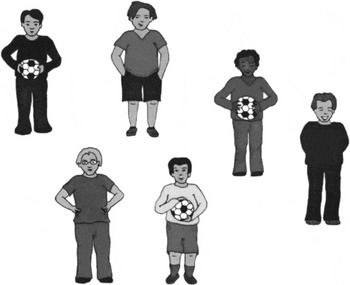
Could a similar kind of triggering occur at an abstract semantic level? Suggestive evidence comes from comparing English and German wh-exhaustivity. Schulz (Reference Schulz2010) asked the question: When do children grasp that wh-words entail exhaustivity in contexts like that shown in Figure 1.
Who has a ball?

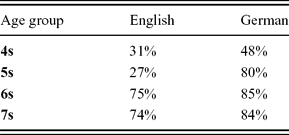
When presented with the picture in Figure 1 and asked Who has a ball?, adults reliably pick out three people, but children initially choose one, called a singleton reading. The subjects were 115 German and English children in four age groups from 4;0–7;11. A curious difference emerged, as shown in Table 2.
wh and exhaustivity: percentage of children grasping that wh-words entail exhaustivity by age group.

Table 2 shows that English speaking four-year-olds produced singleton readings in 79% of the cases and German speaking four-year-olds produced singleton readings in 52% of their responses. As children got older the exhaustivity radically increased, but a sharp difference between the two languages remains until the age of 6 years.
Why should there be a difference? The first question to ask is: Are there any language differences? In fact, German, unlike Standard English, allows a prosodically unified added marker wer-alles “who all”. The same form is found in dialects of English and in the morphology of Asian languages. They argued that this second feature alles independently marked many wh-questions and the children considered the all to be in effect in agreement with the wh-word, triggering its exhaustive feature at an earlier point. It is a case of instructive overlap among grammars.
These facts show an interesting kind of triggering relation whose character requires more careful understanding of how the acquisition of features functions in the larger syntax. One could imagine the opposite: because all marks exhaustivity, then the wh-word does not need to. Therefore, if a language has both, it is more difficult to acquire the hidden exhuastivity feature on wh- because the semantic need is already satisfied by all(es). However, given the required presence of exhaustivity when alles is present, it seems that the child, having experienced a required exhaustivity, then experiences situations whose pragmatics naturally allows for exhaustive readings, and the child then imposes that property on wh-. In other words, the realization of exhaustivity on wh- must follow from a broad acquisition principle which invites the child to see Agreement, or perhaps better called Concord, between alles and wh-, applying the principle:
(35) Seek Concord wherever possible.
This in turn makes the frequently observed phenomenon of “overgeneralization” a reflection of a principle and not a kind of performance mistake. The child says feetses because it ought to be possible to mark plural twice when its presence is seen at two morphological levels. This suggestion requires further refinement before the microscopic, but crucial, basis for such acquisition steps is understood.
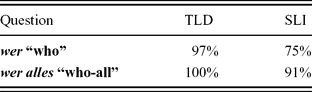
The facilitative effect can be seen, quite sharply, when twenty five-year-old children with TLD were compared with twenty children with SLI (Schulz, Reference Schulz2010), as shown in Table 3.
Exhaustivity and SLI: percentage of correct exhaustive response to the two types of questions by language proficiency group.

Table 3 shows that both groups of children clearly made use of alles in imposing exhaustivity, which leads us to expect that at a younger age the difference would be even sharper. In fact only four children with TLD made errors with wer “who”.
This leads to a prediction about German–English bilingual children: they should be less likely to exhibit extended use of singleton readings than monolingual English speakers because they have an extra clue which, if they seek Agreement, will help them. Thus we have argued that a child with SLI may both fail to realize Agreement in all appropriate domains and use it where it gives extra information.
There are broader applied implications here. The presence of variable readings for wh-questions should be a part of nursery school “curriculum” and something carefully clarified in second-language instruction. If we can introduce questions like Who is sitting where? into the natural life of children in the same way that nursery rhymes with built-in recursion are a natural part of family life, then we can inoculate against this form of language impairment, and it may arise far less often.
7. A typology of Multiple Grammars (“Transfer”) effects
Positive arguments for the benefits of bilingualism for the SLI child are not the end of the story. While a great deal of policy discussion seeks to formulate alternatives in a spare and simple fashion, the reality may be far more complex and, as in medicine, the applied world benefits when analysis is subtle and detailed. We need to look more broadly at the question of where “Transfer” effects arise. In our system we describe these phenomena as domains where Multiple Grammars apply with possibly diverse effects.
In a careful and instructive naturalistic study of the bilingualism of their children, Yip and Matthews (Reference Yip and Matthews2007) have shown one domain where there appear to be negative Transfer effects of bilingualism: object drop (which we discussed above).
7.1 Object drop in Chinese–English bilinguals
Even linguistic experts, fully conscious of object-drop constraints, are nonetheless unable to control the application of object drop. At a conference recently, where object clitics were under discussion, a linguist said: we designed an experiment, but we have not carried out. An English speaker immediately notices the error: it should be carried it out. Although the meaning is totally clear without the pronoun, English grammar requires it while Romance does not (nor does it have particles). Thus, these errors are found among adults and very commonly among children. Yip and Matthews (Reference Yip and Matthews2007) report 45% Null objects in Verb-particle cases for their children in naturalistic contexts, such as:
(36) I know you bought
I want take off (Alicia 2;05)
This is quite plainly a case of compatible Multiple Grammars. Therefore it occurs easily.
We could explore this question with a simple experiment where the absence of object drop in English delivers only one meaning (a variant of the Perez et al. Reference Perez, Pirvulescu and Roberge2008 experiment above):
(37) John went outside and got himself and his toys dirty. He came inside and washed up.
What did he wash up?
If the child answers toys, then object drop is present. If he answers himself then the correct English intransitive meaning has emerged. As in the learnability discussion above, adding (not subtracting) a restriction (just himself, not the toys) is difficult to teach with sharp examples.
7.2 Wh-constructions: differential Transfer
French allows both in situ wh- and moved wh- with possibly different presuppositions:
- (38)
a. il va ou [he goes where]
b. ou va-t-il [where goes he]
Chinese has in situ wh-expressions like (39a) and English has fronted wh-expressions. If the bilingual child put them together, they should generate French. Yip and Matthews (Reference Yip and Matthews2007) show that in situ wh- is generated in a bilingual English–Chinese child, even in non-echo questions, and fronted wh- is not generated.
(39) Daddy are you having what (Alicia 3;09)
Now an extremely intriguing theoretical question arises: Why is there no Transfer of wh-fronting? There would be a good reason to expect it if LF (Logical Form) Transfer must occur in any case.
We have no answer at present, but one can look to the suggestions of Rizzi (Reference Rizzi and Haegeman1997) on a highly differentiated Left-periphery. It carries a CP-landing site in English where the wh-feature has been checked off. If Chinese does not expand the CP-domain in the overt syntax, then the prerequisite for a projection of English onto Chinese has not been met. Why would this happen? In brief, some grammars appear to collapse Subject, Topic and Question positions while others differentiate them. Acquisition evidence (de Villiers & Roeper, Reference Roeper2011; Spinner & Grinstead, Reference Spinner, Grinstead, Toribio and Sagarra2006) suggests precisely that the process of splitting these categories apart can be a challenge for children, and therefore it is not a natural point where one grammar could invade another.
The strongest hypothesis about this phenomenon is: children will not project an entire node from one grammar to another (see Green & Roeper, Reference Green, Roeper, Pica and Craenenburg2008, on stable nodes and unstable features). Thus MG “Transfer” may have constraints of its own: introduction of a new discourse-sensitive node from one grammar (English) into a grammar whose discourse functions are handled differently may be ruled out. These questions cry out for detailed experimental research linked to detailed theoretical hypotheses.
8. Conclusion
We have surveyed several MG effects where exposure to one grammar can have an impact on a second grammar:
1. We provided three examples where the MG effect was positive: case, prepositions and exhaustivity.
2. We provided an example where it is negative: object drop in Asian languages.
3. We showed there may be no Transfer: wh-fronting in Chinese–English bilingualism.
This cursory overview of possible cross-linguistic effects that are relevant to SLI may be just the first of many that are eventually discovered as the properties of linguistic theory are applied to rather microscopic domains where SLI is exhibited.
We have defended a thesis: bilingualism can be beneficial to the SLI child. Utilizing both concepts from the Minimalist Program and useful ideas from earlier theories, we have argued that:
(a) all people utilize Multiple Grammars, and
(b) a more explicit grammar in one language can provide triggering data for a child's acquisition of structures in another language.
We argued that there is no broad-based effect of bilingualism. Instead one must look at the detailed relation between languages to determine if the impact of one language upon another involves compatible overlap, instructive overlap or interfering (negative) overlap. We have looked at SLI and bilingualism from every angle that theory offered. The strength of the data, as in most health domains, is quite diverse, leaving room as always, for the judgement of the SLP.
One of our goals is to wean ourselves away from a disproportionate emphasis upon inflectional errors as the hallmark of disorders. While a child's problems often come in clusters, we have suggested that, just like articulation and syntax are different, modules within syntax might be selectively impaired. Such differences will play an important role when we seek to make real neurological connections. Our examples focused upon case modules, recursion, particles and quantification. Evidence is often slim, but suggestive nonetheless, and we hope comprises a real incentive for further research. We touched upon a variety of traditional concepts in the empirical discussions around bilingual research: Transfer, Dominance and Optionality. We utilized primarily the Minimalist Program together with older theories where they are more explicit. Our approach, we believe, begins to decompose these concepts into their theoretical and empirical dimensions, inviting more refined research.