Introduction
The term ‘biopolitics’, coined by Rudolf Kjellén, has been developed into an important constituent of a modern philosophy of politics with the focal concept of ‘biopower’ established by Michel Foucault. According to Foucault, from the nineteenth century on, the invention of new mechanisms, technologies, and techniques formed the ‘microphysics’ and ‘macrophysics’ of power, exercised over ‘persons specifically insofar as they are thought of as living beings: a politics concerned with subjects as members of a population’ (Gordon Reference Gordon, Burchell, Gordon and Miller1991, 4–5). One pole of the ‘micro’ refers to the disciplinary power centred on the body, namely ‘the micro-politics of the body’; the ‘macro’ pole is concerned with biopolitics relating to human beings insofar as they form a ‘global mass that is affected by overall processes characteristic of birth, death, production, illness, and so on’, namely ‘biopolitics of the human race’ (Foucault Reference Foucault and Macey2003, 242–243). Foucault’s ‘biopower’ refers to disciplinary power over the body, while ‘biopolitics’ situates biopower in the scheme of a ‘whole series of related economic and political problems’ (Foucault Reference Foucault and Macey2003, 243), aiming to ‘optimize a state of life’ (Foucault Reference Foucault and Macey2003, 246). Accordingly, urban management and disease control are part of ‘biopolitics’.
The co-presence of biopower and sovereign power has never been as crystalized and intensified as in the current pandemic. The lack of vaccination cripples the power of technology, yet has been compensated for by the power of sovereignty, which has paradoxically reversed from ‘take life’ to ‘make live’. The metropolis of Beijing, though it did not lock down as tightly as other Chinese cities, still plunged into a state of ‘war’. From the Spring Festival holiday (from late January to early February) until May, all students and employees of public enterprises and institutions were requested to stay home. The whole city, under the domination of sovereignty, turned into the field of a large project of biopolitics.
An Overview of the Results of Beijing’s Handling of the Coronavirus Compared with that of SARS
The current pandemic of Covid-19 is caused by SARS-CoV-2 infection, which belongs to the strain of the severe acute respiratory syndrome (SARS). In 2003, the concurrence of the spread of SARS and the sessions of the National People’s Congress (NPC) and the Chinese People’s Political Consultative Conference (CPPCC) in March led to a news blackout about the contagion of SARS. Evidence shows that lower-level government officials ‘intercepted and distorted the upward information flow’ so that the top-level government’s capability to ‘formulate a sound policy against SARS’ was undermined (Huang Reference Huang2004, 122). On 18 March, an outbreak of nosocomial infection occurred in Dongzhimen hospital, with 55 persons infected. Neither the outbreak in Dongzhimen hospital nor knowledge about SARS was released to the public, not even to the medical personnel. On 5 April, another larger nosocomial transmission occurred in Renmin hospital, where the total number of infected medical personnel ran to 93, and medical resources ran out (Huang Reference Huang2003).
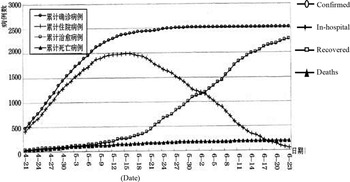
The serious situation is displayed in Figure 1 (Han et al. Reference Han, Wang and Liu2004, 927).
The trend lines of SARS in Beijing: numbers of the cumulative confirmed cases, in-hospital cases, recovered cases and deaths.

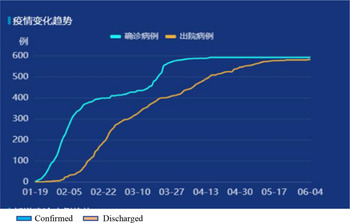
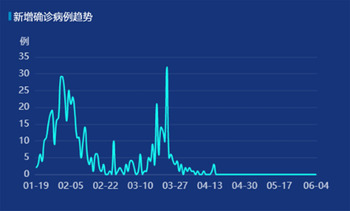
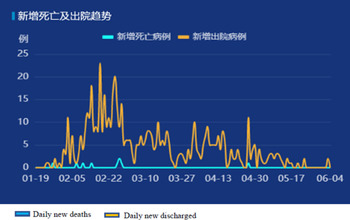
For comparison, the trajectory of the Covid-19 trends identified in the data of the confirmed, discharged, death and daily new cases in Beijing from 19 January to 4 June is shown in Figures 2, 3 and 4 (Beijing Municipal Health Commission 2020a).
The trends of the confirmed and discharged cases. (The upper line shows the number of cumulative confirmed cases; the line below shows the number of cumulative discharged cases. To view this figure in colour please see the online version of this journal.)

Daily new cases. (To view this figure in colour please see the online version of this journal.)

Daily new deaths and daily new discharged cases. (The upper line shows the number of daily new discharged cases; the line below shows the number of daily new deaths. To view this figure in colour please see the online version of this journal.)

The comparison between SARS and Covid-19 suggests an advance in the capability of tackling epidemics. The statistics in Figure 1 started only from 21 April, 44 days after the first case of SARS identified in Beijing. Moreover, the data of in-hospital cases in Figure 1, combining suspected and confirmed cases, in the Covid-19 charts is replaced by statistics of daily new cases, an indicator pointing to the capability of distinguishing suspected cases from confirmed ones. The data of the confirmed SARS cases quintupled from 21 April to 23 June, and the recovered cases didn’t rise until mid-May, whereas the confirmed Covid-19 cases halted at 600 in mid-April, and the discharged cases started to rise at the beginning of February. The first confirmed case of Covid-19 in Beijing was identified on 20 January, 48 days earlier than that of SARS. The total death toll due to Covid-19 is nine (Beijing Municipal Health Commission 2020b) compared with 192 due to SARS (Information Branch, Group of SARS Prevention and Control in Beijing 2003, 1096), and zero nosocomial infection of Covid-19 compared with 1/3 infections of the medical staff of SARS. The SARS crisis has generally been attributed to China’s poor public health infrastructure at the time, its ineffective, fragmented bureaucratic system, which is regarded as the main cause of the concealment of information, and the lack of cooperation between the functional and healthcare departments. The progress reflected in the Covid-19 diagrams suggests that the healthcare system infrastructure has been fortified, and that cooperation between the government and the professional departments has improved. The heavy losses due to SARS show that priority should be given to the guarantee of information transparency, which is the prerequisite for the project and practices of biopolitics.
Strategies to Guarantee the Transparency of Information
At the end of January 2020, the sweeping condemnation on social media awakened the government from the inertia of covering up and denying the spread of disease in Wuhan. Thus, in a drastic strategic U-turn the State Council announced that local governments at all levels should not conceal or delay any clues regarding the contagion from the upper-level governments. On 24 January, Beijing activated a level one response to the public health emergency. On the same day, the Information Office of Beijing Municipality held the first press conference, and since then information has been updated in daily press conferences. Information about the number and location of infected cases is accessible to all people, via mobile phones, in order to dispel rumour and fear. The attempt, as officially reported, is to ‘anchor’ down the vessel of public opinion during the pandemic (chinanews.com 2020).
Next to the immediate notification of the current situation to the public, a lesson drawn from SARS is that an unimpeded bottom-up flow of information is a prior condition for the central government to make the right decisions. To guarantee this, the branch of the supervision offices, belonging to the Commission of Discipline Inspection, an agency of the Chinese Communist Party (CCP), independent of the government, collected first-hand information on-site by closely supervising and assisting the work of the basic-level government. On the one hand, the supervision offices of the 16 districts dispatched three or four special groups per day to check the disinfecting work going on in the supermarkets and the communities at large, and to monitor the infected cases in hospitals. On the other, the supervision offices at the district level dispatched their own inspectors to attend to the checking work. This combination not only ensured that the situation of the infection was fully known. It also maintained discipline in basic-level government. Moreover, the supervision office ‘assigned the duty to a particular administrative department, to a particular man in charge’ (The People’s Government of Beijing Municipality 2020a), thus ensuring that what happened at the basic government level stayed ‘transparent’ to the disciplinary department.
The Allocation of Medical Resources in the Hierarchical Healthcare System
On 26 January, on the official website, 20 Beijing hospitals were set aside for the special treatment of coronavirus. Of these, three were at the municipal level, and the other 17 at the district level (Beijing Municipal Health Commission 2020c). On 22 February, 76 ‘fever clinics’ were assigned the function of ‘detector’ or ‘warner’ for patients to be scaled up for full corona treatment. The community health centres, running 24 hours, 7 days a week, administered the basic medical service for the preliminary selection of suspected cases. The role of the health centres can be likened to that of the ‘goalkeeper’ in a football game. They were to guarantee zero infection to the staff as well as no missing of a single suspected case (thePaper.cn 2020). During the pandemic, these three categories of hierarchical healthcare systems shouldered the responsibility for saving people’s lives. In addition, Xiaotangshan hospital served as back-up. Re-opened on 16 March, this famous makeshift hospital had played a decisive role in the SARS crisis by alleviating the exhausted medical resources with an extra capacity of 1000 beds. In the Covid-19 pandemic, Xiaotangshan was also assigned the duty of checking the massive influx of travellers from abroad (Sun X Reference Sun2020). In a nutshell, to optimize the medical resources, Beijing Municipal Health Commission, by assembling, hierarchically categorizing, and allocating specific roles to the various public hospitals, technically separated the suspected, probable and confirmed cases from one another, thus solving the problem of exhaustion in medical resources and the nosocomial transmission as in the SARS crisis.
Another complementary but significant measure in handling the coronavirus is tracking the paths of the infection. This task is shouldered by the Centre for Diseases Prevention and Control (CDC), affiliated with which is an investigation team that, in addition to its regular staff of 500, has been strengthened by the recruitment of an additional 3000 people. By interviewing the infected individuals, the investigators collect information about their movements and contacts to trace the paths of the infection (thePaper.cn 2020).
Compared with the chaos and the massive nosocomial infection in the local hospitals during the SARS outbreak, the response of the healthcare system to the Covid-19 outbreak has been orderly and organized, and thus able to bring into full play its entire capacity. The seemingly immediate strategy of the pragmatic allocation of available medical resources is partly the result of the implementation of the healthcare system reforms proposed in 2015. Aimed to solve the imbalance in the allocation of resources and the high patient flows in big hospitals, the strategies have proved their viability in the Covid-19 pandemic.
Social Control and Urban Management
Short of vaccination, the only passive yet effective method to contain the coronavirus is ‘quarantine’, a heritage from medieval Europe. The means of quarantine entails an urban management project including measures such as spatial partitioning, surveillance of the citizens’ body temperature, and restrictions on movement. The current situation coincides with Foucault’s illustration of the biopolitics exercises in the seventeenth century: ‘Plague is the moment when spatial partitioning and subdivision of a population is taken to its extreme point, where dangerous communications, disorderly communities, and forbidden contacts can no longer appear’ (Foucault Reference Foucault and Graham2004, 47). Foucault grounded the biopolitical principles through the bodily discourses, and exemplified the early operation of biopower in urban management. To contain the virus in the metropolis of Beijing, spatial sectioning is still vital in the current biopolitical project.
In February, the vast layout of the city, with its passages and intersecting lanes, was divided into compounds. Enclosed with metal walls overnight, these compounds were the substantialized basic units of social management, named ‘the grids’. At the entrance to a compound, inspectors, all in face masks, check every pedestrian’s temporary pass and body temperature with forehead thermometers. The checking procedure is more complex for a visitor who, lacking the temporary pass exclusive to the inhabitants of the compound, should first show his or her ‘health code’, and then fill out some forms listing name, address, time of entrance, body temperature, and so on. The health code is a new application (app) developed by the company of Alibaba and introduced nationwide on 16 February 16. On the Alipay health code app, a visitor should also enter her or his name, address, travel history, ID number, and submit to facial scanning for identification; the app then will assign a code, the colour of which decides if s/he can be granted admittance: green means pass, yellow warning for distancing, red is danger alert. With all the procedures gone through, a visitor will be allowed one entrance.
This system of urban management extends to all 16 municipal districts, comprising over 21 million citizens. The official slogan of the urban management system is ‘inch-by-inch supervision’, leaving ‘no blind spot’ (Sun LQ Reference Sun2020), requiring intense labour and a strong sense of responsibility of the inspectors. Once a case of high fever is identified, the inspectors should immediately report to the grid management centre; the management centre will demand the inspectors send the patient to the health centre of the community (The People’s Government of Beijing Municipality 2020b). Up to 19 May, the grid work had involved about 161,000 members and 100,000 volunteers, most of whom were recruits, under the leadership of 99,000 Party cadres. The grids are also safeguarded by an extra 14,000 police officers (Wang et al. Reference Wang, Zhao, Duan, Wang, Bai and Xu2020).
Initiated in Beijing in 2004, the partitioned ‘grid’, the domain in which things, matters, public affairs are localized, was set as the basic unit of social control and management. The system was extended nationwide over the next 16 years as ‘a digitalized innovation, playing a vital strategic role in realizing the meticulous, organized, systematic urban management’ (Pang Reference Pang2014, 1). The digitalized grid management is underpinned with the technologies of remote sensing (RS), geographic information system (GIS), global positioning system (GPS), etc. The structure of grid management is vertically organized according to the hierarchical triad order, the street, district, and municipality, and is supported by functional departments such as a city management bureau, a police station, an environmental sanitation office, etc.
Foucault’s description of how seventeenth-century ‘quarantine’ operated illustrates the primitive stage of the exercise of biopower, and how it openly intruded into acquiescent citizens’ private daily lives by means of regulation. The current exercise of social control and urban management in Beijing implements biopower in a fashion reminiscent of the seventeenth century, but with more precise regulation of body movements and closer surveillance over daily life. The technological, digital control of the ‘grids’ is ‘under the leadership of 99,000 Party cadres’, representing the dominance of the CCP over the society. For this purpose, the technologies of biopower are instrumentalized, in practice buttressing the whole project of biopolitical practice.
‘Governmentality’ under the Sovereign Power
Foucault’s conceptualization of ‘governmentality’ as political rationality runs parallel to the ‘micro-politics’ practised on the bodies of individuals. In Gordon’s view, Foucault’s ‘governmentality’ ‘could also be addressed to the techniques and practices for governing populations of subjects at the level of a political sovereignty over an entire society’ (Gordon Reference Gordon, Burchell, Gordon and Miller1991, 4). The exercise of ‘biopower’, in Foucault’s genealogical study, started in the nineteenth century, when the powers of technologies and techniques were coded in the state control over the human body, daily life and society, as operated by the liberal governments established across Europe in the nineteenth century, the historical and political context of Foucault’s ‘governmentality’. Twentieth-century ‘neoliberalism’, a resurgence of ‘liberalism’, with shared basic ideas of ‘laissez-faire’ and free-market capitalism, under globalization has mutated into varied forms.
The sovereign state of China, integrated into the world economy after China joined the WTO in 2001, shows quite a few features of neoliberalism. Due to ‘the infiltration of market-driven truth and calculation into the domain of politics’, the relationship between knowledge and power has been reconfigured, ‘through which governing activities are recast as nonpolitical, nonideological problems that need technical solutions’ (Ong Reference Ong2006, 3–4). The aspiration to boost the economy since the 1990s has resulted in policy support for a market economy, whereupon neoliberal rationality has complemented what is lacking in a socialist economic system. Hence, there emerged a new dimension to Chinese sovereignty, labelled ‘neoliberalism as exception’. The powers of techniques and technologies addressed to ‘governmentality’ could be ‘decontextualized from their original sources and recontextualized in constellations of mutually constitutive and contingent relationships’ (Ong Reference Ong2006, 13). Therefore, in accordance with Gordon, ‘governmentality’ could be contextualized into the sovereign politics of China and, in the current situation, be explored on the level of the mechanism of political performance.
Social control plays a vital role in the biopolitical practices implemented in Beijing during the pandemic, with coercive measures imposed by an authoritarian government. Generally, Foucault’s ‘governmentality’ in exercising biopower replaces the right of absolute sovereignty to ‘take life or let live’ with a new right to ‘foster life or disallow it to the point of death’ (Foucault Reference Foucault and Hurley1978, 138), namely, to ‘make live and let die’. Locally, the ‘governmentality’ in current Beijing, exemplified in the design of urban management, the organization and allocation of the medical resources, the meticulous, technological social control, and the technical manipulation of public opinion on social media, has proved its affiliation with the sovereign power, thus helping to consolidate the sovereignty with modern instruments. The tight social control called for by the epidemiological nature of Covid-19 can be implemented most effectively by an authoritarian government. However, to find an exceptional ‘governmentality’ that not only achieves short-term effects, but also mitigates the detriment caused by high-handed, sweeping measures, requires further adjustment between the powers of the ‘contingent relationships’ in a sovereign state.
The ‘General Will’ Underpinning the Narrative of ‘China’s Experience’
The headline in the Wall Street Journal (WSJ), on 3 February 2020 that ‘China is the Real Sick Man of Asia’ (Mead Reference Mead2020), by resurrecting a fossilized epithet, stirred up a hornet’s nest. ‘The sick man of Asia’ is a conveniently eye-catching term for WSJ, but for Chinese people it is a metaphor embodying the nation’s ‘Century of Humiliation’ at the end of the nineteenth century, and has been referred to as a collective, psychological trauma in modern Chinese narrative. The spokesman of the Chinese Ministry of Foreign Affairs, Geng Shuang, harshly accused the WSJ of publishing ‘racist statements, and smear[ing] China with malicious attacks’ (Tracy Reference Tracy2020). Such a severe reaction brought nationwide attention to online blocked media in mainland China, setting off a wave of nationalist sentiment on social media. The diplomatic crisis caused by the WSJ turned into discursive politics: the Chinese people showed their capacity to be mobilized by nationalist remarks, and of manifesting their nationalism.
By metaphorizing China as a community, the symbol of ‘the sick man’ was invented in the late Qing dynasty, after the Chinese Empire’s humiliating defeat in the Sino-Japanese War of 1894–1895. Pioneer thinkers and writers, such as Yan Fu (1854–1921), Liang Qichao (1873–1929) and Lu Xun (1881–1936), referring to the opium-enfeebled, benighted Chinese and the decrepit traditional culture as ‘sick’, instead envisioned a collective image of a robust new China, with a regenerated culture of spiritual health and vitality (Wang Reference Wang1997, 57–59). The self-imposed stigma of the ‘sick man of Asia’, is a constituent of the ‘national allegory’ characterizing all ‘third-world texts’ according to Fredric Jameson. By projecting a political dimension upon modern texts, ‘the story of the private individual destiny is always an allegory of the embattled situation of the third-world culture and society’ (Jameson Reference Jameson1986, 69). Accordingly, nationalism, originally a cultural construct, allegorically relates every individual’s destiny to the state of China, and consequently validates self-sacrifice for the goal of making China a robust nation state, whose status would reciprocally honour and dignify every individual Chinese. The apparently passive public obedience to the tight social control imposed during the Covid-19 outbreak thus, in fact, demonstrates a subjectivity, an active posture reflecting the ‘general will’ (Encyclopaedia Britannica 2020).
Grounded on the historical experience to win national independence led by the agent of Marxism, the CCP, Marxism in the ‘national form’ has gained the broad consent of the vast population of the peasantry and the urban intellectuals alike, both ideologically and hegemonically (Liu Reference Liu2000, xiv). Therefore, the national sovereignty which can only be legitimized with ‘general will’, is achieved through the general acceptance of this culturally modified Marxism.
Mao Zedong’s ‘Three Worlds’ theory, and the path he carved out to national independence, initiated the narrative of ‘China’s exceptionalism’. The discourses of the ‘China model’, ‘China’s experience’, or ‘China’s path’, derivatives of ‘China’s exceptionalism’, are but the manifestation of national subjectivity, and the expressions of Chinese nationalism, which has been instrumentalized in both realpolitik and cultural politics. The biopolitical practices in Beijing, narrated as another ‘China’s experience’, have been propagated as the showcase of the advantages of ‘China’s path’. The immanent East–West dichotomy in the concept of nationalism in these discourses manifests the competitiveness between China and the West, entailing the danger of aggressive posturing in international affairs. Locally, the propaganda of the advantages of ‘China’s path’ keeps up the political pressure on the government to vigorously tackle the pandemic, for the spread of the coronavirus is metaphorized as losing the advantage of ‘China’s path’.
The New Biopower in Handling the Outbreak at Xinfadi Market
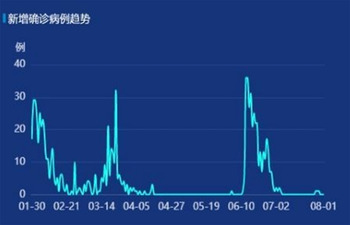
A new Covid-19 case appeared in Beijing on 10 June, breaking the 56 straight days of zero new cases between 15 April and 9 June (Figure 5). Sixteen hours later, Xinfadi market was pinpointed as the source of infection, leading to a strict epidemiological survey to trace the transmission pathways (Li QY Reference Li2020). Xinfadi market is the city’s supply hub of agricultural produce, providing 80% of its raw food materials, and the high number of 60,000 visits per day might have spread the coronavirus to any corner unknown (Yao Reference Yao2020). The strategies implemented earlier were upgraded for this outbreak to comprise targeted control of specific individuals over specific areas differentiated into risk levels (Zhu et al. Reference Zhu, He and Wang2020). The key to the targeted control lies in the capability to identify the targets. By 17 June, 300,000 people had been singled out for nucleic acid testing – hence the apex of 36 new confirmed cases on 13 June marking the record single-day increase (Figure 5). These 300,000 people had circulated in the neighbourhood of the market since 30 May and were traced by big data screening via mobile phone tracking, with data acquired mainly from the location-based services (LBS), and partly by GPS navigation services. In addition, the trajectories of the 2430 outflows – the potential coronavirus carriers from Xinfadi market to other provinces – were localized in the same way (Kepukitchen 2020). With the targets identified, the related areas were managed in line with the risks, and coordinated with differentiated social controls. Holistically, the most powerful tool to ensure environmental security is massive-scale nucleic acid testing, which covered 11 million citizens from 11 June to 7 July (Li YK Reference Li2020).
Daily new cases (Beijing Municipal Health Commission 2020a).

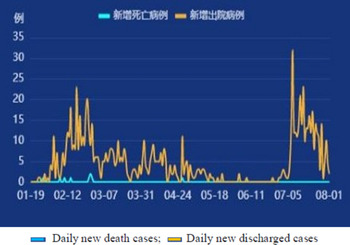
On 7 July, Beijing reported zero new cases for two straight days; the following day, the daily new discharged cases reached the apex of 32 (Figure 6). The total number of infected cases was 335 (until 2 August), 259 less than that of the first outbreak; except for the people in the 45 grids with confirmed cases, the citizens living in the low-risk areas have been less influenced (Li YK Reference Li2020). Compared with the biopolitical practices before, the biopower manifested in the recent outbreak is the technological combination of big data screening and nucleic acid testing. As the tool to guide all other measures in targeted control, big data has shown its great potential in curbing the spread of diseases.
Daily new death and daily new discharged cases (Beijing Municipal Health Commission 2020a). (The upper line shows the number of daily new discharged cases; the line below shows the number of daily new deaths. To view this figure in colour please see the online version of this journal.)

Conclusion
In the double crisis caused by the spread of Covid-19 and public opinion on social media, Beijing carried out a comprehensive plan of biopolitical practices. By optimizing biopower and sovereign power, the biopolitical campaign soon reached the goal of halting the coronavirus in three months. The public obedience to the strict social control, an expression of the ‘general will’, stems from the conception of nationalism which also underpins the discourses of ‘China Exceptionalism’. The handling of the recent outbreak, which started at Xinfadi market, provided an alternative biopolitical experience. Prioritizing the power of technology, all other measures were guided and organized in a system of targeted social control, thus mitigating the detriment caused by uniformly stringent social control. Nevertheless, the application of the new biopower is based on the unity of all the efforts, the cooperation and coordination between the departments of telecommunication, CDC investigation, nucleic acid testing and grid management. A new pattern of biopolitical practices in combining the new biopower with managerial governmentality over the vast population sheds new light on the thinking of ‘China’s path’.
About the Author
Ming Li is an Associate Professor at the University of International Business and Economics in Beijing, China. Her specializations are Comparative Literature and Cultural Studies. She obtained a PhD in Media Management at Shanghai Jiao Tong University, and currently teaches British literature and twentieth-century literary theory. Her publications are mainly on Literature and Cultural Studies.