





Nomenclature
- auto.f.p.
-
trajectory tracking performance of the flight controller
- AFCS
-
autonomous flight control system
- c-SPSA
-
constrained – simultaneous perturbation stochastic approximation
- ERU
-
Erciyes University
- g.f.p.
-
general flight performance
- ISTE
-
Iskenderun Technical University
- PID
-
proportional-integral-derivative
- NBC
-
nuclear, biological or chemical
- UAV
-
unmanned aerial vehicle
- TJP-UAV
-
turbojet-powered unmanned aerial vehicle
1.0 Introduction
Recently, unmanned aerial vehicles (UAVs) have proven beneficial for a wide range of tasks. Rapid research and development have transformed the intrinsic conceptual advantages of UAVs compared to manned aircraft into practical, real-world capabilities. Due to these numerous advantages, they have been implemented in both military and commercial assignments. Other advantages of UAVs compared to manned aircraft include their lightweight design, low energy consumption, reduced operational and manufacturing costs, lower environmental footprints and more adaptable configurations tailored to diverse user demands. These UAVs are also applied in many different tasks for civilian purposes, such as fire services and forestry, electricity companies, pollution and land monitoring, aerial photography, agri-drone services, power line inspection and fisheries protection. In addition, these UAVs are applied by naval forces, land forces and air forces with different purposes such as placement and monitoring of sonar buoys and possibly other forms of anti-submarine warfare for the navy, monitoring of nuclear, biological and chemical (NBC) contamination for army, and elimination of unexploded bombs for the air force [Reference Austin1]. It is also crucial to mention that the jet-powered UAV applied in this research paper is in the class of long-range tactical UAVs [Reference Bento2, Reference Gaurav, Babankumar and Lini3].
During implementation of the old-fashioned UAV design concept, autonomous flight control system (AFCS) staff does not deal with the design stage of the UAV. However, there is a well-known reality relevant to this condition that UAV design and AFCS design tasks are strongly relevant [Reference Grigoriadis and Skelton4, Reference Grigoriadis, Zhu and Skelton5, Reference Oktay and Sultan6]. Inconsiderable adjustments on the UAV design variables may enhance both the trajectory tracking performance of the flight controller and general flight performance substantially. Additionally, the classical design concept does not reveal the finest global solution. In a more qualified methodology, the UAV that will be autonomously guided and AFCS are essential to be designed in an integrated and multi-objective way. In this research article, this fact is taken into consideration. Following this, a turbojet-powered UAV (TJP-UAV) is produced both in Erciyes University and Iskenderun Technical University drone laboratories, and it is called as ERU-ISTE-TJP-UAV. In addition, its AFCS and its (fuel mass/total mass) ratio are stochastically revised in an integrated and multi-objective way in order to maximise its trajectory tracking performance of the flight controller and general flight performance via application of a certain stochastic optimisation tool.
Until today, limited research in the UAV literature has been applied for enhancing trajectory tracking performance of the flight controller and/or general flight performance of turbojet-powered high-speed UAVs in order to minimise some important performance criteria. For example, detailed modeling of each subsection of a high-speed, fixed-wing mini UAV was considered for aerodynamics and stability as well as flight control [Reference Irwanto7]. Controllers were designed for holding pitch angle during 155 km/h and 400 km/h in a Matlab/Simulink flight environment. Successful results were obtained for tracking of relevant reference trajectories. In Ref. (Reference Bilici and Karalı8) integrated flight/thrust vectoring control for TJP-UAV with ACHEON propulsion was considered to evaluate its appropriateness in jet aircraft flight implementations. The flight tests of this research proved that there is substantial enhancement in manoeuvre capability by using thrust vector control. In another research [Reference Cen, Smith, Stewart and Stewart9], automatic hardware and software systems designed for high-speed and autonomous UAVs guided by a specific flight model were investigated. The offered solution ‘FastPilot’ succeeded 40% enhancement in flight speed than classical ‘High Accuracy design’ approach, and 65% increase than ‘Low Latency design’ approach Refs. (Reference Xu, Yu, Zhang, Xiang, Jia and Wang10–Reference Muda13) may also be examined for different control system design application on turbojet powered/high speed UAVs. There are also more studies considering the control of turbojet engines for UAVs existing in the literature. For instance, in Ref. (Reference Tang, Wang, Gu and Gu14), turbojet engine control of a UAV by using artificial intelligence algorithm was investigated. It was obtained from this research that by using the Matlab simulation environment the artificial neural network PID controller performance is much more superior than application of the proportional-integral-derivative (PID) controllers in terms of fast response characteristics for speed, pressure, temperature and fuel flow in a normal state. Refs. (Reference Jie, Mo, He, Lee, Gabrys, Howlett and Jain15–Reference Itoh, Kawamura, Koshikizawa and Abe17) may also be examined for different applications of turbojet engine control of UAVs. Additionally, there are also turbojet-engine-powered UAV design/redesign studies in the relevant literature. As an example, in Ref. (Reference Zhuang, Li, Wang, Liu and Li18) optimisation of high-speed, fixed-wing UAVs’ penetration by using deep reinforcement learning was investigated. It was detected from this research that in a simulation environment, the policy model applied in this research succeeded a superior penetration effect in different adversarial conditions. In addition, under the same circumstances, this method had a more a more substantial penetration effect than that of penetration strategies based on other algorithms. In Refs (Reference Altug and Turkmen19–Reference Ozyetis and Alemdaroglu21), there are also more different turbojet-engine-powered UAV design/redesign researches. (See Refs (Reference Benini and Chiereghin22–Reference Konar, Hatipoglu and Akpinar28) for different flight controller tracking and general flight performance enhancement studies with different UAV systems.)
In this article, initial effect of (fuel mass/total mass) ratio on TJP-UAV’s flight dynamics and flight performance is considered. Following this consideration, structure of implemented AFCS is briefly expressed with a block diagram. Then, benefitted stochastic revision methodology for integrated and multi-objective performance (i.e. both of trajectory tracking performance of the flight controller and general flight performance) maximisation is presented. Lastly, the consequences of integrated and multi-objective revision procedures are given step by step.
-
• It is critical to note that this article is the leading article revising TJP-UAV’s AFCS and (fuel mass/total mass) ratio for enhancing both of trajectory tracking performance of the flight controller and general flight performance in an integrated and multi-objective way. This is the chief contribution and originality of this article.
-
• Additionally, developing a novel framework for this stochastic optimisation problem is one more substantial contribution of this article, and it satisfies reaching the optimal solutions safe and fast.
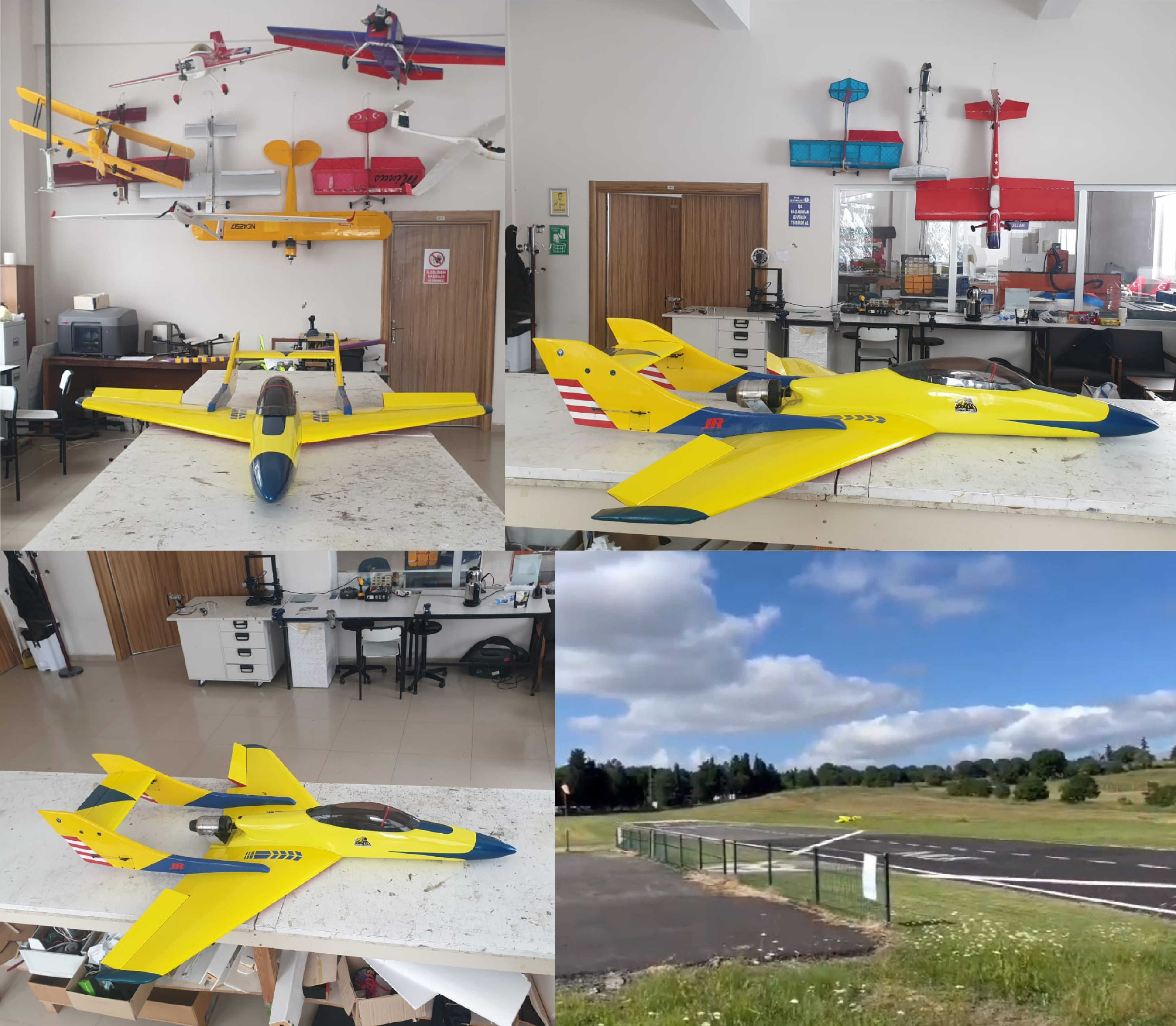
Photos of our TJP-UAV.

Figure 1. Long description
The collage consists of four photos. Panel A shows a workshop with various UAV models hanging on the wall and a yellow UAV on a workbench in the foreground. Panel B depicts the same workshop from a different angle, highlighting more UAV models and equipment. Panel C provides a close-up view of the yellow UAV on the workbench, showing detailed components. Panel D shows the yellow UAV in flight over a grassy field with a runway visible in the background.
2.0 Effect of (fuel mass/total mass) ratio on flight dynamics and flight performance
Here effect of (fuel mass/total mass) on UAV flight dynamics and flight performance is mentioned shortly. Figure 1 shows photos of our used TJP-UAV. Details of the manufactured TJP-UAV are given in the Appendix section.
For any fixed-wing UAV system, longitudinal and lateral state-space models are in the form shared in Equations (1a) and (1b), respectively (see Refs (Reference Nelson29, Reference Etkin and Reyd30) for derivations of these two equations):
 \begin{align}\left[ {\begin{array}{*{20}{c}}{\Delta \dot u}\\[5pt]{\Delta \dot w}\\[5pt]{\Delta \dot q}\\[5pt]\begin{array}{l}\Delta \dot \theta \\[5pt]\Delta \dot h\end{array}\end{array}} \right] & = \left[ {\begin{array}{c@{\quad}c@{\quad}c@{\quad}c@{\quad}c}{{X_u}} {}&{{X_w}} {}&0 {}&{ - g} {}&0\\[5pt]{{Z_u}} {}&{{Z_w}} {}&{{u_0}} {}&0 {}&0\\[5pt]{{M_u} + {M_{\dot w}}{Z_w}} {}&{{M_w} + {M_{\dot w}}{Z_w}} {}&{{M_q} + {M_{\dot w}}{u_0}} {}&0 {}&0\\[5pt]0 {}&0 {}&1 {}&0 {}&0\\[5pt]{ - \sin ({\theta _0})} {}&{\cos ({\theta _0})} {}&0 {}&{ - {u_0}\cos ({\theta _0})} {}&0\end{array}} \right]\left[ {\begin{array}{*{20}{c}}{\Delta u}\\[5pt]{\Delta w}\\[5pt]{\Delta q}\\[5pt]\begin{array}{l}\Delta \theta \\[5pt]\Delta h\end{array}\end{array}} \right] \nonumber\\[5pt] &\quad + \left[ {\begin{array}{c@{\quad}c}{{X_{{\delta _T}}}} {}&{{X_{{\delta _e}}}}\\[5pt]{{Z_{{\delta _T}}}} {}&{{Z_{{\delta _e}}}}\\[5pt]{{M_{{\delta _T}}} + {M_{\dot w}}{Z_{{\delta _T}}}} {}&{{M_{{\delta _e}}} + {M_{\dot w}}{Z_{{\delta _e}}}}\\[5pt]0 &0 \\[5pt]0 &0\end{array}} \right]\left[ \begin{array}{l}\Delta {\delta _T}\\[5pt]\Delta {\delta _e}\end{array} \right]\end{align}
 \begin{align}\left[ {\begin{array}{*{20}{c}}{\Delta \dot \beta }\\{\Delta \dot p}\\{\Delta \dot r}\\\begin{array}{l}\Delta \dot \phi \\\Delta \dot \psi \end{array}\end{array}} \right] & = \left[ {\begin{array}{c@{\quad}c@{\quad}c@{\quad}c@{\quad}c}{\dfrac{{{Y_\beta }}}{{{u_0}}}} {}&{\dfrac{{{Y_p}}}{{{u_0}}}} {}&{ - (1 - \dfrac{{{Y_r}}}{{{u_0}}})} {}&{ - \dfrac{g}{{{u_0}}}\cos ({\theta _0})} {}&0\\[10pt]{L_\beta ^* + \dfrac{{{I_{xz}}}}{{{I_{xx}}}}N_\beta ^*} {}&{L_p^* + \dfrac{{{I_{xz}}}}{{{I_{xx}}}}N_p^*} {}&{L_r^* + \dfrac{{{I_{xz}}}}{{{I_{xx}}}}N_r^*} {}&0 {}&0\\[10pt]{N_v^* + \dfrac{{{I_{xz}}}}{{{I_{zz}}}}L_v^*} {}&{N_p^* + \dfrac{{{I_{xz}}}}{{{I_{zz}}}}L_p^*} {}&{N_r^* + \dfrac{{{I_{xz}}}}{{{I_{zz}}}}L_r^*} {}&0 {}&0\\[6pt]0 {}&1 {}&0 {}&0 {}&0\\[2pt]0 {}&0 {}&{\sec ({\theta _0})} {}&0 {}&0\end{array}} \right]\left[ {\begin{array}{*{20}{c}}{\Delta \beta }\\{\Delta p}\\{\Delta r}\\\begin{array}{l}\Delta \phi \\\Delta \psi \end{array}\end{array}} \right] \nonumber\\&\quad + \left[ {\begin{array}{c@{\quad}c}0 {}&{\dfrac{{{Y_{{\delta _r}}}}}{{{u_0}}}}\\[10pt]{L_{{\delta _a}}^* + \dfrac{{{I_{xz}}}}{{{I_{xx}}}}N_{{\delta _a}}^*} {}&{L_{{\delta _r}}^* + \dfrac{{{I_{xz}}}}{{{I_x}}}N_{{\delta _r}}^*}\\[10pt]{N_{{\delta _a}}^* + \dfrac{{{I_{xz}}}}{{{I_{zz}}}}L_{{\delta _a}}^*} {}&{N_{{\delta _r}}^* + \dfrac{{{I_{xz}}}}{{{I_{zz}}}}L_{{\delta _r}}^*}\\[10pt]0 &0 \\0 &0\end{array}} \right]\left[ \begin{array}{l}\Delta {\delta _a}\\\Delta {\delta _r}\end{array} \right]\end{align}
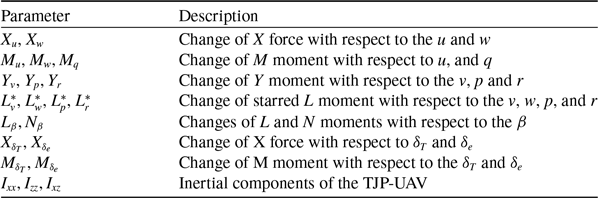
Above many stability derivatives and especially inertial terms are affected by total mass variation. Since fuel mass is a redesign parameter in this research, it is substantially effective on state-space models and also flight dynamics. In Table 1 a short nomenclature for some important stability derivatives are shared (see Refs (Reference Nelson29) and (Reference Etkin and Reyd30) for definitions of other remaining stability derivatives). Numerical values of these matrices are shared in the Appendix.
Nomenclature for some important flight dynamics and flight performance terms

Table 1. Long description
A table with two columns: Parameter and Description. The table has 11 rows, each listing a different flight dynamics or performance term and its description. Row 1: Parameter, X_u, X_w; Description, Change of X force with respect to the u and w. Row 2: Parameter, M_u, M_w, M_q; Description, Change of M moment with respect to u, w, and q. Row 3: Parameter, Y_v, Y_p, Y_r; Description, Change of Y moment with respect to the v, p, and r. Row 4: Parameter, L_u*, L_w*, L_p*, L_r*; Description, Change of starred L moment with respect to the v, w, p, and r. Row 5: Parameter, L_β, N_β; Description, Changes of L and N moments with respect to the β. Row 6: Parameter, X_δT, X_δe; Description, Change of X force with respect to δT and δe. Row 7: Parameter, M_δT, M_δe; Description, Change of M moment with respect to the δT and δe. Row 8: Parameter, I_x, I_yy, I_z; Description, Inertial components of the TJP-UAV.
Furthermore, variation of fuel mass and especially variation of (fuel mass/total mass) is also effective on flight performance. In this research article, maximum endurance, maximum range and ceiling altitude are the focus with regard to the flight performance. Its relations with respect to other important UAV system parameters are shared in Equations (2a) to (2c), respectively (see Refs (Reference Hale31–Reference Leishman33) for derivations of these relations):
 \begin{align}{E_{max}} = \frac{{{E_m}}}{c}In\left( {\frac{1}{{1 - \zeta }}} \right)\end{align}
 \begin{align}{X_{max}} = \frac{{0.866{E_m}{V_{br}}}}{c}In\left( {\frac{1}{{1 - \zeta }}} \right)\ \text{where}\ {V_{br}} = 0.68{\left[ {\frac{{2(W/S)}}{{{\rho _{SL}}\sigma }}} \right]^{1/2}}{\left( {\frac{{3k}}{{{c_{{d_0}}}}}} \right)^{1/4}}\end{align}
 \begin{align}{\sigma _c} = \frac{1}{{{E_m}{{\left( {{T_{max}}/W} \right)}_{SL}}}}\end{align}
3.0 Structure and block diagram of implemented AFCS
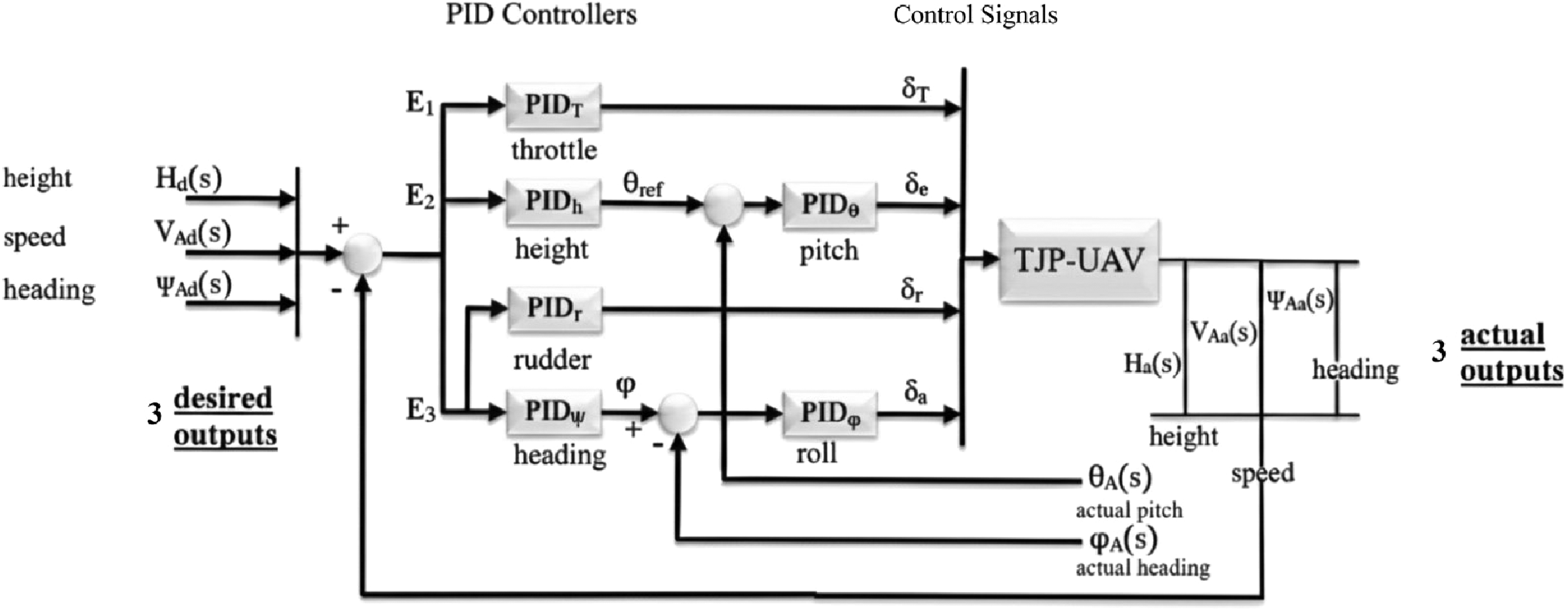
Here hierarchical AFCS is selected for autonomous flight control of our TJP-UAV. Its structure is demonstrated in the block diagram in Fig. 2. Overall it includes six PID controller blocks inside and it is useful for autonomous control of any UAV. It is explained briefly next: any hierarchical AFCS has three covers (i.e. outer cover, middle cover and inner cover) inside. Initially attitudes of TJP-UAV those of pitch and roll angles are stabilised applying the inner cover by using control signals those are elevator deflection angle for pitch and aileron deflection angle for yaw. Additionally, heading and altitude are stabilised in the middle cover. Consequently, tracking of the x- and y-positions of the TJP-UAV is succeeded in the outer cover. For details of hierarchical AFCSs there exist some useful research papers in the relevant literature such as Refs (Reference Oktay, Konar, Onay, Aydin and Abdallah Mohamed34–Reference Budiyono36).
Block diagram of hierarchical AFCS.

4.0 Implemented stochastic revision methodology for integrated and multi-objective performance maximisation
In order to implement stochastic revision methodology on our TJP-UAV for integrated and multi-objective performance (i.e. both of flight controller tracking and general flight) maximisation in this section, a cost index satisfying maximisation of both trajectory tracking performance of the flight controller and general flight performance (i.e. composing of maximum range, maximum endurance and ceiling altitude) is composed and it formulation is shared next:
 \begin{align}{J_{tot}} = {J_{auto.f.p}} + {\lambda _1}*{J_{g.f.p.}}\end{align}
where
 \begin{align}{J_{auto.f.p.}} = {J_{lon}} + {\lambda _2}*{J_{lat}}\ \ \text{and}\ \ {J_{g.f.p.}} = \frac{1}{{{E_{\max }}}} + {\lambda _3}\frac{1}{{{R_{\max }}}} + {\lambda _4}\frac{1}{{{h_{CA}}}}\end{align}
Above it can be seen that the total cost index includes components relevant to longitudinal and lateral trajectories, maximum endurance, maximum range and maximum ceiling altitude of the TJP-UAV, respectively. Since our problem is defined as a minimisation problem, it is required to put inverse of components of the general flight performance (i.e.
 $\frac{1}{{{E_{\max }}}}$
,
 $\frac{1}{{{R_{\max }}}}$
,
 $\frac{1}{{{h_{CA}}}}$
). The weighting coefficients (
 ${\lambda _1}$
,
 ${\lambda _2}$
,
 ${\lambda _3}$
,
 ${\lambda _4}$
) are used in order to put components of the relevant cost indexes equal in importance. It is also crucial to note that the longitudinal and lateral cost indexes (i.e.
 ${J_{lon}}$
and
 ${J_{lat}}$
) capture components (i.e. rise time, settling time and maximum overshoot) relevant to longitudinal and lateral trajectory tracking, respectively, and are obtained by summation of relevant rise time, settling time and maximum overshoot. There exist lower and upper limits on revision parameters of the TJP-UAV as Equations (5a) and (5b):
 \begin{align}\left\{ \begin{array}{l}{k_{{P_{lo{n_l}}}}},\\{k_{{I_{lo{n_l}}}}},\\{k_{{D_{lo{n_l}}}}},\\{k_{{P_{la{t_l}}}}},\\{k_{{I_{la{t_l}}}}},\\{k_{{D_{la{t_l}}}}},\\{m_{_{fue{l_l}}}}\end{array} \right\} \le \left\{ \begin{array}{l}{k_{{P_{lon}}}},\\{k_{{I_{lon}}}},\\{k_{{D_{lon}}}},\\{k_{{P_{lat}}}},\\{k_{{I_{lat}}}},\\{k_{{D_{lat}}}},\\{m_{_{fuel}}}\end{array} \right\} \le \left\{ \begin{array}{l}{k_{{P_{lo{n_u}}}}},\\{k_{{I_{lo{n_u}}}}},\\{k_{{D_{lo{n_u}}}}},\\{k_{{P_{la{t_u}}}}},\\{k_{{I_{lat}}_u}},\\{k_{{D_{la{t_u}}}}},\\{m_{_{fue{l_u}}}}\end{array} \right\}\end{align}
and
 \begin{align}\Psi = \left\{ {{k_{{P_{lon}}}},{k_{{I_{lon}}}},{k_{{D_{lon}}}},{k_{{P_{lat}}}},{k_{{I_{lat}}}},{k_{{D_{lat}}}},{m_{_{fuel}}}} \right\}\end{align}
where
 ${k_{{P_{lon}}}},{k_{{I_{lon}}}},{k_{{D_{lon}}}}$
are the proportional, integral and derivative gains of longitudinal PID controller, respectively, and
 ${k_{{P_{lat}}}},{k_{{I_{lat}}}},{k_{{D_{lat}}}}$
are the proportional, integral and derivative gains of the lateral PID controller, respectively. In addition,
 ${m_{_{fuel}}}$
is the mass of turbojet engine fuel. Table 2A shows the numerical values of weighting coefficients as well as the lower-upper limits. It is also important to mention that the commonly used values of these controller gains are
 ${k_p}$
=50,
 ${k_I}$
=5,
 ${k_D}$
=50 for both the longitudinal and lateral sections. The gains of the PID controller may alter
 $ \pm \% 90$
and fuel mass of the turbojet engine may alter
 $ \pm \% 50$
in the meantime of implementation of constrained stochastic revision.
There is a certain fact about our revision problem that reaching cost index derivatives with respect to the revision parameters is not feasible. Therefore, implementation of certain stochastic optimisation tools is a necessity. In order to contribute a solution to our previously described problem, constrained – simultaneous perturbation stochastic approximation (c-SPSA) is chosen here. It has several advantages with regard to the existing optimisation tools. Initially, it is substantially cheaper since it only needs two evaluations of the cost index during estimation of the gradient. In addition, it is appropriate for the solution of constrained and complex optimisation problems as seen in this research article. Until now numerical investigations demonstrated that c-SPSA is noticeably more efficient in reaching the global minimum with regard to the existing computationally costly tools such as genetic algorithms and simulated annealing [Reference Spall37–Reference Song, Spall and Soh41]
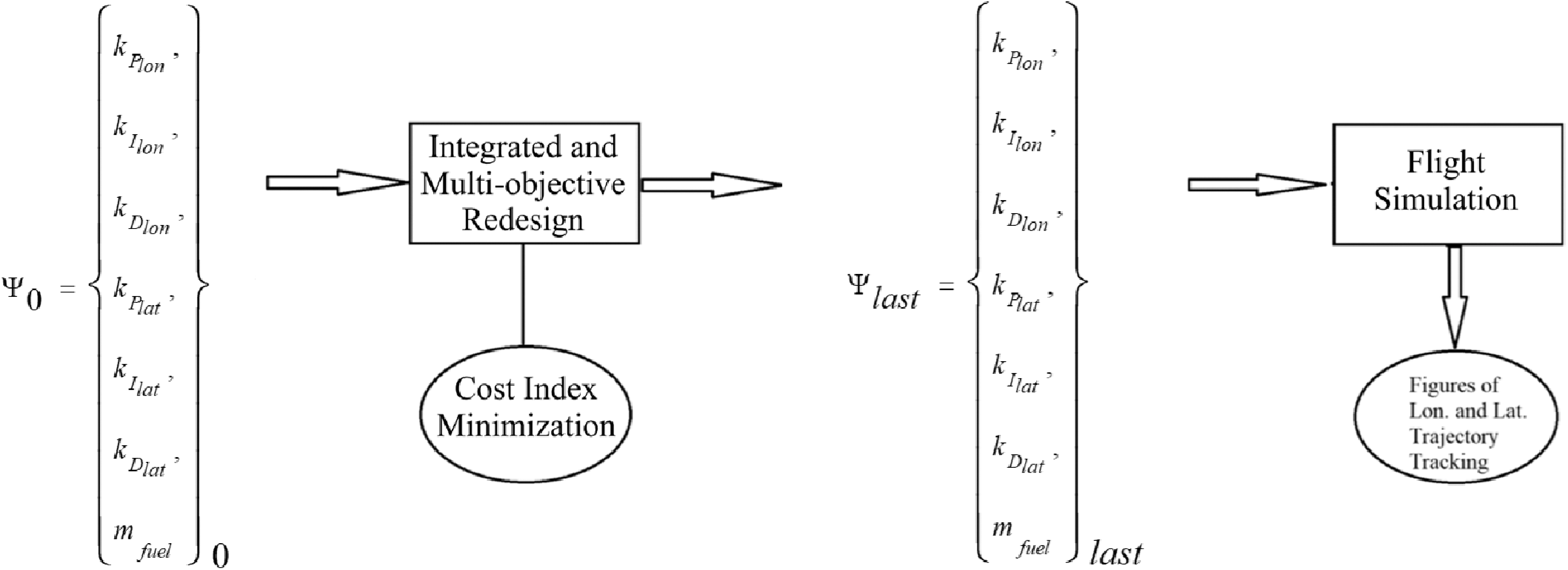
A short explanation of the c-SPSA is shared next: is the estimate of at k-th iteration and. In this optimisation tool is the estimate of the objective’s gradient at and it is computed by using:
 \begin{align}{g_{\left[ k \right]}}{\rm{\;}} = {\rm{\;}}\left[ {{{{\Gamma _ + } - {\Gamma _ - }} \over {2{d_k}{\Delta _{\left[ k \right]1}}}}{\rm{\;\;}}} \right.{\left. {{{{\Gamma _ + } - {\Gamma _ - }} \over {2{d_k}{\Delta _{\left[ k \right]p}}}}} \right]^{\rm{T}}}\end{align}
where is a vector of p mutually independent mean-zero random variables filling certain conditions [Reference Spall37–Reference Song, Spall and Soh41] and are the estimates of the objective computed at and, respectively, is the gain sequence and T is the matrix transpose symbol. In Fig. 4 implementation of stochastic revision concept on our complicated system is illustrated. It can be realised from this figure that during implementation of our integrated and multi-objective redesign concept the inputs are the initial values of gains for longitudinal and lateral PID controllers and fuel mass. There exists cost index minimisation approach in this formerly described redesign stage. The consequences of the stochastic optimisation tool implementation are applied for the autonomous flight simulation of our TJP-UAV and figures for simulation of longitudinal and lateral trajectory tracking are found (see Fig. 3 for illustration).
Illustration of implementation of stochastic revision concept.

Integrated and multi-objective redesign concept consequences after implementation of stochastic tool.

Figure 4. Long description
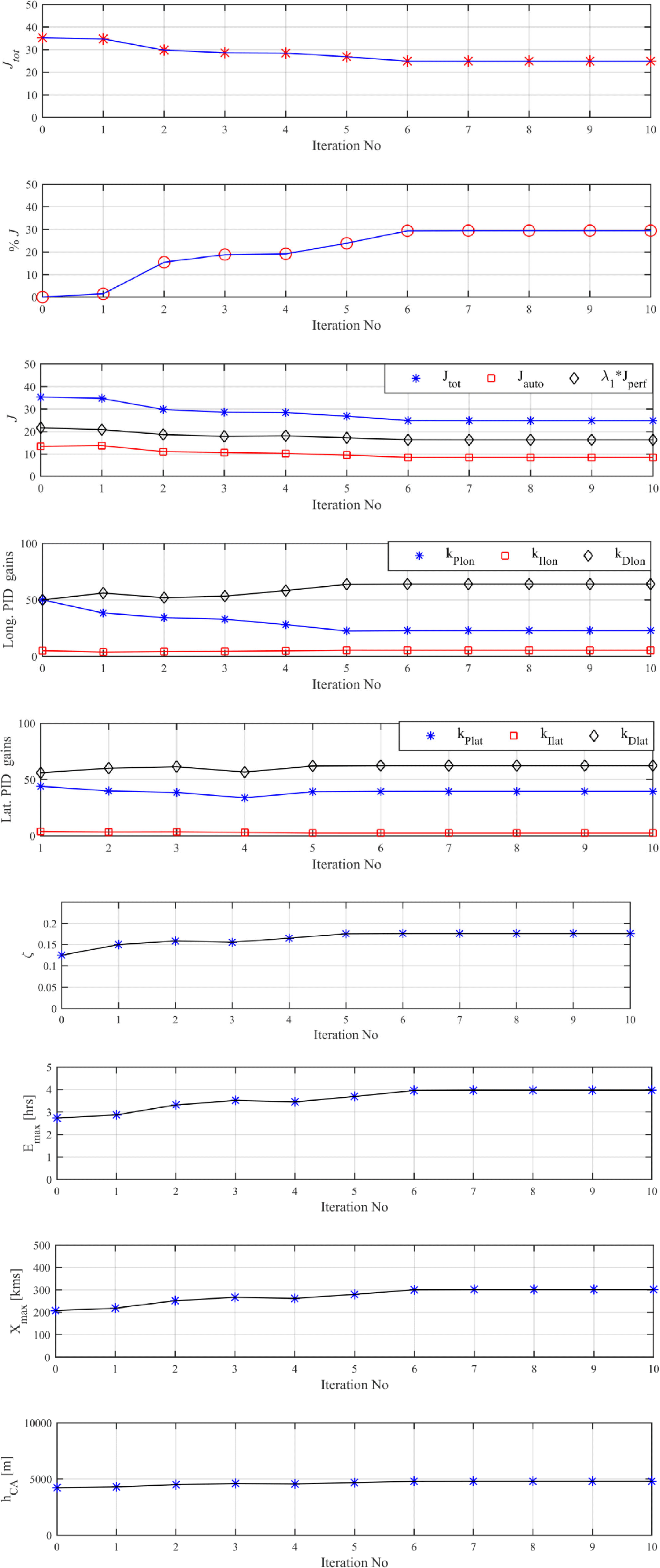
Panel A: A line graph shows the total cost function (J_tot) over 10 iterations. The x-axis represents the iteration number, and the y-axis represents the cost function value. The graph shows a slight decrease in the cost function over the iterations. Panel B: A line graph shows the percentage of J_auto over 10 iterations. The x-axis represents the iteration number, and the y-axis represents the percentage of J_auto. The graph shows an increase in the percentage of J_auto over the iterations. Panel C: A line graph shows the values of J_tot, J_auto, and lambda1*J_perl over 10 iterations. The x-axis represents the iteration number, and the y-axis represents the values of the cost functions. The graph shows a decrease in J_tot and J_auto, while lambda1*J_perl remains relatively constant. Panel D: A line graph shows the longitudinal PID gains (kP_lon, kI_lon, kD_lon) over 10 iterations. The x-axis represents the iteration number, and the y-axis represents the PID gains. The graph shows variations in the PID gains over the iterations. Panel E: A line graph shows the lateral PID gains (kP_lat, kI_lat, kD_lat) over 10 iterations. The x-axis represents the iteration number, and the y-axis represents the PID gains. The graph shows variations in the PID gains over the iterations. Panel F: A line graph shows the value of zeta over 10 iterations. The x-axis represents the iteration number, and the y-axis represents the value of zeta. The graph shows a slight increase in zeta over the iterations.
5.0 Outcomes of the implemented integrated and multi-objective redesign concept
In this section integrated and multi-objective redesign concept with a constrained stochastical optimization tool on our produced TJP-UAV is applied. Its AFCS parameters and turbojet engine parameter are benefitted. It is researched for enhancing trajectory tracking performance of the flight controller responding to minimization of an autonomous cost index including rise time, settling time, and maximum overshoot meanwhile reference trajectory trackings and also general flight performance responding to minimization of a general flight cost index including inverses of the maximum endurance, maximum range, and ceiling altitude.
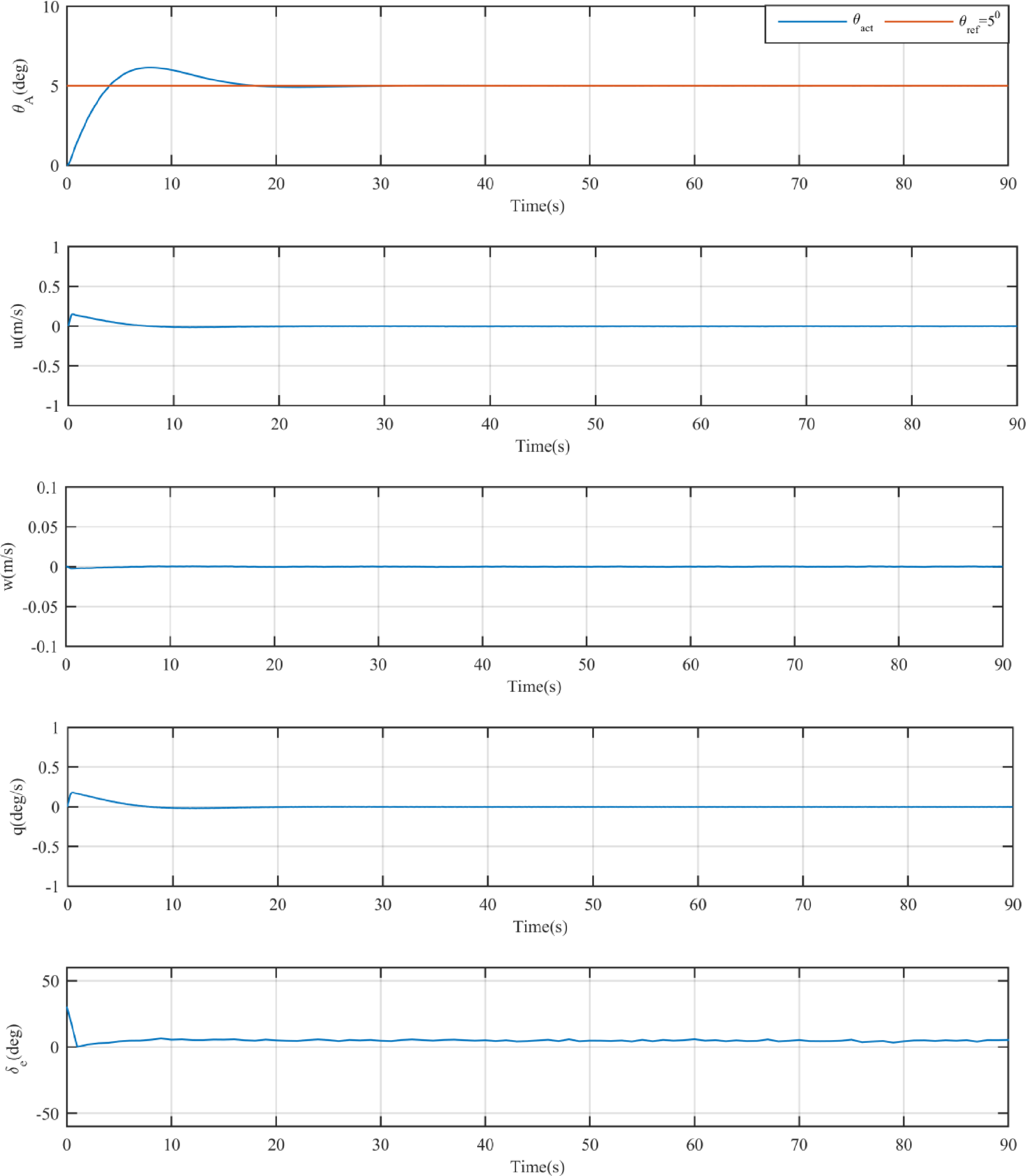
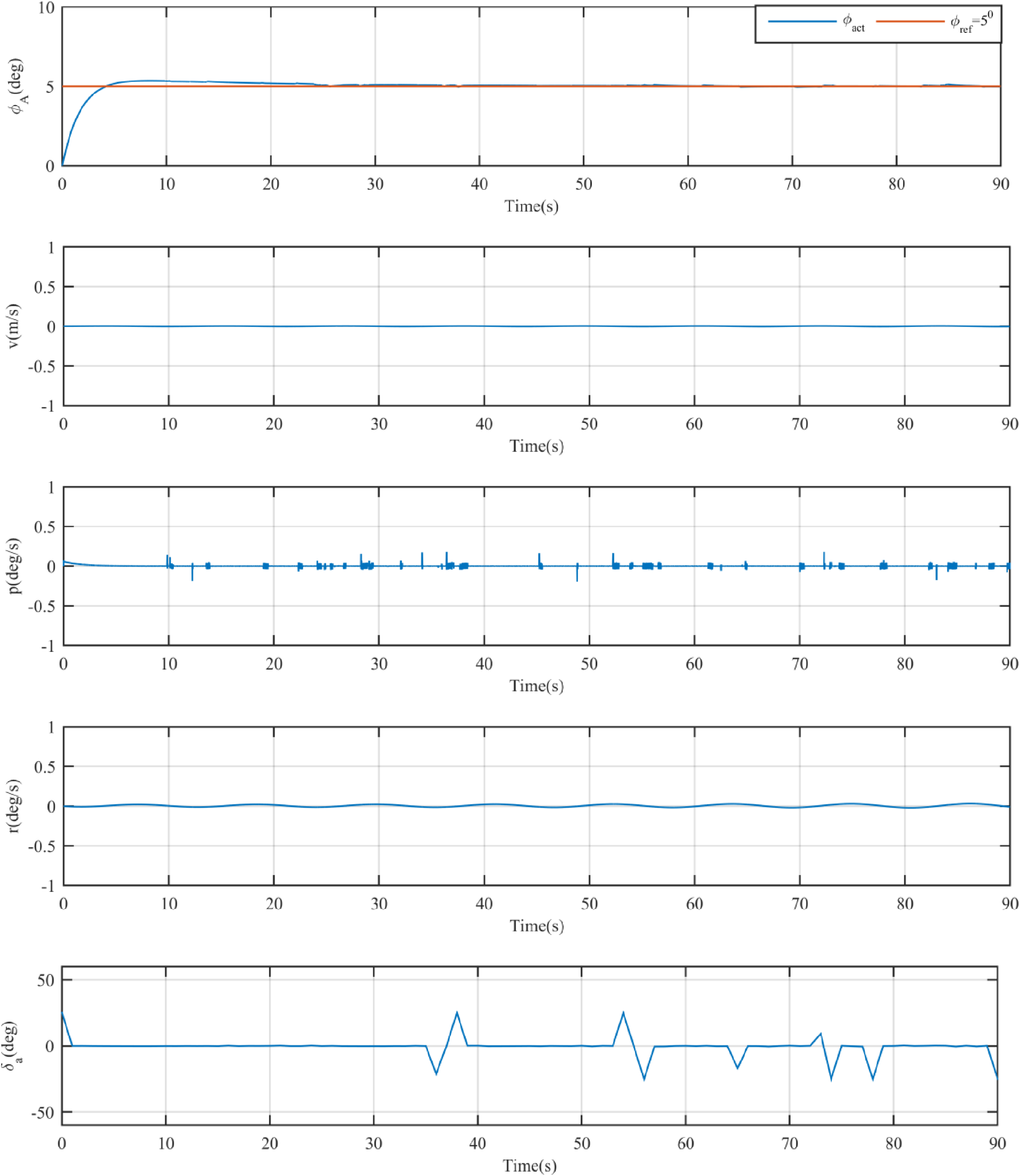
It is also required to note that our TJP-UAV is required to track 5 degrees of aircraft pitch angle for the longitudinal trajectory tracking and is required to track 5 degrees of aircraft roll angle for the lateral trajectory tracking. In this research article, the total cost index includes parameters relevant to both the trajectory tracking performance of the flight controller and the general flight performance, weighted equally.
After the implementation of the integrated and multi-objective redesign concept by using a stochastic tool rather than implementation of the traditional sequential concept mentioned in the introduction, substantially larger cost index minimisation and save is obtained. In Fig. 4 at each c-SPSA optimisation iteration variation of total cost index (4a), relative cost index save (4b), total cost index and its components (4c), autonomous cost index and its components (4d), gains of longitudinal PID controller (4e), gains of the lateral PID controller (4f), maximum endurance (4g), maximum range (4h), ceiling altitude (4i) and (fuel mass/total mass) (4j) are shared, respectively.
Closed-loop responses for longitudinal trajectory tracking of our TJP-UAV.

Figure 5. Long description
Panel A: A line graph shows the pitch angle (theta) in degrees over time in seconds. The graph includes two lines: one for the actual pitch angle (theta_act) and another for the reference pitch angle (theta_ref) set at 5 degrees. The actual pitch angle starts at 0 degrees, rises to meet the reference angle, and then stabilizes around it. Panel B: A line graph displays the longitudinal velocity (u) in meters per second over time in seconds. The velocity starts slightly negative, quickly rises to a small positive value, and then stabilizes around 0 meters per second. Panel C: A line graph illustrates the vertical velocity (w) in meters per second over time in seconds. The vertical velocity remains close to 0 meters per second throughout the time period. Panel D: A line graph presents the pitch rate (q) in degrees per second over time in seconds. The pitch rate starts at 0 degrees per second, becomes slightly negative, and then stabilizes around 0 degrees per second. Panel E: A line graph shows the elevator deflection (delta_e) in degrees over time in seconds. The elevator deflection starts at 0 degrees, becomes slightly positive, and then stabilizes around 0 degrees.
The following key consequences are obtained in this research article: the relative cost index save with respect to the preliminary old-style condition in which
 ${k_p}$
=50,
 ${k_I}$
=5,
 ${k_D}$
=50 for both of longitudinal and lateral PID controllers and
 $\frac{{{m_{fuel}}}}{{{m_{tot}}}} = \frac{1}{8}$
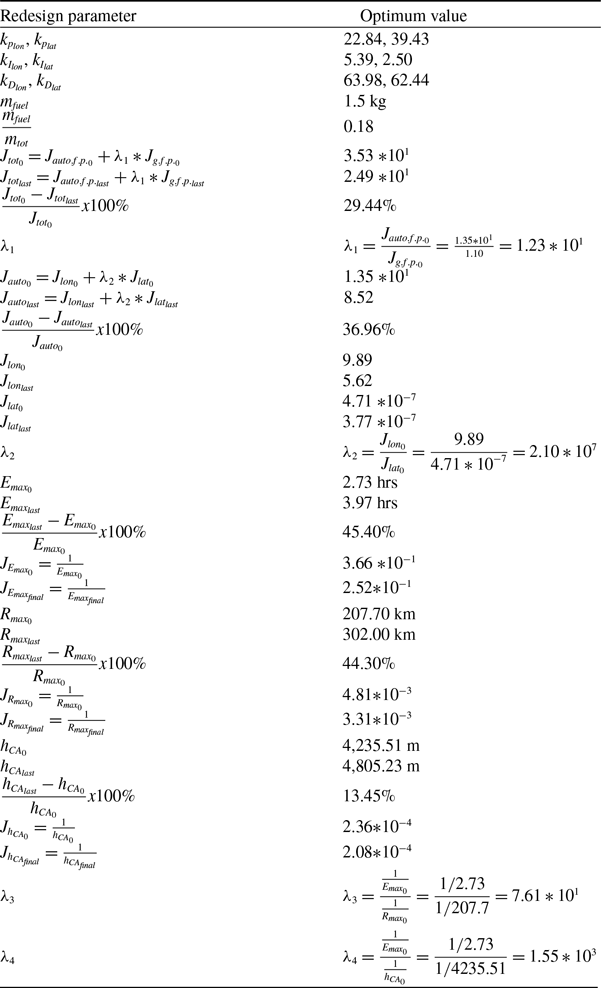
for the turbojet engine is around 29.44% after implementation of the integrated and multi-objective redesign concept. In Fig. 5, for the preliminary iteration in which redesign parameters have the preliminary old-style values, the number ‘0’ is chosen. Additionally, the consequential values of redesign parameters are
 ${k_p}$
=22.84,
 ${k_I}$
=5.39,
 ${k_D}$
=63.98 for gains of the longitudinal PID controller and
 ${k_p}$
=39.43,
 ${k_I}$
=2.50,
 ${k_D}$
=62.44 for the gains of the lateral PID controller,
 $\frac{{{m_{fuel}}}}{{{m_{tot}}}} = 0.18$
for the turbojet engine. Out of the total cost index save important progress and enhancement in autonomous flight and general flight cost indexes are also obtained. For example, almost 36.96% improvement in autonomous cost index, 24.78% improvement in general flight cost index are found with respect to the condition in which integrate sand multi-objective redesign stage with stochastic way is not implemented. Additionally, there is 45.40% improvement in maximum endurance, 44.30% improvement in maximum range and 13.45% improvement in ceiling altitude. For derivation and computation details of these obtained outcomes as well as remaining stochastic optimum details, see the Appendix section and Table A2. There is one more vital piece of information about obtaining our consequences that they are found in ideal weather circumstances in which the temperature is around 20
 ${^{\circ}\text{C}}$
and there is no substantial turbulence in the air. These prerequisites are vital for the implementation of state-space models meanwhile obtaining closed-loop responses. It can be also detected from Fig. 4c that the manners of trajectory tracking performance of the flight controller and general flight performance are similar.
In order to examine the success of our integrated and multi-objective redesign concept by using a constrained stochastic optimisation tool, during existence of small turbulence on our TJP-UAV system, autonomous flight simulations are implemented by using Matlab/Simulink software. For this relevant examination, initial closed-loop responses for autonomous longitudinal flight are shared in Fig. 5. Following this, in Fig. 6 closed-loop responses for autonomous longitudinal flight are shared. For both of the previously mentioned figures the x-axis and y-axis show time in seconds and outputs of interest, respectively. See the Appendix for descriptions of the symbols used.
Closed-loop responses for lateral trajectory tracking of our TJP-UAV.

It can be evidently understood from Fig. 5 that our AFCS after implementation of integrated and multi-objective redesign concept in a stochastic way allows high-performing autonomous flight trajectory tracking for the longitudinal reference trajectory. It can also be seen from this figure that the components of the longitudinal cost index, which are settling time, rise time and maximum overshoot of the relevant trajectory tracking, are substantially small due to the fact that our integrated and multi-objective redesign concept in a stochastic way is so useful. Additionally, the other outputs, which are not of primary interest for controller design, for example, u, w and p do not expose fast and large oscillations during longitudinal reference trajectory tracking. Consequently, during the existence of bounds on inputs of our AFCS as seen in this research article (+−30 degrees for elevator), the desired/reference trajectory is followed with high-performance as well.
Figure 6 shows the details of the lateral closed-loop responses. It is apparently detected from this figure that implementation of integrated and multi-objective redesign concept in a stochastic way also allows high-performing autonomous flight trajectory tracking for the lateral reference trajectory. Additionally, the components of the lateral flight quality criteria, which are settling time, rise time and maximum overshoot during reference lateral trajectory tracking, are also substantially small after implementation of the integrated and multi-objective redesign concept in a stochastic way in this research article. One more crucial consequence of this simulation is that the other states, for instance, v and q do not expose fast and large oscillations while tracking the relevant reference trajectory. Finally, during the existence of constraints on inputs of our AFCS as seen in this study (+−30 degrees for aileron), desired/reference trajectory is followed with high performance as well.
6.0 Conclusions
In this research article, integrated and multi-objective flight performance enhancement for a TJP-UAV was pursued. Physical quantities of the TJP-UAV, which was produced in Erciyes University and Iskenderun Technical University drone laboratories, were implemented. Autonomous flight control system parameters and turbojet engine redesign parameters were the variable parameters that can be changed before beginning the autonomous UAV flight with respect to the consequences of the integrated and multi-objective redesign concept. PID controller gains for both of the longitudinal and lateral autonomous flights and fuel mass/total mass ratio were stochastically redesigned for obtaining best trajectory tracking performance of the flight controller and also best general flight performance. In this research article, trajectory tracking performance of the flight controller is referred to as settling time, rise time and maximum overshoot during autonomous flight trajectory tracking and minimsation of them in a structured cost index, enhancing the quality of autonomous trajectory tracking. Additionally, trajectory tracking performance of the flight controller referred to as maximum endurance, maximum range and maximum overshoot and minimisation of inverse of them again in another structured cost index also enhancing quality of general flight. It is important to note that in this article, trajectory tracking performance of the flight controller and general flight performance were included in a total cost index in a way equal in importance. Stochastic optimisation consequences were implemented during creating simulation environment for longitudinal and lateral autonomous flights.
In this research article, after following integrated and multi-objective flight performance enhancement for a TJP-UAV in a stochastic manner, substantial upgrading for the total cost index that is 29.44% was obtained with respect to the TJP-UAV on which our novel redesign concept was not implemented. This outcome was obtained because of the reality of reaching inconsiderable overshoot, settling time and rise time during autonomous trajectory tracking as well as substantially enhanced maximum endurance, maximum range and ceiling altitude. In addition to a substantial enhancement on total cost index, 36.96% enhancement on autonomous flight cost index and 24.78% enhancement on general flight cost index were obtained compared to the default control and propulsion system design.
Finally, considering the quality of autonomous flight simulations, the existence of inconsiderable turbulence on longitudinal and lateral closed-loop, reasonable responses (i.e. meaning negligible rise time, settling time and maximum overshoot) were detected. It is also crucial to note that this research article donates TJP-UAV workers chances of enhanced trajectory tracking performance of the flight controller and general flight performance, and secured flight as well. Lastly, there is one more beneficial output of this article that our concept is suitable for each type of the fixed-wing UAV.
Data availability statement
The data that support the findings of this study are available from the author upon reasonable request.
Financial support
This work has been supported by Erciyes University Scientific Research Projects Coordination Unity under grant number FBA-2025-14883.
Competing interests
The author declares no competing interests.
Ethical standards
Not applicable.
Appendix
List of limits for design parameters

Table A1. Long description
The table has two columns: Redesign parameter and Optimum value. It contains 38 rows with various parameters and their corresponding optimum values. The parameters include proportional, integral, and derivative gains for longitudinal and lateral PID controllers, fuel mass, and various performance metrics. Each row lists a specific parameter and its optimum value, with some rows containing formulas or calculations. The table provides detailed numerical values and constraints for the redesign parameters of a TJP-UAV.
Results of stochastic optimisation and redesign

Table A2. Long description
Panel A: Line graph showing the relative cost index savings for longitudinal and lateral PID controllers and the turbojet engine. The x-axis represents the redesign parameters, and the y-axis represents the percentage savings. The graph shows a significant improvement in cost index savings after the redesign. Panel B: Bar graph displaying the consequential values of redesign parameters for the gains of the longitudinal and lateral PID controllers. The x-axis lists the parameters, and the y-axis shows their values. Panel C: Line graph illustrating improvements in autonomous flight cost index, general flight cost index, maximum endurance, maximum range, and ceiling altitude. The x-axis represents the performance metrics, and the y-axis shows the percentage improvements.
Physical quantities of the implemented TJP-UAV

Table A3. Long description
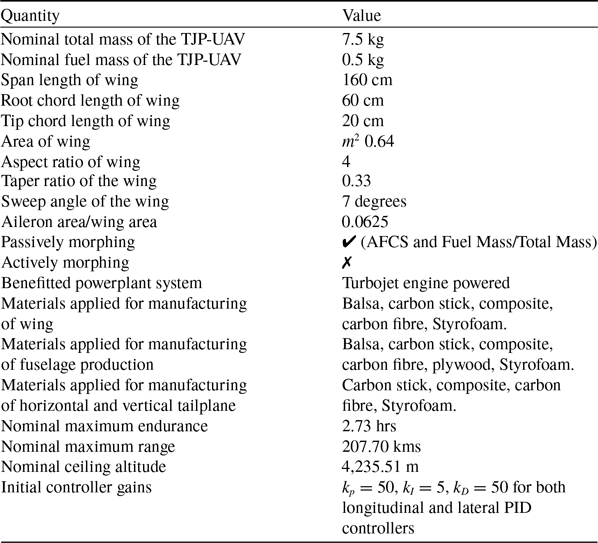
A table with two columns: Quantity and Value. The table lists various physical quantities of the TJP-UAV. Row 1: Quantity: Nominal total mass of the TJP-UAV, Value: 7.5 kg. Row 2: Quantity: Nominal fuel mass of the TJP-UAV, Value: 0.5 kg. Row 3: Quantity: Span length of wing, Value: 160 cm. Row 4: Quantity: Root chord length of wing, Value: 60 cm. Row 5: Quantity: Tip chord length of wing, Value: 20 cm. Row 6: Quantity: Area of wing, Value: 0.64 m^2. Row 7: Quantity: Aspect ratio of wing, Value: 4.
Table A3 summarizes some important physical quantities of implemented TJP-UAV system. The first column refers to the relevant quantity, and the second column refers to the value of this quantity. More data for this UAV system can be obtained by contacting the corresponding author.
Definition of state and controls

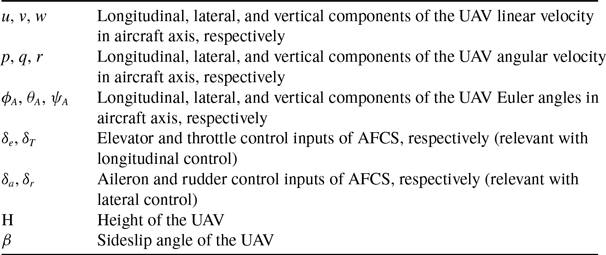
Table A4 Long description
A table defining state and control variables for a UAV. The table has 10 rows and 2 columns. The first column lists the variables and the second column provides their definitions. Row 1: u, Longitudinal component of the UAV linear velocity in aircraft axis. Row 2: v, Lateral component of the UAV linear velocity in aircraft axis. Row 3: w, Vertical component of the UAV linear velocity in aircraft axis. Row 4: p, Longitudinal component of the UAV angular velocity in aircraft axis. Row 5: q, Lateral component of the UAV angular velocity in aircraft axis. Row 6: r, Vertical component of the UAV angular velocity in aircraft axis. Row 7: φ_A, Longitudinal component of the UAV Euler angles in aircraft axis. Row 8: θ_A, Lateral component of the UAV Euler angles in aircraft axis. Row 9: ψ_A, Vertical component of the UAV Euler angles in aircraft axis. Row 10: δ_e, δ_T, Elevator and throttle control inputs of AFCS, respectively (relevant with longitudinal control). Row 11: δ_a, δ_r, Aileron and rudder control inputs of AFCS, respectively (relevant with lateral control). Row 12: H, Height of the UAV. Row 13: β, Sideslip angle of the UAV.
Numerical values of these matrices are shared for allowing the reproducibility of the results for the situation of 100 km/h straight-forward flight.
 \begin{align}\left[ {\begin{array}{*{20}{c}}{\Delta \dot u}\\{\Delta \dot w}\\{\Delta \dot q}\\\begin{array}{l}\Delta \dot \theta \\\Delta \dot h\end{array}\end{array}} \right] & = \left[ {\begin{array}{c@{\quad}c@{\quad}c@{\quad}c@{\quad}c}{ - 3.3266*{{10}^{ - 2}}} {}&{2.4794*{{10}^{ - 1}}} {}&0 {}&{ - 9.81} {}&0\\{ - 6.9523*{{10}^{ - 1}}} {}&{ - 5.5324*{{10}^0}} {}&{2.7778*{{10}^{ + 1}}} {}&0 {}&0\\{5.6647*{{10}^{ - 1}}} {}&{ - 3.4162*{{10}^{ + 1}}} {}&{ - 5.4708*{{10}^{ + 1}}} {}&0 {}&0\\0 {}&0 {}&1 {}&0 {}&0\\{ - 5.2334*{{10}^{ - 2}}} {}&{9.9863*{{10}^{ - 1}}} {}&0 {}&{ - 2.7739*{{10}^{ + 1}}} {}&0\end{array}} \right]\left[ {\begin{array}{*{20}{c}}{\Delta u}\\{\Delta w}\\{\Delta q}\\\begin{array}{l}\Delta \theta \\\Delta h\end{array}\end{array}} \right] \nonumber\\& \quad + \left[ {\begin{array}{c@{\quad}c}0 {}&{1*{{10}^{ + 1}}}\\{ - 7.3953*{{10}^0}} {}&0\\{ - 2.7857*{{10}^2}} {}&1\\0 &0\\0 &0 \end{array}} \right]\left[ \begin{array}{l}\Delta {\delta _T}\\\Delta {\delta _e}\end{array} \right]\end{align}
 \begin{align}\left[ {\begin{array}{*{20}{c}}{\Delta \dot \beta }\\{\Delta \dot p}\\{\Delta \dot r}\\\begin{array}{l}\Delta \dot \phi \\\Delta \dot \psi \end{array}\end{array}} \right] & = \left[ {\begin{array}{c@{\quad}c@{\quad}c@{\quad}c@{\quad}c}{ - 3.3843*{{10}^{ - 3}}} {}&0 {}&{ - 9.8731*{{10}^{ - 1}}} {}&{ - 3.5268*{{10}^{ - 1}}} {}&0\\{3.5258*{{10}^1}} {}&{ - 8.5027*{{10}^1}} {}&{ - 3.0250*{{10}^2}} {}&0 {}&0\\{2.1155*{{10}^2}} {}&{ - 8.8130*{{10}^0}} {}&{ - 1.8599*{{10}^3}} {}&0 {}&0\\0 {}&1 {}&0 {}&0 {}&0\\0 {}&0 {}&{1.0014*{{10}^0}} {}&0 {}&0\end{array}} \right]\left[ {\begin{array}{*{20}{c}}{\Delta \beta }\\{\Delta p}\\{\Delta r}\\\begin{array}{l}\Delta \phi \\\Delta \psi \end{array}\end{array}} \right] \nonumber\\ & \quad + \left[ {\begin{array}{c@{\quad}c}0 {}&{1.9163*{{10}^3}}\\{2.5967*{{10}^3}} {}&{1.0002*{{10}^1}}\\{9.2886*{{10}^1}} {}&{ - 1.1822*{{10}^2}}\\0 &0\\0 &0\end{array}} \right]\left[ \begin{array}{l}\Delta {\delta _a}\\\Delta {\delta _r}\end{array} \right]\end{align}


 Open access

