Introduction
Mass gatherings are defined by the World Health Organization as events attended by sufficient numbers of people to potentially strain the planning and response resources of the community, state, or nation hosting the event. 1 Brazil is the site of many mass gatherings every year, including Carnaval and New Year's Eve celebration in Rio de Janeiro. In addition to the usual gatherings, Brazil is the site for two major world sporting events, the World Cup in 2014 and the Summer Olympics in 2016. A great deal of planning has been undertaken by many sectors in anticipation of these events.
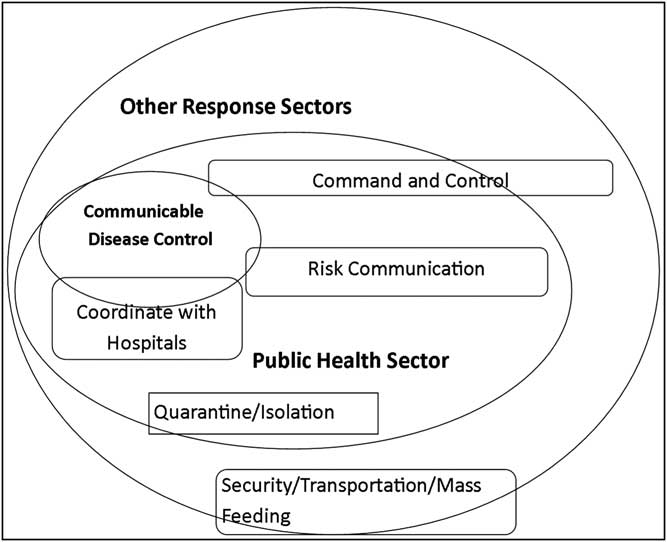
Regardless of the capacity of the health care system of the host nation, mass-gathering events require special planning and preparedness efforts within multiple components of the health system. These components include: disease monitoring and control; environmental and food surveillance; public information and health promotion; and Emergency Medical Services. Coordination also is required within the health sector, and between the health sector and other relevant sectors.Reference Tsouros and Efstathiou 2 , 3 The relevant areas of responsibility of the public health sector for planning, according to the World Health Organization, are shown in Figure 1. 1
Responsibility of Communicable Disease Control vs Public Health vs Other Sectors in Emergency Response (Adapted from the World Health Organization 1 ).

Experiences from previous World Cup and Olympic Events have demonstrated that the presence of large numbers of participants and spectators creates a surge demand on the health system in the host city.Reference Tsouros and Efstathiou 2 , Reference Yancey, Fuhri, Pillay and Greenwald 4 , Reference Morimura, Katsumi and Koido 5 To meet this surge demand, different strategies have been employed by different nations. Most, however, have approached these planned mass-gathering events as planned emergencies and utilized emergency preparedness strategies. The first results from Project “Prepara Brasil,” which is investigating the preparedness of the health sector and pharmaceutical services for these mass gatherings, are presented here.
Methods
Overall, this study was designed to identify the efforts engaged in to prepare the health sector in Brazil for the Fédération Internationale de Football Association (FIFA) World Cup 2014 event as well as the 2016 Summer Olympics. Key informant interviews were conducted with representatives of both the municipality and hospital sectors in the 12 host cities where matches will be played. A semi-structured key informant interview guide was developed, with sections for each type of participant. All participants were informed about the study and signed informed consent documents. The study was approved by the Ethics in Research Committee at the Sergio Arouca National School of Public Health, Oswaldo Cruz Foundation, Brazil.
Sample
All 12 host cities were included in the study. The municipalities were contacted and asked to provide contact information for a respondent from the civil defense, the secretariat of health, and the head pharmacist from the secretariat. One of each municipality's reference hospitals was identified, and seven additional general hospitals were randomly selected from all of the inpatient facilities in each municipality. The interviewers were instructed to contact a reference hospital and two of the other hospitals in the jurisdiction for participation in the study. The director (or the director's designee) was contacted to participate in the study and asked to schedule an interview as well as provide contact information for the hospital pharmacist. If a hospital refused to participate, it was replaced with one of the other pre-identified hospitals on the list. Interviews were conducted from March 16 through April 12, 2014 (two to three months prior to the beginning of the FIFA World Cup).
Analysis
Analysis was limited to responses from the hospital directors in the 12 municipalities. Descriptive analyses were conducted using IBM SPSS Statistics for Windows, Version 22.0 (IBM Corp., Armonk, New York USA) and Microsoft Excel 2010 (Microsoft Corp., Redmond, Washington USA). The existence of plans for mass-gathering events, the interaction between hospitals and government officials in preparation for the World Cup, and their perceptions of their surge capacity to meet the potential demands generated by the presence of the World Cup events in their municipality were explored.
Results
Representatives of 35 hospitals participated in the interview. This included 11 representatives of the sampled reference hospitals and 24 representatives of other general private and public hospitals in the municipalities.
Planning
Five (14%) hospitals stated that they had plans for mass events such as the FIFA World Cup, and were able to provide a copy of the plan (others might have stated that they had a plan but were unable to produce the plan). Most of the hospitals (63%) did state that they had had some type of interaction with government officials in preparing for the World Cup. The most frequently mentioned type of interaction was “meetings,” with nearly half of respondents (49%) responding affirmatively to this question. For a small minority of respondents (14%), “meetings” were the only form of interaction with the government. For more than one-third of the participants (34%), the interaction included training activities described as seminars, courses, workshops, and simulations/exercises.
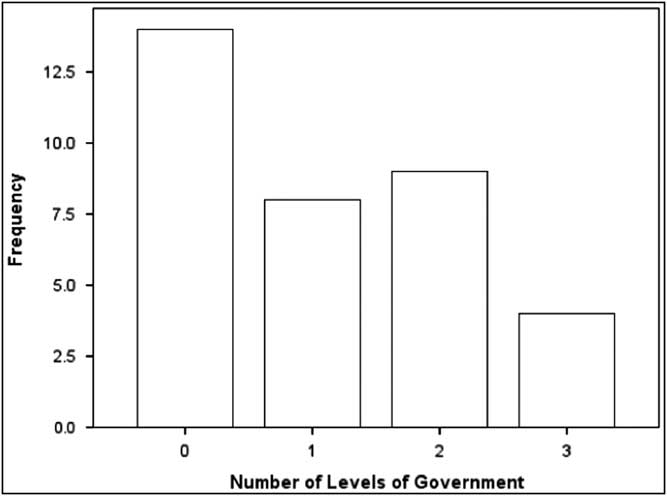
Hospitals reported engaging with individuals from the municipal (46%), state (37%), and federal government (26%). Twenty-one (60%) reported meeting with representatives of one or more government levels (Figure 2). They engaged with individuals from multiple sectors across government. The principal sectors with which they engaged included: health sector (71%); public safety (54%); fire department (37%); and transportation (37%). Other sectors included education, tourism, and the private sector, including private hospitals and the airlines.
Engagement of Hospitals with Government Across Various Levels for the FIFA 2014 World Cup (Project “Prepara Brasil,” 2014).

Respondents also were asked how they would communicate with the various sectors potentially involved during the World Cup events. More than half (54%) of the respondents stated that they either did not know how they would communicate, or that there were no plans for communicating with the other sectors during the World Cup games. Seven (20%) stated that they had plans in place to communicate with the Secretary of Health of the municipality, and that communications with other sectors would go through the Health Secretary. Three of the hospitals that said they had plans to communicate with the Health Secretary stated specifically that they had a “command and control,” or communications unit, through which communications would be funneled to the Health Secretary. Two additional hospitals mentioned the use of a “command and control” unit that would manage communications. Three hospitals stated that they would communicate with the communicable disease surveillance unit of the Health Secretary, and two additional hospitals stated that they would use their existing protocols (like communicable disease surveillance) for communications if necessary. Two hospitals said they had plans to communicate with the Civil Defense of the municipality.
Response Capacity
The hospitals were asked what their plans were in case the surge of demand exceeded their capacity to provide services. More than half (51%) of the hospitals had surge capacity plans. Plans for increasing surge capacity included: cancelling elective procedures (12%); using hallways and other nonpatient care areas (26%); moving patients to other hospitals (12%); and using field hospitals (6%). Seventeen respondents (49%) provided answers that suggested there was little ability for their surge capacity to meet demand. Twelve said there were no plans for surge capacity, one didn't know, three said all of their capacity was currently in use, and one said they were currently waiting for a response from government officials with respect to surge capacity.
In thinking specifically about capacity for a transmissible disease outbreak, respondents were asked about their capacity for isolation. Thirteen hospitals (27%) had plans for isolation, with eight of them having specific isolation rooms or units. Fifteen hospitals (43%) had no plans or space for isolation; five hospitals (14%) would send patients needing isolation to the reference hospital; two hospitals (6%) said they would figure it out when necessary.
Discussion
Overall, the majority of hospitals interviewed had met with government officials in preparation for the World Cup and the Olympic Games. Unfortunately, this does not necessarily translate into significant new planning in regards to preparedness to respond to the potential surge in health care demand that may be placed on the hospitals during these events. Research during the World Cup in Japan/Korea in 2002 found that for every 1,000 spectators at the games, 1.2 individuals needed medical treatment.Reference Morimura, Katsumi and Koido 5 South Africa used an estimate of two individuals needing treatment for each 1000 spectators for the 2010 World Cup, based on the Japanese experience and other large sporting events.Reference Yancey, Fuhri, Pillay and Greenwald 4 Given that approximately 3 million tickets have been sold for the Brazil 2014 World Cup, this translates to approximately 3,600-6,000 additional persons seeking health care during the event. This number is the base surge demand, without the occurrence of any untoward events (such as climate or environmental hazards, civil disturbances, infrastructure failure, or terrorism). Given that almost half of the hospitals interviewed did not have any surge capacity, this could place an additional stress on those hospitals that do have the capacity. However, 12% of those with surge capacity planned to move patients to other hospitals to increase their capacity.
Communication and coordination often are touted as the key to emergency response efforts.Reference Shih and Fan 6 , Reference Manoj and Baker 7 This study demonstrated that while there were connections between the hospitals and the government (particularly the health sector), the lines of communication and coordination for emergency response situations were not necessarily well defined in the minds of the hospital staff. There did appear to be defined communication plans with the Secretary of Health of the municipality for some of the hospitals. Some of those hospitals, however, were only connected through infectious disease surveillance systems. This is not unexpected, as it is the daily connection between hospitals and public health, and indeed is a significant focus for emergency planning efforts. 1 These connections, however, may not be adequate for noninfectious disease emergencies.
Having health care providers communicate directly with the Secretary of Health, and channeling communications with other sectors through the Secretary, is a standard for most command and control/emergency management systems. 8 The Ministry of Health had stated that as of May 2014, there were to be health emergency operations centers (Centro Integrado de Operações Conjuntas da Saúde (CIOCS)) in each of the 12 municipalities to coordinate the health response efforts. 9 There did appear to be a lack of awareness of these centers in each of the municipalities on the part of hospitals. It is unknown how much information about these CIOCSs was communicated to hospitals during the training activities and meetings that hospitals reported having with government agencies, or who from the hospitals participated in those activities.
Limitations
This study has specific limitations. First, this was an exploratory study with key informant interviews. While hospitals were randomly selected from each jurisdiction for participation, the small number of hospitals per municipality limited the ability to extrapolate results to all hospitals in the area. Second, preparing for the World Cup, and certainly the Olympics two years hence, is a process. It was not complete at the time of the interviews; therefore, additional efforts with respect to preparedness may not be reflected in the results presented here. Third, the hospital sample was stratified by designation as a reference hospital late last year. Since that time, additional hospitals, some of which are in the sample as general hospitals, have been designated as reference hospitals for the World Cup.
Conclusion
Overall, although there has been mention of a great deal of planning on the part of the government officials for the World Cup 2014, hospital surge to meet demand still falls short. This planning continues down to the frontline of health care, with about one-third to one-half of the hospitals in the municipalities that are hosting these games having taken specific steps to plan and prepare.