INTRODUCTION
Research in the development of morphosyntax has relied heavily on manual transcription analysis of spontaneous language samples (Brown, Reference Brown1973; de Villiers & de Villiers, Reference de Villiers and de Villiers1973; Moerk, Reference Moerk1980; Thordardottir & Ellis Weismer, Reference Thordardottir and Ellis Weismer2001). The focus of description has been on children's productions. With access to larger corpora and to appropriate analysis tools and algorithms, we are now well equipped to examine the influence of the input to the child. The present study addresses the question of whether input frequency affects the acquisition of suffixes in typical and in language delayed or impaired populations.
Input frequency and typical language development
There is growing evidence that greater amounts of input facilitate children's vocabulary development. Experimentally, Schwartz and Terrell (Reference Schwartz and Terrell1983) showed that higher frequency of presentation of a novel word–referent pair makes a child more likely to produce that word. Others have demonstrated a positive relationship between the number of lexical items a child hears in caregiver speech and the child's rate of vocabulary development (Hoff & Naigles, Reference Hoff and Naigles2002). The acquisition of a word, at least when it is a verb, appears to be predicted by the word's total frequency, final position frequency, and the diversity of the verb's syntactic contexts in mothers' child–directed speech (Naigles & Hoff-Ginsberg, Reference Naigles and Hoff-Ginsberg1998). From a different perspective, Tardif, Shatz and Naigles (Reference Tardif, Shatz and Naigles1997) showed a relationship between input frequency and language at the level of parts of speech. They found that English- and Italian-speaking children produced more noun types than verb types, whereas Mandarin-speaking children produced more verb types than noun types. This pattern could be explained by a non-input-frequency-related child noun bias combined with a bias toward more or less verb usage based on frequency of verbs in caregiver speech: Mandarin caregivers used more verb than noun types, whereas no difference was observed in either English or Italian. Recently, Goodman, Dale and Li (Reference Goodman, Dale and Li2008) found within-lexical-category correlations between word frequency in child-directed parent speech in the CHILDES database (MacWhinney, Reference MacWhinney2000) and the typical age of acquisition of a word as measured by the MacArthur Communicative Development Inventory norming data (Dale & Fenson, Reference Dale and Fenson1996). This result is consistent with input frequency having a facilitative effect on vocabulary acquisition.
Data suggest that input frequency also plays a role at levels of language structures besides the word, including construction (Riches, Faragher & Conti-Ramsden, Reference Riches, Faragher and Conti-Ramsden2006; Tomasello, Reference Tomasello2005; Vasilyeva, Huttenlocher & Waterfall, Reference Vasilyeva, Huttenlocher and Waterfall2006), phonotactic (Storkel, Reference Storkel2001), and morphological levels. Of particular relevance to the present study, Nicoladis, Palmer and Marentette (Reference Nicoladis, Palmer and Marentette2007) found that English–French bilingual children tend to produce more accurate regular past tense verbs in French than in English and tend to produce more accurate irregular past tense verbs in English than in French. Since the proportion of verbs with regular past tense is greater in French than in English and the proportion of verbs with irregular past tense is greater in English than in French, this finding supports the idea that children's acquisition of verb tense inflection is positively affected by input frequency. Additionally, at the derivational morpheme level, there appears to be a positive relationship between input frequency and children's knowledge of suffix behavior (i.e. their distributional constraints and phonological effects on the stem), both in perception and in production (Clark, Reference Clark1993; Jarmulowicz, Reference Jarmulowicz2002; Jarmulowicz, Taran & Hay, Reference Jarmulowicz, Taran and Hay2008).
A few studies have examined the relationship between input frequency and acquisition of grammatical morphemes (including some inflectional suffixes). Brown (Reference Brown1973), de Villiers and de Villiers (Reference de Villiers and de Villiers1973) and Moerk (Reference Moerk1980) all found that mean caregiver frequencies of individual grammatical morphemes (including the present progressive -ing suffix, the plural -s suffix, the possessive -s suffix, the third person regular -s suffix, the regular past tense -ed suffix, irregular past forms, the prepositions in and on, articles, and various forms of the copula and auxiliary verbs) correlated positively with mean rank order of acquisition of those grammatical morphemes. All three studies' caregiver data were from Brown's (Reference Brown1973) famous three families. As for the child data, Brown's and Moerk's came from Brown (Reference Brown1973) whereas de Villiers and de Villiers' came from a cross-sectional sample of twenty-one children. However, the correlation between input frequency and age of acquisition did not reach statistical significance in any of these studies. In all cases, the lack of statistical significance is likely due to lack of statistical power, since the significance testing of the correlations was based on a small number of data points equal to the number of grammatical morphemes under investigation (Moerk, Reference Moerk1980). Because of this low statistical power, Brown's and de Villiers and de Villiers' conclusions that frequency is unlikely to play a significant role in the acquisition of those grammatical morphemes may have been premature.
Other, less well-studied suffixes, such as the adjectival comparative and superlative forms (i.e. -er and -est) and the noun diminutive (i.e. -ie/-y) have limited developmental information, especially on the relationship between input frequency and acquisition. The adjective suffixes can be elicited by age 5 (Graziano-King & Cairns, Reference Graziano-King and Cairns2005), and comparative and superlative suffixation may be relatively spared in children with G-SLI (Grammatical-Specific Language Impairment) (Marshall & van der Lely, Reference Marshall and van der Lely2007). The diminutive is technically a derivational suffix; however, in Clark's (Reference Clark1993) diary report, it emerges around age 2 in novel forms, at around the same time that many inflectional suffixes emerge. Clark further states that ‘the affixes … produced first are among the most productive in English: -er [agentive], -ie/-y [diminutive], -ing [action], and -ness [state]’ (p. 147). Input frequency appears to be a key ingredient in productivity, thus it is reasonable to expect a positive relationship between input frequency and acquisition of affixes.
Computationally, results from unsupervised algorithms that learn to segment morphemes based on natural text support the idea that frequency could facilitate morpheme, including suffix, acquisition (Creutz & Lagus, Reference Creutz, Lagus, Honkela, Könönen, Pöllä and Simula2005; Demberg, Reference Demberg2007). These algorithms use frequency information in order to determine whether or not to represent a segment of text as an independent morpheme. The more frequent a segment is, especially relative to its neighboring segments, the more likely it is to be given status as a morpheme. That such a strategy has been shown to work for segmenting morphemes supports the possibility that children may similarly make use of frequency information in suffix segmentation and acquisition.
Language impairment and input frequency
In addition to typically developing children, two other populations of interest are children with specific language impairment (SLI) and late talkers (LTs). Specific language impairment refers to an impairment of language abilities in the absence of known hearing impairment, oral-motor impairment, low non-verbal intelligence, neurological damage and emotional problems (Leonard, Reference Leonard1998). Difficulty with morphosyntax, particularly the inflectional suffixes used to mark finite verbs, is considered a key area of weakness for children with SLI (Leonard, Reference Leonard1998; Leonard & Finneran, Reference Leonard and Finneran2003).
Among the inflectional suffixes, those associated with the English verb system have been shown to be more difficult for children with SLI than those associated with the English noun system. For example, the past tense -ed and the third person singular -s suffixes are more frequently omitted than the plural -s suffix, which is a relative strength (Rice, Wexler & Hershberger, Reference Rice, Wexler and Hershberger1998). Interestingly, the suffixes that are more difficult for children with SLI are also those that are acquired later by typically developing children. The seminal work by Roger Brown (Reference Brown1973) established a developmental sequence still used today. Brown provided age and order of acquisition data for a number of the inflectional suffixes mentioned above. In that study, the order of acquisition of regular suffixes was: (1) present progressive, (2) plural, (3) possessive, (4) past and (5) third person singular. Thus, Brown's typically developing (TD) participants acquired the plural, a relative strength in SLI, before they acquired the past and third person singular verb suffixes, both considered relative weaknesses in SLI. Note also that in Brown's study, the present progressive verb suffix was the earliest to be acquired. This contrasts with previous claims that grammatical suffix difficulty is particularly associated with the verb system, at least for TD children.
Late talkers are typically identified by age 2 as having small expressive vocabularies relative to age-based expectations (e.g. <50 words) and no delays in cognition. However, what might begin as a vocabulary delay at age 2 often develops into a grammatical delay (Rescorla, Dahlsgaard & Roberts, Reference Rescorla, Dahlsgaard and Roberts2000). Furthermore, Rescorla and Roberts (Reference Rescorla and Roberts2002) reported that the LTs in their sample observed at ages 3 and 4 exhibited more difficulty supplying obligatory verb morphemes (e.g. third person singular -s, contractible auxiliary and copula, etc.) than noun morphemes (e.g. plural -s, articles, pronouns, etc.), although there are some exceptions to this pattern where verbal morphemes do not appear particularly difficult (e.g. the progressive -ing and modals). By age 5, LTs continue to show grammatical delays relative to chronological peers (Girolametto, Wiigs, Smyth, Weitzman & Steig Pearce, Reference Girolametto, Wiigs, Smyth, Weitzman and Steig Pearce2001). There is a significant overlap between LTs and SLI. Children with SLI tend to have slower vocabulary growth in general (Rice, Oetting, Marquis, Bode & Pae, Reference Rice, Oetting, Marquis, Bode and Pae1994), and are likely to have been late talkers (Leonard, Reference Leonard1998).
The role of input frequency has also been studied in children with atypical language development, particularly at the word level. Input-dependence of children with SLI has been demonstrated in studies examining the learning of labels (nouns) (Gray, Reference Gray2003; Leonard, Nippold, Kail & Hale, Reference Leonard, Nippold, Kail and Hale1983; Rice et al., Reference Rice, Oetting, Marquis, Bode and Pae1994) and verbs (Riches, Tomasello & Conti-Ramsden, Reference Riches, Tomasello and Conti-Ramsden2005). Additionally, high-frequency, general-purpose verbs (such as go, make, do and look) have been reported to be over-represented in the speech of children with SLI (e.g. Rice & Bode, Reference Rice and Bode1993); this pattern may not be unique to language impaired children as it is observed in younger typical populations as well (Conti-Ramsden & Jones, Reference Conti-Ramsden and Jones1997; Thordardottir & Ellis Weismer, Reference Thordardottir and Ellis Weismer2001). Furthermore, children with SLI, like their chronological- and mental-age-matched TD controls, are more likely to omit past tense verb inflections on low-frequency words than on high-frequency words (Marchman, Wulfeck & Ellis Weismer, Reference Marchman, Wulfeck and Ellis Weismer1999). Increasing the frequency and saliency of target forms is important in successful grammar interventions for children with SLI and for LTs (Fey, Long & Finestack, Reference Fey, Long and Finestack2003; Kouri, Reference Kouri2005).
At a more general level, some studies suggest that general amounts of caregiver input and feedback are different depending on the language abilities of their children. Conti-Ramsden, Hutcheson and Grove (Reference Conti-Ramsden, Hutcheson and Grove1995) found that in conversational samples, caregivers provided their children with SLI with fewer recasts than they provided for the children's language-matched younger siblings. Caregivers of children with SLI have also been found to report smaller amounts of conversational interaction with their children than caregivers of TD children (Hammer, Tomblin, Zhang & Weiss, Reference Hammer, Tomblin, Zhang and Weiss2001). Thus, often the results are that the very children who need more are getting less. At this general level, children with language impairments are sensitive to adult input: maternal responsiveness, as measured by numbers of imitation, expansion, and interpretation strategies, is related to late talkers' language productivity (Girolametto, Bonifacio, Visini, Weitzman, Zocconi & Steig Pearce, Reference Girolametto, Bonifacio, Visini, Weitzman, Zocconi and Steig Pearce2002).
Although both typically and atypically developing children are sensitive to input frequency, it has been suggested that children with SLI may be more frequency-dependent than TD children. For example, Oetting and Rice (Reference Oetting and Rice1993) found that children with SLI were more likely to use the elicited plural -s noun suffix for nouns that are usually pluralized (e.g. door, hand) than for nouns that are infrequently pluralized (e.g. lid, moon); such a pattern of input frequency being associated with better performance was not statistically significant for TD age- and MLU-matched controls. However, the lack of frequency effect for the TD controls in Oetting and Rice's study could be related to the fact that the TD children were performing nearly at ceiling on the pluralization task and may have had a more fully functional regular pluralization rule than the children with SLI. Thus, it may be not that children with SLI are more frequency dependent per se, but that development of the regular plural and possibly other regular grammatical inflections as well entails a process of transition from high frequency sensitivity to greater frequency independence.
Overview of the present study
Still to be examined are inflectional suffix frequencies in the input to both typically and atypically developing children in natural conversation. We measure frequency (i.e. production rate) in caregivers' child-directed speech and in children's productions, excluding any immediate imitations, based on a set of 217 transcripts of naturalistic conversation between children and their caregivers, available through the Child Language Data Exchange System (CHILDES) database (MacWhinney, Reference MacWhinney2000). We examine two sets of transcripts: one that includes children with SLI with their MLU-matched TD younger siblings, and one that includes LTs with age-matched TD controls.
The first goal of the present study is to examine whether a suffix's frequency in the language input could affect how quickly a child acquires the suffix. The suffixes we investigate are the verb suffixes, past tense -ed, third person singular -s, and progressive -ing; the noun suffixes, plural -s, possessive -'s, and diminutive -ie/-y; and the adjective suffixes, comparative -er and superlative -est. The question has previously been pursued in typically developing populations (Brown, Reference Brown1973; de Villiers & de Villiers, Reference de Villiers and de Villiers1973), but at the time those studies were conducted, the sample sizes that were available and feasibly analyzed were small and the studies lacked statistical power. Since large child language corpora and efficient automated analysis tools are now readily available, the time is ripe for revisiting the question of the role of input frequency in suffix acquisition. We look at correlations between maternal frequencies and Brown's ages of suffix acquisition, correlations between maternal frequencies and their children's suffix frequencies, and consistency between percentages of children using a suffix at least once and the suffix's frequency in caregiver input.
We are interested not only in typically developing children, but also in children with SLI and LTs, who have increased likelihood of a SLI diagnosis. Thus, the second goal is to determine whether input frequency could be related to some of the specific patterns of difficulty in grammatical suffix acquisition that have been reported in SLI. The suffixes we investigate most closely are the past tense -ed verb suffix and the third person singular -s verb suffixes (which are relative weaknesses for children with SLI), and the plural -s noun suffix (which is a relative strength for children with SLI). Our hypothesis is that the plural -s noun suffix will appear more frequently in mothers' speech than the third person singular -s and the past tense -ed verb suffixes. We also test to see if there are differences between the typically developing and delayed or impaired groups in terms of adult input frequencies.
METHOD
The data used in this study are from three corpora found in the Clinical subset of the CHILDES database (MacWhinney, Reference MacWhinney2000). The first two corpora (Conti-Ramsden 1 and Conti-Ramsden 2 in the CHILDES Clinical database) were contributed by Gina Conti-Ramsden and colleagues (Conti-Ramsden & Dykins, Reference Conti-Ramsden and Dykins1991; Conti-Ramsden et al., Reference Conti-Ramsden, Hutcheson and Grove1995; Conti-Ramsden & Jones, Reference Conti-Ramsden and Jones1997). They contain transcripts of naturalistic play conversation between children and their mothers and fathers. The children are British English-speaking children with SLI and their language-matched younger siblings. The third corpus (Weismer in the CHILDES Clinical database) was contributed by Susan Ellis Weismer, Julia Evans, Robin Chapman and Chris Hollar (Moyle, Ellis Weismer, Evans & Lindstrom, Reference Moyle, Ellis Weismer, Evans and Lindstrom2007). This corpus contains transcripts of naturalistic play conversations between children and their mothers and includes American English-speaking late talkers and age-matched controls. These two sources of data on naturalistic child–caregiver conversation allowed us to see how well any of our findings might generalize across differences in conversational context, dialect, age group and type of control group. Whereas the Conti-Ramsden corpora provide data for children with SLI, which is the primary population of interest in this article, the Weismer late talker corpus provides longitudinal data for much larger samples of mother–child dyads for a related clinical population, LTs, providing greater statistical power. Transcripts were retrieved from the CHILDES database using the CLAN software. Further information about the Conti-Ramsden and Weismer corpora can be found in the Language Disorders database manual available through the CHILDES website (MacWhinney, Reference MacWhinney2000).
Conti-Ramsden Corpora (Children with SLI and MLU-sibling-controls)
Participants
Four sets of families were included in the Conti-Ramsden 1 corpus and three sets of families were included in the Conti-Ramsden 2 corpus. Each family had two children, one older sibling with SLI and one typically developing younger sibling. Thus, there were seven children with SLI and seven typically developing children (siblings of the SLI children) across the two corpora. The SLI children in Conti-Ramsden 1 ranged in age from 4 ; 9 through 6 ; 9, and the TD siblings ranged in age from 1 ; 11 through 3 ; 2. The SLI children in Conti-Ramsden 2 were between 3 ; 9 and 5 ; 8 at the start of the study and the their TD siblings were between 1 ; 11 and 2 ; 2. The families were recruited from speech and language treatment centers. In each family, a 50-utterance language sample taken at the start of the study indicated that the older (SLI) sibling and the younger (TD) sibling had similar mean lengths of utterance (MLUs) in morphemes, with the older sibling having a lower MLU than would be expected based on chronological age. MLU calculation was based on Brown (Reference Brown1973) and Miller (Reference Miller1981).
Recording and transcription
In the Conti-Ramsden 1 corpus, each mother–child pair was videotaped individually during a naturalistic play session that lasted about fifteen minutes. All recordings were done in the families' homes, using the families' toys and regular routines. The recording procedure for the Conti-Ramden 2 corpus was approximately the same as that of the Conti-Ramsden 1 corpus, except that several recordings were made over a period of two years, seven of which are included in the corpus for each child. Although transcripts were collected several times over two years, in the present study, we use only the first mother–SLI child and mother–TD sibling transcript for each family.
The first 10 minutes of each recorded play session were orthographically transcribed by native British English speakers for use with CHAT, the CHILDES transcription system (MacWhinney, Reference MacWhinney2000). There is a tier of transcription at the lexical level and a tier of transcription at the morphosyntactic level, the latter of which appear to have been generated using CLAN's automatic software for generating morphosyntactic codes based on lexical information and the CHAT morphosyntactic grammar (MacWhinney, Reference MacWhinney2000). In the CHAT transcription system, there is always a one-to-one mapping between items on the lexical tier of transcription and items on the morphosyntactic tier. This ensures that each transcribed word is given exactly one corresponding morphosyntactic description. However, it is possible for two items to be identical at the lexical level but to have different morphosyntactic codes. For example, the lexical item ducks could in one instance be coded as a noun with a plural suffix and could in another instance be coded as a verb with a third person singular suffix. Further information about the Conti-Ramsden 1 corpus can be found in Conti-Ramsden and Dykins (Reference Conti-Ramsden and Dykins1991). Further information about the Conti-Ramsden 2 corpus can be found in Conti-Ramsden and Dykins (Reference Conti-Ramsden and Dykins1991), Conti-Ramsden et al. (Reference Conti-Ramsden, Hutcheson and Grove1995), and Conti-Ramsden and Jones (Reference Conti-Ramsden and Jones1997).
Weismer Corpus (Late Talkers and age-controls)
Participants
The Weismer corpus contained 122 samples for children aged approximately 2 ; 6, 54 of whom were late talkers with language-specific delays, and 68 of whom were typically developing controls. Additionally, the corpus contained 81 samples for children aged approximately 3 ; 6, 44 of whom were LTs and 37 of whom were TD controls. Children were included in the LT group if they scored at or below the 10th percentile on the MacArthur CDI: Words and Sentences at 2 ; 0. Children were included in the TD group if they scored at or above the 20th percentile. There was partial overlap between the mother–child pairs participating at 2 ; 6 and the mother–child pairs participating at 3 ; 6; 43 of the LT pairs and 33 of the TD pairs participated at both ages. All 203 of the mother–child transcripts in the Weismer corpus were analyzed in the present study.
Recording and transcription
The Weismer corpus contained transcripts of play sessions involving the children and their mothers that were recorded in a laboratory setting. A standard set of toys was used for all play sessions. Recordings were transcribed at the lexical level using the CHAT system and were made available through the CHILDES database. Further information about the Weismer corpus can be found in Moyle et al. (Reference Moyle, Ellis Weismer, Evans and Lindstrom2007).
Because the transcripts from the Weismer corpus did not contain a morphosyntactic tier of transcription, we generated the morphosyntactic tier using CLAN's mor and post commands. Before generating the morphosyntactic tier, some modifications were made to the original transcript files: words beginning with an asterisk, which indicated an omission, were removed; square brackets and anything contained within them were removed; and all instances of ’is were converted to the standard orthographic form for the contraction, ’s.
Obtaining suffix frequencies
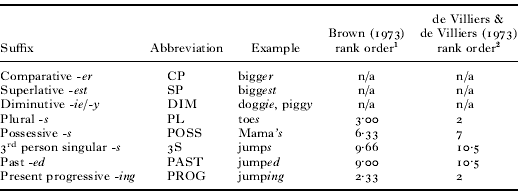
The eight suffixes we investigated are presented in Table 1. The set consists of two adjective suffixes, the comparative (CP) and superlative (SP); three noun suffixes, the diminutive (DIM), plural (PL), and possessive (POSS); and three verb suffixes, third person singular (3S), past (PAST), and present progressive (PROG). For each transcript, the caregiver's and the child's productions of each of these suffixes were counted. Child suffix productions that were exact repetitions (based on morphosyntactic tier transcription) of a word in the most recently produced caregiver utterance were excluded from the child suffix counts.
Suffixes examined in the current study
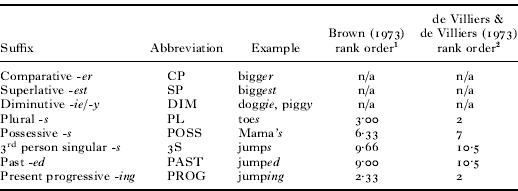
1 The Brown (Reference Brown1973) rank orders are based on longitudinal samples from three children.
2 The de Villiers and de Villiers (Reference de Villiers and de Villiers1973) rank orders are based on a cross-sectional sample of twenty-one children.
A perl script written for this study was used to search within the morphosyntactic tier for occurrences of the eight regular suffixes. The search used regular expressions to search for CHAT's tags for the suffixes. Because gonna was automatically tagged as an instance of the present progressive suffix and because we wanted only clear productions of the -ing, not the catenative, the script was further modified to exclude gonna from all PROG suffix counts. The same perl script counted the total numbers of word types and tokens, numbers of suffix-containing word tokens, and numbers of suffix-containing word types for each speaker in each transcript and eliminated children's repetitions of previous caregiver words from the child suffix counts. The type and token frequencies were then converted to proportions by dividing them by the total number of main-tier word types or tokens, respectively, uttered by the speaker.
The relative frequencies across the suffixes were very similar, regardless of whether tokens or types were used. For the mothers, the mean correlation coefficient across transcripts between suffix token frequencies and suffix type frequencies was r = 0·97, with r never less than 0·65. Thus, only the analyses involving tokens are reported here.
Results
The Conti-Ramsden results and the Weismer results are presented separately for the following reasons: (a) they focus on different, albeit overlapping, populations – the Conti-Ramsden data are from children with SLI and the Weismer data are from late talkers; additionally, there is a large age discrepancy between the children – the SLI children are mostly four years old or older, but the late talkers are all under four years old; (b) the procedures for data collection were different – the Conti-Ramsden data were collected in the children's homes whereas the Weismer data were collected in a laboratory setting; and (c) the participants’ English dialect was different – the Conti-Ramsden participants spoke British English and Weismer participants spoke American English. Whether or not these factors play a role is an empirical question; therefore, we chose to present the two corpora separately.
We first performed t-tests to see if there were any statistically significant differences between the Conti-Ramsden mothers when they were speaking to their older children with SLI compared to their younger MLU-matched TD children or between the Weismer mothers of LTs compared to the Weismer mothers of TD children. We then ran a Pearson correlation for each mother, comparing her suffix frequencies to Brown's rank order of acquisition (the large amount of data included in the current study – 217 transcripts containing a total of 175,265 maternal word tokens and 68,954 child word tokens – made it impractical to individually measure each child's suffix mastery according to Brown's criterion of 90% correct usage in obligatory contexts). Brown's order of acquisition has been found to be highly stable across children (Brown, Reference Brown1973; de Villiers & de Villiers, Reference de Villiers and de Villiers1973) (see Table 1). The superlative, comparative and diminutive suffixes were omitted from this analysis since Brown did not include them in his order of acquisition report. All statistical analyses were performed using R, a free statistical analysis and programming tool (R Development Core Team, 2009). In all statistical tests performed on participant correlation coefficients, undefined participant correlations are excluded from the analysis. Undefined correlations occur when one of the speakers did not produce any of the eight suffixes. We also ran correlations between mothers' suffix production frequencies and their children's suffix production frequencies and we plotted the adult and child suffix production proportions in order to visualize the speakers' usage patterns.
We then compared the caregivers' token frequency proportions for the suffixes that had been reported in the literature as particular strengths or weaknesses in SLI. These included the plural noun suffix -s, reported to be a strength, and the third person singular verb -s suffix and the past tense verb -ed, reported to be weaknesses. The comparisons were done using t-tests, to see if those suffixes previously reported to be relative strengths were significantly more frequent in caregiver speech than those previously reported to be relative weaknesses. For completeness, we also performed these specific comparisons on the child data. Within each group, p's reflect a Holm adjustment for the multiple comparisons.
Finally, we report the proportion of children using each suffix at least once, as an estimate of how many children have acquired the suffix.
Conti-Ramsden corpora
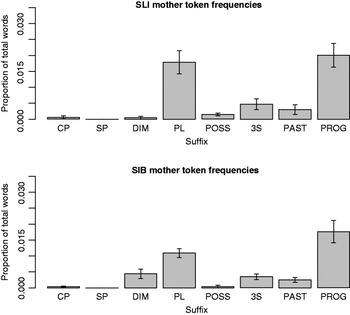
The mean total numbers of words spoken by caregivers were similar for children with SLI and TD children: 911 and 873 respectively, which were not statistically different. Figure 1 displays the maternal suffix token proportions from the Conti-Ramsden corpora. The only suffix that differed in mothers' speech with their children with SLI compared to with the younger TD siblings was the possessive noun suffix, which was more frequent in speech to the SLI group (t(6) = 2·93, p = 0·026, d = 0·98). The PROG and PL were the most frequent suffixes, appearing in a larger proportion of word tokens than the other suffixes. 3S and PAST occurred with moderate frequency and CP, SP, DIM and POSS were lowest in frequency.
Mothers' mean suffix token frequencies in the Conti-Ramsden corpora. Mothers' suffixes tokens when speaking to their children with SLI are shown above and when speaking to their younger typically developing children are shown below. Error bars indicate standard error of the mean.

The average correlation coefficient in the conversation samples between mothers' suffix frequencies when speaking with their elder children with SLI and the rank order of acquisition from Brown's (Reference Brown1973) study was r = − 0·72, indicating that higher mother suffix frequency is associated with earlier acquisition. These correlation coefficients were statistically different from zero across mothers (t(6) = −9·88, p < 0·001, d = 3·73). When mothers were speaking with their younger TD children, results were similar (mean r = − 0·73, t(6) = −10·47, p < 0·001, d = 3·96).
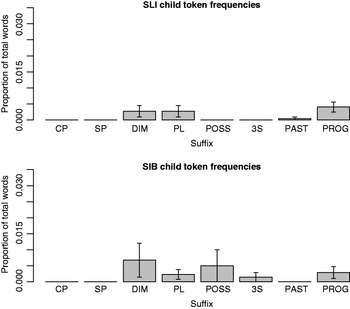
Figure 2 displays SLI and TD child suffix token counts (excluding immediate repetitions of mothers' suffix-containing words) for the Conti-Ramsden corpora. The results generally revealed a pattern of frequency order similar to the adults' suffix frequency order. Quantitatively, the mean correlation coefficient between the SLI children's frequencies (for the children who produced at least one of the suffixes at least once) and their mothers' frequencies, r = 0·60, was significantly different from zero (t(4) = 5·21, p = 0·014, d = 2·61). Similarly, the mean correlation coefficient between the siblings frequencies and their mothers' frequencies, r = 0·46, was also significantly larger than zero (t(4) = 4·07, p = 0·010, d = 1·66).
Children's mean suffix token frequencies in the Conti-Ramsden corpora. Suffix tokens are shown for children with SLI above and for younger TD siblings below. Immediate repetitions of adult suffix-containing words are excluded from the suffix counts. Error bars indicate standard error of the mean.

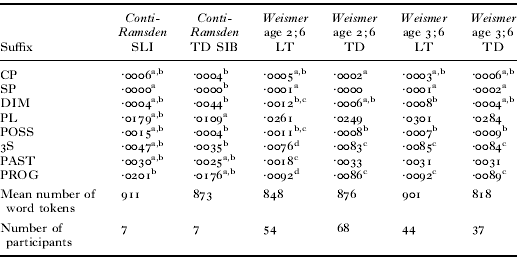
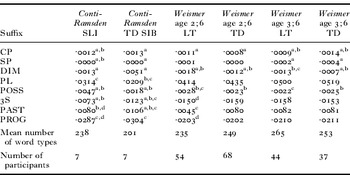
With regard to specific suffixes that have received particular attention in the SLI literature, our hypothesis that the PL plural -s suffix is more frequent in caregivers' speech than the 3S or PAST suffixes was supported. For mothers speaking to their children with SLI, the PL suffix proportion was 0·013 more frequent on average than the 3S suffix proportion (t(6) = 2·85, p = 0·029, d = 1·87). The PL suffix proportion was also 0·015 more frequent on average than the PAST suffix proportion (t(6) = 5·05, p = 0·005, d = 2·18). The same pattern of statistical significance held for the mothers when they were speaking to their TD children (younger siblings of the children with SLI). Post-hoc tests for all 28 pairwise comparisons between suffixes revealed some additional comparisons between suffixes that were statistically significant, even despite the small sample size and a Holm adjustment for multiple comparisons, as indicated by the superscripts in Table 2. Table 3 shows the data for types rather than tokens.
Mothers' mean suffix token frequencies1
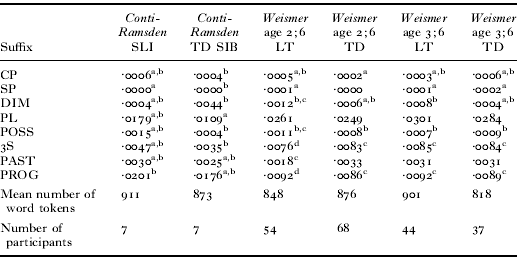
1 Frequencies are given as mean proportions of total words spoken. Superscripts within a column indicate statistically significant different suffixes. Two suffixes having a common superscript letter are not statistically different from each other whereas two suffixes not sharing any common superscript letters are significantly different. Suffixes with no superscripts are significantly different from all other suffixes. Statistically significant was defined as p < 0·05 using a Holm correction for the twenty-eight comparisons performed within each sample. Dallal's (Reference Dallal2001) web program was used to determine the superscripts. Note that for these post-hoc tests the Holm adjustment for multiple comparisons often yielded larger p-values than for the two planned comparisons reported in the text because there were more comparisons in the post-hoc tests.
Mothers' mean suffix type frequencies1

1 Frequencies are given as mean proportions of total word types spoken. Within a column, two suffixes having a common superscript letter are not statistically different from each other whereas two suffixes not sharing any common superscript letters are significantly different. Suffixes with no superscripts are significantly different from all other suffixes. Statistically significant was defined as p < 0·05 using a Holm correction for the twenty-eight comparisons performed within each sample. Dallal's (Reference Dallal2001) web program was used to determine the superscripts.
Among the suffixes produced by the children, the PROG, PL and DIM suffixes were the most frequent. The 3S, PAST, CP and SP suffixes were used less frequently than the other suffixes by both groups of children. The POSS was highly used by the SIB children but not by the SLI children. The SLI children's productions exhibited the same pattern as their mothers' with regard to the specific suffix comparisons of most interest based on previous literature on grammatical suffix acquisition in SLI, though these patterns were not statistically significant, perhaps because of the small sample size (N = 7): the PL frequency in the SLI children's speech was on average 0·003 greater than the 3S frequency (t(6) = 1·54, p = 0·348, d = 1·16), and 0·002 greater than the PAST frequency (t(6) = 1·17, p = 0·348, d = 0·77). A similar pattern held for the TD younger siblings, with the PL being on average 0·001 greater than the 3S (t(6) = 0·38, p = 0·717, d = 0·23), and 0·002 greater than the PAST (t(6) = 1·53, p = 0·353, d = 1·16).
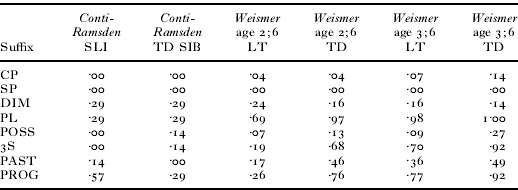
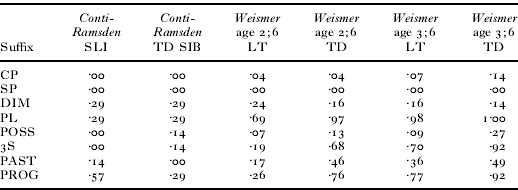
Table 4 gives the proportion of children in each group who produced each suffix at least once, which can be interpreted as a measure of whether or not the suffix has been acquired: 57% of the SLI children used the PROG. In addition, 29% of the SLI children used the PL and DIM whereas only 14% used the PAST and 0% used the 3S. 29% of the TD SIB children used the PROG, PL and DIM whereas 14% used the 3S and POSS and 0% used the PAST.
Proportion of children using each suffix at least once
Weismer corpus
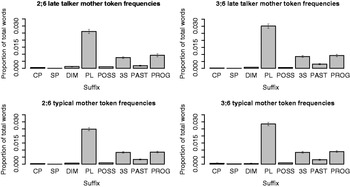
The mean total number of words spoken by caregivers was similar across groups: 848 for the 2 ; 6 LTs, 876 for the 2 ; 6 TDs, 901 for the 3 ; 6 LTs, and 818 for the 3 ; 6 TDs. The differences between LT and TD total token counts were not statistically different. Figure 3 displays the maternal suffix token counts from the Weismer corpus. As was the case for the Conti-Ramsden parents, the suffix usage in the Weismer transcripts is remarkably similar across mothers of late talkers and mothers of TD children. At both 2 ; 6 and 3 ; 6, none of the comparisons between TD and LT mothers' usage of a suffix indicated a statistical difference, except for the PAST suffix at age 2 ; 6, which was present more often in discourse with TD children than with LTs (t(118·5) = −2·88, p = 0·005, d = 0·52). PL was the most frequent suffix in the caregivers' speech, appearing in a larger proportion of word tokens than the other suffixes. 3S and PROG were the next most frequent, and CP, SP, DIM, POSS and PAST were the most rare.
Mothers' mean suffix token frequencies in the Weismer corpus. Mothers' suffixes tokens are shown with late talkers in the top row and with typically developing children in the bottom row. Mothers' suffix tokens directed toward younger children (2 ; 6) are in the left column and toward older children (3 ; 6) are in the right. Error bars indicate standard error of the mean.

At 2 ; 6, the average correlation coefficient between a LT's mother's suffix frequencies and Brown's (Reference Brown1973) rank order of acquisition was r = − 0·53. This was significantly different from zero across mothers (t(53) = −17·08, p < 0·001, d = 2·32). Essentially the same pattern held at 3 ; 6 (r = − 0·52; t(43) = −20·11, p < 0·001, d = 3·03), as well as for mothers of TD children at 2 ; 6 (r = − 0·48, t(67) = −16·77, p < 0·001, d = 2·03), and at 3 ; 6 (r = − 0·53, t(36) = −21·94, p < 0·001, d = 3·61).
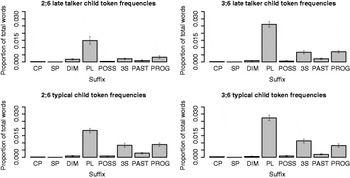
Figure 4 shows the Weismer children's suffix production frequencies. The figure demonstrates a progression in suffix acquisition from 2 ; 6 to 3 ; 6, with the late talkers delayed relative to the typical children. As with the Conti-Ramsden data, correlation coefficients indicate that the Weismer children's suffix token frequencies resembled their mothers' suffix frequencies. These correlation coefficients are higher for the TD group than for the LT group and increase with age for both groups: for the TD group at 2 ; 6, r = 0·77; for the LT group at 2 ; 6, r = 0·66; for the TD group at 3 ; 6, r = 0·87; and for the LT group at 3 ; 6, r = 0·85. Each group's mean correlation coefficient was statistically greater than zero (p < 0·001). The trend for similarity between child and caregiver to increase with age and be greater for the TD group is consistent with the idea that as more suffixes start to emerge more fully, children's speech becomes more similar to adult speech.
Children's mean suffix token frequencies in the Weismer corpus. Suffixes tokens are shown for late talkers in the top row and for typically developing children in the bottom row. Younger children's tokens (2 ; 6) are in the left column and older children's (3 ; 6) are in the right. Error bars indicate standard error of the mean.

Correlations between mothers' suffix token frequencies at 2 ; 6 and their children's frequencies at 3 ; 6 were also highly significant: for the LT group, mean r = 0·78, and for the TD group, mean r = 0·86. In both cases the mean correlation coefficient was statistically greater than zero (p < 0·001).
Our hypothesis that relatively unaffected suffixes reported in the SLI literature would have higher input frequency than suffixes reported to be problematic in SLI was supported. For the mothers of LTs at age 2 ; 6, the PL suffix was on average 0·019 more frequent than the 3S suffix (t(53) = 11·62, p < 0·001, d = 2·40). The PL suffix was also on average 0·024 more frequent than the PAST suffix (t(53) = 16·32, p < 0·001, d = 3·65). The same comparisons were also statistically significant for the LT 3 ; 6, TD 2 ; 6 and TD 3 ; 6 groups. Post-hoc tests for all 28 pairwise comparisons between suffixes revealed a number of additional comparisons between suffixes that were statistically significant after Holm adjustment for multiple comparisons, as indicated by the superscripts in Table 2.
The PL was the most frequent suffix in the 2 ; 6 LT children's speech. The 2 ; 6 LT children exhibited the same pattern as their mothers and the Conti-Ramsden mothers, the same pattern that would be expected based on the SLI literature. The proportion of PL in the 2 ; 6 LT children's speech was on average 0·013 greater than the 3S proportion (t(53) = 4·66, p < 0·001, d = 1·05), and 0·014 greater than the PAST proportion (t(53) = 5·21, p < 0·001, d = 1·26). The same pattern of differences held for the 2 ; 6 TD children and the 3 ; 6 LT and TD children.
Table 4 gives the percentage of children in each group who produced each suffix at least once. At age 2 ; 6, 69% of LTs used the PL suffix, but none of the other suffixes were used by more than 26% of the children. Thus, it might be said that only the PL has emerged in most of the LTs' speech by this age. In contrast, in the speech of the TD children at the same age the PL is well represented and the PROG, 3S and PAST are clearly emerging: 97% used the PL suffix, 76% used the PROG, 68% used the 3S, and 46% used the PAST.
A year later, at age 3 ; 6, 98% of LTs used the PL suffix, 77% used the PROG suffix, 70% used the 3S suffix, and 36% used the PAST suffix. Thus, the 3 ; 6 LT children appeared comparable in suffix production to the 2 ; 6 TD children. Finally, all of the 3 ; 6 TD used the PL suffix, 92% used the PROG, 92% used the 3S suffix, and 49% used the PAST suffix. In sum, the PL suffix was the first to appear, followed by the PROG and 3S, then the PAST. The order of acquisition appears to be similar across typical and late talker populations.
DISCUSSION
The purpose of this study was to examine whether input frequency of English grammatical suffixes from mothers' speech was related to the emergence of those suffixes in the speech of typical and atypically developing children. Despite increasing evidence that input frequency plays a role in linguistic learning (Tardif et al., Reference Tardif, Shatz and Naigles1997), this is the first study to our knowledge that directly assesses the relationship of inflectional suffix frequency in mothers' speech and acquisition using more than just Brown's (Reference Brown1973) three caregiver samples.
Correlation between caregiver and child suffix production
Individual mothers' suffixes were correlated (mean r = − 0·53 across all transcripts) with Brown's (Reference Brown1973) published rank order of acquisition; correlation coefficients were significantly greater than zero as measured by t-tests across mothers. Thus, increased frequency is associated with earlier acquisition. This pattern held for mothers of typically developing children, children with SLI, and late talkers alike.
This finding of an association between increased frequency and earlier acquisition suggests that the frequency of a suffix in a child's language environment may play a role in how difficult it is for the child to learn. While frequency is commonly considered a potential factor in studies of word learning (e.g. Goodman et al., Reference Goodman, Dale and Li2008; Hoff & Naigles, Reference Hoff and Naigles2002; Naigles & Hoff-Ginsberg, Reference Naigles and Hoff-Ginsberg1998), consideration of frequency at the grammatical morpheme level is less common in both the normative literature and the literature on SLI and language delay. Exceptions in the normative literature are Brown (Reference Brown1973), de Villiers & de Villiers (Reference de Villiers and de Villiers1973) and Moerk (Reference Moerk1980), where the power to detect a relationship between frequency and acquisition was severely limited by small sample sizes.
Our results suggest that frequency at the grammatical morpheme level should be given consideration in studies of morphosyntactic learning, both in typical and in language delayed or impaired populations. At the least, studies that aim to address the role of other factors affecting such grammatical morpheme learning should consider using frequency of morphosyntactic items as covariates in their statistical analyses. For example, the optional infinitive account (Leonard, Reference Leonard1998; Rice et al., Reference Rice, Wexler and Hershberger1998; Rice, Wexler, Marquis & Hershberger, Reference Rice, Wexler, Marquis and Hershberger2000) is a linguistic account of SLI that posits a deficit specific to the finite verb system. Another account, the perceptual processing account (Ellis Weismer & Hesketh, Reference Ellis Weismer and Hesketh1996; Riches et al., Reference Riches, Tomasello and Conti-Ramsden2005), proposes that processing deficits, perceptual or cognitive, underlie the language difficulties in SLI; thus, linguistic stimuli that are not acoustically salient (e.g. because they are presented very quickly) or that are infrequent pose especially great challenges for the weak perceptual or memory systems of children with SLI. If the optional infinitive or perceptual saliency accounts were found to explain variance in acquisition of grammatical morphemes by children with SLI even when the variance explained by input frequency has been removed, this would provide more definitive support for that theory of SLI.
Frequencies of specific suffixes in caregiver speech
We also found that specific inflectional suffixes typically considered to be problematic for children with SLI (the 3S and PAST suffixes) were relatively less frequent in caregiver speech than an inflectional suffix typically considered to be a relative strength for children with SLI (the PL) (Marchman et al., Reference Marchman, Wulfeck and Ellis Weismer1999; Rice et al., Reference Rice, Wexler and Hershberger1998). This pattern was highly stable across all groups of caregivers, although effects were more often significant for the Weismer corpus, likely because of the larger sample size (N = 37 to 68 per group) compared to the Conti-Ramsden corpora (N = 7). We also found that the PL emerged earlier and was more frequent than the PAST and 3S in the SLI, LT and TD children's speech, confirming the finding from the SLI literature about their relative ease for children with SLI and generalizing this to LT and TD groups.
In addition to examining suffixes that have been addressed in the SLI literature, we also examined caregivers' usage of additional suffixes that have received less attention in the literature. Stable patterns emerged with respect to these suffixes as well. Frequency in mothers' speech for the progressive verb -ing (PROG) suffix was high for the British English (Conti-Ramsden) sample and was moderately high for the American English (Weismer) sample, and the comparative (CP), superlative (SP), diminutive (DIM) and possessive ’s (POSS) suffixes were relatively low. Based on these findings, we would expect PROG to be acquired relatively early and be a relative strength in SLI. On the other hand, we would expect POSS to be acquired relatively late and be a relative weakness in SLI. Indeed, Brown found that the PROG was among the earliest acquired morphemes and that POSS tended to be acquired later than PROG and PL (CP, SP and DIM were not included in Brown's study). In the next section we will discuss further the order of emergence of these suffixes in child speech.
Both the overall amount of adult speech measured in terms of number of words and the frequencies of specific suffixes were similar across typical and impaired/delayed groups for the corpora included in this study. This stands in contrast with previous findings of differences in the nature and quantity of adult input to children with SLI compared to TD children (Conti-Ramsden et al., Reference Conti-Ramsden, Hutcheson and Grove1995; Hammer et al., Reference Hammer, Tomblin, Zhang and Weiss2001), but can perhaps be explained by differences in the way adult input was measured in the present study as compared to how adult input was measured in those earlier studies. Conti-Ramsden et al. (Reference Conti-Ramsden, Hutcheson and Grove1995) found that caregivers provide fewer recasts to their children with SLI than to their TD children. It is possible that within a recording, interactive features of caregiver input, such as rate of recasts, could differ while overall amount of input and types of words and morphemes used remains similar. Hammer et al. (Reference Hammer, Tomblin, Zhang and Weiss2001) found differences in the amount of conversational interaction reported by parents of children with SLI compared to parents of TD children. It could be the case that rates of interaction during short laboratory play sessions such as those represented by the corpora included in our study are generally high across both groups and not representative of the rates of interaction across a child's whole day (including activities such as feeding, driving, dressing, etc.). Thus, the lack of parent input differences across groups in the present study does not necessarily contradict findings of caregiver input differences from previous studies.
Emergence of suffixes in children's speech
We examined the emergence of the suffixes in the Weismer LT and TD children's speech at two ages (2 ; 6 and 3 ; 6), by reporting the percentages of children who produced a suffix at least once. Given the size of the corpora we were working with, it was not practical in this study to measure production in obligatory contexts. Thus, for the purposes of the present study, any production of a suffix was taken as evidence of a child's having begun to acquire that suffix. We observed that for late talkers and typical children alike, inflectional suffixes appear to emerge in an order consistent with maternal frequencies. Specifically, more frequent suffixes in caregiver speech, such as the PL, appear earlier than less frequent suffixes, such as the 3S and the PAST.
Additionally, the general order of inflectional suffix emergence was somewhat consistent with Brown's (Reference Brown1973: 271, 274) order of acquisition in that the PL suffix was acquired before the POSS, PAST and 3S suffixes. In contrast with Brown's findings, the PROG was not the first suffix to emerge and the POSS did not emerge before the PAST and 3S. The difference regarding PROG could be due to dialect differences between the Brown participants and the Weismer participants (the latter appear to have frequently used gonna in place of going to).
We also found that the late talkers seemed to have delayed acquisition of suffix frequencies compared to typical controls. This replicates previous research that shows children at risk for SLI (late talkers) acquire inflectional suffixes more slowly than typical controls and that for those at-risk children as well as for TDs, the PL suffix is acquired more easily than the 3S and the PAST verb suffixes (Rice et al., Reference Rice, Wexler and Hershberger1998).
As discussed in the previous section, our study extended beyond those suffixes given the most attention in the SLI/LT literature (i.e. PL, PAST and 3S). For example, the PROG suffix was not one of the suffixes involved in our planned comparisons. However, its high frequency in parental input in the British English (Conti-Ramsden) sample, relatively high frequency of production by the children in that same sample, and early age of acquisition as reported in Brown (Reference Brown1973) make PROG an example of a relationship between high input frequency and early acquisition for a verb/verbal suffix. With regard to noun suffixes not traditionally given as much attention in the SLI/LT literature, the POSS and DIM were both relatively rare in adult speech and were late to emerge in the children's speech. Additionally, the CP adjective suffix also follows the pattern of low adult frequency and late emergence in children's speech and the SP adjective suffix is the rarest suffix in adult speech and was not produced by any of the children in this study. In sum, these findings support the idea that verb suffixes need not be acquired late and frequency effects on inflectional suffix acquisition likely apply regardless of the part of speech of the stem.
Specific language impairment and late talking may be associated with a variety of weaknesses in perceiving, understanding, representing and producing language. These weaknesses appear to have a multiplicative rather than a linear effect such that morphemes that are acquired later in typical development tend to be the ones that show the greatest relative weakness in SLI and LT (Rescorla & Roberts, Reference Rescorla and Roberts2002). The frequency data for additional suffixes can thus be used to generate hypotheses about items that may serve as additional markers of language delay or impairment. The input frequencies and child usages reported in Tables 2, 3 and 4 suggest that in addition to PAST and 3s, CP, SP, DIM and POSS would be expected to be difficult for children with SLI and LT, with CP, SP and DIM being the most difficult.
Possible explanations for the relationship between input frequency and child suffix usage
There is variation in the frequency with which different suffixes are used by caregivers. The frequency of a specific suffix likely is determined by a variety of factors, such as the grammar of the language and the frequency with which the speaker wishes to expresses the semantic concepts associated with the suffix. For example, if a conversation between child and caregiver includes many nouns (e.g. object names), and the language dictates that plural nouns be marked, such factors should cause the plural noun suffix to have high frequency in caregiver speech. As another example, if speakers do not often find themselves needing to describe events in the perfect tense as often as they find themselves needing to describe events using the progressive tense, then the regular past -ed suffix should be less frequent in adult speech than the progressive -ing suffix. Likewise, if the superlative adjective suffix represents a concept that individuals do not often find themselves needing to express, and if it is not required for an utterance to be grammatical, such factors should cause the superlative adjective suffix to be low frequency in caregiver speech.
There are multiple reasons why children might tend to acquire suffixes in the order of their frequencies in their parents’ speech. First, high frequency of occurrence in a child's language environment may provide the child with more opportunities to learn through exposure about the perceptual, grammatical and semantic features of the suffix, may make the suffix more salient, and may help the child construct a robust representation of the suffix so that it can generalize productively to novel words (Bybee, Reference Bybee1995; Nicoladis et al., Reference Nicoladis, Palmer and Marentette2007; Tomasello, Reference Tomasello2005). Such factors would presumably increase the frequency of a child's attempts at producing the suffix, providing the child's with practice articulating the suffix (Fey et al., Reference Fey, Long and Finestack2003) and with the communicative rewards afforded by using the suffix.
Future directions
Further research is needed to identify the contribution of input frequency compared to other factors, such as perceptual saliency, grammatical complexity, semantic complexity and pragmatic factors (Brown, Reference Brown1973; de Villiers & de Villiers, Reference de Villiers and de Villiers1973; Goodman et al., Reference Goodman, Dale and Li2008). Empirical investigation of potential interactions between factors is also called for. For example, it is conceivable that an interaction between reduced amounts of language input from caregivers (Hammer et al., Reference Hammer, Tomblin, Zhang and Weiss2001) and a need for greater amounts of input and practice may be at play in the lexical and morphosyntactic development of children with SLI. If children with SLI require more input exemplars than TD children in order to acquire a word or grammatical morpheme, then reduced amount of overall input from caregivers could be particularly detrimental.
The fact that mothers' suffix frequencies were lower for suffixes that have been identified as weaknesses in SLI than for suffixes identified as relative strengths warrants further investigation into the role of frequency in clinical intervention. One possibility is that simply increasing the exposure that a child has to difficult linguistic items, especially those items being targeted in therapy, may promote a child's learning of those items. However, it's also possible that children with SLI may benefit most from approaches that aim to compensate in other ways for difficulty learning lower-frequency items. For example, approaches such as recasting or elicited imitation may help to increase the saliency as well as frequency of target items (Fey et al., Reference Fey, Long and Finestack2003; Girolametto et al., Reference Girolametto, Bonifacio, Visini, Weitzman, Zocconi and Steig Pearce2002; Kouri, Reference Kouri2005).
In conclusion, the present study suggests that input frequency may be a factor in children's acquisition of grammatical suffixes. In the past, the potential role of frequency in acquisition has been downplayed, probably due to insufficient sample sizes in earlier studies. However, the correlational evidence for a relationship between input frequency and suffix acquisition across the large number of language samples from both typical and clinical populations presented here, combined with abundant evidence from other aspects of language acquisition, warrants further, more controlled studies on input frequency and grammatical suffix development. Understanding the role of input frequency is important to our understanding of acquisition of grammatical morphemes in children generally and is important to improving assessment and intervention methods for language delay and impairment.