Imagine Bulpitt observing politics in America. As a good ‘state-centred’ political scientist Bulpitt would be sensitive to institutional arrangements and careful to understand the rules of the game. He would recognize that, formally speaking, America is deeply rooted in a federal structure. Constitutionally, it is a nation of dual sovereignty where two types of government operate at different levels and exercise power over differently conceived territories – a sovereign national power and 50 other ‘sovereign states’.
Bulpitt's own account of federalism is quite nuanced. He disdained labels and recognized federalism as an organic system, capable of growing into complexities where different governmental levels penetrated one another. As Bulpitt recognized, ‘the heat and pressure generated by social and economic changes’ caused central and peripheral governments to ‘melt and flow into each other’.Footnote 1 Bolstering the argument for interpenetration, he approvingly quoted Michael Reagan, who argues that American federalism was transformed during the twentieth century to the point where ‘no sphere of life is beyond the reach of national government.’Footnote 2
Left out of Bulpitt's account are the thousands of local governments, whose history accords them a degree of independence unknown in most other countries. It was this trait that caused De Tocqueville to declare during his sojourns in America that ‘municipal independence is a natural consequence of the sovereignty of the people.’Footnote 3 More than anything else, power and responsibility in the USA are diffused from a national centre to more than 87,000 local governments. Counting only municipalities and townships, America has one of the lowest ratios of government to citizens in the world, amounting to one locality for every 8,139 residents. Over the last 30 years, the number of governments has grown by more than 12 per cent.Footnote 4 We refer to the broad political discretion practised by cities, towns and villages as proliferating autonomy.
The ideas of interpenetration and proliferating autonomy are twin pillars of the system. This rests on the ability of the national government to interject itself in local affairs when the nation's wellbeing is at stake. As he negotiated his way through these incongruities, Bulpitt also recognized legal differences between the United Kingdom (UK) and the USA. Whereas his own countrymen leave fundamental principles inexplicit, Americans prefer to state them. This is made possible by a constitutional warrant to the national government, assigning it the right of ensuring the ‘general welfare’, the privilege of controlling ‘interstate commerce’, and the prerogative of passing laws that are ‘necessary and proper’. Thanks to liberal judicial interpretations of these clauses, national government can legislate throughout the political system. The result is a complex intermingling of national power exercised in a patchwork of state and local governments that enjoy varying degrees of autonomy.
Related to the idea of interpenetration are Bulpitt's dimensions of territorial management or his ‘territorial code’. He outlines five options that might be used to control the periphery.Footnote 5 Briefly stated the options are: (1) central penetration of the periphery; (2) central control of local governments; (3) assimilating local elites; (4) organizing local institutions; and (5) direct citizen mobilization.Footnote 6 However, as we will discuss later, Bulpitt's terminology requires some caveats when applied to the USA.
In simple terms, central penetration refers to the presence of agents from the national capital exercising authority over a given territory. This control covers an ability to impose internal law and order, raise taxes and, at the very least, ensure a level of minimal authority throughout the periphery. The range of central penetration might vary from civil and military intervention to ward off anticipated resistance in a given territory to ‘punitive expeditions’ after the fact in order to bring about local compliance. Central control of governments entails direct and longer-term rule over the periphery. It captures a broad array of central impositions on the periphery, varying from simply limiting the actions of local government all the way to imposing long-term policy objectives.Footnote 7 Local elite assimilation is a form of indirect rule whereby the centre is able to shift the allegiances of peripheral elites to itself. Much of this is a matter of ‘converting’ local elites to favour central objectives. In American parlance this might be a form of co-optation that can be described as a ‘process of absorbing new (peripheral) elements into the structure of an (central) organization’.Footnote 8 As we explain below, this option is not often used in the USA, although there are instances of its occurrence. The last two of Bulpitt's options relate to marshalling local organizations or directly mobilizing the local citizenry to act on behalf of central elites. Because these categories are so similar, we treat them as a single option, under the rubric of popular mobilization. In this case central elites enlist local institutions (political parties, trade unions etc.) or appeal directly to citizens to advance central policy objectives.
Bulpitt adds to the territorial code by classifying the distribution of political responsibilities between the centre and periphery along the lines of high and low politics. ‘High means matters of state, international policy and the economy; low is about administration and public services.’Footnote 9 The terms ‘high’ and ‘low’ politics carry a normative tone, but are to be expected, given Bulpitt's perspective. However, it can be argued that these terms are dependent upon the political ideology of the ruling regime or party. In the American case most Democrats see Bulpitt's low politics on a similar plane to high politics. Republicans take a more Bulpittian view and recognize that each occupies a different place on the policy hierarchy.
In the following pages we illustrate how some of these options work in the American context. We emphasize two of Bulpitt's options (central penetration of the periphery and central control of local governments) that were prominently used during the presidencies of Franklin D. Roosevelt, Lyndon Johnson and Richard Nixon. These were certainly stressful periods in the nation's history in which the centre attempted to control local governments. Citizen mobilization was also used during the Johnson years and has shown some nascent life during the Obama administration.
On the other hand, Bulpitt also understood that national intervention is not always warranted, and there are times when central elites stay out of local affairs. Indeed, for much of the republic's history, Washington DC remained apart from state and local affairs. But, when the Great Depression struck the nation in 1929, the national government exercised all options. Since then the US system has experienced periods of great national presence in local affairs, followed by lesser intrusions and still other periods of near withdrawal. This episode set in motion a pattern that is evident today. Examined over the longer run, the national presence came to resemble a political yo-yo, where it sometimes dropped into local affairs, only to spring back up.
How might Bulpitt begin to explain these radical shifts in the equilibrium of territory and power? Undoubtedly he would discern that the yo-yo effect was prompted by principles similar to those he had observed in Great Britain, which are related to centre–periphery differences, territorial codes and the like. He might also look behind the institutional edifices to uncover how local culture affected power relations and understand how, as he put it, the centre engages organizations and citizens to ‘control and deploy its own interests’.Footnote 10
Notwithstanding Bulpitt's cautions, there are important differences between the two nations for which he did not account. For one, any comparisons will be subject to political facts and the manner in which they are played out in particular contexts. In America the federal context and decentralized political parties make it difficult (though not impossible) to control the periphery. Local politicians are elected on their own, frequently drawing upon a set of issues different to those of their national cohorts. In fact, local politicians often run during ‘off years’ and some can ignore the national election cycle. Even when local voting coincides with national election years, proliferating autonomy makes it possible to run on entirely different agendas (schools systems, police protection, zoning ordinances). Simply put, US federalism encourages a political separation between elites at different levels. For some people the periphery is as important as the centre, and some politicians will intentionally spend their entire careers at the edges of the system. Recalcitrance is often a badge of honour that enables a politician to proclaim his or her ‘independence’. Perforce, any effort to deal with local politics is frequently made by offering carrots, sometimes by supporting the local opposition and most rarely by wielding sticks.
Second, Bulpitt would confirm his principle that national elites gear actions towards preserving their own basic interests and values, but these interests and values can be interpreted differently. Most Republicans prefer to leave well enough alone – that is to exercise a very narrow and sparse national presence in local affairs, while allowing a ‘free marketplace’ to do the rest. Such an approach automatically cultivates the Republican constituency of small towns and suburbs. From a Bulpittian perspective a Republican approach would more closely follow the distinction between high and low politics, allowing elites to concentrate on national fiscal policy, defence and foreign affairs.
For the Democrats, however, the distinctions between high and low politics are less clear. These shift over time, place and ideology. For those on the party's left wing, high politics can be found in the very act of easing domestic crises and rebuilding the cities. Both Franklin D. Roosevelt and Lyndon Johnson – at least initially – considered themselves to be ‘domestic presidents’ with strong local policy agendas.
These differences bring to mind a third consideration, hinging on the role of electoral politics in determining how the national government behaves. It is not coincidence that it was an earthy national Democratic politician named Tip O'Neill who coined the phrase, ‘all politics is local’. For many Democrats, success at the polls was determined by their ability to deliver social welfare policies. Hard-pressed constituencies in the cities, consisting of blue-collar workers, trade unionists, ethnic minorities and urbane liberals, demanded national assistance.
Quite another set of political considerations motivated Republicans. The traditional Republican constituency included farmers and businesses (hence the familiar slogan of ‘Main Street to Wall Street’). After the late 1960s that constituency came to include a suburban middle class whose constituency did not demand government assistance as much as relief from most national intervention (though they favoured expenditures for defence and highway-building). Spending less and doing less for state and local governments defined Republican policy preferences.
To generalize, we might say that most Democrats looked with sympathy towards redistributive policies (social welfare, assisted housing) while Republicans leaned towards developmental policies (low taxes, highway construction). In assessing how territory and power would be treated, Bulpitt would have to be careful to take into account how voters from different places responded to these considerations by favouring one party or another.
Above all, Bulpitt would have been delighted to see how much geography mattered and how elites operated in terms of their perceived geographical base. Bulpitt's territorial cleavage affected demarcations between America's major political parties. Once traditional blue-collar workers bought a house in the suburbs, they shifted allegiance from Democrat to Republican. By the same token, a smaller number of people moved from the hinterland to the cities, and they too shifted their vote, this time from Republican to Democrat. These changes would have a profound effect on how politics was played out along territorial lines.
NATIONAL URBAN POLICY, TERRITORIAL POLITICS AND PRESIDENTIAL APPROACHES
Taking a cue from Bulpitt, we define national urban policy as formal decisions emanating from ‘central institutions in the capital city’.Footnote 11 These decisions are ensconced in law and directly aimed at improving social conditions and the built environment in America's major central cities. They embrace objectives related to the reduction of poverty, increasing employment, improving housing and enhancing community development. National urban policy is particularly useful for examining territorial politics. It demonstrates the extent to which central elites have been committed to cities, it reveals how central elites relied on their own version of a ‘territorial code’ to engage, limit or withdraw federal involvement in different territories and it shows how the benefits of national intervention were distributed over different periods of time.
We approach territorial politics in America by examining the twists and turns of urban policy over a period of approximately 40 years (1964–2008). We focus on how urban policy was played along spatial lines over a designated period of time. This too is consistent with Bulpitt's own historical approach to British politics. Bulpitt believed that, whether the history was ‘detailed’ or presented as a brief ‘overview’, such a perspective was necessary for capturing the essentials of territorial politics.
Moreover, the four decades between the mid-1960s and the turn of the century are both factually important and theoretically valuable. This timeframe is significant because it incorporated new attitudes towards the role of government and was a time that generated a tremendous variety of approaches to urban policy. The uniqueness of this period varied from direct reliance on central government all the way to the other end of the spectrum, where central government withdrew from the cities and defaulted to ‘rule by the marketplace’. The theoretical value of these shifts highlights the tools used to carry out territorial management as well as the generalizations that might be drawn from their effects. This period enables us to identify the operations connected with central penetration of the periphery (during the 1960s), the effects of central control of local governments (the 1960s and 1970s) and the various possibilities related to popular mobilization (the 1960s and post 2000).
The actions of the White House and its respective presidents are the subject of each of our periods and, in Bulpittian terms, considered as representing the centre. Granted, American federalism is much more than the decisions emanating from the West Wing of the White House and it is based on three co-equal branches. Governance is based on a triumvirate of executive, legislature and judiciary, and is constrained, with these institutions holding each other in line by checks and balances. Yet, there are pragmatic and historic realities that put the White House at the centre. Pragmatically, policy leadership must come from a unified, partisan corner of government that neither the legislature nor the courts are equipped to enter. Only the White House possesses the capability to carry out this leadership at a national level, and this capacity is also impelled by campaign pledges made by presidential candidates. We are then left not only with the constitutional mandate for the president to execute law, but also the practicality of initiating and shaping the contours of those laws. History validates the rationale of a strong president, and countless volumes have been written, both celebrating and criticizing this feature of US federalism.Footnote 12 Congress will ratify, reject or amend White House initiatives and the courts will rule on their legality, but presidents set the national agenda and are held responsible for its success or failure. This is particularly true for national urban policy.Footnote 13
We find three different presidential approaches to territorial politics in the post-1964 period. We define these approaches in Bulpittian terms on the basis of their varying treatment of high and low politics. Our prototype presidents are Lyndon Johnson (1963–68) Richard Nixon (1969–73) and Ronald Reagan (1981–88). As Bulpitt reminds us, these approaches are not mutually exclusive. We see Lyndon Johnson as having adopted a ‘commonality of both high and low politics’; Nixon took on a style that ‘separated high from low politics’; and Reagan took a different position by espousing a near-total ‘abandonment of low politics’.
Within this context we also treat other presidents and their policies as subtypes. The subtype presidents are identified as Gerald Ford (1974–76) Jimmy Carter (1977–80), George H. Bush or Bush 41 (1989–92), Bill Clinton (1993–2000), George W. Bush or Bush 43 (2001–8) and Barack Obama (2008–present). Our analysis is based on a conceptual fit rather than on chronological order. Carter's urban policy is subsumed under Lyndon Johnson's prototypical style. Ford and Clinton's urban policies are closer to the Nixon prototype. Bush 41 and Bush 43 are subsumed under the Reagan prototype. We end by using these perspectives to offer a prognosis on Barack Obama's nascent presidency.
Figure 1 presents our conceptual schema of presidential prototypes and subtypes. This figure displays how presidents from different chronological periods fit in terms of their approach to urban policy. It begins with a timeline at its base and shows three major strands of prototype presidencies. Branching out from each prototype (Johnson, Nixon and Reagan) are the subtype presidencies (Carter and Obama; Ford and Clinton; Bush 41 and 43).
Conceptual Schema of Presidential Prototypes and Subtypes

Consistent with this conceptual schema we treat prototype and subtype presidencies in tandem with one another and as they carried out national urban policy. To understand better how our prototype presidents dealt with territorial politics, we show their voting tallies in 12 key cities and their suburbs. Finally, we discuss various presidential responses to national urban policy with respect to Bulpitt's concepts of territorial management (territorial codes).
NATIONAL URBAN POLICY: PRELUDE TO THE 1960s
The New Deal and its Aftermath. Like so many innovations, the beginning of national involvement in the cities was catalysed by a severe crisis. The Great Depression of the 1930s swept Franklin Roosevelt into office. Roosevelt adopted a host of New Deal programmes that touched cities one way or another, some more directly than others. The most notable of these that affected cities directly were the Works Progress Administration (WPA) and Public Works Administration (PWA) – both of which poured millions of dollars into reconstructing infrastructure, schools, highways and municipal buildings. The purpose of these policies was not so much to help cities, rather they were efforts at pump-priming, to put people to work and inject money into the economy. There soon followed an alphabet soup of urban programmes, which included the Federal Housing Authority (FHA), the United States Housing Authority (USHA) and the Federal National Mortgage Association (FNMA).Footnote 14
The ‘big four’ of WPA, PWA, USHA and FNMA were mainstays for cities, but there was little permanency to them. Most were partial and destined for termination after recovery. Roosevelt was determined to limit the national presence in cities, saying, ‘the less the Federal Government has to do with running a municipality in this country, the better off we are going to be in the days to come.’Footnote 15
We should also remember that many of the New Deal programmes began at the behest of mayors and city officials. Rather than ‘rebuild the cities’, city officials were hoping to put their constituents to work. Because the cities lobbied so energetically for this federal role, we do not see these policies as examples of either central penetration or central control of local government. Roosevelt's initiatives are closer to Bulpitt's schema being turned on its head, where local elites attempt to capture central resources by pleading for them and following up those pleas by converting central bureaucrats to the local cause. Here we see a form of co-optation in reverse and, because of this, a greater sensitivity of local conditions. This sensitivity may be the reason why Roosevelt's urban policies are seen as largely benign. For Bulpitt this pattern may seem odd, though it may be the case that reverse co-optation is more prevalent in decentralized systems as in the USA than in unitary states such as Great Britain.
All this changed after the Second World War, when initiatives stemmed heavily from Washington and were imposed upon the cities. By the late 1940s and through the 1950s the federal government began to fund massive urban renewal projects whose mega structures often destroyed the local housing stock, and it aggressively built a national highway system that cut through urban neighbourhoods. During this period the centre became more assertive towards the periphery, often developing central mechanisms that controlled local development agencies. Much of this was done by local officials who became wedded to central objectives and worked with federal bureaucrats to tear down viable neighbourhoods.Footnote 16 The immediate post-war period of federal interposition was more akin to Bulpitt's central control of local government and in some cases managed to assimilate (co-opt) local elites. Within a decade, Washington's intervention would mature and grow more complex.
THE JOHNSON PROTOTYPE: COMMONALITY OF HIGH AND LOW POLITICS
The Great Society. Upon winning his election to the presidency in 1964 Johnson had ambitious plans. His idea of a ‘Great Society’ centred on lifting the nation's dispossessed, many of whom had migrated to cities decades earlier. He immediately put a federal imprint on nearly every run-down inner-city neighbourhood, in every big city throughout the country. The lead agency for this federal presence was the Office of Economic Opportunity (OEO), located in the nation's capital city. Through community action agencies (CAAs), local residents could access a variety of services, ranging from pre-school education to job counselling for adults to organizing tenants and consumers.
Nevertheless, by 1966 the White House had come to believe that its urban commitment was still badly in need of a focus and better coordination. Latched onto the OEO/CAA programmes was an initiative popularly called ‘Model Cities’. The strategy of Model Cities was to single out a critical area within a city and concentrate federal resources on it. Cities that could best coordinate, concentrate and redirect federal programmes in a neighbourhood would receive supplemental grants in aid and be designated as ‘models’. Like their CAA counterpart, Model City projects were based on popular participation and residents ran in local elections for positions within a given project.
The Great Society approach to urban policy was to combine local participation with federal involvement. Having become convinced that the old urban machines were obstacles, the Johnson White House was determined either to force city halls to help the poor or to circumvent them by working directly with neighbourhoods. For this reason Great Society legislation relied on ‘categorical grants’ to channel aid into communities. Completing an application for any one of these grants was long and laborious, but policymakers wanted to justify federal assistance. Categorical grants may have been strangled by red tape, but in many eyes this was the only way to target assistance. For Johnson and his Democratic Party, high politics was also low politics. By 1967, the federal executive was ensconced in the cities, working at the grassroots to plant a grand experiment of social uplift.Footnote 17
Territorial Coalitions. The White House's involvement in urban reform was consistent with its political coalition. Lyndon Johnson had begun to fashion a base of support built on blacks, white liberals and left of centre trade unionists – most of these voters still resided in central cities. By contrast, the Republican candidate in the 1964 presidential election, Barry Goldwater, had opted for conservative support from business, farmers and affluent suburbs. The results of that election can be seen in Figure 2, which shows city versus suburban votes for Lyndon Johnson in 12 key metropolitan areas.
Johnson's Territorial Support: 1964 General Election

We should note that, nationwide, Johnson swept into office with more than 60 per cent of the electorate. Johnson's margins in the cities were even greater: he carried Boston and Washington DC by more than 80 per cent of the voters while Baltimore, San Francisco and St Louis gave him over 70 per cent of the vote. The president's margins in the suburbs were considerably lower. Suburbanites in Louisville and Nashville voted contrary to the national trend, giving Johnson little better than 60 per cent of the vote. By contrast, Goldwater lost decisively in most cities, but did manage better in the suburbs and rural areas.
While Johnson's strategy seemed plausible in 1964, events proved his undoing. Aside from Johnson diverting the nation into a disastrous war, the central cities soon erupted in flames and violence. Mass rioting mounted with each passing year of the CAA/Model Cities era, beginning with four major riots in 1965, 21 in 1966, 83 in 1967 and more than 100 in 1968.Footnote 18 Ironically, the very programmes Johnson had initiated were turned against him.
Quelling the violence required massive force and in some cases the police could not do the job alone. Cities such as Chicago, Detroit, Baltimore and Washington DC required intervention by armed federal troops.Footnote 19 Within days of the rioting, Johnson put soldiers in full battle gear onto the streets of Washington DC, with some sent to guard the White House and Capitol building. Those US cities that did not become protectorates of the US army were placed under the control of their state militias (National Guard).
Carter: A Johnson Subtype
Policy Failures. Carter's attempts at a cohesive national policy are more laudable than successful. By the end of his administration he was known as a president who gave good intentions a bad name. Carter's policies exhibit the same commonality of high and low politics as Johnson's, though the national economy was in worse shape and Carter lacked his predecessor's political acumen. Carter's ideological orientation led him to pursue programmes that intervened more heavily in cities than either Nixon's or Ford's did.
The Carter White House envisioned a path to urban prosperity through a system of public–private partnerships, which required a delicate balance that could enlist private investors in a public cause. In the end Carter's ideas were either still-born or went astray. His plans for a national development bank to promote urban investment never made it out of Congress; his efforts to revitalize neighbourhoods never took root; and his expectations that counter-cyclical funding would reverse the downward course of the economy were never realized. As crises grew deeper, the White House suggested that urban residents needed to move out of rustbelt cities and into the sunbelt, where jobs were available.Footnote 20 As the nation stumbled, Carter blamed it all on a crisis of the American spirit (in his ‘national malaise’ speech).Footnote 21
One of Carter's programmes that did yield sporadic benefits was the urban development action grant (UDAG). UDAGs were based on a highly targeted competitive grant selection. Under their provisions, cities combined public and private finance to reinvigorate critical spaces in a city. It was one way in which central decision-makers involved themselves in local development projects. By 1985 UDAGs had distributed $4 billion and reached over 2,200 cities.Footnote 22
Carter's policies are manifestations of the territorial support he received in the 1976 general election. His political coalition was very similar to Johnson's in 1964, with his base consisting largely of African Americans and urbane liberals. Overall, he went on to do remarkably well in urban areas, earning more than 60 per cent of the urban vote in half the cities examined. Both Washington DC and Baltimore stand out, as Carter garnered 69 per cent and 82 per cent of the urban vote respectively. Conversely, his performance in suburban areas was dismal (receiving just 38 per cent of the vote).
Territorial Management of Johnson and Carter
Under Johnson's initiatives central policy objectives were ensconced within the fabric of CAAs and Model Cities. From a Bulpittian perspective these institutions could be viewed as central control of parts of local government. While these institutions were run by individuals elected from neighbourhoods, both their rules and mandates were derived from Washington DC. However, CAAs and Model Cities were actually based on popular mobilization. The agencies publicized Great Society initiatives, they reached out to neighbourhoods and they recruited all those who would listen. Most of these links were forged directly into urban neighbourhoods and without benefit of existing city bureaucracies. Yet for all their initial appeal and promise, these experiments had backfired into mass rioting and disillusion. After a certain point, some organizational leaders turned on the centre and became uncontrollable; the violence compelled a reluctant centre to impose itself upon the periphery with armed troops. It was not long before Johnson confided to friends that CAA/Model Cities were his least favourite programmes.
By comparison, Carter trod more lightly on central involvement in the periphery – in part because of lack of support but also because the White House was more cautious about the chances of success. For this reason Carter was willing to advise residents to leave the cities rather than deal at length with the problems there. Clearly, the earlier experience of the 1960s had brought the centre to realize its limits with respect to control of local government, territorial penetration and popular mobilization. The caution of the centre persisted even though Democrats needed strong and cohesive territorial coalitions to keep them in power.
THE SEPARATION OF HIGH FROM LOW POLITICS: THE NIXON PROTOTYPE
Revenue Sharing and Block Grants. Nixon entered the White House not as a Republican archconservative but as someone from the moderate wing of his party – a pragmatist who took a broad view of history. In domestic matters he was influenced by Daniel Moynihan, who was himself a maverick and an intellectual with an uncanny ability to dissect social problems. So much did the Moynihan view pervade the new White House that Nixon paraphrased his assistant to others by opining, ‘Of course you know perfectly well that it has always been Tory men with progressive principles who have enlarged democracy.’Footnote 23
Nixon's first acts were to limit Washington's intervention in cities by converting categorical grants into a series of revenue-sharing or block grants to states and localities. By doing this, Nixon would sharply curtail the federal participation in neighbourhoods and distressed cities. The process of substituting one granting method for another took different forms. General revenue-sharing was based on a formula that favoured large cities whose tax efforts and rates of poverty were high, but it also awarded undefined lump sum payments to a large number of states and localities. Another type of block grant, called special revenue-sharing, categorized assistance into particular policy areas such as housing, community development, job training, law enforcement and education.
Not all of the programmes were passed by Congress, but some did take effect. General revenue became a favourite, both in Congress and among the nation's mayors and governors. At the same time CAA/Model Cities and other Great Society programmes were gradually folded into a block grant for community development. Seventeen separate job training grants were collapsed within another block grant under the Comprehensive Employment and Training Act (CETA). Instead of Johnson's targeted categorical grants, Nixon's block grants allowed localities to spend federal funds with maximum discretion, often using them to support basic services such as police and fire departments. Whether Nixon's initiatives were intended to defund the cities eventually is a matter of conjecture. The results, however, were reductions in the massive paperwork required under categorical assistance, much greater flexibility given to localities and the spreading of benefits to a larger number of localities in different parts of the nation. For example, the Community Development Block Grant (CDBG) consolidated seven different categorical grants. While localities could use CDBG funding to retain Model Cities, most localities did not and elected instead to support an array of ‘hard’ public works projects such as street repairs, urban renewal and other physical alterations of the built environment.
The political consequences of block grants were profound. Almost immediately Nixon had moved from a targeted and redistributive urban policy to general distributive policies enjoyed by all kinds of jurisdictions. One writer described general revenue-sharing as ‘distributive localism’ because rich and poor localities were lumped into the same programmes.Footnote 24 Some of the worst excesses occurred in affluent suburbs that used funds to build golf courses. While these were exceptions, there was no question that distressed rustbelt cities such as Detroit and Cleveland now shared funding with affluent sunbelt cities such as Houston and Phoenix.Footnote 25 Moreover, the revenue-sharing formula favoured cities with larger populations, and over time more benefits accrued to growing sunbelt cities and suburbs rather than hard-pressed central cities. By these measures the federal presence was kept at a distance and control left to the machinations of low politics.
Another change Nixon brought on was to set a pattern whereby public services were transferred from provision through standard government-run projects to provision through consumer choice. Instead of federal dollars going into public housing, vouchers for housing were given to qualified applicants, who then used the allowance to purchase their own shelter in the marketplace. The idea was to apply funding in an entirely different way, substituting publicly provided facilities with privately chosen options. The concept proved seminal and was applied to education (school vouchers) and health care (private insurance). This, too, encouraged a separation between high and low politics. Republicans reasoned that if the marketplace could distribute benefits, there would be no reason to call upon Washington DC. All of this was quite intentional. As a Republican aide later confided to one of the authors, ‘What do you want us to do? Save the cities? Do you really believe we should go in there and run them? Why, that would be a political joke, with the biggest laughs made on us by the Democrats.’Footnote 26
Territorial Coalitions. Backing up this view was raw politics. By the time Nixon had occupied the White House, the Republican electoral strategy favoured sunbelt states such as Georgia, Florida, Texas, Arizona and California. The new Republican electoral base was pro-white, pro-middle class and decidedly against multi-racial inner cities. Other, newer suburbs in the north and midwest might join this coalition, but Nixon's strategy no longer rested on the Brahmin upper classes of New England, Pennsylvania and New York.Footnote 27
Figure 3 tells us something about Nixon's base of political support. The tallies are taken from the 1968 election, where the Republican Richard Nixon ran against the Democratic nominee Hubert Humphrey. Like the previous illustration, we use 12 cities and suburbs to gauge political support. Nationally, the election was close, with Nixon carrying 43.4 per cent of the vote against Humphrey's 42.7 per cent. The low voting pluralities may also have contributed to Nixon's relative caution (compared to Reagan's) in dismantling earlier programmes. Nixon, however, needed to do things differently from his Democratic predecessor and show there was an effective Republican alternative. Branding his policies with a different ideology played a part in buttressing his territorial politics.
Nixon's Territorial Support: 1968 General Election

Figure 3 shows Nixon's relative strength in the suburbs and weakness in the cities: he carried the suburbs in eight metropolitan areas and only four central cities. Nixon's strongest showing was in the suburbs of Baltimore, Chicago, Indianapolis and San Francisco. The results showed he could carry a plurality of voters by winning the suburbs and paying little attention to central cities, thus vindicating the separation between high and low politics.
Ford and Clinton: Nixon Subtypes
Cautious Policy Successions. Gerald Ford ascended to the presidency on 9 August 1974 and held the presidency for just two and a half years. Upon taking office, Ford was immediately confronted with a number of domestic crises. The national economy was deteriorating rapidly and inflation was rising. The problems of the national economy were reflected in the 1975 New York City liquidity crisis, which led many to question how many other cities were in similar situations. President Ford's initial response was to remain uninvolved and to refuse any requests for aid. Much like Nixon, Ford had little appetite for federal involvement in peripheral affairs. Only after world stock markets began to collapse did Ford provide New York City with emergency loan guarantees.
Partially in response to the situation in New York, the Ford White House reviewed federal initiatives relating to cities. As an outcome of the review, Ford directed Housing and Urban Development (HUD) Secretary Carla Hills to chair the Cabinet Committee on Urban Development and Neighborhood Revitalization. The committee recommended a revised type of block grant for housing and other policy areas. The new grant called for the redirection of federal money to distressed areas.Footnote 28 The Ford White House also promoted the 1974 Housing and Community Development Act – a leftover piece of legislation from the Nixon era based on the characteristics of a block grant.Footnote 29
Bill Clinton was elected in 1992, defeating the incumbent George W. Bush, inheriting a legacy of federal cuts from the Reagan and Bush years (see below). The Clinton White House approached this situation cautiously, hoping on the one hand not to become directly involved in cities and, on the other hand, anxious to provide some kind of assistance. These cautions were reflected in the 1993 Federal Empowerment Zone Act, a programme that provided funding for select cities to establish differing types of districts (zones), designed to stimulate development. In the tradition of block grants ‘empowerment zones’ were designed by the applicants. Local citizens volunteered to sit on problem-solving committees and their members were usually closer to each other and to local government than to Washington DC. Unlike the Great Society, the major actors in Clinton's empowerment zones were organized laterally across the affected neighbourhoods rather than vertically up to central authorities. City halls constructed strategic plans that linked citizens, private institutions and public agencies within the same neighbourhood. As a matter of course, empowerment zones blended free market features such as tax credits and looser government regulations with social uplift programmes that provided family services and workforce training.
Clinton's policies and approach to America's urban areas are not surprising given the territorial support he received in the 1992 general election. His strongest support came from urban areas: on average he won 62 per cent of the vote there compared to just 40 per cent in suburbia. On the other hand, his rural background made him sensitive about over-involving the national government;Footnote 30 having just a 43 per cent plurality of the national vote also constrained him from pushing national intervention too far. At the same time, Clinton also had to differentiate himself ideologically from his Republican predecessor (as Nixon differentiated himself from his Democratic predecessor). Because of these cross pressures Clinton was apt to keep a distance from cities and to lean towards a separation of high and low politics.
Territorial Management of Nixon, Ford and Clinton
What seemed to work for Nixon also worked for Ford and Clinton. Notwithstanding the differences in presidential temper or political affiliation, all of these presidents approached territorial management with caution, if not trepidation. With the partial exception of Clinton's empowerment zones, popular mobilization was non-existent. Even under the Clinton initiatives the linkages between citizens and government were stronger within the periphery than the links up to the centre. Central penetration of the periphery was rare and consisted mostly of occasional actions to enforce equal opportunities in housing or public accommodations. Efforts to control local government were equally infrequent, and consisted of mandates to protect the environment or strengthen law enforcement. While CDBG funding and enterprise zones did impose minimal conditions, it could hardly be said that the centre was imposing its policy objectives on localities. Likewise, empowerment zones were selectively chosen, with localities competing for the honour of carrying out central objectives. This account should not be interpreted as an absence of the centre in the periphery, but as having a cautious presence. One might characterize territorial management under this prototype and subtype as the centre inviting the periphery to participate in federally chosen objectives. Some peripheries welcomed central objectives and saw them as helpful; others chose to keep central elites at bay; a small minority shunned the centre.
THE REAGAN PROTOTYPE: FEDERAL ABANDONMENT OF LOW POLITICS
Policies of Retrenchment. Ronald Reagan was elected president by 50.7 per cent of the popular vote. Upon his inauguration, Reagan declared, ‘government is not the solution to our problems; government is the problem.’Footnote 31 Clearly, Reagan viewed his election as a repudiation of government intrusion into local affairs.
Despite Nixon's attempt to separate the centre from the periphery, Reagan inherited a federal government with significant ties to the periphery. As he assumed power, the federal government provided either federal grants or social welfare spending. These areas included poverty and unemployment, physical decay and economic development of cities, education, transport and general financial assistance to cities.Footnote 32 Reagan, armed with what he thought to be a mandate, abandoned central intervention in peripheral affairs.
This abandonment of low politics rested on a strong ideological base. Reagan's firm beliefs in supply-side economics and free markets shaped his approach to government and policy. His free market philosophy rejected Keynesian interventionism, and the effects were particularly felt in cities.Footnote 33 This ideology gained further momentum because heavy federal intervention during the preceding Carter years had failed to improve bad economic times during the 1970s. These experiences led many to believe that government intervention had interfered with the proper functioning of the marketplace.
Reagan's new approach influenced his thoughts regarding the periphery and low politics. In his 1984 National Urban Policy Report Reagan embraced the ‘rising tide lifts all boats principle’.Footnote 34 This principle held that rising markets were the best way to address urban poverty and unemployment, and so a strong, robust economy would stimulate development and generate local revenues, thereby enabling localities to solve their own problems without having to rely on the federal government. Reagan felt no need for the centre to involve itself in the periphery. On the contrary, increasing the political distance between Washington and the localities was better for everyone. Nor did Reagan fear the impact of his policy choices, believing that cities would pursue their own developmental policies if federal dollars were no longer available. The administration went as far as to say of the cities: ‘it is in their interests to concentrate on increasing their attractiveness to potential investors, residents, and visitors’, instead of competing for federal grants.Footnote 35
Reagan began to shift the federal government away from redistributive policies by eliminating or reducing a majority of social programmes put in place by Johnson and adapted by Nixon. Between 1980 and 1990 the administration reduced federal funding to local governments by 46 per cent.Footnote 36 During the same period, the president eliminated all general revenue-sharing and local public works funding. In his first two years in office, Reagan reduced Nixon's enormously popular CDBG programme by over 11 per cent, and later in his term the reductions reached a staggering 54 per cent.Footnote 37 Similarly, by 1988 Reagan reduced and eventually terminated the UDAG programme.Footnote 38
Reagan's policies of retrenchment entailed stark realities for cities. His economic recovery programme reduced the federal tax burden on corporations and sharply cut federal funding to cities. Corporate income taxes were lowered from 39.6 per cent to 17.8 per cent between 1981 and 1988, and industries were provided with accelerated depreciation schedules. These reductions lowered the cost of investment, which provided further inducements for corporations to follow the national trend of job decentralization from urban to suburban areas.Footnote 39
If anything, Reagan abandoned any pretence of being involved in local politics. By the end of his presidency, the amount of federal funding sent directly to the largest cities was reduced significantly. For instance, from 1981 to 1986 the amount of federal grant dollars in Chicago went from $472 million to $151 million, Baltimore from $220 million to $124 million, Indianapolis from $125 million to $65 million and Detroit from $456 million to $151 million.Footnote 40 Just before Reagan assumed office, federal and state funds financed 50 to 69 per cent of general fund expenditures in six large cities; towards the end of his presidency in 1989, only three of these cities received comparable federal funding.Footnote 41
Territorial Coalitions. Reagan's policies were reflected in his electoral base. His core support came from conservative white suburban areas. Reagan's coalition was similar to Nixon's, but he had tacked sharply to the right, an ideological transformation that was made easier because of popular disaffection with Carter. During the 1980s Reagan managed to shift the national centre of political gravity towards the right, also obliging rival Democrats to turn rightwards.
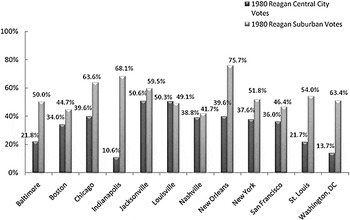
During the 1980 presidential election Reagan garnered half of the total popular vote. However, his territorial support was not as even as the gross totals might suggest. Figure 4 shows how this support split between cities and suburbs in 12 metropolitan areas. In these areas, Reagan received on average a mere 32.9 per cent of the central city vote and 54.6 per cent of the suburban vote. Jacksonville and Louisville, where he received over 50 per cent of the central city vote, were the exceptions. By comparison, Reagan did extremely well in the suburbs, commanding more than 60 per cent of the vote in the suburbs of Chicago, Indianapolis and New Orleans.
Reagan's Territorial Support: 1980 General Election

Like other administrations, Reagan's popularity with the US public was tied to his success or failure. His overall two-term average approval rating of 52 per cent puts his presidency sixth out of the ten past presidencies.Footnote 42 Despite these middling approval ratings, Reagan's new conservative Republican coalition substantially altered territorial politics in America. This was a change that would last for two decades.
Bush 41 and Bush 43: Reagan Subtypes
Less Government, More Market. George H. W. Bush (Bush 41) succeeded Reagan in 1988, having won roughly 53 per cent of the popular vote. Having only served one term and promising not to raise any new taxes, the approach taken by Bush 41 was hardly different from Reagan's. Over the course of his term, the Bush 41 White House reduced CDBG funding by $5 million in constant dollars.Footnote 43 In his 1991 State of the Union message, he declared that government bureaucracies cannot be trusted to achieve desirable domestic goals and values.Footnote 44 Consistent with this message, Bush's HUD secretary, Jack Kemp, developed the idea of federal enterprise zones, modelled on the example set by Hong Kong. The zones were intended to deregulate areas within cities radically, eliminate taxes and minimize government so that private enterprise would flourish. While the enterprise zone bill never made it out of Congress, it did indicate the basic propensities of the new Republican administration.
The electoral base of Bush 41 was firmly entrenched in white conservative suburban areas, the same conservative coalition that propelled Reagan to his two terms. In the 12 metropolitan areas we examined, Bush 41 won an average of 60 per cent of the suburban vote, and he carried one suburban area with 88 per cent. By contrast, he garnered just 38 per cent of the city vote. In Baltimore, New York, San Francisco, St Louis and Washington DC Bush never received more than 30 per cent of the urban vote.
More than a decade later, the elder Bush's son, George W. Bush (Bush 43), was elected president. His election was the closest in history and, having lost the popular vote, Bush 43 entered the White House via a majority of votes in the Electoral College. Bush 43 had campaigned on an agenda of ‘compassionate conservatism’– an ideology that rejected government intervention and believed the poor could be made better through self-reliance, private assistance and religious faith.
Following in the Reagan mould, Bush 43 endeavoured to eliminate what remained of federal assistance to cities. In 2005 his administration introduced the Strengthening America's Communities Initiative, which would have eliminated the CDBG. Had the abolition succeeded, approximately 74 per cent of those funds would have been transferred to the Department of Commerce, a stronghold of business interests. Congress, however, refused to go along with the White House and kept the programme intact, albeit with a $300 million cut. From 2000 to 2006 Bush 43 cut CDBG funding by $1.25 billion in constant dollars.Footnote 45
Bush 43's policies were consistent with his territorial coalition. In 12 metropolitan areas examined, he won a mere 29 per cent of the central city vote while in the suburbs he did better, with 48 per cent. In four of the areas examined, Baltimore, New York, San Francisco and Washington DC, Bush failed to win more than 20 per cent of the urban vote. By comparison, in the suburbs of Indianapolis and Jacksonville Bush 43 won roughly 70 per cent of the vote.
Territorial Management of Reagan and Bush 41 and Bush 43
What the Nixon prototype may have left in abeyance, the Reagan prototype brought to consummation. Reagan and both Bush presidencies kept territorial management of any kind to a minimum. So far as urban policy was concerned, the centre neither engaged in territorial penetration nor attempted to control local government nor take up the cause of popular mobilization.
Bulpitt's prognosis that central intervention in the periphery is integral to normal politics can vary by political system and by the political colours of those holding the centre. Here too Bulpitt might observe that central elites keep a distance from the periphery because it accords with the centre's own desire for autonomy and the preservation of its own interests and values.Footnote 46
Part of the Reagan/Bush resistance to territorial management may have also been due to their ideological aversion to governmental intervention of any kind. There was also no political payoff for the centre to intervene in the periphery; if anything, there were political risks in doing so. Moreover, under Bush 43 the country was politically more polarized than ever before and deeply split between red (Republican/conservative) and blue (Democrat/liberal) areas. During the heyday of Republican dominance party strategists believed that territorial divisions worked to their advantage and would sustain them indefinitely. They were mistaken.
THE OBAMA PROGNOSIS
Democrat Barack Obama ran against Republican John McCain in 2008 and won that election with 53 per cent of the popular vote. Thus far President Obama has had little time to influence the nation's urban policy, but it does appear that the new president is closest to the Johnson prototype. We draw our observations from two Obama initiatives. The first is the American Recovery and Reinvestment Act, signed into law on 17 February 2009. The bill included over $144 billion in state and local fiscal relief, accounting for approximately 18 per cent of the bill's total amount. These monies are supposed to prevent cuts in state and local budgets as well as infuse localities with massive expenditures in public works.Footnote 47 The White House has assumed the role of coordinating and monitoring implementation (through Vice President Joe Biden).
A second initiative is Obama's urban policy agenda. The agenda lays out an ambitious framework to ‘strengthen federal commitment’ to cities. Much of this too will involve a direct role by the White House through its newly created Office of Urban Policy. The director of that office reports to the president and is responsible for coordinating federal urban programmes. Taking a cue from Clinton's empowerment zones, Obama proposed to establish ‘promise neighborhoods’ designed to reduce urban poverty. The programme would provide a full range of social support services to children from birth to adulthood within these neighbourhoods to combat systemic poverty. Lastly the president has rekindled interventionist aspirations by restoring funding for CDBG and other programmes.
Obama is the first president in contemporary history whose primary residence is in a distinctly urban area. His background as a community organizer on the South Side of Chicago makes him uniquely situated to sympathize with the problems facing America's urban areas. We can only speculate that these factors will influence his approach to urban policy. His electoral base may provide even more indication of the policies he will pursue. Obama's electoral core included young voters, progressive liberals and a large percentage of African Americans.
As shown in Figure 5, the territorial coalition supporting Obama is heavily centred in urban areas. On average, he received over 74 per cent of the urban vote, compared to McCain's 24 per cent. Considering his political ideology, it should be noted that Obama did extremely well in the suburbs by winning on average 49 per cent of the vote.
Obama's Territorial Support: 2008 General Election

Obama's approach to territorial politics will be influenced by a number of factors, though it is a fair guess that he will reward his most ardent supporters. Any efforts at direct intervention will be tempered by the availability of funds and the strength of his (mostly Democratic) support in Congress. These factors can pose serious constraints on what he is able to do. Nevertheless, in the long run we are inclined to believe that Obama will follow the Johnson prototype and mix low politics with high politics. He has made a start in this direction by taking some bold steps in popular mobilization through such vehicles as ‘Organizing for America’, a successor to his campaign organization, and the Office of Public Engagement, an agency housed in the White House. This approach separates him from immediate Democratic predecessors and makes him the first president since Johnson to emphasize popular involvement in politics. We see the possibility of Obama engaging popular movements in both high and low politics, but would also caution that these initiatives are not without their potential pitfalls. Such actions may draw the ire of members of Congress who feel that they are being circumvented or even bullied into supporting the president. How Congress reacts and whether this will change the value of popular mobilization is yet to be seen.
CONCLUSIONS
No less than in the UK, territorial politics in the USA is played on a legal and political field. In the USA it is guided by the interpenetration of governments at all levels as well as proliferating autonomy. While these conditions set the rules, they also render territorial politics continually fluid, often erratic and highly differentiated by party affiliation. That said, we should also recognize that Bulpitt is both less and more pertinent to American territorial politics. America is less Bulpittian in that central elites have been cautious about intervening in local affairs, though at times ideology and the desire to bring about social justice have led them into the urban thicket. Presidents Johnson, Carter and now possibly Obama represent that interventionist streak. They are outweighed, however, by Nixon, Ford, Clinton, Reagan, Bush 41 and Bush 43.
By the same token, Bulpittian politics has taken hold in the USA in myriad and unpredictable ways. Central elites co-opted local elites during the urban renewal years of the 1950s, but local elites co-opted central elites during the New Deal programmes of the 1930s. Central elites imposed control on local government and popular mobilization during the Great Society years, but then some neighbourhood elites turned on their supporters. The riots of the 1960s led to a reimposition of the centre in the form of armed troops. Thereafter, the USA witnessed periods of separation, withdrawal and now the possibility of a renewed central presence.
Exactly why America shows such a sharp differentiation in territorial politics can be attributed to several factors. The rules and electoral coalitions of territorial politics are played out in an ideological context that can shift with a presidential prototype. Much depends on the transformative ability of a prototype president. Roosevelt successfully began the ideological shift in the 1930s towards national involvement. Johnson tried to advance it during the 1960s, but was unsuccessful. Reagan was successful in undoing much of that intervention, and by that achievement he affected the behaviour of subtypes in both parties: even a Democrat like Clinton had to operate in an ideological context created by Reagan. We might say that the connection between prototype presidents and the ideological context they create extends far and wide.
Shifting ideological contexts may also contribute to an explanation for why US territorial politics takes more twists than its UK counterpart. Every 20 years or so, an American leader is able to change the direction of national government, and that direction manifests itself in the relationship between the centre and the periphery. It is then not surprising that America's current president, Barack Obama, has expressed his admiration for two very different prototype presidents – Roosevelt and Reagan. It is the transformative power of these two forebears that Obama seeks to emulate, and few domestic initiatives will reveal his success better than his national urban policy. The lesson to be learned is that, regardless of strategy, elites cannot avoid the territorial implications of their behaviour.