

Introduction
As the business environment becomes more dynamic and knowledge-based, employee voice, i.e., employees’ discretionary communication of work-related ideas or opinions to their supervisor (Morrison, Reference Morrison2011), has been found to help supervisors make high-quality decisions (Morrison, Reference Morrison2011, Reference Morrison2014). All too often, however, employees do not speak up because they are aware that their opinions may offend the supervisor and result in negative career consequences (Detert & Edmondson, Reference Detert and Edmondson2011; Milliken, Morrison, & Hewlin, Reference Milliken, Morrison and Hewlin2003). Therefore, scholars have made concerted efforts to examine the factors that motivate employees to take personal risks and speak up to contribute to the organization (Morrison, Reference Morrison2014, Reference Morrison2023).
Current research examined the antecedents of employee voice largely from the perspective of one of the parties, even though it is basically a dyadic interaction process in which employees promote their ideas to their supervisor (Zhang, Liang, & Liu, Reference Zhang, Liang and Liu2023; Zohar & Polachek, Reference Zohar and Polachek2014). For example, researchers have paid attention to employee-related factors such as individual dispositions (Aryee, Walumbwa, Mondejar, & Chu, Reference Aryee, Walumbwa, Mondejar and Chu2017), efficacy and safety calculations (Bienefeld & Grote, Reference Bienefeld and Grote2014), and emotions (Wee & Fehr, Reference Wee and Fehr2021). Meanwhile, other researchers have focused on supervisor-related factors, such as leader humility (Lin, Chen, Tse, Wei, & Ma, Reference Lin, Chen, Tse, Wei and Ma2019), integrity (Peng & Wei, Reference Peng and Wei2020), learning goal orientation (Zhu & Akhtar, Reference Zhu and Akhtar2019), personal control (Sherf, Tangirala, & Venkataramani, Reference Sherf, Tangirala and Venkataramani2019), and leader narcissism (Huang, Krasikova, & Harms, Reference Huang, Krasikova and Harms2020). Such a unilateral perspective may not be able to fully capture the voice scenario co-constructed by an employee and their manager. Therefore, it is a theoretically and empirically deficient approach to understanding employee voice (Krasikova & LeBreton, Reference Krasikova and LeBreton2012; Liden, Anand, & Vidyarthi, Reference Liden, Anand and Vidyarthi2016; Matta, Scott, Koopman, & Conlon, Reference Matta, Scott, Koopman and Conlon2015). Realizing this limitation, recent studies have tried to treat the employee-supervisor dyad as the basic unit of analysis and employed the polynomial regression framework to examine employee voice (e.g., power distance congruence, Guzman & Fu, Reference Guzman and Fu2022; proactive personality congruence, Li & Tangirala, Reference Li and Tangirala2021; Xu, Qin, Dust, & DiRenzo, Reference Xu, Loi, Cai and Liden2019; value congruence, Wang, Hsieh, Tsai, & Cheng, Reference Wang, Hsieh, Tsai and Cheng2012). By considering both employee and supervisor characteristics, this approach provides a more complete picture of employee voice and increases our understanding of when and why employees decide to make valuable contributions to their organizations.
However, previous dyadic approaches have overlooked the goal-oriented nature of employee voice. Employee voice is not just a manifestation of personality traits or values, but a motivational process that involves actively pursuing constructive changes at work (Crant, Reference Crant2000; Morrison, Reference Morrison2011, Reference Morrison2014; Parker & Collins, Reference Parker and Collins2010). Therefore, to fully capture the dynamics of employee voice, we need to consider not only the congruence of personality traits or values but also the congruence of goals between employees and supervisors. Indeed, previous research adopting the bilateral perspective on voice has primarily neglected the notion that individuals with similar personalities may have diverse workplace goals. In contrast, those with different personalities may share objectives. Consequently, redirecting research attention toward examining the (in)congruence between employees and supervisors in goal pursuit complements prior studies predominantly focused on personality or value congruence in the context of understanding voice. In this article, we thus investigate how supervisors aligning their purposeful work striving (i.e., achievement striving) with that of their employees influences their voice, through an underexplored internal motivational mechanism (i.e., organizational identification) in the voice literature.
Achievement striving refers to a strong desire to demonstrate competence and attain a sense of accomplishment by completing job assignments to a high standard (Barrick, Stewart, & Piotrowski, Reference Barrick, Stewart and Piotrowski2002). Directly emanating from motivational strivings (Barrick, Mount, & Li, Reference Barrick, Mount and Li2013), achievement striving is an important proactive goal striving in maintaining and improving job performance. Thus, it is conceptually much closer to voice behavior than other personal attributes (i.e., personality traits or values) examined in previous research on employee-supervisor (in)congruence. However, its relationship with voice behavior is more complex than expected. Intuitively, employees higher in achievement striving have a stronger desire to promote constructive changes and adopt highly efficient methods/procedures to execute tasks. On the other hand, achievement-driven employees might view their voice as a potential threat to their personal success because it may unintentionally challenge the supervisor's authority (Moon, Reference Moon2001; Tangirala et al., Reference Tangirala, Kamdar, Venkataramani and Parke2013). To reconcile the double-edged sword of achievement striving, we suggest that the impact of employee achievement striving on voice is best understood by considering the environment compatibility with the supervisor's level of achievement striving. We, therefore, build a model to investigate this proposition by integrating the theory of purposeful work behavior (Barrick et al., Reference Barrick, Mount and Li2013) with the person-environment (P-E) fit literature (e.g., Kristof-Brown, Barrick, & Kay Stevens, Reference Kristof-Brown, Barrick and Kay Stevens2005; Kristof-Brown, Zimmerman, & Johnson, Reference Kristof-Brown, Zimmerman and Johnson2005).
The theory of purposeful work behavior (Barrick et al., Reference Barrick, Mount and Li2013) suggests that when the social characteristics of work positively link with an individual's purposeful work striving (i.e., achievement striving), achieving personal goals evokes positive feelings of significance, worthiness, and usefulness at work. Following this logic, we suggest that employee-supervisor congruence in achievement striving provides an essential relevant situational cue that enables employees to strive for working goals (Barrick et al., Reference Barrick, Mount and Li2013). Employee-supervisor congruence in achievement striving entails the two parties agreeing on ways that tasks are completed and sharing work standards and the sense of accomplishment. Such mutual understanding creates a favorable social context for employees to pursue their achievement goals and exert personal influence by means of voice behavior. Furthermore, social rewards associated with performing tasks allow individuals to feel fulfillment as a result of their goal striving at work. Consequently, positive experiences of pursuing work goals generate a strong feeling of person-organization fit, which boosts their identification with the organization (Ashforth & Mael, Reference Ashforth and Mael1989; Hornsey, Reference Hornsey2008; Kreiner & Ashforth, Reference Kreiner and Ashforth2004). We, therefore, postulate that identifying with the organization, a psychological merging of the self with the organization (Ashforth, Reference Ashforth1985), mediates the relationship between employee-supervisor congruence in achievement striving and employees’ decisions to voice.
The present investigation contributes to the voice literature in two important ways. First, we enrich the understanding of employee voice by examining the importance of supervisors’ achievement striving to match that of their employees at work. Previous research investigating how employee-supervisor (in)congruence influences voice has focused on congruence in personalities and values (e.g., Guzman & Fu, Reference Guzman and Fu2022; Li & Tangirala, Reference Li and Tangirala2021; Xu, Qin, et al., Reference Xu, Qin, Dust and DiRenzo2019). We extend this line of research by introducing the importance of employee-supervisor (in)congruence in purposeful work striving. This switches the research focus from ‘I understand you as a person’ to ‘I understand why you want to achieve this at the workplace’. Therefore, we demonstrate the importance of social context that facilitates employees’ significance and worthiness of work in motivating employee proactivity (Grant, Reference Grant2008; Parker & Bindl, Reference Parker and Bindl2016).
Second, we highlight the role of employees’ internal motivation (i.e., organizational identification) in understanding the influence of employee-supervisor (in)congruence on voice. Drawing from the person-environment fit literature (Kristof, Reference Kristof1996), previous literature has focused on how affiliative relationships develop in employee-supervisor dyads (Li & Tangirala, Reference Li and Tangirala2021). This approach has improved our understanding about the mechanisms in linking employee-supervisor (in)congruence and voice. However, this approach has overlooked the possibility that employee-supervisor congruence can also positively influence employees’ identification with the organization and motivate them to voice. Incorporating such understanding into the voice research, we complement previous relational understanding in the linkage between employee-supervisor congruence and voice behavior (e.g., Marstand, Martin, & Epitropaki, Reference Marstand, Martin and Epitropaki2017; Tsai et al., Reference Tsai, Dionne, Wang, Spain, Yammario and Cheng2017; Zhang, Wang, & Shi, Reference Zhang, Wang and Shi2012).
Theoretical Background and Hypotheses Development
Achievement Striving and Employee Voice
Individuals characterized by achievement striving have a strong need to maintain high standards (Barrick et al., Reference Barrick, Stewart and Piotrowski2002), to be hardworking (Parker, Bindl, & Strauss, Reference Parker, Bindl and Strauss2010), to demonstrate competence, and to attain a sense of accomplishment (Barrick et al., Reference Barrick, Stewart and Piotrowski2002). Intuitively, a positive relationship is expected between achievement striving and voice. For example, LePine and Van Dyne (Reference LePine and Van Dyne2001) contended that when employees are high in achievement striving, they feel responsible for making suggestions on improvements. This proposition received support in their experimental study. However, Tangirala et al. (Reference Tangirala, Kamdar, Venkataramani and Parke2013) challenged this understanding. They found that highly achievement-driven employees are less motivated to voice because they perceive high personal costs, such as being labeled complainers or troublemakers. To address such inconsistencies, we take a bilateral approach and examine the congruence between employees’ and their supervisors’ achievement striving and its effect on employee voice. The dyadic congruence falls under the broad umbrella of supplementary fit – similarity between a person and others in the organization (Edwards & Shipp, Reference Edwards, Shipp, Ostroff and Judge2007; Kristof, Reference Kristof1996). In line with the person-environment (P-E) fit theory, goal congruence between the supervisor and the employee is a special type of supplementary fit, which entails goal attainment support and reinforcement (Kristof-Brown, Zimmerman, et al., Reference Kristof-Brown, Zimmerman and Johnson2005). That is, supervisors tend to enable employees to attain their working goals when they are aligned with the supervisors’ goal striving.
Achievement Striving (In)Congruence and Voice
Achievement striving congruence and voice
We first argue that supervisors who share a similar level of achievement striving with their employees can create an ideal environment to support the employees’ goal attainment. The congruence in achievement striving allows supervisors to set common goals with employees, including setting agreed performance standards, and completing job assignments in an agreed manner. Consequently, the two sides are likely to agree on working procedures, standards, and a sense of accomplishment. This alignment is particularly encouraging for employees because they would experience a sense of meaningfulness and significance when the context facilitates their goal striving at work (e.g., the leadership, Barrick et al., Reference Barrick, Mount and Li2013; Frieder, Wang, & Oh, Reference Frieder, Wang and Oh2018). From a P-E fit theoretical standpoint (Kristof-Brown, Zimmerman, et al., Reference Kristof-Brown, Zimmerman and Johnson2005), congruence at both high–high and low–low levels of achievement striving should be able to create satisfying experiences which motivate individuals to share change-oriented ideas with their supervisors in order to develop better procedures/methods to achieve their common goals more effectively (Morrison, Reference Morrison2011, Reference Morrison2014). To illustrate, low achievement-driven employees, whose jobs involve standard work process and have little room for achievement or who themselves are job-oriented and focus on financial rewards rather than achievement (Wrzesniewski, McCauley, Rozin, & Schwartz, Reference Wrzesniewski, McCauley, Rozin and Schwartz1997), may feel more comfortable voicing to their supervisors who understand their job and share their goals, compared to leaders who are achievement-driven and set unaccomplished goals.
Achievement striving incongruence and voice
There are two directions of employee-supervisor achievement striving incongruence: (a) employee achievement striving exceeds supervisor achievement striving or (b) supervisor achievement striving exceeds employee achievement striving. Compared to employee-supervisor congruence in achievement striving, both suggest that individuals and their supervisors have different strengths of need for success or accomplishment. Without mutual understanding of achievement motivation, it is difficult for employees to make sense of their supervisors’ demands or lack of demands for achievement and work performance in relation to their own. When employees’ work goals differ from their supervisors’ goals, this is a discordant work situation in the theory of purposeful work behavior. It can create obstacles to employees’ pursuit of goals (Barrick et al., Reference Barrick, Mount and Li2013). These situations can deplete employee energy and make them feel less competent to promote constructive changes at work. As a result, employees are less likely to speak up in both these two incongruence situations.
Specifically, when employees’ achievement striving exceeds that of the supervisor, the supervisor may feel threatened by the employee's level of performance (Khan, Moss, Quratulain, & Hameed, Reference Khan, Moss, Quratulain and Hameed2018; Yu, Duffy, & Tepper, Reference Yu, Duffy and Tepper2018) and refuse to accept their suggestions for improvements. Low achievement striving supervisors may label ambitious and achievement striving employees as troublemakers and respond negatively to their working efforts (Chan, Reference Chan2006). As a result, when employees anticipate or observe their supervisor's negative responses to their accomplishments and suggestions, they would become hesitant to express their opinions and take personal risks that could conflict with their career goals (Tangirala et al., Reference Tangirala, Kamdar, Venkataramani and Parke2013). In contrast, when employees perceive their supervisor's achievement striving as higher than their own, they may struggle to meet the high standards set for work performance and efficiency, leading to a sense of setbacks and frustration in the workplace (Sijbom, Lang, & Anseel, Reference Sijbom, Lang and Anseel2019). The self-initiated nature of voice behavior implies that it is strongly related to how individuals think about themselves, in other words, their self-concept and identity (Strauss & Kelly, Reference Strauss, Kelly, Parker and Bindl2017). When employees feel less confident about meeting their supervisor's goal expectation/requirement, they may start to doubt themselves about their unique values at work. This concern can reduce their initiative and make them less likely to approach their managers to express their ideas (Morrison, Reference Morrison2014).
To sum up, whereas employee-supervisor achievement striving incongruence may interfere with employees’ decisions to voice, we expect employees to be more likely to voice when their leaders’ achievement striving is aligned with their own achievement striving, irrespective of whether achievement striving is high or low. Thus, we hypothesize:
Hypothesis 1 (H1): Employee-supervisor congruence in achievement striving is positively related to employee voice; that is, the more aligned supervisors’ and employees’ achievement striving are, the more employees will voice.
As argued earlier, the congruent situation signals that the supervisor shares similar goals with employees and is willing to provide necessary support in executing employees’ work goals, facilitating employee voice. However, a large body of research on achievement striving has shown that different levels of striving are linked to various attitudes and actions related to goals (Brunstein & Heckhausen, Reference Brunstein, Heckhausen, Heckhausen and Heckhausen2018). Therefore, we argue that high–high and low–low congruence in achievement striving will not influence employee voice equally. The voice literature has suggested that initial motivation (i.e., the desire to bring about changes to the organization) is the starting condition for voice to take place (Morrison, Reference Morrison2014). We draw on this notion to argue that employees are more likely to speak up if their achievement striving and their supervisors’ are congruent at a high level than a low level. This is because high achievement striving employees and their supervisors both have stronger willingness to maintain excellent job performance (Aksoy & Bayazit, Reference Aksoy and Bayazit2022) and aim for constant improvement (Xu, Loi, Cai, & Liden, Reference Xu, Loi, Cai and Liden2019), and are more open to change (LePine & Van Dyne, Reference LePine and Van Dyne2001), compared to low achievement striving employees and supervisors. Therefore, higher achievement striving employees have higher initial motivation to speak up and higher achievement striving supervisors have higher initial motivation to accept and appreciate voice, which makes high–high congruence more beneficial to employee voice than the low–low congruence condition. Thus, we hypothesize the following:
Hypothesis 2 (H2): Employee voice reaches its maximum value when employee-supervisor achievement striving is congruent at a high level.
Achievement Striving (In)Congruence and Organizational Identification
Building on the above direct relationship, which suggests that congruence with a supervisor's achievement striving provides a supportive environment for employees in working goal pursuits, we specifically theorize how employee-supervisor congruence in achievement striving fosters internal employee collective motivation (i.e., organizational identification) to voice. Organizational identification refers to employees’ tendency to (a) define themselves in terms of their organization, e.g., developing feelings of oneness with and belonging to the organization, and (b) perceive the fate of the organization as their own (Ashforth & Mael, Reference Ashforth and Mael1989). They perceive the self as ‘we’ rather than ‘I’ when describing the organization (Brewer & Gardner, Reference Brewer and Gardner1996).
Achievement striving congruence and organizational identification
For two reasons, we contend that employee-supervisor congruence in achievement striving influences employees’ organizational identification. First, both the leadership (Levinson, Reference Levinson1965) and the P-E fit (e.g., Kristof-Brown, Zimmerman, et al., Reference Kristof-Brown, Zimmerman and Johnson2005) literature posit that the supervisor is an important representative of the organization and work environment so that shared motives and goals with the supervisor are akin to shared goals with the organization. Because it is easier to identify with a group of important others, individuals are more likely to identify with an organization if they find themselves similar to current organization members (Turner, Hogg, Oakes, Reicher, & Wetherell, Reference Turner, Hogg, Oakes, Reicher and Wetherell1987). Considering that the supervisor is critical to putting organizational culture into practice (Eisenberger et al., Reference Eisenberger, Shoss, Karagonlar, Gonzalez-Morales, Wickham and Buffardi2014), positive experiences at work indicate a match between employee values and those of the organization, thus creating a strong sense of person-organization fit (Kristof, Reference Kristof1996; Kristof-Brown, Zimmerman, et al., Reference Kristof-Brown, Zimmerman and Johnson2005; van Vianen, De Pater, Kristof-Brown, & Johnson, Reference van Vianen, De Pater, Kristof-Brown and Johnson2004; Verquer, Beehr, & Wagner, Reference Verquer, Beehr and Wagner2003). Employees find their organization an ideal place to pursue personal goals when their values are appreciated by their organization; that is when they fit the organization's values. Moreover, Hall, Schneider, and Nygren (Reference Hall, Schneider and Nygren1970) define organizational identification as a process in which individual and organizational goals become increasingly congruent. Similarly, Mael and Ashforth (Reference Mael and Ashforth1992) indicate that goals shared between individuals and groups are a basis for identification. Therefore, congruence between employees’ and their supervisors’ achievement striving results in high perceived similarity with the organization, which in turn is likely to influence employees’ self-concepts as organization members.
Second, when employees and leaders have similar levels of achievement striving, they are more likely to feel their achievement goals are respected and valued by their supervisors and the organization, which satisfies employees’ needs to have valued identities – a motive for identity construction in the organization (Turner, Reference Turner, Postmes and Branscombe2010). That is, employees’ organizational identification formation builds on whether their supervisor values their identity. Employees’ high achievement striving identity is more easily valued by supervisors who also have a high standard of competence and performance. Similarly, employees with low achievement striving are more likely to be accepted by supervisors who also have a low achievement striving identity because neither the supervisor nor employee strives to exceed task expectations or outperform their peers. In sum, for employees whose supervisor matches their level of achievement striving, their approach to work and how they perceive themselves as employees are likely to be validated by the supervisor during task-related interactions, and this process should reinforce organizational identification.
Achievement striving incongruence and organizational identification
Following the same logic, employees are less likely to identify with the organization when employee-supervisor achievement striving is incongruent. The lack of a supportive environment for employees’ goal attainment impedes organizational identification formation (Ashforth & Mael, Reference Ashforth and Mael1989). Organizational identification is harmed by the tension between self-identity and working roles reflected in a lack of P-E fit. Specifically, for employees whose supervisors do not match their levels of achievement striving, their approach to work and how they perceive themselves as employees are likely to be devalued and deemed unacceptable or threatening by supervisors. For example, when a high achievement striving employee works for a low achievement striving supervisor, they may feel their hard work and efforts to excel are not appreciated by the organization, which may cause them to struggle to make sense of their work in a context that does not reward achievement and identification with the organization. Alternatively, when a low achievement striving employee works for a high achievement striving supervisor, their incompatible standards of competence will likely lead to tension and poor performance evaluations (Sijbom et al., Reference Sijbom, Lang and Anseel2019). Employees are more likely to feel pressure to meet the expectations of the organization or feel that it is difficult to understand the achievement-driven culture of the organization, which leads to a low level of organizational identification. This incongruence between employees’ and their supervisors’ achievement striving can lead to identity conflict (DeRue & Ashford, Reference DeRue and Ashford2010) between the employees’ self-identities and the organizational culture. Taken together, we hypothesize the following:
Hypothesis 3 (H3): Employee-supervisor congruence in achievement striving will be positively related to employees’ organizational identification; that is, the more aligned supervisors’ and employees’ achievement striving are, the higher will be employees’ organizational identification.
Organizational Identification as the Mediator
Because organizational identification reflects a ‘psychological merging of self and the organization’ (Van Knippenberg & Sleebos, Reference Van Knippenberg and Sleebos2006: 527), employees with high organizational identification have a collective self-concept of merging with the organization (Van Knippenberg & Sleebos, Reference Van Knippenberg and Sleebos2006). They experience the collective interests of the organization as their own and share its collective fate (Ashforth & Mael, Reference Ashforth and Mael1989; Dutton, Dukerich, & Harquail, Reference Dutton, Dukerich and Harquail1994). These employees are internally motivated to make contributions to the collective. We contend that because voice is a collective-oriented behavior that aims to improve organizational functioning (Burris, Reference Burris2012; Morrison, Reference Morrison2011), employees’ organizational identification should be predictive of their voice. Because of the risks associated with voice, strong identification with the organization is essential for voice. Indeed, empirical studies have shown that there is a positive relationship between employees’ organizational identification and other non-voice extra-role behaviors (for reviews, see Lee, Park, & Koo, Reference Lee, Park and Koo2015; Riketta & Van Dick, Reference Riketta and Van Dick2005; Van Knippenberg & Van Schie, Reference Van Knippenberg and Van Schie2000).
Together with the arguments we proposed in the last section about the relationship between employee-supervisor achievement striving congruence and organizational identification, we conclude the mediating role of organizational identification in the following hypothesis:
Hypothesis 4 (H4): Employee organizational identification will mediate the relationship between employee-supervisor achievement-striving congruence and employee voice.
Methods
Overview of the Research Design
We conducted two field survey studies to test our proposed hypotheses. As the congruence and incongruence effects of employee-leader achievement striving on voice have not been examined before, we first tested its main effect in Study 1 with a sample of 310 dyadic employee-supervisor pairs in multiple Chinese companies. After finding support for the main effect, we examined the mediating effect of employee organizational identification in Study 2 with a sample of 517 dyadic employee-supervisor pairs in multiple Chinese companies. The data, syntax, and study materials are available on the Open Science Framework at https://osf.io/2fwz8/?view_only = a6fac52d6858415398c92602bb9f0650
Study 1
Sample and procedures
With the help of the alumni office in a large university in eastern China, we contacted 50 human resource (HR) managers. We asked them to distribute hard copies of our questionnaires to full-time employees and their direct supervisors. Finally, 37 HR managers agreed to participate in our survey. They were in different companies in five provinces in China (i.e., Beijing, Tianjian, Jiangsu, Anhui, and Zhejiang) and different industries (i.e., manufacturing, banking, chemistry, and high technology), which greatly increased the diversity of our sample. We asked the HR managers to randomly select two working groups in their company in which the supervisors and the employees worked closely together so we could investigate the employee-supervisor congruence effect.
Before collecting data, we assured supervisors and employees that their participation was confidential and voluntary. The consent form in the questionnaire informed them that their answers were confidential and would only be used for research purposes. The employee questionnaire included questions about their demographics, achievement striving, and employee voice. The employees also provided information on their organizations, departments, and supervisors so we could match leader-employee pairs. The supervisors provided their demographic information, including their gender, age, and education, and their organizational tenure and achievement striving. We provided the participants with prepaid return envelopes so that they could post the completed questionnaire directly back to the research team. We sent out 500 copies of the questionnaires and received returned questionnaires from 310 employees and 64 leaders, making 310 leader-employee pairs, a response rate of 62%.
In our final sample of 310 employees, 64.2% were male and 38.5% were female. The employees’ age was measured as a continuous variable using eight narrow age bands (1 = 18–25, 2 = 26–30, 3 = 31–35, 4 = 36–40, 5 = 41–45, 6 = 46–50, 7 = 51–55, and 8 = 56–60). The average employee age range was 3.27 (SD = 1.27), approximately 32.3 years old. The employees’ average tenure in their current companies was 3.49 years (SD = 4.37). Most employees (44.8%) had a bachelor's degree; 30.7% had an associate degree; 19.3% had graduated from high school or equivalent (GED), and 5.2% had a post-graduate degree. Regarding the 64 supervisors, 72.3% were male and 27.7% were female. Their age was measured as a continuous variable using the same age bands as for employees. The average age range was 3.56 (SD = 1.37), approximately 33.8 years old. On average, the supervisors had worked for their current organizations for 5.58 years (SD = 4.32). Of these participants, most (44.1%) had an associate degree, 36.9% had a bachelor's degree, 11.5% had a post-graduate degree, and 7.5% had graduated from high school or equivalent (GED).
Measures
We used a Likert response scale ranging from 1 (strongly disagree) to 7 (strongly agree). All the materials were presented in Chinese. All English measures were translated into Chinese using the translation and back-translation procedure (Brislin, Reference Brislin1980).
Achievement striving
We adapted four items from the Schwartz Value Survey (Schwartz & Bilsky, Reference Schwartz and Bilsky1987) to measure supervisors’ and employees’ achievement striving. According to Schwartz and Bilsky (Reference Schwartz and Bilsky1987: 557), achievement striving has four facets: being capable, having an exciting life, social recognition, and being ambitious. Rather than measuring it generally, we adapted the measurement items to fit the work context by adding contextualizing phrases such as ‘at work’ or ‘by colleagues’ to the more general items. The four items were ‘Success at work is of great importance to me’, ‘Ambition is of great importance to me’, ‘Being capable at work is of great importance to me’, and ‘Being recognized by colleagues is of great importance to me’. Cronbach's alpha for this scale was 0.79 for employees and 0.83 for supervisors.
Employee voice
We asked employees to report their voice using Van Dyne and LePine's (Reference Van Dyne and LePine1998) 6-item scale. The full scale can be found in the Appendix. Sample items were ‘I develop and make recommendations concerning issues that affect my organization’ and ‘I speak up and encourage others in my organization to get involved in issues that affect the organization’. Cronbach's alpha for this scale was 0.91.
Analytical Method
In this study, we conceptualize employee-supervisor fit in achievement striving as compatibility between the employee's achievement striving and the supervisor's. Therefore, we use polynomial regression to capture the congruence and incongruence effects (Edwards, Reference Edwards, Drasgow and Schmitt2002). Because our employee respondents were clustered in the data, we used cross-level polynomial regressions (Jansen & Kristof-Brown, Reference Jansen and Kristof-Brown2005; Vidyarthi, Erdogan, Anand, Liden, & Chaudhry, Reference Vidyarthi, Erdogan, Anand, Liden and Chaudhry2014; Zhang et al., Reference Zhang, Wang and Shi2012) and response surface modeling (Edwards & Parry, Reference Edwards and Parry1993) to examine the congruence effects on voice (H1). Both employees’ and supervisors’ achievement striving were scale-centered in the regressions, as recommended by Edwards and Cable (Reference Edwards and Cable2009).
Results
Confirmatory factor analyses (CFAs)
Before testing the hypotheses, we conducted CFA procedures to demonstrate the discriminant validity of the two employee-reported variables, i.e., employee achievement striving and self-reported voice. The distinctiveness of the variables was examined by comparing two CFA models: a hypothesized two-factor model and an alternative model which combined these two factors. The hypothesized two-factor CFA model with two pairs of correlated residuals of voice items, χ 2(32) = 83.58, p < 0.01, CFI = 0.95, RMSEA = 0.07, 90% CI [0.05, 0.09], excluding zero, SRMR = 0.05, performed better than the alternative model, χ 2(33) = 439.42, p < 0.01, CFI = 0.64, RMSEA = 0.20, 90% CI [0.18, 0.22], excluding zero, SRMR = 0.15. This was supported by Satorra-Bentler scaled Δχ 2(1) = 147.07, p < 0.01, and lower RMSEA and SRMR. In addition, all the items had significant factor loadings. Therefore, the two factors were distinct in what they measured.
Descriptive statistics
The descriptive statistics are reported in Table 1, including means, standard deviations, correlations, and reliability estimates for the variables used in the study.
Means, standard deviations, and correlations among variables in Study 1 and Study 2

Notes: *p < 0.05; **p < 0.01 (two-tailed). a1 = male; 2 = female. The numbers in parentheses are Cronbach's alpha coefficients for each scale.
Hypotheses testing
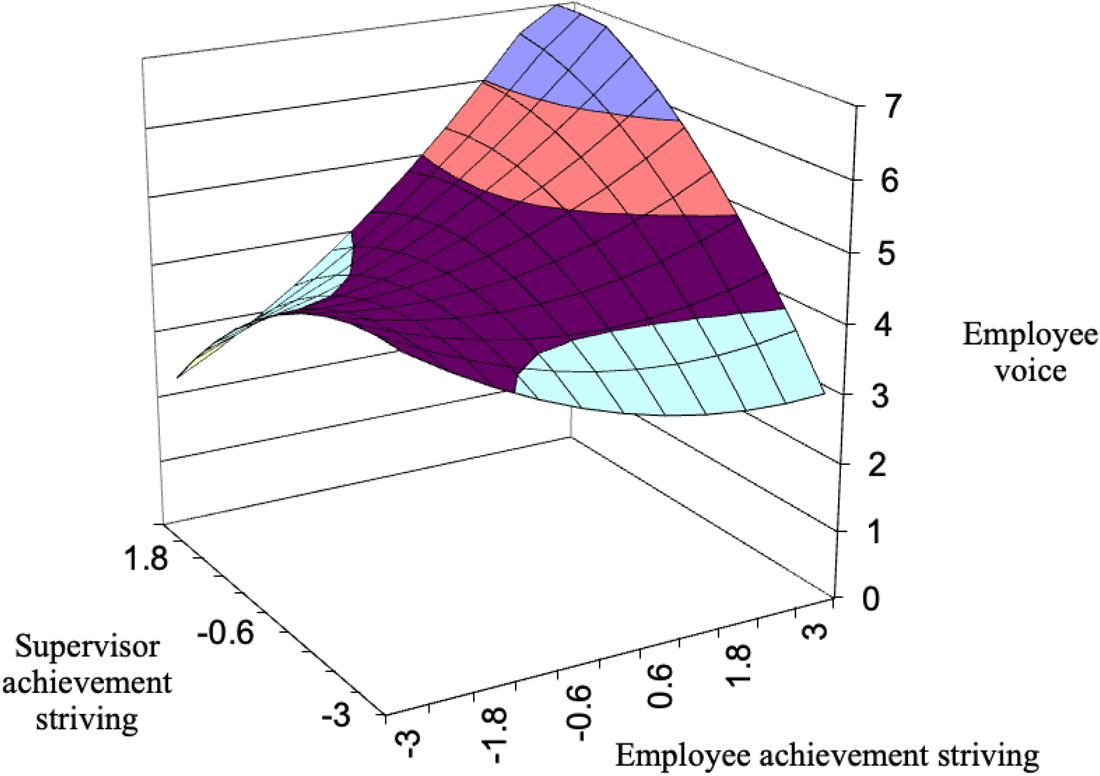
To test H1 and H2, we regressed employee voice on a set of five variables: employee achievement striving and leader achievement striving effects (b1 and b2), their quadratic (squared) effects (b3 and b5), and a product term (b4) (Edwards & Parry, Reference Edwards and Parry1993). After conducting polynomial regressions, we performed additional analyses to examine the slope and curvature along the congruence and incongruence lines to test our hypotheses. According to Edwards and Parry (Reference Edwards and Parry1993), b1 + b2 and b3 + b4 + b5 respectively represent the slope and the curvature of the surface along the congruence line (Y = X; Y: leaders’ achievement striving; X: employees’ achievement striving), while b1 – b2 and b3 – b4 + b5 respectively represent the slope and the curvature of the surface along the incongruence line (Y = –X). To support H1 and H2, a negative and significant curvature (b3 – b4 + b5) along the incongruence line and a positive and significant slope (b1 + b2) and non-significant curvature (b3 + b4 + b5) along the congruence line (Edwards & Parry, Reference Edwards and Parry1993) would be expected.
The resultsFootnote 1 are reported in Table 2 and Figure 1. Figure 1 was produced using the coefficients reported in Table 2. The results showed that along the incongruence line, the curvature (b3 – b4 + b5) was negative and significant (curvature = −0.33, 95% CI = [−0.65, −0.01], excluding 0), and along the congruence line, the slope (b1 + b2; slope = −0.32, 95% CI = [−1.34, −0.73], including 0) and the curvature (b3 + b4 + b5; curvature = 0.31, 95% CI = [−0.01, 0.62], including 0) were both non-significant. The results indicated that the more aligned employees’ and supervisors’ achievement striving were, the more employees were likely to voice. To provide further support for H1, we also tested whether the ridge (or peak) of the response surface (i.e., the position of the first principal axis) ran along the congruence line (Baer, Frank, Matta, Luciano, & Wellman, Reference Baer, Frank, Matta, Luciano and Wellman2021; Edwards & Parry, Reference Edwards and Parry1993; Liu, Zhang, Chen, Li, & Ni, Reference Liu, Zhang, Chen, Li and Ni2023). The 95% CI for the slope of first principal axis (p 11) included 1 (0.45, 3.37) and the 95% CI for the intercept of first principal axis (p 10) included 0 (−2.54, 0.02). Hence, H1 was supported. However, the slope along the congruence line was non-significant, indicating employee voice did not differ in different levels of achievement congruence. Therefore, H2 was not supported.
Results of cross-level polynomial regressions of voice on achievement striving (in)congruence in Study 1 and Study 2

Notes: OID, organizational identification. Unstandardized regression coefficients are reported. Significance tests are based on the bias-corrected confidence intervals derived from bootstrapping estimates with 10,000 samples. *p < 0.05; **p < 0.01 (two-tailed). Our results remained largely the same with or without including control variables in the model. Therefore, we present the results without including control variables.
The congruence effect and asymmetrical incongruence effect of employee and supervisor achievement striving on employee voice in Study 1

Discussion
Study 1 preliminarily examined the direct relationship between employee-supervisor congruence in achievement striving and employee voice, which has yet to be examined in previous studies. It was found that employees are more likely to voice when their and their supervisors’ achievement striving is more congruent. However, why and how achievement striving congruence leads to employee voice was not investigated in Study 1. This was explored in Study 2.
Study 2
Sample and procedures
We approached top managers in 170 companies when they participated in a business workshop held by a large university in eastern China. After we explained our research purpose, 139 agreed to participate. We then contacted the HR manager in each company and asked them to randomly select ten employees and their supervisors in two departments or work groups, making 1390 pairs in total. With the assistance of the HR managers, we provided the employees and their supervisors with surveys along with a cover letter explaining the purpose of the study, assuring confidentiality and informing them that their participation was voluntary. We asked each participant to put his/her completed questionnaire in an envelope and seal it. The HR managers collected the envelopes and mailed them to the researchers. In total, 569 employees and their supervisors completed and returned their questionnaires, among which we matched 517 pairs nested in 125 supervisors, a response rate of 37.2%.
In our final sample, 54.2% of the 517 employees were male and 45.8% were female. The employees’ age was measured using the eight narrow age bands we used in Study 1. The average employee age range was 2.73 years (SD = 1.41), approximately 28 years old. Their average tenure in their current companies was 5.6 years (SD = 6.1). Among the employees, most (55.7%) had a bachelor's degree, 29.1% had graduated from high school or equivalent (GED), 11.4% had an associate degree, and 3.7% had a post-graduate degree. Regarding the 125 leaders, 71.5% were male and 28.5% were female. The average leader age range was 3.90 years (SD = 1.31), approximately 35 years old. Their average tenure was 8.65 years (SD = 6.07). Among the leaders, 51% had a bachelor's degree, 36.1% had an associate degree, 3.2% had graduated from high school or equivalent, and 9.7% had a post-graduate degree.
Measures
Except for employee organizational identification, the measures in Study 2 were identical to those used in Study 1. Cronbach's alpha for employee achievement striving was 0.86, for supervisor achievement striving was 0.77, and for employee voice was 0.90.
Organizational identification
We adopted the 6-item instrument to measure employee organizational identification developed by Mael and Ashforth (Reference Mael and Ashforth1992). An example item is ‘When I talk about my organization, I usually say “we” rather than “they”’. Cronbach's alpha was 0.91 for this instrument.
Control variable
We included a previously identified mediator, leader-member exchange (LMX), in Study 2 as an alternative mechanism to examine the unique effect of organizational identification. LMX was measured with seven items from Graen and Uhl-Bien (Reference Graen and Uhl-Bien1995). An example item is ‘My supervisor understands my problems and needs’. Cronbach's alpha was 0.88.
Analytical Method
We employed the same analytical method as in Study 1 to examine H1 to H3, i.e., the effect of employee-supervisor achievement striving congruence on voice and organizational identification. To examine H4, which predicts that employee organizational identification mediates the relationship between achievement striving congruence/incongruence and employee voice, we used the block variable approach recommended by Edwards and Cable (Reference Edwards and Cable2009) to test the indirect effects of organizational identification. A block variable is a weighted linear composite, the weights of which are the coefficients estimated in a polynomial regression. Therefore, the block variable represents five polynomial terms and can facilitate the assessment of the direct and indirect effects of congruence/incongruence in a mediation model (Edwards & Cable, Reference Edwards and Cable2009) without affecting the coefficients estimated for other variables (Heise, Reference Heise1972; Igra, Reference Igra1979).
Results
Confirmatory factor analyses (CFAs)
To demonstrate the discriminant validity of the four focal variables, we compared alternative models with a baseline model. The baseline model (Model 0 in Table 3) containing three employee-rated variables – employee achievement striving, organizational identification, and voice behavior – indicated good model fit: CFI = 0.96, RMSEA = 0.07, 95% CI [0.06, 0.08], excluding zero, SRMR = 0.04. We first combined two of the three employee-reported variables (Model 1–Model 3 in Table 3) and then combined all the variables (Model 4). Table 3 shows that the baseline model best fitted the data as it had a significantly lower chi-square value than the other alternative models and higher CFI, RMSEA, and SRMR. These results demonstrated the discriminant validity of the variables. These preliminary statistics supported our further analyses.
Confirmatory factor analysis of measurement models in Study 2
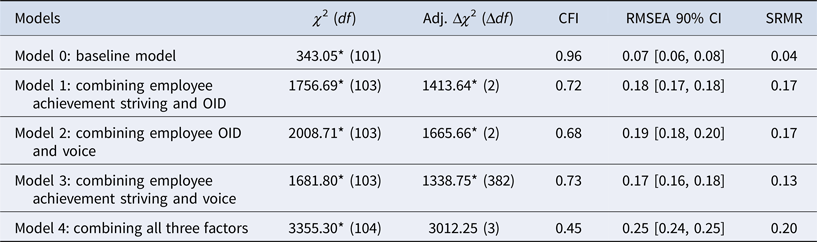
Notes: OID, organizational identification. To determine adjusted Δχ 2, all alternative models were compared with the baseline model, Model 0. *p < 0.05 (two-tailed).
Descriptive statistics
The descriptive results were reported in Table 1, including means, standard deviations, and correlation estimates for the variables used in Study 2.
Hypotheses testing
Just as we did in Study 1, we used cross-level polynomial regressions to test H1 and regressed employee voice on the five polynomial terms. The results are reported in Table 2 and plotted in Figure 2. Similar to the findings in Study 1, the curvature along the incongruence line was negative and significant (b3 − b4 + b5; curvature = −0.22, 95% CI [−0.41, −0.03], excluding zero, and the slope and curvature along the congruence line were both non-significant. We also tested the first principal axis of the surface. Similar to the results of Study 1, the 95% CI for the slope of the first principal axis (p 11) included 1 (0.17, 2.61) and the 95% CI for the intercept of the first principal axis (p 10) included 0 (−0.81, 0.27). Hence, H1 was supported but H2 was not.
The congruence effect and asymmetrical incongruence effect of employee and supervisor achievement striving on employee voice in Study 2
We regressed organizational identification on the five polynomial terms to test H3, which predicted the congruence effect of employee-supervisor achievement striving on employees’ organizational identification. The results are reported in Table 2 and plotted in Figure 3. As expected, the results supported the effect of employee-supervisor achievement striving congruence on organizational identification, with negative and significant curvature (b3 − b4 + b5; curvature = −0.25, 95% CI = [−0.45, −0.07], excluding zero) and non-significant slope (b1 − b2; slope = 0.14, 95% CI = [−0.35, 0.62], including 0) along the incongruence line and non-significant slope (b1 + b2; slope = 0.41, 95% CI = [0.12, 0.98], including 0) and non-significant curvature (b3 + b4 + b5; curvature = 0.16, 95% CI = [−0.02, 0.34], including 0) along the congruence line. As Figure 3 shows, convex plotting indicates that employee organizational identification is higher when supervisor achievement striving is more aligned with employee achievement striving.
The congruence effect and asymmetrical incongruence effect of employee and supervisor achievement striving on employee organizational identification in Study 2

Consistent with previous research methodology (e.g., Cole, Carter, & Zhang, Reference Cole, Carter and Zhang2013; Zhang et al., Reference Zhang, Wang and Shi2012), we tested the mediating effect of organizational identification on the relationship between achievement striving congruence and voice by using the block variable to test the path from achievement striving congruence to organizational identification and the path from organizational identification to voice controlling for the congruence and incongruence effects. The block variable was positively related to organizational identification, B = 0.54, p < 0.01. In addition, when controlling for the effect of LMX, organizational identification was positively related to voice, B = 0.11, p < 0.05. After controlling for the effect of organizational identification and LMX, the achievement striving congruence effect was still significant, B = 0.44, p < 0.01, indicating a partial mediating effect of organizational identification. Monte Carlo bootstrapped CIs of the indirect effect of employee-supervisor achievement striving congruence on employee voice via employee organizational identification was 0.06, 95% CI [0.01, 0.13], excluding zero. Therefore, H4 was supported.
Additional Results
In addition to the hypothesized congruence effect in Study 1, we also found the slope along the incongruence line was positive and significant, which suggested that the convex was sloping to the right, thus indicating employee voice was higher when employee achievement striving was higher than leader achievement striving. However, in Study 2, the slope along the incongruence line was non-significant, 0.14, 95% CI [−0.35, 0.62], including zero, suggesting a need for future research on the nuances and moderators of incongruence on voice.
Discussion
In this article, we have examined how and why employee-supervisor congruence in achievement striving influences employee voice. We found that employees are more likely to voice when they have the same level of achievement striving as their supervisors. This is because employee-supervisor achievement striving congruence can boost employee organizational identification, a critical internal motivator of voice behavior. Our findings have both theoretical and practical implications.
Contributions and Theoretical Implications
This article extends the literature on voice in several ways. First, we advance understanding of the antecedents of employee voice by highlighting the significance of dyadic (in)congruence in work striving. Recent studies have paid considerable attention to understanding the effect of achievement striving on employees’ and leaders’ job performance and extra-role job behaviors (e.g., Chae, Park, & Choi, Reference Chae, Park and Choi2019; Hirschi & Spurk, Reference Hirschi and Spurk2021; Sijbom et al., Reference Sijbom, Lang and Anseel2019; Xu, Qin, et al., Reference Xu, Qin, Dust and DiRenzo2019). By extending this line of research to the voice literature, we have highlighted the importance of achievement striving fit in employee voice. We, therefore, have provided a new approach to investigate the antecedents of voice with a focus on employee-supervisor work striving fit. As achievement striving is one of the four aspects of work striving, we encourage researchers to examine how employee-supervisor congruence in the three other aspects of work striving influences voice: congruence in communion, status, and autonomy striving (e.g., Foulk, Lanaj, & Krishnan, Reference Foulk, Lanaj and Krishnan2019; Tussing, Wihler, Astandu, & Menges, Reference Tussing, Wihler, Astandu and Menges2022). In addition, we found that supervisor achievement striving was positively correlated with employee voice (Study 2), which suggests that achievement-driven supervisors have a positive attitude to suggestions on effective work methods and procedures, echoing previous research on supervisor achievement striving (e.g., Xu, Qin, et al., Reference Xu, Qin, Dust and DiRenzo2019). Therefore, the role of supervisor achievement striving deserves more attention in future voice research.
Second, our findings address the conflicting features of achievement striving. Achievement striving has been conceptualized as a high need to achieve and a desire to perform well (DeShon & Gillespie, Reference DeShon and Gillespie2005; LePine & Van Dyne, Reference LePine and Van Dyne2001), but with a self-centered and agentic orientation to getting ahead (Marinova, Moon, & Kamdar, Reference Marinova, Moon and Kamdar2013; Moon, Kamdar, Mayer, & Takeuchi, Reference Moon, Kamdar, Mayer and Takeuchi2008). Although achievement striving has been found to be positively associated with performance (e.g., Barling, Cheung, & Kelloway, Reference Barling, Cheung and Kelloway1996; Larson, McLarnon, & O'Neill, Reference Larson, McLarnon and O'Neill2020; Parks & Guay, Reference Parks and Guay2012), it reduces collective behaviors such as voicing (Tangirala et al., Reference Tangirala, Kamdar, Venkataramani and Parke2013) and extra-role behavior (Moon et al., Reference Moon, Kamdar, Mayer and Takeuchi2008). Our study provides a new approach to understanding achievement-driven individuals’ behavior and suggests considering the context in which the individuals work. Specifically, we found that while employee-supervisor congruence can increase voice of high achievement striving employees, more importantly, it can motivate low achievement striving employees to speak up based on the employee and the supervisor having common career goals. Therefore, our findings suggest that having a supervisor who shares common goal strivings in the organization is important for individuals to go beyond self-interested motivation and behave collectively. We have used an employee-focused perspective to investigate employee-supervisor congruence in achievement striving. Therefore, we encourage future researchers to use a supervisor perspective to examine how dyadic achievement striving fit influences achievement-driven supervisors.
While building upon prior research on achievement striving and adopting a bilateral approach to voice (e.g., Xu, Qin, et al., Reference Xu, Qin, Dust and DiRenzo2019; Zhang et al., Reference Zhang, Wang and Shi2012), we initially hypothesized an asymmetric effect of congruence at varying levels of achievement striving; however, our two empirical studies did not support this hypothesis. Our findings indicate that employees are inclined to voice their opinions when their supervisors’ achievement striving aligns with their own, regardless of whether it is high or low. This can be attributed to the fact that employees with differing levels of achievement striving have unique expectations of goal attainment and assign varying degrees of importance to it (Aksoy & Bayazit, Reference Aksoy and Bayazit2022), which subsequently leads to diverse working and career goals. Previous voice research has predominantly focused on high achievement striving employees, examining the motivators and obstacles influencing their decision to speak up (e.g., LePine & Van Dyne, Reference LePine and Van Dyne2001; Tangirala et al., Reference Tangirala, Kamdar, Venkataramani and Parke2013). Although they may exhibit less ambition, the working and career goals of low achievement striving employees are equally valuable, as they concentrate on preserving the status quo and performing routine tasks that ensure the organization's continued operation. Our findings imply that employees are more likely to voice their opinions when supervisors share and comprehend these goals. As a result, we unveil new avenues for future research to concentrate on low achievement striving employees, delving into their work motivation, career aspirations, and voice. We urge further research to examine the differences in voice among employees who possess distinct work motivations and career goals.
Third, our results show that when controlling for the previously identified relational mechanism (LMX, Marstand et al., Reference Marstand, Martin and Epitropaki2017; Tsai et al., Reference Tsai, Dionne, Wang, Spain, Yammario and Cheng2017; Zhang et al., Reference Zhang, Wang and Shi2012), organizational identification is an important mechanism that can help us understand why employee-supervisor congruence can boost employee voice. Although research has shown that organizational identification is positively related to voice (Fuller et al., Reference Fuller, Hester, Barnett, Frey, Relyea and Beu2006; Liu, Zhu, & Yang, Reference Liu, Zhu and Yang2010; Wu, Tang, Dong, & Liu, Reference Wu, Tang, Dong and Liu2015), few studies have examined organizational identification as a psychological mechanism in understanding employee-supervisor congruence and voice. We, therefore, advance the bilateral approach to voice by suggesting that positive interactions with the supervisor can develop high-quality exchange relationships and influence employees’ internal motivation to voice (i.e., organizational identification). By linking P-E fit and organizational identification, we have shown that two fundamental processes that each employee undergoes in the organization – (1) how I fit in the working environment and (2) who I am at the workplace – are related and essential for employee voice.
Managerial Implications
Our findings suggest that leveraging or enhancing the congruence between supervisors’ and employees’ achievement striving might effectively encourage employee voice. Our study suggests a counterintuitive P-E fit path. For instance, having employees and supervisors with similar levels of work striving come together in problem-solving forums may maximize the number of solutions or directions voiced by motivating both employees who are high in achievement striving and those who are low to contribute to resolving complex workplace issues. If matching employees and managers with similar levels of achievement striving is not possible, organizations may also generate congruence in motivation, which underlies our findings, with team-building programs, motivational speakers, and other activities. Surveys conducted after the programs or participation metrics could then be used to group employees and managers with similar motivation levels in problem-solving groups.
While organizations may hire high achievement striving, career-oriented employees across the board, Wrzesniewski et al. (Reference Wrzesniewski, McCauley, Rozin and Schwartz1997) found that a good proportion of employees (roughly 1/3) may have a job orientation. They focus on financial rewards and necessity rather than pleasure or fulfillment. People with job orientation are likely to be lower on work-related achievement striving than those with a career orientation because career-oriented individuals focus on achievement and advancement. Thus, increasing congruence of managers with low achievement striving employees by promoting those high in achievement striving to other positions with more opportunities for career advancement may allow the low achievement striving employees to voice essential issues such as suggestions that increase employee well-being (Berg, Wrzesniewski, Grant, Kurkoski, & Welle, Reference Berg, Wrzesniewski, Grant, Kurkoski and Welle2023) to their congruently low achievement striving managers. At the same time, promoting those high on achievement striving may reflect more effective talent management.
Our research suggests that congruence of achievement goal between supervisors and employees can increase employee voice. Therefore, organizations may encourage low achievement goal congruence to facilitate employee voice. However, this practice may also have a downside: it may create a culture of complacency and mediocrity, where employees and supervisors do not strive for excellence, innovation, or improvement. This may harm the organization's ability to adapt to changing customer needs, market conditions, and competitive pressures, and may lower customer satisfaction, profitability, and growth. To avoid this negative impact, organizations may consider implementing some strategies, such as providing clear and challenging goals for both employees and supervisors, to stimulate their motivation and creativity and provide standards and incentives for both employees and supervisors, to reward their performance and innovation.
In sum, voice is highly valued by top managers in organizations because it generates innovative solutions to complex issues (Morrison, Reference Morrison2011) and enhances organizational effectiveness (Farh & Chen, Reference Farh and Chen2014). Because employee voice is a proactive extra-role behavior that creates risks for employees regarding their status (Morrison, Reference Morrison2011; Tangirala et al., Reference Tangirala, Kamdar, Venkataramani and Parke2013), our study suggests that paying attention to supervisor-employee work striving congruence effectively enhances employee voice.
Limitations and Future Research Directions
As in all research, the present article is not without limitations, which, in turn, suggests some intriguing directions for future research. First, the study's cross-sectional design constrained our conclusions about causality between dyadic (in)congruence, organizational identification, and employee voice. In particular, we could not tease out potential reciprocal relationships in our model. For example, although organizational identification has been widely studied as an internal motivator for employees to voice (Morrison, Reference Morrison2014), employees who have opportunities to voice their ideas may feel that their organizations value their contributions and input, thus strengthening their oneness with the organization, that is, organizational identification. In addition, it is also possible that voice may enhance employee-supervisor congruence in achievement striving. This is because employee achievement striving and voice can mutually reinforce each other. The opportunity to voice may be regarded by employees as their supervisors sharing similar achievement striving motivation (Parker et al., Reference Parker, Bindl and Strauss2010). Therefore, future research should use a time-lagged research design to tackle these complex relationships.
In addition to methodological suggestions, our studies suggest several promising future directions for theory-driven research. First, future research may benefit from further exploring the incongruence effects of employee-supervisor achievement striving, for example, by adding moderators in our mediation framework to examine the conditions under which incongruence effects are stronger rather than weaker. The findings in Study 1 suggest that employee voice has a steeper decrease when supervisors’ achievement striving is incongruent with and higher than their employees’, which was not supported in Study 2 where the incongruence effect was non-significant. We suggest that this finding could be explained by a lower power distance orientation of employees in Study 1. We, therefore, call future research to introduce power distance orientation as a moderator. Defined as ‘the extent to which one accepts the legitimacy of unequally distributed power in institutions and organizations’ (Lian, Ferris, & Brown, Reference Lian, Ferris and Brown2012: 108), power distance orientation determines how employees perceive and interact with their leaders based on their perceptions of uneven power distribution. Employees with low power distance orientation are more likely to take the initiative and voice even if their leaders’ achievement striving is lower than theirs because such employees believe everyone should take part in the decision-making process (Brockner et al., Reference Brockner, Ackerman, Greenberg, Gelfand, Francesco, Chen, Leung, Bierbrauer, Gomez, Kirkman and Shapiro2001). In contrast, employees who are high in power distance orientation will follow and obey their supervisors’ preferences and avoid disagreement (Kirkman et al., Reference Kirkman, Chen, Farh, Chen and Lowe2009). These employees are more likely to speak up when the supervisors’ achievement striving is high, even higher than their own.
Second, another interesting moderator that future research can explore is supervisory organization embodiment (SOE, Eisenberger et al., Reference Eisenberger, Karagonlar, Stinglhamber, Neves, Becker, Gonzalez-Morales and Steiger-Mueller2010, Reference Eisenberger, Shoss, Karagonlar, Gonzalez-Morales, Wickham and Buffardi2014), which is defined as ‘a perception concerning the degree of the supervisor's shared identity with the organization’ (Eisenberger et al., Reference Eisenberger, Shoss, Karagonlar, Gonzalez-Morales, Wickham and Buffardi2014: 639). It describes the extent to which employees perceive their supervisors represent their organization. Therefore, SOE potentially moderates the relationship between employee-supervisor fit and organizational identification. Employees with high SOE are more likely to identify with the organization if employee-supervisor congruence exists. In contrast, when employees are low in SOE, they may not care much about fit with the leader, which mitigates the positive relationship between employee-supervisor fit and organizational identification. We encourage future research to further explore this idea.
Third, previous research (e.g., Xu, Qin, et al., Reference Xu, Qin, Dust and DiRenzo2019; Zhang et al., Reference Zhang, Wang and Shi2012) has suggested that employee-supervisor proactive personality congruence is an important predictor of employee proactive behavior like voice because both parties have similar aims to change the working environment and can understand and support each other. Although Parker et al. (Reference Parker, Bindl and Strauss2010) suggest that proactive personality is a distal predictor of proactive behavior and proactive motivation is a proximal antecedent, to the best of our knowledge, no empirical study has investigated this perspective. We, therefore, call for more future research to compare both employee-supervisor congruence in proactive personality and congruence in achievement striving motivation in one study to advance our understanding of employee-supervisor congruence and employee proactive behavior.
Conclusion
Our research has contributed to the bilateral approach to voice by advancing theoretical and empirical understanding of work striving congruence and employee voice. We suggest that employees are more likely to voice when their achievement striving is congruent with their supervisors. This is because employee-supervisor achievement striving congruence enhances employees’ self-definition as organizational members. Overall, we hope our model and findings provide a framework for future examination of the role of employee-supervisor congruence in work striving and the intersection of P-E fit and identity-related processes.
Data availability statement
The final dataset that support the findings of this study are available at https://osf.io/2fwz8/?view_only=a6fac52d6858415398c92602bb9f0650
Funding statement
This research was supported by the National Natural Science Foundation of China (Grant: 72002155 and 71972147).
Appendix
Measure of Voice
1. I developed and made recommendations concerning issues that affect my work group.
2. I spoke up and encouraged others in my group to get involved in issues that affect the group.
3. I communicated my opinions about work issues to others in this group even if my opinion was different and others in the group disagreed with me.
4. I spoke up in my group with ideas for new projects or changes in procedures.
5. I kept well informed about issues where my opinion might be useful to my work group.
6. I got involved in issues that affected the quality of work life here in my group.
Xiaotong (Janey) Zheng (xiaotong.zheng@durham.ac.uk) is an associate professor of Leadership and OB at Durham University Business School. She received her PhD in 2018 from Durham University. Her research focuses on relational leadership (social exchange between leaders and followers, e.g., trust, felt trust, LMX), identity (identity conflict, enhancement, and development), and emotion (e.g., envy and pride). Her work has been published in key journals in the field, such as Journal of Organizational Behaviour, Journal of Occupational and Organizational Psychology, Journal of Vocational Behaviour, Journal of Business Ethics, and European Journal of Work and Organizational Psychology.
Michele Williams (michele-williams@uiowa.edu) is an associate professor of Management and Entrepreneurship at the University of Iowa. She conducts interdisciplinary research on the micro-foundations of collaboration and innovation with a focus on social identity. She received her PhD from the University of Michigan's Ross School of Business and has published in notable academic journals, such as Organization Science and the Journal of Applied Psychology. She speaks internationally on the topics of her research in academic and corporate settings.
Xiaoyu (Christina) Wang (xiaoyuwang@tongji.edu.cn) is a senior research associate of OB at the School of Economics and Management, Tongji University. She received her PhD in 2019 from Nanjing University. She studied as a visiting scholar at the Johnson Graduate School of Management, Cornell University, during her doctoral program. Her research interest focuses on power and status, relational leadership, and ethics. Her work has been published in top journals in the field, such as Journal of Applied Psychology, Journal of Business Ethics, and Journal of Occupational and Organizational Psychology.
Jian Liang (jianliang@tongji.edu.cn) is a professor at the Advanced Institute of Business, Tongji University, China. He obtained his PhD degree in Management from Hong Kong University of Science and Technology. His research focuses on employee proactivity, gig worker, cultural values, and business ethics.



