




No CrossRef data available.
Psycholinguistic evidence for split intransitivity in Spanish second language acquisition
Published online by Cambridge University Press: 17 May 2004
Abstract
This study investigates the acquisition and on-line processing of unaccusative and unergative verbs in second language (L2) Spanish by English-speaking learners. It asks whether L2 learners make a syntactic distinction between the two verb classes and whether there is an effect of semantic subclass, in accordance with a semantic hierarchy. Participants were 35 native Spanish speakers and 44 English-speaking learners of Spanish ranging from intermediate to advanced proficiency. The main task was an on-line visual probe recognition task. Subjects read sentences on a computer screen and had to decide whether a word had appeared in the sentence. The results of this study showed that native speakers who scan their syntactic representations to find a word contained in a complex subject noun phrase recognized the word faster with unaccusative-verb sentences than with unergative-verb sentences, suggesting that the syntactic presence of a trace in unaccusative-verb sentences facilitates comprehension. The L2 learners showed a similar response pattern, confirming that they differentiated between the two classes of verbs. Analyses of reaction times by verb class indicated that not all of the verbs in each class were responded to consistently: some subclasses induced shorter reaction times than others.
Information
- Type
- Articles
- Information
- Copyright
- © 2004 Cambridge University Press
An important goal of second language acquisition research is to understand the kind of linguistic knowledge that second language (L2) learners develop and are capable of achieving when they reach the end state of acquisition. For this reason, formal linguistics plays a fundamental role in investigating knowledge and development of an L2, and many other questions concern this endeavor. To what extent is L2 knowledge constrained by universal and probably innate linguistic knowledge? To what extent, and how, is this linguistic knowledge mediated by the learners' first language (L1)? What role does the linguistic environment, including instructional intervention, play in this development? As recently articulated by Juffs (2001), however, a question that has been significantly unexplored is how linguistic knowledge is mentally processed or accessed in an L2, or whether L2 learners show behavioral reflexes of having acquired linguistic knowledge, of the sort posited by linguistic theories, during sentence comprehension. It is precisely to this emerging body of research addressing the relationship between mental representations and access that the present study attempts to contribute.
This study focuses on an investigation of unaccusativity or split intransitivity, an area of linguistic knowledge that has received considerable attention in linguistic theory and in formal approaches to L2 acquisition. Intransitive verbs are broadly classified into unaccusatives or unergatives based on the lexicosemantic properties of the event and the agentive or nonagentive nature of the single participant in the event. Thus, unergative verbs like talk or work denote a process and have agentive subjects, whereas unaccusative verbs like fall or disappear refer to an instantaneous, pointlike event or change of state (an achievement) and have nonagentive subjects. Notably, the differences between these two classes of intransitive verbs appear to be universal (all languages have them) and may have language-specific syntactic and morphological consequences of the distinction, depending on the language. For example, in English, certain unaccusative verbs can appear with existential subjects (“There appeared three men.”) and in the resultative construction (“The bag fell open.”) whereas unergative verbs cannot (“*There worked three men.” “*Mary laughed hoarse.”) (Levin & Rappaport Hovav, 1995; Perlmutter, 1978). In Italian, Dutch and to a lesser extent, French, unaccusative verbs take the perfective auxiliary essere, zijn, and être (be; “The man is gone.”), whereas unergative and transitive verbs take the auxiliary avere, hebbe, and avoir (have; “The children have laughed; Burzio, 1986; Legendre, 1989; Sorace, 1993a, 1993b; van Hout et al., 1992; Van Valin, 1990; Zaenen, 1993). Moreover, in Japanese, the adverb takusan (a lot) has two distinct readings depending on the verb: with unaccusative verbs the adverb quantifies the argument of the verb (“Many books fell.”), whereas with unergative verbs, the adverb quantifies the activity described by the verb and not the argument (“The children laughed a lot.” not “*Many children laughed.” Kageyama, 1996). A point of debate among linguists of different theoretical approaches is whether the difference is purely semantic, purely syntactic, or a result of the interplay of these two domains.
For most linguists and psycholinguists, the acquisition of unaccusativity represents a classic “poverty of the stimulus” problem. At the surface, all intransitive verbs look alike: they have one argument. However, it is clear that they do not behave alike syntactically. How does the learner find out, just from positive evidence, which particular verbs belong to which class and the reason for the classification? A similar problem occurs in L2 acquisition because the unaccusative/unergative distinction is never taught in language classrooms and is underrepresented in language teaching materials (see Juffs, 1998c, for an analysis of frequency of verb classes in English as a second language materials). Although aspects of lexical semantics may be transferred from the L1 to the L2, it is also not clear to what extent the native language plays a role with the acquisition of the syntax of these verbs.
According to van Hout (1996), children already come equipped with knowledge of the syntactic distinction but must learn the semantic classification by distributional evidence. In general, very few errors have been documented in the L1 acquisition of unaccusativity (Borer & Wexler, 1987; Snyder, Hyams, & Crisma, 1995; van Hout, Randall, & Weissenborn, 1992). By contrast, a number of L2 acquisition studies reported that unaccusative verbs, but not unergatives, cause problems for L2 learners of English of various L1 backgrounds, especially at high intermediate and quite advanced levels of interlanguage develoment (e.g., Balcom, 1997; Hirakawa, 1995; Kellerman, 1978; Oshita, 2001; Sorace & Shomura, 2001; Yip, 1995; Zobl, 1989). Similar difficulties with unaccusatives have been found in Italian (Sorace, 1993a), French (Montrul, 1999; Sorace, 1993b), Japanese (Hirakawa, 2000, 2001), and Chinese (Yuan, 1999). Common errors in English are (a) production (in written and oral texts) and acceptance in judgment tasks of passive unaccusatives: “*An accident was happened.” (b) incorrect rejection of unaccusative verbs in grammatical noun phrase–verb (NP–V) sentences (“John left”) in judgment tasks, but correct use of this sentence pattern in all other cases; (c) production and acceptance in experimental tasks of causative errors with unaccusative and unergative verbs (“*The man disappeared the ball.”), but errors with unergatives are “unlearned” earlier than those with unaccusatives.
To explain these errors, Oshita (2001) proposed the unaccusative trap hypothesis. His basic claim is that initially, guided by distributional evidence in the input, L2 learners assume all intransitive verbs are unergatives, with an underlying subject. L2 learners adopt a linking rule—the single argument linking rule—that is not sensitive to semantic notions, but just to the number of arguments. This explains why at early and intermediate levels of proficiency learners accurately produce the two classes of intransitive verbs with preverbal subjects and no passivization errors are observed. At more advanced levels of proficiency, L2 learners discover that there are two classes of intransitive verbs and “restructure” their interlanguage grammars accordingly. Presumably, they have now discovered the semantic notions that determine which argument gets mapped to which position in the syntax. Therefore, learners posit at this point two different lexicosemantic and syntactic representations. Interestingly, during this restructuring period, all the nontarget phenomena appear (passive unaccusatives, reluctance to accept preverbal subjects, etc.) and learners are very accurate with unergative verbs but inaccurate with unaccusative verbs.
As for Italian, Sorace (1993a) noted that even though near-native speakers made fewer errors with the syntax of auxiliary selection with unaccusative and unergative verbs than beginner and intermediate learners, their judgments with some unaccusative verbs were still more indeterminate than those of the Italian native speakers. Thus, it appears that in this area of linguistic knowledge near-native speakers do not fully acquire the same mental representation as native speakers, especially with the semantic features of lexical items.
Assuming that there is a syntactic distinction between unaccusative and unergative verbs in Spanish, the purpose of this study is to investigate whether English-speaking intermediate and advanced L2 learners of Spanish make the distinction in this language by measuring how learners process sentences with unaccusative and unergative verbs in an on-line task. Additionally, I explore whether verb meaning plays a role in the acquisition of the distinction, as Sorace has suggested. Before discussing the specifics of the L2 experiment let us first review recent proposals on unaccusativity, how unaccusativity works in Spanish, and how it is mentally represented in Spanish native speakers.
THE UNACCUSATIVE HYPOTHESIS
According to the unaccusative hypothesis (Perlmutter, 1978), intransitive verbs are broadly classified into unergatives and unaccusatives, depending on the semantic characteristics of the argument. For some linguists, the difference between the two classes of verbs is purely semantic (Dowty, 1991; Van Valin, 1990) and reduces to the notions of agentivity and telicity. Telicity (from Greek telos “limit, end, goal”) is the property that makes situations telic (with an inherent endpoint) or atelic (with no inherent endpoint). Thus, unergative verbs are usually agentive and denote a process (atelic; run, walk, work), whereas unaccustive verbs (die, disappear, exist) are nonagentive and telic, typically denoting a change of some sort. For other linguists (Burzio, 1986; Rosen, 1984), however, the distinction between the two classes of verbs is largely syntactic.1
Rosen (1984) noted that many verbs that have the same syntax are nevertheless classified as unaccusative or unergative. For example, the verbs shudder and shake in English have basically the same meaning, but whereas shudder is unergative, shake is unaccusative and alternates in transitivity. The specific classification of lexical items as one type or the other is also not consistent, such that in Italian the equivalent of to die is unaccusative, but in Choctaw it is unergative.
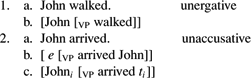
These days, traces no longer have theoretical status in generative grammar. In current minimalist terms (Chomsky, 1995), movement of constituents is performed through an “attract” operation between two elements (a target and a goal), forming a chain between them (the target for movement and the goal). A “trace” is simply an unpronounced copy of the moved element (the antecedent of the trace).
In English, the resultative construction (a small clause describing the effect on the object of the event denoted by the verb) has been used as a syntactic diagnosis for unaccusativity (Carrier & Randall, 1992; Levin & Rappaport Hovav, 1995; but cf. Levin & Rappaport Hovav, 2002). Because resultatives can only be predicated of the object, they are possible with transitive (Example 3) and unaccusative (Example 4) verbs (which have an object), but impossible with unergatives, whose sole argument is a subject (Example 5). Note that the sentence in Example 6 with an unergative verb is grammatical when a fake reflexive, which acts syntactically as an object, is added.
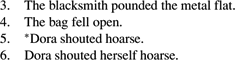
For Levin and Rappaport Hovav (1995), unaccusativity is semantically determined but syntactically represented. The linking rules that regulate the projection of arguments to syntactic positions are sensitive to semantic notions like change of state, immediate cause, and so forth. In English, an argument denoting a directed change is an internal argument, whereas one denoting an immediate cause is an external argument.
If the distinction between unaccusative and unergative verbs is purely structural, then we expect all unaccusative and unergative verbs to behave alike syntactically. However, Sorace's (2000) research has uncovered that, although many verbs display consistent syntactic unaccusative or unergative behavior across and within languages, others display variable syntactic behavior, depending on the contribution of other aspectual or thematic elements in the sentences in which they appear. For example, change of state verbs like decay, agentive verbs of directed motion like run and march, verbs of existence like exist, and so forth systematically display variable syntactic behavior with auxiliary selection and are sensitive to aspectual and thematic elements in the sentences in which they appear. The verb run in Italian (and many other languages) selects the perfect auxiliary “have” and displays unergative behavior when it is atelic (“Maria ha corso velocemente.” “Mary has run fast.”), but it selects “be” and displays unaccusative behavior when a goal prepositional phrase is added, making the event telic: “Maria è corso in farmacia.” “Mary ran to the pharmacy.” By contrast, talk and sing always select the perfective auxiliary “have” in languages that have the auxiliary distinction, and the telicization of the predicate with another element in the sentence does not select “be” (“I colleghi hanno chiaccherato tutto il pomeriggio.” “My colleagues chatted the whole afternoon.”). Similarly, the unaccusatives come and arrive always select “be” as perfective auxiliary and agentivity or detelicization of the event does not affect the choice of auxiliary (“Sono arrivati ospiti per ore e ore.” “Guests arrived for hours.”). Sorace (2000) proposed that there is a continuum (what she calls a “hierarchy”) of gradients of unaccusative/unergative verbs of potential universal significance, as in Example 7. This hierarchy is related to the semantic concepts of telicity and agentivity. The extremes of the continuum (which she calls “core”) are the prototypical unaccusative and unergative verbs. The verbs in the middle are more or less unaccusatives or unergatives, depending on their position in the continuum with respect to the extremes.

Sorace (2000) notes that the potential reality of this hierarchy is confirmed in a series of psycholinguistic studies (Bard, Robertson, & Sorace 1996; Sorace, 1995). Findings from L1 acquisition have shown that, although auxiliary selection with intransitive verbs is learned quite early, it is learned earlier with verbs displaying stable behavior than with those that shift from unaccusative to unergative. Furthermore, experiments with native and near-native speakers of Italian have shown that native speakers have very strong intuitions concerning auxiliary selection with the “stable” verbs and less determinate intuitions about syntactic behavior with the others, attesting to these gradients of unaccusativity.
To summarize thus far, the unaccusative/unergative distinction is a universal phenomenon but languages implement different syntactic and morphological reflexes of unaccusativity, which have to be learned implicitly in L1 or L2 acquisition from exposure to primary linguistic data (input). Debate exists as to whether the distinction could be better characterized as a purely semantic phenomenon (Dowty, 1991; Van Valin, 1990), a purely syntactic phenomenon (Burzio, 1986; Rosen, 1984), or both (Levin & Rappaport Hovav, 1995; Sorace, 2000). Whereas the variable syntactic behavior of these verbs indicates that there is a strong correlation between semantic notions and unaccusativity, it is still far from clear why particular semantic components are sensitive to certain syntactic reflexes when others are not, or why languages are sensitive to different semantic notions for the classification of intransitive verbs.2
For example, whereas the aspectual notion of telicity (or “change with an end point”) is syntactically relevant for the classification of unaccusative verbs in Dutch (so that if the argument of an intransitive verb denotes an entity undergoing a telic change the argument is mapped to object position), German relies on the semantic concept of “transition” (Seibert, 1993, cited in Sorace, 1995), Italian on “existence of a state” (Sorace, 1995), and English on “change of condition” (Sorace, 1995).
SYNTACTIC TESTS FOR UNACCUSATIVITY IN SPANISH
Unlike the situation in Italian and French, present-day Spanish no longer has two perfect auxiliaries to distinguish between the two classes of intransitive verbs. However, other syntactic and morphological tests of unaccusativity in Spanish have been recently identified in the literature. One such test is the distribution of bare plurals (NPs without determiners; Demonte, 1985; Torrego, 1989). Transitive (Example 8) and unaccusative (Example 9) verbs allow bare plurals in postverbal position; unergatives do not, as Example 10 shows (examples from Torrego, 1989, p. 254).3
Aranovich (2000) and other linguists have questioned the validity of this test because it appears that unergative verbs are ungrammatical with bare plural subjects only when the sentence has a presentational reading. Unergatives with bare plural subjects are grammatical in locative inversion construction, that is, when there is a preposed locative phrase, as in aquí han dormido animales (here have slept animals). They are also acceptable when the postverbal subject is the focus of contrast, as in Han dormido animales, no hombres (have slept animals, not men). Note that in English, subjects may also appear in postverbal position under certain circumstances, as with the locative inversion (Coopmans, 1989):
1. Into the room walked John. (unergative)
2. Down the stairs fell the baby. (unaccusative)

A second syntactic test discriminating between unaccusative and unergative verbs in Spanish is the absolutive construction (de Miguel, 1992). Absolutive constructions are clauses with a past participle that modify a postposed noun phrase and agree with it in number and gender. Absolutive constructions are grammatical with transitive (Example 11) or unaccusative (Example 12) participles, that is, with structures that have an object but are clearly ungrammatical if the participle is an unergative verb (Example 13), which presumably does not have an object.

Furthermore, de Miguel (1992) notes that among unaccusative verbs, this construction is sensitive to the aspectual notion of telicity. In other words, the participial absolutive construction is grammatical with telic unaccusative verbs (those that have an end point), as in Example 12, but not with atelic unaccusative verbs, such as verbs of existence, durative verbs, and iterative verbs (e.g., some stative and achievement verbs in Vendler's, 1967, classification), as in Examples 14 and 15.

Another difference between unaccusative and unergative verbs in Spanish concerns the position of the subject with presentational verbs (Contreras, 1978; Suñer, 1982), although this is an optional rule (Demonte, 1985). Stylistically, subjects of unaccusative verbs show a marked tendency to appear in object position (postposed), as in Example 16.

By contrast, if postposed, subjects of unergative verbs sound odd, unless there is special emphasis in the discourse context.4
With deverbal nouns, certain types of derivational morphology appear to be sensitive to the argument taking properties of verbal roots (Demonte, 1985). For example, the agentive affix -dor can only attach to verbs that have an agent (unergatives and transitives). Therefore, unaccusative roots are ruled out.
1. el destructor de la ciudad
the destroyer of the city
2. Mario es muy hablador.
Mario is a good talker.
3. *Mario es buen llegador.
*Mario is a good arriver.
Furthermore, the clitic se as a telicity marker usually attaches to unaccusative verbs and rarely to unergative verbs: caerse (fall-se), morirse (die-se) versus *trabajarse (work-se), *llorarse (cry-se) but reirse (laugh-se).

PSYCHOLINGUISTIC EVIDENCE
Assuming that there is a syntactic basis for the unaccusative/unergative distinction in Spanish, Bever and Sanz (1997) conducted an experiment with 32 Spanish native speakers to assess the role of empty categories in sentence comprehension. Recall that in terms of linguistic representations, the arguments of unaccusative verbs leave an empty category—an NP-trace—in object position. Unergative verbs do not have a trace. To examine the differential effect of the NP-trace left by the movement of the argument during on-line processing, Bever and Sanz used a visual probe-recognition task. According to Bever and McElree (1988) and Bever, Straub, Shenkman, Kim, and Carrithers (1989), a trace, or “copy,” provides an extra representation of its antecedent. This is reflected in shorter latencies to recognize a word contained in the antecedent, when compared to other, similar sentences that do not have traces. Thus, Bever and Sanz (1997) hypothesized that sentences with unaccusative verbs and preverbal arguments should display shorter reaction times (RTs) than sentences with unergative verbs because the trace in object position in unaccusative verbs is “more recent” in the string as the string is being processed.
The task consisted of sentences containing 16 frequency-matched unaccusative and unergative verbs presented on a computer screen. The critical verbs were 8 unaccusatives, crecer (grow), aparecer (appear), desaparecer (disappear), aterrizar (land), morir (die), caer (fall), llegar (arrive), and arribar (arrive by boat) and 8 unergatives, caminar (walk), pasear (stroll), viajar (travel), correr (run), dormir (sleep), hablar (talk), cantar (sing), and llorar (cry).
Eight of the experimental sentences had preverbal subjects and the other eight had postverbal subjects, of the structures shown in Example 18.

Bever and Sanz (1997) included both concrete and abstract adjectives as probes. Sentences were presented on a computer screen in four fragments and without punctuation marks, as Examples 19 and 20 show:

After the segment fragments disappeared from the screen, participants were asked to perform two tasks: decide if the probe word (in this case, the adjective appearing between asterisks) occurred in the sentence and answer a question about the content of the relative clause, by pressing one of two keys (yes or no) for each task. Both questions required the experimental subjects to refer back to the subject NP containing the adjective. Question 1 tested the subjects' sensitivity to the sequence of words in the sentence (i.e., syntactic structure). Question 2 tested whether subjects were paying attention to the meaning of the sentence as well. The computer recorded the time that participants took to respond in milliseconds.
In addition to the 16 experimental trials, the task also included a set of 80 filler sentences of varying length (15–58 syllables), some with probes and some without. Bever and Sanz (1997) then used these distracters with negative answers to classify the participants into two groups, based on how the sentence comprehension process works. According to these authors, comprehending a sentence involves understanding the conceptual representation for its meaning and the syntactic representation for its form. In understanding a sentence, subjects can initially scan the conceptual semantic representation, the syntactic representation, or both. Bever and Sanz (1997) claim that there are individual differences in this respect, because people can be conceptual or syntactic scanners. Because there is no linguistic theory in which semantics can be accessed independently of syntax, this assertion does not make much sense. However, Townsend and Bever (2001, p. 206) discuss how this is a possible strategy in on-line sentence comprehension. To examine this distinction, a correlation was taken between the time it took each subject to recognize that the probe was not in the sentence and the length of the filler sentence in syllables. Half of the subjects (n=16) showed a positive correlation between sentence length and RT, whereas the other half (n=16) showed a negative correlation. The first group of subjects was classified as sequence sensitive, meaning that they pay attention to syntactic structure when they access the probe. The subjects for whom the correlation was negative were classified as sequence insensitive, supposedly because these subjects scan the conceptual representation of a sentence to search the probe. Bever and Sanz (1997) further confirmed the distinction between these two groups by examining the RTs in sentences with concrete and abstract adjectives. It is only the syntactic scanners who should show shorter latencies for unaccusative verbs than for unergative verbs. The results from Bever and Sanz (1997) are displayed in Table 1.

As can be seen from Table 1, sequence-sensitive individuals reacted faster to unaccusative verbs with preverbal subjects (950 ms) than to unergative verbs (1070 ms). The 120-ms difference was significant according to analysis of variance (ANOVA). The sequence-insensitive individuals showed an effect in the opposite direction, responding faster to unergative verbs (960 ms) than to unaccusative verbs (1070 ms). There were no differences between the two types of verbs with postverbal subjects, regardless of type of comprehender. According to Bever and Sanz (1997), the data from the sequence-sensitive participants confirm that there is a trace in the syntactic representation of sentences with unaccusative verbs and preverbal subjects in Spanish. Just like Felser, Nakano, and Clahsen (in press), who used a cross-modal lexical decision experiment with native speakers of Japanese and confirmed the psychological reality of syntactic wh- traces left by movement, Bever and Sanz (1997) results also suggest that the unaccusative/unergative distinction in Spanish is syntactic and psycholinguistically real. This raises the question of whether L2 learners of Spanish attain this type of linguistic knowledge as well and whether it is reflected in an on-line task.
Before turning to L2 acquisition, I would like to mention some shortcomings of the Bever and Sanz (1997) experiment. The first question that arises is the division of subjects by type of comprehender. Unlike individual differences related to working-memory capacity for which there is substantial independent evidence, the distinction between sequence-sensitive and sequence-insensitive comprehenders appears to be post hoc and a way to explain the results. Second, if indeed the sequence-insensitive individuals do not scan the syntactic representation of sentences, then no differences between unaccusatives and unergatives would be expected. Why then did unergative verbs induce shorter reaction times than unaccusatives for these individuals?
Sanz (2000) defends the sequence-sensitive or sequence-insensitive distinction by alluding to the correlations between length and RTs, as well as to the differential responses to the concrete/abstract adjective in the Bever and Sanz (1997) experiment. The correlation between sentence length and reaction time for the sequence-sensitive individuals was r2=.22 (p<.01) and r2=−.10 (ns) for the sequence-insensitive group. Even if significant, the correlation for the sequence-sensitive individuals is very weak and could perhaps be explained by the great variability in individual means, which Sanz (2000, p. 172) herself acknowledges. Moreover, and as an anonymous referee also correctly noted, the use of concrete and abstract adjectives is not well motivated and may even seem spurious. For example, the adjective apuesto (handsome) is presented as a concrete adjective but severo (strict) is classified as an abstract adjective, when in fact these are very impressionistic, relative, or subjective qualities. In short, both the correlations and the responses on adjectives are behavioral evidence consistent with the type of comprehender classification proposed in this particular study and they constitute evidence internal and dependent on this study.
As for the faster responses to unergatives by sequence-insensitive individuals, Sanz (2000, pp. 158–159) citing Bever (1970) explains that in English the first noun of a sentence is usually an agent. However, if speakers assign the thematic role of agent to an unaccusative verb, a reassignment of theta role (from agent to theme) must occur, as it happens in the garden path sentence the horse raced the barn fell, where horse is initially assigned the role of agent and then must be reassigned the role of theme, causing a processing delay. Thus, sequence-sensitive individuals read off the conceptual representation of the sentence and perform a thematic role reassignment. It is this reassignment that causes the delayed response with unaccusative verbs as opposed to unergative verbs. However, this explanation might work for English, where word order is more fixed and subjects are usually agents. In contrast, in Spanish word order is far more flexible, and it is very common for objects or themes to be in preverbal position (see MacWhinney, 1987 and VanPatten, 1996). Because the experiment reported here is on Spanish and unless it can be shown that this “agent first” theta assignment strategy is also frequent in this language, it is dubious whether this explanation could be extended in this case.
Despite these shortcomings, the Bever and Sanz (1997) study is original and important in several ways and merits replication. First, it is the first study on unaccusativity in Spanish with native speakers. Second, the study attempts to provide psycholinguistic evidence for a well-motivated linguistic universal, for which substantial independent evidence exists from a variety of languages. Third, and to the extent that the methodology is valid, the study provides evidence for approaches to the nature of linguistic representations that make use of empty categories like traces or copies, thus making a contribution to linguistic theory.
PROCESSING UNACCUSATIVES IN L2 ACQUISITION
The most widely used methodology to investigate subtle linguistic knowledge in L2 acquisition has been grammaticality judgment tasks. These tasks allow researchers to test constructions that are grammatical and ungrammatical, particularly structures that are likely to not occur in spontaneous production very often. However, like any other technique that is used with native and nonnative speakers, these tasks tap linguistic competence only indirectly, given that they are also measures of some sort of performance. Many researchers have argued that grammaticality judgment tasks do not tap linguistic intuitions (Schütze, 1996); rather, they engage the participants' conscious or learned grammatical knowledge and metalinguistic skills (Birdsong, 1989).
It is also believed that language processing (parsing) and grammatical knowledge are related (Fodor, 1999; Klein, 1999). Successful parsing involves segmenting speech into phrases, assigning category labels to words, and determining syntactic dependencies and hierarchical organization. In recent years L2 researchers have begun to expand their methodological repertoire to include processing tasks, which are also assumed to provide an indirect way of tapping grammatical competence, but without the added metalinguistic factor (see Bley–Vroman & Masterson, 1989; Duffield & White, 1999; Duffield, White, Bruhn de Garavito, Montrul, & Prévost, 2002; Eubank, 1993; Juffs 1998a, 1998b; Juffs & Harrington, 1995, 1996; and see particularly Juffs, 2001, and Marinis, 2003, for recent overviews of the existing research and possibilities). However, many times, the relationship between language processing and grammatical knowledge is not always clear. If L2 learners do not parse L2 speech or written input appropriately, it is likely that they cannot develop the same kind of linguistic competence as native speakers (VanPatten, 1996). According to MacWhinney (1987), L2 learners use processing routines from their native language in their L2. Results of relative clause attachment preferences have shown that this is largely the case: L2 learners transfer low or high attachment parsing strategies from their L1 (Dussias, 2003; Felser, Roberts, Gross, & Marinis, 2002; Fernández, 1999). Or, it may be the case that learners have acquired a certain type of linguistic knowledge, but it is labored or delayed access to that knowledge during processing that gives the impression that grammatical knowledge has not been acquired, as Juffs and Harrington (1995) and White and Juffs (1998) have shown with knowledge of subjacency (or constraints on wh- movement) in English by Chinese-speaking learners.
Despite the above findings, other research has shown that, as it is the case with native speakers, on-line processing indirectly reflects mental and linguistic processes in L2 acquisition as well. For example, Duffield and White (1999) and Duffield et al. (2002) found that the results of an on-line sentence-matching task corroborated and complemented the results of an off-line grammaticality judgment task. In both tasks the L2 learners and the native speakers discriminated between grammatical and ungrammatical sentences with differences in clitic placement in Spanish and French. Not only did the sentence-matching task detect differences in grammaticality, but it also provided corroborating evidence for a particular syntactic approach to clitic placement in Romance languages.
To see whether L2 learners of Spanish distinguish syntactically between unaccusative and unergative verbs and whether this difference would be reflected in processing, in this study I extended the methodology used by Bever and Sanz (1997) to another population of native Spanish speakers from different countries and to a group of English-speaking L2 learners of Spanish. By doing a replication with some modifications that I discuss below, the reliability problems found in the original Bever and Sanz study could perhaps be resolved. In this way, it is possible to tease apart, for example, whether some of the problems of the original study have their roots in the particular selection of subjects and/or stimuli employed in the methodology, or even in the way in which the results were analyzed.
Adopting an event structure approach couched in minimalist terms, Sanz (2000) and Sanz and Bever (2001) have proposed that in English the distinction between unaccusative and unergative verbs is merely semantic, and that unlike Spanish unaccusative verbs, English unaccusative verbs do not have traces. More specifically, Sanz proposes that the syntactic difference between unaccusative verbs in Spanish and in English is that in Spanish the argument of unaccusatives is internal to the verb (sister) and moves to a projection Event Phrase to check [±interpretable] telicity features. By contrast, the argument of unaccusative verbs in English originates in a position above the verb (in a functional category called Transitive Phrase, where the features [±measure] are checked) and does not move overtly to Event Phrase. Evidence for this analysis comes from the behavior of the aspectual reflexive se in Spanish, which Sanz (2000) takes as the morphologically overt expression of the head of Event Phrase in this language, and the fact that the few syntactic reflexes identified in English (there insertion, the locative inversion, and the resultative constructions) either do not readily discriminate between unaccusative and unergative verbs or do not work for all unaccusative verbs (see also Levin & Rappaport Hovav, 1995, for a similar discussion). Sanz (2000, p. 140) therefore concludes that unaccusatives and unergative verbs in English vary in interpretation (i.e., unaccusatives tend to be telic but unergatives are atelic) but not in their syntax, whereas in Spanish they vary both in interpretation and syntax. In a similar psycholinguistic test conducted with English native speakers, Sanz (2000) found no trace-facilitation effect with unaccusative verbs.
Assuming for the sake of argument that Sanz's (2000) proposal is correct for both Spanish and English, if English-speaking L2 learners of Spanish do not respond faster to sentences with unaccusative verbs than to sentences with unergative verbs, there may be at least two reasons for this response: either because English-speaking L2 learners of Spanish transfer their parsing strategies from English into Spanish and L2 processing masks L2 linguistic competence, or because adopting their L1 analysis, English-speaking learners of Spanish do not discriminate between unaccusative and unergative verbs syntactically in Spanish either, and processing reveals linguistic competence.5
All the subjects who participated in this study also completed a grammaticality judgment task with all the structures discussed in the section on syntactic tests for unaccusativity in Spanish. The results of this test are discussed in Montrul (in press) and are not be presented in detail here.
A second aim of this study, which differs from Bever and Sanz (1997), was to investigate whether the semantic hierarchy proposed by Sorace (2000) plays a role in the processing of these verbs. If the unaccusative hierarchy is psycholinguistically real, we expect to find shorter RTs for “core” unaccusatives than for “core” unergatives but variability in RTs with “less core” and “peripheral” unaccusative and unergative verbs for both the native speakers and the L2 learners. According to an anonymous reviewer, this particular hypothesis lacks predictability because it suggests that any result is acceptable with less core verbs. I am very sympathetic with the reviewer's concern about the lack of predictability in general of the concepts of gradience, continua, and prototypicality in grammatical analysis, concepts that are fundamental to functionalist approaches to linguistics. The problem with hierarchies of this sort is that it is difficult to find counterexamples and to make sharp and discrete distinctions among categories of grammatical elements (see Baker, in press, and Newmeyer, 1998, for more extensive arguments along these lines). However, I do not think that Sorace's (2000) account lacks predictability at all. What she says is that peripheral verbs may be susceptible to event-type shifts (sometimes they can be construed as telic or atelic or change from activities, as in “I run for an hour.” to accomplishments, as in “I ran to the store.” or “I ran a mile.”) or they can receive multiple argument realization, depending on other elements in the sentence, like arguments, adverbials, clitics, or prepositional phrases. In turn, this grammatical variability is reflected in how individual speakers may conceptualize these verbs. By contrast, core verbs are not open to such variation, and this is the stronger part of the prediction. Syntactically, this means that sometimes less core and peripheral unaccusatives and unergatives will have a trace and sometimes they will not. Thus, the hypothesis is that with core verbs we should definitely observe the presence of a trace in unaccusative but not in unergatives, but with the more peripheral verbs speakers may vary greatly (see also Sorace, 2000; and Sorace & Shomura, 2001, for elaborations of this hypothesis). Counterevidence for the hierarchy would be if we find that core unergatives are responded to faster than core unaccusatives, we find no differences between these two, or we find this same two patterns of response with all verbs, regardless of their position in the hierarchy.
METHODOLOGY
Thirty-five Spanish native speakers from different countries participated in the study. Twelve of these native speakers were tested in Argentina, and the rest were tested in the United States. Their mean age was 31.03 (range=23–59). The nonnative speakers were 44 English-speaking learners of Spanish who were taking Spanish classes at a major research university in the United States. Their mean age was 23.13 (range=20–35) and their mean age of exposure to Spanish as an L2 was 13.98 (range=11–18).
The main task was an on-line visual probe recognition task, the same used in Bever and Sanz's (1997), with some modifications. In the present study, nine unaccusative verbs and nine unergative verbs were used. These verbs, shown in Table 2, were selected on the basis of semantic subclasses in order to test Sorace's unaccusativity hierarchy (2000).

Because each verb appeared twice, the stimuli consisted of 36 test sentences of the exact form and length used in Bever and Sanz (1997). For the verbs that were also used in Bever and Sanz's study, desaparecer (disappear), morir (die), caer (fall), llegar (arrive), caminar (walk), correr (run), hablar (talk), and cantar (sing), their exact sentences were used. Similar sentences were constructed for the other verbs selected for this study that did not appear in Bever and Sanz's study. However, in this study only concrete adjectives were used as probes; all verbs appeared first with preverbal, and then with postverbal subjects; and in order to be able to perform an analysis by verb, all subjects saw all the verbs. All the distracter sentences used in this task (72 total) were the same sentences used by Bever and Sanz (1997). All the critical sentences were followed by concrete adjective probes and by a content question. The answer to both questions was yes. For the distracter sentences, verbs, nouns, adjectives, and adverbs were used as probes. In 70% of the distracter sentences the probe word was not in the sentence and required a negative response. Only 40% of distracter sentences were followed by a content question. All this was done to divert the participant's attention from the main objective of the experiment. The appearance of each fragment was self-paced (i.e., controlled by the experimental subject), but if no response was made within a 3000-ms span, the fragment disappeared and the next fragment appeared.
The program used to run the experiment was DMDX.6
This program was developed and maintained by Kenneth Forster and Jonathan Forster from the University of Arizona and it can be downloaded from www.u.arizona.edu/~kforster/dmastr/dmastr.htm.
OVERALL RESULTS
Only correct responses to experimental trials (probes and content questions) were kept for the statistical analysis (around 84.65% total). The RTs for each subject were then truncated to 2.5 standard deviations based on all the correct recognition of positive probes. Responses over 2000 ms were discarded. Because there was great variability even between the native speakers in RTs (some reacted in as fast as 600 ms, while others averaged 1200 ms), all data were transformed to z scores. Converted scores were then submitted to a factorial ANOVA with verb (unaccusative vs. unergative) and subject position (preverbal vs. postverbal) as the within variables, and group (native speakers vs. L2 learners) as the between variables. There was no main effect for verb, but there was a main effect for subject position, postverbal was responded to faster than preverbal, F (1, 77)=33.006, p<.0001, and for group, native speakers were faster than L2 learners, F (1, 77)=1879.463, p<.0001; as well as a subject position per verb interaction, F (1, 77)= 4.252, p<.0001. The alpha level for significance was set at .05.
Figure 1 presents the results of the native speakers. When the native speaker group was analyzed as a whole, there were no significant differences between unaccusative and unergative verb sentences with preverbal subjects. Following Bever and Sanz's (1997) procedure, the correlation between sentence length with distracter items and reaction times was calculated for each subject. Of the 35 subjects, 16 (46%) showed a weak positive correlation between sentence length and reaction time (r2=.29, p<.01), and the remaining 19 subjects (56%) showed a negative correlation (r2=−.14,ns). These weak correlations are almost identical to those found by Bever and Sanz (1997). To see whether the effect for subject position and verb would replicate, the difference between sequence-sensitive and sequence-insensitive individuals was taken into account for the native speakers in this experiment as well. Once subjects were divided into these groups, then the results replicated those of Bever and Sanz's (1997). A factorial ANOVA showed a verb by position by comprehender interaction, F (1, 33)=32.045, p<.0001.

The mean reactions times for Spanish native speakers.
As can be seen in Figure 1, sequence sensitive individuals reacted faster to unaccusative verbs with preverbal subjects (mean RT=987) than to unergative verbs with preverbal subjects (mean RT=1091). The 104-ms difference between the two verbs was statistically significant, F (1, 15)=14.325, p<.001. By contrast, the sequence-insensitive individuals showed an effect in the opposite direction: they reacted slower to unaccusative verbs (990 ms) than to unergative verbs (904 ms), and the difference was also significant, F (1, 17)=8.546, p<.002. Also replicating Bever and Sanz's (1997) results, sentences with postverbal subjects were responded to faster than sentences with preverbal subjects, and there were no significant differences between unaccusative and unergative verbs when the subject NP was in postverbal position.7
A reason why postverbal subjects were responded to faster than preverbal subjects in this study may be related to the fact that each verb appeared twice and sentences with postverbal subjects always appeared after sentences with preverbal subjects in the experimental blocks, so the shorter latency for sentences with postverbal subjects could just be a priming effect. However, Bever and Sanz (1997), who did not present each verb twice and did not control for order of presentation of sentences, also found the same pattern. Therefore, recency (the fact that the subject NP appearing last is closer in time and in the string to the question with the probe) might be the explanation for this subject position effect.

The mean reaction times for L2 learners.
The L2 learners show the same pattern of response as the sequence-sensitive native speakers. First, sentences with postverbal subjects were responded to faster than sentences with preverbal subjects, but the difference between the two verb classes was not significant. Second, with preverbal subjects, the L2 learners patterned with the sequence-sensitive native speakers, reacting faster to unaccusative verbs (1053 ms) than to unergative verbs (1097 ms), and the 44-ms difference was significant, F (1, 43)=4.558, p<.038. When the sequence-sensitive versus sequence-insensitive distinction was applied to the L2 learners on the basis of the correlation between reaction time and syllable length of distracter items, the results patterned with those of the native speakers. Sequence-sensitive L2 learners displayed shorter latencies for unaccusative verbs (913 ms) than for unergative verbs (1011 ms), whereas sequence-insensitive L2 learners displayed the opposite pattern: unaccusatives were responded to slower (1070 ms) than unergative verbs (999 ms), and these differences were significant, F (1, 43)=13.423, p<.0001.
To summarize, sequence-sensitive native speakers and L2 learners recognized probe words in the antecedent faster with unaccusative verb sentences with preverbal subjects than with unergative verb sentences with postverbal subjects. This result suggests that there is a syntactic trace or copy in unaccusative-verb sentences, that the NP trace/copy facilitates recognition of the antecedent, and that L2 learners process unaccusative verbs like native speakers.
RESULTS BY SEMANTIC SUBCLASSES
Let us now turn to our other research question: whether native speakers and L2 learners respond differently to different subclasses of unaccusative and unergative verbs depending on their relative position in the unaccusativity hierarchy proposed by Sorace (2000). It was predicted that core unaccusatives should be responded to faster than core unergatives. However, because less core and peripheral verbs are supposed to display variable syntactic behavior within and across languages, differentresponses are expected here: namely, faster RTs for unaccusatives than unergatives, opposite RTs, or no difference between RTs between unaccusatives and unergatives. Crucially, core unergatives should not display shorter latencies than core unaccusatives.
The statistical analysis applied to all the verbs confirmed these trends for the two groups. Note that for this analysis I did not take into account the sequence-sensitive or -insensitive distinction for the native speakers. There was a verb by semantic subclass interaction, F (1, 77)=782.241, p<.0001. The native speakers and the L2 learners responded faster to core and peripheral unaccusatives than to core and peripheral unergatives, and the two groups showed the opposite pattern of response with the less core classes, where the unergatives were responded to faster than the unaccusatives. The results are shown in Figures 3 and 4, respectively.

The mean reaction times per verb class for native speakers.

The mean reaction times per verb class for L2 learners.
This verb analysis shows that the lack of effect for the native speakers in favor of unaccusative verbs shown in Figure 1 are explained by the fact that within the unaccusative and unergative class, the less core verbs display the opposite RT pattern from the other two verb classes, canceling out the effect in favor of unaccusatives. Therefore, an explanation in terms of different types of comprehenders is not necessary.
Recall that the verbs for this study were selected on their lexical semantic meaning and not on the basis of word frequency.8
Bever and Sanz (1997) checked verb frequencies by conducting a survey with native speakers.

What emerges from Table 3 is that core and less core unaccusative verbs are more frequent than core and less core unergative verbs. The peripheral verbs are comparably infrequent. To rule out the possibility that the results obtained with unaccusative verbs were not due to a frequency effect, correlations between RTs for individual verbs and frequencies were calculated. For the native speakers, there was a very weak positive correlation (r2=.007), and for the L2 learners, there was a very weak negative correlation (r2=−.015). In both cases, the correlations turned out to be nonsignificant. Nonetheless, to compare the results of different semantic subclasses and their position in the hierarchy, only verbs of comparable frequency were used. That is, for the core unaccusative and core unergative class, only the verbs fall (freq.=92) and speak (freq.=106) were taken into account; for the less core classes, run (freq.=45) and disappear (freq.=54) were contrasted; and because all the peripheral unaccusative and unergative verbs were comparably infrequent (freq.<5), the 3 verbs in each class were compared.
The results of the native speakers displayed in Figure 5 showed an effect in the predicted direction with the core verbs: unaccusatives were responded to faster than unergatives, and the 68-ms difference was significant according to paired sample t tests, t (34)=−3.275, p<.002. With respect to the noncore verbs, there was no effect for the less core verbs, t (34)=−.954, p<.347, but there was an effect in favor of unaccusatives for the periphery verbs, t (34)=3.829, p<.001.

The mean reaction times for frequency matched unaccusative and unergative verbs per semantic subclass for native speakers.
The results of the L2 learners shown in Figure 6 follow the pattern of response of the native speakers, except that the RTs differences between the verbs were even more marked. The difference between RTs for core unaccusatives and unergatives was 238 ms, t (43)=−3.241, p<.002, and the difference between periphery unaccusatives and unergatives was 197 ms, t (43)=4.196, p<.001. The difference between the less core verbs, of 217 ms, resulted in faster latencies for unergatives, t (43)=3.987, p<.001. Therefore, it seems that verb frequency does not determine how unaccusative and unergative verbs are processed by native and nonnative speakers. Furthermore, by looking at verbs in this way, the distinction between sequence-sensitive and sequence-insensitive individuals is not called for to explain the results.

The mean reaction times for frequency matched unaccusative and unergative verbs per semantic subclass for L2 learners.
DISCUSSION
An important outcome of this study is that the results with native speakers from different Spanish speaking countries replicated Bever and Sanz's (1997) results with native speakers from Madrid, even when several changes were made to the experimental stimuli in order to address other specific objectives. Unfortunately, some of the original problematic results were replicated as well. Although I attempted to do away with the distinction between sequence-sensitive and sequence-insensitive individuals for the overall analysis, considering all the native speakers as a group did not yield an effect in the expected direction. Therefore, I also replicated the original division, and indeed, sequence-sensitive individuals showed faster latencies for unaccusative-verb sentences for unergative-verb sentences with preverbal subjects. Like the results of the original experiment, sequence-insensitive individuals showed an effect in the opposite direction (unergatives were responded to faster than unaccusatives). However, when I considered the results by verbs, I did away with the type of comprehender distinction and this time the results confirmed the predictions according to semantic subclasses. A possibility is that the variation we observed with the native speakers comes from the patterns of responses obtained when individual semantic subclasses are taken into account. Because not all verbs are treated consistently as unaccusative or unergative by all speakers, these results are more compatible with a semantic distinction of verbs for which there is substantial independent evidence in a variety of Indo-European languages. To the extent that the visual probe recognition technique employed here is sensitive to the traces left by syntactic movement, these results show that the existence of an NP-trace or copy with some unaccusative verbs in Spanish is psycholinguistically real. Therefore, it may be possible to infer linguistic knowledge from psycholinguistic behavior in native speakers.
A second important result is that the English-speaking L2 learners of Spanish also displayed an overall trace-facilitation effect with unaccusative verbs, and this effect was statistically significant regardless of the type of comprehender. That is, an overall analysis of the L2 learners showed that they responded faster to unaccusative verbs than to unergative verbs, suggesting that in L2 acquisition the presence of a syntactic trace also facilitates recognition of a probe word in the antecedent.
The result of the L2 learners is significant for several reasons. First, it shows that L2 learners of Spanish display knowledge of a linguistic universal in another language without receiving explicit instruction, suggesting that access to universal grammar is not impaired. Even if L2 learners initially do not make the lexicosyntactic distinction between unaccusative and unergative verbs, as Oshita (2001) proposed in his unaccusative trap hypothesis, the results of this study show that intermediate and advanced L2 learners have moved away from this stage of development because the syntactic distinction between the two verb classes appears to be well-established in their interlanguage grammars.
Second, L1 transfer does not seem to be an explanation for the results obtained. Recall that according to Sanz (2000) and Sanz and Bever (2001) there is no syntactic distinction in English between the two classes of verbs because there is no NP-trace in unaccusative verbs in this language. (The argument of unaccusative verbs in Spanish moves to Event Phrase to check telicity features, whereas in English it checks telicity features covertly at logical form.) If their analysis is correct, then contrary to what other processing studies of relative clause attachment have shown with different on-line methodologies, L1 processing strategies do not seem to transfer in this case (cf. MacWhinney, 1987). Alternatively, one could assume that English does have a syntactic distinction with these verbs as well (Levin & Rappaport Hovav, 1995), and then these results are compatible with L1 transfer.
Third, if the visual probe recognition task used in this study indirectly reflects syntactic knowledge of native speakers, and given that the same pattern of response was observed with the L2 learners, then these results show that for this particular linguistic domain and with this psycholinguistic technique, linguistic knowledge and language processing are related in adult L2 acquisition as well. In addition, it must be mentioned that all the L2 learners in this study also completed a grammaticality judgment task with different syntactic structures in Spanish. Because the difference between unaccusative and unergative verbs for intermediate and advanced learners was very robust in this study as well (Montrul, in press), then it is possible to conclude that these learners have the linguistic contrast between unaccusative and unergative verbs established in their Spanish interlanguage. In common with Duffield and White (1999), the results of the on-line task used in this experiment further confirm the results of the off-line grammaticality judgment task used in Montrul (in press).
Having shown that native Spanish speakers and L2 learners make a syntactic distinction between unaccusative and unergative verbs, let us now discuss the other aspect of the study that was not part of Bever and Sanz's (1997) original experiment: whether there is an effect of semantic subclass in the processing of intransitive verbs, as per Sorace's (2000) unaccusativity hierarchy. According to Sorace, some verbs, those she calls “core” unaccusatives and “core” unergatives, display systematic and consistent syntactic behavior with auxiliary selection within and across languages both synchronically and diachronically, whereas other verbs do not have consistent behavior and display different degrees of variability depending on their meaning. Psycholinguistic evidence with native and nonnative speakers using off-line measures such as absolute-scale grammaticality judgment tasks and magnitude estimation tasks (Bard et al., 1996; Sorace, 1996; Sorace & Shomura, 2001) suggests that native and nonnative speakers have more determinate judgments with core verbs and display inconsistent judgments with less core and peripheral verbs. Although Sorace (2000) focuses mainly on auxiliary selection, and she (Sorace, 1993a) also discussed ne-cliticization and modal verbs, here I attempted to extend this phenomenon to constructions with preverbal subjects in Spanish. The results of this study with an on-line measure also confirmed the psycholinguistic reality of the unaccusativity hierarchy. Both native speakers and L2 learners showed shorter reaction times for core unaccusatives than core unergatives and either the same pattern, the opposite pattern or no difference among verbs for the less core and peripheral classes. Therefore, the prediction for the core versus the noncore classes of unaccusative and unergative verbs were borne out by the data.
However, a question that arises is why the peripheral verbs, which are assumed to be the most variable, were processed like the core verbs (i.e., unaccusatives faster than unergatives), whereas it was only the less core verbs that showed the exact opposite pattern (unergatives were processed faster than unaccusatives)? Although this fact does not invalidate the hierarchy, it deserves some explanation. One possibility that Sorace (2000) considers is that the verbs in the middle of the hierarchy are variable and this variability can be expressed in a number of ways in different languages. Individual languages may classify verbs along the hierarchy differently. I assumed the hierarchy that Sorace proposed for Italian and Romance in general, but perhaps it is the case that in Spanish the less core verbs are, in fact, more variable than the peripheral verbs or that the cutoff points for the hierarchy are different. In Sorace's (2000, p. 886) words, “not all languages distinguish all classes presented in the ASH: classes may be merged, or languages may make individual distinctions within individual classes.” Therefore, this may be what is going on in Spanish, and it certainly deserves further scrutiny. The results of this study showed exactly what Sorace predicted: “Nevertheless, I predict that the implicational relationships among verb classes are maintained from language to language…. It should not be possible for a language to exhibit consistent … syntactic manifestations of split intransitivity … with intermediate verbs but not with core verbs” (Sorace, 2000, pp. 886–887).
Finally, I would like to discuss the issue of verb frequency, which was factored out when evaluating the semantic hierarchy in the verb class analysis. According to many psycholinguists and L2 acquisition researchers who subscribe to an emergentist or connectionist view of language learning, language processing is intimately tuned to input frequency at all levels (from phonology, morphology, and syntax through discourse; Bybee, 2002; Ellis, 2002). “The acquisition of grammar is the piecemeal learning of many thousands of constructions and the frequency-biased abstraction of regularities within them” (Ellis, 2002, p. 168). Indeed, there are psycholinguistic studies of verb ambiguity and argument structure with native speakers that appear to support precisely this particular view (see, e.g., Garnsey, Pearlmutter, Myers, & Lotocky, 1997). The results of the experiment presented here show that this view cannot be entirely correct because the corpus frequency of the verbs used in this study did not always correlate with faster or slower RTs. That is, when corpus frequency was controlled for, core and peripheral unaccusatives were responded to faster than unergatives, whereas the opposite result obtained for less core verbs. A similar lack of relationship between corpus frequency and reaction times is reported by Gibson and Schütze (1999) in a study of syntactic ambiguity of conjoined NPs. Of course, this also raises the question of the usefulness and reliability of written corpora as a basis for measuring frequency, and its relationship with actual processing. What I conclude here is that, although frequency effects may have a role to play in some areas of language acquisition, syntactic knowledge is complex and cannot be reduced to a simple statistical operation (see also Gregg, 2003). The results of this experiment are compatible with a theory of abstract syntactic representations like the one proposed by generative linguistics.
Despite these seemingly encouraging results, I would like to end on a note of caution about the methodology employed here, because partial replication did not solve all the reliability issues originally brought up in the Bever and Sanz (1997) study with the native speakers, at least when the results were considered as a whole. Unlike cross-modal priming experiments in which the sentence is presented visually and the probe is presented aurally at the point of the trace, in the visual probe recognition task both sentence and probe are presented visually. That is, in visual probe recognition tasks subjects have to read the sentence and the probe before responding. Because the lexical decision is not made immediately after the trace site, then it could be argued that this technique is not a true on-line technique. According to Fodor (1989), this task, unlike others, cannot be used to discriminate between syntactic versus conceptual scanning because by the time experimental subjects respond to the probe word they have already had time to access all levels of representation. Disagreeing with Fodor's concerns, Sanz (2000) argues that the fact that her groups responded differently to the two types of verbs shows that the technique is valid.
To be on the safe side and to be able to make stronger claims about the external validity of this study, it would be profitable to replicate this experiment with another on-line technique that is more sensitive to the presence of traces at the trace site or immediately after the trace site, such as a self-paced reading task like the moving-window technique (Just, Carpenter, & Woolley, 1982). This task has been successfully used in L2 acquisition research to detect parsing differences between subject and object wh-traces and verbs that have ambiguous argument structure and ambiguous modifiers (Felser et al., 2002; Juffs, 1998a; Juffs & Harrington, 1995), as well as for the psychological reality of syntactic traces left by movement (Felser et al., in press). Participants read a sentence segment by segment, and this is something that they control (i.e., the task is self-paced). The computer records reaction times at different points in the sentence. Because subjects are not required to recognize words in antecedent constituents, no trace or copy facilitation effect is expected here. On the contrary, given that the trace is an extra element in the representation, subjects should display longer reaction times at the trace site as opposed to sentences that do not involve a trace.
In conclusion, to the extent that the methodology employed here is valid to detect NP traces or copies, the results of this study show that L2 learners process unaccusative and unergative verbs like native speakers. This suggests that reaction time measures in L2 acquisition can indirectly tap linguistic competence and even complement results of other off-line methodologies. However, this study should be replicated with other on-line measures before concluding that a syntactic analysis for unaccusativity in Spanish is psycholinguistically motivated for both native and nonnative speakers.
ACKNOWLEDGMENTS
The research presented in this article was conducted under the generous support of the University of Illinois Campus Research Board, for which I am grateful. I want to thank María Isabel Martínez Mira for her invaluable help recruiting participants and conducting all the testing and Montserrat Sanz from Kobe University in Japan for permission to use some of her original stimuli and for walking me through many of the details of her experiment. This paper was presented at the Generative Approaches to Second Language Acquisition Conference held in Ottawa in April 2002 and at the Fifth Conference on the Acquisition of Spanish and Portuguese held at the University of Iowa in October 2002. I want to thank Harald Clahsen, Claudia Felser, Bonnie Schwartz, Karlos Arregui, James Yoon, and Lydia White for their invaluable feedback and suggestions. All remaining errors are my own.
References
Alameda J., &
Cuetos F.
1995
Diccionario de frecuencias de las unidades lingüísticas del castellano.
Oviedo, Spain:
Universidad de Oviedo, Departamento de Psicología.
Aranovich R.
2000
Spanish inchoatives and the semantics of split intransitivity.
Paper presented at the Annual Meeting of the Linguistic Society of America, Chicago.
Baker M. (in press).
Nouns, verbs and adjectives. Their universal grammar.
Cambridge:
Cambridge University Press.
Balcom P.
1997
Why is this happened? Passive morphology and unaccusativity.
Second Language Research,
13,
1–
9.Google Scholar
Bard E.,
Robertson D., &
Sorace A.
1996
Magnitude estimation of linguistic acceptability.
Language,
72,
32–
68.Google Scholar
Bever T.
1970
The cognitive basis of linguistic structures.
In R. Hayes (Ed.),
Cognition and language development
(pp. 279–
362).
New York:
Wiley.
Bever T. &
McElree B.
1988
Empty categories access their antecedents during comprehension.
Linguistic Inquiry,
19,
35–
43.Google Scholar
Bever T. &
Sanz M.
1997
Empty categories access their antecedents during comprehension: Unaccusatives in Spanish.
Linguistic Inquiry,
28,
69–
91.Google Scholar
Bever T.,
Straub K.,
Shenkman K.,
Kim J., &
Carrithers C.
1989
The psychological reality of NP-trace.
Talk given at the 19th Annual Meeting of the Northeast Linguistic Society,
Cornell University,
Ithaca, NY.
Birdsong D.
1989
Metalinguistic performance and interlinguistic competence.
New York:
Springer–Verlag.
Bley–Vroman R., &
Masterson D.
1989
Reaction time as a supplement to grammaticality judgments in the investigation of second language learners' competence.
University of Hawai'i Working Papers in ESL,
8,
207–
237.Google Scholar
Borer H., &
Wexler K.
1987
The maturation of syntax.
In T. Roeper &
E. Williams (Eds.),
Parametter setting
(pp. 123–
172).
Dordrecht:
Reidel.
Burzio L.
1986
Italian syntax: A government and binding approach.
Dordrecht:
Reidel.
Bybee J.
2002
Phonological evidence for exemplar storage in multiword sequences.
Studies in Second Language Acquisition,
24,
215–
222.Google Scholar
Carrier J., &
Randall J.
1992
The argument structure and syntactic structure of resultatives.
Linguistic Inquiry,
23,
173–
234.Google Scholar
Chomsky N.
1995
The minimalist program.
Cambridge, MA:
MIT Press.
Contreras H.
1978
El orden de las palabras en español.
Madrid:
Cátedra.
Coopmans P.
1989
Where stylistic and syntactic processes meet: Locative inversion in English.
Language,
65,
728–
751.Google Scholar
de Miguel E.
1992
El aspecto en la sintaxis del español: Perfectividad e imperfectividad.
Madrid:
Ediciones de la Universidad Autónoma de Madrid.
Demonte V.
1985
Papeles temáticos y sujetos sintácticos en el sintagma nominal.
Rivista di Grammatica Generativa,
9–10,
265–
331.Google Scholar
Duffield N., &
White L.
1999
Assessing L2 knowledge of L2 clitic placement.
Second Language Research,
15,
133–
160.Google Scholar
Duffield N.,
White L.,
Bruhn de Garavito J.,
Montrul S., &
Prévost P.
2002
Clitic placement in L2 French: Evidence from sentence matching.
Journal of Linguistics,
38,
487–
525.Google Scholar
Dussias P.
2003
Syntactic ambiguity resolution in L2 learners: Some effects of bilinguality on L1 and L2 processing strategies.
Studies in Second Language Acquisition,
25,
559–
582.Google Scholar
Ellis N.
2002
Frequency effects in language processing: A review for implications for theories of implicit and explicit language acquisition.
Studies in Second Language Acquisition,
24,
143–
188.Google Scholar
Eubank L.
1993
Sentence matching and processing in L2 development.
Second Language Research,
12,
73–
106.Google Scholar
Felser C.,
Nakano Y., &
Clahsen H. (in press).
Antecedent priming at trace positions in Japanese long-distance scrambling.
Journal of Psycholinguistic Research.
Felser C.,
Roberts L.,
Gross R., &
Marinis T.
2002
The processing of ambiguous sentences by first and second language learners of English.
Essex Research Reports in Linguistics,
40,
1–
38.Google Scholar
Fernández E.
1999
Processing strategies in second language acquisition: Some preliminary results.
In E. Klein &
G. Martohardjono (Eds.),
The development of second language grammars. A generative approach
(pp. 217–
240).
Amsterdam:
John Benjamins.
Fodor J.
1989
Empty categories in sentence processing.
Language and Cognitive Processes,
4,
155–
209.Google Scholar
Fodor J.
1999
Learnability theory: Triggers for parsing with.
In E. Klein &
G. Martohardjono (Eds.),
The development of second language grammars: A generative approach
(pp. 363–
406).
Amsterdam:
John Benjamins.
Garnsey S.,
Pearlmutter N.,
Myers E., &
Lotocky M.
1997
The contributions of verb bias and plausibility to the comprehension of temporarily ambiguous sentences.
Journal of Memory and Language,
37,
58–
93.Google Scholar
Gibson E., &
Schütze C.
1999
Disambiguation preferences in noun phrase conjunction do not mirror corpus frequency.
Journal of Memory and Language,
40,
263–
279.Google Scholar
Gregg K.
2003
The state of emergentism in second language acquisition.
Second Language Research,
19,
95–
128.Google Scholar
Hirakawa M.
1995
L2 acquisition of English unaccusative constructions.
In D. MacLaughlin &
S. McEwen (Eds.),
Proceedings of the 19th Boston University Conference on Language Development
(pp. 291–
302).
Sommerville, MA:
Cascadilla Press.
Hirakawa M.
2000
Unaccusativity in second language Japanese and English.
Unpublished doctoral dissertation,
McGill University,
Montreal, Canada.
Hirakawa M.
2001
L2 acquisition of Japanese unaccusative verbs.
Studies in Second Language Acquisition,
23,
221–
246.Google Scholar
Juffs A.
1998a
Main verb vs. reduced relative clause ambiguity resolution in second language sentence processing.
Language Learning,
48,
107–
147.Google Scholar
Juffs A.
1998b
Some effects of first language argument structure and syntax on second language processing.
Second Language Research,
14,
406–
424.Google Scholar
Juffs A.
1998c
The acquisition of semantics–syntax correspondences and verb frequencies in ESL materials.
Language Teaching Research,
2,
93–
123.Google Scholar
Juffs A.
2001
Psycholinguistically oriented second language research.
International Journal of Applied Linguistics,
21,
207–
220.Google Scholar
Juffs A., &
Harrington M.
1995
Parsing effects in L2 sentence processing: Subject and object asymmetries in wh-extraction.
Studies in Second Language Acquisition,
17,
483–
516.Google Scholar
Juffs A., &
Harrington M.
1996
Garden path sentences and error data in second language sentence processing research.
Language Learning,
46,
286–
324.Google Scholar
Just M. A.,
Carpenter P. A., &
Woolley J. D.
1982
Paradigms and processes and in reading comprehension.
Journal of Experimental Psychology: General,
3,
228–
238.Google Scholar
Kageyama T.
1996
Doushi-imiron [Verb semantics].
Tokyo:
Kuroshio.
Kellerman E.
1978
Giving learners a break: Native language intuitions as a source of predictions about transferability.
Working Papers on Bilingualism,
15,
49–
58.Google Scholar
Klein E.
1999
Just parsing through.
In E. C. Klein &
G. Martohardjono (Eds.),
The development of second language grammars: A generative approach
(pp. 197–
216).
Amsterdam:
John Benjamins.
Levin B., &
Rappaport Hovav M.
1995
Unaccusativity at the syntax semantics interface.
Cambridge, MA:
MIT Press.
Levin B., &
Rappaport Hovav M.
1998
Building verb meaning.
In M. Butt &
W. Geuder (Eds.),
The projection of arguments. Lexical and compositional factors
(pp. 97–
134).
Stanford, CA:
CSLI Publications.
Levin B., &
Rappaport Hovav M.
2002
An event structure account of English resultatives.
Language,
77,
766–
797.Google Scholar
Levin B., &
Rappaport Hovav M. (in press).
From lexical semantics to argument realization.
Cambridge:
Cambridge University Press.
MacWhinney B.
1987
The competition model.
In B. MacWhinney (Ed.),
Mechanisms of language acquisition
(pp. 249–
308).
Hillsdale, NJ:
Earlbaum.
Marinis T.
2003
Psycholinguistic techniques in second language acquisition research.
Second Language Research,
19,
144–
161.Google Scholar
Montrul S.
1999
Causative errors with unaccusative verbs in L2 Spanish.
Second Language Research,
15,
191–
219.Google Scholar
Montrul S. (in press).
On knowledge and development of unaccusativity in Spanish L2 acquisition.
Linguistics.
Newmeyer F.
1998
Language form and language function.
Cambridge, MA:
MIT Press.
Oshita H.
2001
The unaccusative trap hypothesis in second language acquisition.
Studies in Second Language Acquisition,
23,
279–
304.Google Scholar
Perlmutter D.
1978
Impersonal passives and the unaccusative hypothesis.
In Proceedings of the Fourth Annual Meeting of the Berkeley Linguistic Society
(pp. 157–
189).
Berkeley Linguistic Society, University of California,
Berkeley.
Rappaport Hovav M., &
Levin B.
1998
Building verb meaning.
In M. Butt &
W. Geuder (Eds.),
The projection of arguments. Lexical and compositional factors
(pp. 135–
164).
Stanford, CA:
CSLI Publications.
Ritter E., &
Rosen S.
1998
Delimiting events in syntax.
In M. Butt &
W. Geuder (Eds.),
The projection of arguments: Lexical and compositional factors
(pp. 135–
164).
Stanford, CA:
CSLI Publications.
Rosen C.
1984
The interface between semantic roles and initial grammatical relations.
In D. Perlmutter &
C. Rosen (Eds.),
Studies in relational grammar 2
(pp. 38–
77).
Chicago:
University of Chicago Press.
Sanz M.
2000
Events and predication. A new approach to syntactic processing in English and Spanish.
Amsterdam:
John Benjamins.
Sanz M., &
Bever T.
2001
A theory of syntactic processing in the bilingual.
In J. Nicol (Ed.),
One mind, two languages
(pp. 134–
158).
Malden, MA:
Blackwell.
Schütze C.
1996
The empirical base of linguistics: Grammaticality judgments and linguistic methodology.
Chicago:
University of Chicago Press.
Snyder W.,
Hyams N., &
Crisma P.
1995
Romance auxiliary selection with reflexive clitics: Evidence for early knowledge of unaccusativity.
In E. Clark (Ed.),
Proceedings of the Twenty-Sixth Annual Child Language Research Forum
(pp. 127–
136).
Stanford, CA:
CSLI Publications.
Sorace A.
1993a
Incomplete vs. divergent representations of unaccusativity in native and non-native Italian grammars of Italian.
Second Language Research,
9,
22–
47.Google Scholar
Sorace A.
1993b
Unaccusativity and auxiliary choice in non-native grammars of Italian and French: Asymmetries and predictable indeterminacy.
Journal of French Language Studies,
3,
71–
93.Google Scholar
Sorace A.
1995
Acquiring linking rules and argument structures in a second language: The unaccusative/unergative distinction.
In L. Eubank,
L. Selinker, &
M. Sharwood Smith (Eds.),
The current state of interlanguage
(pp. 153–
175).
Amsterdam:
John Benjamins.
Sorace A.
1996
The use of acceptability judgments in second language acquisition research.
In C. Ritchie &
T. Bhatia (Eds.),
Handbook of second language acquisition
(pp. 375–
412).
New York:
Academic Press.
Sorace A.
2000
Gradients in auxiliary selection with intransitive verbs.
Language,
76,
859–
890.Google Scholar
Sorace A., &
Shomura Y.
2001
Lexical constraints on the acquisition of split intransitivity: evidence from L2 Japanese.
Studies in Second Language Acquisition,
23,
2.Google Scholar
Suñer M.
1982
Syntax and semantics of presentational sentence types.
Washington, DC:
Georgetown University Press.
Torrego E.
1989
Unergative–unaccusative alternations in Spanish.
MIT Working Papers in Linguistics,
10,
253–
269.Google Scholar
Townsend D., &
Bever T.
2001
Sentence comprehension. The integration of habits and rules.
Cambridge, MA:
MIT Press.
van Hout A.
1996
Event semantics and verb frame alternations: A case study of Dutch and its acquisition
(Tilburg Dissertations in Language Studies).
Tilburg, The Netherlands:
University of Tilburg.
van Hout A.,
Randall J., &
Weissenborn J.
1992
Acquiring the unaccusative/unergative distinction.
In M. Verrips &
F. Wijnen (Eds.),
The acquisition of Dutch.
(Amsterdam Series in Child Language Development 1, pp. 79–120).
Amsterdam:
University of Amsterdam.
VanPatten B.
1996
Input processing and grammar instruction in second language acquisition.
Norwood, NJ:
Ablex.
Van Valin R.
1990
Semantic parameters of split intransitivity.
Language,
66,
221–
260.Google Scholar
White L., &
Juffs A.
1998
Constraints on wh- movement in two different contexts of non-native language acquisition: Competence and processing.
In S. Flynn,
G. Martohardjono, &
W. O'Neill (Eds.),
The generative study of second language acquisition
(pp. 111–
119).
Hillsdale, NJ:
Erlbaum.
Yip V.
1995
Interlanguage and learnability.
Philadelphia, PA:
John Benjamins.
Yuan B.
1999
Acquiring the unaccusative/unergative distinction in a second language: Evidence from English-speaking learners of Chinese.
Linguistics,
37,
275–
296.Google Scholar
Zaenen A.
1993
Unaccusativity in Dutch: Integrating syntax and lexical semantics.
In J. Pustejovsky (Ed.),
Semantics and the lexicon.
Dordrecht:
Kluwer.
Zobl H.
1989
Canonical typological structures and ergativity in English L2 acquisition.
In S. Gass &
J. Schachter (Eds),
Linguistic perspectives on second language acquisition
(pp. 203–
221).
Cambridge:
Cambridge University Press.
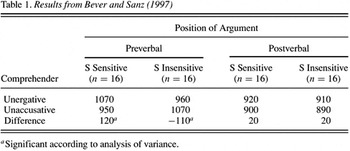
Results from Bever and Sanz (1997)
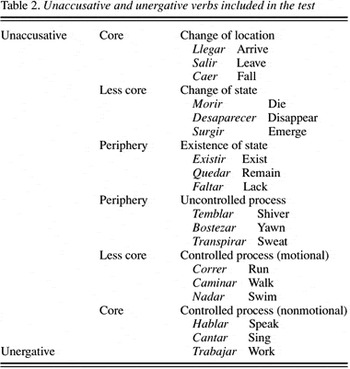
Unaccusative and unergative verbs included in the test
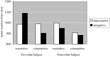
The mean reactions times for Spanish native speakers.
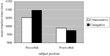
The mean reaction times for L2 learners.
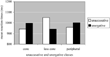
The mean reaction times per verb class for native speakers.
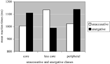
The mean reaction times per verb class for L2 learners.
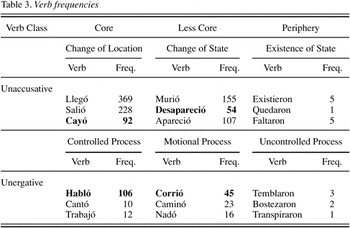
Verb frequencies
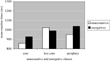
The mean reaction times for frequency matched unaccusative and unergative verbs per semantic subclass for native speakers.
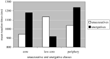
The mean reaction times for frequency matched unaccusative and unergative verbs per semantic subclass for L2 learners.
 You have
Access
- 15
- Cited by