Background
The clinical paradigms used to assess cognitive function in elderly adults range from short screening tests of memory to comprehensive behavioral ratings by trained psychiatrists (Folstein et al., Reference Folstein, Folstein and McHugh1975; Rosen et al., Reference Rosen, Mohs and Davis1984; Molloy et al., Reference Molloy, Alemayehu and Roberts1991). Some of the traditional measures of cognitive status or decline show limitations in sensitivity for differentiating normal from reduced or impaired cognitive functioning (Duncan and Siegal, Reference Duncan and Siegal1998; Geerlings et al., Reference Geerlings, Jonker, Bouter, Adler and Schmand1999; Christensen, Reference Christensen2001; Burns et al., Reference Burns, Lawlor and Craig2002). Cognitive tests can also introduce cultural, linguistic, and/or educational biases. The finite nature of these scales, generally with point scores ranging from 1 to 30, and relatively large increments between points can make it difficult to quantify gradual aberrations or positive changes after medication (Palmqvist et al., Reference Palmqvist, Minthon, Wattmo, Londos and Hansson2010). The processing-speed theory of cognitive aging proposes that slower speed of activating or processing information is the key to cognitive decline rather than the rate of information loss or decay (Salthouse, Reference Salthouse1996).
During the last decade, A Quick Test of Cognitive Speed (AQT) (Wiig et al., Reference Wiig, Nielsen, Minthon and Warkentin2002; Reference Wiig, Nielsen, Minthon and Warkentin2003) has been used extensively in Sweden to assess cognitive aging and decline associated with dementia, including Alzheimer's disease and dementia with Lewy bodies (Andersson et al., Reference Andersson, Wiig, Londos and Minthon2007; Palmqvist, Reference Palmqvist2011; Kvitting et al., Reference Kvitting, Wimo, Johansson and Marcusson2013, p. 68). AQT has been used in research involving Arabic, English, Greek, Japanese, Norwegian, Spanish, and Swedish speaking adults (Wiig et al., Reference Wiig, Nielsen, Minthon and Warkentin2002; Reference Wiig, Nielsen, Minthon and Warkentin2003; Reference Wiig, Nielsen and Jacobson2007; Jacobson et al., Reference Jacobson, Nielsen, Minthon, Warkentin and Wiig2004; Warkentin et al., Reference Warkentin2005; Bruna et al, Reference Bruna2007; Ijuin et al, Reference Ijuin2013; Wigg and Al-Halees, Reference Wiig and Al-Halees2013). The purpose of this study was to obtain objective, quantitative AQT processing-speed measures for cognitively healthy Italian primary care patients to develop normative data for cognitive screening in primary care. The design replicates previous research with AQT (Wiig et al., Reference Wiig, Nielsen, Minthon and Warkentin2003; Nielsen et al., Reference Nielsen, Wiig, Warkentin and Minthon2004; Andersson et al., Reference Andersson, Wiig, Londos and Minthon2007; Warkentin et al., Reference Warkentin, Erikson and Janciauskiene2008).
A Quick Test of Cognitive Speed uses a rapid-naming format to assess cognitive processing speed and efficiency by measuring the amount of time required to complete relatively simple tasks with controlled input (Wiig et al., Reference Wiig, Nielsen, Minthon and Warkentin2002; Reference Wiig, Nielsen, Minthon and Warkentin2003; Nielsen and Wiig, Reference Nielsen and Wiig2011). The measures account for reaction, retrieval, and response time as well as time for making choice decisions and cognitive set shifting. AQT measures are sensitive to small changes in the time used for processing and responding, and have been used to examine, among others, the comparative effects on cognition of Alzheimer's disease and dementia with Lewy bodies and individual responsiveness to Alzheimer's disease's specific medication (Warkentin et al., Reference Warkentin2005; Andersson et al., Reference Andersson, Wiig, Londos and Minthon2007; Warkentin et al., Reference Warkentin, Erikson and Janciauskiene2008; Palmqvist et al., Reference Palmqvist, Minthon, Wattmo, Londos and Hansson2010; Palmqvist, Reference Palmqvist2011, p. 62). AQT has also proved useful in differentiating adults with and without attention deficit hyperactivity disorders (ADHD; Wiig and Nielsen, Reference Wiig and Nielsen2012).
A recent primary care study (Kvitting et al., Reference Kvitting, Wimo, Johansson and Marcusson2013) compared the Mini-Mental State Examination (MMSE) with the AQT and the Clock Drawing Test (CDT) in dementia assessments and showed that AQT in combination with MMSE had a sensitivity of 91%. AQT sensitivity alone was 78%, MMSE 59%, and CDT 26%. The AQT specificity of 67% was lower than that for CDT 88% and MMSE 91%, but AQT had the highest negative predictive value of 69% (MMSE 61% and CDT 46%). So a combination of AQT and MMSE proved to be a quickly administered and suitable instrument for primary care dementia screening.
A Quick Test of Cognitive Speed has shown a high test-retest reliability (r = 0.84 to 0.96) with no significant gender differences or differences caused by years of education after achieving literacy (grades 8 and above; Wiig et al., Reference Wiig, Nielsen, Minthon and Warkentin2002; Wiig et al., Reference Wiig, Nielsen, Minthon and Warkentin2003; Jacobson et al., Reference Jacobson, Nielsen, Minthon, Warkentin and Wiig2004; Nielsen and Wiig, Reference Nielsen and Wiig2006). Previous studies have shown that AQT times correlate positively with age, which is in agreement with the fact that aging is associated with slower cognitive speed (Jacobson et al., Reference Jacobson, Nielsen, Minthon, Warkentin and Wiig2004; Nielsen and Wiig, Reference Nielsen and Wiig2006; Wiig et al., Reference Wiig, Nielsen and Jacobson2007). Criterion cut-off times (in seconds) for typical (less than +1.0 SD), slower-than-typical (between +1.0 and +2.0 SD), and atypical/pathological performance (greater than +2 SD) were identical for English and Swedish languages (Wiig et al., Reference Wiig, Nielsen, Minthon and Warkentin2002; Reference Wiig, Nielsen, Minthon and Warkentin2003). AQT can be administered and scored with minimal training. These considerations prompted the collection of normative AQT processing-speed and efficiency measures from a representative sample of cognitively healthy Italian primary care patients.
The objective of this study was to obtain normative data for AQT color, form, and color–form combination naming in Italian adults and to develop culturally and linguistically appropriate criterion cut-off times for typical, slower-than-typical, and atypically slow processing speed.
Methods
Sample
Participants were patients who for any reason visited one of the nine primary care physicians spread all over Italy over a two-week period. The patients were included consecutively. Only patients with MMSE scores of 26–30 points were included. Other criteria for inclusion were that the patients lived independently, managed personal finances, had not experienced recent changes in patterns of eating, sleeping, general health, or mood, and had no personal history of psychiatric or neurological disorders or family history of early dementia. Patients in nursing homes, or with psychiatric disorders, requiring treatment or severe stages of diseases which could interfere with cognitive performance, such as severe chronic obstructive pulmonary disease, severe chronic heart failure, anemia, diabetes, impairment of visual perception, were all excluded. However, patients with chronic diseases but in a clinically stable condition determined by the primary care physician and unmodified medication for the last six months were included.
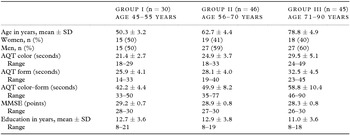
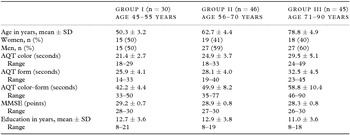
We started with 128 presumably cognitively healthy primary care patients, 57 women and 71 men, with no memory or cognitive complaint either self-reported or reported by close relatives who were contacted and interviewed. Seven patients were subsequently excluded because they met the exclusion criterion of being in a severe stage of a chronic disease. All the 121 enrolled patients (52 women and 69 men) were fully literate and responded to a verbal questionnaire of well-being, family history of dementia, and past and present medical history. Their age ranged from 45 to 90 years (mean (M) = 65.6 year, SD = 12.1 years). All were native speakers of Italian, resided in Italy, and had completed 8 to 21 years of education (M = 12.2 years; SD = 3.7 years). Their MMSE scores ranged from 26 to 30 points (M = 28.8; SD = 0.9). See Table 1 for demographics stratified by age groups.
Characteristics of participants and AQT test results in cognitively normal Italian primary care patients
Measurements
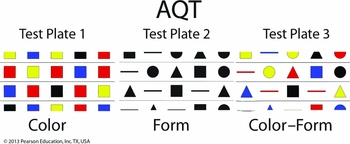
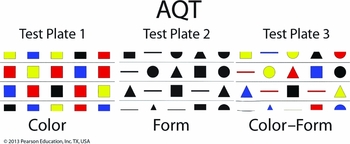
The AQT color, form and color–form processing-speed tests were administered in Italian to all participants. Short familiarization trials were done to establish adequacy and consistency in naming the stimuli. AQT consists of three separate naming tasks. Of these, color naming (e.g., red) and form naming (e.g., circle) provide single-dimension naming measures that account primarily for reaction, retrieval, and response time. The third, color–form combination naming (e.g., red circle) measures reaction, retrieval, and response time as well as time for co-articulation and shifting cognitive set (alternating between naming colors and forms; Figure 1; Wiig et al., Reference Wiig, Nielsen, Minthon and Warkentin2002).
A sample of AQT. Each original test contains 40 figures. The patient is instructed to quickly name the color of each figure on the first test (AQT color), the form on the second test (AQT form), and the color and form on the third test (AQT color–form).
Procedures
Nine primary care physicians, trained by the main investigator, administered the AQT processing-speed tests to their patients. Participants were tested during routine visits to their primary care physician. The order of administration was fixed with color naming tested first, then form naming, and last color–form naming. It should be noted that in Italian the word “tondo” (round) was used instead of the geometric reference “cerchio,” (circle) since the latter is more difficult to pronounce in rapid sequence. The total naming time for each test plate with 40 visual stimuli was recorded with a digital stopwatch in seconds and fractions of seconds, beginning with voice onset. For clinical purposes and ease of administration and scoring, the examiner did not record the first three naming errors.
Statistical analysis
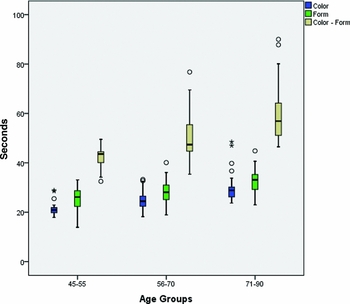
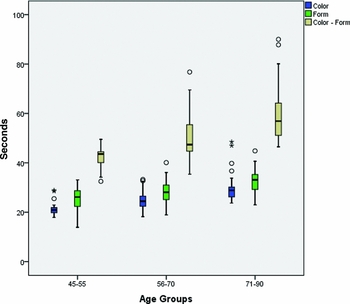
Descriptive statistics were conducted using SPSS Statistics for Windows Version 21.0 (IBM Corp, Armonk, NY, USA). The AQT scoring times of the three age groups are illustrated in the box plot graph (Figure 2) and show the presence of both extreme and mild outliers. Extreme outliers were defined as those whose data points were above or below Q3 (upper interquartile range) ± 3 × IQR (interquartile range), and mild outliers were those whose data points were above or below Q3 ± 1.5 × IQR, but were not extreme outliers. The outliers were examined and these all proved to meet the inclusion criteria. To achieve normality, all naming time measures in seconds were transformed to log normal (ln) measures for further statistical analysis. One-way ANOVA tested the significance of difference in naming–time means (ln) between each age group and between women and men. Correlation coefficients (Pearson's r) explored relations between individual ages and years of education and AQT (ln) measures. Measures of variability (SDs) were used to establish preliminary criterion cut-off time scores (in seconds) for typical, slower-than-typical, and atypical/pathological processing speed.
Naming time results in seconds for AQT color, form, and color–form in three age groups: 45–55, 56–70, and 71–90 years old, of 121 cognitively healthy Italian primary care patients presented as box-plots with median and outliers. *Extreme outliers: data points that are above Q3 + 3 × IQR. Mild outliers: data points that are above Q3 + 1.5 × IQR, but are not extreme outliers. Q3: the upper interquartile range; IQR: interquartile range.
Ethics and consent
In compliance with the Helsinki guidelines for human subject research, all patients were legally competent to provide informed consent, and were informed of the following:
-
1. The study's purpose, aims, potential risks, and benefits.
-
2. The confidential manner in which the data would be collected and handled to protect privacy.
-
3. They could abstain or withdraw at any time from the study without affecting their physician–patient relationship.
-
4. They would not be identified by any published results.
According to Italian legislation, an ethical approval was not necessary for this type of study. Participants received no compensation.
Results
A Quick Test of Cognitive Speed naming times stratified for age-level groups and gender are reported in Table 1. The number of naming errors was low in agreement with findings in healthy American and Swedish adults (Wiig et al., Reference Wiig, Nielsen, Minthon and Warkentin2002; Reference Wiig, Nielsen, Minthon and Warkentin2003).
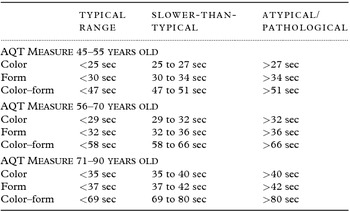
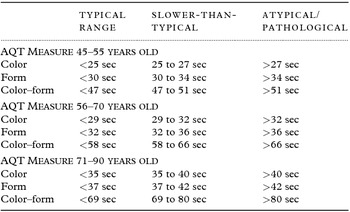
Normality tests for all AQT naming times distributions rejected normality. The non-normal distribution pattern was also confirmed by distribution curves and by quantile–quantile plots. There were significant AQT naming time differences between younger (45–55 years old), older (56–70 years old), and the oldest (71–90 years old) participants for all AQT measures. One-way ANOVA comparisons of mean lognormal naming time differences for color, form, and color–form combination naming between the three age groups showed for AQT color: F(2, 118) = 45.64, p < 0.0001; AQT form: F(2, 118) = 23.76, p < 0.0001; AQT color–form: F(2, 118) = 42.90, p < 0.0001. Differences in AQT reading times between the young–old group (56–70 years old) and the old–old group (71–90 years old) also proved to be substantial and significant (p < 0.001; Table 1). The distribution of naming time results of the three age groups is also shown in corresponding box plots in Figure 2. Age as a continuous variable correlated positively and moderately with AQT naming times: r = 0.65 for AQT color (p < 0.001), r = 0.53 for AQT form (p < 0.001), r = 0.63 for AQT color–form (p < 0.001), and correlated negatively and moderately with the MMSE score: r = –0.44, p < 0.001. Separate criterion cut-off times were thus developed for different age groups. Standard deviations from the naming–time mean scores determined the typical (less than +1 SD), slower-than-typical (between +1 and +2 SD), and atypical/pathological (greater than +2 SD) ranges adopting the same theoretical approach used in other languages (Wiig et al., Reference Wiig, Nielsen, Minthon and Warkentin2002; Reference Wiig, Nielsen, Minthon and Warkentin2003). Cut-off times were rounded to the nearest second for ease of reference (Table 2).
AQT criterion-referenced cut-off times in seconds for the typical (less than +1.0 SD), slower-than-typical (between +1.0 and +2.0 SD), and atypical/pathological (greater than +2 SD) performance ranges for 121 cognitively healthy Italian primary care patients divided into three age groups
Years of education correlated positively but weakly with the MMSE score (r = 0.27, p = 0.003), and negatively but weakly with AQT naming times for AQT color (r = –0.16, p = ns), AQT form (r = –0.24, p = 0.007), and AQT color–form (r = –0.19, p = 0.041). T-tests showed no significant differences between genders for either MMSE scores or AQT reading times.
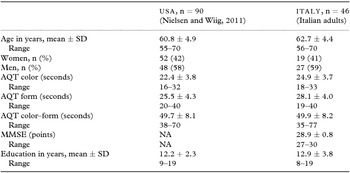
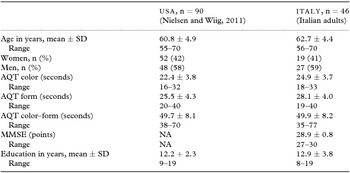
A Quick Test of Cognitive Speed naming times in a US population-based sample of 90 cognitively healthy 55–70-year-old patients (Nielsen and Wiig, Reference Nielsen and Wiig2011) and 46 Italian primary care patients aged 56–70 years in this study are shown in Table 3.
AQT test results comparing cognitively healthy samples of the US patients and the Italian primary care patients
Discussion
In this study, we obtained normative naming-times for AQT processing-speed tests used to assess cognitive function from a culturally and linguistically representative sample of cognitively healthy Italian primary care patients. Age proved to have a significant effect on processing speed and this concurs with previous findings (Jacobson et al., Reference Jacobson, Nielsen, Minthon, Warkentin and Wiig2004; Nielsen and Wiig, Reference Nielsen and Wiig2006; Wiig et al., Reference Wiig, Nielsen and Jacobson2007). Years of education also correlated significantly but weakly with AQT naming times, a finding previously unreported.
The differences between AQT naming times in 46 Italian primary care patients aged 56–70 years in this study and 90 American subjects (Nielsen and Wiig, Reference Nielsen and Wiig2011) of the same age range seen in Table 3 were considerably smaller than the differences between 90 American subjects and 90 healthy Arabic speaking Jordanian adults of the same age range (Wiig and Al-Halees, Reference Wiig and Al-Halees2013). This may reflect cultural, educational, and linguistic differences. It should also be noted that the order of naming of colors and forms in the dual dimension the AQT color–form test is reversed between Italian and English, which could impact naming times.
Cardiovascular diseases, diabetes, and hypertension are common in middle-aged and elderly people visiting primary care and are indeed associated with impaired cognition (Halling and Berglund, Reference Halling and Berglund2006; Elias et al., Reference Elias, Goodell and Dore2012). A few outliers in our study showing long AQT reading times in the two older groups of patients could be explained by the high sensitivity of the AQT test, which might have detected initial cognitive impairment not yet clinically evaluable and not detected by MMSE, although the present study was not designed to test this assumption. This study was carried out in primary care, and the assessment of cognitive normality was based on the MMSE score, the clinical judgment of patient's primary care physician, and information obtained from patient's close relatives and patients themselves. No extensive neuropsychological battery was used. However, we trust that our broad definition of cognitive normality provides a more accurate representation of the real population and therefore better normative data for clinical usage.
Primary care physicians are usually the first health professionals that patients or their families contact for memory loss concerns (Waldorff et al, Reference Waldorff, Rishøj and Waldemar2005; Brodaty et al., Reference Brodaty, Low, Gibson and Burns2006; Pirani et al., Reference Pirani, Broda, Martini, Zaccherini, Neviani and Neri2010). Yet, these physicians often complain about the lack of suitable instruments and time to assess cognition. The ideal cognitive screening test for primary care would be brief, easily administrable, and scored with high sensitivity and specificity for identifying impairment (Milne et al., Reference Milne, Culverwell, Guss, Tuppen and Whelton2008; Holsinger et al., Reference Holsinger, Plassman, Stechuchak, Burke, Coffman and Williams2012). In Italy, as in many other countries, the CDT and MMSE are commonly used in combination as “first line tests” for dementia evaluation by both neurologists and primary care physicians. Alas, the CDT has proved to be difficult to assess in the primary care setting (Ehreke et al., Reference Ehreke2009). So it has been suggested that AQT could replace CDT in combination with MMSE for dementia evaluation (Kvitting et al., Reference Kvitting, Wimo, Johansson and Marcusson2013). The AQT is currently in clinical use in Sweden for dementia assessments in both primary and secondary care. The high negative predictive value of an AQT result is one of its main advantages making it suitable as a clinical screening tool. Whether the cut-off time developed in our study would be suitable in validating AQT as a cognitive screening tool remains to be investigated in future studies. The AQT brain speed test however seems to fill a gap in cognitive testing since few tests measure speed, which is correlated to brain processing.
This study has acknowledged limitations: First, the sample of 121 patients was small; however, the patients were consecutively recruited from different parts of Italy: North and South, rural, and urban settings. This indicates that our dataset is representative of the Italian population. We did not follow the patients over time to rule out incipient dementia, however, there is a paucity of published results as to how normal groups of people respond to clinical measures of different types of morbidity. And for the AQT brain processing speed test there are few published studies on the performance of cognitively healthy people. To our knowledge, only two previous normative AQT studies have used a larger population than the present study (Bruna et al., Reference Bruna2007; Wiig and Al-Halees, Reference Wiig and Al-Halees2013). We have designed a future validation study to establish AQT sensitivity and specificity measures in the Italian population to differentiate between neurotypical adults and adults with mild cognitive impairment or mild-to-moderate dementia.
Conclusions
We have established preliminary normal cut-off times for the AQT test in Italian primary care patients based on +1 and +2 SDs, adopting the theoretical approach used in other languages and settings. We have also planned a future study to eventually refine the AQT naming cut-off times for normality aiming at an optimal balance between sensitivity and specificity in cognitive diagnostics.
Conflict of interest
None.
Description of the authors’ roles
Ferdinando Petrazzuoli and Elisabeth Wiig conceived the study. Ferdinando Petrazzuoli was responsible for the manuscript and the analysis of the data. Sebastian Palmqvist and Hans Thulesius helped in study plans and critically revised the manuscript. Ferdinando Petrazzuoli, Marco Cambielli, Nicola Buono, Carmine Farinaro, Valerio Marsala, Alfredo Cuffari, Enzo Pirrotta, Maurizio D’Urso, and Francesco Chiumeo provided data for the study and reviewed the manuscript.
Acknowledgments
We express our gratitude to the Italian primary care patients who participated in the study. The study did not receive external funding.