A coordinated and effective action requires that individual perceives and evaluates the possible action information provided by the environment. The affordance provides such a possibility. Gibson (Reference Gibson1979) used the term affordance to refer to the fact that human not only visually perceive physical property of an object, but also perceive the potential actions for carrying out with the object. For example, when an individual sees a chair, he knows how to sit on it.
Since Gibson (Reference Gibson1979) proposed a theory of affordance, many behavioral and neuroscience studies have shown that the visual properties of object, such as location (Symes, Ellis, & Tucker, Reference Symes, Ellis and Tucker2007), size (Tucker & Ellis, Reference Tucker and Ellis2001), weight (Brouwer Georgiou, Glover, & Castiello, Reference Brouwer, Georgiou, Glover and Castiello2006; Scorolli, Borghi, & Glenberg, Reference Scorolli, Borghi and Glenberg2009), shape (Smith, Reference Smith2005; Panis, Vangeneugden, de Beeck, & Wagemans, Reference Panis, Vangeneugden, de Beeck and Wagemans2008; Panis, Vangeneugden, & Wagemans, Reference Panis, Vangeneugden, de Beeck and Wagemans2008), and orientation of graspable parts (Tucker & Ellis, Reference Tucker and Ellis1998), automatically activates a series of motor responses. For example, when observing a left or right orientated graspable object, responses were facilitated if the responding hand was congruent with the orientation of object (Tucker & Ellis, Reference Tucker and Ellis1998). Additional studies revealed that canonical neurons (found in parietal-premotor cortical circuits of monkeys) were responsible for the encoding of the visual features in accordance with action potentialities (Jeannerod, Arbib, Rizzolatti, & Sakata, Reference Jeannerod, Arbib, Rizzolatti and Sakata1995; Murata et al., Reference Murata, Fadiga, Fogassi, Gallese, Raos and Rizzolatti1997; Raos, Umiltá, Murata, Fogassi, & Gallese, Reference Raos, Umiltá, Murata, Fogassi and Gallese2006; Umiltà, Brochier, Spinks, & Lemon, Reference Umilta, Brochier, Spinks and Lemon2007). Those neurons were activated even when monkeys simply observed graspable objects without explicit response requirements.
Among the numerous properties of the object, the safety of object is an important characteristic because it concerns our survival. To survive, humans need to distinguish between objects that may contain potential risk and objects that can be safely approached. Some studies have demonstrated that participants are sensitive to the dangerousness of objects (e.g., Anelli, Borghi, & Nicoletti, Reference Anelli, Borghi and Nicoletti2012; Anelli, Nicoletti, Bolzani, & Borghi, Reference Anelli, Nicoletti, Bolzani and Borghi2013; Hudson, Nicholson, Simpson, Ellis, & Bach, Reference Hudson, Nicholson, Simpson, Ellis and Bach2016; Zhao, Reference Zhao2017). In a study of Anelli et al. (Reference Anelli, Borghi and Nicoletti2012), participants were required to perform a natural/artifact categorization task. Results showed a facilitating effect with neutral objects and an inhibitory effect with dangerous objects. In a symbol identification task, Zhao (Reference Zhao2017) simultaneously presented a neutral object and a dangerous object to investigate whether sequential modulations of congruency effects occurred across two types of affordance conflict. It is typically assumed that such an effect only occurs between same conflict types (Egner, Delano, & Hirsch, Reference Egner, Delano and Hirsch2007; Zhao, Bai, Ma, & Wang, Reference Zhao, Bai, Ma and Wang2015). This effect within same types of affordance conflict (e.g., within neutral objects or dangerous objects) occurred, but not across different types of affordance conflict (e.g., between neutral objects and dangerous objects). These studies indicate that objects with potential danger can cause special processing that is different from neutral objects.
Due to children's strong curiosity and inadequate control ability, accidental injury events caused by inappropriate manipulation often occur, and these phenomena inevitably appear in a child’s development. Nevertheless, research has shown that children possess certain discrimination ability of dangerous object. For example, in a study by Anelli et al. (Reference Anelli, Borghi and Nicoletti2012), children were presented with a neutral or dangerous object preceded by a grasping hand. They were required to judge the natural/artifact categorization of object. Results showed the judgment of dangerous objects became slower. The current research is interested in whether children's manipulation of dangerous objects can be modulated by external cues. To solve this issue, the cues about the danger level of a graspable object were adopted, and their modulating effect on affordance was investigated. Additionally, in order to explore the development of influence of object affordance on action responses develops from childhood to adulthood, two age groups of children and adults were recruited to participate in the experiments. This approach referred to the study of Anelli et al. (Reference Anelli, Borghi and Nicoletti2012), which investigated how the motor resonance develops from childhood to adult. If the manipulation of dangerous objects could be modulated by the cues, an increased affordance effect would be expected.
Method
Participants
Seventy-two students took part in the Experiments. Thirty-six students (18 males, 18 females) with a mean age of 7.9 (range: 6–10) years participated in Experiment 1a and thirty-six (17 males, 19 females) with a mean age of 23.8 (range: 20–28) years participated in Experiment 1b. All self-reported as right-handed and had normal or corrected-to-normal vision.
Apparatus and Stimuli
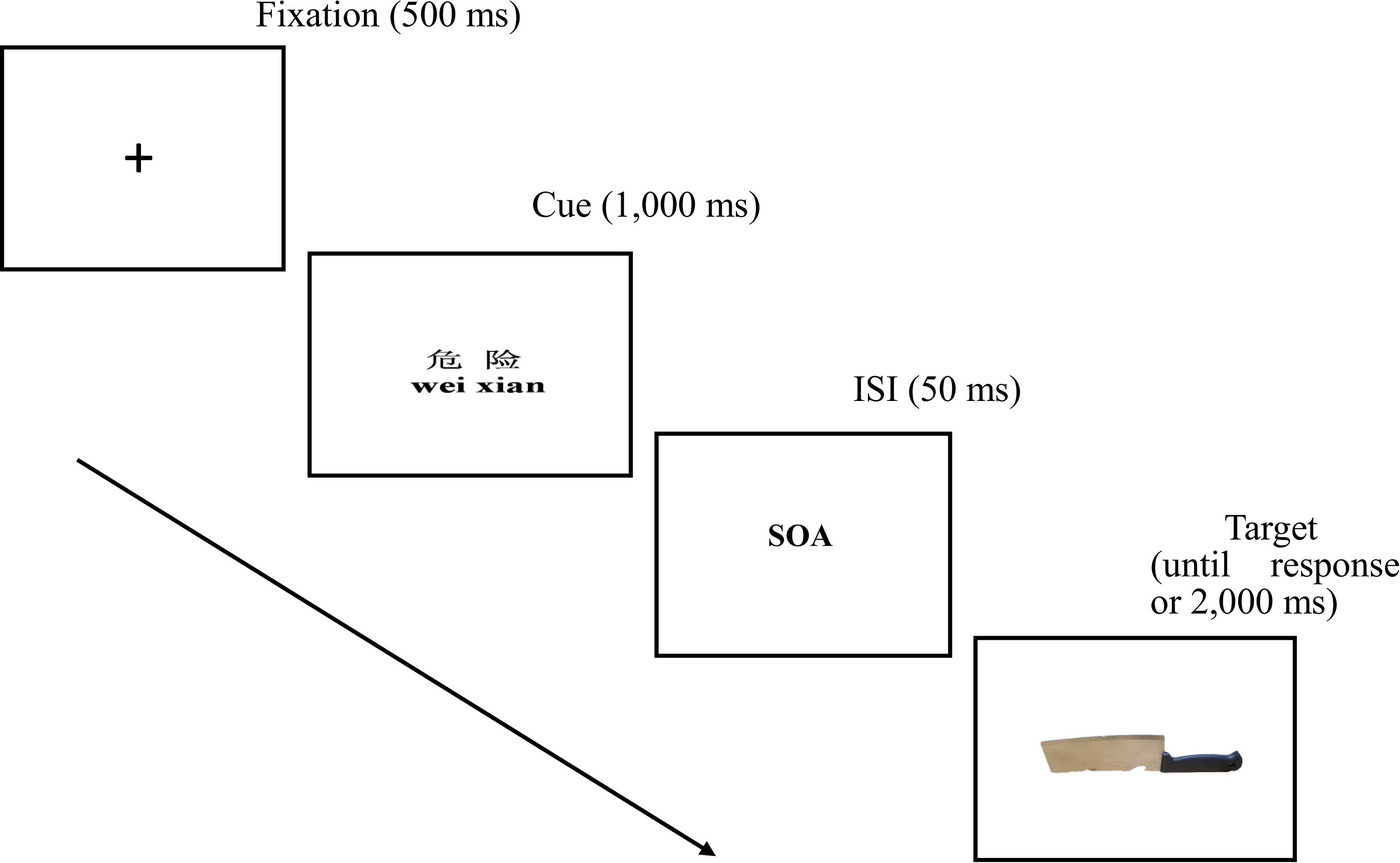
The stimuli were displayed on a 17-in. color monitor that was placed approximately 50 cm distant from the participant. E-Prime 1.1 software was used for stimuli presentation and responses collection (Schneider, Eschman, & Zuccolotto, Reference Schneider, Eschman and Zuccolotto2002). Each trial consisted of a cue and an image of graspable object (see Figure 1). The cues were Chinese characters, which subtended 0.9 × 0.9° of visual angle. The meaning of cue was danger or safety (valid cue condition). The dangerous characters corresponded to the dangerous objects, and the safe characters corresponded to the neutral objects. The distance between two characters was 1.6° of visual angle. The control condition was a blank picture (invalid cue condition). In order to ensure that children could understand the meaning of the words, there was a corresponding Chinese Pinyin under each wordFootnote 1. The image of graspable object was obtained from color photographs (9.32 ° × 9.32 °) of neutral and dangerous objects, which were typically encountered in everyday life. Objects consisted of eight upright/upside down neutral objects (cup, spoon, teapot, and toothbrush) and eight upright/upside down dangerous objects (knife, axe, dagger, and hacksaw). Pictures of all objects subtended 4.6–17.3° horizontally and 2.8–5.3° vertically. The objects were presented with their handles pointing either to the left or right. This orientation could activate an apparent affordance for grasping with either left or right hand. The risk level of these objects was assessed in our previous study (Zhao, Reference Zhao2018). It had been demonstrated the level of risk for group of dangerous objects, M = 6.10, was significantly higher than for the group of neutral objects, M = 1.80, t(19) = 5.31, p < .001, Cohen’s d = 2.43. The material of Experiment 1a was the same as the material of Experiment 1b.
The Timeline of a Trial in the Experiment. (In this trial, the cue meaning danger, indicating the danger level of dangerous object).

Procedure
Each trial began with a fixation point cross (0.5º × 0.5º) presented for 500 ms in the center of screen. Then, a cue (character or blank) was shown for 1,000 ms, followed by a white screen for 50 ms. Next, a target object appeared at the center of the screen and remained visible on the screen until a response was made or 2,000 ms had elapsed. Following a 1,000 ms blank interval, the next trial began. Participants were asked to decide whether the object was upright or upside down, as quickly and accurately as possible. Upside down or upright was defined depending on the object’s normal use. Half of the participants were instructed to press the “A” key with left hand if the object was upright or the “L” key with right hand if the object was upside down. The other half of the participants received the opposite key-response instructions. Experiment 1a and Experiment 1b utilized the same procedure.
Design
Both Experiment 1a and Experiment 1b comprised 5 blocks of 64 trials each in a within-participants three-factor design. The factors consisted of cue type (valid cue, invalid cue), object type (neutral, dangerous), and congruency between response hand and handle orientation (congruent, incongruent). The participants completed 20 practice trials before beginning the experimental phase.
Results
Reaction times:
Reaction times (RTs) for incorrect responses (Experiment 1a: 10.2%; Experiment 1b: 5%) and RTs of more than two standard deviations from the mean for each participant (Experiment 1a: 7.5%; Experiment 1b: 3.8%) were discarded from subsequent RTs analyses. A repeated measures ANOVA was carried out for both experiments with the following factors: Cue type (valid cue, invalid cue), object type (neutral, dangerous), and congruency between response hand and handle orientation (congruent, incongruent).
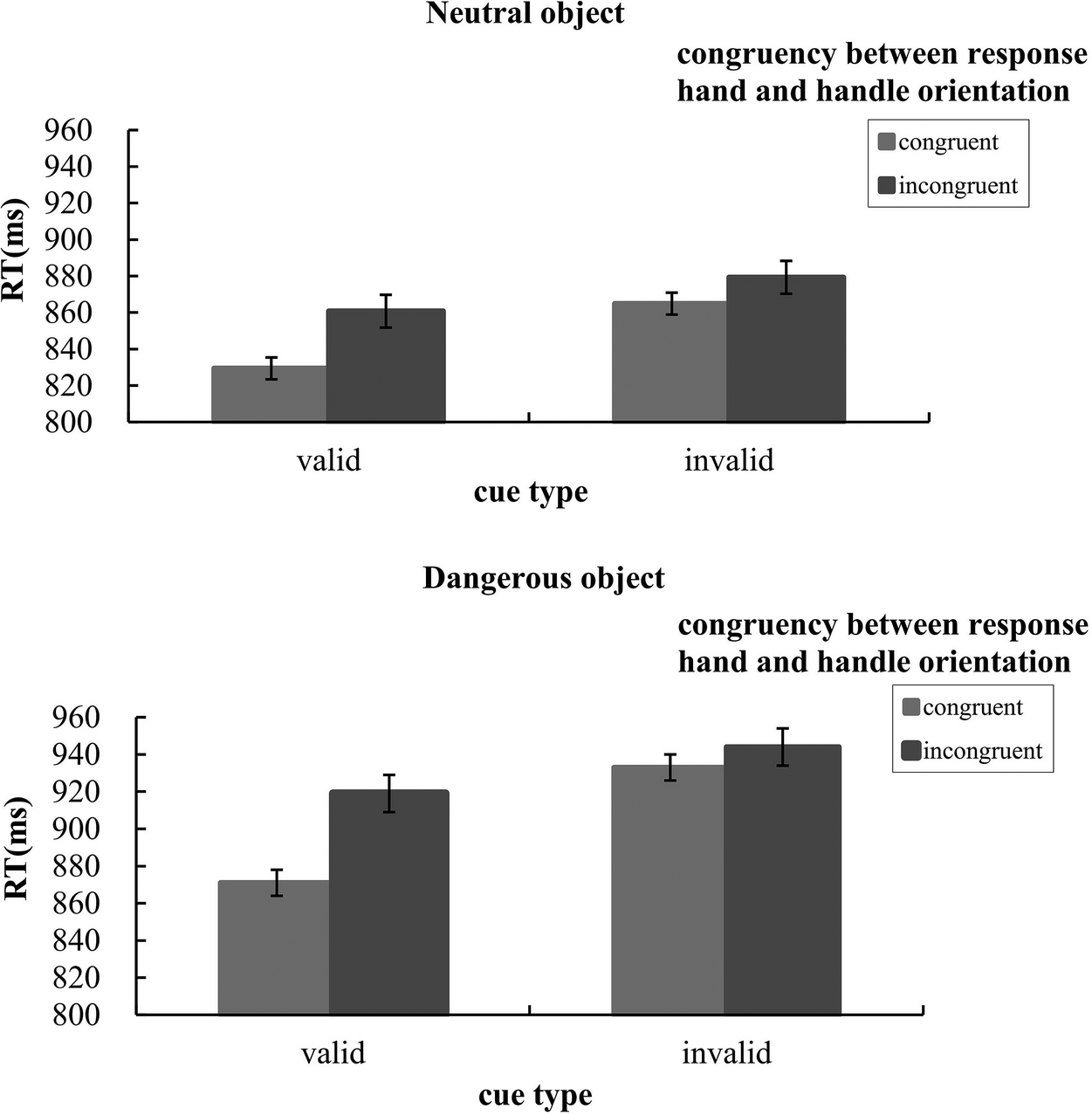
Experiment 1a (see Figure 2)
The ANOVA demonstrated a significant main effect of cue type, F(1, 35) = 23.68, p < .001, η2p = .26, indicating that the participants responded faster to the target object when it was preceded by a valid cue (M = 868 ms, SD = 90) than an invalid cue (M = 905 ms, SD = 88). There was also a main effect of the target object, F(1, 35) = 10.64, p < .01, η2p = .24, with faster RTs when the target object was neutral (M = 859 ms, SD = 91) rather than dangerous (M = 915 ms, SD = 103). The main effect of congruency between the response hand and handle orientation was also significant, F(1, 35) = 71.30, p < .001, η2p = .67, with faster RTs occurring when the participants’ response hand and handle orientation were congruent (M = 874 ms, SD = 82) than incongruent (M = 899 ms, SD = 85). The cue type interacted with the congruency between the response hand and handle orientation, F(1, 35) = 14.70, p < .001, η2p = .31. Post-hoc paired t-tests revealed that the size of the congruency effect between handle orientation and participants’ hand when there was a valid cue (size = 35 ms; congruent = 850 ms, SD = 86; incongruent = 885 ms, SD = 96) was greater than invalid cue condition (size = 13 ms, congruent = 899 ms, SD = 89; incongruent = 912 ms, SD = 88), t(35) = 3.83, p < .01, Cohen’s d = 1.29. There was no other interaction effects (all ps > .10).
Mean Response Times (with Standard Errors) for Children in Experiment 1a. (Error bars denote standard errors).

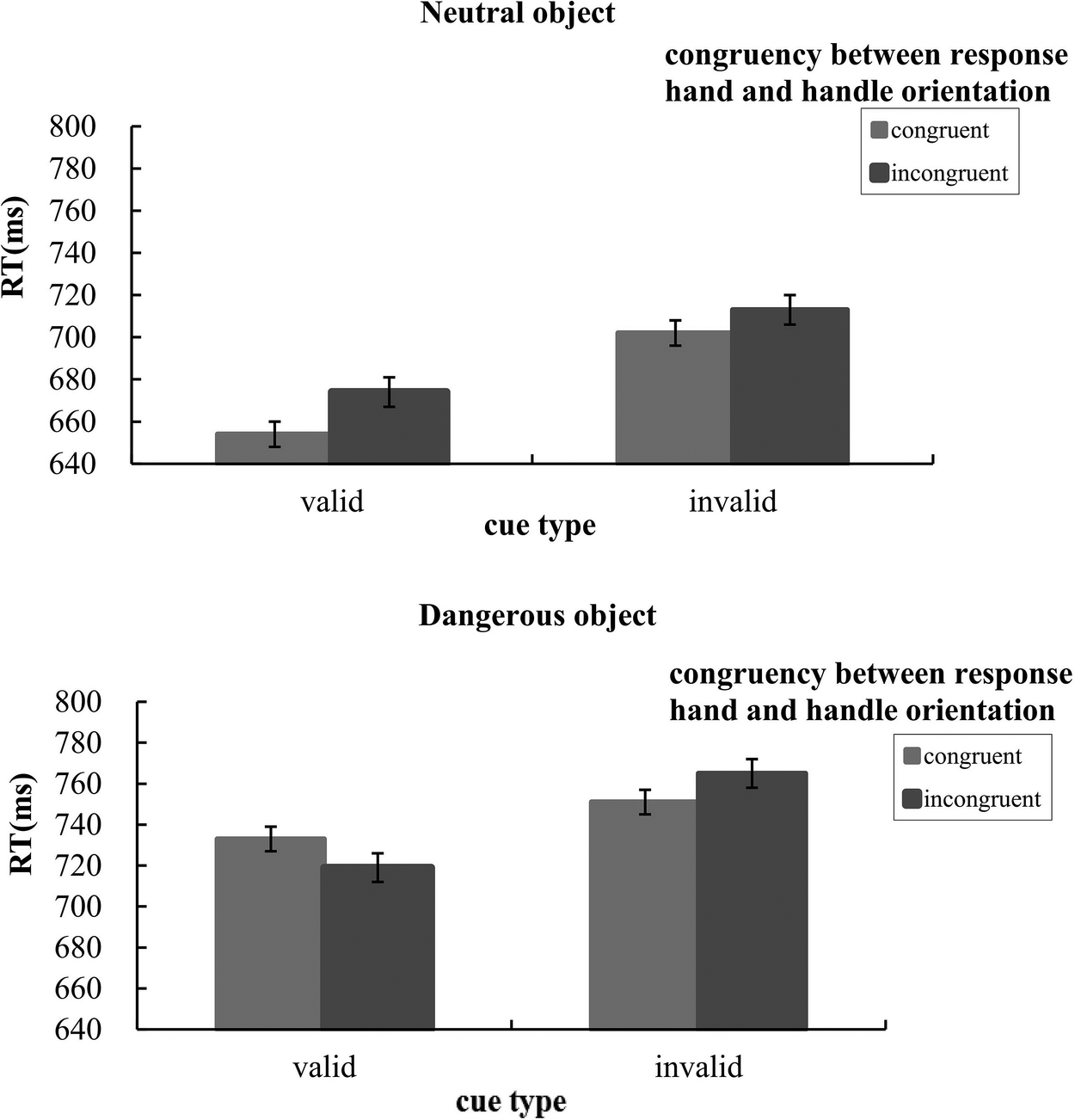
Experiment 1b (see Figure 3)
The main effect of cue type was significant, F(1, 35) = 21.32, p < .001, η2p = .38. Responses were faster when there was a valid cue (M = 695 ms, SD = 81) than an invalid cue (M = 733 ms, SD = 80). There was also a main effect of the object type, F(1, 35) = 45.60, p < .001, η2p = .57. Responses were faster for neutral objects (M = 686 ms, SD = 77) rather than dangerous objects (M = 742 ms, SD = 84). The main effect of congruency between the response hand and handle orientation was significant, F(1, 35) = 14.44, p < .001, η2p = .29, with faster responses for congruent (M = 710 ms, SD = 76) than for incongruent trials (M = 718 ms, SD = 77). The cue type interacted with the congruency between the response hand and handle orientation, F(1, 35) = 7.74, p < .01, η2p = .38. The object type interacted with congruency between the response hand and handle orientation, F(1, 35) = 10.60, p < .01, η2p = .23. There was a three-way interaction among the cue type, object type, and congruency between the response hand and handle orientation, F(1, 35) = 18.43, p < .001, η2p = .35.
To explore this further, separate ANOVAs were performed on the cue type (valid cue, invalid cue) and congruency between response hand and handle orientation (congruent, incongruent) for each of the two types of object.
For neutral objects, the results showed a significant main effect of cue type, F(1, 35) = 18.43, p < .001, η2p = .35, with faster RTs when there was a valid cue (M = 664 ms, SD = 84) than there was an invalid cue (M = 707 ms, SD = 81). The main effect of congruency between the response hand and handle orientation was significant, F(1, 35) = 26.58, p < .001, η2p = .43, with faster responses for congruent (M = 678 ms, SD = 75) than incongruent trials (M = 693 ms, SD = 78), indicating a typical affordance effect. No interaction between the two factors was found, F(1, 35) = 2.21, p = .15, η2p = .06.
For the dangerous objects, the results showed a main effect of cue type, F(1, 35) = 5.96, p < .05, η2p = .15, which was modulated by an interaction of cue type and congruency between the response hand and handle orientation, F(1, 35) = 25.14, p < .001, η2p = .42. Post-hoc paired t-tests revealed that when there was a valid cue, a reverse congruency effect was found, with faster responses for incongruent (M = 719 ms, SD = 96) than for congruent trials (M = 733 ms, SD = 96), t(35) = 4.00, p < .001, Cohen’s d = 1.35. When there was an invalid cue, a congruency effect between participants’ hand and handle orientation was observed, with faster RTs for congruent (M = 751 ms, SD = 95) than incongruent trials (M = 765 ms, SD = 87), t(35) = 2.87, p < .01, Cohen’s d = .97.
Mean Response Times (with Standard Errors) for Adults in Experiment 1b. (Error bars denote standard errors).

Error rates
The same ANOVAs were conducted for error rates. In Experiment 1a, the main effect of cue type was obtained, F(1, 35) = 6.06, p < .05, η2p = .15, with lower error rates for valid cue condition (M = 8.6%, SD = 6.0) than for invalid cue condition (M = 11.7%, SD = 8.6). The main effect of congruency between the response hand and handle orientation was significant, F(1, 35) = 5.30, p < .05, η2p = .13, with lower error rates for congruent (M = 8.9%, SD = 6.0) than incongruent trials (M = 11.4%, SD = 8.6). There was no other significant effects (all ps > .10).
In Experiment 1b, the main effect of cue type was significant, F(1, 35) = 4.23, p < .05, η2p = .11, with lower error rates for the valid cue condition (M = 4.1%, SD = 7.2) than for invalid cue condition (M = 5.9%, SD = 7.2). The main effect of object type was obtained, F(1, 35) = 5.69, p < .05, η2p = .14, with lower error rates for neutral objects (M = 3.2%, SD = 3.0) than dangerous ones (M = 7.2%, SD = 11.4). There was no other significant effects (all ps > .10).
Discussion
The present study investigated how cues for the danger level of objects influenced the processing of action components during discrimination of graspable objects. In addition, the difference between perceived and processed graspable objects with different ages was examined.
The results revealed that children were sensitive to the cues that indicated the danger level of the object. When experiencing such a cue, both the affordance effects of dangerous objects and neutral objects were enhanced. This indicates that children can focus their attention on the surface of the object according to the implications of character cue. Since the concept of affordance was proposed, researchers have generally believed that the reason for this phenomenon is that visual features on the surface of the object activate the individual's actions on manipulating the object (Gibson, Reference Gibson1979; Vingerhoets, Vandamme, & Vercammen, Reference Vingerhoets, Vandamme and Vercammen2009; Tucker & Ellis, Reference Tucker and Ellis1998, Reference Tucker and Ellis2001). Moreover, Murphy, van Velzen, and de Fockert (Reference Murphy, van Velzen and de Fockert2012) found that only when an object receives sufficient attention, it can potentiate an action. The more attention paid to the surface of the object, and the action activated by the object was stronger, resulting in an enhanced affordance effect.
However, it generated different effects on dangerous objects and neutral objects for adults. When there were character cues for the danger level of objects, the affordance effects of neutral objects were increased, whereas the affordance effects of dangerous objects were reversed. After experiencing safe cues, adults were able to relax their vigilance and focus on the surface of neutral objects, thus resulting in an enhanced affordance effect. When warned of danger, the awareness of danger might be activated. Adults may paid more attention to the source of the dangerous information, such as the blade of a knife, making it difficult to assign attention to the handle of the knife. Therefore, a reversed affordance effect of dangerous objects occurred. Indeed, it is acknowledged that attention involves activation of affordance (Makris, Hadar, & Yarrow, Reference Myachykov, Ellis, Cangelosi and Fischer2013; Myachykov, Ellis, Cangelosi, & Fischer, Reference Myachykov, Ellis, Cangelosi and Fischer2013; Pellicano, Iani, Borghi, Rubichi, & Nicoletti, Reference Pellicano, Iani, Borghi, Rubichi and Nicoletti2010).
Some believe that there is a close relationship between language comprehension and the processing of action information (Ambrosini, Scorolli, Borghi, & Costantini, Reference Ambrosini, Scorolli, Borghi and Costantini2012, Borghi & Riggio, Reference Borghi and Riggio2015; Myachykov et al., Reference Myachykov, Ellis, Cangelosi and Fischer2013). Borghi and Riggio (Reference Borghi and Riggio2015) argued that during language processing, a motor prototype was formed. This prototype included the affordance active by object size and orientation. Myachykov et al. (Reference Myachykov, Ellis, Cangelosi and Fischer2013) tested the ability of visual cues to induce grasp affordance effects. In their experiments, a cue about the object's name appeared before the occurrence of target object. Results showed that linguistic cues potentiated activation of grasp affordances. In the present experiments, the cue indicated the danger level of the object, and a reinforced affordance effect was obtained. The cues in the research of Myachykov et al. (Reference Myachykov, Ellis, Cangelosi and Fischer2013) activated the object semantics, and the cues in this study enhanced the individual's alertness level, thus enhancing the activation of affordances. Nevertheless, the present results extended these views by demonstrating that the affordances of objects can be reinforced during language processing about the danger level of objects.
In summary, the data provide evidence for the effect of cues on processing of objects. The results indicates that character cues can enhance the individual’s awareness to assist with appropriate manipulation of objects.
Acknowledgments.
This study was supported by the grant from Humanity and Social Science Youth foundation of Ministry of Education of China (17XJC190011), Shaanxi philosophy and Social Sciences fund (2017P016), and Scientific Research Project of Shaanxi Education Department (19JK0033)