Introduction
Obsessive–compulsive disorder (OCD) is a relatively common disorder that is characterised by significant impairment in occupational and social functioning and diminished quality of life (Andrews, Henderson, & Hall, Reference Andrews, Henderson and Hall2001; Fontenelle et al., Reference Fontenelle, Fontenelle, Borges, Prazeres, Rangé, Mendlowicz and Versiani2010; Kugler et al., Reference Kugler, Lewin, Phares, Geffken, Murphy and Storch2013; Leon, Portera, & Weissman, Reference Leon, Portera and Weissman1995). Numerous subtypes or thematic presentations of OCD have been identified. Religious OCD or scrupulosity is a common thematic presentation characterised by religious-themed obsessions and compulsions (Abramowitz, Huppert, Cohen, Tolin, & Cahill, Reference Abramowitz, Huppert, Cohen, Tolin and Cahill2002; Buchholz et al., Reference Buchholz, Abramowitz, Riemann, Reuman, Blakey, Leonard and Thompson2019; Siev, Baer, & Minichiello, Reference Siev, Baer and Minichiello2011). Obsessions can include the excessive fear of sinning, intrusive blasphemous thoughts, persistent doubts of having committed sins or moral transgressions, the excessive fear of not being fully committed to one's faith, and the extreme fear of punishment from God (Abramowitz et al., Reference Abramowitz, Huppert, Cohen, Tolin and Cahill2002; Abramowitz & Jacoby, Reference Abramowitz and Jacoby2014; Besiroglu, Karaca, & Keskin, Reference Besiroglu, Karaca and Keskin2014; Nelson, Abramowitz, Whiteside, & Deacon, Reference Nelson, Abramowitz, Whiteside and Deacon2006; Siev et al., Reference Siev, Baer and Minichiello2011). Compulsions can include behaviours, such as excessive prayer, the seeking of reassurance from others, such as clergy or rabbis, and excessive attention to minor details in religious practice (Abramowitz et al., Reference Abramowitz, Huppert, Cohen, Tolin and Cahill2002; Abramowitz & Jacoby, Reference Abramowitz and Jacoby2014; Besiroglu et al., Reference Besiroglu, Karaca and Keskin2014; Nelson et al., Reference Nelson, Abramowitz, Whiteside and Deacon2006; Rosmarin, Pirutinsky, & Siev, Reference Rosmarin, Pirutinsky and Siev2010; Siev et al., Reference Siev, Baer and Minichiello2011). Research in the area of scrupulosity is particularly important, as scrupulosity could be less responsive to treatment relative to other subtypes of OCD (Siev et al., Reference Siev, Baer and Minichiello2011), and the treatment of scrupulosity raises some unique clinical challenges and may require specialised approaches to intervention (Huppert & Siev, Reference Huppert and Siev2010). Consequently, ongoing research is needed to understand the nature of scrupulosity.
The Penn Inventory of Scrupulosity (PIOS) is the only known self-report measure developed to assess scrupulosity (Abramowitz et al., Reference Abramowitz, Huppert, Cohen, Tolin and Cahill2002). As a self-report measure, with 19 items measured on a Likert scale, the PIOS assesses scrupulosity as a continuous variable. Based on factor analytic studies, general support has been found for a two-factor model, with factors labelled Fear of God (FOG) and Fear of Sin (FOS; Abramowitz et al., Reference Abramowitz, Huppert, Cohen, Tolin and Cahill2002; Olatunji, Abramowitz, Williams, Connolly, & Lohr, Reference Olatunji, Abramowitz, Williams, Connolly and Lohr2007; Shapiro, Krompinger, Gironda, & Elias, Reference Shapiro, Krompinger, Gironda and Elias2013). However, some variations in the structure of the PIOS have been noted. Olatunji et al. (Reference Olatunji, Abramowitz, Williams, Connolly and Lohr2007) arrived at a two-factor model with 15 items and referred to this shorter version as the Pennsylvania Inventory of Scrupulosity-Revised (PIOS-R). Another exception is a study by Huppert and Fradkin (Reference Huppert and Fradkin2016) in which support was found for a bifactor model. In particular, the authors found that most items loaded simultaneously in a primary factor and one of two secondary factors. The secondary factors were generally consistent with the original FOS and FOG subscales with a few items removed. However, the label ‘Fear of Sin’ was replaced with ‘Fear of Immorality’, as the remaining items on this subscale emphasised immorality and did not include items reflecting concerns about sin.
Numerous studies have found this 19-item measure to exhibit good psychometric properties (Abramowitz et al., Reference Abramowitz, Huppert, Cohen, Tolin and Cahill2002; Nelson et al., Reference Nelson, Abramowitz, Whiteside and Deacon2006). For example, the PIOS has consistently been found to be associated with religiosity and OCD symptoms in both clinical and non-clinical samples (Abramowitz et al., Reference Abramowitz, Huppert, Cohen, Tolin and Cahill2002; Abramowitz, Deacon, Woods, & Tolin, Reference Abramowitz, Deacon, Woods and Tolin2004; Nelson et al., Reference Nelson, Abramowitz, Whiteside and Deacon2006). The psychometric properties of the PIOS have also been found on a sample of individuals from different religious backgrounds (Inozu, Clark, & Karanci, Reference Inozu, Clark and Karanci2012; Pirutinsky, Siev, & Rosmarin, Reference Pirutinsky, Siev and Rosmarin2015; Witzig & Pollard, Reference Witzig and Pollard2013). Furthermore, Huppert and Fradkin (Reference Huppert and Fradkin2016) found that scores on the PIOS distinguished between Christian patients with scrupulosity and Christian patients with other OCD subtypes; however, the PIOS did not effectively distinguish between OCD with and without scrupulosity for patients of other faiths (Huppert & Fradkin, Reference Huppert and Fradkin2016).
Although the PIOS has provided a substantial understanding of scrupulosity and religious OCD, some potential limitations of this measure are noteworthy, and through the development of a new measure, it may be possible to refine and expand the construct of scrupulosity. Perhaps the most salient limitation of the PIOS is that scrupulosity and religious OCD, as defined by researchers and clinicians, includes both obsessions and compulsions (Abramowitz et al., Reference Abramowitz, Huppert, Cohen, Tolin and Cahill2002). However, based on the inspection on items on the PIOS, it appears that the measure focuses almost exclusively on thoughts/obsessions and gives limited attention to compulsions and related behaviours. Second, many of the items on the PIOS appear to assess general fears in relation to religion and religiosity (e.g., ‘I am afraid my thoughts are unacceptable to God’). However, it may be beneficial to develop a measure that also includes a broader range of more specific thoughts and behaviours related to scrupulosity, including excessive prayer, repetition of rituals, and dietary restrictions. Third, it may be helpful to include items that capture the degree to which participants perceive specific thoughts or behaviours to be extreme, excessive, and/or persistent.
In response to the above observations and potential limitations of the PIOS, the purpose of this study was to develop and provide a preliminary psychometric evaluation of a new measure of scrupulosity called the Scrupulous Thoughts and Behaviours Questionnaire (STBQ). In particular, the authors sought to expand the construct of scrupulosity to include both thoughts and behaviours related to scrupulosity, to include a variety of items that identify specific thoughts and behaviours, and to include items in which participants are asked to recognise thoughts and behaviours as excessive, extreme, or disruptive. The successful development of such a measure may have utility for both clinicians and researchers, who study the construct of scrupulosity. For example, such a measure may improve the accuracy of identification of individuals with scrupulosity, beyond more general diagnostic measures not specifically designed to assess scrupulosity. It could also be a more responsive measure of treatment outcome in clinical trials that include individuals with scrupulosity. Furthermore, the measure could be used in research as a tool to compare and contract scrupulosity systems across various religions and cultures. Finally, a measure of this nature may assist clinicians in identifying specific symptoms that would otherwise be overlooked.
It was hypothesised that STBQ would yield a two-factor solution, with one factor measuring thoughts/obsessional content and the other factor measuring behaviours/compulsions. In terms of validity, the authors expected the correlation between the STBQ and the PIOS to be moderate to large in magnitude, as the PIOS is the only other known measure of scrupulosity. Furthermore, it was expected that the association between the STBQ and measures of internalising psychopathology, including OCD symptoms, depression, and anxiety, would be significant and moderate in magnitude. In addition, based on previous research in the area of scrupulosity, it was anticipated that the STBQ would yield a positive and significant association, moderate in magnitude, with religiosity, and cognitive measures consistently found to be associated with obsessional thinking, including thought–action fusion and thought suppression. More specifically, thought–action is the belief that disturbing and unacceptable thoughts are the equivalent to committing unacceptable behaviours and/or are likely to lead to unacceptable actions (Shafran, Thordarson, & Rachman, Reference Shafran, Thordarson and Rachman1996), whereas thought suppression assesses the practice of suppressing unwanted, intrusive thoughts, which appears to have a paradoxical effect (Wegner & Zanakos, Reference Wegner and Zanakos1994).
Method
Participants
Participants were undergraduate students enrolled at a large university in the United States, who volunteered to participate in exchange for extra credit. Participants were required to be at least 18 years old. Furthermore, to be included in data analysis, participants were required to identify with a specific religion. Non-religious respondents were excluded, as previous research has indicated that non-religious respondents tend not to endorse items designed to assess scrupulosity (Phillips & Fisak, Reference Phillips and Fisak2020). Based on this criterion, of a total of 553 participants, 413 reported that they identified with a specific religion and were included in subsequent analyses. The remaining participants did not identify with a specific religion (i.e., atheist, agnostic, or no response).
Of the 413 participants who identified with a specific region, 70.0% identified as female, 29.3% identified as male, and 0.7% identified as ‘other’ or did not respond to the gender question. Regarding racial/ethnic distribution of the sample, 53.0% identified as White, 22.0% identified as Hispanic/Latino, 11.1% identified as Black/African American, 8.2% identified as Asian or Pacific Islander, 0.5% identified as Native American, and 5.1% identified as ‘other’ or did not provide a response. Regarding religion, a majority of the participants identified as Christian, 85.4%. Of the remaining participants, 5.8% identified as Muslim/Islamic, 4.8% identified as Jewish, 1.8% identified as Hindu, 1.2% identified as Buddhist, and 1% of participants endorsed ‘other’.
Design and Procedures
The study was internet-based, in which participants completed the self-report measures described below. The project was approved by the appropriate institutional review board, and informed consent was obtained from all individual participants included in the study. All procedures were conducted in accordance with the American Psychological Association Ethical Code and the Code of Ethics of the World Medical Association (Declaration of Helsinki).
Measure Development
An extensive literature review was conducted to identify common experiences of individuals with scrupulosity. Case studies, qualitative studies, and quantitative studies were reviewed to generate an item pool. A total of 86 items were initially generated. Redundant items were merged or eliminated. In addition, items were refined as needed for clarity. The final measure included 44 items designed to assess a range of thoughts and behaviours perceived to be relevant to the construct of scrupulosity. Studies relevant to item development are denoted in the reference section with an asterisk.
Measures
In addition to the STBQ and a demographics form, the participants were asked to complete the following measures:
Pennsylvania Inventory of Scrupulosity-Revised
The PIOS is a 19-item measure of scrupulosity that includes two subscales: FOS and FOG (Abramowitz et al., Reference Abramowitz, Huppert, Cohen, Tolin and Cahill2002). This measure has been found to exhibit good psychometric properties, including great internal consistency and validity. For example, the PIOS has the ability to differentiate between patients to have OCD with scrupulosity and those who experience OCD without scrupulosity (Shapiro et al., Reference Shapiro, Krompinger, Gironda and Elias2013). For the purpose of the current study, the more recent 15-item PIOS-R was utilised (Olatunji et al., Reference Olatunji, Abramowitz, Williams, Connolly and Lohr2007). In the current sample, Cronbach's alpha was good, α = .96.
White Bear Suppression Inventory
The White Bear Suppression Inventory (WBSI) is a 15-item self-report measure used to assess the tendency and practice of suppressing unwanted, intrusive thoughts (Wegner & Zanakos, Reference Wegner and Zanakos1994). Items are rated on a 5-point Likert scale. The WBSI has been found to yield good psychometric properties, including good convergent validity, including positive correlations with measures of obsessive thinking, depression, and general anxiety, and good reliability, including internal consistency and test–retest reliability (Muris, Merckelbach, & Horselenberg, Reference Muris, Merckelbach and Horselenberg1996; Wegner, & Zanakos, Reference Wegner and Zanakos1994). A number of studies have found a two-factor solution for the WBSI, with factors labelled Suppression and Intrusion (Schmidt et al., Reference Schmidt, Gay, Courvoisier, Jermann, Ceschi, David, Brinkmann and Van der Linden2009). In the current sample, Cronbach's alpha was good, α = .96.
Thought–Action Fusion Scale
The Thought–Action Fusion Scale (TAFS) is a 19-item self-report measure designed to assess the construct of thought–action fusion, with items on a 5-point Likert scale (Shafran et al., Reference Shafran, Thordarson and Rachman1996). More specifically, thought–action assesses the belief that disturbing and unacceptable thoughts are the equivalent to committing unacceptable behaviours and the belief and disturbing and unacceptable thoughts are likely to lead to unacceptable actions (Shafran et al., Reference Shafran, Thordarson and Rachman1996). In addition to a total score, the TAFS has three subscales, which include moral-TAF, which assesses TAF in relation to morality, TAF-Likelihood-Others, which assesses concerns about the negative outcome for others, and TAF-Likelihood-Self, which assesses concerns about the negative outcome for the self. The total score on the TAFS along with the subscales have been found to exhibit good reliability, including internal consistency, and consistent support has been found for the validity of the TAFS, including significant associations with measures of OCD symptoms (Meyer & Brown, Reference Meyer and Brown2012; Rassin, Merckelbach, Muris, & Schmidt, Reference Rassin, Merckelbach, Muris and Schmidt2001; Shafran et al., Reference Shafran, Thordarson and Rachman1996). In the current sample, Cronbach's alpha was good, α = .96
Yale–Brown Obsessive–Compulsive Scale – Self-Report Version
The symptom severity scales of the Yale–Brown Obsessive–Compulsive Scale – Self-Report Version (Y-BOCS-SR) were administered (Ólafsson, Snorrason, & Smári, Reference Ólafsson, Snorrason and Smári2010). Separate scales for obsessions and compulsions assess components of symptom severity, including the amount of distress, interference, time spent, and perceived control of obsessions and compulsions. The measure has been found to exhibit good psychometric properties, including good internal consistency, convergent validity, and discriminant validity (Ólafsson et al., Reference Ólafsson, Snorrason and Smári2010). Two items from the severity scale of the Brief Obsessive–Compulsive Scale (BOCS; Bejerot et al., Reference Bejerot, Edman, Anckarsäter, Berglund, Gillberg, Hofvander, Humble, Mörtberg, Råstam, Ståhlberg and Frisén2014) were modified and added to the current version of the Y-BOCS-SR to create a more compressive construct. In particular, the BOCS is adapted from the Y-BOCS and includes two items that are not on the Y-BOCS-SR. One item measures symptom avoidance, and the other measures the number of consecutive hours that one is free of obsessions or compulsions on a daily basis. The modified Y-BOCS-SR severity scale included a total of seven items to measure obsessions (an obsessions scale), and seven items to measure compulsions (a compulsion scale). In the current sample, Cronbach's alpha was good, α = .87.
Obsessive–Compulsive Inventory-Revised
The Obsessive–Compulsive Inventory-Revised (OCI-R; Foa et al., Reference Foa, Huppert, Leiberg, Langner, Kichic, Hajcak and Salkovskis2002) is an 18-item scale of symptoms consistent with OCD symptoms. Validity has been supported, as the OCI-R has been used as an effective measure to differentiate individuals with and without pathological levels of OCD, and the OCI-R has been found to exhibit good internal consistency (Foa et al., Reference Foa, Huppert, Leiberg, Langner, Kichic, Hajcak and Salkovskis2002). In the current sample, Cronbach's alpha was good, α = .90.
Depression Anxiety Stress Scales
The 21-item version of the Depression, Anxiety, and Stress Scales (DASS) is a commonly utilised measure of depression and anxiety symptoms (Brown, Chorpita, Korotitsch, & Barlow, Reference Brown, Chorpita, Korotitsch and Barlow1997). The subscales of the DASS were developed using a data-driven approach and are designed to differentiate depression and anxiety symptoms (Brown et al., Reference Brown, Chorpita, Korotitsch and Barlow1997). It is noteworthy that the Anxiety and Stress scales both appear to assess dimensions of anxiety. More specifically, the Anxiety scale assesses symptoms consistent with physiological arousal and fearfulness, and the Stress scale assesses symptoms related to chronic tension, irritability, and feeling ‘on edge’ (i.e., symptoms related to Generalised Anxiety Disorder). The DASS-21 has exhibited good validity, including the ability to distinguish depression and anxiety, and good reliability, including internal consistency (Antony, Bieling, Cox, Enns, & Swinson, Reference Antony, Bieling, Cox, Enns and Swinson1998; Brown et al., Reference Brown, Chorpita, Korotitsch and Barlow1997). Cronbach's alphas were good, as the obtained values were .92, .92, and .93 for the Stress, Anxiety, and Depression scales, respectively.
Santa Clara Strength of Religious Faith Questionnaire
The Santa Clara Strength of Religious Faith Questionnaire (SFRQ) is a 10-item measure of religious faith. Support has been found for the reliability of the SFRQ, including good test–retest reliability (Sherman et al., Reference Sherman, Simonton, Adams, Latif, Plante, Burns and Poling2001) and internal consistency (Plante & Boccaccini, Reference Plante and Boccaccini1997a, Reference Plante and Boccaccini1997b; Sherman et al., Reference Sherman, Simonton, Adams, Latif, Plante, Burns and Poling2001). Furthermore, support has been found for the validity of SFRQ, including significant correlations with measures of intrinsic religiosity, moderate correlations with organisational religiosity and non-organisational religiosity, comfort from religion, and ratings of self as religious (Plante & Boccaccini, Reference Plante and Boccaccini1997a, Reference Plante and Boccaccini1997b; Sherman et al., Reference Sherman, Simonton, Adams, Latif, Plante, Burns and Poling2001). In the current sample, Cronbach's alpha was good, α = .96.
Results
Factor Structure and Reliability of the STBQ
Before examining the factor structure of the STBQ, items were inspected for redundancy based on the magnitude of inter-item correlations and similarity in content, and 11 items with similar wording and elevated inter-item correlations were eliminated. Next, a series of confirmatory factor analyses (CFAs) were conducted utilising M-plus version 8.1, and for all models, a WLSMV extraction method was used. The first-factor analysis was conducted to examine the hypothesised two-factor structure, with one factor assessing thoughts/obsessions and the other factor measuring behaviours/compulsions. The model was a good fit with the data, with all items loading significantly on their designated factors, CFI = .957, TLI = .954, RMSEA = .070, χ2/df = 2.79. Furthermore, all item loadings were significant. Alternative models were also examined, including a single-factor model and a bifactor model, and both models did not adequately fit the data (see Table 1).
Results of CFAs of the STBQ

Note: A WLSMV extraction method was used.
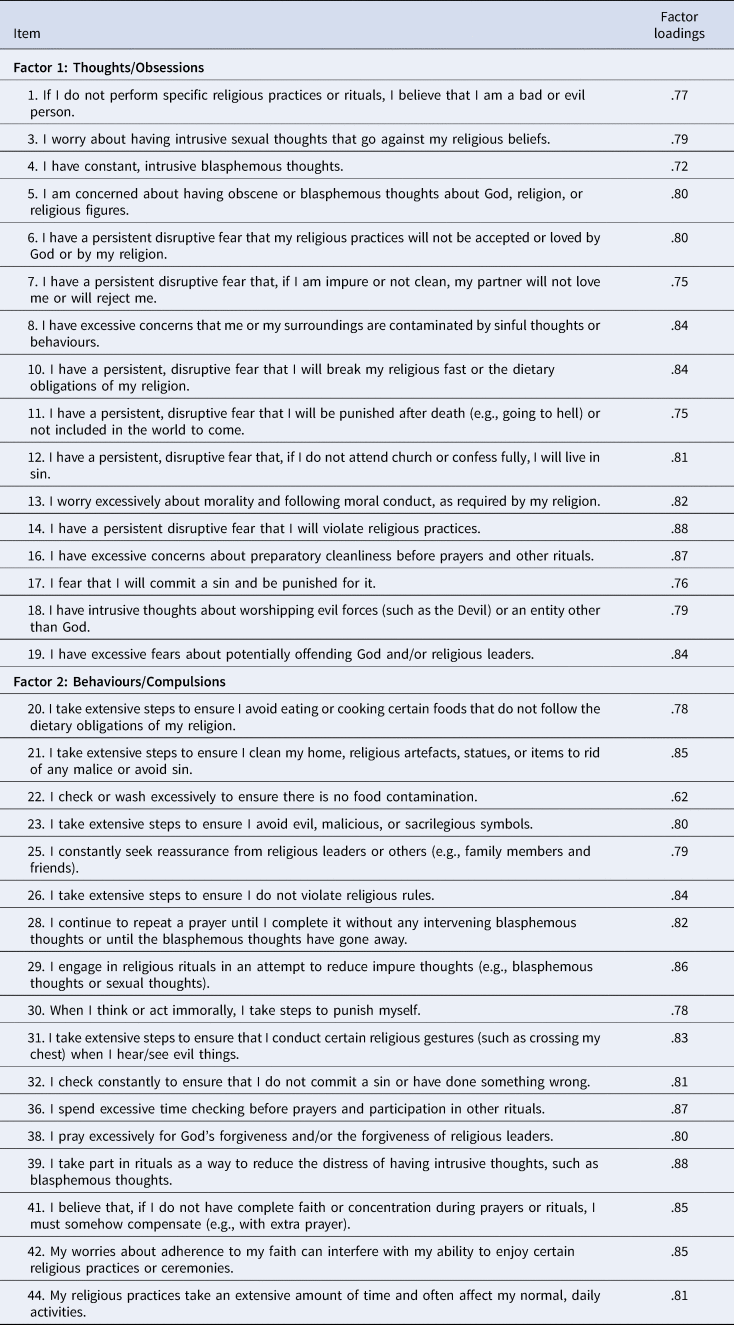
Regarding the final two-factor model, all items loaded significantly on their designated factors (see Table 2). The first factor, consisting of 16 items, assesses religious-themed intrusive and distressful thoughts, including obsessions (STBQ — Thoughts/Obsessions subscale), including concerns about having repugnant thoughts, breaking religious rules, and more general religious-based fears and worries. Internal consistency for this scale was excellent (Cronbach's alpha = .94). The second factor, which includes 17 items, assesses religious-themed behaviours, including excessive engagement and/or reputation or rituals (STBQ — Behaviours/Compulsions subscale), including engagement in compensatory rituals, and avoidance. Internal consistency for this scale was excellent (Cronbach's alpha = .94).
Factor Loadings for Items on the STBQ Based on CFA

Note: The item numbering depicts original numbering (dropped items excluded). CFA is based on a WLSMV extraction method.
Validity of the STBQ
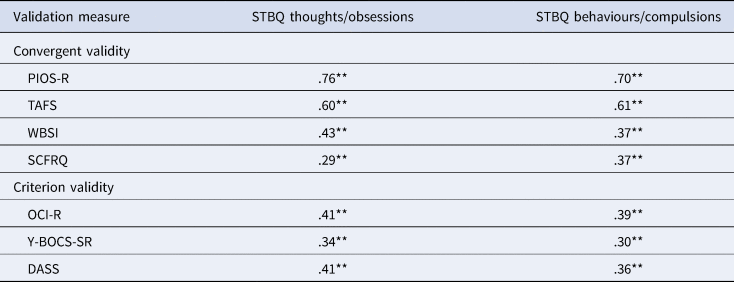
Regarding convergent validity, robust associations were expected between the STBQ subscales and the PIOS-R, as both are measures of the same construct. As anticipated, the significant and positive associations were found between PIOS-R and STBQ — Thoughts/Obsessions, and between the PIOS-R and STBQ — Behaviours/Compulsions (see Table 2). Furthermore, bivariate correlations were conducted to examine the association between the STBQ subscales and measures of constructs that have been found to be associated with scrupulosity and OCD symptoms (see Table 2). As anticipated, the STBQ scales were found to be associated with thought–action fusion, as measured by the TAFS, thought suppression, as measured by the WBSI, and religiosity, as measured by the SFRQ. All correlations were positive, significant, and moderate in magnitude, with rs ranging from .44 to .32 (see Table 2).
Criterion validity was assessed by measuring the association between the STBQ subscales and measures of OCD symptoms. The magnitude of the correlations was anticipated to be in the moderate range, as general measures of OCD capture a larger domain of symptoms relative to scrupulosity. As anticipated, subscales of the STBQ were positively and significantly associated scores on the OCI-R and Y-BOCS, and the correlations were moderate in magnitude, ranging from .30 to .40 (see Table 2). Finally, significant associations were anticipated between the STBQ and internalising symptoms, measured by the DASS-21. As anticipated, correlations were significant, with r coefficients ranging from .33 to .40 (Table 3).
Correlations Between Validation Measures and Subscales of the SBTQ

Note: STBQ = Scrupulosity Thoughts and Behaviours Questionnaire; PIOS-R = Penn Inventory of Scrupulosity-Revised; TAFS = Thought–Action Fusion Scale; WBSI = White Bear Suppression Inventory; SCFRQ = Santa Clara Strength of Religious Faith Questionnaire; DASS = Depression Anxiety Stress Scales; OCI-R = Obsessive–Compulsive Inventory-Revised; and Y-BOCS-SR = Yale–Brown Obsessive–Compulsive Scale – Self-Report Version.
** p < .001.
Discussion
The purpose of this study was to develop and provide a preliminary validation of a new measure of scrupulosity, the STBQ (see Appendix). In developing a new measure, the authors of this study sought to build upon previous work based on the PIOS by broadening the operationalisation of the construct of scrupulosity. Perhaps the most novel feature of the STBQ is the inclusion of items intended to assess compulsions and related behaviours that may be indicative of scrupulosity and religious OCD. This is in contrast with the PIOS, which generally appears to be limited to religious-based thoughts/obsessions.
Based on factor analyses, support was found for a two-factor solution. The first factor, labelled Thoughts/Obsessions, assesses religious-themed obsessions and related thoughts. More specifically, items on this scale include themes, including concerns, fears, and worries, about having repugnant thoughts, about rejection from God or other religious figures, and about breaking religious rules. Furthermore, this subscale also includes items that assess concerns about the consequences of failing to complete rituals, and more general religious-based fears and worries.
The second factor, labelled Behaviours/Compulsions, assesses religious-themed compulsions and related behaviours. Content includes excessive repetition and/or engagement in religious rituals and practices, such as prayer, seeking of forgiveness and/or reassurance. Items also assess engagement in compensatory rituals, avoidance, and self-punishment. Collectively, these findings indicate that both obsessions and scrupulous compulsions can be reliably assessed. Furthermore, although the two factors are correlated, the two-factor model may suggest that at least some distinction can be made between scrupulous obsessions/thoughts and compulsions/behaviours.
Other unique features of the STBQ are noteworthy. In particular, the measure was developed to capture a variety of specific thoughts and behaviours, as listed above. Furthermore, the measure includes a number of items that assess the degree to which participants specific thoughts or behaviors perceived to be excessive, extreme, and/or persistent. In addition, the authors also sought to minimise the inclusion of items that do not directly assess religious obsessions or compulsions. For example, some items on the PIOS may not uniquely assess religious obsessions, as direct references to religion are minimal. For example, some items reflect dishonesty (e.g., ‘I worry that I might have dishonest thoughts’). It is possible that one could be concerned about dishonesty outside of a religious context.
Overall, based on the above-mentioned unique features of the STBQ, this measure has the potential to be a useful tool in subsequent research in the area of scrupulosity and religious OCD, and the authors hope that this study is an impetus for additional studies focused on the STBQ and related efforts to examine religious obsessions and compulsions.
Despite the promising findings of the current study, a number of limitations and directions for future research are noteworthy, and due to the limitations in the current study, the validation of the STBQ should be considered preliminary. Among the most salient limitations is the reliance on a sample of predominantly Christian, non-referred college students. This limits the generalisability of the findings, and in response to this limitation, it is recommended that subsequent studies are conducted in which psychometric properties of the STBQ are examined in clinical samples, including samples of individuals with and without religious OCD/scrupulosity. In addition to examining the factor structure of the STBQ, it would also be of interest to determine if the measure improves the ability to detect cases of scrupulosity and religious OCD and to determine if the measure is sensitive enough to detect symptom improvement following intervention. Furthermore, subsequent studies are recommended in which the psychometric properties and general utility of the STBQ are evaluated in community-based samples of individuals of various religious backgrounds. In addition, more research is needed to provide confirmation for the factor structure, to assess divergent validity, and to examine the test–retest reliability of the STBQ. Finally, another, more general potential direction for subsequent research is, for researchers, to consider the development and refinement of measures of scrupulosity to include both universal, inter-faith measures of scrupulosity and more specific measures designed to assess scrupulosity based on the beliefs and practices of specific religions.
Finally, it is noteworthy that the STBQ has a number of relevant implications for clinical practice. In particular, this measure may enhance the diagnosis and treatment planning of individuals who experience scrupulosity/religious OCD. For example, this measure has the potential to identify specific thoughts or behaviours that may not be captured with other assessment procedures. Furthermore, because the STBQ may assess a wider range of thoughts and behaviours relative to the PIOS, it may improve the ability to accurately detect and distinguish between individuals with and without scrupulosity/religious OCD (Huppert & Fradkin, Reference Huppert and Fradkin2016). In addition, the STBQ has the potential to be utilised as an outcome measure in clinical trials focused on the treatment of OCD.
Appendix
The Scrupulous Thoughts and Behaviours Questionnaire
Below is a list of statements about thoughts, beliefs, and behaviours related to religion and religious practices. Please rate the degree to which you agree each of these statements applies to you using the following scale: