Introduction
New Guinea already has more species of Vireya rhododendrons than any of the other Malesian Islands and approximately three times the number of species as the next most species-rich island, Borneo (Argent, Reference Argent2015). The recent intense mountain building of the island has led to a situation analogous to that of the Himalaya, the other great area of diversification of Rhododendron. Given that many areas of New Guinea are still little known or unknown botanically, it is not surprising that any exploration is likely to provide novelties.
Taxonomic Treatment
Rhododendron stanleyi S.James & Argent sp. nov.
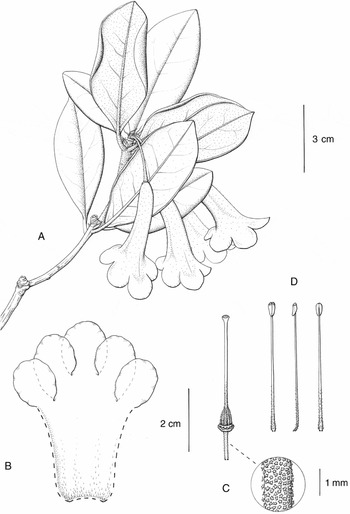
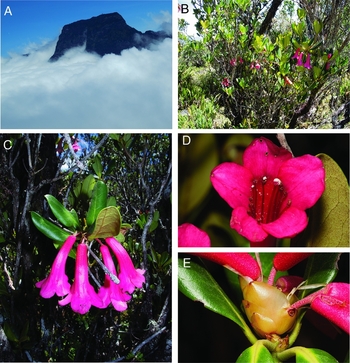
Similar to Rhododendron haematophthalmum Sleumer but differing in having cuneate leaf bases (not truncate to rounded), a smooth upper surface to the leaf after the scales have gone (not persistently rough-papillose), twigs without persistent protruding scale bases, slender pedicels c.0.5 mm in diameter (not c.2 mm in diameter) and a disc-shaped stigma c.2 mm in diameter (not thick globose, distinctly 5-lobed). – Type: Papua New Guinea Central Province, Mount Yule, west of Telikom Repeater Station, 8.20864°S, 146.783°E, 3258 m, 13 x 2013, S.A.James SAJ1221. (holo LAE; iso E!, BISH!, barcode BISH1019605, occurrence ID 960dddea-59c5-4a57-bf72-cd4ceea9ff42). Figs 1 , 2 .
Rhododendron stanleyi S.James & Argent. A, Branch showing habit of flowers; B, corolla opened out, showing inner surface with indumentum; C, pistil with enlarged section of pedicel to show indumentum (circled); D, stamens in different aspects. Scale bars: habit, 3 cm; open corolla, pistil and stamens, 2 cm; circled enlargement of pedicel, 1 mm.

Rhododendron stanleyi S.James & Argent. A, Mount Yule, habitat of Rhododendron stanleyi; B, habit; C, inflorescence; D, floral structure; E, bracts subtending inflorescence. (Photographs by S. A. James.)

Shrubby tree to c.2 m. Twigs 2–3 mm in diameter, rounded, stellate-scaly but very early glabrescent, and rough owing to longitudinal folds but without conspicuous persistent tubercles; internodes 1.3–4 cm. Leaves in tight pseudowhorls, 3–5 together, spreading. Blade 40–60 × 20–30 mm, broadly elliptic, occasionally subobovate; base cuneate; apex obtuse to rounded occasionally apiculate; margin entire, revolute; when young densely scaly, becoming glabrescent, smooth adaxially when the scales have gone, weakly papillose abaxially when the scales have gone. Scales subdendroid, laxly arranged, each on a low, pale epidermal tubercle. Midvein more slender than the petiole, impressed as a narrow groove above, raised throughout its length below; lateral veins 4 or 5 per side, slender, diverging at c.45°, only very weakly elevated beneath, smooth above, reticulate. Petiole 5–7 × 1–1.5 mm, densely stellate-scaly, grooved above. Flower bud c.20 × 10 mm, ellipsoid. Bracts, the outermost triangular, caudate with a few scales abaxially along the midline, main bract to 10 × 20 mm, ovate to obovate, obtuse, membranous, glabrous except for a dense fringe of marginal scales. Bracteoles to c.20 × 1 mm, linear at the base, broadening to a subspathulate distal portion, glabrous except for marginal scales. Flowers hanging in 3- or 4-flowered open umbels. Pedicels 15–21 × c.0.5 mm, densely brown stellate-scaly, without hairs. Calyx c.3 mm in diameter, oblique, disc-shaped, but undulate, densely scaly outside proximally, becoming glabrous towards the perimeter, without hairs, the margin fringed with scales. Corolla zygomorphic, tubular below, dilated towards the mouth, red; tube c.30 × 6 × 12 mm, curved, very laxly, stellate-scaly outside, very shortly hairy inside towards the base, distinctly curved; lobes c.15 × 13 mm, irregularly subcircular, laxly scaly outside near the base. Stamens slightly dimorphic and exserted to c.2 mm, arranged all around the mouth but loosely clustered on the dorsal side of the flower; filaments linear, laxly and shortly patently hairy for the proximal 1/4, glabrous distally; anthers c.4 × 1.8 mm, slightly broadening distally and with oblique pores. Disc hairy on the upper margin, otherwise glabrous. Ovary 5–6 × c.3 mm, shortly cylindrical, tapering distally, shortly hairy, the hairs subpatent, semidistally directed, and densely scaly beneath the hairs; style as long as the stamens, shortly patently hairy and scaly in the proximal 3 mm, hairy only for the next 6 mm, completely glabrous distally; stigma disc-shaped c.2 mm diameter. Fruit not seen.
Distribution
Known only from the type locality.
Ecology
Subalpine forest and open montane shrubbery among rocks. Growing with Rhododendron alticola Sleumer.
Conservation status
Data Deficient. Noted to be common on the summit. Mount Yule is within the margin of a logging concession, but the area where this species was collected is unlikely to be logged owing to the precipitous cliffs surrounding the summit area. The vegetation is more likely to be adversely affected by lightning strikes and consequent fires in an El Niño drought, along with human-lit fires. If the species does occur in the forest as an epiphyte at lower elevation, the population could be adversely affected by logging.
Etymology
Named in honour of Jonathan H. Stanley (1960–2006), an avid sailor and keen naturalist; and Evan R. Stanley (1895–1924), the first Government Geologist for the Territory of Papua, from 1911–1924.
This species belongs in section Hadranthe (sensu Argent, Reference Argent2015) because of the prominent papillae on the underside of the leaf, although the scales are not the typical dendroid form but appear rather more stellate with a relatively broad central flange. This species keys in Argent (Reference Argent2015) to Rhododendron haematophthalmum, a species from west New Guinea, a long way from the location of the present plant collection locality. It differs from that species most obviously in having tapering leaf blades (not truncate to cordate). It also differs from that species in having smooth adaxial leaf surfaces after the scales have gone; being altogether much less densely scaly in all parts, notably with smoother twigs; having much more slender pedicels; having a smaller, disc-shaped stigma rather than the large, lobed one of Rhododendron haematophthalmum; and having twigs that are rough with longitudinal striations but lack the persistent protruding scale bases found in R. haematophthalmum. This species superficially resembles Rhododendron scabridibracteum Sleumer, treated by Argent (Reference Argent2015) as a member of section Schistanthe, subsection Euvireya. However, that species has a much larger truss of flowers, with a different disposition, and lacks the prominent papillae clearly seen in the present species on the abaxial surface of the leaves.
A record of the isotype at BISH may be seen at iDigBio (no date).
Mount Yule (8°12′S, 146°47′E), or Kovio, was ascended to the summit on Christmas Day 1890 in the first recorded climb of this mountain by an expedition led by George Belford (Steenis-Kruseman, Reference van Steenis-Kruseman1950), an assistant to Sir William MacGregor, at the time administrator of the British Crown Colony of New Guinea. There appear to be no records of any plants collected on this visit. The summit was subsequently collected by J. F. Veldkamp and M. Kuduk in October 1989, during which approximately 150 collections were made, including two new species (Agapetes kudukii = Paphia kudukii (Veldkamp) P.F.Stevens – Ericaceae (Veldkamp, Reference Veldkamp1991a; Stevens, Reference Stevens2004) and Papuacalia yuleensis Veldkamp – Asteraceae (Veldkamp, Reference Veldkamp1991b)). Mount Yule is a volcanic peak of the Kumuga Range (Stanley, Reference Stanley1911), isolated from the main Owen Stanley Range of mountains, with a single native path leading to the top. The summit of Mount Yule comprises Pliocene Mount Davidson volcanics, which consist of terrestrially derived basaltic and minor andesitic agglomerate, tuff, lava and lava breccia, with intercalated volcanically derived conglomerate and sandstone, resting on Miocene volcanics (Geological Survey of Papua New Guinea, 1977; H. L. Davies, University of Papua New Guinea, pers. comm., 2016). A telecommunications station has been established in the summit area, which allows helicopter access to the summit. There was evidence of recent fires in the vegetation set by local people or from lightning strikes, or both.
Acknowledgements
This work was supported in part by US National Science Foundation grants DEB-0950207, DEB-0743890, DBI-1547229 and EF-1115210. S.A.J. thanks colleagues A. Allison, P. Shearman, B. Iova and D. Damas, and the LAE Herbarium, for their logistical support; H. Davies for his geological knowledge; and Telekom PNG and the traditional landowners for allowing access to the site. The pen-and-ink plate was ably drawn by Claire Banks.