




Crossref Citations

This article has been cited by the following publications. This list is generated based on data provided by Crossref.
Grein, Jonathan D.
and
Murthy, A. Rekha
2016.
Preparing a Hospital for Ebola Virus Disease: a Review of Lessons Learned.
Current Treatment Options in Infectious Diseases,
Vol. 8,
Issue. 4,
p.
237.
Weber, David J.
Rutala, William A.
Fischer, William A.
Kanamori, Hajime
and
Sickbert-Bennett, Emily E.
2016.
Emerging infectious diseases: Focus on infection control issues for novel coronaviruses (Severe Acute Respiratory Syndrome-CoV and Middle East Respiratory Syndrome-CoV), hemorrhagic fever viruses (Lassa and Ebola), and highly pathogenic avian influenza viruses, A(H5N1) and A(H7N9).
American Journal of Infection Control,
Vol. 44,
Issue. 5,
p.
e91.
Dowall, Stuart D.
Bosworth, Andrew
Rayner, Emma
Taylor, Irene
Landon, John
Cameron, Ian
Coxon, Ruth
Al Abdulla, Ibrahim
Graham, Victoria A.
Hall, Graham
Kobinger, Gary
Hewson, Roger
and
Carroll, Miles W.
2016.
Post-exposure treatment of Ebola virus disease in guinea pigs using EBOTAb, an ovine antibody-based therapeutic.
Scientific Reports,
Vol. 6,
Issue. 1,
Kwon, Jennie H.
Burnham, Carey-Ann D.
Reske, Kimberly A.
Liang, Stephen Y.
Hink, Tiffany
Wallace, Meghan A.
Shupe, Angela
Seiler, Sondra
Cass, Candice
Fraser, Victoria J.
and
Dubberke, Erik R.
2017.
Assessment of Healthcare Worker Protocol Deviations and Self-Contamination During Personal Protective Equipment Donning and Doffing.
Infection Control & Hospital Epidemiology,
Vol. 38,
Issue. 9,
p.
1077.
Nikiforuk, Aidan M.
Cutts, Todd A.
Theriault, Steven S.
and
Cook, Bradley W. M.
2017.
Challenge of Liquid Stressed Protective Materials and Environmental Persistence of Ebola Virus.
Scientific Reports,
Vol. 7,
Issue. 1,
Siegel, Jane D.
and
Guzman-Cottrill, Judith A.
2018.
Principles and Practice of Pediatric Infectious Diseases.
p.
10.
Weber, David J.
Sickbert-Bennett, Emily E.
Kanamori, Hajime
and
Rutala, William A.
2019.
New and emerging infectious diseases (Ebola, Middle Eastern respiratory syndrome coronavirus, carbapenem-resistant Enterobacteriaceae, Candida auris): Focus on environmental survival and germicide susceptibility.
American Journal of Infection Control,
Vol. 47,
Issue. ,
p.
A29.
Andersen, Bjørg Marit
2019.
Prevention and Control of Infections in Hospitals.
p.
1077.
Namiki, Takahiro
and
Hayakawa, Satoshi
2020.
Possible importance of carcasses for ebolavirus persistence in the ecosystem.
Medical Hypotheses,
Vol. 138,
Issue. ,
p.
109595.
2020.
Hilfiker, Lorenz
and
Ganguly, Shashwat
2020.
Integrated Risk of Pandemic: Covid-19 Impacts, Resilience and Recommendations.
p.
21.
Sood, Geeta
and
Perl, Trish M.
2021.
Outbreaks in Health Care Settings.
Infectious Disease Clinics of North America,
Vol. 35,
Issue. 3,
p.
631.
Biondi, Mia J.
Garnett, Lauren
Bello, Alexander
Funk, Duane
Poliquin, Philippe Guillaume
Jones, Shane
Tierney, Kevin
Tran, Kaylie
Kozak, Robert A.
Leung, Anders
Grolla, Allen
Nakamura, Cory
Soule, Geoff
Ranadheera, Charlene
Hagan, Mable
Dhaliwal, Amrinder
Kobasa, Darwyn
Falzarano, Darryl
Bovendo, Hugues Fausther
Feldmann, Heinz
Kesselman, Murray
Hansen, Gregory
Gren, Jason
Mortimer, Todd
Racine, Trina
Deschambault, Yvon
Edmonds, Jocelyn
Aminian, Sam
Saurette, Ray
Allan, Mark
Rondeau, Lauren
Huynh, John
Hadder, Sharron
Press, Christy
DeGraff, Christine
Kucas, Stephanie
Kubay, Julie
Azanarsky, Kim
Cook, Bradley W. M.
Hancock, BJ
Kumar, Anand
Soni, Reeni
Schantz, Daryl
McKitrick, Jarrid
Warner, Bryce
Griffin, Bryan D.
Qiu, Xiangguo
Kobinger, Gary P.
Safronetz, Dave
Wood, Heidi
Stein, Derek R.
Cutts, Todd
Pickering, Brad
Kenny, James
Theriault, Steven
Menec, Liam
Vendramelli, Robert
Higgins, Sean
Banadyga, Logan
Liu, Guodong
Rahim, Md Niaz
Kasloff, Samantha
Sloan, Angela
He, Shihua
Tailor, Nikesh
Albietz, Alixandra
Wong, Gary
Gray, Michael
Feldmann, Friederike
Marzi, Andrea
Risi, George
and
Strong, James E.
2021.
Characterization of Ebola Virus Risk to Bedside Providers in an Intensive Care Environment.
Microorganisms,
Vol. 9,
Issue. 3,
p.
498.
Wyer, Mary
Hor, Su-Yin
Barratt, Ruth
and
Gilbert, G L
2021.
Testing the efficacy and acceptability of video-reflexive methods in personal protective equipment training for medical interns: a mixed methods study.
BMJ Open,
Vol. 11,
Issue. 10,
p.
e052985.
Warmbrod, Kelsey Lane
Cole, Jennifer
Sharkey, C. Matthew
Sengupta, Aparupa
Connell, Nancy
Casagrande, Rocco
and
Delarosa, Patricia
2021.
Biosafety Professionals: A Role in the Pandemic Response Team.
Health Security,
Vol. 19,
Issue. 4,
p.
454.
Contreras, George W.
Burcescu, Brigitte
Dang, Tiffany
Freeman, Jeanette
Gilbreth, Nathan
Jacobson, Juliet
Jayaseelan, Keerthana
and
Markenson, David S.
2022.
Drawing Parallels Among Past Public Health Crises and COVID-19.
Disaster Medicine and Public Health Preparedness,
Vol. 16,
Issue. 6,
p.
2634.
Lukowski, Joseph
Vasa, Angela
Arguinchona, Christa
ElRayes, Wael
Frank, Maria G
Galdys, Alison L
Garcia, Mary C
Garland, Jennifer A
Kline, Susan
Persson, Caroline
Ruby, Darrell
Sauer, Lauren M
Vasistha, Sami
Carrasco, Sharon
and
Herstein, Jocelyn J
2023.
A narrative review of high-level isolation unit operational and infrastructure features.
BMJ Global Health,
Vol. 8,
Issue. 7,
p.
e012037.
The ongoing outbreak of Ebola virus disease (EVD) in West Africa, the largest in history, has devastated the affected countries and raised public health concerns throughout the world. The Centers for Disease Control and Prevention (CDC) in conjunction with the World Health Organization (WHO) has reported that as of July 8, 2015, there have been 16,913 total cases (suspected, probable and confirmed) in West Africa (of which 11,965 were laboratory confirmed) and 6,446 deaths. 1 The CDC has estimated that there is potential underreporting by a factor of 2.5. 2 For the first time ever, an Ebola outbreak has crossed international boundaries, initially moving among neighboring countries from Guinea to Liberia and Sierra Leone, and then spreading to non-contiguous countries including Nigeria, Senegal, Mali, Spain, the United Kingdom, and the United States. 1 According to the WHO, as of July 5, 2015, a total of 875 confirmed healthcare personnel (HCP) infections had been reported from Guinea, Liberia, and Sierra Leone, with 509 deaths. 3 As of March 12, 2015, 11 EVD-infected HCP had been transferred from West Africa to US hospitals.Reference Heavey, Jenkins and Kerry 4 Secondary transmission from a patient with EVD to healthcare providers has also been reported in the United States and Spain.
EBOLA TRANSMISSION
Epidemiological studies have suggested that the Ebola virus spreads primarily through direct contact with a symptomatic person or their body fluids, especially in the latter stages of clinical disease.Reference Dowell, Mukunu and Ksiazek 5 , Reference Francesconi, Yoti and Declich 6 The elevated risk of transmission in the latter stages of EVD is likely due to a combination of increased viral titers in body fluids and increased body fluid discharges (ie, vomitus, stool, and blood). Post-mortem contact is also associated with a high risk of Ebola virus transmission.Reference Dowell, Mukunu and Ksiazek 5 Concern has been raised regarding the possibility of aerosol transmission “either via large droplets or small particles in the vicinity of source patients.”Reference Osterholm, Moore and Kelley 7 Although animal studies suggest that droplet/airborne transmission may occur when the virus is experimentally aerosolized, epidemiologic studies of household contacts suggest that this rarely, if ever, occurs.Reference Dowell, Mukunu and Ksiazek 5 , Reference Francesconi, Yoti and Declich 6 , Reference Johnson, Jaax, White and Jahrling 8 However, there is concern that droplet or airborne transmission could occur in healthcare settings during aerosol-generating procedures such as intubation and induced sputum collection.
The fact that Ebola has been demonstrated to survive and remain infectious in liquid media at room temperature for at least 46 days raises concern about fomite transmission.Reference Piercy, Smither, Steward, Eastaugh and Lever 9 Ebola inoculated onto glass carriers and maintained in the dark survived for hours to days (ie, 1-log10 decrease in 35.3 hours and 4-log10 decrease in 5.9 days).Reference Sanripanti, Rom and Holland 10 Some epidemiologic studies have suggested the possibility of transmission from contaminated environmental sources.Reference Francesconi, Yoti and Declich 6 Further, in the current outbreak, multiple environmental samples from an Ebola treatment unit were positive via polymerase chain reaction (PCR) testing.Reference Osterholm, Moore and Kelley 7 However, in a different study in which sampling was done following routine cleaning, all 31 environmental samples were negative by reverse-transcriptase PCR (RT-PCR), suggesting that routine environmental cleaning and disinfection can decrease the potential for fomite transmission.Reference Bausch, Towner and Dowell 11
PREVENTING EBOLA ACQUISITION BY HCP
As noted above, a substantial number of HCP in West Africa have acquired EVD. Nosocomial transmission of Ebola and infection of HCP has been repeatedly documented in past outbreaks.Reference Kerstiens and Matthys 12 – Reference Khan, Tshioko and Heymann 14 The cluster of Ebola cases in Dallas is illustrative of the 2 major risks for Ebola acquisition faced by US HCP.Reference Chevalier, Chung and Smith 15 , Reference Chung, Smith and Weil 16 First, early recognition, triage, and isolation of all potential EVD cases are essential so adequate infection control measures can be applied and potential transmission of Ebola virus to HCP can be minimized. Second, the acquisition of EVD by 2 HCP who had substantial interaction with an Ebola patient while wearing protective equipment raised concern regarding the adequacy of protection afforded by personal protective equipment (PPE) or the training provided in its use.
The basis for preventing the spread of infectious agents in healthcare facilities is the implementation of transmission-based precautions, which includes different room placement (ie, private room or airborne isolation room) and HCP use of PPE (gloves, gowns, mask, N95 respirator, and/or face shield) based on the mechanism of transmission of the infectious agent (ie, contact, droplet, airborne).Reference Siegel, Rhinehart, Jackson and Chiarello 17 Given the acquisition of Ebola by HCP in Dallas and the large number of HCP in West Africa, 2 key questions have arisen. First, what is the evidence that PPE protects HCP from acquiring a contact transmitted disease? Second, what steps can we take to minimize the risk to HCP of acquiring EVD while caring for an infected patient?
The gloves and gowns of HCP frequently become contaminated with pathogens while providing care to patients on contact precautions. Recently, Williams et alReference Williams, McGraw and Schneck 18 reported that HCP frequently contaminated their clothing despite wearing gloves and gowns for patient care. Casanova et alReference Casanova, Alfano-Sobsey, Rutala, Weber and Sobsey 19 , Reference Casanova, Rutala, Weber and Sobsey 20 assessed the ability of standard PPE (ie, gloves, gowns, respirator, and goggles) to protect against contamination of skin and clothes by dotting the outside of the PPE with bacteriophage MS2, a nonenveloped, nonpathogenic RNA virus. PPE was removed using the CDC-recommended doffing procedure. Initial experiments revealed that underlying clothing (scrub shirt, pants) and skin (dominant and nondominant hand) were contaminated >70% of the time.Reference Casanova, Alfano-Sobsey, Rutala, Weber and Sobsey 19 Further, the mean viral titer recovered was 1.8–2.4-log10 (inoculating dose = 104 on several PPE sites). Despite double gloving, skin contamination (6%–23%) and clothing contamination (56%–94%) remained common.Reference Casanova, Rutala, Weber and Sobsey 20 The failure of standard PPE to protect HCP against skin and clothing contamination and the lack of validation of the level of protection afforded by PPE recommended for Ebola care have raised concerns.Reference Sprecher, Caluwaerts and Draper 21
At the present time, it is recommended that HCP providing care to a patient with EVD use enhanced PPE.Reference Fischer, Weber and Wohl 22 Although there is no consensus on each of the specific components of PPE among the major organizations providing care to EVD patients, all agree that it should uniformly protect the major portals of entry including mucous membranes and nonintact skin. CDC guidelines, which are directed toward the use of PPE in US hospitals, recommend double gloves, a single-use fluid-resistant gown or coverall, an impervious apron, and either a powered air-purifying respirator (PAPR) or an N95 respirator. If the latter is used, then it must be accompanied by a single-use surgical hood extending to the shoulders and a full face shield. Critical to maximizing PPE protection are detailed donning and doffing procedures, comprehensive training on proper donning and doffing, and use of a monitor to ensure proper donning and doffing.Reference Fischer, Weber and Wohl 22
As demonstrated by Casanova et al, the major risk to the HCP is that during the doffing procedure contamination of underlying clothes or skin may occur. This raises the question of whether additional methods may be used to further protect the HCP such as decontamination of the PPE prior to removal by either ultraviolet light (UV) or use of a germicide (eg, hypochlorite). In this issue, Tomas et alReference Tomas, Cadnum, Jencson and Donskey 23 report that a portable booth using UV-C radiation can be used to disinfect full-body PPE. They demonstrated that the delivered UV-C radiation resulted in ≥3-log10 reduction in MS2 virus and methicillin-resistant Staphylococcus aureus (MRSA) within 3 minutes. Additionally, UV-C radiation has been demonstrated to inactivate the Ebola virus.Reference Sagripanti and Lytle 24 Although the UV-C booth may reduce the risk of skin/clothing contamination during the doffing procedure, it may be impractical for use in lesser-developed countries. Another strategy to mitigate the risk of skin/clothing contamination during doffing would be to decontaminate the outside of the PPE using a germicide applied by spray or wipe such as hypochlorite (diluted bleach).Reference Rutala and Weber 25 However, although this procedure has often been used in the field, there is considerable debate about the use of sprays because of concern for aerosolizing laden body fluids that may contaminate the PPE.
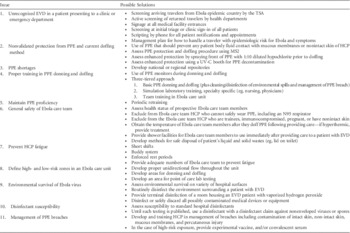
To protect our HCP against acquisition of highly virulent pathogens such Ebola, we must assess all the potential risks for transmission (eg, inadequate detection of possible cases, inappropriate use of PPE) and implement strategies to minimize this risk (Table 1). The public health community needs to reduce the risks to our HCP by validating the currently recommended PPE, improving PPE as necessary, improve training of our HCP, and expand the number of facilities with healthcare units specifically designed to care for highly communicable diseases. We need to continue to develop innovative approaches such as that assessed by Dr. Tomas.
Protecting Healthcare Personnel from Acquisition of Ebola: Defining the Problems and Possible Solutions
NOTE. TSA, Transportation Security Administration; ED, emergency department; EVD, Ebola vial disease; HCP, healthcare personnel; PPE, personal protective equipment.
Finally, HCP at all US hospitals need to remember that more than 1 million travelers arrive in the United States each week. 26 As demonstrated by the recent case of Lassa fever in New Jersey, 27 the outbreak of MERS-CoV in Korea, 28 and the Ebola cases resulting from travelers from West Africa,Reference Bogoch, Creatore and Cetron 29 we are all only a plane ride away from potentially highly communicable and virulent infectious diseases.
ACKNOWLEDGMENTS
Financial support. No financial support was provided relevant to this article.
Potential conflicts of interest. All authors report no conflicts of interest relevant to this article.