Introduction
As the elderly population drastically increases (Christensen et al., Reference Christensen, Doblhammer, Rau and Vaupel2009), more and more attention is being paid to clarifying the ethical problems associated with elderly care in general, and dementia care in particular. However, moral issues of intimacy and sexuality especially as experienced by institutionalized elderly people with cognitive impairment need to be studied further. Aging accompanied by ill health might challenge the way in which individuals experience their own sexuality (Glass and Webb, Reference Glass and Webb1995), but it does not diminish their needs and desires for sexual fulfillment and human companionship (Harris and Wier, Reference Harris and Wier1998; Loue, Reference Loue2005). Sexuality in geriatric residents nevertheless remains a troubling issue for most caregivers. Residents are often infantilized which makes it hard for nursing staff to contemplate them as sexual beings (Archibald, Reference Archibald1998). This ambiguous attitude toward later-life sexuality is further reinforced by the ageist stereotypes that permeate our Western society. Given that sexual activity is particularly associated with youth, older people are dismissed as being highly inhibited or totally inactive (Hodson and Skeen, Reference Hodson and Skeen1994). Stereotypes concerning aged sexuality are found to be even more manifest for institutionalized elderly people (Glass et al., Reference Glass, Mustian and Carter1986). As a result, the sexual interest of elderly residents might easily be perceived to be a behavioral problem rather than the expression of a basic human need for love and intimacy.
From a moral point of view, it is particularly challenging to deal with the sexual activity of dementia patients. Their physical and mental deterioration places them at major risk of sexual abuse. But this is not the only concern. The behavior of dementia patients might be easily misinterpreted as sexual in nature when, in fact, it has a completely different meaning to the residents themselves (Kuhn et al., Reference Kuhn, Greiner and Arseneau1998). The dementia patient may not be having sexual thoughts, in so far as expressing a desire for intimacy or human connection is the result of what is called “iatrogenic loneliness” (Miles and Parker, Reference Miles and Parker1999) – loneliness induced by staff attitudes and organizational structures that fail to accommodate any form of intimacy within the institutional setting (Higgins et al., Reference Higgins, Barker and Begley2004). In rare cases, dementia may also be accompanied by hypersexuality or disinhibited sexual behavior (Higgins et al., Reference Higgins, Barker and Begley2004). Within this complex context it is not always obvious what ethically responsible care might mean. To date, no adequate description of the state of the art on the development of sexual ethics regarding institutionalized elderly persons has been available. Such an overview, however, might enable us to gain insight into the ongoing ethical debate on aged sexuality within long-term care. The aim of this review is therefore to explore the ethical concepts and arguments grounding the above-mentioned debate on sexuality in institutionalized elderly persons as reported in the argument-based research literature on this subject.
Methods
We constructed our systematic review of argument-based ethics literature in accordance with the method developed by McCullough et al. (Reference McCullough, Coverdale and Chervenak2007) encompassing four steps: (1) identify the focused question(s); (2) conduct a literature search to identify articles relevant to the focused question(s); (3) assess the adequacy of the argument-based methods used by the papers identified; and (4) identify the conclusions and the position of the author(s) in connection with the focused question(s). The ethical analyses, arguments and conclusions of the included papers will be presented in the results section of this paper.
Focused questions
We formulated two guiding questions to determine the focus of our literature review:
• What are the ethical arguments grounding the debate on sexuality in institutionalized elderly persons? And on which ethical concepts are they based?
• Is there a difference in ethical arguments when the person involved in sexual behavior has dementia or not?
Literature search
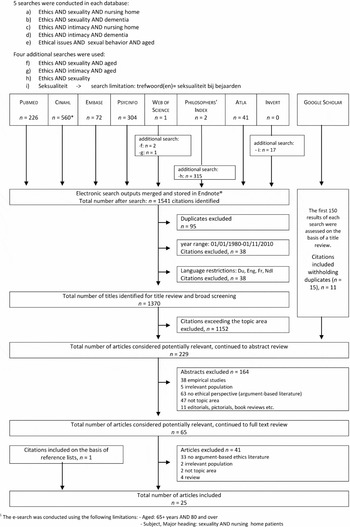
Figure 1 outlines the literature search process from electronic database searching to final selection for review. The electronic databases Medline, Cinahl, Embase, Psycinfo, Web of Science, Philosophers' Index, Atla, Invert and Google Scholar were searched using a combination of five basic search strings. When no results were found, additional searches were conducted to broaden the scope of our search. The outputs of the different database searches were merged in EndNote®, and duplicates were removed prior to the inclusion assessment on the basis of titles, abstracts, and full texts. We only included normative ethics literature that met the description given by McCullough et al. (Reference McCullough, Coverdale and Chervenak2004) and was published from January 1980 to November 2010. We specifically looked for ethical analyses and reasoned arguments addressing sexuality in institutionalized elderly persons, i.e. elderly persons who are accommodated in an intramural health care institution. Empirical studies, editorials, therapeutic strategies and guidelines, position papers of professional organizations, institutional ethics policies and ethics codes were not included. The reference lists of all appropriate articles were searched in order to identify additional relevant publications. Only articles published in English, French, German and Dutch were considered. The selection process was conducted in consultation with the co-author (CG).
Electronic search for literature identification and the selection process.

Search outcome and quality appraisal
The literature search yielded 25 appropriate publications. In accordance with the formal tool for critically appraising argument-based ethics literature developed by McCullough et al. (Reference McCullough, Coverdale and Chervenak2004), we only included literature that addressed a focused ethics question, was based on relevant articles within the field of elderly sexuality, and reported the analysis and arguments accurately and clearly. Some of the articles included also offered a clear statement of conclusion and/or clinical application.
Most of the included articles originated from the USA (n = 17). The remaining literature comes from Canada (n = 3), Germany (n = 2), Israel, Scotland and Sweden (n = 1 for each country). One of the included articles was published anonymously. Twelve articles had either a nurse (n = 6) or doctor (n = 6) as first author. Seven papers were written by ethicists. The remaining articles can be ascribed to lawyers (n = 2), psychologists (n = 2) or social workers (n = 1). The majority of the included studies specifically dealt with sexuality in older people with dementia (n = 14). Nine studies addressed ethical issues regarding sexuality in both elderly persons with and without cognitive impairments. The remaining two papers offered a broader picture discussing the moral values associated with aged sexuality in general.
Data abstraction and synthesis
The data abstraction and synthesis process consisted of re-reading, isolating, comparing, categorizing, and relating relevant data. Included articles were read repeatedly to obtain an overall understanding of the material. Significant passages explicitly dealing with ethical arguments on aged sexuality were marked and summarized on a data extraction form. These forms were repeatedly discussed with the co-author (CG).
A thematic examination of the summarized data led us to distinguish two major groups of ethical arguments. These were related to principles and to care. When it comes to the principle approach there is a fine dividing line between beneficence and nonmaleficence. Especially within the field of biomedical ethics, both principles have to be balanced together, but that does not give us permission to conflate them into a single principle. Based on our examination of the included articles, we decided not to follow the distinction formulated by Beauchamp and Childress (Reference Beauchamp and Childress2009). The positive acts of preventing and removing evil or harm were consequently classified under the principle of nonmaleficence. Protection from harm was included in the same category. The obligation to provide benefits (the principle of positive beneficence) and to balance these benefits against probable risks (the principle of proportionality), were both situated under the principle of beneficence. The process of analysis was frequently discussed with the co-author (CG).
Results
Ethical arguments related to principles
The four principles of biomedical ethics – respect for autonomy, beneficence, nonmaleficence and justice (Beauchamp and Childress, Reference Beauchamp and Childress2009) – largely cover moral reasoning on sexuality in institutionalized elderly persons. The bearing of these principles, however, is questioned when it comes to cognitively impaired residents seeking to engage in a sexual relationship (Casta-Kaufteil, Reference Casta-Kaufteil2003–2004; Hajjar and Kamel, Reference Hajjar and Kamel2003; Kamel and Hajjar, Reference Kamel and Hajjar2004).
Respect for autonomy
The principle of respect for autonomy is founded upon the aspirational ideal of the autonomous agent. As an autonomous agent, one is entitled to act in accordance with a freely self-chosen and informed plan. Within the included literature, autonomy is mainly described as the right to self-determination (Illhardt, Reference Illhardt1992; Post, Reference Post1995; Feldkamp, Reference Feldkamp2003; Everett, Reference Everett2007; Reference Everett2008) and individual choice (Lichtenberg and Strzepek, Reference Lichtenberg and Strzepek1990; Post, Reference Post1995; Lichtenberg, Reference Lichtenberg1997; Kuhn, Reference Kuhn2002; Tenenbaum, Reference Tenenbaum2009). According to Illhardt (Reference Illhardt1992), sexuality expresses the human capability to shape one's own life. It therefore functions as a measuring standard for the degree of autonomy preserved amidst the physical and psychological deterioration accompanying the aging process.
Informed consent. Within clinical practice, the principle of respect for autonomy finds its reflection in the ethical concept of informed consent. Based upon our study of the included literature, this concept plays a key role in the debate on aged sexuality. Consent measures have been designed to enable autonomous choice by patients and to protect these patients from harm. The determination of an “all or nothing” global competence, however, is not likely to be a useful approach (Lichtenberg and Strzepek, Reference Lichtenberg and Strzepek1990; Lichtenberg, Reference Lichtenberg1997; Anonymous, 2001; Kuhn, Reference Kuhn2002; Metzger and Gillick, Reference Metzger and Gillick2002; Casta-Kaufteil, Reference Casta-Kaufteil2003–2004; Everett, Reference Everett2007; Reference Everett2008; Tenenbaum, Reference Tenenbaum2009). A considerable number of authors therefore urge the recognition of partial (Lichtenberg and Strzepek, Reference Lichtenberg and Strzepek1990; Kuhn, Reference Kuhn2002), functional (Lichtenberg, Reference Lichtenberg1997; Everett, Reference Everett2007; Reference Everett2008; Tenenbaum, Reference Tenenbaum2009), or decision-specific competency (Metzger and Gillick, Reference Metzger and Gillick2002). A person who is incapable of giving informed consent for medical treatment, because of the complexity and the novelty of the information given, might be capable of giving informed consent to engage in a sexual relationship, a decision that is based more on old learning (Lichtenberg and Strzepek, Reference Lichtenberg and Strzepek1990). After all, according to Lichtenberg (Reference Lichtenberg1997, p. 6), sexuality is one of “the earliest learned behaviors.” As a result, determinations of incapability should always pertain to a specific area of a person's life (Lichtenberg and Strzepek, Reference Lichtenberg and Strzepek1990; Lichtenberg, Reference Lichtenberg1997; Anonymous, 2001; Kuhn, Reference Kuhn2002; Hajjar and Kamel, Reference Hajjar and Kamel2003; Gordon and Sokolowski, Reference Gordon and Sokolowski2004; Everett, Reference Everett2007; Reference Everett2008; Tenenbaum, Reference Tenenbaum2009). Lichtenberg and Strzepek (Reference Lichtenberg and Strzepek1990) identified three essential elements to assess a patient's competency to engage in an intimate sexual relationship. They especially focused on the assessment of institutionalized dementia patients. First of all, the patient has to be aware of the relationship. A second element is the patient's awareness of the benefits and risks associated with having a sexual relationship. Thirdly, the patient involved must not be physically or psychologically coerced in any way.
Berger (Reference Berger2000) argues that the voluntariness to engage in a sexual relationship rests on the absence of undue influences and the authenticity of personhood. Similarly, Lichtenberg (Reference Lichtenberg1997) and Lichtenberg and Strzepek (Reference Lichtenberg and Strzepek1990) refer to the authenticity of choice. In the case of dementia, some of the included articles, however, make a clear distinction between the “then” self that existed prior to the onset of dementia, and the “now” self that lives almost entirely in the present, without any connection to the past (Lichtenberg and Strzepek, Reference Lichtenberg and Strzepek1990; Post, Reference Post1995; Reference Post2000; Reference Post2001; Lichtenberg, Reference Lichtenberg1997; Berger, Reference Berger2000; Kuhn, Reference Kuhn2002; Archibald, Reference Archibald2003; Gordon and Sokolowski, Reference Gordon and Sokolowski2004; Tenenbaum, Reference Tenenbaum2009). This distinction definitely calls into question the concept of authenticity of personhood for dementia patients. After all, who is the authentic self following the onset of dementia? In line with this question, two competing notions are offered that may guide the decision-making process in case of cognitive impairment (Berger, Reference Berger2000). These notions are discussed at length in six of the included studies (Post, Reference Post1995; Reference Post2000; Reference Post2001; Berger, Reference Berger2000; Gordon and Sokolowski, Reference Gordon and Sokolowski2004; Tenenbaum, Reference Tenenbaum2009). Precedent autonomy or critical interest, on the one hand, underlines the stewardship responsibility of the “then” self for the journey into forgetfulness. As a consequence, post-dementia decisions should be based on historical lifetime values and beliefs. If the former self is authentic, sexual behavior that does not comply with the identity-defining values of the past, may be deemed offensive to what is understood to be one's dignity (Berger, Reference Berger2000). Respecting prior values, however, could prevent the current disabled patient from having his/her needs met. Value histories, additionally, carry the risk of being biased by the own values and beliefs of family members and old-time friends. The concept of experiential interest on the other hand pleads for an autonomy grounded in the moral significance of the “now” self sensation. Contemporary preferences, needs and desires, coupled with the present well-being of the dementia patient should be the main focus area of substituted decision-making. Given the possible identity changes, decisions should be based on the patient's best interests (Tenenbaum, Reference Tenenbaum2009). This, however, poses a criterion problem as it is almost impossible for a substitute decision-maker to take his or her own values and beliefs out of the decision-making process (Tenenbaum, Reference Tenenbaum2009). Both competing notions are therefore accompanied by bias risks. According to Tenenbaum (Reference Tenenbaum2009), critical and experiential interests should be balanced against each other. Tenenbaum is in fact convinced that the value of an intimate relationship will generally outweigh the value of the critical interests affected.
Unlike most authors, Post (Reference Post2001, p. 84) finds it “utter nonsense to strongly bifurcate the self into ‘then’ and ‘now’,” as if no continuities are manifest. “While it is intellectually interesting as a ‘thought experiment’ to bifurcate the self into ‘then’ and ‘now,’ those who have wrongly asserted this radical discontinuity of personal identity in order to develop an ethics in the pure present that takes no account of past journey have been soundly refuted scientifically, metaphysically and morally”(Post, Reference Post2000, p. 316). As a consequence, the journey into forgetfulness does not undo the historical character of the “now” self. This shows why it is so important for caregivers to be aware of a patient's life story. Until the very advanced and even terminal stage of dementia, old memories may occasionally be stirred up leading to emotional moments of relational recollection. These moments of explicit residual continuity may arouse feelings of shame and regret as one becomes conscious of sharing an intimate relationship with a total stranger. According to Post (Reference Post2000; Reference Post2001), the apparent benefits of sexual intimacy make no odds against the risk of causing emotionally devastating shame or guilt. By the time the terminal stage of dementia is reached, the physical decay is so far advanced that it is no longer credible to speak of “sexual needs” (Post, Reference Post2000).
Howe (Reference Howe2000), for his part, encourages elderly persons to engage in discussing sexual advance directives prior to the onset of cognitive deterioration. Metzger and Gillick (Reference Metzger and Gillick2002) expect participation in an advance sexual directives initiative to be quite low, although it might help to determine the appropriateness of those sexual behaviors which could be easily categorized as a form of sexual disinhibition. Uninhibited sexual behavior is a rare but possible symptom of dementia. In common with Metzger and Gillick (Reference Metzger and Gillick2002), Berger (Reference Berger2000) points out that there is a fine dividing line between pathological and non-pathological sexual interest in dementia patients.
The authenticity of personhood, however, is not the only concern when a patient with cognitive impairment engages in a sexual relationship. Owing to a sudden decline in functional competence or disorientation, consent can become ambiguous (Berger, Reference Berger2000; Howe, Reference Howe2000; Casta-Kaufteil, Reference Casta-Kaufteil2003–2004; Gordon and Sokolowski, Reference Gordon and Sokolowski2004; Tenenbaum, Reference Tenenbaum2009). In addition, the capacities of people with dementia are easily underestimated (Archibald, Reference Archibald2003). Based solely on the principle of autonomy one can easily jump to the conclusion that dementia patients are non-autonomous agents and therefore incapable of consenting to a sexually intimate relationship (Lingler, Reference Lingler2004). According to Andrew Casta-Kaufteil (Reference Casta-Kaufteil2003–2004, p. 74), “the choice to partake in sexual intimacy is transformed and removed from the resident in being medicalized into the framework of supervised informed consent.”
Privacy. Respect for autonomy does not confine itself to the concept of informed consent. It also extends to specific autonomy-related rights, such as privacy (Lichtenberg and Strzepek, Reference Lichtenberg and Strzepek1990; Ehrenfeld et al., Reference Ehrenfeld, Tabak, Bronner and Bergman1997; Lichtenberg, Reference Lichtenberg1997; Mattiasson and Hemberg, Reference Mattiasson and Hemberg1998; Berger, Reference Berger2000; Howe, Reference Howe2000; Metzger and Gillick, Reference Metzger and Gillick2002; Archibald, Reference Archibald2003; Casta-Kaufteil, Reference Casta-Kaufteil2003–2004; Feldkamp, Reference Feldkamp2003; Hajjar and Kamel, Reference Hajjar and Kamel2003; Gordon and Sokolowski, Reference Gordon and Sokolowski2004; Kamel and Hajjar, Reference Kamel and Hajjar2004; Tabak and Shemesh-Kigli, Reference Tabak and Shemesh-Kigli2006; Tenenbaum, Reference Tenenbaum2009). When it comes to sexuality within a nursing home environment, the general right to privacy can be subdivided into three different categories (Berger, Reference Berger2000): physical privacy (Berger, Reference Berger2000; Feldkamp, Reference Feldkamp2003; Gordon and Sokolowski, Reference Gordon and Sokolowski2004), privacy of information (Berger, Reference Berger2000; Feldkamp, Reference Feldkamp2003; Gordon and Sokolowski, Reference Gordon and Sokolowski2004), and privacy of association (Berger, Reference Berger2000; Kuhn, Reference Kuhn2002; Casta-Kaufteil, Reference Casta-Kaufteil2003–2004; Feldkamp, Reference Feldkamp2003; Hajjar and Kamel, Reference Hajjar and Kamel2003; Kamel and Hajjar, Reference Kamel and Hajjar2004). A number of authors agree that every reasonable effort should be made to uphold these rights as long as it does not put residents at risk of unreasonable harm (Ehrenfeld et al., Reference Ehrenfeld, Tabak, Bronner and Bergman1997; Berger, Reference Berger2000; Anonymous, 2001; Casta-Kaufteil, Reference Casta-Kaufteil2003–2004; Hajjar and Kamel, Reference Hajjar and Kamel2003; Kamel and Hajjar, Reference Kamel and Hajjar2004; Tabak and Shemesh-Kigli, Reference Tabak and Shemesh-Kigli2006; Tenenbaum, Reference Tenenbaum2009).
According to Archibald (Reference Archibald2003), family involvement is an important ethical issue when elderly people with dementia are seeking to engage in a sexual relationship. While most authors agree on the relevancy of this topic, there seems to be considerable disagreement on whether or not a resident's sexual behavior should be disclosed to family members. Metzger and Gillick (Reference Metzger and Gillick2002) sharply question the family's need to be acquainted with a resident's sexual behavior; since providing such information compromises the resident's right to autonomy. Concerning the role of health care proxies, Metzger and Gillick (Reference Metzger and Gillick2002) state that, as an agent, the proxy is authorized to make medical decisions with the patient's autonomy in mind. It is nevertheless doubtful whether informing health care proxies about the sexual longings of patients would still safeguard residents' autonomy. The same question is also raised by Kuhn (Reference Kuhn2002). According to him it is highly debatable whether surrogate decision-making also concerns the personal realm of sexual intimacy. Feldkamp (Reference Feldkamp2003), for his part, argues that the resident's consent is a necessary condition for informing family members about his/her sexual activities. Without consent, the resident's right to privacy of information should be honored. Four authors adopt a more moderate course stating that family members only have to be involved when the risk for potential harm outweighs the resident's right to privacy and confidentiality (Hajjar and Kamel, Reference Hajjar and Kamel2003; Casta-Kaufteil, Reference Casta-Kaufteil2003–2004; Gordon and Sokolowski, Reference Gordon and Sokolowski2004; Kamel and Hajjar, Reference Kamel and Hajjar2004). In addition to this, some authors highlight the necessity of family involvement whether the resident is deemed competent to consent to a sexual relationship or not (Lichtenberg and Strzepek, Reference Lichtenberg and Strzepek1990; Lichtenberg, Reference Lichtenberg1997; Berger, Reference Berger2000; Tabak and Shemesh-Kigli, Reference Tabak and Shemesh-Kigli2006). According to Berger (Reference Berger2000), family members should be drawn into the picture to maintain at least a minimal level of personal commitment. As the resident's health deteriorates, this will enable the family to continue to act in the patient's best interests. Family members may furthermore provide “an additional perspective for advocacy”(Berger, Reference Berger2000, p. 312).
Beneficence
The included literature generally circumscribes the principle of beneficence as the obligation to do and promote good (Post, Reference Post1995; Reference Post2000; Lichtenberg, Reference Lichtenberg1997; Mattiasson and Hemberg, Reference Mattiasson and Hemberg1998; Berger, Reference Berger2000; Kuhn, Reference Kuhn2002). Within the field of biomedical ethics, the duty to confer benefits especially holds an obligation to the patient's quality of life (Ehrenfeld et al., Reference Ehrenfeld, Tabak, Bronner and Bergman1997; Berger, Reference Berger2000; Kamel and Hajjar, Reference Kamel and Hajjar2004; Tabak and Shemesh-Kigli, Reference Tabak and Shemesh-Kigli2006; Everett, Reference Everett2007; Reference Everett2008), safety (Ehrenfeld et al., Reference Ehrenfeld, Tabak, Bronner and Bergman1997; Berger, Reference Berger2000; Metzger and Gillick, Reference Metzger and Gillick2002; Gordon and Sokolowski, Reference Gordon and Sokolowski2004; Tenenbaum, Reference Tenenbaum2009), and well-being (Ehrenfeld et al., Reference Ehrenfeld, Tabak, Bronner and Bergman1997; Berger, Reference Berger2000; Casta-Kaufteil, Reference Casta-Kaufteil2003–2004; Feldkamp, Reference Feldkamp2003; Gordon and Sokolowski, Reference Gordon and Sokolowski2004; Kamel and Hajjar, Reference Kamel and Hajjar2004; Tabak and Shemesh-Kigli, Reference Tabak and Shemesh-Kigli2006; Everett, Reference Everett2008; Tenenbaum, Reference Tenenbaum2009). There seems to be a general consensus on the beneficial effects of intimacy and sexuality for older people. According to some authors (Lichtenberg and Strzepek, Reference Lichtenberg and Strzepek1990; Ehrenfeld et al., Reference Ehrenfeld, Tabak, Bronner and Bergman1997; Howe, Reference Howe2000; Casta-Kaufteil, Reference Casta-Kaufteil2003–2004; Lingler, Reference Lingler2004; Everett, Reference Everett2007; Tenenbaum, Reference Tenenbaum2009), sexual activity is proven to have a positive effect on both the physical and psychological health of elderly residents. Ehrenfeld et al. (Reference Ehrenfeld, Tabak, Bronner and Bergman1997), for instance, reports that love coupled with sexual intimacy plays a major role in maintaining energy levels. It enriches the internal life of residents and might even be considered as an important factor concerning longevity (Ehrenfeld et al., Reference Ehrenfeld, Tabak, Bronner and Bergman1997).
The promotion of welfare is indeed important when dealing with aged sexuality, but equally important is the obligation to balance the possible benefits against the degree of harms and the probability of harm eventuating (Lichtenberg and Strzepek, Reference Lichtenberg and Strzepek1990; Howe, Reference Howe2000; Post, Reference Post2000; Reference Post2001; Anonymous, 2001; Kuhn, Reference Kuhn2002; Archibald, Reference Archibald2003; Everett, Reference Everett2007; Reference Everett2008). This is especially the case when people with dementia are involved. Their cognitive impairment places them at major risk of sexual abuse and mistreatment (Howe, Reference Howe2000; Archibald, Reference Archibald2003; Lingler, Reference Lingler2004). The degree of vulnerability in combination with the possible costs or risks might legitimize interference with a resident's sexual activity. This interference, however, has to comply with some basic conditions (Anonymous, 2001; Everett, Reference Everett2007; Reference Everett2008). Each intervention has to be effective to begin with. In addition to this, the intervention used always has to be the mildest one possible to reduce the foreseeable level of harm. Following naturally from this line of argument, each intervention must prevent greater harms than it might generate.
Nonmaleficence
Based on the included literature, we can say that the principle of nonmaleficence includes two slightly different imperatives. First of all there are the obligations to protect fellow human beings from evil or harm (Ehrenfeld et al., Reference Ehrenfeld, Tabak, Bronner and Bergman1997; Lichtenberg, Reference Lichtenberg1997; Mattiasson and Hemberg, Reference Mattiasson and Hemberg1998; Berger, Reference Berger2000; Howe, Reference Howe2000; Kuhn, Reference Kuhn2002; Metzger and Gillick, Reference Metzger and Gillick2002; Archibald, Reference Archibald2003; Casta-Kaufteil, Reference Casta-Kaufteil2003–2004; Feldkamp, Reference Feldkamp2003; Hajjar and Kamel, Reference Hajjar and Kamel2003; Gordon and Sokolowski, Reference Gordon and Sokolowski2004; Kamel and Hajjar, Reference Kamel and Hajjar2004; Tabak and Shemesh-Kigli, Reference Tabak and Shemesh-Kigli2006; Everett, Reference Everett2007; Reference Everett2008; Tenenbaum, Reference Tenenbaum2009), and to prevent unreasonable harm from occurring (Post, Reference Post1995; Ehrenfeld et al., Reference Ehrenfeld, Tabak, Bronner and Bergman1997; Anonymous, 2001; Tabak and Shemesh-Kigli, Reference Tabak and Shemesh-Kigli2006; Tenenbaum, Reference Tenenbaum2009). According to Everett (Reference Everett2007; Reference Everett2008), the duty to protect should not be taken to the extreme as both capable and incapable persons are entitled to live at reasonable risk. Within the context of aged sexuality, this means that the duty to protect especially relates to the risk of unreasonable harm associated with the sexual behavior concerned (Everett, Reference Everett2007; Reference Everett2008).
The principle of nonmalificence secondly denotes the obligation not to inflict harm (Post, Reference Post1995; Reference Post2000; Reference Post2001; Anonymous, 2001; Casta-Kaufteil, Reference Casta-Kaufteil2003–2004; Kamel and Hajjar, Reference Kamel and Hajjar2004; Everett, Reference Everett2007; Reference Everett2008). Everett (Reference Everett2007; Reference Everett2008) suggests that the permissibility of intervening in a resident's sexual behavior mainly depends on the involvement of harm to self (and anticipating others), harm to others, or offense to others. When harm to the self is at issue, Everett (Reference Everett2007; Reference Everett2008) distinguishes two major concerns: the capacity to consent and the reasonableness of the associated risks. Reasonableness can be determined on the basis of five primary factors: the probability of causing harm to oneself, the severity of the harm being risked, the chance to reach one's goal by taking the risk, the significance of that goal and how easily less risky alternatives can be obtained (Everett, Reference Everett2007; Reference Everett2008). As regards harm to others, interference is justified, if and only if, three basic conditions are met (Everett, Reference Everett2007; Reference Everett2008). First, the associated harm must have a high degree of gravity. Secondly, there must be a high probability of harm arising. Thirdly, the resulting harm must be anticipated to be greater than the social harm caused by not allowing people to do as they choose. According to Everett (Reference Everett2007; Reference Everett2008), the bar of non-interference is significantly higher when dealing with offense to other people. First, the offense has to be intense, durable and extensive. Secondly, it has to be impossible for the offended person to reasonably avoid the objectionable event. Thirdly, the gravity of the offence must outweigh the reasonableness of the resident's sexual behavior. Berger (Reference Berger2000) states that nursing staff have the right to nonparticipation in direct care if the resident's sexual behavior is unavoidable and morally or religiously offensive. As independent moral agents, caregivers should not be asked to compromise their own ethical values while providing patient care. Their inner conflict may endanger the quality of care provided to the resident in question. In such cases it might be advisable to reassign the given caregiver (Hajjar and Kamel, Reference Hajjar and Kamel2003; Tenenbaum, Reference Tenenbaum2009). Tabak and Shemesh-Kigli (Reference Tabak and Shemesh-Kigli2006) similarly underline the fact that the staff's sensitivities must be respected.
Justice
The included literature mainly specifies the principle of justice by referring to the wrongful act of age discrimination or ageism (Lichtenberg and Strzepek, Reference Lichtenberg and Strzepek1990; Ehrenfeld et al., Reference Ehrenfeld, Tabak, Bronner and Bergman1997; Berger, Reference Berger2000; Archibald, Reference Archibald2003; Casta-Kaufteil, Reference Casta-Kaufteil2003–2004; Hajjar and Kamel, Reference Hajjar and Kamel2003; Lingler, Reference Lingler2004; Tabak and Shemesh-Kigli, Reference Tabak and Shemesh-Kigli2006; Tenenbaum, Reference Tenenbaum2009). Later-life sexuality, especially, has to contend with numerous myths, stereotypes, and ingrained prejudices (Dornberg, Reference Dornberg1992; Ehrenfeld et al., Reference Ehrenfeld, Tabak, Bronner and Bergman1997). Elderly people are considered to be unattractive and uninterested in sex (Tabak and Shemesh-Kigli, Reference Tabak and Shemesh-Kigli2006). As a consequence, aged sexuality is often ignored (Ehrenfeld et al., Reference Ehrenfeld, Tabak, Bronner and Bergman1997; Berger, Reference Berger2000; Casta-Kaufteil, Reference Casta-Kaufteil2003–2004; Kamel and Hajjar, Reference Kamel and Hajjar2004; Lingler, Reference Lingler2004; Everett, Reference Everett2007; Tenenbaum, Reference Tenenbaum2009). Older people who, nevertheless, presume to express sexual interests expose themselves to the risk of infantilization (Ehrenfeld et al., Reference Ehrenfeld, Tabak, Bronner and Bergman1997; Berger, Reference Berger2000). As such, ageism often deters elderly people from sexual activity. Lingler (Reference Lingler2004) therefore questions the moral relevancy of age in discussing the sexual intimacy of patients with dementia. Everett (Reference Everett2007; Reference Everett2008) additionally, states that it is discriminatory “not to allow long-term care residents to use the private areas of their homes, like the rest of us can, as appropriate places to engage in sexual activity” (Everett, Reference Everett2008, p. 89).
The principle of justice furthermore concerns the assessment of possible interventions, such as demanding abstinence or the relocation of a resident. According to Everett (Reference Everett2007; Reference Everett2008), each intervention must be thought justifiable – if at all possible – by those upon whom it is imposed. Furthermore, an intervention can only be justified if there is no bias against a particular group of people (Everett, Reference Everett2007; Reference Everett2008).
Arguing strongly in favor of the right to sexual freedom for dementia patients, Howe (Reference Howe2000) draws on the Rawlsian sense of justice. He refers to the difference principle in which John Rawls states that social and economic inequalities must be to the greatest advantage of those who are worst-off. In line with this principle, Howe (Reference Howe2000) suggests that the plight of dementia patients is so wretched that the slightest elevation of their suffering might be warranted, as it would make them “less worse-off”.
Ethical arguments related to care
Although the four principles of biomedical ethics seem to play a prominent role in ethically evaluating the sexual behavior of institutionalized elderly, some of the authors are doubtful about an approach that focuses solely on these principles. Howe (Reference Howe2000) clearly takes the lead stating that situations involving dementia patients differ ethically from those in which this is not the case. Our moral codes were originally developed for persons whose cognitive abilities enable them to reason through the steps of ethical decision making (Casta-Kaufteil, Reference Casta-Kaufteil2003–2004; Hajjar and Kamel, Reference Hajjar and Kamel2003; Kamel and Hajjar, Reference Kamel and Hajjar2004). Consequently, dementia patients fall outside the scope of traditional moral codes (Howe, Reference Howe2000; Hajjar and Kamel, Reference Hajjar and Kamel2003; Kamel and Hajjar, Reference Kamel and Hajjar2004). To do them justice, Howe (Reference Howe2000), Hajjar and Kamel (Reference Hajjar and Kamel2003) and Kamel and Hajjar (Reference Kamel and Hajjar2004) make a case for reexamining and eventually even redirecting our current moral values. Complex situations caused by having dementia seem to warrant different ethical concepts such as care and dignity.
Care as an ethical concept
According to Lichtenberg and Strzepek (Reference Lichtenberg and Strzepek1990) and Lichtenberg (Reference Lichtenberg1997), caring is a useful ethical concept for dealing with the sexual behavior of people with dementia. Repeated references are hereby made to the caring concept developed by Nel Noddings (Reference Noddings1984). In accordance with her line of reasoning, caring is founded upon and rooted in the receptiveness, relatedness, and responsiveness of the caregiver to the one cared for. As a consequence, one could state that morality is eventually grounded on the affective foundation of human existence. Howe (Reference Howe2000, p. 297) partially concurs, noting that dementia patients warrant “much more than moral sanctions”; they call for compassion. While Howe (Reference Howe2000) ardently pleads for allowing sexual activity in the context of dementia on the basis of compassion, Lichtenberg (Reference Lichtenberg1997) clearly states that the concept of caring does not give blanket approval to all possible types of sexual behavior that dementia patients might display. Mattiasson and Hemberg (Reference Mattiasson and Hemberg1998) highlight the fact that taking care of a fellow human being is never a “right”; it is always a trust, a “privilege” given by the patient. To care is an ethical responsibility characterized by reciprocity. It can only be given and received; enforcing or seizing it is therefore out of the question (Mattiasson and Hemberg, Reference Mattiasson and Hemberg1998). Within this line of reasoning, care mainly attests to the principle of respect. As a result it can never be interpreted as a justification to act against the wishes of the patient. This, however, does not mean that caregivers should give full rein to dementia patients with regard to their sexual behavior. Archibald (Reference Archibald2003), additionally, warns about the thin dividing line between care and control.
The notion of care is intrinsically interwoven with notions such as dignity and vulnerability. Although a considerable number of the included articles agree upon the fact that the dignity of elderly people has to be preserved as far as possible (Post, Reference Post1995; Ehrenfeld et al., Reference Ehrenfeld, Tabak, Bronner and Bergman1997; Mattiasson and Hemberg, Reference Mattiasson and Hemberg1998; Berger, Reference Berger2000; Anonymous, 2001; Kuhn, Reference Kuhn2002; Metzger and Gillick, Reference Metzger and Gillick2002; Casta-Kaufteil, Reference Casta-Kaufteil2003–2004; Feldkamp, Reference Feldkamp2003; Gordon and Sokolowski, Reference Gordon and Sokolowski2004; Kamel and Hajjar, Reference Kamel and Hajjar2004; Tabak and Shemesh-Kigli, Reference Tabak and Shemesh-Kigli2006; Tenenbaum, Reference Tenenbaum2009), we must admit that they generally just scratch the surface as far as the concept of human dignity is concerned. Some authors seem to confine themselves to notions such as self-worth and self-esteem without grounding them on the basis of the universal dignity of humankind. Post (Reference Post1995), by contrast, states that the value of a human being can never be diminished by the onset of forgetfulness; though he does not pursue the matter any further. For the sake of protecting residents' dignity, Kuhn (Reference Kuhn2002) states that public masturbation should be forbidden within a nursing home context. Metzger and Gillick (Reference Metzger and Gillick2002) similarly suggest that privacy and dignity are somehow interrelated. Yet no further explanation is given. Although some authors mention the increased vulnerability accompanying old age (Lichtenberg and Strzepek, Reference Lichtenberg and Strzepek1990; Dornberg, Reference Dornberg1992; Howe, Reference Howe2000; Kuhn, Reference Kuhn2002; Archibald, Reference Archibald2003; Casta-Kaufteil, Reference Casta-Kaufteil2003–2004; Hajjar and Kamel, Reference Hajjar and Kamel2003; Lingler, Reference Lingler2004; Tenenbaum, Reference Tenenbaum2009), ethical considerations regarding human vulnerability hardly extend beyond the principle of nonmaleficence.
An holistic approach
Dornberg (Reference Dornberg1992) and Illhardt (Reference Illhardt1992) both, in their own way, plead for an holistic approach to elderly care and later-life sexuality. According to Illhardt (Reference Illhardt1992), sexuality in its broadest sense bears upon all aspects of life, links them together and grants a certain unity. As a consequence it should be integrated in the life of elderly people. Moreover, caregivers must become aware of the fact that sexuality is of great significance for people of all ages. Dornberg (Reference Dornberg1992) additionally states that, within the field of biomedical ethics, issues must be discussed in their broadest contexts, not just the biological. In terms of aged sexuality, this means that not only should biological aspects be considered but also the social and recreational function of sex, along with the individual's personal history and the social tendency to intervene in sexual relationships and to curtail them. Without further explanation, Ehrenfeld et al. (Reference Ehrenfeld, Tabak, Bronner and Bergman1997) support both Dornberg and Illhardt in their plea for an holistic approach to elderly care.
Singularity and historicity
The singularity of every human being finds its reflection in the multiplicity of ways in which people experience their own sexuality. Dornberg (Reference Dornberg1992) clearly mentions the wide variety of ways in which people manage their own sexual needs and desires. Not only has each person his/her own way of dealing with sexuality, the heterogeneity of a disease such as dementia makes it even more complicated to assess ethically the sexual behavior of elderly patients with cognitive impairment (Casta-Kaufteil, Reference Casta-Kaufteil2003–2004; Hajjar and Kamel, Reference Hajjar and Kamel2003; Kamel and Hajjar, Reference Kamel and Hajjar2004). Post (Reference Post2000), Casta-Kaufteil (Reference Casta-Kaufteil2003–2004), Hajjar and Kamel (Reference Hajjar and Kamel2003) and Kamel and Hajjar (Reference Kamel and Hajjar2004) therefore argue that each case has to be individualized. Similarly, Kuhn (Reference Kuhn2002, p. 169) finds it unrealistic to adopt a “cookie-cutter” approach since such an approach counteracts “the uniqueness of each resident, each relationship and each family situation.”
Consistent with the notion of singularity, Lingler (Reference Lingler2004) advances the historical dimension of human existence. According to her, the historical contingency of a sexual relationship plays a crucial role in the ethical analysis of aged sexuality. The sexual activity in a couple with mixed cognitive capacities should be evaluated based upon whether or not the more powerful partner is relying on dementia-related qualities in the impaired one to secure sexual engagement. To put it differently, if the life story of a patient with dementia testifies to the fact that this patient had always dissented to sex and only since the onset of dementia had begun to assent to, or even initiate, sexual activity, then it would be morally impermissible for the more powerful partner to give his or her assent to such activity.
Relationality and intersubjectivity. Lingler (Reference Lingler2004) is the only author who addresses the complexity of sexual ethics in the context of cognitive impairment from a contextual relationship-centered perspective. By applying Baier's moral conceptualization of trust relationships (Baier, Reference Baier1986), Lingler develops a new framework to morally assess sexual activity between partners with mixed cognitive capabilities. According to this framework, “sexual activity is morally impermissible if either the truster dissents or the trusted is only able to engage the truster in such activity as a result of the truster's vulnerability” (Lingler, Reference Lingler2004, p. 98). It is not the truster's cognitive impairment in itself that has to be scrutinized, but the trusting relationship that is transformed by it. To establish whether sexual activity is morally acceptable, three aspects have to be taken into consideration: (1) the nature of the relationship, (2) the historical context, and (3) the extent to which the truster's and the trusted's interests coincide. Lingler (Reference Lingler2004) thus disassociates herself from the oppressive nature of hypercognitivism and moves away from autonomy-focused discussions which tend to bear out the absolute power of rationality.
Post (Reference Post2001) and Tenenbaum (Reference Tenenbaum2009) wonder whether or not the covenant of marriage is a morally relevant factor in considering the ethics of sexual engagement within a dementia context. Owing to their cognitive deterioration, dementia patients may be totally unaware of their marital status or they may misidentify a perfect stranger as their beloved husband or wife. Post (Reference Post2001) states that any kind of sexual intimacy with a partner other than the own spouse has to be prevented at all costs. The reality of deep forgetfulness does not nullify the everlasting lovers' vows, nor does it undo the consequential pledge of bodily exclusiveness. Conversely, Tenenbaum (Reference Tenenbaum2009) states that there is no reason to hold dementia patients to a higher standard than everyone else given that adultery is a commonplace within society. As a consequence, nursing staff should never deprive a dementia patient of extra-marital sex based solely on the spouse's request to preserve the nuptial bond and its attendant conjugal fidelity. This, however, has no bearing on those situations in which a patient mistakes a fellow resident for his or her own spouse.
Discussion
Methodological issues
The overall aim of this review was to explore the argument-based ethics literature on aged sexuality within long-term care. A thematic analysis of the included literature enabled us to provide a broad outline of the different ethical concepts and arguments grounding the debate on later-life sexuality. When interpreting the results of this review, however, it is important to consider some methodological shortcomings. A large majority of the included articles (21 out of 25) are Anglo-Saxon in origin. Although we did not confine our search to literature written in English, the databases used might contain a certain bias as they mainly seem to focus on Anglo-Saxon literature. To obtain a more global understanding of the debate at issue, further research is warranted beyond the Anglophone world. Furthermore, the lack of any clear conceptualization of the ethical notions mentioned within the included literature leads to results that are divergent, which makes it hard to compare and integrate them.
Main findings
In most of the included literature, principle-related arguments were apparent. In part, this might be explained by the fact that most of the articles originated in Anglo-Saxon countries. The principle of respect for autonomy was frequently mentioned and seems to be a predominating factor in assessing the moral permissibility of sexual behavior in institutionalized elderly persons. While the principle of respect for autonomy generally leads to an argument in favor of sexual freedom for this cohort, questions arise about its applicability to cases in which dementia patients are involved.
Because dementia is marked by progressive deterioration, affecting both the memory and reasoning capabilities, dementia patients fall short of the ideal of the autonomous agent that grounds the principle of respect for autonomy. This, however, does not constrain research literature from emphasizing the ethical notion of informed consent as a necessary condition for sexual expression. As a consequence, the cognitive impairment of dementia patients often appears to be a key factor in deciding whether or not it is morally permissible for these patients to engage in a sexually intimate relationship. By referring to the concept of informed consent and the concomitant notion of precedent autonomy, the choice to engage in a sexual relationship is made within a framework of personal capabilities. Within this framework, mental and physical conditions are attached to human lovingness and sexual intimacy. Because elderly people suffering from mental and physical deterioration do not meet these pre-conditions, their need and desire for sexual fulfillment and human intimacy is being denied. By focusing on their deficiencies, they are seen only as patients. This reduction is taken even further when a solely biological view on human corporeality and its attendant vulnerability dominates healthcare practice. We have to be cautious, however, not to reduce elderly people with dementia merely to patients or eventually even to the disease that slowly but surely gains control over their whole life.
Dementia patients' competency to engage in a sexual relationship may easily be underestimated when concentrating too much on the ideal of human autonomy, an ideal that within actual practice comes into conflict with the hard facts of old age and its attendant infirmities. From a moral point of view, dementia patients offer a particular challenge as the standard principles of biomedical ethics are mainly developed for competent persons capable of reasoning through the steps of ethical decision-making (Casta-Kaufteil, Reference Casta-Kaufteil2003–2004; Kamel and Hajjar, Reference Kamel and Hajjar2004). When dealing with the sexual longings of dementia patients, an approach based solely on the four principles of biomedical ethics seems to be a rather restricted and formalized way to discuss sexual ethics. The limited number of basic principles simplifies the ethical decision-making process by means of standardization. The danger of standardization, however, is that ethicists will tend not to reflect on the fundamental values that underlie these basic principles. That is why we suggest enriching the principles approach by including ethical notions related to care.
In keeping with a care ethics approach, ethical concepts such as empathy, responsibility, respect, and vulnerability might provide us with a new orientation for dealing with the sexual needs and desires of institutionalized residents with dementia. Some of these concepts were also mentioned within the included literature, although hardly any attention was paid to the anthropological framework that grounds them. A broader ethical perspective on aged sexuality, which also heeds the fate of people with cognitive impairment, requires that every human being is viewed as a unique, embodied person living within a relational network (Groenhout, Reference Groenhout2004). A normative ethics approach that is linked to the anthropological features of the embodied and relational self may provide us with a new perspective for dealing with issues of intimacy and sexuality in institutionalized residents with dementia. While some attention was paid to the socially embedded nature of human existence, none of the included authors mentioned human embodiment as a morally relevant factor in discussing aged sexuality. Nevertheless, the embodied nature of human experience also concerns sexual needs and desires, especially within the context of dementia where the living body becomes the locus par excellence for experiencing human connectedness since all other faculties have deteriorated.
Conflict of interest
None.
Description of the authors' roles
L. Mahieu wrote the paper under the supervision of C. Gastmans.