Education is seen as the driving force for ushering change (Ferreira, Ryan, & Tilbury, Reference Ferreira, Ryan and Tilbury2006; UNESCO, 2005) and teachers, as well as their operational contexts, are considered crucial (Flores, Reference Flores2016). The relevant contexts of teaching and learning, along with the need to respond to social, cultural and political demands, has placed teachers in a position where they are grappling with increasing complexities (Flores, Reference Flores2016; Flores & Day, Reference Flores and Day2006). Teachers are seen as agents of change who can and should lead the way towards reform, especially during times of societal change (Almeida, Reference Almeida2015; Almeida & Cutter-Mackenzie, Reference Almeida and Cutter-Mackenzie2011; Darling-Hammond, Reference Darling-Hammond, Cochran-Smith, Feiman-Nemser, McIntyre and Demers2008).
Environmental Education for Sustainability (EEfS) has been at the forefront of policy rhetoric over recent years and is gaining importance in curriculum documents in many nations. The recently concluded United Nations Decade of Sustainable Development in 2015 (UNESCO, 2014), and the newly announced Sustainable Development Goals (UNESCO, 2015) have worked toward reinforcing the implementation of EEfS at all levels of education. While these efforts have led to some shifts in approaches towards EEfS, there is a clear need for more. Numerous studies point towards the lack of support and pedagogical direction for implementation of EEfS, with a wide gap between policy decisions and practices (Almeida, Reference Almeida2015; Darling-Hammond, Reference Darling-Hammond2006; Day, Reference Day, Townsend and Bates2007; Lotz-Sistika, Reference Lotz-Sistika2009; Loughran, Reference Loughran2014).
In Australia, EEfS (initially Environmental Education) has been present in the national agenda for over 30 years (Department of Environment, Water, Heritage and Arts, 2009). The Melbourne Declaration on Educational Goals for Young Australians (Ministerial Council on Education, Employment, Training and Youth Affairs, 2008) set the foundation for the national curriculum prioritising sustainability by acknowledging that ‘complex environmental, social and economic pressure such as climate change that extend beyond national borders pose unprecedented challenges, requiring countries to work together in new ways’ (p. 4). The goals of the Melbourne Declaration and the intent of sustainability as the cross-curriculum priority in the Australian Curriculum provided a guide for action. EEfS was first suggested to be mandated for all states as a priority through this Declaration, and then as a cross-curricular priority in the national curriculum developed by the Australian Curriculum Assessment and Reporting Authority (ACARA, 2016). Individual states, like Victoria, have since included, then deleted, and after much controversy reintroduced these in their state curricula. The intention is to allow teachers and stakeholders the flexibility to adapt their learning and teaching tools to incorporate sustainability as an overarching umbrella concept.
This article offers an Australian perspective on the implementation of an EEfS initiative in educational settings with a focus on the influence of teacher identity construction on EEfS. The study looks at one particular government initiative offering a website as an EEfS resource to a large number of schools and teachers in a particular Australian state/territory. It draws upon commissioned research conducted to evaluate the program and its impact on teachers.
Literature Review
The following literature review considers first the shifts in terminology used to describe the global response to environmental education; existing definitions of the term ‘identity’ following this, then an exploration of the role of teacher identity in EEfS; and finally, literature around the need to address implementation of EEfS policies while working with teachers.
Terminology Shifts
Education has gained global acceptance as a fundamental means of tackling growing global environmental challenges (UNESCO, 2005, 2015). Over the years, Environmental Education (EE), Education for Sustainable Development (ESD), Education for Sustainability (EfS) and now EEfS have been key terms coined to address the many concerns and offer opportunities for creating an informed citizenry. In turn, these shifts in terminology use from EE to EEfS have been linked to different policies and ideological approaches toward environmental and sustainability issues (Cutter-Mackenzie, Edwards, Moore, & Boyd, Reference Cutter-Mackenzie, Edwards, Moore and Boyd2014). While the term ‘sustainability’ has multiple meanings in multiple contexts (Davis, Reference Davis and Davis2010), there has been an accepted understanding that education is the medium through which many present and future environmental issues can be addressed (Kuzich, Taylor, & Taylor, Reference Kuzich, Taylor and Taylor2015). Consequently, the term Environmental Education for Sustainability or EEfS has become increasingly used on a global basis when discussing ways to approach environmental concerns from an educational stance. In our work as researchers and for the purpose of this article, we have used the term EEfS to reflect the more current understandings of these concepts.
In Australia, the approach toward EEfS over the years has been through information and awareness, but more importantly by building people's capacity to innovate and implement solutions, Education for Sustainability is essential to reorienting the way we live and work, and for Australia to become a sustainable society. (Ferreira, Ryan, Cavanagh, & Thomas, Reference Ferreira, Ryan, Cavanagh and Thomas2009, p. 2)
This study is significant as it highlights the challenges that tokenistic approaches face for policy uptake. This is of special relevance, given the need for research that documents policy implementation and the enablers and barriers that support or constrain these processes.
Identity, the Tole of Teacher Identities, and EEfS
Identity theory can offer an insight into how policies are interpreted and implemented by individuals. While there are no universally accepted definitions, there is universal recognition that identity is formed over time through a range of social, cultural, and political influences (Zembylas, Reference Zembylas2003). How identities have been viewed and defined has subsequently changed and shifted over time. We begin with Erikson's (Reference Erikson1974) definition, which in many ways can be seen as the start of conversations, and focuses on identities in research. Erikson (Reference Erikson1974) defined a sense of identity as ‘being at one with oneself as one grows and develops: it also means, at the same time, a sense of affinity with a community's sense of being at one with its future as well as its history or mythology’ (pp. 27–28).
Head (1997, as cited in Dillon, Kelsey, & Duque-Aristizabal, Reference Dillon, Kelsey and Duque-Aristizabal1999) sees identity as ‘the functional life script’ (p. 398) that allows individuals to make choices in life. Over time, this definition has been extended to acknowledge not only the influence of the environment, but also to take into account an individual's agency (Dillon et al., Reference Dillon, Kelsey and Duque-Aristizabal1999). Payne (Reference Payne2001) asserts that identity is espoused through the practices of acting, interacting, and communicating. In other words, how an individual reacts to any new enterprise is directly related to her/his identity practices — failure to account for this can lead to gaps in implementing any policy initiatives (Dillon et al, Reference Dillon, Kelsey and Duque-Aristizabal1999).
According to Loughran (Reference Loughran2011), identities develop over a long period of time, with much effort and after considerable struggles. Identity formation in teachers, in particular, stretches over the entire span of their teaching careers, and so it is difficult to pinpoint the exact factors that shape identities. What is clear, however, is that identities are fluid and can be shaped and reshaped throughout teachers’ professional and personal journeys (Beijaard, Meijer, & Verloop, Reference Beijaard, Meijer and Verloop2004). To be effective then, teacher education and professional development programs need to take this into account. This can be done by organising strategies that would appeal to teachers as individuals, ensuring deep impact programs that become embedded within teachers’ identities. Reshaping professional development to consider identity development also provides hope in that any policy initiative will have a much higher chance of successful uptake (Almeida, Reference Almeida2015; Barnes, Moore, & Almeida, Reference Barnes, Moore and Almeida2018).
As a teacher's identity is continually being shaped and reshaped over time, it is important to note that a teacher's identity is not shaped in isolation but is influenced by tensions internally and externally. A teacher's identity, more holistically, is realised within the tension and negotiation between several identities, and in this article we focus on the tension between teachers’ professional and ecological identities. For example, teachers must balance the tension between having to equip students for numeracy and literacy targets, yet wanting to explore cross-disciplinary EEfS concepts. In addition, a teacher's identity is often shaped by the identity orientation of the schools they have attended and/or worked within. The identity of an organisation is constructed through the symbols, processes, and behaviours observed by others, making them distinct and set apart from other organisations (Bartlett, McDonald, & Pini, Reference Bartlett, McDonald and Pini2015). Identity also spells out how these organisations relate and position themselves in relation to their stakeholders (Bartlett et al., Reference Bartlett, McDonald and Pini2015; Brickson, Reference Brickson2008). While there are some schools who position themselves as leaders in EEfS, the majority of schools construct their identity in others ways, such as being a leader in the national literacy and numeracy exams, providing a well-developed and successful sport program, espousing particular religious beliefs, and so on. Therefore, teacher identity is shaped and influenced in the ways in which it aligns or is in tension with the school's identity orientation.
Key Factors Influencing Implementation of EEfS by Teachers
EEfS has been gaining a slow but sure foothold in curriculum documents in Australia. The Australian Research Institute for Environment and Sustainability (ARIES, 2005) conducted an extensive review of EEfS implementation, suggesting the need for ongoing programs featuring learning opportunities that go beyond the superficial. To summarise, the ARIES (2005) review called for ‘systemic change within the community, institutions, government and industry’ (p. 4) through a range of approaches including: mentoring to provide advice and support; the facilitation of learning through skill and knowledge development; and, action research to promote innovative ways to approach sustainability.
Environmentalism (or lack thereof) can be seen to be deeply ingrained in one's personality (Payne, Reference Payne1997). Hart (Reference Hart2003) asserts that this is why teachers’ thinking matters when implementing EEfS. He asserts that what teachers think, believe and feel is what becomes highlighted in their everyday practices. Building on Hart's work, we contend that teachers’ identities also matter when planning for EEfS. Deeper lifelong changes happen when teachers’ professional identities are underpinned by deep-rooted environmentalism woven into it. Taking teachers’ identities into account is therefore essential when it comes to meaningful uptake of resources and innovative practice among teachers (Newberry, Reference Newberry2014). Ineffective implementation of EEfS is directly linked with the level of knowledge, skills, and confidence of the teachers involved (Kuzich et al., Reference Kuzich, Taylor and Taylor2015). Teachers’ skills, beliefs and drive are all key factors for effective EEfS (Wilson, Reference Wilson2012), which are also directly linked to their professional identities.
Background to the Study
In 2008, the Australian government's National Solar Schools Program (NSSP) offered eligible early childhood centres, primary and secondary schools the opportunity to compete for grants to install solar and other renewable systems. With 86 local schools participating in this program, one of the Australian state/territory governments (which will not be identified for anonymity reasons) chose their preferred Data Collection, Storage, Visualisations System (DCSVS; Department of Resources Energy Tourism [DRET], 2013) in the form of a smart meter website.
The website itself is designed to provide live data that is collected from installed smart meters at each of the local schools. These smart meters measure the consumption of electricity, solar, water and gas. On its home page, users can select a school from the dropdown menu or click on a map of the region with designated landmark points for each school. Information on current weather and temperature is also displayed. Once the user chooses a school, either from the dropdown menu or the map, general information is provided about the school and its key sustainability initiatives. There are options to check usage for electricity, solar, water and gas. The website also offers the opportunity to compare the sustainability practices of educational organisations in the region.
While the website offers excellent information that helps track usage of utilities, there are no resources or guides to support teachers and/or students to implement this information in their teaching and learning areas. There is no information on why and how conservational efforts matter, nor any explicit linking of behaviours with educational outcomes. Overall, the website has very few interactive opportunities to engage potential users — teachers or students. This is problematic given that one of the five objectives of the NSSP was to ‘allow schools to provide educational benefits for school students and their communities’ (DRET, 2013, p. 85). In a report by the DRET (2013), it is reported that even with the implementation of the NSSP and the Australian curriculum's prioritisation of sustainability across content areas, less than 50% of surveyed schools nationwide incorporated the subject of energy efficiency in their learning materials (p. 88).
The aim of the commissioned study upon which this article is based was to evaluate the local government's DCSVS in light of NSSP's objective to provide educational benefits and the Australian curriculum's aim to promote sustainability as a cross-curriculum priority. The following research questions guided this study in order to explore how the DCSVS was used to provide educational benefits, and more importantly to explore how sustainability or EEfS was positioned in this particular state/territory's schools: (1) How is the DCSVS implemented and used in the classroom? (2) How is the DCSVS implemented, used, and promoted by school leaders? (3) What links are made between the DCSVS and the sustainability curriculum aims? (4) What are the participants’ experiences, beliefs, and attitudes toward the DCSVS and how could it be improved to further EEfS educational outcomes?
Conceptualising the Study
Hart (Reference Hart2003) contends that environmental issues are ethical issues, similar to how politics and religion are ethical issues. Environmental and sustainability beliefs and practices depend on a host of contributing factors. While credible, reliable knowledge and understanding of the issues is important, there are also other influences involving ‘the politics of human decision making’, which includes emotional understanding, cultural understanding, and many other ‘capabilities and beliefs’ (Hart, Reference Hart2003, p. 207). An individual's professional and ecological identity has strong influences on their environmental beliefs and the translation of these into everyday practices (Almeida, Reference Almeida2015). EEfS, in other words then, is an individual teacher's action based on personal critical choices. As a consequence, what matters in EEfS is less dependent on the nature of curriculum, the prescribed curriculum matter and the enactment of EEfS practices, but more on the teacher's basic beliefs (Hart, Reference Hart1999). This does not mean that nature or structure or depth of the curriculum does not matter — what it does mean is that even the best-written curriculum amounts to nothing in the hands of teachers who do not believe it to be significantly important (Almeida, Reference Almeida2015, Reference Almeida and Pinn2017). With teachers, this would be manifested in their approaches and implementation of key terms and policies stemming from major societal events, cultural influences and ethical dispositions that shape their lives as environmentally informed (or not informed) and active (or inactive) individuals. In other words, teachers’ implementation of policies depends on their environmental identities. As outlined, multiple determinants and influences have an impact on the development of an individual teacher's identities. Personal experiences — especially significant life experiences in early years and contexts, together with learning opportunities, professional, and ecological identities — all play significant roles (Day, Reference Day, Townsend and Bates2007; Rodgers & Scott, Reference Rodgers, Scott, Cochran-Smith, Feiman-Nemser, McIntyre and Demers2008). Therefore, unless teachers have a personal investment or connection even the best EEfS policies, resources and initiatives can be limited in implementation (Almeida, Reference Almeida2015). However, it is difficult to bifurcate or compartmentalise influences on individual identities. This article sheds light on how identities and engagement are melded, as it is difficult to separate behaviours that have an impact on or stem from teachers’ identities.
Professional Identities
As previously discussed, the formation of a teacher's professional identity is an ongoing process involving the integration of the ‘personal’ and the ‘professional’ sides of becoming and being a teacher (Beijaard et al., Reference Beijaard, Meijer and Verloop2004). Teachers bring themselves into the classrooms, and their identities influence their decision making in what needs to be implemented into their everyday practices. Teachers’ identities play an important role when choosing which among the many policies vying for their attention will actually be addressed. This provides a strong reason to provide teachers with the opportunities to reflect on their existing understandings and influences on identity, as well as to further shape these through professional development that offers prospects for learning and development of ‘agency’ (Loughran, Reference Loughran2010). Agency is an important element of professional identity, meaning that teachers have to be active in their processes of professional learning — critical especially in developing pro-environmental attitudes (Almeida, Reference Almeida2013). Agency also means providing teachers more choice, voice and power when it comes to developing their professional identities. Any new resource development and professional development opportunities need to offer opportunities for teachers to reflect on and build upon their existing professional identities.
The following section draws from the data to illuminate the influence of teacher identity on participants’ engagement with EEfS.
Methods
Data Collection
Data were collected through the anonymous online survey program, Qualtrics. The surveys, one designed for teachers and the other for school leaders, were distributed to 86 local schools in July 2016. Primary and secondary teachers and school leaders (e.g., principals, assistant principals, sustainability leaders, and business managers) were invited to participate. The surveys were both quantitative and qualitative in nature. This resulted in data that answered questions such as ‘How often?’, ‘Why?’, and ‘How?’, and made direct links to how the DCSVS is furthering sustainability practices and outcomes. This aligns with the aim of this research project, which was to investigate the efficacy of the DCSVS as a resource in classroom practice and to offer recommendations to enhance its usability. The survey also gauged teachers and school leaders’ access to the resources as opportunities for developing better understanding, and negotiating and implementing sustainability into their educational practices.
It is important to state at the outset that while the researchers would have liked to follow up the survey with conversations, they were limited by the scope of research and accessibility to participants. This does mean that the data analysis was reductionist in its approach. However, the survey had open-ended questions that were aimed at gleaning deeper understandings of participants’ perspectives.
Participants
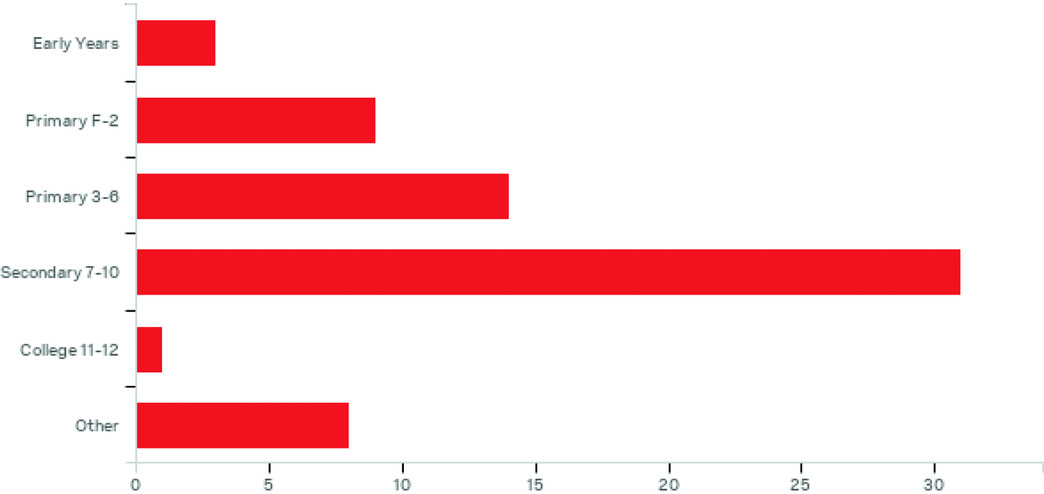
There were 66 teachers and 50 school leaders among a total of 116 respondents. Of the participating teachers, 49% taught in secondary school Years 7–10, 35% worked as primary school teachers teaching F–6 and 5% were early years teachers. Of the remaining 11%, one was teaching college Years 11–12, two were working with a mixture of K–6 years, two were specialist science and sustainability teachers, one taught Years 6–8, and there was one support teaching staff (see Figure 1).
Age groups the participating teachers teach by percentage.

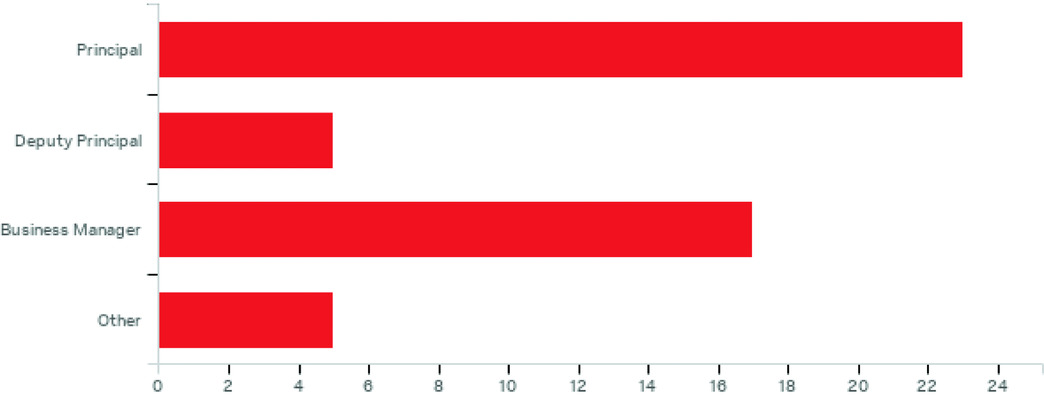
Of the 50 school leader participants, 46% were principals, 34% were business managers, 10% were deputy principals, and the remaining 10% were a mixture of administrative staff, sustainability coordinator, business service officer, and one unspecified (see Figure 2).
Roles of participating school leaders by percentage.

While this study revealed a number of themes, for the purpose of this article, the results and discussion will be focused primarily on how teachers utilise and implement resources as part of policy initiatives within classroom settings in Australia and the roles their identities play in shaping their uptake of these resources.
Findings: Core Issues and Themes
Data were analysed using an interpretative, thematic approach (Denzin & Lincoln, Reference Denzin and Lincoln2005). The data aggregated three core issues within the implementation of such a large initiative. These issues included policy implementation, EEfS as a cross-curriculum priority, and the role of teacher identity. This article focuses on this last core issue. The trends that emerged during analysis of data were categorised into the following three main sections within this core theme: (1) teachers’ access to and utilisation of the website, (2) the role of the school leaders, and (3) links to curriculum and deeper pedagogical practices.
Each of these trends will be discussed and critically analysed in turn using direct quotes from the surveys to support the analysis and discussion.
Teachers’ Access to and Utilisation of the Website
The creation of the website and its promotion was an expensive exercise for the funding body. However, despite the significant budget, there seemed to be very little awareness of the website and its features among teachers who were intended to be the end-users; 82% teachers had never heard of the website, while 9% had heard about and seen the website but never used it. This points to the disproportionate efforts made in creating resources (especially digital) with little energy and effort spent in promoting this to end-users. There seemed to be no effort to develop teachers’ skills, confidence and knowledge about the resource itself, or any promotion of the relevance or value of the website as a resource for teachers and students.
This strengthens earlier claims around the importance of opportunities to facilitate reflection and development of teachers’ identities. Spending large sums of money to design and create resources without adequate investment in teacher development as seen in this case is not the answer.
In this instance, the resource seemed to have been created as part of a larger project around energy conservation, with teachers and children only receiving ‘trickle-down’ benefits such as access to the website that was meant to track consumption. Opportunities to create meaningful and/or well-used resources were not offered as professional development to enrich teachers’ pedagogical approaches as well as content knowledge.
Interestingly, the teachers displayed an overwhelming willingness to learn about and experiment with the functionality of the website once they heard about the website through our survey questions. This willingness is exemplified in the quotes below:
I am a new teacher, but now that I know about the site I can use it in Maths for calculations kW per hour, and per square metre, and compare it to houses and other buildings.
Now that I am aware of its existence, I will consider integrating its use and data into health and civics.
A website such as this would link in very well with curriculum goals (such as, technologies). Has a link been provided on the website? Who is responsible for informing teachers about this site? If I could receive their contact information I would happily email them to make an inquiry about this website.
I will now investigate the website to see what it can offer and then plan appropriately from there. Our Sustainability Committee may also use the data in their planning.
Overall, teachers showed curiosity about what the website offered and how they could use it, with one teacher stating: ‘I will now consult the website out of curiosity.’
Of the 12 teachers who had engaged with the website, most felt that the site was user-friendly or somewhat user-friendly, with only one teacher feeling that it was not user-friendly. The small number of users is still to some extent poor engagement, either due to lack of information about the availability of the resource, or lack of knowledge or skill or confidence to use the website as a resource to its maximum potential. We propose this is due to the absence of quality professional development opportunities. However, teachers who were keen at the outset made the time and effort to engage with the website and resources therein.
Role of School Leaders
School leaders are widely recognised as crucial to the success of whole-school sustainability approaches (Kensler & Uline, Reference Kensler and Uline2017). Whole-school approaches have been consistently shown to support successful EEfS implementation (Lewis, Baudains, & Mansfield, Reference Lewis, Baudains and Mansfield2009; Shallcross & Robinson, Reference Shallcross, Robinson, Reid, Jensen, Nikel and Simovska2008). Active support from principals has been shown to encourage primary teachers, enabling them to overcome some of the initial hesitancies in implementing EEfS (Evans, Whitehouse, & Hickey, Reference Evans, Whitehouse and Hickey2012). A study conducted in New South Wales and Victoria (Flowers & Chodkiewicz, Reference Flowers and Chodkiewicz2009) reinforced the credibility of whole-school approaches. The authors (Flowers & Chodkiewicz, Reference Flowers and Chodkiewicz2009) found that school audits and environmental management plans led by school leaders were proven to have more potential for authentic learning experiences in, about, and for the local environments. Strong leadership and whole-school approaches were identified as key factors influencing the overall impact of sustainability programs (Flowers & Chodkiewicz, Reference Flowers and Chodkiewicz2009). In all these above-mentioned studies, teachers’ implementation of EEfS is directly shaped and reinforced by strong leaders who bolster and support individual teachers. Their encouragement with the implementation plans helps foster and nurtures their teachers’ professional and ecological identities.
This study also uncovered a strong link between the school leaders’ support (or lack thereof) and the use of website by teachers. While this study focused on teachers, it also offered insight into school leadership and the key roles the leaders play in effective whole-school sustainability programs. Overall, school leaders agreed with the need for better promotion and advertising of the availability of the website to schools and teachers. However, there was better awareness among school leaders as compared to teachers about the website, with only 34% reporting that they had never visited and 24% rarely visited the website. This reflects the often-used strategy of first contacting school leaders who are then expected to disseminate information to their teachers.
School leaders generally reported using the website from a business and economics point of view. The main focus seemed to be on reducing resource consumption by identifying water leaks, followed by solar energy generation and tracking energy conservation efforts. Only 10% of the 50 responding school leaders reported use of the website for linking with curriculum and improving pedagogical practice. This finding is concerning because research has shown that focusing on mainly economic aspects undermines the social and educational value of policy initiatives (Smith & Stevenson, Reference Smith and Stevenson2017). This is problematic in terms of EEfS implementation as it shows that school leaders are mainly driving whether EEfS is implemented in their schools at all, with lesser autonomy for teachers. The data shows uneven professional development opportunities afforded to school leaders, with many reporting a total lack of support:
NO support, just use and learn.
Has not been promoted for general use.
Professional development is conducted by the department for teachers interested in sustainability.
Explored it myself, other than the email giving the link.
I have attended the professional development to show how to use this site and discuss the use with other business managers.
I have received PD on how to use this website. I print out copies of usage each month and file so I can compare months/times of year/peak times etc.
Another barrier, outlined in the quotes below, concerns the fact that sustainability is only a cross-curriculum priority with ACARA and not a core competency. Its standing in regional versions of the National Curriculum has often wavered, with the individual states like Victoria deciding to include it, then drop it, only to recently reintroduce it into the Victorian Curriculum (as discussed in Barnes et al., Reference Barnes, Moore and Almeida2018). This seems to play a major role in school leaders’ choices. In responding to a question about professional learning opportunities offered to staff, respondents mentioned:
In all honesty, professional learning for staff has been mainly around literacy, numeracy and special needs education specifically. While the website clearly links to maths and science concepts, teachers are not aware of the site and what it has to offer learning.
We don't [offer any professional development]. We focus on literacy and numeracy along with student welfare and engaging parents.
Apart from the above-mentioned issues, the data showed other pressures of running a school that seemed to take priority for school leaders, as seen here:
I'm not saying there is anything wrong with the website but it is a low priority behind a staff member who has just lost a close relative, another has had a baby, one is suffering domestic violence, another is suffering from sleep deprivation due to newborn babies and three are on suicide watch for their highly depressed teenage children. That's the reality and I have no doubt we are a normal school like everyone else. No offence but this website is not core business so I'll avoid it as long as I can.
The above quote demonstrates the immense pressures school leaders and teachers face in everyday practice. Given these demands, it seems all the more difficult to make connections with EEfS. Therefore, offering professional development opportunities for teachers and school leaders to build upon their professional and ecological identities as well as foresight to see the importance of EEfS in their everyday practices seem necessary.
Those school leaders who did engage with the website offered specific and constructive suggestions on how it could be improved. For example:
I would like to see a week done as the day is done — by the hour, so I can find patterns. I could go on daily but this would be easier.
Graphs are hard to set for specific dates. Maybe it would be easier with lots of use but I only use occasionally so not familiar enough with it.
It could be good to go directly into our school instead of having to search from the front screen.
Too many alerts — we have a hydro pool and usage is high overnight, so get lots of alerts. Too many water alerts — if irrigation is turned off we get an alert every day and you end up deleting messages and not looking at them as they are received every day.
The school leaders’ willingness to offer ways in which to improve on their own experiences with the website demonstrates their level of engagement (and ongoing commitment) to this online tool.
Links to Curriculum and Deeper Pedagogical Practices
Teachers who used the website showed ability and confidence to do so in varied ways. Their approaches featured a range of curriculum areas, including science, maths, civics, citizenship, economics, business, history, arts, technologies English, languages, health and physical education, as well as the obvious environmental and sustainability studies components. Teachers engaged with the various features of the website, including comparing schools, time periods and utilising tips of the day. Teachers also used a variety of sections within the website, including electricity, water, solar and gas.
When teachers used the website, they did so in variety of ways which included:
(1) Improving class goals regarding sustainability:
Demonstrating the real use of electricity in our school, in order to show the need for change and a reduction in usage. Looking at trends that connect with seasonal changes.
(2) Motivating students for behaviour change:
It shows that small changes in behaviour — for example, turning off lights — can have a significant and measurable impact at our school, helping to motivate and inform students and staff.
(3) Graphing information:
Looking at an assignment that uses locally generated data.
I can use it in Maths for calculations kw per hour, and per square metre, compare it to houses and other buildings.
(4) Linking with sustainability curricula:
This website is a good resource for the ‘Science as a Human Endeavour’ aspect of the science curriculum. It also ties in nicely to the Physics learning outcomes regarding energy transfer and transformation.
In my role as Sustainability teacher, linking to relevant curriculum content/area of focus for the term.
(5) And, supporting participation in local or national sustainability challenges:
It was a helpful tool for students to justify their proposals for Parliament of Youth.
This suggests the widespread resourcefulness of the teachers who engaged with the website. It appears the teachers who used the website were confident, possessed skills to navigate the website, and were not affected by the poor promotions or lack of professional development opportunities needed to engage with the website. This is especially true because no extra efforts were made to advertise or promote the website to the teachers who did use it. It came down to personal preferences and motivations, which in turn supports Hart's (Reference Hart2003) claim that an individual teacher's thinking is crucial in EEfS. The best of resources cannot ensure implementation if it is not underpinned by strong, motivated and committed teachers who can overcome barriers like the lack of strong curriculum and state-of-the-art resources.
Teachers provided interesting suggestions and feedback to inform more effective use of resources provided through the website. Key suggestions to overcome limited engagement with the website included better promotion of the existence of this website, providing training and brochures, and making it user-friendly and accessible to all students —‘Promoting website awareness to stakeholders, for example, teachers, P&C and students and provide training and brochures to schools.’
It was evident that there was need for ongoing support to overcome technical issues and inaccurate data issues. These issues were reported as reasons teachers stopped using the website:
It used to have a few bugs that made it difficult to navigate and find information. I haven't used it since last year, so haven't checked it lately.
Accurate data of water usage. It doesn't seem right or is there months of data missing?
Even those who used the website more frequently felt strongly that it needed to be more widely advertised for the benefit of all. Those few teachers who were eager to use website, agreed that these could be improved for better uptake in the following iteration.
Conclusion
While this study was situated in an Australian context, it offers insights that are easily transferable and applicable to global contexts. The study strengthens calls for all teachers worldwide, not just environmental and sustainability teachers, to focus on building capacity and individual strengths rather than relying too heavily on resources. Any program aiming to raise awareness and achieve strong educational outcomes (especially in sustainability) requires authentic teacher involvement in the planning stages. This cannot be an afterthought, with leftover funds being used to work with the teachers. We strongly suggest engaging with teachers from the initial planning stages so that these programs are tailored to meet the real needs of the field. This ensures that resources and programs are not seen as externally imposed but are accepted and ingrained in teachers’ everyday practices. Allowing teachers the opportunity and agency to articulate their thinking exponentially increases chances of the programs’ uptake. This approach carries the added advantage of providing professional development opportunities at a deeper level, thereby working toward shaping teachers’ professional identities and thus achieving a longer lasting impact.
This article strengthens existing global understandings of policy implementation and the crucial role of the individual and organisations as support systems. The findings from this study do not assume that teachers who did not engage with the website are therefore not interested in sustainability or the environment. On the contrary, it has reinforced the notion that teachers’ enactment of EEfS initiatives can be limited by their beliefs and personal understandings of sustainability. This calls for a different model of teacher professional development when implementing new programs. Professional development needs to be inclusive of all teachers in a rich variety of ways, enabling a deep, long-lasting, and meaningful impact on their professional identities as teachers. For example, offering multifaceted and multimodal resources, experiential experiences, and the development of collaborative communities or communities of practice to support meaningful sharing. Considering the overwhelming push for professional development that many teachers find lacks meaning and relevance (Matherson & Windle, Reference Matherson and Windle2017), there is a need to trial differentiated professional development opportunities to investigate the best ways in which teachers can reflect on their practices and embed EEfS in their identities and practices. This is crucial to create a harmonious balance between the pressures, expectations and priorities of everyday classroom practices and one's own environmental experiences.
This kind of professional development also puts into perspective the complex and often competing social, cultural and political reforms that teachers are expected to deal with in their curriculum and teaching (Flores, Reference Flores2016). It is also apparent that just offering resources with limited training is not sufficient towards meeting these deep learning outcomes. There needs to be a constant conversation among teachers as a ‘process of practical knowledge building characterised by an ongoing integration of what is individually and collectively seen as relevant to teaching’ (Beijaard et al., Reference Beijaard, Meijer and Verloop2004, p. 123). It is only then that we can hope for the successful implementation of EEfS initiatives.
Author Biographies
Sylvia Christine Almeida is Lecturer in Environmental, Sustainability and Science Education at Monash University. She has been a teacher in India, Africa, United States and Dubai before starting her PhD. Her doctoral research explored ways in which teacher educators understand, negotiate, determine and implement environmental education in a climate of major policy reforms. Sylvia's research interests are in policy and practice of teachers including teacher educators and young children. She is working towards creating a sustainable collaborative community of environmental educators in India.
Deborah Moore is a lecturer in Education at Deakin University working with Master of Teaching preservice teachers. Deb's PhD doctoral research was an intergenerational narrative inquiry examining imaginative play places over time. Deb's research interests include researching with young children and, in particular, the methodologies that are most conducive to listening to young children; researching with children and their outdoor environments; and environmental education for sustainability with children and with teachers.
Melissa Barnes’ teaching career began in the United States, but it is her teaching experiences in Germany, Vietnam, Australia and Brunei that have collectively shaped her understanding of language, literacy, assessment and teacher education in diverse educational contexts. Melissa has been both a primary classroom teacher, an EAL primary specialist and a high school English as an Additional Language teacher. Her research interests include second language assessment, teacher education accreditation and TESOL.