Tobacco use remains a major health concern for many couples after they become parents. Although it is common for females to stop smoking during pregnancy, there is evidence to suggest that males are less likely to quit (Flemming, Graham, McCaughan, Angus, & Bauld, Reference Flemming, Graham, McCaughan, Angus and Bauld2015; Greenhalgh, Stillman, & Ford, Reference Greenhalgh, Stillman, Ford, Scollo and Winstanley2016; Hemsing, Greaves, O'Leary, Chan, & Okoli, Reference Hemsing, Greaves, O'Leary, Chan and Okoli2012). Furthermore, approximately half of those females who cease smoking during pregnancy resume within 6 months postpartum (Colman & Joyce, Reference Colman and Joyce2003; Gadomski, Reference Gadomski2010; Park et al., Reference Park, Chang, Quinn, Regan, Cohen, Viguera, Psaros, Ross and Rigotti2009) and more than three-quarters (80%) of low income mothers have relapsed by 12 months (Ma, Goinis, Pbert, & Ockene, Reference Ma, Goinis, Pbert and Ockene2005). In addition to the negative health consequences of postpartum smoking relapse and second-hand smoke (e.g., Ashford, Hahn, Hall, Rayens, & Noland, Reference Ashford, Hahn, Hall, Rayens and Noland2009), parental smoking can increase the risk of smoking initiation among adolescents (den Exter Blokland, Engels, Hale, Meeus, & Willemsen, Reference den Exter Blokland, Engels, Hale, Meeus and Willemsen2004). A comprehensive understanding of factors that influence parental tobacco use is therefore necessary to inform social policy (e.g., targeting expectant fathers in anti-smoking campaigns) and practitioners working with couples expecting a child, as well as parents to assist them remain quit after childbirth.
One factor that has received empirical attention in relation to spousal smoking is the influence of partners. Smokers are more likely to marry spouses who smoke, and there is a greater likelihood of tobacco cessation if a partner quits at the same time (Park, Tudiver, Schultz, & Campbell, Reference Park, Tudiver, Schultz and Campbell2004). Furthermore, living with a former smoker can encourage cessation more than living with a partner who has never smoked (Jackson, Steptoe, & Wardle, Reference Jackson, Steptoe and Wardle2015; Monden, de Graaf, & Kraaykamp, Reference Monden, de Graaf and Kraaykamp2003), and this effect appears to be stronger for quitting amongst females (Cobb et al., Reference Cobb, McAdams_DeMarco, Huxley, Woodward, Koton and Coresh2014; Foulstone, Kelly, & Kifle, Reference Foulstone, Kelly and Kifle2017). Mothers have also been at an elevated risk of relapse or continuing to smoke after childbirth when their partner smokes compared women who live with partners who do not smoke (Ashford et al., Reference Ashford, Hahn, Hall, Rayens and Noland2009; Fitzpatrick, Gray, & Quigley, Reference Fitzpatrick, Gray and Quigley2016; Martin et al., Reference Martin, McNamara, Milot, Bloch, Hair and Halle2008; Orton, Coleman, Coleman-Hayes, & Ussher, Reference Orton, Coleman, Coleman-Hayes and Ussher2017; Simmons, Sutton, Quinn, Meade, & Brandon, Reference Simmons, Sutton, Quinn, Meade and Brandon2014). Similarly, living with a heavy smoking spouse has been associated with a decreased likelihood of smoking cessation (Dollar, Homish, Kozlowski, & Leonard, Reference Dollar, Homish, Kozlowski and Leonard2009).
Although the smoking status of the partner appears important, less is known how relationship satisfaction might influence parental tobacco use. Using data from 238 tobacco-using young to mid-aged adult couples, we found that relationship satisfaction influenced how partner smoking was associated with tobacco use for males (Foulstone et al., Reference Foulstone, Kelly and Kifle2017). More specifically, males were more likely to quit when they reported higher relationship satisfaction and their partner ceased smoking. In contrast, attempts to regulate a partner's health behaviour in poor quality relationships may be perceived as an additional source of strain (Umberson, Crosnoe, & Reczek, Reference Umberson, Crosnoe and Reczek2010) making smoking cessation difficult. Despite the importance of partner smoking and relationship satisfaction, little research has examined the impact of partner smoking status and the quality of relationships on tobacco use after childbirth. Furthermore, it is unclear how stressors related to parenting are associated with tobacco use.
Anxiety and stress are well-established psychological predictors of tobacco use and nicotine addiction (Morissette, Tull, Gulliver, Kamholz, & Zimmering, Reference Morissette, Tull, Gulliver, Kamholz and Zimmering2007). When parenting stressors have been studied as a predictor of tobacco use, there is limited research to explain how these stressors influence tobacco use. In a study of single mothers, higher stress exposure (particularly financial stressors, but not stress due to household and family demands) explained increased smoking rates (Sperlich, Maina, & Noeres, Reference Sperlich, Maina and Noeres2013). Stress symptoms were also associated with an increased risk of smoking 6 months after childbirth among a small sample of 65 women who had quit smoking during or just prior to becoming pregnant (Park et al., Reference Park, Chang, Quinn, Regan, Cohen, Viguera, Psaros, Ross and Rigotti2009). These preliminary findings suggest that stress may be positively associated with smoking relapse after childbirth for females; however, it remains unclear how specific stressors related to parenting are associated with tobacco use after childbirth.
The proposed research examined parental tobacco use within couple relationships. This research was unique in that previous studies have more commonly focused on interventions to prevent smoking during pregnancy and reduce the probability of relapse after childbirth. Less research has focused on the social context in which postpartum smoking occurs (Bottorff, Oliffe, Kalaw, Carey, & Mroz, Reference Bottorff, Oliffe, Kalaw, Carey and Mroz2006; Greaves et al., Reference Greaves, Cormier, Devries, Bottorff, Johnson and Kirkland2003). There are also little population-based studies that have analysed how relationship quality and parenting stress may influence tobacco use after childbirth.
Data came from adult couple relationships in which the female partner indicated being pregnant within the past 12 months and a previous or current smoker. Partners were followed over 9 years to examine how partner smoking, parental stress, and relationship satisfaction was associated with individual tobacco use. Given that partner smoking (Jackson et al., Reference Jackson, Steptoe and Wardle2015), relationship satisfaction (Foulstone et al., Reference Foulstone, Kelly and Kifle2017) and perceived stress (Morissette et al., Reference Morissette, Tull, Gulliver, Kamholz and Zimmering2007) have been associated with smoking in previous studies, it was hypothesised that parents will be at a greater risk of smoking in households in which their partner smokes, they perceive lower relationship satisfaction, or experience greater parental stress.
Methods
Participants
Participants were 115 Australian heterosexual couples (married or defacto) in which the female partner had been a smoker in the previous year or was currently a smoker and had been pregnant in the past year. At Time 1, the average age was 30.5 years for female partners and 33.5 years for male partners, and 20% of females and 25% of males had completed a tertiary degree. The average household disposable income was a little less than $60k per annum (M = 59.98k, SD = 29.82k) and the average length of relationships was 4.3 years. A greater proportion of couples were married (67.0%) compared with cohabiting (33.0%). Approximately 30% of the sample reported current daily smoking, and 38% of male partners were current daily smokers. Male partners who reported using tobacco were on average heavy smokers, consuming 78 (SD = 64) cigarettes per week.
Measures
Tobacco use
Each partner was asked whether they smoked cigarettes or other tobacco products using a five-point response scale where 1 = ‘No, I have never smoked’, 2 = ‘No, I no longer smoke’, 3 = ‘Yes, I smoke daily’, 4 = ‘Yes, I smoke at least weekly (but not daily)’, and 5 = ‘Yes, I smoke less often than weekly.’ Responses were recoded to construct a variable with ‘0’ coded as ‘Non-smoker’ if initial responses ranged between 1 and 2 (inclusive), and ‘1’ as ‘Current Smoker’ if initial responses ranged between 3 and 5 (inclusive).
Relationship satisfaction
Relationship satisfaction was measured using the Relationship Assessment Satisfaction Scale (RAS: Hendrick, Reference Hendrick1988). The RAS is based on the five-item Marital Assessment Questionnaire (Hendrick, Reference Hendrick1981). This inventory measures how well the partner meets one's needs, how well the relationship compares with other relationships, regrets about the relationship, how well one's expectations have been met, love for the partner, and relationship problems (Hendrick, Dicke, & Hendrick, Reference Hendrick, Dicke and Hendrick1998). Scores on the scale ranged from 1 to 5, with higher scores corresponding to greater relationship satisfaction.
Parenting stress
Parenting stress was measured using the Aggravation in Parenting Scale (Macomber & Moore, Reference Macomber and Moore1999). Participants responded to four items that measured general aggravation and stress in parenting. The four items were ‘Being a parent was harder than expected’, ‘I often felt exhausted from meeting the needs of our children’, ‘I feel trapped by my responsibilities as a parent’, and ‘Caring for my child/children is much more work than pleasure’. Each item was rated using a seven-point scale ranging from 1 ‘Strongly disagree’ to 7 ‘Strongly agree’. An overall continuous measure of parenting stress was obtained by adding scores for the four items, so scores ranged from 4 to 28 with higher scores indicated greater levels of parental stress.
Mental health and demographics
Mental health was measured using the mental health scale of the SF-36 Health Survey, a 36-item multi-purpose general health survey (Australian version; Ware and Gandek, Reference Ware and Gandek1998). Participants reported on their highest level of education achieved (‘1’ corresponded to ‘less than year 12’, ‘2’ – ‘completed year 12’, ‘3’ – ‘diploma or certificate’, or ‘4’ – ‘bachelor's degree or higher’). Income was measured by deriving the respondent's financial year disposable income estimates. This was calculated by considering a respondent's wages, salary, business income, private or foreign pensions or transfers, government benefits, private income to produce an estimated amount of their gross annual income. Estimated taxes were then taken from this figure to produce an estimated disposable income.
Procedure
Surveys were delivered to a large national probability sample of Australian households occupying private dwellings as part of the ongoing Household, Income and Labour Dynamics in Australia (HILDA) Project. The HILDA survey is funded by the Australian Government and administered through the Department of Social Services. Household interviews are initially conducted with at least one adult member, then sought from all individual household members over the age of 15 years. All interviewees are given a questionnaire to complete and return by mail, or to the interviewer on his/her return. Participants were informed of the purpose of the national research, how data will be used, and the confidential nature of the survey. Households were randomly selected from districts based on census boundaries in Australia with all eligible household members being invited to participate (see Watson & Wooden, Reference Watson and Wooden2012 for full details of the HILDA study and sampling procedures). The overall response rates were 81.4%, 77%, 73.6% and 74.1% for Times 1–4, respectively. The sample used in this study (meeting the inclusion criteria of being married/defacto, a female smoker presently or in the past year, and pregnant in the past year) was first surveyed in 2003 (Time 1) and then were followed across three further waves (at 3-year intervals, ‘Times 2–4’). The authors were not involved in the data collection but completed a secondary analysis of the data collected as part of HILDA. The project was approved by the Research Ethics Committee of the University of Queensland.
Analytic Strategy
Stata Statistical Software: Release 13 was used for the analyses (StataCorp, 2013). Simple associations between tobacco use, partner smoking, relationship satisfaction, and parental stress were determined with Pearson correlation coefficients. A fixed effects model was not appropriate due to tobacco use patterns remaining unchanged over the four assessment points for almost three-quarters of partners (73.5%). Thus, our main analysis incorporated a random effects binary logit model to estimate the probability of tobacco use equalling one. Demographic and psychological factors that have been related to tobacco use such as highest level of education attained (Greenhalgh, Bayly, & Winstanley, Reference Greenhalgh, Bayly, Winstanley, Scollo and Winstanley2015), pregnancy (Gadomski, Reference Gadomski2010), and mental health (Park et al., Reference Park, Chang, Quinn, Regan, Cohen, Viguera, Psaros, Ross and Rigotti2009) were controlled in the main analyses.
Results
Attrition
Significantly more female partners were lost to follow-up if they reported smoking daily (41.0%), compared with those who reported smoking less often than weekly (20.7%) or were no longer smoking (21.0%) at Time 1, χ 2(4) = 9.95, P < 0.05. Female partners who did not provide data at Time 4 reported smoking significantly more weekly cigarettes on average at Time 1 (M = 95.9, SD = 70.1) compared with those who were retained (M = 67.2, SD = 57.7), t(91) = 2.15, P < 0.05. Participants who had missing data at Time 4 were significantly less satisfied with their relationships at Time 1 (M = 4.2, SD = 0.7), compared with those who provided data (M = 4.5, SD = 0.6), t(216) = 3.05, P < 0.05, and reported significantly lower mental health (M = 71.6, SD = 17.4) compared with partners who were retained (M = 78.2, SD = 14.0), t(221) = 3.0, P < 0.05.
Descriptive and Correlation Analyses
Tobacco use declined over the assessment period with the proportion of smokers being significantly lower at Time 4 (24.0%) compared with Time 1 (42.0%), χ 2(8) = 21.7, P < 0.05. At Time 1, significantly more males (40.7%) compared with females (29.6%) reported being daily smokers χ 2(4) = 52.3, P < 0.01. In terms of smoking cessation, a greater proportion of females (63.5%) reported being a previous smoker compared with males (25.0%), although about a quarter of males reported having never smoked cigarettes (26.9%). Approximately one in 10 parents (13.1%) who reported being a previous smoker at an earlier time point, relapsed and reported using tobacco. There was also a small proportion (9.6%) of parents who reported being daily smokers at every assessment. Smoking concordance within couples was also high 9 years after the initial assessment, with a little more than four-fifths (80.9%) of individuals residing with partners who reported the same smoking status.
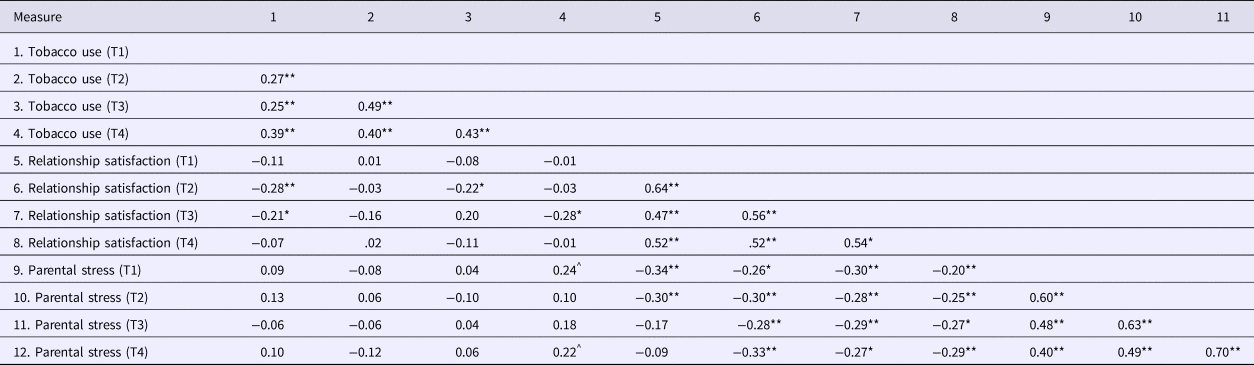
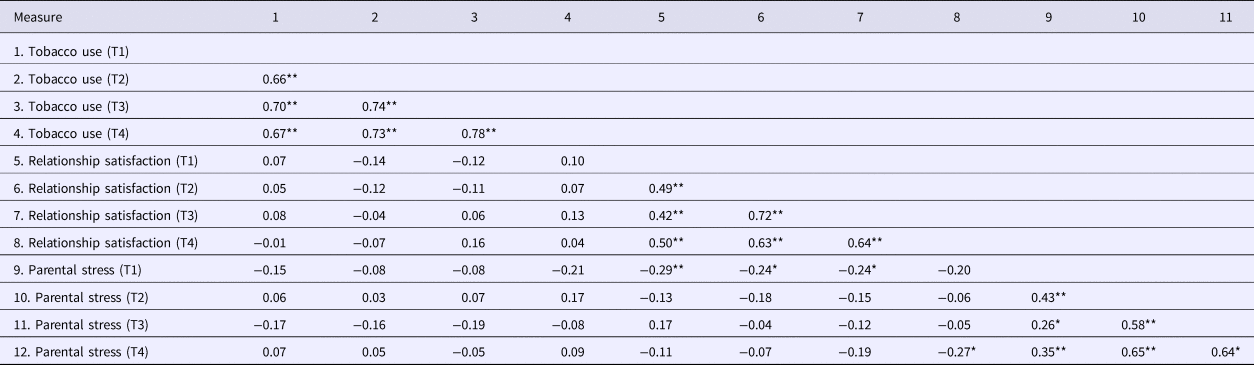
Pearson correlation coefficients between tobacco use, relationship satisfaction and parental stress across the four assessments are shown for female (Table 1) and male (Table 2) partners separately. Own tobacco use autocorrelations were moderate for female partners [r(range) = 0.25–0.49] and moderate-to-large for male partners [r(range) = 0.66–0.78] indicating stability in tobacco use over time. Autocorrelations for relationship satisfaction and parental stress were also moderate to high for female [r(range) = 0.40–0.70] and male partners [r(range) = 0.26–0.72] separately.
Correlation matrix for female tobacco use, relationship satisfaction, and parental stress over time (n = 115#)

Source: HILDA Waves 3, 6, 9, 12.
Note. #Sample size at Time 1; T, time; ^P < 0.10; *P < 0.05; **P < 0.01.
Correlation matrix for male tobacco use, relationship satisfaction, and parental stress over time (n = 115#)

Source: HILDA Waves 3, 6, 9, 12.
Note. #Sample size at Time 1; T, time; *P < 0.05; **P < 0.01.
Logistic Regression Analysis
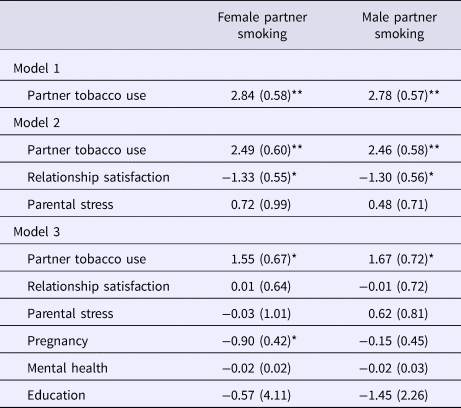
Random effects binary logistic regression models tested whether tobacco use was influenced by the smoking status of partners, relationship satisfaction and parental stress for male and female partners separately (Table 3). In the full multivariate models controlling for mental health, education and pregnancy in the past 12 months, partner tobacco use was significantly associated with a females’ likelihood of being a smoker over the assessment period. Similarly, males were more likely to use tobacco over the assessment period if their partners were smokers. In the final model of female's tobacco use, being pregnant again during the assessment was significantly associated with a lower likelihood of tobacco use.
Path coefficients (standard errors) for the random effects binary logit model (with Mundlak corrections) of female/male partner tobacco use

Note. *P < 0.05; **P < 0.01.
Discussion
The purpose of this study was to explore whether adult females and males influence their partners’ likelihood of tobacco use in couple relationships after child birth. It extended previous research by examining whether partner smoking, relationship satisfaction and parental stress are associated with tobacco use over a 9-year period using a sample of vulnerable couples in which the mother reported being a current or previous smoker whilst pregnant or shortly after giving birth. We analysed whether female partners and male partners were more likely to use tobacco if their partner was a smoker. Furthermore, we examined whether participants who were less satisfied in their relationships or experienced greater parental stress were at a greater risk of tobacco use.
It was hypothesised that female and male partners would be more likely to use tobacco during the early years of parenting if their partner smoked cigarettes, they perceived lower relationship satisfaction, or greater parental stress. The hypothesis was partially supported with both females and males being significantly more likely to use tobacco when their partner smoked. This provides further evidence to support a growing literature that has demonstrated the increased risks for tobacco use amongst females who reside with a partner who uses tobacco after childbirth (Ashford et al., Reference Ashford, Hahn, Hall, Rayens and Noland2009; Fitzpatrick et al., Reference Fitzpatrick, Gray and Quigley2016; Martin et al., Reference Martin, McNamara, Milot, Bloch, Hair and Halle2008; Orton et al., Reference Orton, Coleman, Coleman-Hayes and Ussher2017; Simmons et al., Reference Simmons, Sutton, Quinn, Meade and Brandon2014). These results extend this research, by showing that male partners are also at risk of relapsing or continuing to use tobacco during parenthood if their partner smokes. Accordingly, smoking cessation interventions need to consider the household context that the individual resides, and both partners’ smoking behaviour.
We also examined whether relationship satisfaction predicted tobacco use after childbirth. Based on research showing that relationship distress creates additional strain (Umberson et al., Reference Umberson, Crosnoe and Reczek2010), we anticipated that relationship satisfaction would be negatively associated with tobacco use. However, when partner tobacco use was accounted for in the full model, path coefficients showed that female and male partners were not at a greater risk of using tobacco over time when they were less satisfied in their relationships. This suggests relationship satisfaction may not be predictive of smoking behaviour during the first 9 years after childbirth when the partner's tobacco use is also considered. In contrast, it may be that tobacco use is a stronger predictor of relationship quality, particularly when there are discrepancies in tobacco use (Homish, Leonard, Kozlowski, & Cornelius, Reference Homish, Leonard, Kozlowski and Cornelius2009), and it is important for future longitudinal studies to examine the complex, potentially reciprocal association between partner tobacco use, relationship satisfaction, and individual smoking behaviour within family relationships.
Although tobacco use at Time 1 was marginally associated (P < 0.10) with paternal stress at Time 1 and Time 4 for mothers, the finding that parental stress was not a significant predictor of tobacco use in the full model over 9 years was contrary to expectations. It also contrasted with prior research showing that anxiety and stress are associated with tobacco use and nicotine use disorders (e.g., Umberson et al., Reference Umberson, Crosnoe and Reczek2010). Stress has also been positively associated with maternal tobacco use shortly (e.g., 6 months) after childbirth (Gadomski, Reference Gadomski2010). It appears partner smoking may be more important than parental stress in predicting tobacco use over longer periods during parenthood, a relatively novel finding in the field.
When couples became pregnant there was a lower likelihood of tobacco use for female partners, but male partners did not significantly change their smoking behaviour. The higher proportion of males, who reported being daily smokers and lower proportions of ex-smokers at Time 1, indicates that expectant fathers may not be as willing to change their health behaviour in preparation for, or soon after childbirth. This has implications for social policy, in that interventions need to be more targeted at expectant fathers, informing them of risks associated with second hand smoke and how their behaviour can put their partners at risk of smoking after childbirth.
The limitations of this study are that causality cannot be determined because of the correlational nature of the study, and there were high overall attrition rates among tobacco using couples. Similarly, attrition appeared to be higher for participants who were less satisfied with their relationships or had lower mental health at baseline. Although these findings limit the conclusions that can be drawn from the analyses, previous research has shown that tobacco users can be problematic in longitudinal research (Siddiqui, Flay, & Hu, Reference Siddiqui, Flay and Hu1996). Dysfunctional couples may also be less likely to take part in follow-up studies because of problems in their relationships, or the dissolution of their relationship. Without access to this information it could not be ascertained whether partners were still together but had not completed HILDA, or separated, moved households and dropped out of the research.
In conclusion, using a sample of Australian couples where the female partner reported being a current or previous smoker during pregnancy or shortly after childbirth, we found that the strongest predictor of tobacco use over a 9-year period was the partner's smoking status. Female partners, but not male partners, were less likely to use tobacco when pregnancy occurred. The current findings suggest that clinicians working to help parents quit smoking, or avoid relapsing after childbirth, need to understand the client's household environment and involve partners who smoke in interventions and treatment.
Acknowledgements
The authors would like to acknowledge The University of Queensland for providing institutional support for the research.
Financial support
This work was financially supported by Australian Research Council Discovery Grant DP130102015 and the third investigator is supported by Australian National Health and Medical Research Council Grant APP1087781. The funding source had no role in the study design, collection, analysis, or interpretation of data, writing the manuscript, and the decision to submit the manuscript for publication.
Conflict of interest
The data used for this manuscript came from The Household Income and Labour Dynamics in Australia survey funded by the Commonwealth Department of Families, Housing, Community Services and Indigenous Affairs (FaHCSIA), now called Department of Social Services (DSS) and conducted by the Melbourne Institute for Social and Economic Research at The University of Melbourne (Watson & Wooden, Reference Watson and Wooden2012). The research findings were the product of the researchers and should not be attributed to the DSS or the Melbourne Institute.
Ethical standards
The first author is a research assistant student under the supervision of the third author. The first author acquired the data and contributed to the conception and design of the study. The second and third authors assisted with drafting and revising the manuscript; and the second author assisted with the data analysis. All authors declare that they have had access to the data reported in this manuscript and take responsibility for the integrity and accuracy of the data analysis. No ethical standards were breached in relation to human or animal experimentation.