Japan is subject to frequent natural disasters. Since the Great Hanshin-Awaji earthquake in 1995, certain hospitals have been designated by the government as disaster-based hospitals.Reference Homma1 A disaster-based hospital is required to have earthquake-resistant structures, lifelines, medical supplies, and life support systems. The hospital is required to accept all those seriously injured and retain a disaster dispatch medical care team.Reference Homma1
Data on a large earthquake with a magnitude of 7 that was predicted to occur in southern Tokyo were assessed.2 The ability to provide medical care during a sudden increase in the number of victims at the disaster settings is a main concern of these hospitals.Reference Einav, Hick and Hanfling3–Reference Sheikhbardsiri, Raeisi and Nekoei-Moghadam4 Managing the surge capacity requires strategic planning from quantified medical risks and needs of pediatric patients by using an objective indicator, in not only individual hospitals, but also the whole area.Reference Einav, Hick and Hanfling3–Reference Sheikhbardsiri, Raeisi and Nekoei-Moghadam4 The use of the medical risk resource ratio (RRR) and the need for medical resources (NMR) have been advocated as new indicators for the formulation of a regional disaster medical response plan.Reference Morimura, Toida and Abe5 The RRR is defined as the number of patients required to be treated per bed in a hospital immediately following a disaster occurrence. The NMR is defined as the number of beds required to restore to a certain level of RRR for each hospital. We adopted the number of “2” vacant beds required to restore the RRR in the NMR estimation because, to cope with mass casualties caused by natural disasters, the government requires a disaster-based hospital to prepare and expand by doubling the number of beds.Reference Hick, Einav and Hanfling6
Approximately 10%–30% of all casualties in mass casualty incidents involve children.Reference Gnauck, Nufer and LaVally7–Reference Hodgetts, Hall and Maconochie9 However, little is known regarding the surge capacity of hospitals to care for children. This study examines the RRR and NMR of pediatric patients for each hospital in Kanagawa. We quantified the imbalance of the medical risk and needs of pediatric patients for each hospital in the region.
METHODS
We used data from the Kanagawa Prefecture Earthquake Anticipated Damage Survey report.2 We assessed the damage estimated when an earthquake with a magnitude of 7 struck southern Tokyo at 6:00 PM on a winter weekday. This earthquake caused extensive damage, leading to 2,990 deaths and 2,810 critically ill patients in Kanagawa. We defined critically ill patients as those whose lives would be under threat if emergency treatment or surgery is not performed, and who would require treatment in the intensive care unit (ICU).
We considered the total number of pediatric victims and critically ill pediatric patients as the medical risk. We calculated the total number of pediatric victims and critically ill pediatric patients based on the ratio of the child population and the whole population of the municipality being researched.
 $$\eqalignno { {\rm Total}\,{\rm number}\,{\rm of}\,{\rm pediatric}\,{\rm victims}{\equals}{\rm Total}\,{\rm number}\,{\rm of}\,{\rm victims}\cr {\times}{{{\rm The}\,{\rm number}\,{\rm of}\,{\rm child}\,{\rm population}\,{\rm age}\,{\rm under}\,15\,{\rm years}} \over {{\rm The}\,{\rm number}\,{\rm of}\,{\rm total}\,{\rm population}}}$$
 $$\eqalignno { {\rm Total}\,{\rm number}\,{\rm of}\,{\rm critically}\,{\rm ill}\,{\rm pediatric}\,\cr {\rm patients}{\equals}{\rm Total}\,{\rm number}\,{\rm of}\,{\rm critically}\,{\rm ill}\,{\rm patients}\cr {\times}{{{\rm The}\,{\rm number}\,{\rm of}\,{\rm child}\,{\rm population}\,{\rm age}\,{\rm under}\,15\,{\rm years}} \over {{\rm The}\,{\rm number}\,{\rm of}\,{\rm total}\,{\rm population}}}$$
There are 33 disaster-based hospitals. Because not every municipality had a disaster-based hospital, we used the following method to calculate the total number of victims and critically ill patients whom each hospital should be in charge of treating. If a municipality had only 1 hospital, the hospital would be in charge of all of the victims and patients in the municipality. If a municipality had multiple hospitals, all of the victims and patients would be equally assigned to each hospital. If a municipality had no hospital, the number of victims and patients in the municipality would be divided equally by the number of hospitals in the adjacent municipalities.
We considered the sum of the total number of beds for all victims and critically ill patients as the medical resource. Beds for critically ill patients were defined as the number of beds in the ICU, high care unit, and coronary care unit. We calculated the total number of beds for pediatric patients according to the ratio of the child population and the total population of the researched municipality. We assumed that the number of vacant beds in each hospital would be 15% of the total number of beds, as well as for critically ill patients. We used the number of vacant beds, as it corresponds to the staff and equipment at each hospital and provides a representative value of the medical resources.
 $$\eqalignno { {\rm RRR}\,{\rm for}\,{\rm all}\,{\rm pediatric}\,{\rm victims}{\equals}{{{\rm The}\,{\rm number}\,{\rm of}\,{\rm expected}\,{\rm pediatric}\,{\rm victims}} \over {{\rm The}\,{\rm number}\,{\rm of}\,{\rm vacant}\,{\rm beds}\,{\rm in}\,{\rm the}\,{\rm disaster}{\minus}{\rm based}\,{\rm hospital}\,{\rm at}\,{\rm the}\,{\rm time}\,{\rm of}\,{\rm the}\,{\rm occurrence}\,{\rm of}\,{\rm the}\,{\rm disaster}({\rm NVB})}}$$
 $${\rm RRR}\,{\rm for}\,{\rm critically}\,{\rm ill}\,{\rm pediatric}\,{\rm patients}{\equals}{{{\rm The}\,{\rm number}\,{\rm of}\,{\rm expected}\,{\rm critically}\,{\rm ill}\,{\rm pediatric}\,{\rm patients}} \over {{\rm NVB}{\minus}{\rm the}\,{\rm number}\,{\rm of}\,{\rm vacant}\,{\rm beds}\,{\rm used}\,{\rm for}\,{\rm critically}\,{\rm ill}\,{\rm pediatric}\,{\rm patients \ }({\rm NVBCI})}}$$
 $${\rm NMR}\,{\rm for}\,{\rm all}\,{\rm pediatric}\,{\rm victims}{\equals}{{{\rm The}\,{\rm number}\,{\rm of}\,{\rm expected}\,{\rm pediatric}\,{\rm victims}} \over 2}{\minus}{\rm NVB}$$
 $${\rm NMR}\,{\rm for}\,{\rm critically}\,{\rm ill}\,{\rm pediatric}\,{\rm patients}{\equals}{{{\rm The}\,{\rm number}\,{\rm of}\,{\rm expected}\,{\rm pediatric}\,{\rm victims}} \over 2}{\minus}{\rm NVBCI}$$
We calculated the proportion of the NMR (ie, NMR%) of each disaster-based hospital to the total NMR in the entire region.
Statistical Analysis
Differences of relative frequencies of RRR and NMR between hospitals were analyzed by the χ2 test of independence. When we had observed significant associations from the tests, we then performed post hoc analyses based on adjusted residuals, which were calculated by dividing the residual, the difference between observed and expected frequency by the standard error. A significant value of adjusted residuals was set at 1.96 or −1.96, which a larger than the former or a lower than the later values was considered statistically significant.
RESULTS
The total number of expected pediatric victims were 8,391 (Table 1). The total number of vacant beds for pediatric victims of the 33 hospitals were 352. The median RRR and NMR of the total number of pediatric victims were 27 (minimum to maximum: 2–92) and 224 (32–519), respectively. There was no hospital in which the RRR of all of the pediatric victims was less than 2. The median RRR and NMR of the number of critically ill pediatric patients were 27 (2–152) and 12 (1–30), respectively. There were only 3 hospitals in which the RRR of critically ill pediatric patients was less than 2. Almost all hospitals exhibited an imbalance in the disaster medical demand and supply.
The Number of Pediatric Patients, Empty Hospital Beds for Pediatric Patients, RRR, and NMR

* P <0.05; (-) = statistically lower than the mean; (+) = statistically higher than the mean
NMR = need for medical resource; RRR = risk resource ratio.
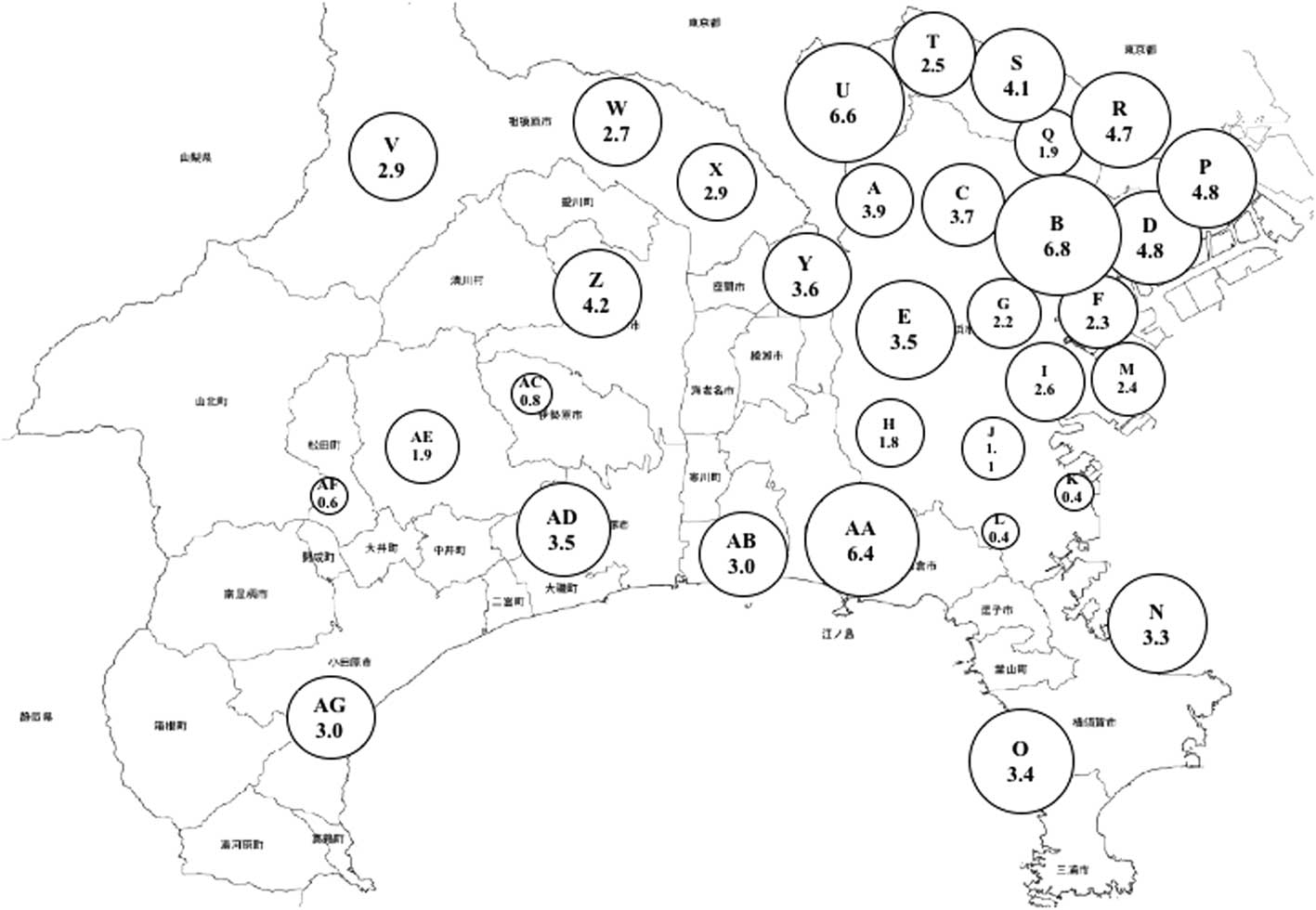
The NMR and NMR% for pediatric victims clearly presented a deviated distribution and showed different levels of medical resource needed for hospitals (Figure 1; see Table 1). We also compared the differences of RRR and NMR. The mean value of RRR for pediatric patients was 27, which means that, after the disaster, each hospital might have 27 patients per bed, and the NMR was 233, so each hospital might need 233 extra beds. We observed an imbalance in frequencies of RRR and NMR between hospitals (Ps <0.001); 8 hospitals have relatively higher RRR values for pediatric victims than the mean, and 12 hospitals have relatively lower RRR values (Ps <0.05); 6 hospitals have relatively higher NMR values for critically ill pediatric patients, and 9 hospitals have relatively lower NMR values (Ps <0.05) (see Table 1).
Distribution of Need for Medical Resources (NMR) for All Pediatric Victims in Kanagawa.
The background is the map of the Kanagawa Prefecture. The circles denote the location of each disaster base hospital. The numbers in the circles represent the proportion (%) of NMR for pediatric victims, and the alphabets are the hospital code (instead of the hospital name). The size of the circles is generally proportional to the NMR.

DISCUSSION
We quantified the medical risks and needs of pediatric patients for each disaster-based hospital in Kanagawa by using the RRR and NMR as objective indicators for evaluation. The absolute imbalance of medical risk and needs of pediatric patients for each hospital in the region could be quantified.
At the disasters, the effective use of medical resources is important to be able to treat the greatest number of injured victims.Reference Hick, Hanfling and Cantrill10 However, it is difficult for only a single hospital to take on the medical care for all of the victims. There are no standard indicators to evaluate an imbalance in the medical demands and the needs of children in hospitals across the area, based on predicted damage. The use of the RRR, NMR, and NMR% for pediatric victims is an effective indicator. Because the NMR% enables a comparison across regions, it allows for a more detailed examination of the distribution of medical support in the entire region.
This study showed that the RRR of almost all hospitals was overwhelmed and imbalanced; on the other hand, Kanagawa is dotted with a few hospitals where the levels of RRR and NMR are lower than those of the other hospitals across the region, such as the hospitals G, F, J, K, L, Q, R, AC, AF, as shown in Table 1. This finding is useful for devising a prior medical support plan. We should consider a support system in which hospitals with high levels of RRR and NMR are supported on a priority basis compared with hospitals with low levels of RRR and NMR. Furthermore, it is easier to develop disaster preparedness in the whole area so that we are able to point out these imbalances visually by using the RRR and NMR.
The pediatric population constitutes around 10% of the whole population of Japan. Pediatric emergencies are less common than emergencies among adults, so fewer hospitals are able to provide critical care for children in each region. This study demonstrated the absolute need for the medical support of pediatric victims in Kanagawa. Therefore, coordinated regional disaster planning, such as the development of a transport system between hospitals across Japan, is necessary to provide suitable treatment for a large number of pediatric patients who require critical care but cannot be treated inside of the disaster zone.
This study had several limitations. First, we estimated the total number of expected pediatric victims and patients according to the proportion of the child population to the whole population, because there are no data that have predicted the actual number of pediatric victims. Second, the number of victims per hospital was assigned to a hospital based on a municipal level without considering the access to a nearest hospital, based on geographical information. Thus, we simply assumed that the predicted number of those injured in the region would be equally distributed in a municipal level. Third, we calculated the number of vacant beds as the indicator of medical resources, based on data of the bed occupancy rate being 85%, even though the bed occupancy rate for each hospital differs; examining data based on the yearly average bed occupancy rate is important in the future. It is also essential to evaluate RRR and NMR by considering children with special health care needs. However, in this study, we could only evaluate children in general. To generalize to specific groups of pediatric patients at greater risk, an additional study should be conducted. Moreover, we should evaluate RRR and NMR according to the medical needs of pediatric patients, including the number of pediatric ICU beds and equipment available to them in the future.
CONCLUSION
We quantified the absolute imbalance of the medical risks and support needs of children at each disaster-based hospital in Kanagawa by using the new indicator, including RRR and NMR. We might embark on disaster preparedness strategies for children in advance.
Funding
This work was funded by JSPS KAKENHI Grant Number 17K17064 [Grant-in-Aid for Young Scientists (B)].