1. Introduction
On the new mechanist view of explanation, explanatory models represent entities and activities organized so as to produce some phenomenon of interest, such as protein synthesis or long-term potentiation (see, e.g., Bechtel and Richardson Reference Bechtel and Richardson1993; Machamer, Darden, and Craver Reference Machamer, Darden and Craver2000; Bechtel and Abrahamson Reference Bechtel and Abrahamson2005; Craver Reference Craver2007; Craver and Darden Reference Craver and Darden2013).Footnote 1 Mechanistic models successfully explain insofar as they accurately represent spatial, temporal, and causal relations among components of the system of interest that are relevant to producing the explanandum phenomenon. Such explanations appear to be a variety of causal explanation, representing causal relations at the component-level description, and thereby explaining how some phenomenon is produced. Many new mechanists endorse interventionism (Woodward Reference Woodward2003) as the correct analysis of causal explanation, incorporating key concepts of that theory into their accounts (e.g., Glennan Reference Glennan2002; Woodward Reference Woodward2002; Craver Reference Craver2007).
This article argues that new mechanists’ reliance on interventionism should be tempered. While Woodward’s theory and its refinements do account for many important features of mechanistic explanation, there are some it does not capture. The latter are illustrated by a case from molecular biology: the operon model of gene regulation. The operon model is typical of much explanation in molecular, cellular, and developmental biology. Moreover, Woodward (Reference Woodward2002, Reference Woodward2008) takes it as an example of interventionist mechanistic explanation. But, I argue, the original operon model exhibits features omitted by Woodward’s theory. The argument proceeds as follows. Section 2 provides background on mechanistic explanation and interventionism. Section 3 presents the interventionist account of the operon model. Section 4 presents the original operon model (Jacob and Monod Reference Jacob and Monod1961a, Reference Jacob and Monod1961b), noting contrasts with the interventionist treatment. Section 5 considers and rejects three interventionist responses to the discrepancy. This result motivates a new, complementary approach to mechanistic explanation (Section 6).
2. Background
2.1. Mechanistic Explanation
Philosophers of biology define ‘mechanism’ as follows:
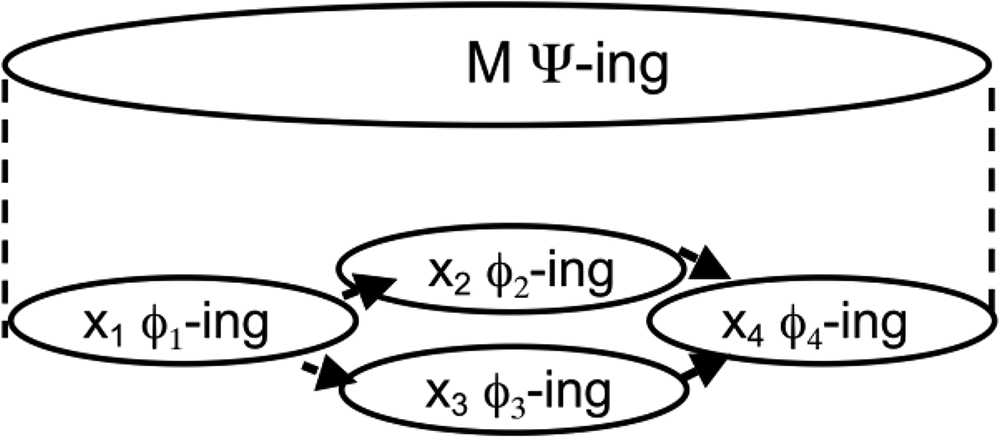
(M) A mechanism M consists of a number of components (x 1 … x n) engaging in causal relations or activities (ɸ 1 … ɸ n) such that ɸ-ing x’s are spatially and temporally organized so as to produce, underlie, or maintain M’s Ψ-ing.Footnote 2
A mechanistic explanation is a model that accurately represents (according to standards of the relevant scientific community) the working components of some mechanism M, so as to display how ɸ-ing x’s are organized so as to give rise to M’s Ψ-ing (fig. 1). The explanandum is M’s Ψ-ing, while the explanans represents ɸ-ing x’s, their spatiotemporal arrangement, and causal interactions among them. Such an explanation is causal, in that both the overall mechanism M and its component x’s engage in causal activities (Ψ-ing and ɸ-ing, respectively). Exactly how these causal aspects of mechanisms should be analyzed is the subject of considerable debate.Footnote 3 One influential answer is provided by interventionism (Woodward Reference Woodward2003).
Mechanism schema (after Craver Reference Craver2007).

2.2. Interventionism
Woodward’s theory nonreductively analyzes causal dependency in terms of intervention:
(I) “X is a type-level cause of Y in some background condition Bi … if and only if there is a possible intervention on X in Bi such that if such an intervention were to occur, the value of Y or the probability distribution of Y would change” (Woodward Reference Woodward2013, 45–46).Footnote 4
Causal relations, on this theory, hold between entities, properties, or events represented by variables. An intervention, roughly speaking, is an idealized hypothetical experiment that isolates a causal relationship between variables X and Y, if any exists, by ‘breaking’ all potentially confounding causal ties that could produce correlated changes in the values of X and Y. The latter clause of statement I is the schema for an interventionist counterfactual, the class of statement Woodward uses to analyze the meaning and truth conditions of causal claims. Statements of the form ‘X causes Y’ are understood as claims about how the value or probability distribution of values of Y would change if an intervention were to occur that changes the value of X.
Another important feature of interventionist explanation is invariance. Causal relations are defined as invariant (i.e., the same functional form maps values of X onto values of Y) under some possible interventions rather than all—relieving interventionist explanations of the requirement to include genuine laws of nature.Footnote 5 Rather than state covering laws, interventionist explanations aim to answer such “what if things had been different?” questions, thereby enabling prediction and control of Y’s value across a range of circumstances. To explain Y, then, is to reveal causal factors (X), changes in the value of which can make a difference to Y’s value across a wide range of circumstances.
2.3. Mechanisms and Interventionism
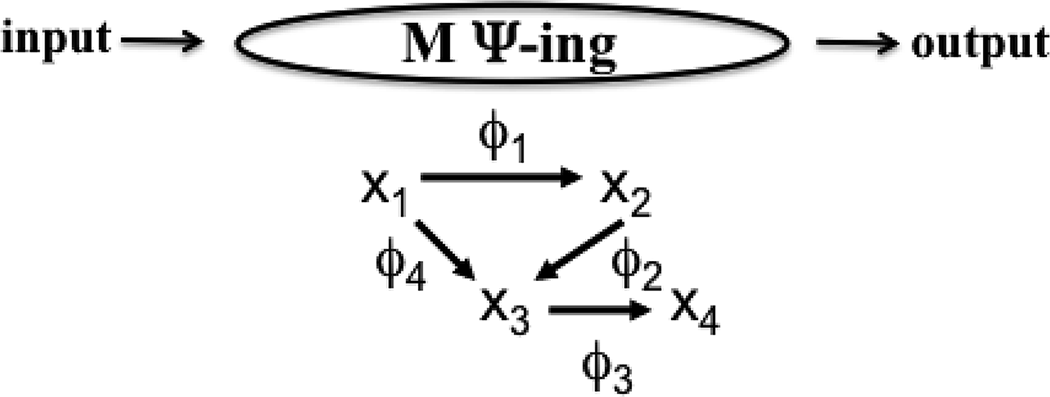
Mechanistic explanations in biology are based on results of experiments that conform well to an interventionist interpretation. Norms and heuristics for mechanism discovery, elicited from careful observation of scientific practices, can be fruitfully analyzed in interventionist terms (e.g., Craver Reference Craver2007). In this way, interventionism offers deeper insight into explanatory practices in biology. It is a further step, however, to identify mechanistic explanation as such with interventionist explanation. To do so, schema M must be explicated in interventionist terms. The explanandum for an interventionist mechanistic explanation is an overall input/output (IO) relation characterizing some mechanism M, where Ψ-ing is the activity mediating between input and output. The explanans is a more fine-grained description of the causal structure linking input and output variables, supplemented with description of their spatiotemporal arrangement (Woodward Reference Woodward2011; Craver Reference Craver and Huneman2013; Woodward Reference Woodward2013, 51; Woodward, Reference Woodwardforthcoming). This causal structure can be represented as a set of generalizations {Gi} each specifying a causal dependency relation among components of M (ɸ-ing x’s), or as a directed causal graph (fig. 2; Glennan Reference Glennan2002, S344; see also Craver Reference Craver and Huneman2013, 140, 149–51).
Mechanism schema, interventionist version.

An interventionist mechanistic explanation represents causal dependence of an overall mechanism’s result (the output of M Ψ-ing) on the organized activities of its parts (ɸ-ing x’s). Such an explanation specifies how changes to components (or initial and boundary conditions) would make a difference to M’s Ψ-ing, providing a ‘blueprint’ for manipulating the mechanism’s overall behavior.Footnote 6 Woodward (Reference Woodward2002, Reference Woodward2008) characterizes the operon model as an explanation of this type. I now turn to this example.
3. The Interventionist Operon
3.1. Background
The operon model is an explanation of the regulation of protein synthesis, proposed in 1961 by François Jacob and Jacques Monod.Footnote 7 Soon after, this model became the dominant explanation for gene action and genetic control of phenotype, garnering Jacob and Monod (with André Lwoff) a Nobel Prize in 1965. Though its generality was later challenged, the operon model remains the standard explanation of genetic regulation in prokaryotes and is a staple of introductory biology courses and textbooks. So the operon is a well-chosen example of mechanistic explanation in biology. But as support for interventionism, it is questionable.
3.2. Woodward’s Operon
Woodward presents the operon model in three statements (Reference Woodward2002, S372):Footnote 8
(i) Three structural genes code for enzymes, and the operator region controls access of RNA polymerase to structural genes.
(ii) In the absence of lactose, a regulatory gene is active that produces a repressor protein that binds to the operator for the structural genes, thus preventing transcription.
(iii) In the presence of lactose, allolactose is formed from lactose and binds to the repressor, inactivating it and thereby preventing it from repressing the operator, so that transcription proceeds.
The operon model’s explanandum is the overall IO relation between lactose and lactose-metabolizing enzymes. Lactose, the input variable, is either present or absent in a bacterium’s environment. Lactose-metabolizing enzymes, the output variable, are synthesized if lactose is present and not synthesized if lactose is absent. The explanatory task is to show how the presence or absence of lactose makes a difference to synthesis of lactose-metabolizing enzymes. To this end, statements i–iii can be translated into a set of generalizations {Gi} describing causal dependencies between variables in a mechanistic model:Footnote 9
(G1) Structural genes (G) code for enzymes (E).
(G2) The operator region (OR) controls access of RNA polymerase to structural genes (P).Footnote 10
(G3) Access of RNA polymerase to structural genes (P) controls enzyme synthesis (E).
(G4) A regulatory gene (RG) produces repressor protein (R).
(G5) Repressor protein binding to the operator (RO) prevents transcription (T).Footnote 11
(G6) Transcription (T) controls enzyme synthesis (E).
(G7) Lactose (L) forms allolactose (A).
(G8) Allolactose binding to repressor protein (AR) controls repressor protein activity (R).
(G9) Inactive repressor protein (R) does not bind to the operator (RO).
(G10) In the absence of operator–repressor binding (RO), transcription proceeds (T).
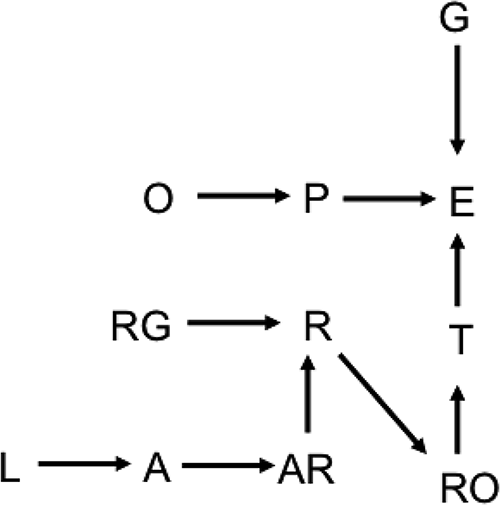
These generalizations together specify the causal relations of component entities and activities of the operon mechanism. G10 is redundant, describing a difference-making relation among the same variables as G5 (although with different values), and so can be omitted. One further generalization yields a set of variables that can be represented as a connected directed graph (fig. 3):
(G10b) Allolactose binding to repressor protein (AR) depends on the presence of allolactose (A).
I take G1–G10b, together with statements of initial and boundary conditions specifying spatial relations and intracellular locations of component entities, to compose the interventionist account of the operon model.Footnote 12 The directed graph representation makes it easy to identify the dependent variable (E) and four exogenous variables (L, G, O, and RG). Lactose is the input variable, taking the values {present, absent}. The other three exogenous variables represent DNA sequences, which take fixed values in the normal (wild-type) operation of the operon mechanism. Enzyme synthesis (E) is the output variable determined by the value of L. The causal structure initiated with L and the three gene sequences describes the mechanism by which L controls E.
Directed graph of the interventionist operon model (G1–G10b).

4. Jacob and Monod’s Operon
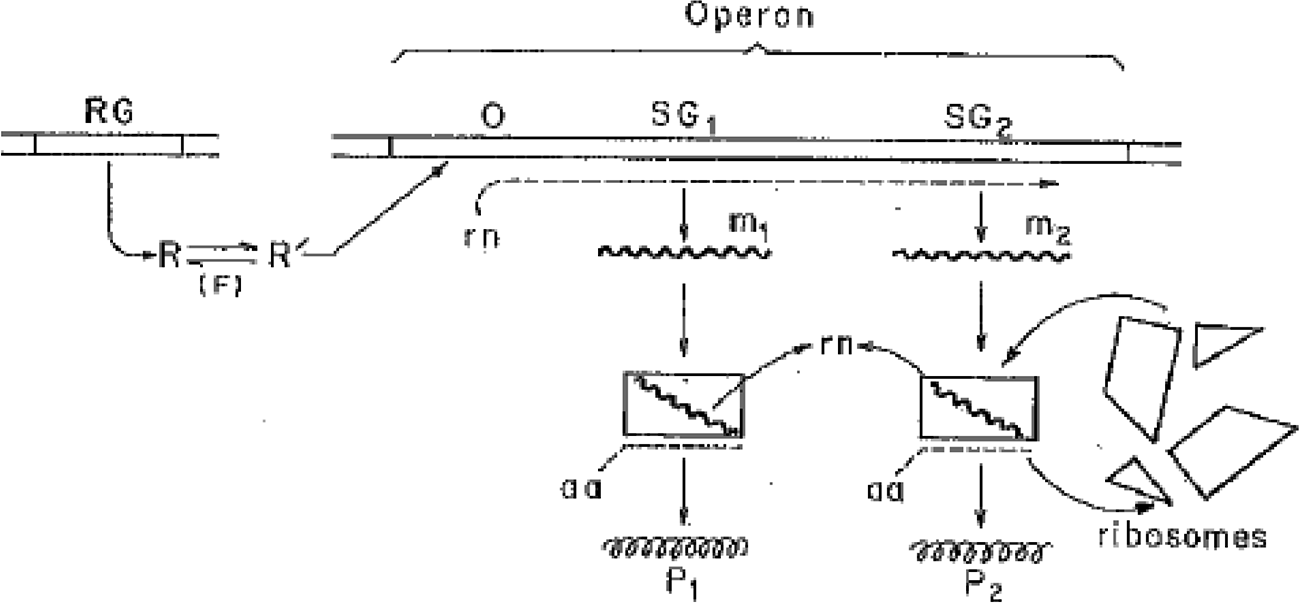
Jacob and Monod’s operon model (Reference Jacob and Monod1961a, Reference Jacob and Monod1961b) also conforms to mechanist schema M. Their explanandum phenomenon is “control of protein synthesis,” accounted for by “a model designed to embody the main elements which we were led to recognize [by experiments described in the original paper] as playing a specific role” in that process: “the structural, regulator, and operator genes, the operon, and the cytoplasmic repressor” (Jacob and Monod Reference Jacob and Monod1961a, 352). Jacob and Monod present their model as a set of general statements defining these components and their relations to one another, with an accompanying diagram (fig. 4).Footnote 13 Reordered to parallel the interventionist treatment above, the 1961 model consists of the following generalizations:Footnote 14
(G1a*) Structural genes (G) encode enzymes (E), via the intermediary of messenger RNA.
(G1b*) Messenger RNA (mRNA) is produced by transcription (T) from structural genes (G).
Operator (O) is the initiation site of transcription (T) for structural genes (G).
The operon (OP) is a set of structural genes (G) sharing an operator (O).
Repressor (R) is a molecule of complementary sequence to the operator (O); “the specific repressor, acting with a given operator.”
Operator (O) “tends to combine (by virtue of possessing a particular base sequence) specifically and reversibly” to repressor protein (R).
(G4) A regulatory gene (RG) produces repressor protein (R).
(G5) Repressor protein binding to the operator (RO) prevents transcription (T).
(G6) The rate of transcription (T) controls enzyme synthesis (E).
Repressor (R) “tends to combine specifically with certain specific small molecules” (including allolactose).
(G8*) Small molecule binding to repressor protein (AR) controls repressor protein activity (R).
Inducible system: “the combined repressor has no affinity for the operator and the combination therefore results in activation of the operon.”
Repressible system: the repressor “by itself is inactive (i.e., it has no affinity for the operator) and is activated only by combining with certain specific small molecules. The combination therefore leads to inhibition of the operon.”
(G9) Inactive repressor protein (R) does not bind to the operator (RO).
Several points emerge from comparison of the interventionist and 1961 operon models. First, the latter includes a number of generalizations that correspond closely to those of the former. Generalizations G4–G6 and G9 are common to both, while G1a*–G1b* and G8* correspond closely to G1 and G8, respectively. Second, the interventionist model includes some generalizations with no 1961 counterpart. For G2 and G3 this is to be expected, as the role of RNA polymerase was not understood in 1961. More significant is the absence of generalizations corresponding to G7 and G10b. Jacob and Monod’s model does not refer to lactose or allolactose, although these experimental results are discussed in their papers as evidence on which the general model is based. The lactose/allolactose system is just one example to which Jacob and Monod’s operon model applies.
Diagram portion of Jacob and Monod’s operon model (Reference Jacob and Monod1961b, 194). Reprinted with permission from Cold Spring Harbor Laboratory Press.

Third, the 1961 model includes a number of generalizations without interventionist counterparts. The first two listed above, defining the operator and operon, respectively, could be considered spatiotemporal description, as they describe the relative positions of causally interacting components. However, the remaining statements of the 1961 model describe neither causal nor spatiotemporal relations. Rather, they describe specific, reversible binding relations between pairwise components: operator and repressor, repressor and specific small molecules. For example, repressor protein is defined in terms of combining with the operator region “specifically and reversibly,” “by virtue of possessing a particular base sequence” (Jacob and Monod 1961a, 352).Footnote 15 Depending on whether the system is inducible or repressible, binding of the repressor and “certain specific small molecules” activates or inhibits the repressor’s binding to the operator (352). Such statements figure prominently in Jacob and Monod’s operon model. But the interventionist version (sec. 3.2) does not include such ‘binding statements’. The discrepancy suggests that mechanistic explanations in molecular biology may not be identical to interventionist explanations (supplemented with spatiotemporal details).
Furthermore, the two operon models have different explananda, suggesting that they are distinct explanations rather than alternative presentations of a single explanatory model. Jacob and Monod’s explanandum is not an input/output relation, but “control of protein synthesis” (Jacob and Monod 1961a, 352). Their 1961 model does not include lactose presence or absence as input; indeed, lactose does not figure in their model at all. Similarly, though production of enzymes (protein synthesis) does figure in the 1961 model, enzymes’ presence or absence is not treated as an overall ‘output’. Rather, the explanandum phenomenon is described as a whole—“the regulation of enzyme synthesis”—rather than parsed as a relation between input and output variables (Jacob and Monod 1961b, 194). It is, of course, possible to recast the operon model in terms of an IO relation. But it is not obvious why one should alter or restrict the explanandum in this way, absent an antecedent commitment to interventionism. So, although the two operon models overlap considerably, they contrast in at least two significant ways: regarding binding relations and explananda.Footnote 16 The remaining sections focus on the former. Can interventionists accommodate statements describing binding relations between components, which feature so prominently in Jacob and Monod’s model? I consider three possible interventionist responses, and I show that none are adequate.
5. Interventionist Responses
5.1. Omission
The simplest response is to acknowledge the discrepancy, maintaining that statements about binding relations have no explanatory significance. But this is unsatisfying. Statements describing binding relations compose roughly one-third of the 1961 model’s statements, and these are also illustrated in the diagram (fig. 4). It is implausible to suppose that such a significant portion of Jacob and Monod’s seminal model is nonexplanatory. Moreover, binding relations are crucial to the operon mechanism’s working. Mutual binding, or “combination,” of operator and repressor is responsible for inhibition of transcription (Jacob and Monod 1961a, 352). This inhibition involves interference with yet another binding relation, between RNA polymerase and DNA at the site of transcription initiation. Blocking this inhibitory activity involves binding relations as well: the combination of repressor protein and small molecules (allolactose) prevents formation of the operator–repressor complex (or the reverse, in repressible systems). Overall, the operon mechanism’s behavior depends on what binding relations hold in a given situation. So binding relations are central to the operon model as a mechanistic explanation. To cast them as explanatorily irrelevant is to ignore scientific practice in favor of philosophical theory. This would be a Pyrrhic victory for interventionism, which appeals to new mechanists largely because of its fit with scientific practice.
In addition, binding statements in the 1961 model are interwoven with descriptions of components’ causal relations, suggesting that the explanatory roles of the two kinds of statement are related. In particular, “combinations” of components engage in causal activities distinct from the activities of components taken individually. For example: “The operator tends to combine (by virtue of possessing a particular base sequence) specifically and reversibly with [a repressor protein] possessing the proper (complementary) sequence” (Jacob and Monod 1961a, 352). Two different component entities (one DNA region, one protein) mutually connect in virtue of complementary shape and charge at their binding sites. It is their combination that “blocks initiation of [transcription] … of the structural genes” (352). ‘Blocking’ is a causal activity, which can be represented as a dependence relation between variables (G5). But neither the operator nor the repressor alone engages in this activity. In this sense, the combining relation between operator and repressor is a precondition for the causal activity of blocking gene expression. To claim that only the causal generalizations of the 1961 model are explanatory is to distort the model’s original presentation.
5.2. Causal Analysis
A second response is to analyze binding statements in terms of interventionist generalizations. Presence or absence of individual components obviously makes a difference to the presence or absence of a complex (“combination”) of multiple components. So it seems that the interventionist can accommodate binding statements by casting individual components as cause variables and complexes as effect variables.Footnote 17 Indeed, generalization G10b is of this type (see above). Other generalizations could be added to {Gi}, linking components to complexes with distinct causal roles in the operon mechanism. For example, G5 (repressor protein binding to the operator prevents transcription) could be supplemented with causal generalizations describing the dependence of binding event (RO) on the presence or absence of repressor protein (R) and operator (O):
(G11) Repressor protein (R) is required for repressor protein binding to the operator (RO).
(G12) Operator (O) is required for repressor protein binding to the operator (RO).
So it seems that binding statements can be accommodated within an interventionist account of mechanistic explanation.
However, this response is unsatisfactory. G11 and G12, as interventionist generalizations, describe how features of a complex would change if features of its individual components were to change. Compare this to the relevant binding statement of the 1961 operon model:
Operator (O) “tends to combine (by virtue of possessing a particular base sequence) specifically and reversibly” to repressor protein (R).
Jacob and Monod’s generalization describes a relation (specific, reversible binding) between two individual components (repressor and operator), as well as the features (possessing a particular base sequence) in virtue of which this relation obtains.Footnote 18 The binding tendency is ‘symmetric’: a mutual relation between multiple components. A difference-making relation between operator and repressor would specify the influence one component has on another—but such relations are not included in any version of the operon model. Components that bind one another do not thereby induce changes in one another. In contrast, G11 and G12 do not describe a relation between operator and repressor at all, but between each component taken separately and the binding event. The interventionist analysis does not account for the binding relation between components, but omits it.
The interventionist might reply that the binding relation itself can be interpreted causally, as a variable, the value of which depends on features of the two components.Footnote 19 For example, let X 1 be the operator sequence and X 2 be the sequence and/or conformation of the corresponding region of the repressor protein. Changing the value of X 1 or X 2 changes the characteristics of the binding relation—its strength, specificity, and so on. On this interpretation, the binding relation is itself a submechanism within the overall mechanism for regulating protein synthesis, which is causally explained by the values of variables X 1 and X 2. What we have is a ‘nested’ causal explanation, encompassing multiple causal explananda.Footnote 20 So, the interventionist can claim, binding relations can be accommodated within an interventionist framework, interpreted as explananda that causally depend on features of their lower-level components.
The above is an intelligible gloss of the relations between variables in the operon model. (It is, one might say, the interventionist model of sec. 3.2 taken one step deeper.) But the contrast noted above still holds. Generalizations describing the causal account of the binding relation state the dependence of this relation on features of each component molecule taken separately:
(G13) Operator–repressor binding (ORB) depends on the sequence of the operator (SO).
(G14) Operator–repressor binding (ORB) depends on the sequence of the repressor (SR).
These generalizations analyze binding as a causal relation between a binding event (or features thereof) and properties of individual molecules, but they do not describe a mutual relation between operator and repressor, which obtains in virtue of features of those molecules. The interventionist treatment compresses the mutual binding relation of operator and repressor into a single variable (ORB), which depends on features of the operator and features of the repressor, taken separately. In this way, the interventionist approach systematically elides mutual binding relations among components, which figure in scientists’ own explanatory models.
Interventionists might take this result as validation of their approach. But the mere fact that a situation (or model thereof) can be glossed in interventionist terms does not tell us that all the relations obtaining in that situation are causal. Consider the relation ‘is the same size as’. This is a mutual relation between two or more objects, which is not plausibly interpreted as causal. But whether or not objects A and B are the same size depends, evidently, on the size of A and the size of B. So ‘is the same size as’ can be represented as depending on causal variables representing the size of each object. Changing the value of either, while holding the other constant, changes the value of the ‘same size’ relation for A and B. Yet we do not conclude from this that the relation ‘is the same size as’ is causal, nor that the interventionist analysis captures its important features. The interventionist treatment of the binding relation sketched above is the same.Footnote 21 That this relation can be parsed in causal terms does not settle all questions about it. In particular, it does not settle the question of the role of binding statements in explanatory models like the operon.
These considerations put pressure on the notion that all relations depicted in a mechanistic model must be given a causal interpretation. Why not take the binding statements of the 1961 operon model at face value, as part of the explanatory model in their own right? The new mechanist approach was initially motivated by glaring discrepancies between biological practice and philosophical accounts of explanation (e.g., Bechtel and Richardson Reference Bechtel and Richardson1993; Machamer et al. Reference Machamer, Darden and Craver2000). The discrepancies with interventionism are subtler, but as with the covering law view, our understanding of biological models is constrained by a successful philosophical theory. The interventionist gloss on descriptions of binding relations systematically omits mutual relations between components, substituting for these dependency relations between each of the components taken separately and an aspect of the complex they form together. But it is more consistent with the new mechanist approach to emphasize scientific practice and place the burden of proof on defenders of philosophical theories than the reverse.
5.3. Parallel Decomposition
A third response is to allow for aspects of mechanistic explanation other than interventionist generalizations. For example, Woodward (Reference Woodward2013) proposes that mechanistic explanations include generalizations specifying a “parallel decomposition” identifying spatiotemporal relations among M’s component øing x’s, which “systematically correspond” to counterfactual generalizations {Gi}.Footnote 22 This is a more promising response. Binding relations described in the operon model do involve spatiotemporal proximity, but they also involve complementarity in certain properties of the components, notably molecular shape and charge. Woodward’s suggestion remains focused on causal relations—causal processes systematically corresponding with interventionist counterfactuals. Expanding the view of mechanistic explanation to include other modes or aspects of causal relations among components does not account for binding statements. The relations described by the latter may not be causal at all. It seems premature at best to claim that binding statements can be accommodated in a purely causal account of mechanistic explanation. The operon case shows that mutual binding relations, no less than causal dependencies, play a central role in at least some important mechanistic explanations. So something more than a purely interventionist, or even causal, account of these explanations is needed. This motivates consideration of alternatives.
6. Conclusion
I conclude with a positive suggestion. As a complement to the interventionist account (secs. 2.3 and 3.2), explanatory models such as the operon can be viewed as describing binding relations writ large.Footnote 23 On this ‘combination view’, mechanistic explanations describe how different components fit together to form a complex system—the phenomenon to be explained. The crux of the explanation is the interlevel connection between interacting components (ɸ-ing x’s) and the overall system (M Ψ-ing). The features in virtue of which components fit together so as to constitute MΨ-ing are essential to the explanation. ‘Fitting together’ involves causal, spatiotemporal, and mutual binding relations. This alternative view of mechanistic explanation preserves the main features noted in section 2.1 but admits other relations than causal dependence and spatiotemporal details within the explanans. The details and implications of this approach are a task for another article.